Contents Introduction
The Monetary Problem at the Dawn of the Meiji Era The Preceding National Bank−Kawase Kaisha The Essence of the National Bank Act
The Function of Accounting:The Provision of Disclosure
The Establishment of National Banks and their Accounting Reports Conclusion
The Role of Modern Accounting in the Monetary System of Late 19
thCentury Japan
Nobuko Takahashi
Abstract:
This study examines the role of financial accounting in Japan’s monetary system of the late 19th century. After examining various official documents, this study concludes that the govern- ment intended to gain the public trust in paper money by obliging the so−called money issuing national banks to publish relevant financial information.
In 1872, Japan introduced laws that regulated the adoption of a modern double−entry account- ing system and a modern banking system. The government required by law that each national bank publish its financial statements in line with modern accounting practice, even though this practice had just been adopted and was still new to most people. Since the disclosure of financial statements provided information that backed the issuance of paper money, publishing financial statements seemed an effective way to gain the desired credibility.
Key words:
Monetary system, Financial facility, Dajokan−satsu(non−convertible paper money),Kawase Kai- sha, National Bank Act, The First National Bank(Dai−ichi National Bank)
Introduction
Today, many countries have adopted a controlled monetary system with a central bank. Masaaki Shirakawa, the Governor of the Bank of Japan, stated,“Central banks practice policy by manipu-
Essay
lating the dimension and structure of their balance sheets.”(Shirakawa, 2008:16).This comment leads us to consider the correlation between currency and the function of accounting. In this study, the word“currency”stands for paper money issued by a central bank or designated banks and backed with assets held by the issuer or issuers. Examining the Japanese accounting history of the late 19th century provides some useful information on the correlation between the role of accounting and credibility of the currency−issuing institutions. The purpose of introducing the National Banking Act in 1872 and promoting national banks was to help the government cope with problems related to the issue of paper money. In this Act, there was a provision requiring currency issuing institutions to publish their financial statements in a newspaper or similar me- dia, even though the modern double−entry accounting system had just been adopted and was probably not yet completely understood by many. Since no firmly−established stock market exist- ed at that time, the intention of the disclosure provision deserves consideration.
This study clarifies how the function of accounting correlated with the public trust in paper money during the early stages of capitalism in Japan. The Meiji government, which came to pow- er in 1868, succeeded the feudalistic system. It attempted to join the great world powers with a policy aimed at building a wealthier nation as well as a stronger military regime, seeking to avoid colonization by foreign nations.To achieve modernization, the new government adopted various political, economic, and cultural institutions and practices from the West, which included a mod- ern accounting system.
In the Edo era,(the period preceding the Meiji era),each merchant adopted his own account- ing system. The merchants employed a traditional diary−style bookkeeping method. The double−
entry bookkeeping approach they used did not include a two−sided reckoning of debits and cred- its. The bookkeeping methodwas viewed as a mystique by the experts and so the technique did not spread as an institution or even as general practice(Ogura, 2001:5).The capital market was underdeveloped, and therefore the accounting report was solely used for internal purposes.
Therefore, each merchant practiced accounting individually, as the union method of accounting practice was not yet popular(Nishikawa, 1993:33−34).K.Nishikawa(1977:27)states,“Neverthe- less, there were several basic similarities or common characteristics in the isolated systems which were developed independently, in order to maintain the effectiveness of a system, it must constantly be compatible with the common environment in which it operates.”
The transition from traditional bookkeeping methods to the modern double entry accounting system was accomplished in two different ways. First, modern accounting methods were taught in elementary and junior high schools. Second, these modern accounting methods were practically applied at national banks, following the new laws and regulations. Therefore, the modern account- ing method was first applied to the national banks. Because of this significance, the accounting re-
ports of the national banks have been made available to the public and many researchers have considered national banks’ accounting records and system as an object of study. Much of Japan’s financial literature covering the banks’ accounting methods of that period analyzed the origin of the numeric structure of the adopted accounting method. The function of accounting in the eco- nomic society of the time has remained relatively unexplored. Katano’s and Hisano’s writings are masterworks of research on the national banks’ accounting practice. Both researches focused on the transition of the financial accounting system of the national banks and examined its numeric formation. They perceived the role of financial accounting in the period as evidenced in reports provided to the authorities, stockholders, and depositors(Katano, 1968, 1976;Hisano, 1987).Chiba examined the influence of the British accounting system on the adopted modern accounting sys- tem, and focused on the lack of autonomous aspects. Chiba states the reason as,“It was more im- portant for early leading companies in Japan to account for the particulars to the government than to the general meeting of stockholders”(Chiba, 1987:11).The premise for the research was that national banks had been established with the aim of“achieving financial flexibility”and that the accounting system was introduced for the purpose of financial accounting in general.
However, as shall be examined later in this study, the purpose of adopting a modern banking sys- tem was not only achieving financial flexibility, but also eliminating paper money. Reexamining the role of accounting in that period based on the oversight purpose would expand our knowl- edge of the accounting system.
This study examines the role of the adopted accounting system along with the purpose of es- tablishing a modern banking system and focuses on the new government intention with regard to the publication of banks’ financial statements. In particular, this study considers the correlation of the role of accounting with the trust in paper money.
The Monetary Problem at the Dawn of the Meiji Era
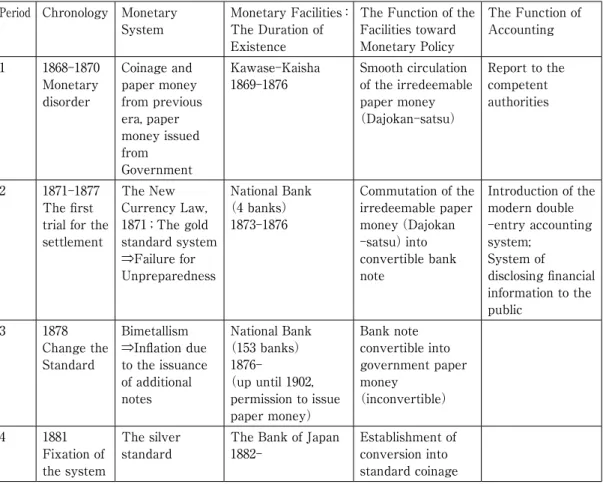
The Ministry of Finance issued a report in 1887 regarding Japan’s monetary status at the be- ginning of the Meiji era;1868−1884. The report divided the period into 4 segments(The Ministry of Finance, 1934:19−20).Table 1 displays the monetary facilities involving policies related to the monetary system in chronological order defined by the report.
Masayoshi Matsukata, who was the Finance Minister and the key person to establish the Bank of Japan, stated,“The start of the elimination of paper money was issued by the government through the establishment of national banks”(The Ministry of Finance, 1890:25)in the 2nd peri- od. As reported by the Ministry of Finance in 1887, the Japanese monetary system was fixed af- ter the establishment of the Bank of Japan. However, prior to that, the government introduced several policies based on other approaches. This study focuses on the relation between the estab-
lishment of the national bank and the accounting regulations in the second period as shown in Table 1, when modern double−entry accounting system had just been adopted. The regulations related to accounting will be examined to find the intention of the authority.
This section discusses the background and the progress of the monetary problems that the new government faced.
The beginning of the Meiji era saw the transition from a feudal system to a central govern- ment system. This brought about disorder in several systems. Foreign governments exerted pressure on the Japanese authorities to urgently address the problem of monetary disorder be- cause of its negative impact on trade.
The establishment of the national bank took place against the background of a huge societal change. Before the Meiji era, the Japanese still lived in the feudal age of the Edo era which lasted from 1603 to 1867. The established order of society was that the supreme lord, Tokugawa, pro- vided fief to each feudal lord. The base of taxation was the rice crop. A monetary economy had developed in many cities, but the monetary system had not been applied nationwide. The Toku-
Table 1 The Transition of the Monetary System and Related Facilities Period Chronology Monetary
System Monetary Facilities:
The Duration of Existence
The Function of the Facilities toward Monetary Policy
The Function of Accounting 1 1868−1870
Monetary disorder
Coinage and paper money from previous era, paper money issued from
Government
Kawase−Kaisha
1869−1876 Smooth circulation of the irredeemable paper money
(Dajokan−satsu)
Report to the competent authorities
2 1871−1877 The first trial for the settlement
The New Currency Law, 1871;The gold standard system
⇒Failure for Unpreparedness
National Bank
(4 banks)
1873−1876
Commutation of the irredeemable paper money(Dajokan
−satsu)into convertible bank note
Introduction of the modern double
−entry accounting system;
System of
disclosing financial information to the public
3 1878
Change the Standard
Bimetallism
⇒Inflation due to the issuance of additional notes
National Bank
(153 banks)
1876−
(up until 1902, permission to issue paper money)
Bank note convertible into government paper money
(inconvertible)
4 1881
Fixation of the system
The silver
standard The Bank of Japan
1882− Establishment of
conversion into standard coinage
gawa Shogunate established coinage and controlled mintage;however, the western region of the nation tended to use silver currency by weight, while the eastern region of the nation tended to use gold coins. Paper money was issued by each feudal lord, which caused financial problems and was only circulated in that particular region. The Tokugawa had taken certain steps toward uni- fying the monetary system, particularly, with regard to coins.
In 1868, when the Meiji government came to power, the only financial source was the definitive land which was under the direct control of the Tokugawa. This meant that the feudality under the indirect control of the Tokugawa were not included. The new government faced financial dif- ficulties right from the beginning. It financed the shortfall by issuing a great amount of paper money which was called Dajokan−satsu. The government did not offer to change this paper mon- ey into coins. In the Edo era, the government had only minted coins, not paper money, so the monetary system was in disarray. The coins issued in the later stages of the Edo era were of poor quality and contained less precious metal than earlier minted coins. The coins and paper money issued by the various feudal agents and Dajokan−satsu were circulated in a jumble.
The issuance of non−convertible paper money by the new government aggravated the situa- tion. From the beginning, the non−convertible Dajokan−satsu did not circulate at par value due to the lack of credibility toward both the government and paper money itself. Therefore, the Meiji government forced people to accept Dajokan−satsu at par value. In 1868, the government pro- claimed several laws concerning the circulation of Dajohkan−satsu;among them was one that rigidly prohibited rejecting Dajokan−satsu for financial settlements.“Prohibition of Paying a Pre- mium on Exchanging Dajohkan−satsu”was declared in June,“Stopping the Sabotage of Circula- tion of Dajohkan−satsu”and“Strict Notice to the Region under Interruption”were declared in October, and the declaration,“Official Permission of Quotation Passing,”in December revealed that Dajokan−satsu was already exchanged at the market price(The Ministry of Finance, 1887:
183−85).These proclamations revealed that Dajohkan−satsu was not acceptable to many people.
At that time, several ports were opened up for trade with western countries. The monetary disorder, particularly regarding Dajokan−satsu, annoyed foreign traders based at foreign settle- ments. The government received letters of protest against Dajokan−satsu from the U.K., France, Germany, the U.S., and Italy in June 1869(Fujiwara, 1979:456).To eliminate the monetary disor- der was not only the most significant economic policy at that time, but also a diplomatic issue for the government, particularly because the government was willing to be recognized by foreign countries.
In 1869, the Meiji government finally announced the exchange of Dajokan−satsu for new coins, something which at that time was still in process of being minted. It was impossible to mint new coins sufficiently for exchange because of the government’s poor financial condition(Shimbo,
1964a:88).Nevertheless, the government announced that Dajokan−satsu would be exchanged for new coins by 1872, and after that, on any remaining Dajokan−satsu, interest of 0.5% per month would be paid. In 1871, the government declared the New Coinage Act, a gold standard. In the same year, new paper money would be exchanged for the old paper money that had been issued during the Tokugawa period. However, foreign governments persistently demanded coins for ex- changing Dajokan−satsu of a fixed value. The issuance of Dajokan−satsu totalled 50 million yen by then, and conversion of the whole amount into coins in full was utterly impossible, given the new government’s financial limitations.
The Preceding National Bank−Kawase Kaisha
There were preceding financial facilities: Kawase Kaisha at Period 1 as shown in Table 1. Its purpose was to promote establishment of businesses and smoothen circulation of Dajohkan−satsu.
These financial facilities failed, following which national banks were established based on the analysis of their failure.
Since the preceding financial facility was obligated to report accounting to the competent au- thority before the introduction of a modern accounting system, a comparative examination would be effective to clarify the role of the modern accounting system which was later adopted by stat- ute. This section clarifies the structure of the Kawase Kaisha and its accounting report. Kawase Kaisha is considered important because it was the first modern financial facility in Japan. There- fore, all data were compiled and published by the Ministry of Finance(The Research Depart- ment of the Bank of Japan, 1955;1956).The factual description in this section is based on this compilation.
Kawase Kaisha was established in 1869 under the vigorous leadership of the government at eight important ports:Tokyo, Yokohama, Kyoto, Osaka, Kobe, Ohtsu, Niigata, and Tsuruga. The government nominated wealthy merchants from the Edo era, Mitsui, Ono, Shimada, and so on, to operate the facility. Among several Kawase Kaisha, Tokyo Kawase Kaisha was selected for ex- amination in this study. As it was primarily operated by Mitsui, whose accounting practice was already established during Edo era(N.Nishikawa, 1993),examining it will clarify the effective- ness of the introduction of the modern accounting system.
There were no statutes to provide the organizational structure or operation. However, Tokyo Kawase Kaisha determined its own regulations. The structure of the organization is shown in Figure 1.
(a)Syatyu;Constituent Member:The government nominated by the wealthy merchant. They invested the capital and owed unrestricted responsibility. They had the right to receive a divi- dend.
(b)Soh−Toudori;Representa- tive Organization:The govern- ment extracted from Shatyu and appointed.
(c)Toudori−Nami and(d)Ka- wase−Gata; The government extracted from Shatyu and ap- pointed and that administered internal clerical work.
(e)Torisimari;Manager:Em- ployee of Syatyu;the wealthy merchant who took the responsibility for daily operation. This role was a monthly duty. Accordingly, each merchant was monthly appointed as the manager.
Syatyu could be considered as a kind of joint−stock corporation;however, their unlimited re- sponsibility prevents a complete view of the organization. It is apparent that the government was at the helm of Kawase Kaisha, even though the organization was a private sector.
Its business lines were deposits, loans, exchange, and the buying and selling of old coins. The sources of earnings were interest from loans, charges from exchange, and profit from buying and selling old coins. Kawase Kaisha was financed by Dajokan−satsu, the funds were invested by Shatyu, and deposits and bank notes were issued by Kawase Kaisha for loans. The financial pro- vision of Tokyo Kawase Kaisha regulations were as follows:
1. 1% interest payment to the capital from Syatyu.
2. 1% interest payment to the deposits.
3. 1.5% interest receipt on loans.
4. Income split into three:tax payment, disbursement for salary, and dividend of profit to Syatyu.
The results of operation were reported to the competent authority via the accounting report.
The accounting reports were included in the above−mentioned compilation by the Ministry of Fi- nance. However, no regulations regarding the accounting system−daily recording method, forma- tion of a report, or frequency of a report−were not found.
The accounting reports of Tokyo Kawase Kaisha were available for compilation every two or three months, with a combined report from November and December 1869 to March 1871(The Research Department of the Bank of Japan, 1956:5−18).However, after that, there were no re- port forms, only daily records regarding the balance of the restricted title of accounts were avail- able. In this study, the first report for the element of composition and its relationships are exam- ined to clarify the peculiarity and problem in Exhibit 1.
It was possible to confirm that the address of the report was the competent authority:the
Extraction by Routine operation government
(a) Syatyu;
Constituent Member
(b) Soh-Toudori;
Representative Organization
(c) Toudori-Nami;
Administrator (d) Kawase-Gata;
Administrator
(e) Torisimari Manager
Figure 1 Structure of Kawase Kaisha
Trade department in part(a),followed by the source of funds in(b),and the operation form of the fund in(c).Only the current assets, cash, bank notes, and loans, were recognized in the oper- ation form of the fund. The total amount was not displayed on the operation form of the fund;
however, the total was equal to the source of the fund. Therefore, this part could be similar to the balance sheet information. The following part is the list of revenues in(d),the list of expens- es in(e),the difference shown in(f),and the amount divided into three in(g).Only the interest expenses, interest for Syatyu and interest for deposits, were recognized in the list of expenses.
This part could be similar to an income statement and a statement of disposal of profit. However, part(b)did not display the beginning balance or flow during the period;it just displayed the bal- ance at the end of the period. Accordingly, the equal relation between the periodical profit/loss and increase/decrease of the capital was not confirmed.
Among the items, were silver coins that were used exclusively for foreign trades. It was repre- sented in a quantity, not in a currency amount. Yokohama Kawase Kaisha managed foreign cur- rency exchange all together, and they were in charge of the silver coins. Even if the other Ka- wase Kaisha received the silver coins temporarily, they would eventually be exchanged. This would be the reason to represent the silver coins in a quantity on the report.
The peculiar feature is extracted based on the operation and accounting report.
1. Lack of responsibility for the operation:The merchants began the operation reluctantly, by the Excerpt from the Research Department of the Bank of Japan(1956):5−6
Exhibit 1:Tokyo Kawase−Kaisha:The First Accounting Report for November and December 1969
nomination of the government. Each merchant was in charge of the operation monthly and was appointed as a dispatched manager, therefore the labor cost was one object of the disposal of profit. The labor might be considered as contributing to profits;therefore, it could be treated as a dividend.
2. Lack of corporate status:Another aspect is their recognition of capital. The fixed assets were not represented in the operation form of the fund. It was recognized in the accounting report during the Edo era, so the merchants had the sense of capital as the source of gains from opera- tions. Each merchant might focus on the management of the invested fund and the security of the fixed earnings from it. The recognition of Kawase Kaisha as an independent organization for operation was found to be defective.
3. Lack of financial discipline:All profits were results of the disposal and outflow outside the com- pany. Operating funds were financed by Dajokan−satsu and bank notes, so there was no need for retained earnings. The Kawase Kaisha operation was set up with the government’s complete sup- port.
The perspective of each merchant was that the operation of Kawase Kaisha was an extension of their own economic activity. From the accounting report, Kawase Kaisha seemed just a locus for inflow and outflow of money. Therefore, a fixed asset was not recognized as capital, and the temporarily−owned silver coins for trade were recognized in quantity. The recognition of Kawase Kaisha as an economic entity for operation failed.
The reason for failure of Kawase Kaisha was given(The Compilation Dept., 1957:55)as fol- lows:
1. Incompleteness of regulations.
2. The mixture of the government and private sector, and the indefinite locus of responsibility.
3. Insufficient preparation for the establishment of the Kawase Kaisha.
4. Management in charge was not accustomed to joint operations.
The fourth problem is clearly represented in the accounting report, and was aggravated by the absence of a so−called business entity.
For a financial facility, especially one taking responsibility for currency treatment, acquisition of public trust is indispensable. The trust is based on financial ability and the independence of the facility. Kawase Kaisha was not independent, and the absence of a business entity was a fatal de- fect.
The Essence of the National Bank Act
This section explains how the national banks were structured to correspond to the governmentës intention to avoid a repeat of the failure of Kawase Kaisha.
The national banks were established not because there was an economic need at the time, but because of the government’s wishes. The New Currency Law set the due date for the exchange of Dajokan−satsu into standard coins, and that date had approached. It was imperative to adopt a policy to deal with the issue. The institution of a national bank was adopted as a solution, similar to the national banking system in the U.S.(The Ministry of Finance, 1890b:173;Katoh and Ohuchi, 1963:331).
“National bank”here implies that the banks were instituted by a national statute and were op- erating as private banks. By examining the banking system in the U.S. at that time, it becomes clear why this had become the solution for the issue. In the following paragraph, we will closely examine the U.S.’s National Bank Act and the Japanese National Bank Act, and point out the sim- ilarities and differences(Shimbo, 1964a).
The purpose of the U.S.’s National Bank Act of November 1863 was to settle two major issues.
First, the government needed to issue bonds in the market to finance the Civil War. Second, the monetary system was in disorder. There were many banks which had been established under state ordinances, and each bank issued its own bank notes based on the rules of its state. This called for an integration of currency.
The regulations of the above Act were as below(Katoh and Ohuchi, 1963:p.350):
1. Requirement for the establishment of a national bank:
National banks were required to deposit with the Department of the Treasury more than one−
third of their paid−in capital in the form of government bonds;
2. Issuance of bank notes:
National banks would receive from the Department of the Treasury bank notes equal to 90% of the market price of the deposited government bonds. The amount of bank notes the banks were authorized to issue could not exceed the amount of their paid−in capital. The bank notes could be used for any payment to the government except for custom duties;
3. Reserves:
Each national bank was obligated to keep cash reserves equivalent to 25% of the amount of is- sued bank notes and deposits received.
The Act was revised in 1865 and the state banks were taxed at the rate of 10% on the amount of bank notes issued. This encouraged state banks to convert into national banks. The bank notes issued under state rules decreased sharply and therefore the purpose of currency integration was accomplished. A high ranking Japanese government official visited the U.S. to familiarize himself with the system of national banks and proposed it to the Japanese government for adoption.
In 1872, the National Bank Act was introduced in Japan. Its purpose was to have the national banks perform two functions, i.e., the elimination of previously issued paper money and money
supply.(The Fiscal History in Meiji, The Ministry of Finance, 1972:p.100).Reviewing the proce- dures to settle the issue of previously issued paper money, Mr. Masayoshi Matsukata, a former Minister of Finance, stated that national banks were a substitute for the government to retire Dajokan−satsu(The Ministry of Finance, 1890a:25).The government hired Mr. Alexander Allen Shand, a Scotsman and employee of the Yokohama branch of the Chartered Mercantile Bank of London, India, and China, to teach bookkeeping methods to the national banks. In his critical re- marks, he emphasized the role of national banks to eliminate Dajokan−satsu while disregarding the money supply function(Okdada, 1975:154).
Article 6 of the National Bank Act was very similar to the corresponding U.S. regulations. It clarified the procedures for the establishment of a national bank. A summary of this is given be- low:
1. Requirements for the establishment of a national bank:
60% of paid−in capital had to be deposited in the form of Dajokan−satsu. The government then is- sued an equivalent amount in bonds with an interest rate of 5% p.a. and exchanged those for the Dajokan−satsu;
2. Issuance of bank notes:
The government bonds were to be deposited with the Ministry of Finance as collateral to acquire the right to issue bank notes of an equivalent amount. The bank notes themselves would be sup- plied by the Ministry of Finance. The print base on the bank notes was identical, but each nation- al bank’s notes were characterized by an additional print feature so that the issuing bank could easily be recognized;
3. Reserves:
Each national bank was obligated to maintain reserves equivalent to 40% of its paid−in capital in standard gold coins. If a holder of bank notes requested a national bank to convert its paper mon- ey into standard gold coins, the national bank was obligated to do so.
The system seemed very similar to the one of the U.S. national banks. However, there was an important difference. When the U.S. National Bank Act was enacted, bank notes had already been in circulation and the intention was merely to have a unified currency. In Japan, the newly estab- lished banks would put bank notes into circulation in lieu of the converted Dajokan−satsu which was not circulated at par. Consequently, the banks’ reserves had to be set at a higher level. The responsibility to convert new paper money into gold coins was shifted from the government to private national banks. The government would achieve its goal of eliminating the Dajokan−satsu and supplying sufficient levels of stable paper money, supported by the financial strength of na- tional banks(Shimbo, 1964a:96).Since the newly issued paper money was convertible into gold, the process of replacing Dajokan−satsu was credible.
The point is that the government attempted to gain the public’s trust in paper money without being responsible for conversion;the privately capitalized banks assumed full responsibility for this. By passing the regulation, the government was free from real liabilities. First, Dajokan−satsu was out of circulation and replaced with government bonds. Second, since a national bank could issue bank notes only on retaining the government bonds, the government’s liability(government bonds)was frozen as long as the national bank was in business. Although the government con- trolled the printing of bank notes, with each national bank's issued bank notes being different from those of the other national banks, the national banks rather than the government were re- sponsible for converting bank notes into valuable coins.
Although the government had clear intentions, setting up a specific regulation was not suffi- cient. Shimbo(1964b:15)states that“without maintaining a higher reserved fund and a reserve requirement ratio, paper money did not have sufficient circulation in the current state at that time.”
Even though the government set up the specific regulations, especially the reserve provision from the reflection of the preceding facility’s failure, this was not sufficient to gain public trust in the new instruments.
The Function of Accounting:The Provision of Disclosure
This section attempts to explain the probable intention of the provision regarding the publication of financial statements.
The regulations on reports by the national banks are provided in Article 12 of the National Bank Act. “The accounting report had to be submitted to the Chief of the Printing Bureau at the Ministry of Finance and disclosed to the public through newspapers and other means”(The Edi- torial Board of Ministry of Finance for Fiscal History of Meiji, 1972:p.123).The issue here was the provision regarding the publication of financial reports. At that time, very few people were able to understand the content of the financial reports since modern accounting practices had just been adopted in line with the new law. The national banks were stock companies and therefore the financial reports were generated to benefit the stockholders. As there were no stock markets, the reports were destined for the existing shareholders only. This view is supported by the pro- visions of Article 13 which focused on the stockholders. According to it,“The President of the bank had to calculate the profit semiannually and announce it to the stockholders.”(The Editorial Board of Ministry of Finance for Fiscal History of Meiji, 1972:p.123)The national banks’ semi−
annual reports have been made available in The Record of Japanese Financial History(1957).Each bank published a semi−annual report. These reports stated that the previous semiannual reports had been distributed to all stockholders and clients after submission to the Ministry of Finance,
clarifying that the reports’ primary audience were the stockholders.
At the same time, the information contained in the reports may have been for the general pub- lic, since it was made available through newspapers. To that effect, there is a remark in the Re- port of the Bank Department of the Ministry of Finance:“The semi−annual gross profit should be re- ported to the Finance Minister through decisions taken during the stockholders’ general meeting.
After receiving the approval from the Minister, it should be disclosed to the public along with the list of assets and liabilities.”“Understanding the financial position of the banks should allow the public to avoid risks and increase their trust in banks. Therefore, the report should be clear and accurate. The current conditions of banks would be “confirmed visibly” [double quotes by the au- thor] and statistics could be organized.”(The Research Department of the Bank of Japan, 1960:
p.32−33)
The remark seemed to clarify the target of the announcement−the banks’ creditors, the group most concerned with the banks’ liabilities. The banks’ creditors included not only depositors but also the holders of bank notes;therefore, gaining and maintaining the credibility of bank notes was essential. Because bank notes changed hands frequently, informing the general public was significant. The phrase,“confirmed visibly”was the key expression. The holders of bank notes were able to see the financial information of the responsible entity. Since any organization’s finan- cial information was confidential before this provision, the disclosure was an attempt to gain pub- lic confidence.
The idea to gain the confidence through a public announcement is very democratic. It may not have been the spontaneous idea of the Japanese government, since previously it was a custom to keep all financial information confidential. A possible explanation could be that the government learned from its contact with Western countries. The U.K., France, Germany, the U.S., and Italy officially protested against the Japanese monetary system and complained about it several times.
The detailed contents are available in the History of the Ministry of Finance(The Ministry of Fi- nance, 1932).One particular report is remarkable, since all the details were recorded. In the thick of a monetary problem, ambassadors of Western countries put pressure on the Japanese government to convert Dajokan−satsu into coins with a fixed value.
When the Meiji Government sent a formal letter to the ambassadors on June 22, 1869, it tried to convince them that it would settle the current issue by prohibiting people by law from accept- ing Dajokan−satsu under par, and explained that new coinage was in progress. The ambassadors of the Western countries gave their responses separately. Harry Parks, ambassador of the U.K., pointed out the lack of credibility in the new government. Responses from the other countries were similar and also contained important advice. This is significant for two reasons. First, there was an indication that both the people and foreign governments did not trust the Meiji govern-
ment. Second, there was a suggestion to build confidence through publication of information.
“Force cannot make people use the currency at par value. If the government wins the confidence of the public, then the currency will be accepted. The current situation will have a large impact on foreign trade and cause great problems.”Moreover,“If the government disclosed in detail the current situation to the people, all receipts and expenses, purpose of the fiscal system, and so on, it would help to make people understand government ordinances. It does not imply that only your nation should adopt it alone. This policy has already been adopted by Western countries”
(The Ministry of Finance, 1932:58−59).From the detailed record, the government seemed to consider it worthwhile.
In any case, as the ambassadors stated, the detailed National Bank Act was not sufficient to gain trust in the currency;transparency was also needed.
The Establishment of National Banks and their Accounting Reports
In this section, we will look at how the Act was applied and how effective and clear the financial information was. Accounting information was unknown to the general public. The disclosed finan- cial information will let us grasp the meaning of the phrase“confirmed visibly.”
The National Bank Act was revised in 1876, four years after the foundation of the national banks, because of the banks’ sluggish operation, suggesting that the national banks had not been operating as originally intended. Contrary to the expectations of the Ministry of Finance, only four national banks were established. The location of the banks and the amount of stockholders’
equity is as given below(The Research Department of the Bank of Japan, 1960:7):
Name Location Stockholder’s Equity
The First National Bank Tokyo 2,500,000 Yen
The Second National Bank Yokohama 250,000 Yen
The Third National Bank Osaka Not in business*
The Fourth National Bank Niigata 200,000 Yen
The Fifth National Bank Osaka 500,000 Yen
*The first stockholders’ general meeting at the Third National Bank led to confusion. Because of this, the bank did not start its business.
The total stockholders’ equity of the four operating banks amounted to 3.45 million yen;60% of it was in Dajokan−satsu. With the total amount of government−issued Dajokan−satsu being 50 million yen, only about 4% of this amount was eliminated through the national banks. The high reserve requirements prevented the formation of more banks.
The First National Bank was the leading bank among these four banks;therefore, in this study, we examine its accounting report as published in the newspaper. In accordance with the National Bank Act, The First National Bank periodically reported financial information in the Tokyo−nichinichi newspaper. On February 2, 1874, the first report was released to the newspaper detailing the required items:profit, dividends, and retained earnings. The list of assets, liabilities, stockholders’ equity, revenue, and expenses was made in the second report, on July 22, 1874. The format of the report is shown in Exhibit 2(The Editorial Board of Eighty−years History of Dai−
ichi Ginko, 1957:p.454−459).This format is the same as that of other banks’ announcement in the newspaper. The original presentation in the newspaper was made in traditional Japanese writing style, i.e., from top to bottom and from right to left, and for numbers, Chinese characters were used. The style resembled an itemized report more than a table. The message from the bank’s President was(c)in Exhibit 2. It declared,“Here we disclose the second report for the stockhold- ers from the president.”In this sentence, it clearly mentioned that this report was exclusively for the stockholders. However, as observed in the semi−annual report, the announcement was not solely made for the stockholders. The semi−annual report was released after the general stock- holders meeting which was held 11 days after the end of the accounting period. The“General Af- fairs of the Bank”section in every semi−annual report included the statement that“the semi−an- nual report will be distributed to the stockholders and customers, and the summary of the
Exhibit 2:The First National Bank 2nd Semi−annual Report(on the newspaper)
Excerpt from the Editorial Board of Eighty−years History of Dai−ichi Ginko(1957),pp454−459
accounting report will be published in the newspaper.”This sentence clarifies that the publication in the newspaper was intended neither for the stockholders nor for the depositors to whom the bank could report directly. The announcement of the banks’ results was mostly made for the ben- efit of the creditors of the banks, particularly the holders of bank notes who frequently changed, as seen in the“Report of the Bank department of the Ministry of Finance.”
The following part attempts to examine the role of the report. First, the report itself demon- strated the independence of the organization as a business entity. This recognition was lacking in the preceding financial facility. The bank’s name appeared on the first report in part(a),fol- lowed by capital and reserves from the operation in(b),then liabilities, obligations in(d),assets and rights in(e).The accounting reports of the preceding financial facility, Kawase Kaisha, did not include fixed assets−which was included in this report. Under the modern accounting system, ownership of assets and liabilities is recorded as a business entity. In this aspect, the adoption of the modern accounting system promulgated the concept of corporate status in joint operations.
Moreover, in this period, very few people were able to understand the content of the financial re- ports, so the information on the balance sheet itself might not have had a significant meaning.
The fact of financial disclosure as a responsible economic entity consequently led to public confi- dence. Takatera(1982:79)stated,“Financial reporting is a form of financial advertisement”(dis- tilled from quotations of several writings of late 19th century in the U.K.).He meant an advertise- ment toward stockholders, although in this case, it was more an advertisement toward the people who had the possibility of obtaining paper money.
Second, the list of names of six executive directors is the last part of the report in(f).The six executive directors named in the report belonged to the promoters of the First National Bank and two of the wealthiest trading houses, famous from the time of the Edo era. This name list added to the credibility of the institution.
Third, the most important items are listed right at the top. The first item of the Liabilities and Obligations was“Head Office’s circulated bank notes”in(g)which contrasted with the“Reserves for bank notes”in(h),the first item in Assets and Rights section. It demonstrated the fulfillment of the strict regulation regarding the reserve provision. As Shimbo stated, a higher reserve fund was essential to fulfill sufficient circulation. However, without people’s recognition, it does not achieve the original goal. The accounting report testified to the financial ability of the banks to fulfill their obligations as independent organizations, to assume responsibility, and to serve as proof of the ability to provide conversion. Evidently, the report demonstrated this ability. Al- though few people recognized the actual meaning of the report, by making this disclosure, the is- sued paper money might gain public trust via the fact of disclosure.
However, this monetary policy did not work well, primarily because only few national banks
were established due to the strict reserve requirements(Shimbo, 1964b:28).Therefore, the Na- tional Bank Act was revised on 1876.
Conclusion
At the beginning of the Meiji era, the monetary system was in turmoil and non−convertible paper money, Dajokan−satsu, was issued by the new government. The purpose of the adoption of a Na- tional Bank system was to eliminate and replace the Dajokan−satsu and restore the stability of the monetary system. To accomplish this and remain consistent with previous policy, it was nec- essary to acquire public trust in the new paper money and establish a stable monetary system.
The focus was therefore on the primary purpose of adopting the National Bank system and the role of the modern accounting system, especially the role of the publication of financial state- ments. Under the modern accounting system, publication of the financial information in newspa- pers provided information regarding the transparency of the responsible entity. This demonstrat- ed credibility. Through this information disclosure, public trust in paper money was gained. The essential provision in the National Bank Act for the accounting function was the publication of the accounting report in the newspapers. It is essential to reveal the independence of the organi- zations, their financial transparency, and the full financial position to ensure trust in paper money.
The publication of the accounting information was assumed to fulfill this role.
Despite this intention, the four national banks’ business stagnated after a couple of years. The major cause was the fact that there were only four national banks in business. Therefore, a great amount of non−convertible paper money was still in circulation. While the national banks convert- ed it into new bank notes, much of the newly issued bank notes were returned to the banks for conversion. However, because the national bank’s reserves were only 40% of the total amount of issued bank notes, there was a sharp decline in these reserves which were now deficient to guar- antee conversion. The national banks lost the financial ability to fulfill their obligations.
In this situation, it was imperative to retain the conversion system. The government, however, abandoned it, revised the National Bank Act in 1876, and restored the system only when the Bank of Japan was established in 1882 as shown in Table 1.
References
Chiba, J. (1987),“British Company Accounting 1844−1885 and its Influence on the Modernisation of Japanese Financial Accounting,”Tokyo Metropolitan University Journal of the Faculty of Economics, Vol.
60,:1−27
Fujiwara, A.(1979),“Formation and Character of the Rules of the Banking Company Kawasekaisha)in the Early Meiji Period,”Kobe University Law Bulletin, Vol. 28, No.4:439−487
Hisano, H. (1987),Wagakuni Zaimu Shohyo Seido no Kenkyu(The Study of the History of Financial Statement Institutions),Tokyo:Gakusyuin University Publishing.
Katano, I. (1976),Nihon Ginnko Kaikei Seido Shi(History of Bank Accounting in Japan), Tokyo:
Zenkoku Chiho Ginko Kyokai
Katano, I. (1968),Nihon Zaimushohyou Seido no Tenkai(Accounting Evolution of Japanese Financial Accounting and the Regulation),Tokyo:Dobun Kan Publishing Co.
Katoh, T., Ohuchi, C.(1963),Kokuritsu Ginko no Kenkyu(The Study of the National Banks),Tokyo:
Keisoh Shoboh.
Nishikawa, N.(1993),Mitsui−ke Kanjoh Kanken(The Research of Mitui Family’s Accounting),Tokyo:
Hakutoh Shoboh
Nishikawa, K.(1977),“The Introduction of Western Bookkeeping into Japan,”The accounting Historians Journal, Vol. 4, No. 1, Spring:25−36
Ogura, E. (2001),Kohsyu Nakai−ke Tyohai−no−Hoh(Nakai Family’s Bookkeeping Method) Reprinted Edition, Saga:Yohgaku−doh publishing
Okada, S.(1975),Meiji−ki Tuuka Ronsoh−shi Kenkyu(The Study of the History of Currency Controversy in Meiji−era),Tokyo:Chikura Shoboh
Shimbo, H.(1964a),“The National Banking Act of 1872 in Japan,”Kobe University Journal of economics &
business administration, Vol. 110, No. 3:82−98
Shimbo, H. (1964b),“On the National Banking Act in Japan,”Kobe University Journal of economics &
business administration, Vol. 110, No. 6:13−28
Shirakawa, M. (2008),Modern Monetary Policy in Theory and Practice, Tokyo:Nihon Keizai Shinbun Publishing
Takatera S.(1982),The Accounting a la carte, Tokyo:Dohbunkan Syuppan
The Compilation Dept. for 80th year of The First Bank(Dai−ichi Ginko 80nenshi Hensan−shitsu)(1957),
Dai−ichi Ginko Shi(The History of the First Bank),Vol. 1, Tokyo:Dai−ichi Ginko.
The Editorial Board of Eighty−years History of Dai−ichi Ginko(1957),Dai−ichi Ginko Shi(The History of the First Bank)Volume I, Volume II, Tokyo:The First Bank.
The Editorial Board of Meiji Fiscal History;The Ministry of Finance(1972),Meiji Zaisei Shi(The Fiscal History in Meiji),Tokyo:Yoshikawa−Kohbun Kan.
The Ministry of Finance (1932),Ohkurasyoh Enkaku Shi(The History of the Ministry of Finance),
Tokyo:Kaizo−sya.
The Ministry of Finance(1887),Meiji Kasei Kouyou(The Consideration of the Transition of Monetary System);The Historical Information of the Finance and Economy for the first term of Meiji Era Volume XIII
(1934),Tokyo:Kaizoh sya.
The Research Department of the Bank of Japan(1955),Nihon Kinyu Shiryo Meiji Taisho Hen(The Record of Japanese financial History) Volume I, Tokyo:The Ministry of Finance Publishing Research Department of the Bank of Japan (1956),Nihon Kinyu Shiryo Meiji Taisho Hen(The Record of Japanese Financial History)Volume II, Tokyo:The Ministry of Finance Publishing
The Research Department of the Bank of Japan(1960),Nihon Kinyu Shiryo Meiji Taisho Hen(The Record of Japanese Financial History2−1)Volume VII;Part 1, Tokyo:The Ministry of Finance Publishing The Ministry of Finance (1890a),Shihei Seiri Simatsu(The Settlement of the Erasure for the Paper
Money);Nihon Kinyu Shiryo Meiji Taisho Hen(The Record of Japanese financial History)Volume XVI
(1957):2−143, Tokyo:The Ministry of Finance Publishing
The Ministry of Finance(1890b),Shihei Seiri(The Settlement of the Paper Money);Nihon Kinyu Shiryo Meiji Taisho Hen(The Record of Japanese financial History)Volume XVI(1957):170−182, Tokyo:
The Ministry of Finance Publishing