Acta Med. Nagasaki 44 : 45 - 48
Cancer Specific Long-term Survival After Surgery for Carcinoma of the Splenic Flexure
Tohru NAKAGOE 1), Terumitsu SAWAI 1), Takashi TSUJI 1), Masaaki JIBIKI 1), Atsushi NANASHIMA 1), Hiroyuki YAMAGUCHI 1), Toru YASUTAKE 1), Hiroyoshi AYABE 1), Hiroshi ISHIKAWA 2)
1) First Department of Surgery, Nagasaki University School of Medicine 2) Department of Surgery, Sasebo Municipal General Hospital
Purpose: Carcinoma of the splenic flexure is uncommon and it is associated with a high risk of obstruction.
However, survival after resection of this tumor is contro- versial. The aim of this study was to evaluate cancer spe- cific long-term survival after surgery for splenic flexure cancers compared to survival for the colon cancer at other sites.
Patients and Methods: Of 500 patients undergoing surgery for colon cancer, 16 (3.2%) had cancers of the splenic flex- ure. Clinicopathological features and cancer specific long- term survival after curative resection were evaluated.
Results: Splenic flexure carcinomas were found to be asso- ciated with a high risk of obstruction (4 out of 16; 25.0%) and a high risk of penetration/perforation (1 out of 16;
6.2%) compared with colon cancers at other sites (P
<0.0001 and P=0.0128, respectively). Operative mortality rate for patients with carcinomas of splenic flexure was significantly higher than that of other sites (6.3% versus 0.8%; P=0.0319). However, resection for splenic flexure tu- mors was usually possible, and there was no difference in cancer specific long-term survival after surgery between the patients with splenic flexure cancers and the other site colon cancers (P=0.3505).
Conclusions: Carcinoma of the splenic flexure has a simi- lar prognosis to colon cancer at other sites.
Key words: splenic flexure, colon cancers, cancer specific long-term survival
Address Correspondence: Tohru Nakagoe, M.D.
First Department of Surgery, Nagasaki University School of Medicine, 1-7-1 Sakamoto, Nagasaki 852-8501, Japan
TEL: +81-958-49-7304 FAX: +81-958-49-7306 E-mail: [email protected]
Introduction
The clinical features of carcinoma of the splenic flexure have been elucidated: it is uncommon, 1,1,31 and symptoms are often vague and misleading, which may be responsible for a delay in diagnosis.2> The incidence of obstruction in splenic flexure cancers is approxi- mately twice that of colon cancers at other sites.',') However, survival after resection of splenic flexure cancers is controversial. Some authors reported that the survival rate of splenic flexure cancers was worse than that of other colon cancers"" whereas other stud- ies have not made any reference to this. 1,2,1) The aim of this study was to review our experience with this dis- ease and to evaluate the cancer specific longterm sur- vival after surgery for splenic flexure cancers com- pared to that of colon cancers at other sites.
Methods
Between January 1982 and December 1997, 500 pa- tients with a single primary adenocarcinoma of the colon underwent surgery at Nagasaki University Hos- pital. Patients with more than one carcinoma of the colon (synchronous or metachronous) were not in- cluded in the study. The splenic flexure is defined as the junction of the distal third of the transverse colon with the first part of the descending colon.2 3> In this paper, carcinoma of the rectosigmoid junction was con- sidered with carcinoma of the rectum and patients with these cancers were excluded from the study!) Colon obstruction was defined in the following situa- tions: symptoms of increasing constipation, pain and vomiting; radiographic signs of abdominal distension and abnormal gaseous distension of the gut laparotomy findings of proximal bowel distension and edema; and
urgent surgery performed within 48 hours of admis-
sion. Curative resection was defined as the removal of the primary tumor, with or without an anastomosis, which was histologically complete, with no metastasis to liver, peritoneum or other distant organs. Local re- currence was defined as convincing evidence of recur- rence of cancer at the anastomosis, in the abdominal wound, in the drain site or peritoneum, but not he- patic or peritoneal secondaries. Tumor staging was classified by Dukes staging, i.e. cancers limited to the bowel wall were classified as Dukes' A, those extend- ing through the wall with negative lymph nodes were classified as Dukes' B, cancers with positive lymph nodes were defined as Dukes' C, and those with dis- tant metastasis were classified as Dukes' D.1`
Categorical data were analyzed by chi-square or Fisher's exact probability test, and continuous data were analyzed with a Student's t-test. Analysis of sur- vival was performed using the method of Kaplan and Meier," and differences between the curves were deter- mined using the log rank test." By this method cases were classified as either "Fails" (uncensored data) or
"Non -fails" (censored data) . Fails were defined as pa- tients who died due to recurrence of colonic cancer, non-fails being surviving patients, or patients who died of causes other than cancer of the colon." Patients who died within one month of the operation were not
included in the survival analysis. All tests were two- tailed and a p value of less than 0.05 was considered significant.
Results
500 patients, 16 (3.2%) had carcinomas of the sple- nic flexure. They included 7 males and 9 females with a mean age of 60.7 years (S.D. ± 11.0 years). Table 1 compares clinical features of splenic flexure cancers and colon cancers at other sites. More splenic flexure cancers were obstructing than were those occurring at other sites (P<0.0001). The splenic flexure cancers had perforation and/or penetration induced by the colon carcinoma more than the other site colon cancer (P
=0 .0128). However, there were no significant differ- ences in age, sex, peritoneal dissemination, hepatic me- tastasis and extra-abdominal metastasis between the two groups (Table 1).
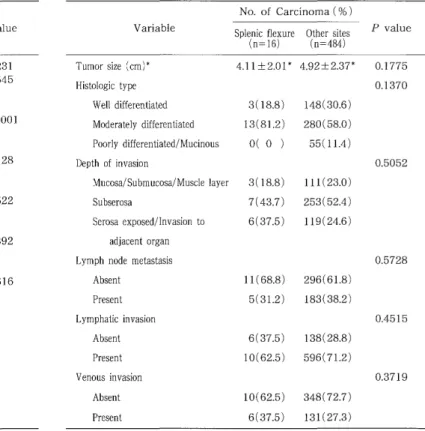
Table 2 compares histopathological features of sple- nic flexure cancers and colon cancers at other sites.
There were no significant differences in tumor size, histologic type, depth of invasion, lymph node metas- tasis, lymphatic and venous involvement between the splenic flexure cancer and the other site colon cancer.
Table 1. Comparison between clinical features in splenic flex- ure cancers and colon cancers at other sites.
No. of Carcinoma (%)
Variable Splenic flexure Other sites P value (n=16) (n=484)
Age (years)* 60.7±11.0* 65.4±11.9* 0.1231
Sex 0.2545
Male 7(43.7) 281(58.1)
Female 9(26.3) 203(41.9)
Obstruction < 0.0001
Absent 12 (75.0) 468(96.7)
Present 4(25.0) 16( 3.3)
Penetration/perforation 0.0128
Absent 15(93.8) 481(99.4)
Present 1( 6.2) 3( 0.6)
Peritoneal dissemination 0.4522
Absent 15(93.8) 461(92.6)
Present 1( 6.2) 23( 7.4)
Hepatic metastasis 0.1392
Absent 14(87.5) 448(89.2)
Present 2(12.5) 36(10.8)
Extra-abdominal metastasis 0.2616
Absent 15(93.8) 474(97.9)
Present 1( 6.2) 10( 2.1)
Site of extra-abdominal metastasis
Supra-clavicular lymph node 0 3
Lung 1 4
Bone 0 1
Brain 0 0
Stomach 0 1
Skin 0 1
Table 2. Comparison between histopathological features of
splenic flexure cancer and colon cancers at other sites.
*Mean ± standard deviation .
No. of Carcinoma (%)
Variable Splenic flexure Other sites P value (n=16) (n=484)
Tumor size (cm)* 4.11±2.01* 4.92±2.37* 0.1775
Histologic type 0.1370
Well differentiated 3(18.8) 148(30.6)
Moderately differentiated 13 (81.2) 280(58.0)
Poorly differentiated/Mucinous 0( 0 ) 55(11.4)
Depth of invasion 0.5052
Mucosa/ Submucosa/ Muscle layer 3(18.8) 111(23.0)
Subserosa 7(43.7) 253(52.4)
Serosa exposed/Invasion to 6(37.5) 119(24.6)
adjacent organ
Lymph node metastasis 0.5728
Absent 11(68.8) 296(61.8)
Present 5(31.2) 183(38.2)
Lymphatic invasion 0.4515
Absent 6(37.5) 138(28.8)
Present 10(62.5) 596(71.2)
Venous invasion 0.3719
Absent 10 (62.5) 348(72.7)
Present 6(37.5) 131(27.3)
*Mean ± standard deviation .
Curative resection was performed in 12 of the 16 pa- tients with splenic flexure cancers. Non-curative resec- tion was performed in 4 patients (Table 3). Curative re- section included left hemicolectomy with lymph node dissection. There was no difference in a proportion of curative resection between the two groups. There was also no significant difference in Dukes' stage between the two groups (Table 4).
Median follow-up was 546 days (range, 112-3775 days). At the end of the follow-up period (April, 1998), 393 (78.6%) of the colon cancer patients were alive, 84 (16.8%) had died from colon cancer, 5 (1.0%) had died from operative complications and 18 (3.6%) had
died of causes other than cancer. Operative mortality rates for patients with carcinomas of splenic flexure and other sites were 6.3% (1 out of 16 patients) and in 0.8% (4 out of 484 patients), respectively, which in- dicated significant difference (P=0.0319).
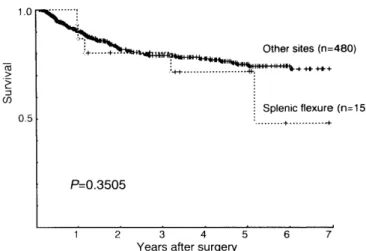
There was no significant difference in cancer spe- cific long-term survival after surgery between the pa- tients with splenic flexure cancers and those with can- cers at other sites (P=0.3505) (Fig. 1). There was also no significant difference in survival after curative re- section between the patients with splenic flexure can- cers and those with cancers at other sites (P=0.6076) (Fig. 2).
Table 3. Comparison between type of operation in splenic flexure cancers and colon cancers at other sites.
Splenic flexure Other sites p
value (n=16) (n=484)
Operation 0.4820
Curative 12(75.0) 414(85.5)
Non-curative 4(25.0) 69(12.3)
Irresectable 0 ( 0 ) 1( 0.2)
Table 4. Comparison of Dukes stage between splenic flexure cancers and colon cancers at other sites.
No. of Carcinoma (% )
Splenic flexure Other sites P value
(n=16) (n=484)
Dukes stage 0.5242
A 3(18.8) 98(20.3)
B 6(37.5) 189(39.1)
C 3(18.8) 135(27.9)
D 4(25.0) 62(12.8)
Fig. 1. Cancer specific survival in relation to tumor sites in patients who underwent surgery. Survival curves indicate carcinoma of the splenic flexure (open circles) and other sites (closed circles).
Table 5. Comparison of patterns of initial recurrence after curative surgery between splenic flexure cancers and colon cancers at other sites.
Splenic flexure(%) Other sites(%)
(n=11) (n=412) P value
Recurrence 0.5467
No 9(81.8) 362(87.9)
Yes 2(18.2) 50(12.1)
Site of initial recurrence
Hematogenous 2(18.2) 28( 6.8)
Liver 1 23
Lung 0 5
Spleen 1 0
Brain 0 1
Peritoneum 0 9( 2.2)
Lymph node 1( 9.1) 7 ( 1.7)
Local 0 5 ( 1.2)
Unknown 0 4( 1.0)
Fig. 2. Cancer specific survival in relation to tumor sites in patients who underwent curative resection. Survival curves indicate carcinoma of the splenic flexure (open circles) and other sites (closed circles).
Discussion
In our series 3.2% patients presented colon cancers located at the splenic flexure, which is consistent with the 2-5% described in other series."' Carcinoma at the splenic flexure is associated with the highest risk of obstruction. 1-3,11 In our series, the incidence of obstruc- tion in splenic flexure cancers was approximately eight times that of colon cancers at other sites, which is 2- fold higher than that described in other reports.'-"" In this series, there was no significant difference in Dukes' stage between splenic flexure cancers and colon can- cers at other sites. Most authors 1-3) reported that there was no significant difference in Dukes staging between the two groups. Aldridge et al') reported that the rate of curative resection did not vary with tumor site as this was constant at approximately 70% at all colon sites. Carcinoma of the splenic flexure is often mani- fested as left upper quadrant or epigastric pain, with no abnormal physical findings. Barium enema studies in such cases may reveal a tumor of the splenic flexure, but special techniques are often necessary for its visu- alization.') Total colonoscopy is essential for early diag- nosis of splenic flexure cancers, because of their loca- tion above the reach of the sigmoidoscope.
Survival among patients with splenic flexure cancers has been found to be worse than in those with colon cancers at other sites3'4' and Aldrige et a13' reported that this was the case even in splenic flexure cancers without obstruction. However, other studies','," revealed that when the tumor site was the splenic flexure sur- vival was not affected in spite of the high incidence of obstruction. It is widely accepted that obstruction in large-bowel cancer has some independent effect on sur- vival.""") In this series, there was no significant differ- ence in survival between splenic flexure cancers and colon cancers at other sites.
Extended resection, such as subtotal colectomy or extended right hemicolectomy with ileodescending co- lostomy, might logically be expected to improve sur- vival of patients with colon cancer at the splenic flexure" because the lymph nodes along the course of
both the superior and inferior mesenteric vessels would be removed.') In our series, prognosis of splenic flex- ure cancers was not worse than in other colon cancers, although none of the splenic flexure cancer patients underwent the extended resection. In addition, we did not observe local recurrence at this site. We thus think that dual lymphatic drainage is not disadvantageous in terms of survival and that extended resection is un- necessary."
With reference to the report by Aldridge et al,') one can pose the question of whether the carcinoma at the
splenic flexure is biologically different from that at other sites within the large bowel ? We feel that splen- ic flexure carcinoma in terms of tumor biology may not differ from colon cancers at other sites, because there were no differences in modes of metastasis at op- eration and recurrence between splenic flexure and other sites cancers in this series. However, one prob- lem remains and that is the fact that splenic flexure carcinomas carry a high risk of obstruction. The acute angle at the splenic flexure may contribute towards this risk."") The term 'silent growth' has been applied to the splenic flexure carcinoma in the past") as it is frequently refractory to diagnosis, often presenting only once obstruction has occurred.') Certainly, the present study has failed to' identify a clinicopathological rea- son for increased obstruction at this site. Further ad- vances in study of the biology of tumors occurring at the splenic flexure might help answer this question of the high risk of obstruction.
References
1) Levien DH, Gibbons S, Begos D, Byrne D. Survival after resection of carcinoma of the splenic flexure. Dis Colon Rectum 34:401-403,
1991.
2) Steffen C, Bokey EL, Chapuis PH. Carcinoma of the splenic flexure.
Dis Colon Rectum 30:872-874, 1987.
3) Aldridge MC, Philips RKS, Hittinger R, Fry JS, Fielding LP.
Influence of tumor site on presentation, management and subse-
quent outcome in large bowel cancer. Br J Surg 73:663-670, 1986.
4) Khafagy MM, Stearns MW. Carcinoma of the splenic flexure. Dis Colon Rectum 16:504-507, 1973.
5) Phil E, Hughes ESR, McDermott FT, Milne BJ, Korner JMN, Price AB. Carcinoma of the colon. Cancer specific long-term survival. A
series of 615 patients treated by one surgeon. Ann Surg 192:114-
117, 1980.
6) Corman ML. Colon and rectal surgery. Philadelphia: JB Lippincott, 1998.
7) Kaplan El, Meier P. Nonparametric estimation from incomplete ob- servations. J Am Stat Assoc 1958;53:457-81.
8) Peto R, Pike MC, Armitage P, et al. Design and analysis of ran- domized clinical trials requiring prolonged observation of each pa-
tient. Br J Cancer 35:1-39, 1977.
9) Waldran RP, Donovan IA. Mortality in patients with obstructing colorectal cancer. Ann R Coll Surg Engl 68:219-221, 1986.
10) Kaufman Z, Elitch E, Dinbar A. Completely obstructive colorectal cancer. J Surg Oncol 41:230-235, 1989.
11) Philips RKS, Hittinger R, Fry JS, Fielding LP. Malignant large bowel obstruction. Br J Surg 72:296-302, 1985.
12) Lockhart-Mummery HE. Discussion on the management of acute large bowel obstruction due to carcinoma. Proc R Soc Med 44:785-
788, 1951.