The Plight of the Sick or Injured Wage Earner in Mitaka City
Pauline Newell
Introduction
373
This study formes part of an overall study of social welfare admimstration in suburban Tokyo, being carried out under the Graduate School of Pubhc Admimstrat10n of the International Christian University by means of a research grant by the Ford Foundat10n. The overall study is concerned to throw light upon special areas of poverty and welfare need under the already highly developed system of social welfare in Japan. In the relatively wealthy countries of the world the number of families living in extreme poverty, that is unable to meet mmimum requirements for food, fuel, shelter and clothing with any regularity, for the simple reason of inadequate remuner‑
ation for work done, tends to decrease and the attention of social admmistrators becomes focused upon poverty arising from special causes such as old age, disabihty, widowhood, regional unemployment and temporary inability to earn owmg to illness or injury Welfare pohc1es have used two approaches ; that of separate provision by msurance for specific causes of need backed up by a general assistance scheme to fill the gaps missed by the specific schemes and that of non‑contributory services or allowances applied broadly in a preventative way.
This・ study is about one aspect of the first approach. Sickness
or mjury of the mam wage earner of a fam!ly is one of the main causes of need for public assistance. In Japan, out of 20, 832 persons applymg for Livelihood Assistance (Seikatsu Hogo) in June 1965, 49 9% of cases mvolved the illness of the househead. The aims of the study were (a) to give a detailed account of the various welfare provisions which are used to give fmanc回lrelief to families whose main wage earner falls ill or is injured as they a1ゆか四 the.四burbandistrict of Mitaka City; (b〕togam an idea of the incidence and extent of hard‑ ship among such workers; (c) to make an assessment of the adequacy of the various measures designed to meet the case of such workers and of the operation of the measures from the
consumer point of view.
The research work was done m the period between July 1963 and December 1965 by a part time director and a part time research assistant using a small team of interviewers durmg the summer vacat10ns. It was felt that.by selecting a particu‑ Jar area greater insight could be gamed into the details of administration and into individual cases. Moreover, since all the pro3ects in the 、h'elfare field had decided to stress the
demand for胃elfareservices or m other words to approach the subject from the 'consumer upwards, it was thought to be worthwhile to try and fit the work of the several sub‑sections to the Mitaka area as far as possible. Mitaka City was chosen for its convenience and accessibility for the part・time team What we have presented, therefore, is a study of a particular part of胃elfarem a rapidly expanding outer suburb of Tokyo.
The picture of social welfare administration that would come out of a predominately poor class urban district or a remote agricultural area would possibly be very di旺erentand we hope that it will be possible eventually to make similar studies in other types of field As a suburb of a huge conurbation, Mitaka does not neatly fulfil the research needs of all sect10ns.
375
In the case of old people and fatherless families it is convenient to make intensive studies of small residential sections within Mitaka or to use residentially based lists from M1taka Cityヘ However, where the welfare demaud is connected to Mitaka by workplace and often covered by various agencies dealing with a wider area than the city, as with this particular study, the city approach could provide only a startmg point and sometimes from an ideal point of view, an unsatisfactory stopping po mt. The National Background
In Japan the mam measure for assisting the sick or iniured worker is the Health Insurance 〔KenkoHok凶:) first begun in 1922. There are other specific schemes of health insurance covering daily wage workers, seamen, employees of private schools and public employees at varions levels, but we shall only be concerned with the first of these. There JS also a Nat10nal Health Insurance scheme (Kokumzn Kenko Haken) designed to cover those uncovered by the other schemes and self employed persons A Workmens Compensat10n Insurance scheme (Rosai) provides compensat10n, medical care and cash benefits to persons injured or incapacitated while at work.
Unemployment Insurance provides sickness benefit to persons who fall 111 while in receipt of unemployment benefit Except for this last scheme, the various types of health insurance are mamly concerned, of course, with the provision of the cost of medical treatment and hospitalisation, and the provision of cash sickness benefits forms a lesser part of their work. In more detail:
a〕 Health Insurance is compulsory for all regular employees of enterprises employing five or more persons, except those employed m agriculture and forestry and hotels and restaurants. It provides for the medical care and hospitalisat10n of the insured and for half the cost of such care for his dependents.
376
Drugs and applicances to be prescribed are agreed upon between the medical profession and the Mmistry of Health and Welfare and in practice as there are some drugs and applicances which do not fall w1thm the lists there might be some medical expenses to be paid by the msured. There are also some small nommal charges made for the first examination ( ¥ 100) and for hospitalisation (¥ 30 a day〕
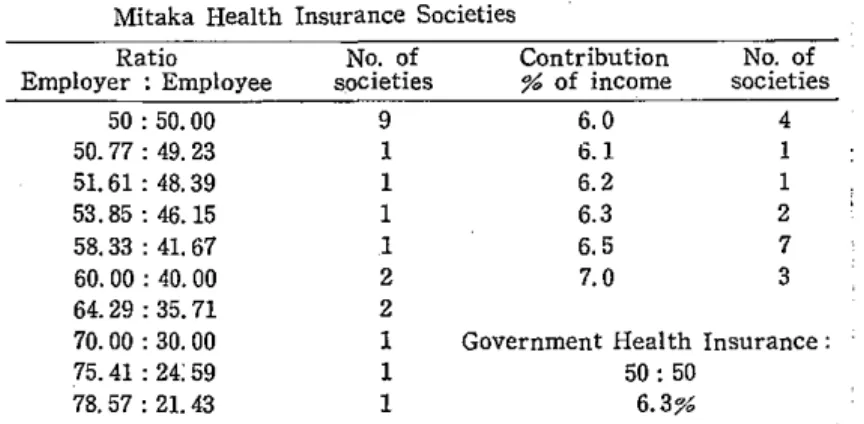
A cash benefit during absence from work known as Shobyo Teate Kin (hereafter sickness benefit') may be claimed for any penod up to six months and eighteen months m the case of tuberculosis. The benefit amounts to approximately sixty per cent of the insured persons normal earnmgs and forty per cent m the case of hospitalised single persons. The scheme is fmanced by a monthly contribution shared between employer and employee and by national subsidy. There are in fact two types of Health Insurance, that operated by the government from local offices and known as Seifu Kansho Hoken or briefly Seikanand that operated by health insurance societies, Kumiai k酎nPo,which may be formed by an enterprise or a group of enterprises employing at least 300 employees between them.
Societies must conform to the same conditions and benefits as the government health insurance as a mmimum standard but they do often improve on those of the government operated scheme from the point of view of the employee. The extent to which this is so in Mi taka enterprises is discussed below. In 1964 the number of persons covered by the govern‑
ment operated health insurance was 11, 426, 000, representing 26 4% of the employed population. In the same year there were 1, 320 registered health insurance societies covering 7, 097, 000 employees, bemg 15. 2% of the employed populat10n.
b〕 DailyWorkers' Health Insurance (庇iyatoi KemPo Ho加の
1s operated by local government admimstrat10n on behalf of the msurance carrier, the nat10nal government. The scheme 1s