Bidding for the Right to be a Proposer: An Experimental Investigation on the Effect of Self-determination
Yoshio Kamijo
∗and Ai Takeuchi
†February 25, 2011
Abstract
People are affected not only by how they evaluate the outcomes and intentions, but also by how they per- ceive the procedures that leads to the outcome. This paper focuses on one aspect of the procedure, the self- determination property, and analyzes the data from an experiment to see its effects on the subjects’ behavior. The experiment consists of ultimatum game in which the roles are assigned through a procedure either with or with- out the self-determination property. In the ultimatum game with the procedure satisfying the self-determination property, proposers tend to act more selfishly and the responders tend to accept an offer more, compared to the same game with the procedure not satisfying the property.
Key Words: Self-determination, Ultimatum Game, Role Assignment Procedure JEL CODE:C72; C91
1 Introduction
Since the findings by G¨uth, Schmittberger, and Schwarze (1982) on the subjects’ behavior in the ultimatum game, many experiments had been conducted to study the reasoning behind people’s deviation from the equilibrium prediction. Many researches has shown that people are affected by the ways they evaluate an ‘outcome’ from a normative aspect, such as fairness or an inequality aversion, and how the deviation from the equilibrium prediction can be explained to some extent by incorporating these aspects of individuals into the model (for example, Fehr and Schmidt, 1999; Bolton and Ockenfels, 2000). On the other hand, there are also evidences which indicate that people’s behaviors are affected by factors beyond an ‘outcome.’ Results from researches on the labor management (Greenberg, 1990), survey results (Frey and Pommerehne, 1993; Kahneman, Knetsch, and Thaler, 1986) and experimental results (Bolton, Brandts, and Ockenfels, 2005) suggest that a normative aspect of procedures also affects the human behavior.
The normative aspect of a procedure affects the feeling of the individuals that use them and changes the be- havior of those engaging in and after the procedure. So, even if the people play identical games, if the procedures which lead to the games are different, then the behaviors in the identical games might differ. In the literature on procedural fairness, it is argued that people tend to respond in a cooperative manner to a process in which they subjectively assess as fair.1 However, an effect of normative property of the procedure on the choice behavior is not studied much, and in this article, we study this using an experimental method.
Because studies on the normative aspects of a procedure is still limited, we only focused on one characteristic of a procedure that can be objectively judged whether the process satisfies or not, and analyze its effect on the people’s behavior by conducting an experiment which compares the procedure with and without the characteristic.
The characteristic which we focus on is thesense of self-determination; whether the participants of the procedure feel the sense of self-determination to the outcomes given by the procedure. A process that assigns divisible or indivisible goods among participants is considered to haveself-determination propertyif the assignment of the
∗Waseda Institute for Advanced Study (WIAS). 1-6-1, Nishi-Waseda, Shinjuku-ku, Tokyo 169-8050, JAPAN
†Corresponding author. Tel: +81 3 3442 8827. E-mail: [email protected]. Faculty of Political Science and Economics, Waseda University, 1-6-1, Nishi-Waseda, Shinjuku-ku, Tokyo 169-8050, Japan.
1Many examples are included in Lind and Tyler (1988) and Frey, Benz, and Stutzer (2004).
goods depends on the choices or decisions of the individuals and each have an equal opportunity to win the goods prior to making their decisions. When the process has self-determination property, the participants of the process are more likely to feel the sense of self-determination. For example, the random assignment procedure of the goods does not have self-determination property because it does not satisfy the former part of the definition; there is no choice by the individuals and the results are not responsible for them. Also, the asymmetric bargaining procedure, like a simple sequential move game in which there is a well-known winning strategy for either a first mover or a second mover leading one to have more portion of the pie, does not have the self-determination property because it does not satisfy the latter part of the definition; one of the two roles has a strategic advantage and the possible winning portion of the pie is not equal among them.
To analyze the effect of such a property on the subjects’ behavior, we conducted ultimatum game experiments and considered role assignment procedures which determine the subjects’ roles in the game. We chose the role of the ultimatum bargaining game as the goods to be assigned by the procedure for the following two reasons.
First, the ultimatum game is simple in structure, so changes in the subjects’ behavior between the two different treatments could be tested using a statistical technique. Second, several procedures on the role assignment of the bargaining game with strategic advantage on one of the roles had already been studied in the existing literatures, and it is possible to make comparisons with these results. For example, Hoffman and Spitzer (1985) studied a puzzle with winning strategy for the first mover, Hoffman, McCabe, Shachat, and Smith (1994) studied the general knowledge quiz and Sonneg˚ard (1996) studied the general knowledge quiz and the computer game. These role assignment procedures do not have the self-determination property, because the complexity of the procedure makes the individuals compete using their skills or ability, allowing for the the high skilled individuals to control the outcome by making right or wrong decisions on purpose, whereas leaving no such room for the skill-less individual. Thus, there is not an equal opportunity for the participants of these procedures to win the role they prefer.2
A role assignment procedure used in this experiment is abidding gameand this possesses the self-determination property. In this game, paired subjects simultaneously announce an amount of money (called bid) they are willing to pay to their counterpart to obtain the role of the proposer in the ultimatum game played after the bidding game.
The subject who announces the higher bid gets the right to decide an allocation of a certain pie between the two and only he has to actually pay his bid to his counterpart.3 Thus, the determined roles in the ultimatum game after the bidding game are the results of the individuals’ choices, and each subject has an equal opportunity to become the proposer by the symmetry of the bidding game.
To analyze the pure effect of self-determination property of the procedure, we created the treatment of control in a way that the role of the subjects and their asymmetric endowments are determined by a random device.
This is because in the ultimatum game played after the bidding game, the paired subjects could have different endowments and it is known from researches on ultimatum game with outside options that when the payoffs the players are going to earn at the time of rejection are asymmetric, it effects both the proposers’ and the responders’
behavior.4 The Baseline treatment, which we will explain in detail in the next section, is designed rigorously to test the effect of the self-determination property on the subjects’ behavior.
The rest of the paper is organized as follows. Section 2 describes the design of the experiment and how the treatment of control is created to derive the pure effect of self-determination property of the procedures. In Section 3, we present observations and findings of the experiment. We discuss about the limitation and interpretations of our findings in Section 4, and conclude in Section 5.
2General knowledge quiz could be considered as a procedure with self-determination property if the subjects were given enough prepa- ration time before the experiment, where those with less ability can cover their disadvantage through effort. Also, the word search puzzle studied in Burrows and Loomes (1994) is a procedure with the self-determination property. In this puzzle, the subjects try to find as many words as possible which are hidden in a 15×15 square of alphabets. This does not require any skill or ability of an individual, but an effort to search for the words.
3For the theoretical progress and application of this game, see P`erez-Castrillo and Wettstein (2001, 2002) and related literatures.
4 For example, Knez and Camerer (1995), Buchan, Croson, and Johnson (2004), Fischer (2005), Schmitt (2004) and Diermeier and Gailmard (2006).
2 Experimental Design
The experiment was conducted on December 2006, at the Political-Economics Experimental Room of Waseda University Political-Economics Department with 108 students of Waseda University.5 We had two treatments, the Baseline treatment and the Bid treatment, in between subject design. Due to the constraint of the design of the Baseline treatment, we had precisely the same number of subjects for each treatment.
In the experiment, 4 sessions were conducted per treatment, and each session proceeded in the following order. First, the subjects were randomly and anonymously seated into a computer terminal.6 The instruction was handed out to each subject, which was read out loud by the experimenter. After the instruction was read, the game structure was briefly reviewed using the over-head projector.7Then, the subjects took an understanding quiz which was checked one by one by the experiment staff. We conducted two practice rounds so the subjects got used to the computer program. In the practice rounds, the choices of the subjects were assigned and controlled by the experimenter to prevent the subjects from receiving any additional information before the start of the treatment.8 After the practice rounds, the actual treatment, consisting of 8 rounds, was conducted, which was then followed by a short questionnaire. Their earnings, 500 Yen participation fee and the sum of the points they had earned in the two randomly chosen rounds multiplied by 5, were paid in cash. Each session lasted for an hour, and the average payment was about 1,500 Yen (about 12.80 US dollars in Dec. 2006).
Let us now explain the two treatments in detail. The game in the two treatments consists of two stages, the bidding stage and the ultimatum game stage. The ultimatum game stage was the same for both treatments: the proposer, whom the role was determined from the proceeding bidding stage, proposes a division of the pie of 100 points, and the responder either accepts or rejects the proposal. If accepted, the pie was divided accordingly; if rejected the two earned no points for the second stage.
The bidding stage in the Bid treatment was played as follows:9
1. The subjects are anonymously divided into pairs using the perfect stranger matching protocol.
2. Each subject was given an endowment of 50 points.
3. Out of the 50 points, each subject decided on the bidbi ∈[0,50], the amount they are willing to pay in order to become the proposer of the following ultimatum game stage.
4. In each pair, the one with the higher bid actually pays the bid to the other player and becomes the proposer in the next stage. If the bid coincides in a pair, then one of the two is selected randomly, pays his bid to the other player and becomes the proposer.
Let us call the higher bid of a pair as thewinning bidand denote it asb,0 ≤b ≤ 50. Also, let us call the proposed portion of the pie to the responder as theofferand denote it asx,0≤x≤100. The payoff of the two stage game is determined as follows. In the case of acceptance, the payoff for the proposervpyand the responder vryis
(vpy, vyr) = (50−b+ 100−x,50 +b+x), and in the case of rejection, the payoff for the proposervnp and the respondervrnare
(vpn, vrn) = (50−b,50 +b).
5The subjects were recruited through the university’s web recruitment system for part time jobs. Their major was not restricted to Economics. No subjects participated more than once, and they had not previously participated in similar ultimatum game experiments.
6The experiment was programmed and conducted with the software z-Tree (Fischbacher, 1999).
7The experiment was conducted in Japanese.The translated version of the instruction is available from the publisher’s web page, the slides and the understanding quiz are available from the author upon request.
8However, by mistake, we announced different offers (the amount of pie proposed for the responder) for each treatment. In the Bid treatment, the offers were controlled to 30, whereas in the Baseline treatment, the offers were controlled to 10. This could have caused a downward effect on the offers in the Baseline treatment, weakening the effect of the two treatments which would be later discussed in Section 3.
9Since the bidding game looks similar to an auction, one may wonder the difference between our Bid treatment and the experiment by G¨uth and Tietz (1986), who conducted an experiment where the subjects participate in the second-price auctions for the role of the proposer and the responder in the ultimatum game. There are many differences, but the most crucial difference is that in the experiment by G¨uth and Tietz (1986), (1) the subjects are randomly assigned to the auction for the role of either a proposer or a responder, so the subjects could not intentionally choose the role they are going to be, but rather chose to be in or out of the ultimatum game, and (2) the proposer (responder) did not know how much the responder (proposer) paid to be in the position, so the payoff of the other subject in case of rejection is not common knowledge, making the ultimatum game into a game with incomplete information.
Thus, as we had already mentioned in the introduction, the ultimatum game after the bidding stage have different initial endowments between the proposer and the responder and this difference may cause income effects on the subjects’ behavior.10
Because our goal is to examine the effect of the self-determination property in the role assignment procedure, our Baseline treatment is designed to control the income effect in our second stage ultimatum game. In the Baseline treatment, the subjects participated in the two stage game just like the Bid treatment, except for the fact that the bids are exogenously determined. The subjects were not able to choose their bid, instead it was determined for them by the computer program. Further, the set of bids generated by the computer are programmed to perfectly replicate the distribution of pairs of bids observed in the Bid treatment. To be more precise, let(bi, bj)tk be an actual pair of bids made by some pairkat periodtin the Bid treatment. Then, at the same periodtof the Baseline treatment, some pair is randomly chosen to be pairkand one of the subjects in this pair is assigned with a bid ofbi and the other is assigned with the bid ofbj.11 This way, the distribution of pairs of bids in the Baseline treatment perfectly replicates the distribution of pairs of bids made in the Bid treatment, allowing us to control the income effect of the bidding stage.12 So, the only difference between the Baseline treatment and the Bid treatment was whether the bids were chosen by the subjects or not.
3 Results
This section compares the results of the ultimatum game stage in the two treatments to see the effect of the self- determination property of a procedure. We also compared the differences in the two treatments with the results of the existing literatures to draw some conjectures.
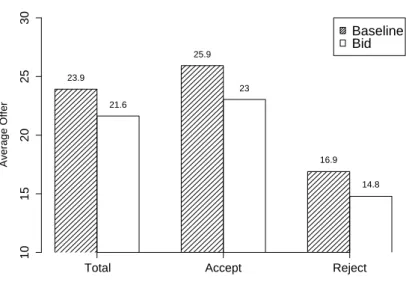
Let us first start the analysis with the proposers’ behavior. If the subjects are maximizing their own monetary payoff, then the game theoretical prediction would be that the average offer would be 0 or 1 in both treatments.13 Figure 1 is the bar graph of the average offers of all observations, and the average offers of accepted and re- jected observations in both treatments. From this graph, one can see that the offers made in the Bid treatment is lower than the offers made in the Baseline. The difference in the distribution of offers in the two treatments is statistically significant at 1 % level (Wilcoxon rank sum test,p-value = 0.008, two-sided).
This result that the player with strategic advantage, the proposer in this case, assigns a more selfish offer under manipulated role assignment procedure has also been observed in experiments by Hoffman, McCabe, Shachat, and Smith (1994), Hoffman and Spitzer (1985) and Burrows and Loomes (1994). The common interpretation of these results, which we also like to adopt, is that when the player role is manipulated somehow, the proposer feels that s/he deserves the right to allocate the pie as freely as s/he wish. In other words, the proposer feels the entitlement to allocate the pie. This effect of the entitlement is also observed in the proposers’ behavior of our experiment.
Next, let us analyze the responders’ behavior. The responders’ behavior is more important from the per- spective of efficiency, because if we think of the efficiency in terms of the total profit earned by all the subjects, the procedure with a higher acceptance rate is the procedure which induce higher efficiency. If the subjects are maximizing their own monetary profit, then according to the game theoretical prediction, they should accept any positive offer and should be indifferent between accepting and rejecting the offer of zero, thus, there should be no difference between the two treatments. The acceptance rate in the Bid treatment was higher with 83 % (179/216)
10To make the payoff structure of our ultimatum game more clear, let us state the relationship between our ultimatum game after the bid transfer and the ultimatum game with the outside option (see footnote 4 for references). Ultimatum games with outside option are ultimatum games with payoff asymmetry in case of rejection, where one or both subjects earn positive but unequal payoffs rather than both earning zero.
In these games, the responders decide over the proposed pie and the outside option. If they accept the proposal, the pie is split accordingly, and if they reject, they earn according to the outside option. Ultimatum game with outside option and the ultimatum game with bid transfer are similar in a way that the payoff of the two subjects will be asymmetric in case of rejection (unless the winning bid equals zero). The difference between the ultimatum game with outside option and the ultimatum game after the bid transfer is that in the latter, the amount of pie is an extra payoff the subjects can earn along with the payoff from the bidding game, but in the former, the responders has to decide between the outside option and the proposed offer.
11To do so, we first conducted the Bid treatment on the first week of December 2006 and collected the data for the set of bids. Then conducted the Baseline treatment the next week.
12In the instruction of the Baseline Treatment, the subjects were told that “The bids will be determined by the computer.” We believe that this should not be considered as a problem, or a deception of any sort. In our experiment, the allocation of both the pair and the bid within the pairs were determined randomly, making it impossible even for the experimenter to know which subject would be assigned with which bid.
13Predictions of the subjects’ behavior based on the inequality aversion model of Fehr and Schmidt (1999) is in Appendix. Surprisingly, the predicted equilibrium strategy is the same as self-utility maximization even if we allow for some degree of inequality aversion.
Total Accept Reject Average Offer 1015202530
Baseline Bid
23.9 21.6
25.9
23
16.9 14.8
Figure 1: Comparison of the Average Accepted and Rejected Offers in the Two Treatments
whereas 78 % (168/216) in the Baseline treatment, but this 5 point difference is not statistically significant (Exact Fisher test;p-value = 0.23). However, in order to analyze the effect of the role assignment procedure on the re- sponders’ behavior, it is necessary to take into account the difference in the proposals made in the two treatments.
That is, since the offers made by the proposers in the Bid treatment are lower than that of the Baseline, this could reduce the raise in the acceptance rate. Therefore, the following logit function was estimated:
Logit(acceptance) =Intercept+β1TransferredBids +β2Offer +β3BidDummy
where ‘BidDummy’ is a variable that takes 1 for Bid treatment and 0 for Baseline. The results of the estimation is in Table 3. Since the coefficient of the ‘BidDummy’ is positive and statistically significant at 10% level, there is an effect of the treatment and the subjects in the Bid treatment are more likely to accept the offer than the subjects in the Baseline.
Variable Estimate S.D. Error P-Value (Intercept) -4.498 0.878 -5.120 0.000
Offer 0.169 0.022 7.630 0.000
Winning bid 0.094 0.024 4.014 0.000
Bid Dummy 0.481 0.274 1.760 0.078
Table 1: Logit Analysis of the Responders’ Behavior
Unlike the proposers’ behavior, this effect of the treatment on the responders’ behavior have not been observed in Hoffman, McCabe, Shachat, and Smith (1994)14. One important factor that exists in our role assignment procedure with self-determination property that does not exists in their’s is the equal opportunities for the paired subjects. As defined in the Introduction, it is important for the procedure with self-determination property to not only reflect the participants’ choices but also to assure them with equal opportunities to be in each role.
14Other literatures on role assignment procedure cannot be used for comparison. Sonneg˚ard (1996) does not observe the difference in either the proposer or the responder’s behavior. Hoffman and Spitzer (1985) and Burrows and Loomes (1994) were face to face bargainings with no rejection option.
4 Further Discussion
This section analyzes the subjects’ behavior in more detail, and discuss about three topics. First, we describe the bidding behavior of the subjects. Although the bidding behavior does not reflect the effect of self-determination property, it is one of the three choice variables in the Bid treatment and is worth analyzing. Then, we further analyze the proposers’ behavior and examine the limitations of the entitlement effect. Finally, we look at the responders’ behavior and discuss about how this experiment can be interpreted in relation to the egocentric assessment of fairness.
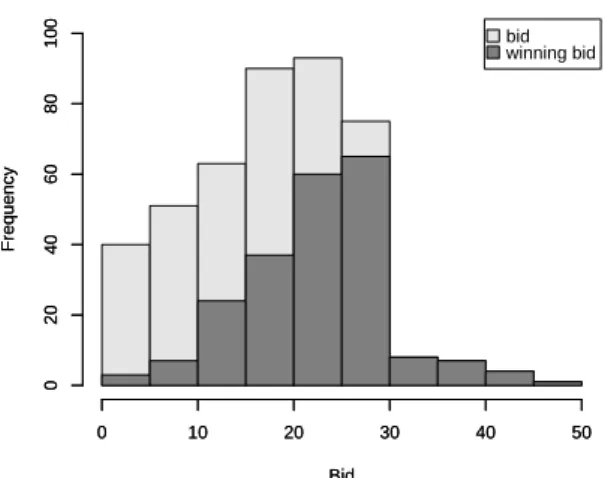
Let us start with the descriptive analysis on the subjects’ bidding behavior. The equilibrium choice of the 2 stage game is to bid 50 in the bidding game, and offer 1 to the responder in the ultimatum game. However, as Figure 2 depicts, such behavior is not observed in the bidding stage. This Figure is the histogram of bids and winning bids, pooled across all 8 rounds. From this figure, one can see that the mode is around 20 to 30, and that bids over 30 are uncommon. The mean bid was 19.05. When we compare the bids across the time period, the mean is fairly constant across the 8 rounds (Krusukal-Wallis rank sum test,p-value = 0.171). However, this does not mean that each subjects’ bids were constant during the experiment. Out of 378(54×7) possible cases, 65.6% increased or decreased their bids from the previous round. This tendency was independent of whether the offer was rejected or accepted in the previous round, but was dependent on the role they played in the previous round (Fisher exact test,p-value = 0.2586 andp-value<0.001, respectively). When the subjects did change their bid, 76% of these changes were to the direction of their counterpart’s bid, so the proposer tends to lower their bid whereas the responder tend to raise their bid in the next round. Therefore, in the aggregate, the average bids were relatively constant across the rounds.
Bid
Frequency
0 10 20 30 40 50
020406080100
Bid
Frequency
0 10 20 30 40 50
020406080100 bid
winning bid
Figure 2: Histogram of Bids
Next, let us discuss about the causes of the differences in the proposers’ behavior of the two treatments. In the previous section, we saw that the offers made by the proposers are lower in the Bid treatment, and argued that this is due to the entitlement effect; since the player role reflects the subjects’ choices, the proposers feel a stronger entitlement to allocate the pie as freely as s/he wish. However, it is also possible to argue that this result is due to the effect ofself-selection15, and this argument is as follows. In the population, there are people with a tendency to make lower offers as well as people with a tendency to make higher offers. In the Bid treatment, those subjects who wants to make low offers can bid higher amounts in order to earn the role of the proposer, so the distribution of the proposers in the Bid treatment could be biased in a way that there are more proposers who want to make lower offers compared to the Baseline. This would also result in lower offers in the Bid treatment.16 We do not
15Usually, self-selection is used for the self-selection of the participants of the experiment. Here, we are using it in a different context.
16Self-selection effect is a possible explanation for the proposers behavior, but it does not help explaining the responders’ behavior. Ac- cording to the argument of self-selection effect, those subjects who became the responder are those with the tendency to make higher offers,
have an effective counter argument for the effect of self-selection, still, not all of the proposers’ behavior could be explained by self-selection. Thus we speculate that the proposers’ behavior is the result of a mixture of the two effects.
If there is an effect of self-selection, those subjects who want to make lower offers should be making higher bids, and those who want to make higher offers should be making lower bids. So, there should be a strong negative correlation between the winning bid and offer in the Bid treatment, and this fits the observations of the data. Figure 3 is the comparison of the scatter plot of the winning bids and offers in the two treatments.
●
●
●
●
●
●
●
●
●
●
●
●
●
●
●
●
●
●
●
●
●
●
●
●
●
●
● ●
●
●
●
●
●
●
●
● ●
●
●
●
●
●●
●
●
●
●
●
●
●
●
●
● ●●
●
● ●
●
●
●
●
●
● ●
●
●
●
●
●
●●
●
●
●
●
●
● ●
●
●
● ●
●
●
●
●
●
●
●
●
●
● ●
●● ●
●
●
●
●
●
●
●
●
●
● ●
●
●● ●
●
●
●
●
●
●
●
●
●
●
●
●
●
●
●
●
●
●
●
●●
●
●
●
●
●
●
●
●
●
●
●
●
●
●
●
●
●
● ●
●
●
●
●
●
●
●
●
●
●
●
●
●
●
●
●
●
●
●
●
●
●
●
●
●
●
●
●
●
●
●
●
●
● ●
●
●
●
● ●
●
● ●
●
●
●
● ● ●
● ●
● ●
●● ● ●
●
● ●
●
●
●
●
0 10 20 30 40 50
0102030405060
Bid Treatment
Winning Bid
Offer
●
●
●
●
●
●
●
●
●
●
●
●
●
●
●
●●
● ●
●
●
●
●
●
●
●
●
●
●
●
●
●
●
●
●
●
●
●
●●
●
●
●
●
●
●
●
●
●
●
●
●●
●
●
●
●
●
●
●
●
●
● ●
●
●
●
●
●
●
●
● ●
●
●
●
● ●
●
●
●
●
●
●
●
●
●
●
●
●
●
● ● ●
●
●
●
●
● ● ●
●
●
●
●
●
●
●
●
●
● ●
●
●
●
●
●
●
●
●
● ●
●
●
●
●
●
●
●
●
●
●
●
●
●
●
●
●
●
●
●
●
●
●
●
● ●
●
●
●
●
●
●
●
●
●
●
● ●
●
●
●
●
●
●
●
●
●
●
●
●
●
●
● ●
●
●
●
● ●
● ●
●
●
●
●
●
●
●
●
●
●
●
●
●
●
● ●
●
●
●
●
●
●
●
●
●
●
● ●
●
●
●
●
●
●
0 10 20 30 40 50
0102030405060
Baseline Treatment
Winning Bid
Offer
Figure 3: Comparison of the Scatterplot of Winning Bid and Offer in the Two Treatments
From this figure, it is clear that the negative correlation between the winning bids and offers is stronger in the Bid treatment compared to the Baseline (Pearson’s Correlationρwas−0.69and -0.38respectively. See Table 4). Following the argument of self-selection, in the scatter plot of negative correlations in the Bid treatment, each
Pearson’s Regression Intercept F-Statistics correlation Coefficient
Bid treatment
All -0.69 -0.57 (0.04) 36.40 (0.96) <0.001 Accepted -0.72 -0.62 (0.05) 38.05 (1.11) <0.001 Rejected -0.59 -0.63 (0.14) 34.86 (2.29) <0.001 Baseline treatment
All -0.38 -0.26 (0.043) 30.24 (1.14) <0.001 Accepted -0.47 -0.34 (0.05) 33.01 (1.36) <0.001 Rejected -0.22 -0.19 (0.13) 26.38 (2.37) 0.14
Table 2: Relationship Between the Winning Bid and Offer
individuals’ winning bid and offer should show up as clusters. The observations of those subjects who want to make lower offers should cluster in the high bid low offer range, whereas observations for those subjects who want to make higher offers should cluster around the low bid higher offer range. However, if we look into the data of each individuals, there are some individual who do make these clusters, but at the same time there are many who change their bids over the course of the experiment. When we compare the data of those subjects who change their bids in the two treatments, we find stronger negative correlation for the individuals in the Bid
and therefore make a lower bid. However, there is no reason why such a person would be more accepting. If the responders’ tendency to make higher offers was drawn from the expectation of aggressive rejection behavior, and if, based on the false consensus effect, such an expectation is based on her/his own behavioral pattern, then it is even possible that these responders are people who reject aggressively.
treatment compared to the Baseline. This change in the individual data cannot be explained by the effect of self-selection, and could be interpreted as the effect of the entitlement.
To summarize, the treatment effect of the self-determination property seems to cause two effects on the proposers’ behavior; the effect of entitlement and the effect of self-selection. The sense of self-determination does not just make the proposers selfish, but also effects the proposers’ sensitivity to the winning bid. However, in order to clarify this point, further investigation is necessary.
Next, we look at the responders’ behavior in Figure 3 and Table 4. These suggest a reasoning behind the raise in the acceptance rate in the Bid treatment. Knez and Camerer pointed out in their paper in 1995 that “when there are multiple ways of describing or ‘framing’ the game ... even if subjects agree on the same choice function,”
if different frames lead to different outcomes, people tend to select the frame that gives them more payoff and behave accordingly. In other words, even if people evaluate the outcome on the same fairness perception, if the participants unconsciously chose the frame in a self-serving manner, they could disagree on what is a fair outcome. Such an egocentric assessment of fairness can be observed in many negotiations from international politics to the division of house labors among a couple.
In the ultimatum game, this egocentric assessment of fairness may lead to rejection behavior. For instance, although this rarely seem to happen in experiment, if the proposer and the responder disagree on the right of the proposer to allocate the pie (i.e. a proposer might believe that s/he can exploit her/his negotiation power since s/he is in a position with strategic advantage, and feel that it is acceptable to take most of the pie, whereas a responder might believe that there is no such right and it is fair to divide the pie equally) then such pairs’ bargaining are likely to end up in a failure. In our experiment, the situation is worse because there are two reasonable frames of the game depending on how they interpret the transferred bid. The first frame interprets the transferred bid as a sunk cost and only considers the division of the pie in the ultimatum game. The second frame thinks that both the transferred bid and offer are on the table for negotiation. If they both agree in one of the two ways, then the negotiation is likely to succeed. On the other hand, in cases where the responder believes the former and the proposer believes the latter is likely to fail. Whether or not such a dispersion on the interpretation of the transferred bid existed between the proposer and the responder can be checked from the difference in the correlation of rejected and accepted bid and offer. If a pair shared the same interpretation of the transferred bid, then the cause of the disagreement could be reduced to an error or difference in the choice function. If most pairs share the same interpretation, then the correlation between the rejected bid and offer should not be so different from the correlation of the accepted bid and offer. Whereas this difference should increase with the number of pairs who disagree on the interpretation. From Table 4, one can see that the difference in the Pearson’s correlation is less under the Bid treatment. So the differences in the interpretation of the transferred bid among pairs were lower in the Bid treatment. This suggest that the self-determination property of a procedure might play a role in reducing the egocentric assessment of fairness.
5 Conclusion
In this paper, we investigated the effect of the self-determination property of a procedure, by using the role of the ultimatum game as the indivisible goods to be allocated by the procedure. The bidding game was used for the procedure with the self-determination property, which was compared with the Baseline treatment which randomly assigns the bid to the subjects. From the comparison of the two treatments, we found that the treatment effect of self-determination property induces more selfish offers by the proposers and more accepting behavior by the responder. As a result, there were more efficiencies under the role assignment procedure with self-determination property than the random procedure.
As a concluding remark, let us compare this result with that of Bolton, Brandts, and Ockenfels (2005), which focuses on the procedure with random mechanism as a procedure which fulfills nice normative properties, such as fairness. However, there are many literatures which support procedures with self-determination property over the random procedure, showing a tendency of the people to assess procedures with self-determination property as being more fair (see Frey, Benz, and Stutzer (2004) for detailed review from many different disciplines). Our results and these survey results seem like a counter example to the experimental results of Bolton, Brandts, and Ockenfels (2005) at first glance, but this is not necessarily true. One of the main reasons why Bolton and their co-authors focused on the random procedure is because it guarantees the ‘level playing field’ of the participants.
Bolton, Brandts, and Ockenfels (2005) writes, “In modern societies, procedures deemed fair are typically those
that create a ‘level playing field,’ a place where the participants have equal opportunity even if the resulting allocation is not equal.” From the definition, the procedure with the self-determination property must create a
‘level playing field’ for the participants, and as we had seen in Section 3, this property might be the necessary element to induce a more efficient outcome. Therefore, like the experiment by Bolton, Brandts, and Ockenfels (2005), this experiment also supports the creation of ‘level playing field’ as an important property of a procedure, but since the procedure with self-determination property has the additional feature to allow the allocation of the goods to depend on the subjects’ choices, self-determination property is a better criterion for a procedure to fulfill than the randomization.
Acknowledgements
We wish to thank Yukihiko Funaki, Takao Kusakawa, Charles Noussair, Jan Potters, Tatsuyoshi Saijo, Kazumi Shimizu, Daisuke Udagawa, Jana Vyrastekova, Motoki Watabe, Toshio Yamagishi, and the participants of the 2007 Fall Meeting of JEA and 2007 Asia-Pacific Regional Meeting of ESA for their helpful comments. The first author has received the financial support from Japan Society for the Promotion of Science, 17-52312 and Waseda University Grant for Special Research Projects, 2007A-806.
References
Bolton, G. E., Brandts, J.andOckenfels, A. (2005). “Fair Procedures: Evidence From Games Involving Lotteries.”
Economic Journal. 115, 1054–1076.
Bolton, G. E.,andOckenfels, A. (2000). “ERC: A Theory of Equity, Reciprocity, and Competition.”American Economic Review. 90(1), 166–193.
Buchan, N. R., Croson, R. T. A.andJohnson, E. J. (2004). “When Do Fair Beliefs Influence Bargaining Behavior?
Experimental Bargaining in Japan and the United States.”Journal of Consumer Research. 31, 181 – 190.
Burrows, P.,andLoomes, G. (1994). “The Impact of Fairness on Bargaining Behaviour.”Empirical Economics.
19, 201 – 221.
Diermeier, D., and Gailmard, S. (2006). “Self-Interest, Inequality, and Entitlement in Majoritarian Decision- Making.”Quarterly Journal of Political Science. 1, 327 – 350.
Fehr, E.,andSchmidt, K. M. (1999). “A Theory of Fairness, Competition, and Cooperation.”Quarterly Journal of Economics. 114(3), 817–868.
Fischbacher, U. (1999). “z-Tree. Zurich Toolbox for Readymade Economic Experiments.” IEW Working paper No.21, Zurich; University of Zurich.
Fischer, S. (2005). “Inequality Aversion in Ultimatum Games with Asymmetric Conflict Payoffs – A Theoretical and Experimental Analysis.” available at http://ideas.repec.org/p/esi/discus/2005-36.html.
Frey, B. S., Benz, M.and Stutzer, A. (2004). “Introducing Procedural Utility: Not Only What, but Also How Matters.”Journal of Institutional and Theoretical Economics. 160, 377 – 401.
Frey, B. S., and Pommerehne, W. W. (1993). “On the Fairness of Pricing – An Empirical Survey Among the General Population.”Journal of Economic Behavior and Organization. 20(3), 295 – 307.
Greenberg, J. (1990). “Employee Theft as a Reaction to Underpayment Inequity: The Hiddn Cost of Pay Cuts.”
Journal of Applied Psychology. 75(5), 561 – 568.
G¨uth, W., Schmittberger, R.and Schwarze, B. (1982). “An Experimental Analysis of Ultimatum Bargaining.”
Journal of Economic Behavior and Organization. 3(4), 367 – 388.
G¨uth, W.,andTietz, R. (1986). “Auctioning Ultimatum Bargaining Positions: How to Act if Rational Decisions are Unacceptable?.” In Scholz, R.W. (eds.),Current Issues in West German Decision Research.Lang Publisher, Frankfurt Bern New York. 173 – 185.
Hoffman, E., McCabe, K., Shachat, K.andSmith, V. (1994). “Preferences, Property Rights, and Anonymity in Bargaining Games.”Games and Economic Behavior. 7(3), 346 – 380.
Hoffman, E.,andSpitzer, M. L. (1985). “Entitlements, Rights, and Fairness: An Experimental Examination of Subjects’ Concepts of Distributive Justice.”The Journal of Legal Studies. 14(2), 259–297.
Kahneman, D., Knetsch, J. L.andThaler, R. H. (1986). “Fairness As a Constraint on Profit Seeking: Entitlements in the Market.”American Economic Review. 76, 728–741.
Kamaga, K., and Kamijo, Y. (2007). “Bidding for Social Alternatives: A Simple One-Stage Mecha- nism and its Extension.” 21 COE-GLOPE Working Paper Series 22, Waseda University, http://21coe- glope.com/paper/21COE WP22.pdf.
Knez, M. J., andCamerer, C. F. (1995). “Outside Options and Social Comparison in Three-Player Ultimatum Game Experiments.”Games and Economic Behavior. 10(1), 65 – 94.
Lind, E. A.,andTyler, T. R. (1988).The Social Psychology of Procedural Justice. New York: Plenum Press.
P`erez-Castrillo, D., and Wettstein, D. (2001). “Bidding for the Surplus: A Non-cooperative Approach to the Shapley Value.”Journal of Economic Theory. 100(2), 274 – 294.
(2002). “Choosing Wisely: A Multibidding Approach.”American Economic Review. 92(5), 1577 – 1587.
SCHMITT, P. M. (2004). “On Perceptions of Fairness: The Role of Valuations, Outside Options, and Information in Ultimatum Bargaining Games.”Experimental Economics. 7(1), 49 – 73.
SONNEGARD˚ , J. (1996). “Determination of First Movers in Sequential Bargaining Games: An Experimental Study.”Journal of Economic Psychology. 17(3), 359 – 386.
Appendix
In other regarding models, the subjects’ utility are assumed to be affected not only by her/his own payoff but also by the payoff of her/his focal group members. In the ultimatum game, the focal group member is, of course, her/his paired subject. In this section, we calculate the prediction of the subjects’ behaviors in the ultimatum game with bidding stage, based on the inequality aversion model of Fehr and Schmidt (1999).
Letiandjbe paired subjects, andviandvjbe their monetary payoffs. Then, in the inequality aversion model of Fehr and Schmidt (1999), the utility of subjectiis given by
Ui(vi, vj) =vi−αi max{vj−vi,0} −βimax{vi−vj,0}
where0≤βi≤αi<0.5. So, the subjects receive disutility from the difference between her/his own payoff and the counterpart’s. If subjectiobtains less than subjectj,ifeels disutility which is expressed by the difference in the payoff multiplied by the parameterαi. This disutility is often regarded asi’s ‘envy.’ When iobtains more thanj, the disutility, which is often considered as a disutility from ‘guilt,’ is expressed by the difference in the payoff multiplied by the parameterβi. In the original work of Fehr and Schmidt (1999), they make weaker assumptions on the two parameter , i.e. 0 ≤ βi ≤ αi,β ≤ 1. Here, we require more because this stronger assumption simplifies the equilibrium analysis in the bidding stage. This can be interpreted as assuming that players’ deviation from the self-utility maximization is relatively small compared to the original model.
Theorem 1. In the subgame perfect equilibrium,
1. in the ultimatum game after the bidding stage, the proposer makes an offer
x∗(b) = max{100αr−2b(αr+βr) 1 + 2αr
,0}.
The responder accepts an offerxifx≥x∗(b), and rejects otherwise.
2. in the bidding stage, with an additional assumption of homogeneity of subjects, the unique equilibrium pair of bids are
b∗=bi =bj= 50.
Let us first consider the prediction of this model on the subjects’ behavior in the ultimatum game after the bidding stage. To simplify the discussion, denotepas a winner of the bidding stage with the winning bidb,0≤ b≤50,rasp’s counterpart, andxas an offer made byp. Then,r’s utility when s/he accepts is
Ur(vry, vpy) =vyr−αr max{vpy−vyr,0} −βrmax{vyr−vyp,0}
= 50 +b+x−αr max{100−2(b+x),0} −βrmax{−100 + 2(b+x),0},
whereas,
Ur(vnr, vpn) =vnr −αr max{vpn−vnr,0} −βrmax{vrn−vnp,0}
= 50 +b−αr max{−2b,0} −βrmax{2b,0}
= 50 +b−2bβr
when rejects. To simplify the proof, we assume thatraccepts the offer ifUr(vry, vyp)≥Ur(vnr, vnp). Note that if pmakes an offer which equalizes the final payoff between them (100−2(b+x) = 0),rwould accept the offer.
So, the optimal offer forpshould be less than or equal to50−band the final payoff forpshould be greater than or equal to the final payoff ofr. So, the optimal offer is the minimizedxwhich satisfies
Ur(vyr, vpy)≥Ur(vnr, vpn) ⇐⇒ 50 +b+x−αr (100−2(b+x))≥50 +b−2bβr. Thus, we have
x≥x∗(b) = max{100αr−2b(αr+βr) 1 + 2αr ,0}.
From this equation, we can obtain some predictions on the tendency of the subjects’ behavior. First, the lower offers are more often rejected than the higher offers. Second, holding an offer constant, if the transferred bid in- creases, the same offer is more likely to be accepted. Third, proposers tend to make lower offers as the transferred bid increases, thus according to this model,x∗should be negatively correlated to the winning bidb.
Next, we consider the subjects’ behavior in the bidding stage predicted from the inequality aversion model.
Because of the assumption of homogeneity of subjects, α = αi = αj andβ = βi = βj. In fact, this is a necessary assumption to guarantee the existence of the equilibrium in the bidding stage when the equilibrium utility after the bidding game is irrelevant to the transferred bids (see Kamaga and Kamijo, 2007). Under this assumption, we obtain the results similar to a theoretical analysis on the bidding game when the equilibrium utility after the bidding game is irrelevant to the transferred bids (for example, see Claim (c) and Claim (d) in the proof of Theorem 1 of P`erez-Castrillo and Wettstein (2001).
Claim AIn the subgame perfect equilibrium, the bids of the paired subjects must be equal. So,bi=bjholds.
Suppose thatbi 6=bj in equilibrium. Without loss of generality, we assumebi > bj. Subjectiwill be the winner of the bidding game, and her/his final payoff can be calculated as
50−bi+ 100−x∗(bi)−αi(100−2(bi+x∗(bi))). (1) Whenb≤50(α+βα ),x∗is(100α−2b(α+β))/(1 + 2α). Differentiating equation (1) would give us
(1−2β)(2α−1) (2α+ 1) <0.
On the other hand, whenb >50(α+βα ),x∗is0. In this case, differentiate (1), and we obtain 2α−1<0.
Therefore, in both cases,ihas an incentive to decrease her/his bidbi. Thus, this is a contradiction, andbimust equalbjin equilibrium.
Claim BIn the subgame perfect equilibrium, whether subjectiwins or looses in the bidding game is irrelevant to his/her final utility.
From Claim A, each player’s bid coincides in the equilibrium, so both players could become a winner with the same probability. We prove the contrapositive of the claim. Suppose that some playericould get the highest payoff when s/he becomes a proposer. Then, sufficiently small increase inbiimproves her/his final payoff because x∗(b)is continuous inb. Therefore, s/he will deviate from the equilibrium strategy. Similarly, if the individuali could obtain the most payoff when the counterpartjis a proposer, then s/he has an incentive to decrease her/his bid, and will deviate from the equilibrium strategy.
From Claim A, we have
b∗=bi=bj.
Moreover, from Claim B, the final utility of subjectiwhen s/he becomes a winner of the bidding stage, 50−b∗+ 100−x∗−β(100−2(b∗+x∗)),
is equal to the final utility of subjectiwhen s/he does not become a winner of the bidding stage, 50 +b∗+x∗−α(100−2(b∗+x∗)).
After some calculations, whenx∗= (100α−2b(α+β))/(1 + 2α), we obtain b∗= 50
1−2β and
x∗(b∗) = 100β
−1 + 2β,
which is not in the reasonable range of our experiment. On the other hand, whenx∗ = 0, we obtainb∗ = 50.
This satisfies the condition thatb > α+β50α and thus, in ultimatum game after transferring the bid of 50, the pair of actions that a proposer makes an offerx= 0and the responder accepts, is certainly a unique subgame perfect equilibrium. Moreover, when both subjects announce bidsbi=bj = 50, reducing the bidbidoes not change the utility of subjecti. Thus, this is an equilibrium in the bidding stage.