厚生労働行政推進調査事業費補助金(化学物質リスク研究事業)
OECDプログラムにおいてTGとDAを開発するためのAOPに関する研究 令和2年度 分担研究報告書
AOP
、
TG、
DAの開発、
AOP国内マニュアルの作成
研究分担者 小島 肇
国立医薬品食品衛生研究所 安全性生物試験研究センター 安全性予測評価部 室長
研究協力者 相場節也
東北大学医学系研究科・医学部 皮膚科学分野教授
足利太可雄
国立医薬品食品衛生研究所 安全性生物試験研究センター 安全性予測評価部 主任研究官 研究要旨
動物実験 3Rs の国際的な浸透に加えて、実験動物とヒトとの種差等の克服のために、
既存の毒性試験法の見直しが世界的に進んでいる。経済協力開発機構(OECD: Organisation for Economic Co-operation and Development)においても、全身毒性試験(免疫毒性、生殖発 生毒性、発がん性及び光安全性等)の有害性発現経路(AOP: Adverse Outcome Pathway)を 開発し、その情報を活用して動物実験代替法を念頭においた試験法ガイドライン(TG:
Test Guideline)の公定化やin silico法を確立する一方で、AOP等の毒性情報を網羅した“試 験の実施と評価のための戦略的統合方式(IATA : Integrated Approaches to Testing and Assessment)”を開発し、それに基づき、TGと同格の扱いになる確定方式(DA:Defined
Approach)による化学物質の安全性評価を推進している。このような国際的な潮流に乗
り、日本が得意とする分野で主導権を握って、AOPやTGを公定化し、さらにはIATAや DAの開発に協力することが本研究班の目的である。
昨年度からの継続した活動の中、日本人の開発した以下のTG 3件の改定が令和2(2020) 年6月にOECDにより公表された。
1) AR STTA 法 : AR-EcoScreenTM細胞を用いた アンドロゲン受容体恒常発現系転写活 性化試験(TG458)
2) 眼刺激性試験 短時間曝露法(TG491)
3) 皮 膚感 作 性試 験 代替法 ア ミ ノ酸 誘導 体 反応試 験 (ADRA: Amino acid Derivative Reactivity Assay)(TG442)
AOPに関しては、“Inhibition of Calcineurin Activity Leading to impaired T-Cell Dependent Antibody Response”が日本発のAOPの一つとして、令和2(2020)年12月にOECD, EAGMST (Extended Advisory Group on Molecular Screening and Toxicogenomics)において内諾となっ た。
22
一般社団法人日本化学工業協会 化学品管理部長
大石 巧
日本免疫毒性学会試験法委員会 AOP検討小委員会
尾上誠良
静岡県立大学 薬学部・薬剤学分野 教授
笠原利彦
富士フィルム株式会社
安全性評価センター 技術マネージャー 加藤雅一
株式会社ジャパン・ティッシュ・エンジ ニアリング(J-TEC)主任研究員
木村 裕
東北大学医学系研究科 医学部 皮膚科学分野 助教
久田 茂
日本免疫毒性学会試験法委員会 AOP検討小委員会
A. 研究目的
本 研 究 班 で は 、OECD(Organisation for Economic Co-operation and Development)の AOP(Adverse Outcome Pathway)開発プロジ ェクトの中で、化学物質の毒性情報等を集 積しながら、免疫毒性、発がん性及び光安 全性等に関する日本発の AOP 開発を進め る。既存の AOP 情報をもとに開発された 皮膚感作性試験代替法ADRA、免疫毒性試 験 MITA(Multi-Immuno Toxicity Assay)、光 安全性試験スクリーニング ROS(Reactive Oxygen Species ) assay 、 LabCyte EPI-
MODEL24を用いる腐食性試験代替法につ
いては、試験法毎に独立した国内外の専門 家による第三者評価(peer review または
review)を受けた後、TGを開発する。一方
とを通じて、IATA(Integrated Approaches to Testing and Assessment)やDAの国内での普 及に務める。
B. 研究方法
B.1. AOP、TG、DAの開発、AOP国内マニ ュアルの作成
B.1.1. AOP国内マニュアルの作成
OECD の AOP 開 発 プ ロ ジ ェ ク ト EAGMST (Extended Advisory Group on Molecular Screening and Toxicogenomics)及び、
TGの 開 発 プ ロ ジ ェ ク トWNT(Working Group of the National Coordinators of the Test Guidelines Programme)の進捗に合わせ、班員 を支援した。
この過程で、AOP作成のルール変更に対 する日本の貢献をまとめた。
B.1.2. AOP開発
AOPに関しては、足利分担研究者ととも に、日本免疫毒性学会会員をメンバーとす る同学会試験法委員会 AOP 検討小委員会 に免疫毒性AOPの開発を委託している。
文献調査の結果に基づいて、カルシニュ ー リ ン 阻 害 を 分 子 初 動(MIE: Molecular initiating event)とし、T細胞依存性抗体産生 抑 制 ( TDAR: T-cell dependent antibody response) を 有 害 性 発 現(AO:Adverse Outcome)と す Inhibition of Calcineurin Activity Leading to impaired T-Cell Dependent Antibody Response(AOP154)を作成し、外 部 reviewに対応した。
B.1.3. TG開発
AR STTA法 : AR-EcoScreenTM細胞を 用いた アンドロゲン受容体恒常発現系転 写 活 性 化 試 験 (AR STTA: The Stably
試験 短時間曝露法 TG491 及び皮膚感作 性試験代替法In Chemico Skin Sensitisation,
(ADRA: Amino acid Derivative Reactivity
Assay)TG442Cの改定に向け、尽力した。
B.1.4. OECD作業計画にある試験法
B.1.4.1. 免疫毒性試験
相場が開発し、他の研究班でバリデー ションを終了させたIL-2を指標とした免 疫毒性試験のTGを目指し、海外の専門 家を招聘したバリデーション報告書の peer reviewを実施した。また、in vitro免 疫毒性に関するDRP (Detailed Review
Paper)を国際的な専門家とともに作成し
た。
B.1.5. DAの開発協力
足利分担研究者とともに、OECD専門家 会議において、DASSの開発に協力した。
C. 研究結果
C.1. AOP、TG、DAの開発、AOP国内マニ ュアルの作成
C.1.1. AOP国内マニュアルの作成
平成30(2018)年まで本研究班からの提案
も含む8本のAOP 案を日本からOECDに 提案してきた。さらに平成30(2018)年、本 研 究 班 か ら の 提 案 も 含 む 17 本 の SPSF(Standard Project Submission Form)を提 案した。その中で、13本の「ラットにおけ る非遺伝毒性発がん性」に関する AOP 案 を日本製薬工業協会グループの協力を得 て提出した。
これらの過程で AOP 作成のルール変更 に対する日本の貢献をまとめた。ただし、
目標にしていた国内マニュアルはまだ完 成していない。この理由として、国内マニ ュアルの基になるOECDにおけるAOPハ
ためである。
貢献の第一は、AOPの行政的な受け入れ 委への関与である。医薬品のがん原性評価 の多くは、ICHがん原性試験ガイドラインに 基づき、げっ歯類がん原性試験により評価 されており、げっ歯類で発生が増加した腫 瘍について、発癌機序を検討し、ヒトでの発 がんリスクを評価する。これまでに医薬品 による非遺伝毒性機序による発がんの知見 が蓄積されていることから、これらの発が ん機序とヒトでのリスク評価に基づいて作 成されたAOPは、薬理作用からげっ歯類に おける発癌とヒトでのリスクを予測するた めに有用と考えられた。しかしながら、薬理 作用等のデータがほとんど無いことが多い 一般化学物質の発がん性評価には医薬品と は異なるアプローチが求められる。従って、
ヒトのAOP開発を念頭におかず、ラットに おける取り組みを用いたAOPでは、化学物 質全般を評価対象とするOECDの枠組みに は疑問が呈された。
本件を初動として、以降、EGMAST は WNT や WPHA (Working Party on Hazard Assessment) にAOPのSPSFにおいて、規 制との関連性が明記されることになった。
具体的には、以下の設問が追加された。
Proposers should indicate if and how the proposed AOPs are associated to any regulatory toxicological endpoints (e.g. acute or chronic toxicity, toxicity to reproduction, developmental neurotoxicity, non-genotoxic carcinogenicity, endocrine disruption etc.). Proposers will indicate what are the potential regulatory applications of the proposed AOPs. The following elements can be considered in addressing this section:
24
projects in OECD such as Integrated Approach to Testing and Assessment (IATA) projects [link to webpage – see case study projects] or Test Guideline development [Link to current OECD TGs - Link to TG development workplan]? (if so, please describe)
• Do the proposed AOPs complement an
existing network of AOPs addressing a regulatory endpoint? (if so, please describe)
• Do the proposed AOPs identify a regulatory
gap, or lack of adequate testing methods and thus:
o Help identify candidate in vitro assay or battery of assays (if so, please describe) o Help standardise testing for certain endpoints
(if so, please describe)
Proposers should also mention if they are aware of any indications of commitment from any organisation (e.g. government/agency/
academia) to support AOP development and eventual review.
この追加により、SPSF提出時にナショナ ルコーディネーターが事前に確認するこ とになった。
もう一点、日本の AOP 開発への貢献が
reviewシステムの変更である。AOP開発の
ためには、これまで EAGMST における内 部review の後に、外部review へと進む。
AOP に 不 慣 れ な 日 本 人 対 応 の た め 、
EAGMSTは早期に外部review に進むべく
コーチ制度と導入した。現在、免疫毒性の 3AOP に関しては、コーチとの意見交換に よる修正を進めている。
C.1.2. AOP開発
(AOP154)については、外部reviewerからの コメントに対応した結果、外部reviewがほぼ 終了した。
令和2(2020)年12月にはEAGMSTの内諾 もなされ、WNTとWPHAの了承が得られ次 第、OECDの正式なAOPとなる。
C.1.3. TGの開発
AR-STTA TG458の改定に向け、追加さ
れ る 2 試験 法 The AR-CALUX® method using the AR-CALUX® cell line 及 び The ARTA method using the 22Rv1/MMTV_GR- KO cell lineのpeer reviewerを務めた。結果 として、これら試験法を含む改定TG458は 令和 2年6月に正式にTG となった(添付 資料1)
眼刺激性試験 短時間曝露法TG491に、
揮発性物質に関する適用範囲の拡大が議 論され、2020 年 4 月に開催された 32nd WNT 会議で改定が採択され、6 月に公表 された(添付資料2)。
ADRA TG442Cの改訂については、ADRA の Annex1 Table 1 の習熟度確認物質の中 のプロピルパラベンの分子量が 110.1 から 180.2 に修正された(添付資料3)。引き続き、
1)適用濃度を1mMから4mMに引き上げに より、偽陰性の改善が期待される。本件につ いては、バリデーション研究を実施するこ とになり、専門家会議での計画審議を受け、
令和2年12月より開発者の富士フィルム主 導のもと、5 施設の協力を受け、12物質を 用いるバリデーション研究が別研究班で実 施されている。2)混合物を評価するため、蛍 光を利用した試験法の追加については、1) の結果と合わせ、来年度に議論される。
3)陽性対照物質を追加する及び 4)性能 標準物質を変更するについては、本年の
案が採択される予定である。
C.1.4. OECD作業計画にある試験法
C.1.4.1. 免疫毒性試験
表1に示す海外の専門家を招聘し、IL-2 Luc assayバリデーション報告書のpeer review報告書が完成した(添付資料4)。
結論として、バリデーション報告書では、
以下のように結論された。
We conducted the validation study of the IL- 2 Luc assay among the 4 luciferase assays that comprise the MITA. The results of both Phase I and Phase II studies satisfied the acceptance criteria for the validation study. Although the predictivity could not reach 80%, it may be acceptable when considering its applicability domain and limited target. So, we would like to propose the IL-2 Luc assay for the OECD test guideline of in vitro immunotoxicity test.
これを受けたPeer review報告書では、以 下のように結論された。
The PRP concluded that, even though the predictive capacity was not sufficient to allow use as a stand-alone test, the IL-2 Luc assay validation has demonstrated that the method should be acceptable as a part of IATA for the predictive screening of T-cell targeted immunotoxicity
一 方 、in vitro 免 疫 毒 性 試 験 は 未 だ に OECD で採択されたことはない。このよう な場合、DRPを作成し、その分野の現状を 報告することになっている。
そこで、DRPの開発をOECD に提案し、
表2 に示す国際的な専門家の協力を受けて 作成した。このDRPをOECDに令和2(2020) 年秋に送ったところ、各国からの意見が寄 せられた。この意見をもとに改訂を続けて いる。
C.1.5. DAの開発協力
OECD専門家会議(電話会議)でDASS の開発に寄与した。2週間に一度の電話会 議で、データベースの見直しを行うととも に、DASS案をもとに、試験法の組み合わ せにおける予測性、適用限界、不確実性に 関する議論が進んだ。
このDASS案について、令和3年4月の 33rd WNT 会議で採択される予定である。
D. 考察
国際的な潮流に乗り、日本が得意とする 分野で主導権を握って、AOPやTGを公定 化し、さらには IATAやDAの開発に協力 することを目指してこの3年間取り組んで きたが、TGはともかくとしても、AOPや IATAなど思うように進んでいない。担当者 としてももどかしい毎日を送っている。他 国が作成した文書に日本の意見を送ると いうレベルと日本が中心となって国際的 な論文を作成するというレベルまでなら ともかく、日本が中心となって国際的な規 制をまとめることは異次元のものである。
世界の中心でいるためには、国内の専門家 をまとめ、国際的な合意を計らねばならな い。免疫毒性や生殖毒性など初めての取り 組む毒性分野ではましてや、抵抗も大きく、
想定内とはいかない労苦を伴う。積極的な 取り組みをする専門家が孤立しないよう 引き続き、怠りない支援を続けていきたい。
E. 結論
昨年度からの継続した活動の中、本年度 にTGに関する3件の改定が令和2年6月 にOECDにより公表された。
1) AR STTA法: AR-EcoScreenTM細胞を用 いた アンドロゲン受容体恒常発現系転 写活性化試験(TG458)
26
3)皮膚感作性試験代替法 アミノ酸誘導体 反応試験(ADRA)(TG442)
AOP に関しては、Inhibition of Calcineurin Activity Leading to impaired T-Cell Dependent Antibody Response(AOP154)が日本発の AOP の一つとして、令和 2 年 12 月に
EAGMSTにより内諾となった。
引き続き、OECD の活動の中で、日本が 得意とする分野で主導権を握って、AOPや TGを公定化し、さらにはIATAやDAの開 発に協力していく予定である。
F. 添付資料
1. OECD Test Guideline 458: Stably Transfected Human Androgen Receptor Transcriptional Activation Assay for Detection of Androgenic Agonist and Antagonist Activity of Chemicals
2. OECD Test Guideline 491: Short Time Exposure In Vitro Test Method for Identifying i) Chemicals Inducing Serious Eye Damage and ii) Chemicals Not Requiring Classification for Eye Irritation or Serious Eye Damage
3. OECD Test Guideline 442C for the Testing Chemicals on in chemico skin sensitisation assays addressing the Adverse Outcome Pathway Key Event on covalent binding to proteins
4. IL-2 Luciferase (IL-2 Luc) Assay Report of the Peer Review Panel
G. 研究発表
G-1. 学会誌・雑誌等における論文一覧
1) 山田 隆志, 足利 太可雄, 小島 肇, 広 瀬 明 彦: AOP (Adverse Outcome
レンジ. Yakugaku Zasshi. 2020;140(4):
481-484.doi: 10.1248/yakushi.19-00190- 1
2) 小島 肇:OECD試験法ガイドライン開
発における CERI の国際貢献. CERI NEWS, 2020;90:2-3.
3) 小島 肇:AOP及びIATAに基づく安全 性評価手法の進捗. JETOC 40周年記念 誌, 2020;71-101.
4) Mizoi K, Arakawa H, Yano K, Koyama S, Kojima H, Ogihara T: Utility of Three- Dimensional Cultures of Primary Human Hepatocytes (Spheroids) as Pharmacokinetic Models. JBiomedicines.
2020;8(10):374. doi:
10.3390/biomedicines8100374
5) Kato Y, Yamamoto N, Hiramatsu N, Sato A, Kojima H: Inhouse Fabrication of a Reconstructed Human Corneal Epithelium Model for Use in Testing for Eye Irritation Potential. Applied in Vitro Toxicology, 2020;6(3), doi:
10.1089/aivt.2020.0003
6) 尾上誠良, 上月裕一, 豊田明美, 笛木 修, 細井一弘, 小島 肇, 足利太可雄, 小野寺 博志:光安全性評価の現状と課 題. YAKUGAKU ZASSHI, 2021, 141(1), 111-124.
https://doi.org/10.1248/yakushi.20-00148 7) Imamura M, Wanibuchi S, Yamamoto
Y, Kojima H, Ono A, Kasahara T, Fujita M: Improving predictive capacity of the Amino acid Derivative Reactivity Assay test method for skin sensitization potential with an optimal molar concentration of test chemical solution, J Appl Toxicol.2021;41(2):303-329. doi:
1) 小 島 肇: 安 全 性 評 価 に お け る Replacement の概要, 第 47 回日本毒性 学会学術年会, 2020/6/29, 国内(web開 催)
2) 小島 肇: ICHにおける発生毒性代替法 の考え方, 第60回日本先天異常学会学 術集会, 2020/7/12, 国内(web開催)
3) 小島 肇: 化粧品安全性研究はどこま で進んでいるか -国際情報・代替法-, アレルギー成分確認方法のエキスパー トセミナー/多職種ワークショップ, 2020/8/30, 国内(web開催)
4) 深井悠貴, 溝井健太, 松本映子, 小山 智志, 矢野健太郎, 石田誠一, 小島 肇, 荻 原 琢 男: OECD/TG の cytochrome P450 誘導試験における mRNA 測定の 有用性, 第27 回 HAB研究機構学術年 会, 2020/9/3-4, 国内(web開催)
5) Kojima H, Ishida S: Challenge of standardization in the AMED-MPS project, Global Summit on Regulatory Science (GSRS20), 2020/9/30, 国外(web 開催)
6) 小島 肇: OECDにおけるコンピュータ
ーモデルの行政的な受け入れ, CBI 学 会2020年大会, 2020/10/28, 国内(web 開催)
7) 小島 肇: 医薬品の発生毒性試験にゼ ブラフィッシュ試験を利用する上での 期待,問題点,課題, 第6回ゼブラフィ ッ シ ュ 創 薬 研 究 会, 2020/10/30, 国 内
(web開催)
8) 赤木隆美, 村上将登, 宮崎裕美, 田口 浩之, 池田英史, 加藤雅一, 山田知美, Mura S, Couvreur P, 足利太可雄, 小島 肇, 明 石 満:三 次元 培養 皮 膚モ デル
LbL-3D Skin を用いた皮膚刺激性試験
代替法の バリデーション研究, 日本
2020/11/12, 国内(web開催)
9) 水町秀之, 渡辺美香, 生悦住茉友, 梶 原三智香, 安田美智代, 水野 誠, 今井 教安, 佐久間めぐみ, 芝田桃子, 渡辺 真一, 上野順子, Basketter D, Eskes C, Hoffmann S, Lehmann D, 足 利 太 可雄, 寒水孝司, 武吉正博, 宮澤正明, 小島 肇:皮 膚 感作 性試 験代 替法 Epidermal Sensitization Assay (EpiSensA) の Validation 研究(施設内再現性 Phase I), 日本動物実験代替法学会 第33回大会, 2020/11/12, 国内(web開催)
10) 木村 裕, 安野理恵, 渡辺美香, 小林美 和子, 岩城知子, 藤村千鶴, 近江谷克 裕, 山影康次, 中島芳浩, 真下奈々, 岡 山昂祐, 高木佑実, 大森 崇, 小島 肇, 相 場 節 也 :Multi-ImmunoTox Assay (MITA):IL-1 Luc assay バリデーション 試験の結果, 日本動物実験代替法学会 第33回大会, 2020/11/12, 国内(web開 催)
11) 山口宏之, 押方 歩, 綿谷弘勝, 小島 肇, 竹澤俊明:固体を含む被検物質に使用 可能な Vitrigel-EIT 法の改訂手順の提 案, 日本動物実験代替法学会 第 33 回 大会, 2020/11/12, 国内(web開催)
12) 浅野哲秀, 笠松俊夫, 北本幸子, 山本 美佳, 足利太可雄, 小島 肇: Bhas42細胞 形質転換試験法(Bhas 42 CTA)の評価, 日 本 環 境 変 異 原 学 会 第 49 回 大 会,
2020/11/27, 国内(ハイブリッド開催)
13) 小島 肇:発生毒性代替法の状況と方向 性について, 第 2 回日本生殖発生毒性 フォーラム, 2020/11/28, 国内(web開催)
14) Kojima H: Establishment of the Asian Consortium for Three R’s,The 26th Frontier Scientists Workshop, 2020/12/18, 国外(web開催)
28
Consortium for Three R’s with SAAE-I, International Webinar & 3rd National Conference of the Society for Alternatives to Animal Experiments (IWSAAE&
NCSAAE-2020) , 2020/12/28, 国外(web 開催)
16) Kojima H: Non-animal Alternative Toxicology and Regulatory Testing: An Update from Japan. Virtual International Conference to Mark the Launch of the Society for Alternatives to Animal Testing in Sri Lanka (SAAT-SL), 2020/2/7, 国外
(web開催)
17) Kojima H: Current projects for systemic toxicological testings in Japan. Global Collaboration Coffee When and How We Can Stop Using Animals in Toxicology, 2021 SOT Virtual Annual Meeting, 2021/3/16, 国外(web開催)
H. 知的所有権の取得状況 1. 特許取得
特になし 2. 実用新案登録
特になし 3. その他
特になし
No. Name Affiliation Country
1 Henk van Loveren Maastricht University Netherlands
2 Haley Neff-LaFord Seattle Genetics, Inc. USA
3 Barbara Kaplan Mississippi State University USA
4 Fujio Kayama Jichi Medical University Japan
5 Xingchao Geng National Center for Safety Evaluation of Drugs
(NCSED) China
6 Sang-Hyun Kim Kyungpook National University Korea
7 Takao Ashikaga National Institute of Health Sciences Japan
表2.In vitro 免疫毒性試験 総説(Detailed Review Paper)作成メンバーリスト
No. Name Affiliation Country
1 Emanuela Corsini Università degli Studi di Milano Italy
2 Dori Germolec NTP/NIEHS USA
3 Barbara Kaplan Mississippi State University USA
4 Henk van Loveren Maastricht University Netherlands
5 Haley Neff-LaFord Seattle Genetics, Inc. USA
6 Erwin L. Roggen 3RsMC ApS Denmark
7 Setsuya Aiba Tohoku University Japan
8 Yutaka Kimura Tohoku University Japan
9 Takayuki Yoshimoto Tokyo Medical University Japan
10 Hajime Kojima JaCVAM, National Institute of Health Sciences Japan
30
Test Guideline No. 458 Stably Transfected Human Androgen Receptor Transcriptional Activation Assay for Detection of Androgenic Agonist and Antagonist Activity of
Chemicals
26 June 2020
OECD Guidelines for the Testing of Chemicals
Section 4
Health effects
Adopted:
26 June 2020
© OECD, (2020)
You are free to use this material subject to the terms and conditions available at http://www.oecd.org/termsandconditions/.
OECD GUIDELINE FOR THE TESTING OF CHEMICALS
Androgen Receptor TransActivation Assays for Detection of Androgenic Agonist and Antagonist Activity of Chemicals using Stably Transfected Cell Lines
Table of Contents
Introduction ... 2
Literature ... 5
Annex A. Definitions and abbreviations ... 6
Annex B. Information relevant to the three test methods. ... 12
Annex C. (Method 1) Androgen Receptor TransActivation Assay for Detection of Androgenic Agonist and Antagonist Activity of Chemicals using the stably transfected human AR- EcoScreen™ cell line ... 26
Annex D. (Method 2): Androgen Receptor TransActivation Assay for Detection of Androgenic Agonist and Antagonist Activity of Chemicals using the stably transfected human AR- CALUX® cell line ... 49
Annex E. (Method 3): Androgen Receptor Transactivation Assay for Detection of androgenic Agonist and Antagonist Activity of Chemicals using the stably transfected human 22Rv1/MMTV_GR-KO cell line ... 68
32
Introduction
Androgen receptor transactivation (ARTA) test guideline of similar in vitro methods
1. Disruption of the endocrine system may occur through a number of different mechanisms including interference with (i) hormone action mediated via nuclear receptors linked to the endocrine system (ii), hormone production via steroidogenic or other enzymes, (iii) metabolic activation or deactivation of hormones, (iv) distribution of hormones to target tissues, and (v) clearance of hormones from the body. This Test Guideline (TG) exclusively addresses transcriptional activation and inhibition of an androgen-regulated reporter gene.
2. The results of the methods in this TG should not be directly extrapolated to the complex in vivo situation of androgen regulation of any cellular or physiological processes.
3. This TG describes the methodology of Androgen Receptor TransActivation (ARTA) assays that detect agonist and antagonists. It comprises several mechanistically and functionally similar test methods for the identification of androgen receptor agonists and antagonists. The fully validated reference test methods described in this TG are:
The AR-EcoScreen™ method using the AR-EcoScreenTM cell line (1) (Method 1, found in Annex C)
The AR-CALUX® method using the AR-CALUX® cell line (2) (Method 2, found in Annex D)
The ARTA method using the 22Rv1/MMTV_GR-KO cell line (3) (Method 3, found in Annex E)
4. These three test methods address the same endpoint, i.e. transactivation of a reporter gene by a ligand bound androgen receptor (see paragraphs 5 and 6). An overview of the similarities and differences between the test methods is given in Annex B (Tables B.1 and B.2). All three test methods are performed in 96-well plates while a high-throughput application has also been reported (but not yet validated according to OECD Guidance Document 34, 2020) for the AR-CALUX® test method (4). Method 1 includes a specificity control for the agonist detection but not for the antagonist, whereas methods 2 and 3 include a specificity control for the antagonist assay to give assurance that what is measured is a competitive antagonist. Each test method has a distinct protocol and test run acceptability criteria. Each test method has its own data interpretation criteria to conclude on agonist and antagonist activity.
Background and principles of the test methods included in this test guideline 5. In vitro Transactivation (TA) methods are based upon the transcription and translation of a reporter gene (e.g. luc gene) following binding of a chemical to a specific receptor and subsequent transactivation. Different reporter genes can be used in these assays.
TA methods have been used to evaluate the gene expression profiles regulated by specific nuclear receptors, such as the estrogen receptors (ERs) and androgen receptors (ARs) (5) (6) (7) (8). They have been proposed for the detection of nuclear receptor-mediated transactivation (5) (6) (9).
©OECD 2020
6. Androgen agonists and antagonists act as ligands for the AR through AR binding, and may activate or inhibit the transcription of androgen responsive genes. This interaction may have the potential to trigger adverse health effects by disrupting androgen-regulated systems e.g. processes necessary for cell proliferation, normal fetal development, and reproductive function.
7. The OECD initiated a high-priority activity in 1998 to revise existing, and to develop new TGs for the screening and testing of potential endocrine disrupting chemicals. The OECD Conceptual Framework for testing and assessment of potential endocrine disrupting chemicals comprises five levels, each level corresponding to a different level of biological complexity (10). The 3 ARTA methods described in this TG are included in level 2 for "in vitro assays providing data about selected endocrine mechanism(s)/pathway(s) (Mammalian and non mammalian methods)".
8. The test methods described in this TG cannot be used on their own for safety assessment decisions. They provide concentration-response data for chemicals with in vitro (anti)androgenic activity, which may be used for screening and prioritization purposes and can also be used as mechanistic information in a weight of evidence approach.
9. Validation studies of the AR-EcoScreen™ test method, the AR-CALUX® test method, and 22Rv1/MMTV_GR-KO test method have demonstrated their relevance and reliability (1, 3, 11).
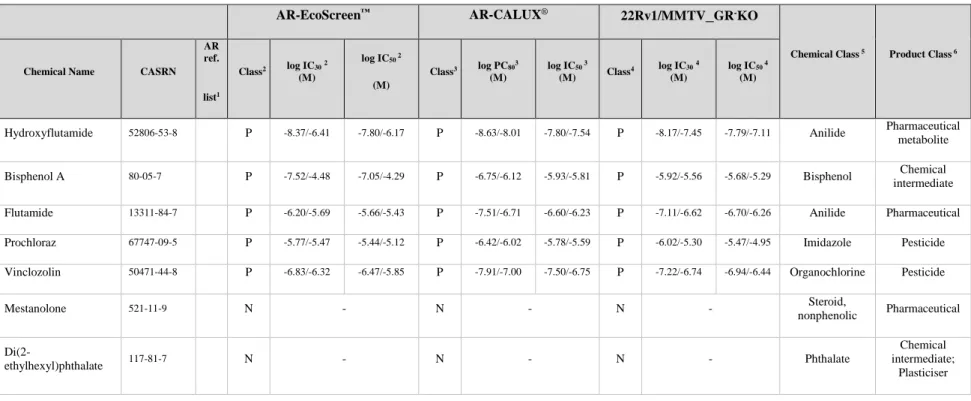
10. An overview of the main characteristics, the acceptability criteria and the main abbreviations used in each test method is described in Annex B (Tables B.1 and B.2). For information purposes, Tables B.3a and B.3b of Annex B provide the results for the chemicals that were tested in common between at least 2 test methods of this TG. The classification comparison is made with the ICCVAM list of 2003 (6) (used as the reference list for the AR- EcoScreen™ which was adopted in 2016) and with the recently updated ICCVAM list of 2017 (12). For the antagonist testing, the 3 test method results were concordant, whereas results of agonist testing resulted in 4 non concordant classifications with the 22Rv1/MMTV_GR-KO method. A possible reason for this could be the different cell lines used in the 3 different test methods (1, 3, 11). The chemical 17β-Estradiol, known as an ER agonist, shows AR agonist activity with all 3 test methods, although in the AR-CALUX®
method only a weak activity was observed.
11. Supplementary information on these chemicals as well as on an additional 13 chemicals tested with the AR-CALUX® method can be found in the validation study reports (1, 3, 11).
12. General and test method specific definitions and abbreviations used in the test methods in this TG can be found in Annex A.
Demonstration of laboratory proficiency
13. Each laboratory should demonstrate proficiency in using the test method of choice prior to using that method for testing chemicals with unknown activity. Proficiency is demonstrated by testing 8 proficiency chemicals for agonist activity (see Table B.4a in Annex B) and 9 proficiency chemicals for antagonist activity (see Tables B.4b and B.4c in Annex B). This testing will also confirm the responsiveness of the test system. Testing should be replicated at least twice, on different days, and the results should be consistent to the listed classifications and values in Tables B.4a and B.4a. Moreover, a historical database of data generated with the reference standards and the vehicle/solvent controls shall be maintained to confirm the reproducibility of the test method in the respective laboratory over time.
34
Test report
14. For reporting purposes, the template provided in Annex B, should be used for each test method.
©OECD 2020
Literature
1. OECD (2016), Validation report of Androgen Receptor (AR) Mediated Stably Transfected Transactivation (AR STTA) Assay to Detect Androgenic and Anti-androgenic Activities. Environment, Health and Safety Publications, Series on Testing and Assessment ( No. 241), Organisation for Economic Cooperation and Development, Paris.
2. Transactivation assay for the detection of compounds with (anti)androgenic potential using AR- CALUX® cells (2019). Available at (https://tsar.jrc.ec.europa.eu/test-method/tm2010-07).
3. Validation Study Report of the 22Rv1/MMTV_GR-KO ARTA assay (2019). Available at (http://www.nifds.go.kr/brd/m_18/view.do?seq=12486&srchFr=&srchTo=&srchWord=&srchTp=&itm_seq_1=0
&itm_seq_2=0&multi_itm_seq=0&company_cd=&company_nm=&page=1) .
4. Van der Burg, B., Pieterse, B., Buist, H., Lewin, G., van der Linden, S.C., Man, H.Y., Rorije, E., Piersma, A.H., Mangelsdorf, I., Wolterbeek, A.P., Kroese, E.D., van Vught-Lussemburg, B. (2015). A high troughput screening system for predicting chemically-induced reproductive organ deformities. Reprod Toxicol 55, 95-103.
5. EDSTAC (1998), Endocrine Disruptor Screening and Testing Advisory Committee (EDSTAC) Final report. Available at (https://www.epa.gov/endocrine-disruption/endocrine-disruptor-screening-and- testing-advisory-committee-edstac-final).
6. ICCVAM (2003), ICCVAM Evaluation of In Vitro Test Methods for Detecting Potential Endocrine Disruptors: Estrogen Receptor and Androgen Receptor Binding and Transcriptional Activation Assays.
Available at (https://ntp.niehs.nih.gov/iccvam/docs/endo_docs/edfinalrpt0503/edfinrpt.pdf).
7. Jefferson, W.N., Padilla-Banks, E., Clark, G. and Newbold R. (2002). Assessing estrogenic activity of phytochemicals using transcriptional activation and immature mouse uterotrophic responses. J. Chromat.
B., 777, 179-189.
8. Sonneveld, E., Riteco, J.A., Jansen, H.J., Pieterse, B., Brouwer, A., Schoonen, W.G. and van der Burg, B.
(2006). Comparison of in vitro and in vivo screening models for androgenic and estrogenic activities.
Toxicol. Sci., 89, 173-187.
9. Gray, L.E. Jr. (1998). Tiered screening and testing strategy for xenoestrogens and antiandrogens. Toxicol.
Lett., 102-103, 677-680.
10. OECD (2018), Revised Guidance Document No 150 on Standardised Test Guidelines for Evaluating Chemicals for Endocrine Disruption, OECD Series on Testing and Assessment, No. 150, OECD Publishing, Paris, https://doi.org/10.1787/9789264304741-en .
11. Validation Study Report on the Performance assessment of the AR-CALUX® in vitro method (2019).
Available at (https://tsar.jrc.ec.europa.eu/test-method/tm2010-07) .
12. Kleinstreuer, N.C., Ceger, P., Watt, E.D., Martin, M., Houck, K., Browne, P., Thomas, R.S., Casey, W.M., Dix, D.J., Allen, D., Sakamuru, S., Xia, M., Huang, R., Judson, R. (2017). Development and Validation of a Computational Model for Androgen Receptor Activity. Chem Res Toxicol., 30(4):946- 964.
36
Annex A. Definitions and abbreviations
General definitions and abbreviations that apply to all the test methods in this TG and/or to the tables in Annex B
Acceptability criteria: Minimum standards for the performance of experimental controls and reference standards. All acceptability criteria should be met for an experiment to be considered valid
Agonist: A chemical that binds to a specific receptor and triggers a response in the cell. It mimics the action of an endogenous ligand that binds to the same receptor
Androgen activity: The capability of a chemical to mimic a ligand in its ability to bind to and activate androgen receptors
Antagonist: A type of receptor ligand or chemical that does not provoke a biological response itself upon binding to a receptor, but blocks or dampens agonist-mediated responses
Anti-androgen activity: The capability of a chemical to suppress the action of the agonist ligand mediated through androgen receptors. AR-mediated specific anti-androgen activity can be detected in this Test Guideline.
AR: Androgen Receptor
ARE: Androgen Receptor Element
ARTA: Androgen Receptor TransActivation BDS: BioDetection Systems (The Netherlands) BLR: Between Laboratory Reproducibility
CERI: Chemicals Evaluation and Research Institute (Japan) CASRN: Chemical Abstracts Service Registry Number
CRISPR-Cas9: Clustered Regularly Interspaced Short Palindromic Repeats-CRISPR associated CV: Coefficient of Variation
Cytotoxicity: Harmful effects to cell structure or function ultimately causing cell death. It can be reflected by a reduction in the number of cells present in the well at the end of the exposure period or a reduction of the capacity for a measure of cellular function when compared to the concurrent vehicle control.
DHT: 5α-DiHydroTestosterone DMSO: DiMethyl SulfOxide
EC50: The half maximal effective concentration of a stimulating (agonist) test chemical ED: Endocrine Disruptor
ER: Estrogen Receptor FBS: Fetal Bovine Serum
©OECD 2020
IF: Induction Factor/Fold InhF: Inhibition Factor/Fold GR: Glucocorticoid Receptor
IC50: The half maximal effective concentration of an inhibitory (antagonist) test chemical InChI: International Chemical Identifier
IUPAC: International Union of Pure and Applied Chemistry KO: KnockOut
Luc: Luciferase gene
MTA: Material Transfer Agreement
MFDS: Ministry of Food and Drug Safety (Korea) MMTV: Mouse Mammary Tumour Virus
Negative control: Separate part of a test system treated with a chemical for which it is known that the test system should not respond. The negative control provides evidence that the test system is not responsive under the actual conditions of the assay
NIHS: National Institute of Health Sciences (Japan) PCR: Polymerase Chain Reaction
PR: Progesterone Receptor
Positive control: Separate part of the test system treated with a chemical for which it is known that the test system should respond. The positive control provides evidence that the test system is responsive under the actual conditions of the assay
R2: Square of the correlation coefficient (criterion for the specificity control test)
Reference chemical: A chemical used to provide a basis for comparison with the test chemical
Reference standard: Used to demonstrate the adequacy of a test method. In this TG, reference standards refer to 3 chemicals of which 2 elicit a positive response (a dose response or at one fixed concentration) and one does not provide a response. One of the 2 chemicals with a positive dose response is the reference chemical
Reliability: Measure of the extent that a test method can be performed reproducibly within and between laboratories over time, when performed using the same protocol. It is assessed by calculating WLR and BLR
RI: Relative Induction RLU: Relative Light Units
Run: An individual experiment that evaluates chemical action on the biological outcome of the test method.
Each run is a complete experiment performed on replicate wells of cells plated from a common pool of cells at the same time
38
SD: Standard Deviation
SMILES: Simplified Molecular-Input Line-Entry System
Study: The full range of experimental work performed to evaluate a single, specific chemical using a specific test method. In this TG, a study comprises all steps including tests of dilution of test chemical in the test media, runs (which can be pre-screen runs and comprehensive runs), data analysis, quality assurance, cytotoxicity assessments, etc. Completion of a study allows the classification of the test chemical activity on the toxicity target that is evaluated by the test method used and an estimate of potency relative to the positive reference chemical
TA: Transactivation. The initiation of mRNA synthesis in response to a specific chemical signal, such as a binding of an androgen to an androgen receptor
Test chemical: what is being tested and is not related to the applicability of the assay to the testing of mono- constituent chemicals, multi-constituent chemicals and/or mixtures
Test method: Within the context of the TG, a test method is one of the methodologies accepted as valid in meeting the performance criteria outlined in the TG. Components of the test method include, for example, the specific cell line with associated growth conditions, specific media in which the test is conducted, plate set up conditions, arrangement and dilutions of test chemicals along with any other required quality control measures and associated data evaluation steps
Test system: Any biological, chemical or physical system or a combination thereof used in a study. In vitro test systems are mainly biological systems (e.g. cells or tissues)
UN GHS: United Nations Globally Harmonized System of classification and labelling of chemicals UVCBs: Chemicals of Unknown or Variable Composition, Complex Reaction Products and Biological
Materials
Validated test method: A test method for which a validation study has been completed to determine the relevance (including accuracy) and reliability for a specific purpose. It is important to note that a validated test method may not have sufficient performance in terms of accuracy and reliability to be found acceptable for the proposed purpose
Validation: The process by which the reliability and relevance of a particular approach, method, process or assessment is established for a defined purpose
Vehicle control: The solvent (vehicle) that is used to dissolve test and reference standards. It is tested solely as vehicle without dissolved chemical
WLR: Within Laboratory Reproducibility
Test method specific terminology AR-EcoScreen™ test method
AG ref: Agonist reference (500 pM of DHT) in the antagonist assay BPA: BisPhenol A
DCC-FBS: Dextran-Coated Charcoal treated Fetal Bovine Serum DEHP: Di(2-EthylHexyl)Phthalate
©OECD 2020
HF: HydroxyFlutamide
IC30: the concentration of a test chemical at which the measured activity in an antagonist assay inhibits at level of 30% of the maximum activity induced by 500 pM DHT in each plate
PCAGO: AR agonist control displaying a positive response with DHT at 10 nM
PCATG: AR antagonist control displaying a positive response with 500 pM DHT and1 μM of HF PCCT: The response of the cytotoxic control (10 μg/mL of Cycloheximide)
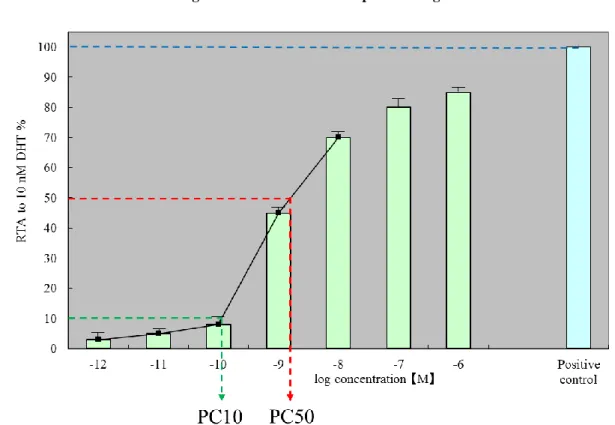
PC10: The concentration of a test chemical at which the response in an agonist assay is 10% of the response induced by the reference chemical (DHT at 10 nM) in each plate
PC50: The concentration of a test chemical at which the response in an agonist assay is 50% of the response induced by the reference chemical (DHT at 10 nM) in each plate
PCmax: The concentration of a test chemical inducing the RPCmax
RPCmax: Maximum level of response induced by a test chemical, expressed as a percentage of the response induced by PCAGO (10 nM DHT) on the same plate
RTA: Relative Transcriptional Activity AR-CALUX® test method ARE: Androgen Responsive Elements AU: Absorbance Units
Comprehensive run: experiment carried out after the pre-screen run with a smaller dilution step (e.g. 2, 3 or 5) in order to calculate the parameters with more precision
DF: Dilution Factor
DMEM: Dulbecco's Modified Eagle's medium
EC10, EC50: Concentration of a test chemical at which 10% or 50% of its maximum induction response is observed
FLU: Flutamide
hAR: Human Androgen Receptor HTS: High Throughput Screening
IATA: Integrated Approach to Testing and Assessment. IATA are pragmatic, science-based approaches for chemical hazard characterisation that rely on an integrated analysis of existing information coupled with the generation of new information using testing strategies
IC20, IC50: Concentration of a test chemical at which 20% or 50% inhibition is observed when compared to its maximum response
IP: Intellectual Property LDH: Lactate Dehydrogenase
40
PC10, PC50, PC80: Concentration of test chemical giving 10%, 50% or 80% induction (or inhibition) with respect to the maximum induction of the reference chemical DHT (agonist), or, the solvent control (antagonist)
PCmax, PCmin: Concentration of a test chemical where the response is maximal (corresponding to RPCmax ) or minimal (RPCmin)
Pre-screen run: Experiment that evaluates the dose response, usually carried out with a large dilution step (e.g. 10) in order to capture the full dose response (if possible). It serves to determine the range of concentrations to be used in a following comprehensive run.
REF RPC10,REF RPC50,REF RPC80: Response level (as determined by relative induction (RI)) of the reference chemical DHT or Flutamide at 10%, 50% or 80%
REF EC50: Concentration of the reference chemical DHT at which 50% of its maximum response is observed (in the agonist assay)
REF IC50: Concentration of the reference chemical Flutamide at which 50% of its maximum response is observed (in the antagonist assay)
RPCmax: The maximum response level (highest induction) of the test chemical RPCmin: The minimum response level (highest inhibition) of the test chemical RI: Relative induction
Specificity control: A test which is carried out to assess if the antagonist response is the result of competitive binding to the AR
Sc: Specificity control response at a specific concentration c, expressed in relative induction.
Scn
: Normalized specificity control response at a specific concentration c, expressed in relative induction SC: Solvent control (agonist: assay medium plus 0.1 % solvent; antagonist: assay medium plus 0.1 %
solvent and spiked with the EC50 concentration DHT)
VC: Vehicle control (assay medium plus 0.1% solvent, used in the antagonist assay)
Yic: Standard response at concentration c (C1-C8), expressed in relative induction) and technical replicate i (1-3)
Yc: Average of the standard response Yic over the 3 technical replicates ZF: Z-factor
22Rv1/MMTV_GR-KO test method ATCC: American Type Culture Collection
Comprehensive run: experiment carried out after the pre-screen run with a smaller dilution step (e.g. 3 or 5) in order to calculate the parameters with more precision
DCC-FBS: Dextran-coated charcoal treated fetal bovine serum
©OECD 2020
DEHP: Di(2-EthylHexyl)Phthalate
GF-AFC: Glycyl phenylalanyl-aminofluorocoumarin
IC30: The concentration of a chemical at which its inhibitory response equals 30% of the maximum response of the AR agonistic control (800 pM DHT) in AR antagonist assay
KTR: Korean Testing and Research Institute
NIFDS: National Institute for Food and Drug Safety Evaluation
PC10: The concentration of a chemical at which its response equals 10% of the maximum response of the AR agonistic control (10 nM DHT) in AR agonist assay
PC50: The concentration of a chemical at which its response equals 50% of the maximum response of the AR agonistic control (10 nM DHT) in AR agonist assay
PCAGO1: Control for AR agonist assay displaying a positive response with 10 nM DHT PCAGO2: Agonist control for AR antagonist assay (800 pM DHT)
PCANTA: Antagonist control displaying a positive response with 800 pM DHT and1 μM of Bicalutamide.
PCCT: Cytotoxic control (1 mM SDS)
Pre-screen run: Experiment that evaluates the dose response, usually carried out with a large dilution step (e.g. 10) in order to capture the full dose response (if possible). It serves to determine the range of concentrations to be used in a following comprehensive run.
RTA: Relative Transcriptional Activity SDS: Sodium Dodecyl Sulfate
Specificity control: A test which is carried out to assess if the antagonist response is the result of competitive binding to the AR
Sc: The relative induction of a test chemical at concentration c when 100 nM DHT is used in the antagonist assay (specificity control)
Yc: The relative induction of a test chemical at concentration c when 800 pM DHT is used in the antagonist assay
42
Annex B. Information relevant to the three test methods.
Overview tables and list of proficiency chemicals
Table B.1. Overview of the characteristics of the 3 test methods in this TG
Test method name AR-EcoScreen™ AR-CALUX® 22Rv1/MMTV_GR_KO
Developer Otsuka Pharmaceuticals Co., Ltd., CERI and
NIHS. BDS MFDS, Korea Univ. and Dongguk Univ.
Cell line AR-EcoScreen™ AR-CALUX® 22Rv1/MMTV_GR-KO
Cell type Chinese hamster ovarian cancer cell Human osteo-sarcoma cell Human prostate carcinoma epithelial cell Genetic modification Human AR cDNA
heat shock protein promoter
-4 C3 ARE-firefly luc (Photinus pyralis)
SV40 promoter-renilla luc (Renilla reniformis) (for simultaneous measurement of cytotoxicity)
Human AR cDNA
TATA promoter -3xARE -firefly luc (Photinus pyralis)
Endogenous AR
MMTV LTR promoter containing ARE- firefly luc (Photinus pyralis)
Knocked out GR by CRISPR-Cas9
Special feature Minimal GR crosstalk due to the selection of an appropriate androgen responsive element
High throughput applicability
No or little GR, ER and PR expression
High throughput applicability
No ER and PR expression
GR knock-out
©OECD 2020 Availability Material transfer agreement (MTA)
including a licence agreement with Japanese Collection of Research Bioresources (JCRB) Cell Bank and cell owner
Licence agreement with BDS Material transfer agreement (MTA) including a licence agreement with Korean Cell Bank and Korean MFDS
Table B.2a. Overview of reference standards and acceptability criteria for the three test methods for AGONIST properties.
Test method name AR-EcoScreen™ AR-CALUX® 22Rv1/MMTV_GR-KO
AGONIST
Reference chemical 5α-Dihydrotestosterone (DHT) 5α-Dihydrotestosterone (DHT) 5α-Dihydrotestosterone (DHT)
Criteria
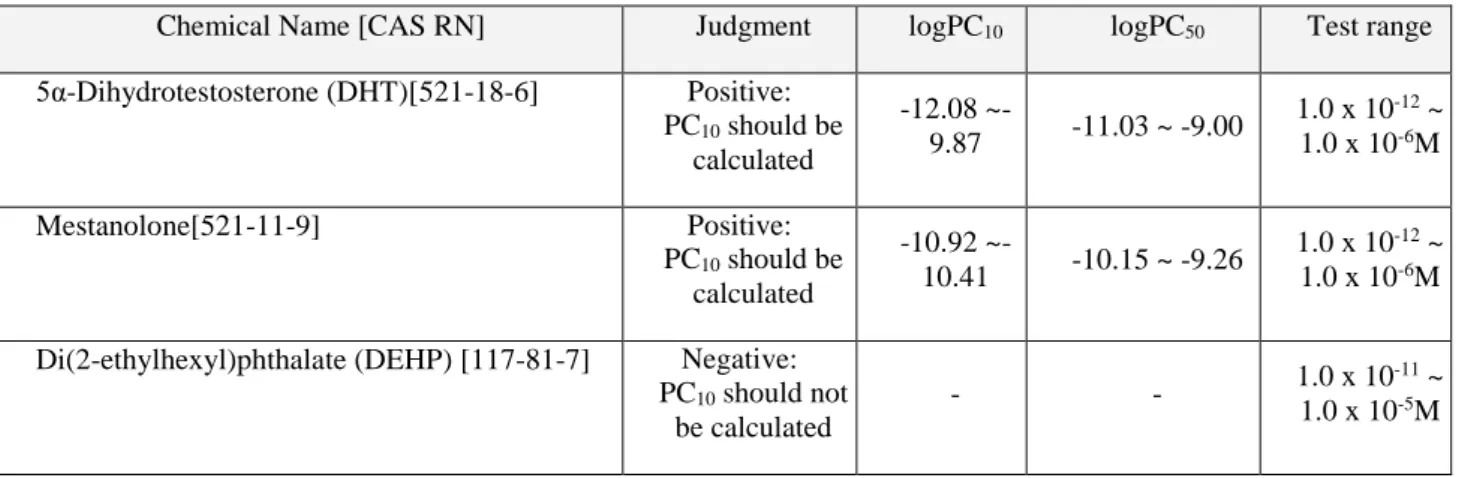
Range logPC50 -11.03/-9.00 (log[M]) Range EC50 1.10-10/1.10-9M Range logPC50 -10.6/-9.0 (log[M]) Range logPC10 -12.08/-9.87 (log[M]) Range logPC10 -12.2/-9.7 (log[M])
Sigmoidal curve Sigmoidal curve Sigmoidal curve
IF PCAGO> 6.4
(PCAGO: DHT 1.0 x 10⁻⁸ M) IF DHT 1.0 x 10⁻⁷ M > 20 IF PCAGO≥ 13
(PCAGO: DHT 1.0 x 10⁻⁸ M)
IF PC10 > 1 + 2SD (induction of VC) IF PC10 > 1 + 2SD (induction of VC) CV < 20% in triplicate wells |CV| logEC50 < 1.5%
ZF > 0.5
Positive control Mestanolone 17α -Methyltestosterone Mestanolone
Criteria
Range logPC50 -10.15/-9.26 (log[M]) RI > 30% Range logPC50 -10.2/-8.6 (log[M]) Range logPC10 -10.92/-10.41 (log[M]) Range logPC10 -12.3/-9.8 (log[M]) Sigmoidal curve
CV < 20% in triplicate wells
Negative control Di(2-ethylhexyl)phthalate (DEHP) Corticosterone Di(2-ethylhexyl)phthalate (DEHP)
44
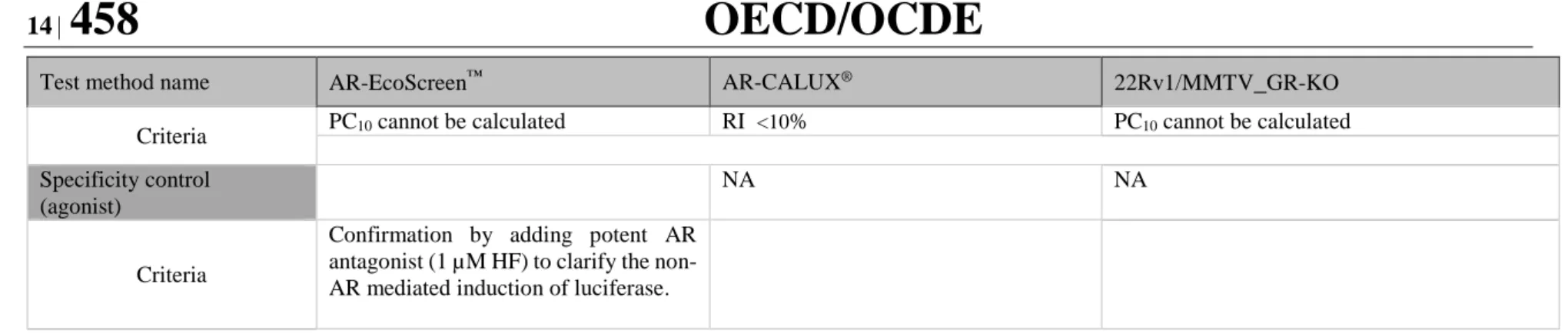
Test method name AR-EcoScreen™ AR-CALUX® 22Rv1/MMTV_GR-KO Criteria PC10 cannot be calculated RI <10% PC10 cannot be calculated Specificity control
(agonist)
NA NA
Criteria
Confirmation by adding potent AR antagonist (1 µM HF) to clarify the non- AR mediated induction of luciferase.
Table B.2b. Overview of reference standards and acceptability criteria for the three test methods for ANTAGONIST properties.
Test method name AR-EcoScreen™ AR-CALUX® 22Rv1/MMTV_GR-KO
ANTAGONIST
Reference chemical Hydroxyflutamide (HF) Flutamide (FLU) Bicalutamide
Criteria
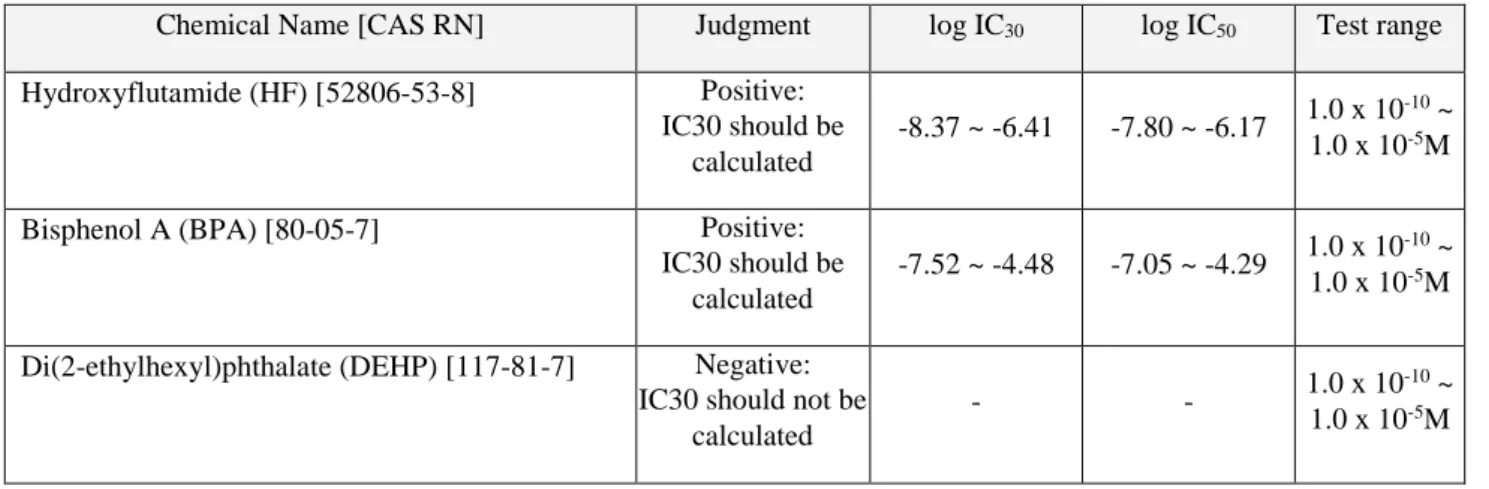
Range logIC50 -7.80/-6.17 (log[M]) IC50 range 1.0 x 10⁻⁷/1.0 x 10-6M Range logIC50 -7.0/-5.8 (log[M]) Range logIC30 -8.37/-6.41 (log[M]) Range logIC30 -7.5/-6.2 (log[M]) RTA of PCATG < 46%
(PCATG: 500 pM DHT + HF 1 µM) )
InhF FLU 3.10-5M > 10 RTA of PCATG ≤ 53.6 %
(PCATG: 800 pM DHT + Bicalutamide 1 µM)
Sigmoidal curve Sigmoidal curve Sigmoidal curve
CV< 20% in triplicate wells |CV| logIC50 < 3%
ZF > 0.5
Positive control Bisphenol A Linuron Bisphenol A
Criteria
Range log IC50 -7.05/-4.29 (log[M]) RI < 60% Range log IC50 -6.2/-5.0 (log[M]) Range logIC30 -7.52/-4.48 (log[M]) Range logIC30 -6.6/-5.4 (log[M]) CV< 20% in triplicate wells
©OECD 2020
Test method name AR-EcoScreen™ AR-CALUX® 22Rv1/MMTV_GR-KO
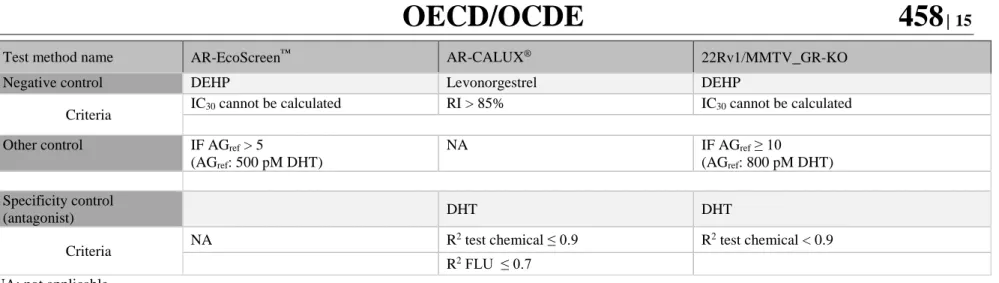
Negative control DEHP Levonorgestrel DEHP
Criteria IC30 cannot be calculated RI > 85% IC30 cannot be calculated
Other control IF AGref > 5
(AGref: 500 pM DHT)
NA IF AGref ≥ 10
(AGref: 800 pM DHT) Specificity control
(antagonist) DHT DHT
Criteria NA R2 test chemical ≤ 0.9 R2 test chemical < 0.9
R2 FLU ≤ 0.7 NA: not applicable
Note: 1) Different mathematical techniques are used in the three methods for the calculation of IC50, IC30 (interpolation for AR-EcoScreen™ test method and 22Rv1/MMTV_GR- KO test method; curve fitting for AR-CALUX®test method); 2) Different spiking concentrations of DHT were used in the antagonist assay: 500 pM in AR-EcoScreen™ test method; 300 pM in AR-CALUX® test method; 800 pM in 22Rv1/MMTV_GR-KO test method.
Table B.3a. Overview of results from the three test methods in this TG. Chemicals were tested in two or three methods for AGONIST properties
Expected
outcome1 AR-EcoScreen™ AR-CALUX® 22Rv1/MMTV_GR-KO
Chemical Class 5
Product Class
6
Chemical Name CASRN Ref.
(2003) Ref.
(2017)
Outcome Validatio
n2
log PC10 2
(M)
log PC50 2
(M)
Outcome Validatio
n3
log PC10 3 (M) log EC50 3
(M)
Outcome Validation3
log PC10 4
(M)
log PC50 4
(M)
5α-Dihydrotestosterone 521-18-6 P P P -12.08/-9.87 -11.03/-9.00 P -10.64/-10.14 -9.98/-9.42 P -10.60/-9.83 -9.73/-8.95 Steroid,
nonphenolic Pharmaceutical Mestanolone
(Methyldihydrotestosterone)
521-11-9 P P -10.92/-10.41 -10.15/-9.26 P -10.26/-9.99 -9.53/-9.39 P -10.36/-9.66 -9.65/-8.39 Steroid,
nonphenolic Pharmaceutical
46
Testosterone 58-22-0 P P P -10.42/-9.73 -9.46/-8.96 P -9.81/-9.60 -9.25/-8.80 P -10.28/-9.91 -9.67/-8.66 Steroid,
nonphenolic Pharmaceutical
17β-Estradiol 50-28-2 P P -7.74/-6.75 -5.34/-4.88 P -6.70/-5.85 - P -8.76/-8.49 -7.19/-6.03 Steroid, phenolic Pharmaceutical
Medroxyprogesterone 17-
acetate 71-58-9 P P P -9.64/-8.89 -8.77/-8.37 P -9.91/-8.32 -9.23/-7.75 P -8.77/-8.20 -7.64/-6.01 Steroid,
nonphenolic Pharmaceutical
17α-Ethinyl estradiol 57-63-6 N N - N - P -6.21/-5.27 - Steroid, phenolic Pharmaceutical
Butylbenzyl phthalate 85-68-7 N N N - N - N - Phthalate Plasticiser
Di(2-ethylhexyl)phthalate 117-81-7 N N - N - N - Phthalate
Chemical intermediate;
Plasticiser
Hydroxyflutamide 52806-53-8 N N - N - P -5.54/-5.04 - Anilide Pharmaceutical
metabolite
Bisphenol A 80-05-7 N N - N - N - Bisphenol Chemical
intermediate
Methyl testosterone 58-18-4 P P NT NT P -9.73/-9.57 -9.11/-8.95 P -10.39/-9.99 -9.63/-9.28 Steroid,
nonphenolic Pharmaceutical
Progesterone 57-83-0 P NT NT N P -7.13/-6.19 -5.50/-5.01 Steroid,
nonphenolic Pharmaceutical
Corticosterone 50-22-6 N NT NT N P -7.16/-5.47 , Steroid,
nonphenolic Pharmaceutical
Levonorgestrel 797-63-7 P P NT NT P -9.42/-9.26 -8.91/-8.61 P -10.28/-9.73 -9.06/-8.46 Steroid,
nonphenolic Pharmaceutical
Vinclozolin 50471-44-8 N NT NT N - N - Organochlorine Pesticide
Prochloraz 67747-09-5 N NT NT N - N - Imidazole Pesticide
Atrazine 1912-24-9 N N NT NT N - N - Triazine; Aromatic
amine Pesticide
6-Propyl-2-thiouracil 51-52-5 N NT NT N - N - Pyrimidines Pharmaceutical
o,p-DDT 789-02-6 N N NT NT N - N - Organochlorine Pesticide
Bicalutamide 90357-06-5 N NT NT N - N - Anilide Pharmaceutical