九州大学学術情報リポジトリ
Kyushu University Institutional Repository
非直交多元接続を用いる異種無線網のための高スペ クトル効率かつ低演算量の干渉制御法
アハメド, ナッサー, アハメド, アハメド, イスメイル
https://doi.org/10.15017/4060189
出版情報:Kyushu University, 2019, 博士(学術), 課程博士 バージョン:
権利関係:
Spectrum Efficient and Low Complexity Interference Coordination Schemes for
NOMA Heterogeneous Networks
By
Ahmed Nasser Ahmed Ahmed Ismail
A Thesis Submitted to the
Graduate School of Information Science and Electrical Engineering Kyushu University
In Partial Fulfillment of the Requirements for the Degree of
Doctor of Philosophy
in
Electronicas and Communications Engineering
March 2020
c Copyright by Ahmed Nasser Ahmed Ahmed Ismail, 2020.
All rights reserved.
DECLARATION AND CERTIFICATE OF ORIGINALITY
I certify that in the preparation of this thesis, I have observed the provisions of Kyushu University Code of Ethics. Further; I certify that this work is free of plagiarism and all materials appearing in this thesis have been properly quoted and attributed. I certify that all copyrighted material incorporated into this thesis is in compliance with the international copyright law and that I have received written permission from the copyright owners for my use of their work, which is beyond the scope of the law. I agree to indemnify and save harmless Kyushu University from any and all claims that may be asserted or that may arise from any copyright violation. I hereby certify that the research work in this thesis is my original work and it does not include any copied parts without the appropriate citation.
Fukuoka, Japan, December 10, 2019
Ahmed Nasser Ahmed Ahmed Ismail,
To my ...
ACKNOWLEDGMENT
First of all, countless thanks to ALLAH the almighty
I wish to express my sincere appreciation to my supervisors: Assoc. Prof.
Osamu Muta for his continuous encouragement, support, patience, discus- sions, valuable comments, and excellent suggestions to improve the quality of this work. He gave me a pleasant research environment and a tremendous opportunity to pursue my Ph.D. Also, He gave me many chances to attend national and international conferences to improve myself. I will cherish the friendship with him.
I would like to thank Prof. Maha Elsabrouty and Dr. Haris Gacanin for their help in modifying my papers and gave me many useful advice and comments for writing and presentation. I also would like to thank Prof. Koji Okamura and Assoc. Prof. Yutaka Jitsumatsu for their comments for im- proving my thesis. Also, I would like to thank the administration of Kyushu University for their efforts to provide a distinctive model research university.
Last but not least, I would like to show my sincere appreciation and grat- itude to my colleagues and friends. Thanks to my beloved family, my wife, and my son, for their self-sacrifice, consistent love, support, understanding, and encouragement.
Finally, the thesis is supported in part by JSPS KAKENHI (JP17K06427), Kyushu University Platform of Inter/Transdisciplinary Energy Research (Q- PIT), Center for Japan-Egypt Cooperation in Science and Technology, Kyushu University, Ministry of Higher Education in Egypt (MOHE), and NTRA Egypt, which is gratefully acknowledged.
Fukuoka, Japan, March 2020
Ahmed Nasser Ahmed Ahmed Ismail,
SUMMARY
Demand for high data rates is increasing rapidly due to the emerging of new applications that generate a huge number of wireless data. Three promising technologies are adopted to achieve such high requirements; heterogeneous networks (HetNets), non-orthogonal multiple access (NOMA), and multiple input multiple output (MIMO). MIMO and NOMA coexist with HetNets to form MIMO-NOMA HetNets cellular system. HetNets adopt different types of tiers or cells ranging from micro cell then pico cell and femto cell under the coverage of a macro cell. One of the major problems in the MIMO-NOMA HetNets is the interference among cells of the same type (i.e., co-tier interfer- ence) or interference among cells of different types (i.e., cross-tier interference), which results in serious data transmission errors. Consequently, interference mitigation (IM) is necessary for MIMO-NOMA HetNets. The objective of this thesis is to develop spectrum efficient IM approaches to increase the ca- pacity of MIMO-NOMA HetNets while reducing the required complexity and reducing the signaling overhead between the cells. In this thesis, we propose three new techniques to manage the interference in MIMO-NOMA HetNets based on the following three approaches; beamforming base, power allocation (PA) base, and resource block (RBs) allocation base.
In the first proposed algorithm ( i.e., Chapter 2), we study the beamform- ing based IM due to the deployment of MIMO technology in NOMA HetNets.
To reduce the cross-tier interference in MIMO-NOMA HetNets with a limited signal overhead, we propose a cross-tier interference alignment and coordi- nated beamforming (CrIA-CB) technique. The proposed CrIA-CB utilizes the available degrees of freedom to design the beamforming vector in the null space of the cross-tier interference. Simulation results show an improvement on average of 60% in the capacity and 20% in the outage probabilities for the proposed CrIA-CB over conventional schemes as long as the number of antennas at BSs side is enough to completely cancel the interference.
In the second proposed algorithm ( i.e., Chapter 3), we study the PA as an effective technique even when the number of antennas at BSs is not sufficient for cross-tier interference mitigation in MIMO-NOMA HetNets. To relax the non-convex PA problem into a convex problem, we propose to model
the PA problem as a non-cooperative competitive game between the macro cell and the small cell to maximize the total sum rate while guaranteeing users’ quality of service (QoS). Simulation results show an improvement on average of 30% in the capacity and 10% in the outage probabilities for the proposed PA algorithm over conventional schemes as long as the cross channel state information (CrCSI) of the worst user is available at a central control unit (CCU).
In the third proposed algorithm (i.e., Chapter 4), we study the joint problem of power and RBs allocation as an efficient technique even when the number of antennas at BSs is not sufficient for both co-tier and cross- tier IM in NOMA HetNets. We propose a low-complexity algorithm, where the compressive sensing (CS) is utilized to exploit the sparsity property of the RBs allocation to relax the NP-hard joint problem into an equivalent l1 norm problem for a near-optimum solution. Then, based on CS theory, an interference management technique with a restricted weighted fast itera- tive shrinkage-thresholding (R-WFISTA) algorithm is proposed to solve the equivalent sparse l1-norm problem. Simulation results show an improvement on average of 25% in the capacity and 10% in the outage probabilities for the proposed PA algorithm over conventional schemes as long as the CSI and CrCSI information of all users are available at a CCU. Moreover, the pro- posed algorithm reduces the complexity on average by 80% compared to the exhaustive search by considering the quadratic time complexity of CS instead of exponential time complexity in the exhaustive search.
Based on the above summary and results, this thesis clarifies that the proposed schemes for beamforming, PA, and RBs allocation are effective in suppressing the interference and increasing the capacity of NOMA HetNets.
Besides, the system requirements and restrictions decide the choice of the adopted IM algorithm. Such improvement in the capacity can improve human life and participate in economic growth towards the future sustainable society.
TABLE OF CONTENTS
DECLARATION AND CERTIFICATE OF ORIGINALITY iv
ACKNOWLEDGMENT vii
ABSTRACT ix
TABLE OF CONTENTS xi
LIST OF TABLES xiv
LIST OF FIGURES xv
NOMENCLATURE xviii
ABBREVIATIONS xx
1 INTRODUCTION 1
1.1 Background . . . 1
1.1.1 Heterogeneous Networks (HetNets) . . . 2
1.1.2 Non-orthogonal Multiple Access (NOMA) . . . 3
1.1.3 Multiple Input Multiple Output (MIMO) . . . 4
1.2 Technical Challenges on Interference Mitigation (IM) for MIMO-NOMA HetNets . . . 5
1.2.1 Typical Interference Situations in NOMA HetNets . . . 6
1.2.2 Interference Mitigation Approaches . . . 7
1.3 Motivations and Contributions of the Thesis . . . 10
1.3.1 Motivation of the Thesis . . . 10
1.3.2 Contributions of the Thesis . . . 11
1.4 Organization of the Thesis . . . 12
2 Cross-tier Interference Alignment and Coordinated Beamforming for IM in MIMO-NOMA HetNets 13 2.1 Introduction . . . 13
2.1.1 Related Works . . . 14
TABLE OF CONTENTS
2.2 System Model and Conventional IA-CB . . . 15
2.2.1 HetNets System Model and Assumptions . . . 15
2.2.2 Conventional IA-CB . . . 19
2.3 Proposed Cross-Tier IA-CB Technique . . . 22
2.3.1 Cross-Tier IA-CB for Single MC Scenario . . . 22
2.3.2 Cross-Tier IA-CB for Multiple MC Scenario . . . 26
2.4 Outage Probability Analysis . . . 28
2.5 Numerical Results and Discussion . . . 30
2.5.1 Simulation Assumptions . . . 30
2.5.2 Sum Rate Performance . . . 31
2.5.3 Outage Probability Performance . . . 34
2.6 Conclusion . . . 35
3 Game Theory Based Power Allocation Scheme for IM in MIMO-NOMA HetNets 38 3.1 Introduction . . . 38
3.1.1 Related Works . . . 39
3.2 HetNets System Model . . . 40
3.2.1 System Description and Assumptions . . . 40
3.2.2 Signal Model . . . 41
3.3 Proposed Method for Power Allocation with IA-CB . . . 45
3.4 Outage Probability Analysis . . . 52
3.5 Numerical Results and Discussion . . . 55
3.5.1 Simulation Assumptions . . . 55
3.5.2 Performance Versus Conventional OMA and NOMA . . . 57
3.5.3 Performance Versus CrIA-CB . . . 60
3.6 Conclusion . . . 65
4 Compressive Sensing Based Spectrum Allocation and Power Control for IM in NOMA HetNets 68 4.1 Introduction . . . 68
4.1.1 Compressive Sensing (CS) . . . 69
4.1.2 Related Works . . . 69
4.2 NOMA HetNets . . . 70
4.2.1 Mathematical Signal Modelling . . . 71
4.2.2 Problem Formulation . . . 73
4.3 Proposed Resource and Power Allocation Scheme based on Compressive Sensing . . . 78
4.3.1 Design of Dictionary Matrix . . . 78
4.3.2 Design of Measurement Vector . . . 81
TABLE OF CONTENTS
4.3.3 Proposed R-WFISTA Algorithm . . . 82
4.4 Outage Probability and Complexity Analysis . . . 84
4.4.1 Outage Probability Analysis . . . 84
4.4.2 Complexity Analysis . . . 86
4.5 Numerical Results and Discussion . . . 88
4.5.1 Simulation Assumptions . . . 88
4.5.2 Sum Rate Performance . . . 88
4.5.3 Outage Probability and Fairness . . . 89
4.6 Conclusion . . . 91
5 Conclusion and Future Works 95
LIST OF PUBLICATIONS 99
REFERENCES 101
LIST OF TABLES
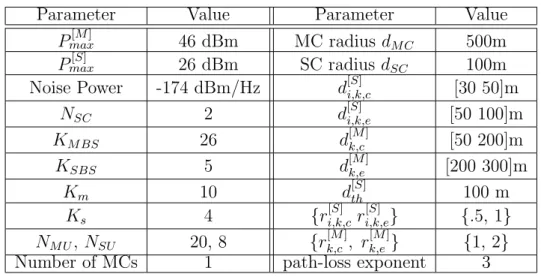
2.1 Simulation Parameters. . . 30
3.1 Simulation Parameters. . . 56
4.1 The complexity order of the investigated algorithms . . . 87
4.2 Simulation Parameters. . . 87
LIST OF FIGURES
1.1 (a) The evolution of the cellular system and applications. (b) The Global
mobile data traffic. . . 2
1.2 Typical illustration of the HetNets. . . 3
1.3 Typical illustration of the NOMA HetNets. . . 4
1.4 Typical application of MIMO to NOMA HetNets. . . 5
1.5 (a) Illustration of the same RBs allocation in NOMA HetNets. (b) Illus- tration of co-tier, cross-tier, and inter-user interference in NOMA HetNets. 6 1.6 Typical Interference situations in MIMO-NOMA HetNets based on the RBs reuse among the tiers. . . 7
1.7 Illustration of beamforming coordination based interference mitigation in HetNets. . . 9
1.8 Typical illustration of the power control based interference mitigation in HetNets. . . 10
2.1 Illustration of the proposed MIMO-NOMA HetNets model. . . 16
2.2 A Block diagram for single-MC scenario that describes (a) the signal trans- mission and detection model for SUi,k,n, and (b) the signal transmission and detection model for MUk,n. . . 18
2.3 Proposed interference coordination framework for NOMA-HetNets with MIMO. . . 23
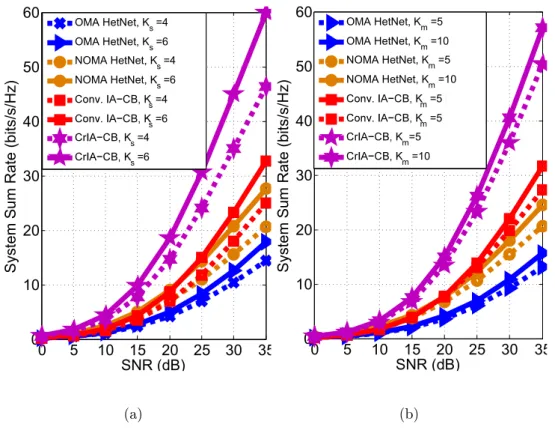
2.4 The performance of the proposed CrIA-CB versus conventional techniques in terms of system sum rate at different values of SNR for (a) different Ks values (b) different Km values. . . 32
2.5 The performance of the proposed CrIA-CB versus conventional techniques in terms of maximum achievable sum rate versus theKM BS. . . 33
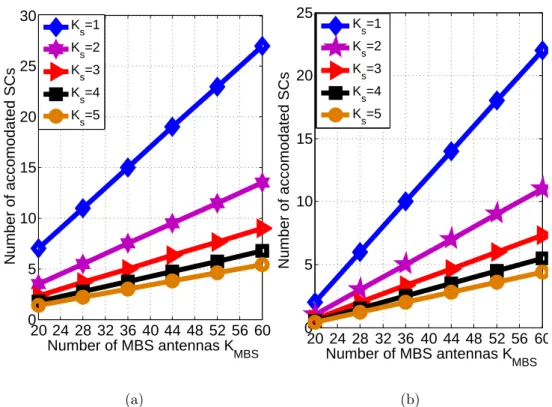
2.6 The Maximum number ofNSC versusKM BS at differentKs values for (a) Km = 5 (b)Km = 10. . . 33
2.7 The performance of the proposed CrIA-CB versus conventional techniques at different values of coverage distance. (a) The sum rate of the SUi,k,e versus the distanced[S]i,k,e, (b) the sum rate of the MUk,e versus the distance d[Mk,e]. . . 34
LIST OF FIGURES 2.8 The performance of the proposed technique versus conventional techniques
for two MC sceario in terms of system sum rate at different values of SNR. 35 2.9 The performance of the proposed CrIA-CB versus conventional techniques
in terms of (a) the outage probability of the SUi,k,e,Pout[S]i,k,e, (b) the outage probability of the MUk,e, Pout[M]k,e , at different values of SNR. . . 36 2.10 The performance of the proposed CrIA-CB versus conventional techniques
in terms of (a) The outage probability of the SUi,k,e,Pout[S]i,k,e, versusri,k,e[S] , (b) the outage probability of the MUk,e, Pout[M]k,e , versusrk,e[M]. . . 36 3.1 Illustration of the proposed MIMO-NOMA HetNets model. . . 41 3.2 A Block diagram that describes the signal transmission at SBSs and MBS,
while the signal detection is the same as Fig.2.2. . . 44 3.3 Flow chart of the proposed PA based interference mitigation for MIMO-
NOMA HetNets. . . 53 3.4 The performance of the proposed PA-IA-CB versus OMA, NOMA, and
conv. IA-CB in terms of sum rate at different values of SNR. . . 58 3.5 The performance of the proposed PA-IA-CB versus OMA, NOMA and
Conv. IA-CB in terms of (a) the sum rate of the SUi,k,2 versus the d[S]i,k,2, (b) the sum rate of the SUi,k,e versus the d[S]i,k,e. (c) the sum rate of the MUk,2 versus the distance d[Mk,2]. (b) the sum rate of the MUk,e versus the distanced[M]k,e . . . 59 3.6 The performance of the proposed PA-IA-CB versus OMA, NOMA and
Conv. IA-CB in terms of (a) the outage probability of the SUi,k,n,Pout[S]i,k,n versus the SNR (b) the outage probability of the MUk,n, Pout[Mk,n] versus the SNR. . . 61 3.7 The performance of the proposed PA-IA-CB versus OMA, NOMA and
Conv. IA-CB in terms of (a) the outage probability of the SUi,k,n,Pout[S]i,k,n, versus r[S]i,k,n, (b) the outage probability of the MUk,n, Poutk,n[M], versusrk,n[M]. 61 3.8 Convergence behavior of the proposed non-cooperative game based PA for
Tmax = 100. . . 62 3.9 The performance of NC-PC, and MBC cancellation in terms of (a) total
system sum rate, (b) SCs’ sum rate, and (c) MC’s sum rate, versus SNR for KM BS = 17. . . 63 3.10 The performance of NC-PC, and MBC cancellation in terms of (a) total
system sum rate versusKM BS for SNR = 40dB, (b) total system sum rate versus SNR for KM BS = 9, and (c) total system sum rate versus SNR for KM BS = 5. . . 64
LIST OF FIGURES 3.11 The performance of NC-PC, and MBC cancellation in terms of (a) total
system sum rate, (b) SCs’ sum rate, and (c) MC’s sum rate, versus SNR for different number of KM BS. . . 66 3.12 The performance of NC-PC, and MBC cancellation under the existence of
co-tier interference in terms of (a) total system sum rate versus SNR for KM BS = 17, (b) SCs’ sum rate versus SNR for KM BS = 9. . . 67 4.1 Illustration of the proposed HetNets model. . . 71 4.2 A block diagram for single-MC scenario that describes (a) the signal trans-
mission and detection model for SUi,n, and (b) the signal transmission and detection model for MUk,n. . . 73 4.3 Illustrative examples of the HetNets sparsity property for the case of
NSC = 15, NRB = 3, and qmax = 5. (a) Illustration of the RB allocation at 1st RB, (b) illustration of the RB allocation at 2nd RB, (c) illustration of the RB allocation at 3rd RB. . . 77 4.4 The performance of the proposed CS-PA-RB versus OMA HetNets and
NOMA HetNets in terms of system sum rate at different values of SNR for (a) NSC = 9 (b)NSC = 19. . . 90 4.5 The performance of the proposed CS-PA-RB versus OMA HetNets in terms
of system sum rate at different values of SNR for NSU = 1 and NKm = 1 in the case of (a) NSC = 9 (b)NSC = 19. . . 91 4.6 The performance of the proposed CS-PA-RB versus OMA HetNets and
NOMA HetNets in terms of system sum rate at (a) different NSC values (b) differentqmax for different NSC. . . 92 4.7 The performance of the proposed CS-PA-RB versus OMA HetNets and
NOMA HetNets in terms of (a) outage probability of the SUi,n, Pout[Si,nb] versus SNR, and(b) outage probability of the MUk,n, Pout[Mk,nb] versus SNR. 93 4.8 The performance of the proposed CS-PA-RB versus OMA HetNets and
NOMA HetNets in terms of (a) outage probability of the SUi,n, Pout[Si,nb], versus r[Si,nb], and (b) the outage probability of the MUk,n, Pout[Mk,nb], versus r[Mk,nb]. . . 93 4.9 The Jain’s fairness index versus the nubmer os SCs,NSC, for differentqmax
values. . . 94
NOMENCLATURE
x,X
vectors and matrices are denoted with lowercase and upper- case boldface letters.
(.)T Transpose operator.
(.)H Conjugate transpose operator.
(.)† Pseudo-inverse operator.
#(.) Cardinality operator.
a\b Excluding ’b’ from ’a’.
a⊥b ’a’ is orthogonal to ’b’.
5(.) Gradient operator.
k.kf Frobenius norm operator.
k .k∗ Nuclear norm operator.
kxkp denotes the lp-norm= (P
n|xn|p)1/p. kXkp,q denotes the lp,q mixed-norm= (PN
j=1kXjkqp)1/q.
|.| Absolute operator.
Ia identity matrix of dimension a×a . Za×b Integer field of dimension a×b.
Ra×b Real field of dimension a×b.
Ca×b Complex field of dimension a×b.
N Kronecker product.
supp(x) The index set of non-zero rows of vector x.
eig(.) Eigenvalues estimator.
vec(.) Conversion operator of a matrix into a vector.
matx(.) Conversion operator of a vector into a matrix.
sign(.) Return the sign of its entry.
sof t(.) Soft thresholding operator.
diag(x) Creates a matrix with a vector x on its diagonal.
SC The set of small cells (SCs).
MU,SU The sets of macro-cell (MC) users (MUs) and SC users (SUs).
NSC, NM U, NSU Number of SCs, MUs, and SUs.
Km, Ks Number of MC’s clusters, and number of clusters per SC.
KM,KS The sets of clusters per MC and SC.
NKm,NKs The sets of MUs and SUs per MC and SC clusters.
Nkm, Nks Number of MUs and SUs per cluster.
KM BS, KSBS Number of antennas at MBS and SBS.
KM U, KSU Number of antennas at each MU, and each SU.
MU[b]k,n,SU[b]i,k,n
Thenthuser in thekthcluster of MC andithSC atbthresource block (RBs), respectively.
MU[b]k,e,SU[b]i,k,e
The cell-edge user in the kth cluster of MC and ith SC at bth RB, respectively.
α[Mk,nb], α[Si,k,nb]
The power allocation (PA) coefficients for MUk,n and SUi,k,n at bth RB, respectively.
ABBREVIATIONS
5G Fifth Generation.
AoAs Angles of Arrivals.
AW GN Additive White Gaussian Noise.
BS Base Station.
CCU Central Control Unit . CoM P Coordinated Multipoint .
CS Compressive Sensing.
CSI Channel State Information.
CrCSI Cross CSI .
DOF Degree of Freedom.
EE Energy Efficiency
ES Exhaustive Search.
F DD Frequency Division Duplexing.
F IST A Fast Iterative Soft Thresholding Algorithm..
HetN ets Heterogeneous Networks.
IA Interference Alignment.
IM Interference Mitigation.
IST A Iterative Soft Thresholding Algorithm.
LS Least Square.
M BS Macro BS .
M C Macro cell.
M IM O Multiple Input Multiple Output.
mM IM O Massive MIMO.
M M SE Minimum Mean Square Error.
M SE Mean Square Error.
M U Macro User .
M U−M IM O Multi-user MIMO.
N E Nashi Equilibrium.
N OM A Non-orthogonal Multiple Access.
OF DM Orthogonal Frequency Division Multiplexing.
OM A Orthogonal Multiple Access.
OM P Orthogonal Matching Pursuit.
P A Power allocation.
P C Power Control.
QoS Quality of Service.
RB Resource Block.
RIP Restricted Isometry Property.
R−W IST A Restricted Weighted FISTA.
SBS Small BS .
SC Small Cell .
SE Spectrum Efficiency
SIN R Signal to Interference plus Noise Ratio . SN R Signal to Noise Ratio .
SU Small User.
T DD Time Division Duplexing.
U HD Ultra High Definition . W −F IST A Weighted FISTA.
ZF Zero Forcing .
Chapter 1
INTRODUCTION
1.1 Background
Wireless cellular networks are one of the most significant technological innovations in recent times that improves human life and participating in economic growth. By 2030, mobile subscriptions are expected to increase exponentially and reach 8.9 billion;
meanwhile, cellular internet of things (IoT) connections will reach 4.1 billion. Also, new applications with a vast amount of wireless data are expected to emerge, such as cloud applications, augmented reality, and ultra high definition (UHD) video streaming, as shown in Fig.1.1 (a). Thus, the mobile data traffic is expected to rapidly grow up with approximately up to 136 EB per month, while 74% will be utilized for mobile video traffic, as shown in Fig. 1.1 (b) [1]. Unfortunately, the achieved capacity by the recent mobile network is not enough for these applications [2, 3]. Consequently, towards the future sustainable society, the 5G beyond and future wireless cellular networks have to keep pace with this explosive demand for high data rates. Different techniques have been proposed to improve the capacity of the existing cellular systems in terms of modulation schemes, channel estimation, cognitive radio, frequency reuse, and carrier aggregation. However, the improvement in the capacity due to utilizing these new schemes is still limited. Three promising techniques can be adopted, which can dramatically increase the capacity to achieve the high requirements of the future cellular system, are heterogeneous networks (HetNets), non-orthogonal multiple access (NOMA), and multiple input multiple output (MIMO).
1.1 Background
Application - Multimedia - Messaging - Medium speed
Packet data
1995 2000 2005 2010 2015 2020
5G (10Gpbs)
4G (1Gbps)
3G (100Mbps)
2G (10Kbps)
Application - Broadband Multimedia - Social Media - High speed
Packet data - IP applications
Application - Digital
voice
Application - Internet of things
(IOT)
- 3D and UHD videos - Work and play in
clouds - Augmented reality
Target Requirements - 10 to 100 times
Improvement in capacity over 4G - 100% coverage
System capacity
Target Period Target Generation
(a)
0 10 20 30 40 50 60
2016 2017 2018 2019 2020 2021
Exabytesper month
Year
Voice Data: Mobile Handheld Data: PC/Tablets 49EB
7EB
(b)
Figure 1.1: (a) The evolution of the cellular system and applications. (b) The Global mobile data traffic.
1.1.1 Heterogeneous Networks (HetNets)
HetNets adopt different types of small cells (SCs) with vastly different transmit power and coverage area (i.e., micro cell, pico cell, and femto cell) under the coverage of macro cell (MC) [4], which can be generalized as multi-tier cellular systems [5, 6]. The most widely adopted configuration for HetNets, such as in standardized ones, utilizes a two- tier cellular systems [7], where MC and SC are managed by a powerful macro base station (MBS) and short-range small base stations (SBSs), respectively, as shown in Fig.
1.2. HetNets are capable of increasing the capacity since part of users are offloaded from the MC to SCs, so that more users can be accommodated. Also, reducing the coverage area of the SCs can increase the capacity and improve the spectrum efficiency due to the applicability of dense spectrum reuse among SCs. However, the reuse of the available resource blocks (RBs) (i.e., time, and frequency) among MC and SCs will result
1.1 Background
MBS with massive antennas
SBS SBS
SBS
SBS
SU
SU
SU
MU MU
MU
Figure 1.2: Typical illustration of the HetNets.
in undesirable interference among SCs and MC. Since the interference limits the achieved capacity by the HetNets, interference management is considered as a critical research challenge that needs to be addressed in HetNets [8].
1.1.2 Non-orthogonal Multiple Access (NOMA)
In the widely adopted non-orthogonal multiple access (NOMA) technique [9, 10] , namely, power-domain NOMA, multiple users are permitted to reuse the same RBs via superimposed signals with different power levels relying on the ability of the receiver to manage the inter-user interference. At the receiver side, successive interference cancella- tion (SIC) can be applied to the superimposed received signal to cancel the interference on the strong user, while the weak user (with the higher transmitted power) can treat the scaled-down strong user signal as interference [10]. NOMA provides a higher sum rate over orthogonal multiple access (OMA) as long as non-orthogonally multiplexed users are properly paired [11,12]. NOMA has been adopted in HetNets as a spatial domain for user multiplexing [13, 14], as shown in Fig.1.3. In Fig.1.3, For fairness, BSs send high power to users that are far from the BS and low power for near users. In the detection step in Fig.1.3, the near user can perform SIC detection to cancel the inter-user interference, and then decode its signal, while the far user can directly decode its signal and consider the signal of the near user as inter-user interference. The performance of NOMA in Het- Nets is affected by the interference. Thus, interference mitigation in NOMA-HetNets is a critical issue.
1.1 Background
MBS
Decode MU2 Decode
MU1 SIC for
MBS to MU2 MU2
MBS to MU1 Power
Time/Frequency Resources MBS superimposed
signal
SBS
Decode SU2 Decode
SU1 SIC for
SU2 interference
SBS to SU2 SBS to SU1
Power
Time/Frequency Resources SBS superimposed
signal
SU2
SU1
MU2 MU1
Figure 1.3: Typical illustration of the NOMA HetNets.
1.1.3 Multiple Input Multiple Output (MIMO)
Multiple Input Multiple Output (MIMO) is one of the key driving technologies for fu- ture wireless communication systems. In MIMO, a large number of antennas are equipped at both sides transmitters and receivers [15, 16]. Thus, MIMO can increase data rates, enhance reliability, improve energy efficiency, and increase the diversity gain by provid- ing an extra degree of freedom [15, 17]. Massive MIMO (mMIMO) is a MIMO system with hundreds or thousands of antennas. mMIMO gathers all the benefits of the MIMO system, but on a much larger scale.
With the deploying of MIMO technology at the BSs side, the extra degree of freedom can be exploited for multi-user beamforming in the NOMA HetNets, where more users can be accommodated on the same RBs without affecting the level of inter-user interference [18]. A typical example of MIMO-NOMA HetNEts is shown in Fig. 1.4. By using MIMO on BS in Fig.1.4, we can cluster users into a different beam, where each beam reuses the same frequency, time, and power resources. However, to cancel the inter-beam (i.e., inter- cluster) interference, a filtering step needs to be applied first before the other detection steps, as shown in Fig.1.4. Thus, MIMO can improve the capacity of NOMA HetNets.
However, the technical challenges regarding the interference coordination and the design
1.2 Technical Challenges on Interference Mitigation (IM) for MIMO-NOMA HetNets
filtering
MIMO MBS
SIC for MU2
MBS to MU2 MBS to MU1
Power
Time/Frequency Resources
Beam 1 Decode
MU2
MBS to MU3 MBS to MU4
Power
Time/Frequency Resources
Beam 2
Decode MU1 filtering
filtering SIC for MU2
Decode MU1
Decode filtering MU2
MU2
MU1
MU4 MU3
Figure 1.4: Typical application of MIMO to NOMA HetNets.
of beamforming vectors must be solved.
1.2 Technical Challenges on Interference Mitigation (IM) for MIMO-NOMA HetNets
To maximize the achieved capacity from MIMO-NOMA HetNets, the same RBs (time/frequency) have to be allocated and reused among all SCs and MC, as shown in Fig. 1.5(a). However, the same RBs allocation induced a critical interference prob- lem among MIMO-NOMA HetNets tiers, which limits the achieved capacity. From Fig.
1.5 (b), MIMO-NOMA HetNets suffer three types of interference, i.e., co-tier interfer- ence, cross-tier interference, and inter-user interference. The co-tier interference occurs between two cells of the same type such as the interference on small-cell user (SUS) of one small cell from the SBS of another small cell. On the other hand, the cross-tier interference occurs between two different cell such as the interference on SUS of one SC from the MBS of the MC or the interference on macro-cell user (MUS) form the SBS of the SC. In addition, in NOMA, inter-user interference occurs among users who use the same resource. Thus, it is important to mitigate these both types of interference to fully harvest the potential performance of MIMO-NOMA HetNets. In the following, we will state some of the typical interference situations and their promising interference mitigation approaches in MIMO-NOMA HetNets.
1.2 Technical Challenges on Interference Mitigation (IM) for MIMO-NOMA HetNets
P ow er
Frequency Time
(a)
Desired signal with Inter-user interference
Macro BS
Small BS#2 Small BS#1
(b)
Figure 1.5: (a) Illustration of the same RBs allocation in NOMA HetNets. (b) Illustration of co-tier, cross-tier, and inter-user interference in NOMA HetNets.
1.2.1 Typical Interference Situations in NOMA HetNets
Based on the reuse of the RBs among the different tiers in MIMO-NOMA HetNets, four typical interference situations are considered as follow, which are also summarized in Fig. 1.6.
• Situation # 1 (Same RBs allocation): In this scenario, MC and SCs reuse the same RBs. Although this scenario increases the capacity due to assigning the whole RBs to all users, this capacity is limited due to the existence of co-tier and cross-tier interference.
• Situation # 2 (Orthogonal SCs RBs allocation): In this scenario, the RBs are divided among SCs such that SCs reuse orthogonal RBs, while the same RBs are
1.2 Technical Challenges on Interference Mitigation (IM) for MIMO-NOMA HetNets
Situation #1
Situation #2
Situation #3
Situation #4
Figure 1.6: Typical Interference situations in MIMO-NOMA HetNets based on the RBs reuse among the tiers.
reused by the MC; therefore, only cross-tier interference exists.
• Situation # 3 (Orthogonal MC RBs allocation): In this scenario, the RBs are divided between SCs and MC, while the same RBs are reused by the SCs; therefore, only co-tier interference exists.
• Situation # 4 (Custom RBs allocation): In this scenario, the SCs are not completely orthogonal, and a qmax SCs can reuse the same RBs. Thus, a limited co-tier and cross-tier interference exist.
Even if we adopt any of the above situations, an IM technique is required to manage the residual interference.
1.2.2 Interference Mitigation Approaches
In terms of interference, the two-tier HetNets experiences the same types of interfer- ence as multi-tier HetNets. Also, the above typical interference situations are applica- ble to both two-tier and multi-tier HetNets. So, In this work, we will concentrate on the interference mitigation approaches for two-tier HetNets, which can be straightfor- wardly applied for the multi-tier HetNets. In this work, we will focus on the following three promising approaches for IM in MIMO-NOMA HetNets; beamforming coordination, power allocation, and RBs allocation.
1.2 Technical Challenges on Interference Mitigation (IM) for MIMO-NOMA HetNets 1.2.2.1 Beamforming based IM
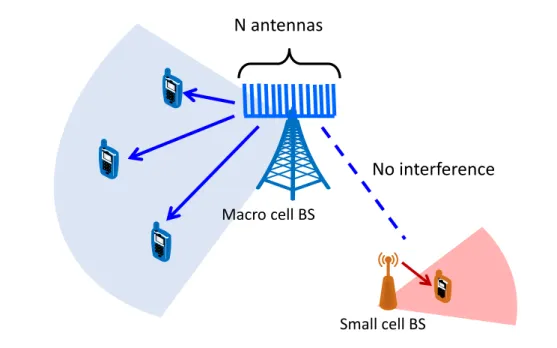
The large degrees of freedom in massive MIMO can be used for IM by properly designing the beamforming (BF) vectors to be in the null space of the interference, as shown in Fig.
1.7. Zero forcing (ZF) [19] is considered one of the legend techniques that can be used to design the beamforming vector for interference mitigation purposes. Based on MIMO technology, two techniques are considered for interference mitigation.
• Coordinating beamforming (CB) technique: In this technique, MIMO exists only at the BSs side while a single-antenna user is considered. Thus, the BSs must have enough antennas to design the precoding vector in the null space of all existing interference, as shown in Figs. 1.7.
• Interference alignment (IA) technique: In this technique, MIMO exists at both sides;
BSs and users. Thus, the precoding vector at the BS side and the postcoding vector at the user side have to be jointly designed to cancel all the existing interference.
Both CB and IA can be jointly applied to fully utilize the degree of freedom as in [12]. However, if the number of extra antennas on BS sides is not enough, the achieved total data rate may be degraded due to residual interference. Besides, the channel state information (CSI) of all users must be available at the interfering BSs which increases the signaling overhead between cells in the HetNets. These issues must be taken into account while considering MIMO for interference management.
1.2.2.2 Power Allocation (PA) based IM
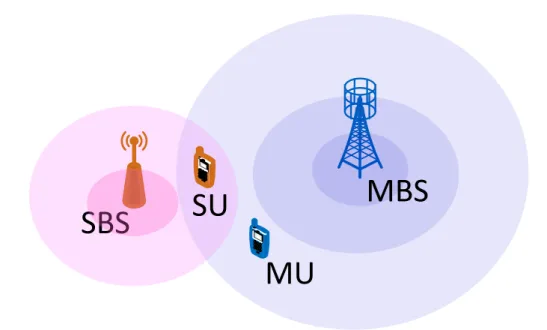
Since the transmitted power decays as we move away from the BS, the interference can be suppressed by optimizing the transmitted power from both SBS and MBS under the maximum power and QoS constraints, as shown in Fig. 1.8. The power allocation based techniques are considered effective in the cases that the number of BSs’ antennas is not enough to fully cancel the interference. Although the increase in the transmitted power from one of the BSs has a positive effect on the sum rate of its corresponding cell, it affects the other cells negatively through either cross-tier or co-tier interference. Thus, the power allocation problem among the different tiers in HetNets is non-convex, and effective techniques for near-optimum solutions are needed. Some primary works have been investigated in adopting the game theory to relax the non-convexity of the original
1.2 Technical Challenges on Interference Mitigation (IM) for MIMO-NOMA HetNets N antennas
No interference Macro cell BS
Small cell BS
Figure 1.7: Illustration of beamforming coordination based interference mitigation in Het- Nets.
PA problem [20–22], where the PA is modeled as a competitive game among SBSs or between SBSs and MBS. Game theory based PA is considered an effective technique since it can give a comparable performance with the beamforming based technique without the need for multiple antennas at the BSs side.
1.2.2.3 Resource Blocks Allocation (time \ frequency) based IM
In the RBs allocation based IM techniques, the available RBs are appropriately allocated among SCs and between the MC and the SCs in order to increase the total system sum rate, while limiting the existing co-tier and cross-tier interference. In other words, in the RBs allocation, a limited number of BSs can reuse the same RB. The RBs allocation problem is a combinatorial search problem to find appropriate SCs to be allocated to a dedicated RB, which is considered an NP-hard problem since its complexity increases ex- ponentially with the number of BSs. Thus, effective optimization algorithms are needed.
The PA approach can be combined with the RBs allocation approach to improve the ca- pacity of the HetNets. Thus, jointly optimizing the allocated power and RBs to manage the interference and improve the capacity is a critical issue in HetNets.
1.3 Motivations and Contributions of the Thesis
SBS SU MBS
MU
Figure 1.8: Typical illustration of the power control based interference mitigation in HetNets.
1.3 Motivations and Contributions of the Thesis
1.3.1 Motivation of the Thesis
Based on the above analysis, interference mitigation is necessary in MIMO-NOMA HetNets in order to maximize its achieved capacity. Also, there are different challenges regarding the application of some existing interference mitigation schemes. Concretely, in the deployment of MIMO, we need to consider how to coordinate the interference among the different cells. Also, we need to consider the adequacy of the available degree of freedom and the signaling overhead between the cells. In PA based technique, we need to consider how to control the transmitted power without affecting the users’ QoS. In RBs allocation based technique, we need to consider the combinatorial complexity of the RBs allocation as long as the joint problem of RBs and power allocation. Thus, the motivation of this thesis is to maximize the capacity of MIMO-NOMA HetNets by solving the above challenges related to the IM. From this motivation, we identify the main three objectives of this thesis as follow
• The first objective is to study the beamforming based IM in MIMO-NOMA HetNets, where the performance in terms of capacity, signaling overhead, and the required number of antennas associated with MIMO are investigated (i.e., Chapter 2).
• The second objective is to study the PA-based IM in MIMO-NOMA HetNets as an alternative approach, which is effective even when the number of MIMO antennas at
1.3 Motivations and Contributions of the Thesis
the BSs is not enough for beamforming based IM to cancel the cross-tier interference.
Also, this part is to investigate how to model the non-convex PA problem into a relaxed convex problem (i.e., Chapter 3).
• The third objective is to study the RBs allocation with PA in NOMA HetNets as an alternative approach, which is effective even when the number of MIMO antennas at the BSs is not enough for beamforming based IM to cancel both the co-tier and the cross-tier interference. Also, this part is to investigate how to relax the NP-hard problem of the RBs allocation for a near-optimum solution (i.e., Chapter 4).
1.3.2 Contributions of the Thesis
The key contributions of this thesis are summarized as follow
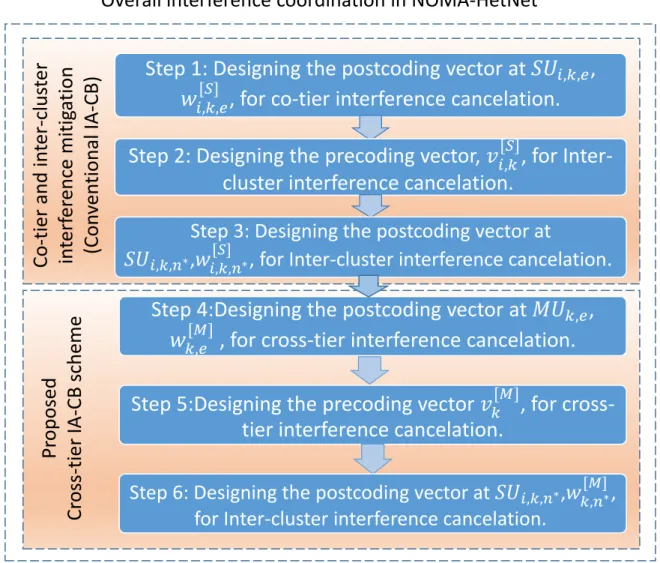
• For the 1st objective, we propose a cross-tier interference mitigation framework based on IA and CB (CrIA-CB) for downlink MIMO-NOMA HetNets. The pro- posed framework utilizes the degrees of freedom provided by the MIMO technology for designing the transmit and receive beamforming vectors to null the cross-tier interference at the user side while decreasing the signaling overhead between SCs and MC (i.e., Chapter 2).
• For the 2nd objective, we propose a game theory-based PA algorithm for the case that the number of antennas at BSs is not sufficient to cancel the cross-tier inter- ference in MIMO-NOMA HetNets. The non-convex PA problem is modeled as a non-cooperative game between the MBS and SBSs to maximize the total sum rate while taking the maximum power and QoS constraints into account. The proposed algorithm increases the overall sum rate and decreases the signaling overhead be- tween SCs and MC, while multiple antennas are not needed at the BSs sides (i.e., Chapter 3).
• For the 3rd objective, we propose a low complexity joint power and RBs allocation based compressive sensing (CS) algorithm for the case of co-tier interference mitiga- tion as well as cross-tier interference mitigation in NOMA HetNets. The proposed algorithm relaxes the NP-hard of the joint problem into a convex l1-norm problem based on the sparsity property of the RBs allocation in HetNets. Then, a restricted
1.4 Organization of the Thesis
weighted fast iterative shrinkage-thresholding (R-WFISTA) algorithm is proposed to solve the relaxed problem (i.e., Chapter 4 ).
1.4 Organization of the Thesis
The main objectives of this thesis are described in five chapters, which are summarized as follows.
• In chapter 2, we study the deployment of MIMO in NOMA HetNets, the required number of antennas, and the signaling overhead. Also, this chapter explains the proposed CrIA-CB framework for cross-tier IM in NOMA HetNets.
• In chapter 3, we study the PA problem for cross-tier IM in NOMA HetNets. Also, this chapter explains the proposed algorithm for utilizing the non-cooperative game to solve this problem. Moreover, this chapter includes a performance comparison between PA based IM and BC based IM.
• In chapter 4, we study and model the joint power and RBs allocation problem for co-tier and cross-tier interference mitigation in NOMA HetNets. Also, this chapter explains the proposed algorithm, where CS theory is utilized to relax this joint problem based on the sparsity property of RBs allocation.
• In chapter 5, we conclude the thesis from the obtained results. The advantages and limitations of each proposed algorithm, in addition to their applicable ranges in terms of system requirements and restrictions are also concluded in this chapter.
Moreover, this chapter states the direction of future works.
Chapter 2
Cross-tier Interference Alignment and Coordinated Beamforming for
IM in MIMO-NOMA HetNets
2.1 Introduction
As we explained in chapter 1, to fully harvest potential performance of HetNets, it is critical to mitigate the undesirable co-tier and cross-tier interference result from the reuse of the available resources among MC and SCs [4, 8]. The large degrees of freedom provided by MIMO can be used for interference mitigation and coordination, such as interference alignment (IA) in HetNets [23, 24], where the beamforming precoding and postcoding vectors are designed to be orthogonal to the interference subspace. Moreover, by non-orthogonal multiplexing users over the power, NOMA can be jointly investigated with MIMO for interference management in HetNets [25, 26].
In this chapter, an interference mitigation framework based on IA and coordinated beamforming (CB) is investigated for HetNets with downlink NOMA and MIMO (i.e., MIMO-NOMA HetNets), where we propose a cross-tier interference mitigation technique, named cross-tier IA-CB (CrIA-CB). particularly, the contributions of this chapter are as follows:
1. We propose a new interference mitigation technique (i.e., CrIA-CB) to eliminate cross-tier interference between MC and SCs unlike the conventional IA-CB tech- nique in [12] which is capable of mitigating only co-tier and inter-cluster interference.
2.1 Introduction
2. We design linear precoding and postcoding vectors for beamforming to utilize the extra degrees of freedom provided by MIMO for the cross-tier interference cancella- tion in a single MC scenario. Using the proposed design, the cross-tier interference can be mitigated by utilizing only cross-channel state information estimated at the user side.
3. We extend the concept of the proposed CrIA-CB to multiple MC scenario, where the most dominant interference from other MBS in downlink is suppressed at user side at the expense of increasing its number of antennas.
4. We prove the capability of the proposed CrIA-CB to improve the system sum rate and the cell-edge users’ rates compared with the conventional IA-CB, MIMO-OMA, and MIMO-NOMA. The outage probability and the impact of utilizing the degrees of freedom in MIMO on the system sum rate are also analyzed.
2.1.1 Related Works
By properly designing the beamforming precoding and postcoding v, the IA tech- niques have been investigated to manage the cross-tier and co-tier interference in Het- Nets [27, 28]. MIMO and NOMA have been jointly investigated in HetNets as in [25, 26].
Authors in [25] propose a new user association technique, while authors in [26] propose a resource allocation scheme as an interference management technique for K-tier NOMA HetNets. However, in [25, 26], MIMO is applied to only the MC while NOMA is adopted to the SCs with single-antenna SBS, and thus beamforming design for MIMO and NOMA are not jointly investigated for interference management. Authors in [12] manage the in- terference in MIMO-NOMA multi-cell system where inter-cell interference is coordinated by combining the IA with the coordinated beamforming (CB), named IA-CB. However, the proposal in [12] is confined to the multi-cell case and does not address the HetNets scenario, i.e., cross-tier interference between MC and SC is not taken into account. To the best of our knowledge, exploiting the advantages of MIMO technology to interference mitigation based on the IA with NOMA is still limited.
2.2 System Model and Conventional IA-CB
2.2 System Model and Conventional IA-CB
2.2.1 HetNets System Model and Assumptions
Consider a downlink two-tier NOMA HetNets shown in Fig. 2.1, where the first tier represents a single MC of macro BS (MBS) with MIMO, and the other tiers represent NSC SCs with small BSs (SBSs) underlaid to the coverage area of the MBS. The MBS is equipped with KM BS antennas and serves NM U macro cell users (MUs) with KM U antennas. On the other hand, each SC has a SBS with KSBS antennas and serves NSU small cell users (SUs) withKSU antennas. The MUs are divided intoKmclusters including Nkm MUs, where NM U =Km×Nkm. Also, SUs in each SC are divided into Ks clusters including Nks SUs, where NSU = Ks×Nks. Users in the clusters are randomly chosen as in [12], where the furthest user in each cluster is defined as a cell-edge user and denoted by the subscript ‘e’ as shown in Fig. 2.1. In the simulation section, we assume Nks =Nkm = 2. Both MC and SCs share the same frequency resources and use NOMA as a signaling mechanism.
Moreover, as per the usual NOMA signal detection procedure, we assume that the signals with worse channel conditions are decoded first and then respectively subtracted from the received overlapped signals [29]. Also, we assume that the CSI of the serving MUs and SUs are available at their MBS and SBSs, respectively, and the users are pre- associated to their appropriate MC or SCs.
Let us consider x[S]i,k = PNks
n=1x[S]i,k,n is the superimposed transmitted signal from the SBSi to itskth cluster, wherex[S]i,k,n =α[S]i,k,np[S]i,ks[S]i,k,n is the transmitted signal to SUi,k,n, in which α[S]i,k,n,p[S]i,k, ands[S]i,k,n are the power allocation coefficient of SUi,k,n, the transmitted power from the SBS to its kth cluster, and the message signal for SUi,k,n, respectively.
x[M]k is the superimposed transmitted signal from the MBS to its kth clusters.
By assuming i ∈ SC , {1, . . . , NSC}, k ∈ KS , {1, . . . , Ks}, and n ∈ NKs , {1, . . . , Nks}, where SC, KS, and NKs are the sets of SCs, SCs’ clusters, and SUs per cluster, respectively, the received signal at the nth SU in the kth cluster of the ith SC,
2.2 System Model and Conventional IA-CB
𝑆𝐶1
𝑆𝐶2
𝑆𝐶3 𝑆𝐶𝑁𝑆𝐶
𝑀𝐶
.𝑆𝑈1,1,1
.
𝑆𝑈1,1,𝑒. .
𝑆𝑈1,𝐾𝑠,1
𝑆𝑈1,𝐾𝑠,𝑒
𝑀𝑈𝑘,1
𝑀𝑈𝑘,𝑒
MC cluster
SC cluster
Figure 2.1: Illustration of the proposed MIMO-NOMA HetNets model.
y[S]i,k,n∈CKSU×1, can be approximated as
y[S]i,k,n'Hi,k,n[S] v[S]i,kx[S]i,k,n
| {z }
Desired signal
+ Hi,k,n[S] v[S]i,k
Nks
X
j=1, j6=n
x[S]i,k,j
| {z }
Intra-cluster interference,=i[S]rai,k,n
+Hi,k,n[S]
Ks
X
l=1, l6=k
v[S]i,lx[S]i,l
| {z }
Inter-cluster interference
+
Fi,k,n[S]
Ks
X
l=1
vi[S]∗,lx[S]i∗,l
| {z }
Co-tier interference
+G[S]i,k,n
Km
X
l=1
vl[M]x[M]l
| {z }
Cross-tier interference
+zi,k,n[S]
| {z }
Noise
, (2.1)
where i[S]rai,k,n represents the intra-cluster interference term before applying the SIC de- tector. The matrices Hi,k,n[S] ∈ CKSU×KSBS and G[S]i,k,n ∈ CKSU×KM BS are the channel coefficients between SUi,k,n and its served SBS and that between SUi,k,n and the MBS, while Fi,k,n[S] ∈ CKSU×KSBS is the channel coefficients between the SUi,k,n and the nearest (dominant) interfering SBSi∗, where i∗ ∈ SC\ {i}. The vectors v[S]i,k ∈ CKSBS×1 and vk[M] ∈ CKM BS×1 are the precoding vectors of the kth cluster at the MBS and the SBSi. zi,k,n[S] ∈ CKSU×1 is the additive white Gaussian noise (AWGN) at SUi,k,n with variance σ2. From (2.1), the received signal is affected by intra-cluster interference due to the non-orthogonal multiplexing of NOMA and inter-cluster interference from other clusters
2.2 System Model and Conventional IA-CB
in the same SC. In addition, the SUs in one cell experience co-tier interference from the neighboring SCs and cross-tier interference from the MC.
On the other hand, by assumingk ∈KM ,{1, . . . , Km}, andn ∈NKm ,{1, . . . , Nkm}, whereKM andNKm are the sets of MCs’ clusters and MUs per cluster, respectively, the received signal at the MUk,n from the MBS, yk,n[M]∈CKM U×1, can be approximated as
y[M]k,n 'Hk,n[M]vk[M]x[Mk,n]
| {z }
Desired signal
+ Hk,n[M]vk[M]
Nkm
X
j=1, j6=n
x[M]k,j
| {z }
Intra-cluster interference,=i[M]rak,n
+Hk,n[M]
Km
X
l=1, l6=k
vl[M]x[Ml ]
| {z }
Inter-cluster interference
+
G[Mk,n]
Ks
X
l=1
vi,l[S]x[S]i,l
| {z }
Cross-tier interference
+zk,n[M]
|{z}
Noise
, (2.2)
where x[M]k = PNkm
n=1 x[Mk,n] and x[M]k,n = α[M]k,np[M]k s[Mk,n] is the transmitted signal to MUk,n, in which αk,n[M], p[M]k , and s[M]k,n are the power allocation coefficient of MUk,n, the transmitted power from the MBS to its kth cluster, and the message signal for MUk,n, respectively.
The notation = i[Mrak,n] represents the intra-cluster interference term before applying the SIC detector. The matricesHk,n[M]∈CKM U×KM BS andG[Mk,n]∈CKM U×KSBS are the channels matrices between MUk,n and the MBS, and that between the MUk,n and the nearest SBSi as dominant interference1, respectively. The vector zk,n[M]∈CKM U×1 is the AWGN.
Figure 2.2 summarizes the signal transmission and detection models for MUs and SUs, respectively. In this model,KM U andKSU antennas are equipped with MU and SU, respectively. To obtain the desired signal at user side, the received signalsy[S]i,k,n andyk,n[M] are multiplied first by the postcoding vectors wi,k,n[S] ∈ CKSU×1 and w[M]k,n ∈ CKM U×1 at SUi,k,n and MUk,n, respectively. The vectorw[S]i,k,n is designed for co-tier and inter-cluster interference mitigation in the SCs as in Sect. 2.2, while w[M]k,n is designed for inter-cluster interference mitigation in the MC as in Sect. 2.3. Then, the NOMA SIC detector will be applied to the resultant superimposed signal. SIC is applied to cancel the intra- cluster interference on the strong user, while the weak user (with the higher transmitted power) treats the scaled-down strong user signal as interference [10]. Consequently, the
1In this analysis, we consider to suppress only the most dominant interference, i.e., co-tier and cross- tier interference from the nearest SBS. Note that in simulation, each user is affected by all SBS which use the same resources as user side, while the proposed scheme works so as to mitigate the most dominant one.