著者 Kato Makiko
出版者 法政大学大学院
journal or
publication title
大学院紀要 = Bulletin of graduate studies
volume 72
page range 27‑47
year 2014‑03
URL http://doi.org/10.15002/00009951
1 . Introduction
Events in the United States in 2008 triggered the recent global financial and economic crisis owing to the diversification and globalization of the world economy. This crisis has made the world economy sluggish and caused changes to the structure of world demand. Moreover, in the previous five years, the world has witnessed a financial crisis in Europe, earthquake in Japan, floods in Thailand, and other severe climate change and energy resource issues. These have all had a significant impact on the global economic situation, with implications for markets, natural resources, human resources, and technologies.
Alongside this global economic environment, China also faces continuous changes to its domestic economy. Hence, the Chinese central government recognizes the need for its economic development model to undergo a paradigm shift. China’s 12th Five-year Plan emphasizes the construction of an internally linked economic development model structured for the domestic economy. First, the Chinese government is attempting to develop or redevelop China’s major cities as triggers the creation and development of the core of the global city function. Second, these cities’ development areas are connected to each other via transportation infrastructure. The plan envisages the establishment of a network linkage to extend the internal development model across the whole of China.
In this paper, the Yangtze Delta economic area is examined as a case study. In this area, Shanghai plays the role of the global city, but this paper describes the roles of the cities and economic development areas around the global city, with a focus on Hangzhou city. In so doing, the paper (1) assesses the Chinese economy, (2)provides case study of Hangzhou, (3) discusses relations with the global city, Shanghai and Hangzhou, and (4) examines the current situation of China’s cities and the economic development areas through relevant literature reviews, interviews, and an examination of related documents, information, and data.
Keywords: turning point of the Chinese economy, 12th Five-year Plan, global city, economic development areas, Hangzhou city, Shanghai city
China’s cities and development zones as a turning point of the Chinese economy: The case of Hangzhou city
*経済学研究科 経済学専攻
博士後期課程3年 加藤 真妃子
*Acknowledgement: This paper used a portion of the results from fieldwork of firms, development areas, and related government institutions in China from the fiscal year 2011. This paper was supported by a government subsidy for foreign academic investigation in the fiscal years 2009-2012 (the representative of the research group was Prof. Tetsuji Kawamura); and a subsidy for overseas research activity in the fiscal year 2011 by the Graduate School of Economics, Hosei University. I am deeply grateful to Prof. Tetsuji Kawamura, whose comments and suggestions were extremely valuable throughout. I am also indebted to the relevant institutions and companies for enabling access to informative data.
2 . Turning point of the Chinese economy
The recent, successful economic development in China is notable and unique. China has transitioned from a socialist planned economy to a market economy under the global framework of the “Global economic growth linkage1” (Kawamura 2011). This linkage is a conjunction of two major developments centered on the US economy: one is the increasing shift of the US economic growth structure to the “global city” nexus and the other is the new structure of global capital flows, or the so-called “New Imperial Circulation” nexus2. However, the current global financial crisis is a crisis of the “global economic growth linkage” itself. Therefore, it has also greatly changed the global framework of China’s economic development and growth.
Since adopting an open policy at the end of the 1970s, China has attained remarkable economic development and industrialization by depending mainly on foreign capital. China has overtaken Japan in terms of gross domestic product (GDP) and become the second largest economy in the world since 2010 to become increasingly prominent worldwide.
Originally, China was known as the “global factory” and “global growth center,” but recently, it has also been labeled a
“global market” because of its huge consumption market. However, in tandem with rapid economic growth, China still has various issues and problems; it is now facing the major challenge of shifting its economic development model to become more domestic oriented. The limitations of the previous Chinese economic development model are one of the significant issues. For instance, from the perspective of Chinese exports, the top export destination in 2012 was the United States, followed by the European Union, following a similar pattern in recent years (China customs statistics yearbook 2012; JETRO 2013b). The developed regions remain the key drivers of the global economic and financial crisis and related financial instability. This implies that China’s export-oriented economic development model is no longer sustainable, as it is dependent on the amount of Chinese exports. Thus, an economic development model that relies on foreign countries, especially developed countries, is unstable and difficult to maintain in the medium and long term.
Furthermore, there are various other issues affecting China’s economic development model, such as depopulation owing to the country’s ageing society and one-child policy; increasing wages in coastal areas; labor unrest; inequality of investment and consumption; income disparity; weak scientific innovation abilities; irrationality of the industrial structure;
and an insufficient agricultural base.3 Therefore, in order to develop its economy further, China and each of its local government structures have to deal with these issues and problems.
3 . The most essential issues of the turning point of the Chinese economy
As noted above, it is necessary to transform China’s economic structure by moving away from growth that depends on foreign capital to growth that is driven by domestic demand. This should occur with the establishment of balanced industrialization and economic growth linkages; harmonization of coastal and inland development; development of infrastructure, such as domestic transportation and electricity power supplies.
1 The global economic growth linkage is the linkage of the United States and US-centered new economic expansion that occurred via global capitalization. The details can be found in Kawamura (2011) Chapter 6: Progress of economic globalization and issues of Chinese economy, pp.137-176 in Sugawara (ed.) The presence of Chinese socialistic market economy (in Japanese).
2 New Imperial Circulation is based on the US dollars as the key currency and combined relation of (1)develop the global network of bank and investment bank, and (2) integrated financial facilities in global financial center in New York to create global capital circulation (Kawamura 2003a;2003b;2005;2008).
3 For details of the economic turning point of China, refer to Kato (2013) China s economic turning point:Business developments and issues for Japanese MNCs.
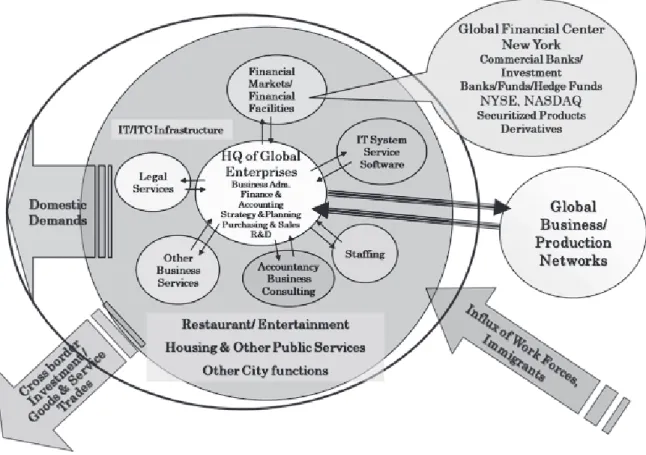
Figure 1: Conceptual Model of the Global City Nexus
Source: Kawamura (2012), PPT slide No. 10 from “The Brazilian Keynesian Association (AKB) 2012 Conference”.
Post the global financial and economic crisis, China implemented economic stimulation measures with an injection of 4 trillion yuan to support Chinese domestic consumption. However, except for part of the preferential policies, most of the measures have already ended. Thus, the 12th Five-year Plan is required to establish the economic structure to expand domestic consumption in the longer term.
Establishing a globally open domestic income core is one of the most important issues for China’s internal economic growth linkages. To attain this goal, China should attempt to establish the function of each city, their multilayered development areas, and the networks among them as global cities4 (see Figure 1). To expand Chinese consumption, it is necessary to create markets that are the core of domestic demand. In this way, each city has nodes and is part of the inter- city networks (Kawamura 2011). This is the role of each city’s economic development areas.
3.1. The 12th Five-year Plan
From a development strategy perspective, China implements medium-term plans, the so-called Five-year Plans, which set out goals for the national economy and social development, including industrial polices and priority projects. These plans have played significant functions as the economic development strategies of the Chinese government (The Japan
4 A global city is a concentration of the headquarters of global enterprises (namely, business administration, finance and accounting, strategy and planning, purchasing and sales, and research and development); special operational services (namely, accounting business consulting, IT systems, service and software, and financial markets and facilities); enlargement of business services, other city functions and related jobs (such as restaurants, entertainment, housing, and other public services); and other global business linkages (Sassen 2009; Kawamura 2011). Typical examples of the global city are New York City, London, Paris, and Tokyo. Shanghai is ranked 24th as a global city on the global power city index of the Mori memorial foundation at the Institute for Urban Strategies (2011). For details of the global city, refer to Reich (1991), Sassen (2001), and Kawamura (2003a; 2003b; 2008; 2011).
Research Institutes Limited 2011). The 12th Five-year Plan consists chiefly of six features; (1) economic growth, (2) increased income in both urban and rural areas, (3) the strategic adjustment of economic structure, (4) deepening reform and the opening-up policy, (5) the reinforcement of social construction, and (6) the enhancement of strategic emerging industries (Mitsui Global Strategic Studies Institute 2011). In particular, expansion of domestic demand and structural adjustment are the primary targets to transform the economic development model (Mitsui Global Strategic Studies Institute 2011). Under the current continuously changing conditions of the world economy and China’s domestic economy, the period for the 12th Five-year Plan (2011-2015) is significant as a turning point of China’s economic development model. China needs to adjust to this changing environment and dissolve several contradictions. Thus, the plan focuses mainly on further encouraging China’s open policy and the modernization of socialism. As a result, it is expected to progress the transformation of China’s economic development patterns and open a new scientific phase. To do so, the Chinese government has set economic and social development goals for next five years, such as adjusting the economic structure and improving public welfare (Sano 2011). In the 11th Five-year Plan (2006-2010), China had already targeted the advancement of industry based on a national medium-term scientific technology development plan. However, it has caused “unbalanced, disharmonized, and unsustainable” issues. The former Prime Minister, Zhu Rongji, announced the shift from a resourced based “extensive” development model to an improved efficiency “intensive” development model.
However, even ten years later, the transformation of the industrial structure has not yet been attained, mainly because local governments have hardly been involved in the intensive shift of the industrial structure. Under these circumstances, almost all provinces have announced measures to improve and encourage industries based on the Chinese central government policy. They strive to maintain the “full set” of industrial structure, from light industry to heavy industry, to create jobs and secure tax revenues (Ke 2011).
To deal with the 2008 global financial and economic crisis, China undertakes to maintain development by infrastructure investment. It has provided economic stimulus measure worth about 4 trillion yuan and selected eight main industries as central industries. In the 12th Five-year Plan, these were condensed to seven strategic advancement industries, namely (1) energy saving and environment friendly, (2) new-generation technology information, (3) bio, (4) advanced equipment manufacturing, (5) new energy, (6) new materials, and (7) new energy automobile industries(Mizuho Research Institute 2011).
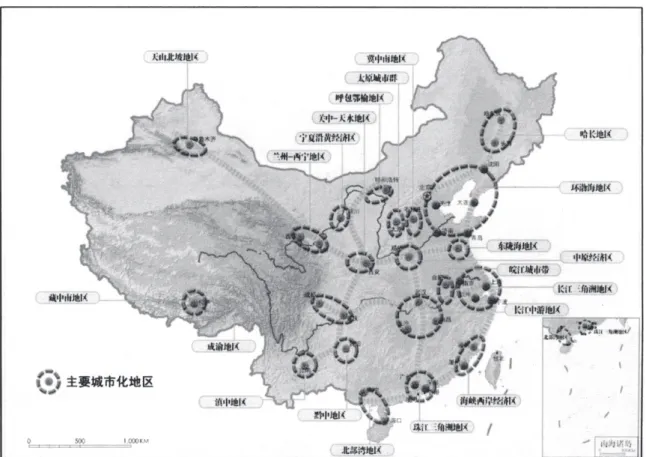
In this way, China proposes to transform from its former economic development and growth model that was dependent on foreign capital to a more self-dependent one. These seven globally competitive strategic advancement industries are actually an expression of China’s slogan of “indigenous innovation” to develop its own technology through its own innovation. The economic development zones are placed as models, leaders, or triggers for the development strategy of each city function. In fact, those economic development areas have grown with huge foreign capital (e.g., Wei and Leung 2005). Once their economic development has succeeded, they are expected to stimulate city functions to transform the domestic economy and advance the industry structure for the whole of China (Matsuno 2011). The 12th Five-year Plan clearly shows the attempts to link economic development areas and cities with an infrastructure network throughout China (see Figure 2).
Figure 2: Chinese main economic areas and their network
Source: “Two vertical, three horizontal” strategic urbanization pattern, 12thFive-year Plan for National Economic and Social Development (full text). Published by the Xinhua News Agency.
3.2. Economic development zones5
Since 1978, China has adopted an open policy in which it gives “serious consideration” to coastal areas and foreign capitals. In addition to trade, direct investment, public loans, and labor exports, it opened partial coastal areas, such as Guangdong province and Fujian province, as “development areas or zones” (e.g., Marukawa 2013 ; Seki and Han 2003).
China referred to developing countries’ export processing zones as a model and allowed the establishment of joint enterprises in these areas. The following economic development zones have been designated in Guangdong province:
Shenzhen, Zhuhai, Shantou, Amoy, and Hainan. These areas were located far from capital cities and existing economic centers, indicating that China wanted to examine their influence on the domestic economy by utilizing them as an experiment (Ariga 2013). The economic zones adopted an economic structure of a “totally extroverted economic model”
by combining manufacturing industries and trade. Within the economic development zones, there are several preferential treatments, such as exemption from taxation on imported consumption goods for daily living and most of materials in the markets. They also set a preferential tax system for corporations and provide permission to establish 100% independent capital corporations. Since the end of 1984, 14 coastal cities in China have opened as “coastal open cities.” In 1985, four special economic zones (SEZs) were established in addition to the Yangtze delta economic areas. Moreover, in 1988, SEZs were gradually opened toward the main inland cities, such as that established in Hainan city (Kubo 2009; Wu 2007).
In coastal open cities, economic technological development zones have been established in each city since the end of 1980s. The increase in investment in those economic technological development zones was at first likely to be limited as 5 In this paper, economic development zones/areas are used as general terms for special economic zones, economic technological
development zones, high-tech parks, free trade zones, and export processing zones.
they lacked foreigners’ living facilities (Ariga 2013). These zones are under the direct control and guidance of each local government. Their priority purposes are development of advanced industry, manufacturing, and high-technology projects through preferential treatment. With preferential treatment, they waive taxes on imported equipment, consumption goods for daily living, import duty, and corporate tax.6 The economic technology zones are similar to export processing zones, as opposed to SEZs, which exempt foreign firms are from taxes on imported machinery equipment and intermediate products. Instead of such low tax duties, SEZs have obligations to export a certain percentage of products and earn foreign currencies (JETRO 2012b).
Since 1991, high-tech development zones have been established in each province, city, and autonomy region across China. They are controlled and guided by the local government and aimed to be scientific technological economic zones.
Only high-tech business corporations are accepted by the government. They qualify for preferential treatment, such as immunity from corporate tax and imported equipment tax, and other preferential treatments and incentives based on high- tech policy, venture capital investment, and research and development (R&D) (JETRO 2012b).
Free trade zones (FTZ) fall under customs supervision and management. They were originally established to keep imported goods as “bonds,” by which goods from foreign countries do not need to go through the formal custom process at the time of entry into the FTZ. However, the trade between FTZ and non-FTZ areas in China is required to go through the custom process as exported and imported goods. In doing so, foreign trade, especially intermediate trade and processing trade, can be further expanded and promoted. There are various preferential treatments, such as that for corporate tax, exemption of tax on imported equipment and imported production materials and ingredients for export, and bonds or tax exemption for intermediate trade goods (JETRO 2012b).
In this manner, China establishes the development zones in each city to build enterprises. Therefore, China is able to increase personal income and consumption. In terms of the Chinese economic turning point, China encourages “indigenous innovation” that is not dependent on foreign capitals and technologies. Because of many Chinese firms making significant achievements, some of the economic development zones tend to remove the preferential treatment for foreign capital and firms.7 This indicates that the traditional role and meaning of the economic development zones are now changing.
4 . Case study of Hangzhou city
84.1. Overview of Hangzhou city
Since the 1990s, the Yangtze River Delta economic development area, including Shanghai city, Jiangsu province, and Zhejiang province, has led Chinese economic development with its manufacturing production bases. Shanghai city, Hangzhou city, Suzhou city, and Ningbo city were visited in 2011 to undertake fieldwork. Each city has its own features and roles as follow: Shanghai plays a significant role as a “global city”; Suzhou city, as the central city in Jiangsu province, has historical and cultural clusters; the development of Ningbo city is mainly owing to the cluster of private companies and high-tech industry, which have become the central city function; and Hangzhou is well known for its culture, sightseeing, economy, and “Silicon Valley.”
Hangzhou city is the capital of the Zhejiang province, which is approximately 450 km from East and West, and the same distance from North to South. Its land area, at 100,180 km², is the smallest among Chinese provinces, and accounts for 1.08% of China’s total land area. Hangzhou and Ningbo are both sub-provincial cities. Zhejiang has 9 prefecture level
6 The corporate tax is exempted for the first two years and then reduced by half for the next three years.
7 Refer to the 2011 Chinese fieldwork.
8 The following two research objects were used: (1) Hangzhou economic and information committee and Hangzhou people s committee.
Investigation date, September 14, 2011, 9:40am-1:00pm. Method: interviews with responsible officers, deputy commissioner, and subhead. (2) Hangzhou National High-tech industrial development park (Bingjian), foreign trade economic collaboration bureau/
foreign capital attraction bureau. Method: interviews with responsible officers, manager of foreign capital attraction bureau and assistant division director.
cities, 36 prefectures, 22 county level cities, and 32 districts. By the end of 2012, the total permanent resident population was 54.77 million (Zhejiang province government’s official website). The population of long-term residents in Hangzhou was 8.8 million at the end of 2012. Urban residents accounted for 74% of the city, or 6.54 million people. The registered household population was 7.01 million, which consisted of an agricultural population of 3.16 million and a non- agricultural population of 3.84 million (Hangzhou Municipal Government website). Hangzhou has 8 districts:
Shangcheng, Xicheng, Jiangguan, Gongshu, Xihu, Binjiang, Ciaoshan, and Yuhang. There are also 3 country-level cities, Jiande, Fuyang, and Lin’an, 2 counties, Tonglu, and Chun’an, and 193 villages and towns. The total area of Hangzhou is 16,596 km², including an urban area of 3,068 km² (Hangzhou Municipal Government website).
Established in the Qin Dynasty, Hangzhou has a history of over 2200 years. It is one of the seven ancient capitals in China and was the capital of Wuyu State and the Southern Song Dynasty (Hangzhou Municipal Government HP). In the 13th century, Marco Polo, the Italian merchant traveler, described Hangzhou as “the most beautiful and elegant city in the world.” More recently, in 2011, the West Lake was registered as a World Heritage Site. Owing to its beautiful scenery, fine weather, and comfortable living environment, it is known as “Paradise on Earth” and was chosen as both “the happiest city,” and “the best Chinese sightseeing city” in the “Life quality city” awards.
From the economic perspective, despite the sluggish global and Chinese economies, Hangzhou city maintained relatively stable economic growth in 2012 (see Figure 3). Its GDP was 780.398 billion yuan, up by 9% at comparable prices from 2011. GDP per capita, calculated on the basis of permanent residents, was 88,985 yuan, up 8.4% at comparable prices from 2011 (Hangzhou Municipal Government website).
4.2. Links with the current Chinese economic situation
China has developed primarily thanks to globalization and international trade. Hangzhou has also adopted the central government open policy and attained moderate development. In recent years in particular, enterprises in Hangzhou have grown rapidly, thus confirming that the central policy was correct.9 Since the 2008 global financial and economic crisis, the world economy has been in depression. This directly affects Chinese exports as foreign demand declines. As a result, Hangzhou is paying more attention to the future direction and shift of its development model.9
Hangzhou comprehends that it faces several challenges for with its current economic development. For instance, low-
9 Refer to the interviews of (1) Hangzhou economic and information committee and Hangzhou people s committee and (2) Hangzhou National High-tech industrial development park (Bingjian).
Source: Prepared by author, with material from Hangzhou Municipal Government website.
end products and service industries face difficulties in growing further. This is caused by, among other things, the increase in overall costs owing to land and energy resource issues, environmental protection, human resources, shortage of industrial innovation, intellectual property rights. It implies that not only China but also Hangzhou requires transforming its economic development strategy from dependence on foreign demand to domestic demand. Other major challenges affecting Hangzhou are shortages of land in the coastal areas, of energy and electric power, and of labor, especially blue- collar workers. Thus, Zhejiang province has had to transform its industries to become more efficient and land-saving advanced equipment industry rather than bio or medicine manufacture and traditional chemical industries.10
It is estimated that costs in inland China will increase 10-20 years later compared to the coastal areas; thus, some companies have already started to move toward inland China, in particular, as cost competition among companies in Hangzhou is fierce. To deal with this, Hangzhou undertakes to establish employment regulation to deal with the shortage of labor, and to improve the labor department, system of the wage security, and housing policy. In August 2011, Hangzhou held a three-way meeting with the labor department, labor union, and businesses to enhance the formation of the platform for laborers and entrepreneurs. Labor relations are generally cordial in Hangzhou. The local government has attempted several of its own activities based on evaluation of enterprises, such as adjustment of their minimum annual wages and training of the labor forces with institutions.11
4.3. Links to the 12th Five-year Plan
As mentioned in the 12th Five-year Plan, China now emphasizes inland economic development as well that of the coastal regions. As a result, Hangzhou removed its preferential policy for the coastal areas to concentrate more on the inland cities, such as Tibet Autonomous Region, Sinkiang Uighur Autonomous Region, Sichuan province, Qinghai province, and Jiangxi province. The ties among them are getting stronger these days. As a result, during the next 2 to 3 decades, the numbers of the local workers are expected to increase, while the number of the migrant labors from inland China will decrease correspondingly. It is forecast that the disparity and imbalance between the regions will be dissolved.
On the other hand, for the coastal cities such as Hangzhou, it gives rise to the issue of the transformation of the economic development model12.
As the 12th Five-year Plan noted, advancement of existing industries and improvement of unsustainable industries are also the most essential issues for Hangzhou. Hangzhou has established its own plan based on the central government’s direction and decisions. As mentioned in Chapter 3, the government decided on seven strategic emerging industries for sustainable development. Hangzhou follows this policy, but focuses more precisely on 10 industries,13 as their own development industries as these still have room for development. One of the significant issues is how to improve traditional industries such as spinning, apparel, food and beverages, and general-purpose machinery. Moreover, the state council of China has identified the “encouragement of operations to eliminate inefficient production capability in industries.” Hangzhou strives to eliminate low or unsatisfactory environmental standards and technological standards in industries that cause pollution with lower technology level and mass energy consumption, by paying subsidies (Ke 2011).
Additionally, Hangzhou attempts to accept only companies that meet the standards of the economic development zone to improve industry with internal adjustments.14
10 Refer to the interviews of (2) Hangzhou National High-tech industrial development park (Bingjian) and Hangzhou economic and technological development zone website.
11 Refer to the interview of (1) Hangzhou economic and information committee and Hangzhou people s committee.
12 Refer to the interviews of (1) Hangzhou economic and information committee and Hangzhou people s committee and (2) Hangzhou National High-tech industrial development park (Bingjian).
13 The 10 industries are (1) cultural and imagination, (2) leisure and sightseeing,(3) corporate services, (4) advanced manufacturing, (5) telecommunication, (6)electronic commerce, (7) internet of things, (8)bio and medical, (9)energy-saving and eco, and (10)new energy industries.
14 Refer to the interview of (1) Hangzhou economic and information committee and Hangzhou people s committee.
4.4. City function and network
“Without improvement of the city function, it is impossible to develop 10 industries and service industry in the future.”15 China recognizes that it is still in the middle of industrialization; thus, the manufacturing and construction industries are still important relative to new materials industries. The city function of developed countries is also shifting from focusing on the service industry as well as new manufacturing industries. This implies that China is required to concentrate on both service and manufacturing industries to maintain the network with developed countries as its city function.
Hangzhou is the hub city of eastern China. Its transportation infrastructure connects with Shanghai, other Chinese cities, and foreign countries, including Japan. Hangzhou Xiaoshan International Airport is ranked in the top 10 in China in terms of freight and post throughput. Via a 2-hour flight from Hangzhou, passengers can arrive in Beijing, Guangzhou, and Hong Kong. At the end of 2008, 193 airlines serviced Hangzhou, including 38 international or district airlines with flights to, among other destinations, Tokyo, Osaka, Bangkok, Singapore, and Seoul.
There are 5 expressways (Shanghai-Hangzhou-Ningbo Expressway, Hangzhou-Nanjing Expressway, Hangzhou-Jinhua- Quzhou Expressway, Hangzhou-Thousand Island Lake Expressway and Hangzhou-Huangshan Expressway) and 11 national and provincial highways. Thus, it is possible to reach the main cities of the Yangtze delta economic areas within 3 hours.
Hangzhou has also completed a 175 km high-speed railway that connects Hangzhou to the south of the Shanghai in 79 minutes (Nikkei BP 2012). Moreover, there are 3 important railroads: Shanghai-Kunming Railroad, Hangzhou-Xuancheng (Anhui Province) Railroad, and Hangzhou-Ningbo Railroad. In 2012, Hangzhou Metro Line 1 was completed and 4 terminals were established in Hangzhou’s national high-tech industry development zone. Another 8 lines are planned for construction by 2050 to make access much easier from the inland cities (Hangzhou Municipal Government HP).
With regard to water transportation, Beijing-Hangzhou Grand Canal has been connected to the Qiantang River.
Hangzhou has convenient water transportation connections to rivers, lakes, and seas all over China.16
4.5. A case study of Panasonic Gold Fish (Hangzhou Panasonic Home Appliance Co., Ltd.)
From the business perspective, as an example of a successful company in Hangzhou city, the case of Panasonic Gold Fish is examined. Panasonic Gold Fish was established as a partnership firm in 1994 with Panasonic Corporation and Hangzhou Gold Fish Electrical Appliances Co., Ltd (Hangzhou Gold Fish). The products of Panasonic Corporation are higher quality than that of Hangzhou Gold Fish; therefore, the partners have succeeded in their main products, such as washing machines, motors, air conditioners, and electric rice cookers, in Chinese markets by complementing each other.
On January 26, 2011, they announced that the Panasonic Home Appliances Washing Machine (Hangzhou) Co., Ltd. would extend the joint-venture contract for another 20 years. Hangzhou is considered to be the most important production outlet for producing the Panasonic white goods to expand market share in China (China Press 2011). Their success is mainly owing to similar management principles between Zhejiang province and Japanese firms. For instance, the Chinese occupy the management posts, which possibly results in better coordination, leading to their success. People and firms from Hangzhou also tend to obey the laws, regulations, and rules from the central government compared to those in Suzhou and Wuxi. For these reasons, trust is created between the joint venture companies, leading to their success. Moreover, Hangzhou is a comfortable living place for Japanese. In a similar vein, “cooperation” contributes toward establishing a long-term industrial chain for Panasonic Corporation, as well.
On the other hand, many companies have failed and withdrawn from Hangzhou. This implies that to succeed in China, it may necessary to embark on joint ventures or partnerships with local Chinese companies, like in this case. As mentioned above, China faces several issues, such as increased labor costs, severe competition, and a shortage of electric power.
15 Refer to the interview of (1) Hangzhou economic and information committee and Hangzhou people s committee.
16 Refer to the interview of (2) Hangzhou National High-tech industrial development park (Bingjian) and Hangzhou Municipal Government website.
Therefore, Hangzhou local government strives to provide services to encourage technological development, to support companies, and to increase the number of successful firms in Hangzhou.17
4.6. The economic development zone: Hangzhou Economic and Technological Development Area (HEDA)18
The Hangzhou Economic and Technological Area (HEDA) was ratified in April 1993 as a national level development zone. It is located on the east part of Hangzhou, downstream of the Qiantang River, and south of the Hangzhou bay. It is also called “big sub city (Xiasha Xincheng/New City),” consisting of one city center and three sub centers. Shanghai, Suzhou, and Ningbo can be reached within 1.5 hours. The infrastructure of HEDA’s 104.7 km² management area has already been completed. The population was approximately 400,000 at the end of 2009 in HEDA. HEDA has pursued Hangzhou city’s goals, including “one garden and many districts” and “construct big city and build new heaven,” by utilizing the advantages of geography, human resources, industries, and environment. HEDA aims to create an international garden style ecological new town based on the high-tech and advanced manufacturing industries, with international manufacturing outlets, as well as places for government and business, education and science, a new century university garden district, and living and housing.
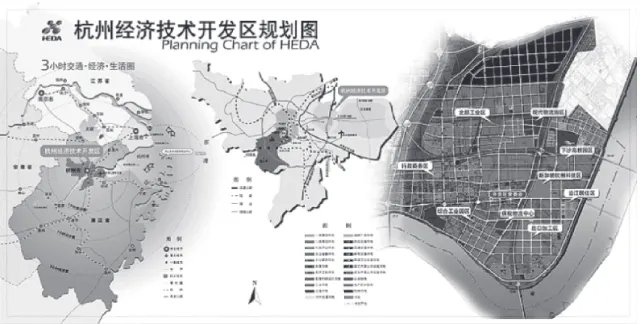
In the HEDA, there are 11 districts as follows (see Figure 4)19. (1) The administrative and commercial zone of Xiasha has a general planned area of 7.8 km² out of 60 km² of the urban area of HEDA. It has recently accepted the ideology of the “network city” and aims to build a modern, effective, and ecological urban center. It will be a future center of administration, business, education, culture, science, and residential living. (2) Riverside residential area is a high-quality living and residential area with a population of 150,000. It utilizes the landscape of the Qiantang River and ecological wetland resources. (3) The college town will form a multifunctional and integrated riverside landscape based on its rational layout, convenient transportation, beautiful environment, industries, research and development outlets, and living and residential facilities. Subway Line 1 was completed in this area. (4) The export processing zone, totaling 2.92 km²,
17 Refer to the interview of (1) Hangzhou economic and information committee and Hangzhou people s committee.
18 Refer to the Hangzhou Economic and Technological Development Area s website; http://www.xitong.net/heda/
19 The information and data of 11 districts are referred to in the interview of (1) Hangzhou economic and information committee and Hangzhou people s committee, Hangzhou Technological and Economic Area s website; http://www.xitong.net/heda/, and Nikkei BP (2012).
Figure 4: Planning chart of HEDA
Source: Hangzhou Technological and Economic Area website.
was established as the first national pilot export processing zone in April 2000. It adopts a series of preferential policies, such as “outside the customs and within the boundary” to keep consistency with the intern. Moreover, it is managed by customs with enclosed type and electronic customs declaration, and direct port though procedures. (5) The northern industrial district has a planned area of 8 km², and more than 50 domestic and foreign companies have operated here, such as Panasonic Industrial Park, CPMC Holdings Ltd., Air Liquide, Global Logistic Properties, and Long Chen Paper Co., Ltd. (6) The total area of the comprehensive industrial park is 18 km². The more than 700 domestic and foreign industrial companies help to form the base of the electronic information, biomedicine, equipment manufacturing, and food and beverage industries. (7) A modern logistics park deals with bounded warehousing, circulation processing, value-added services, global purchasing, international distribution, information, amongst other functions. Its area is 335,500 m² including 173,500 m² of the bounded logistics center (first phase). (8) Singapore Hangzhou Technology Park is a multifunctional and high quality new modern technological park based on service outsourcing, R&D, and financial back- office services. The planned area is 42.9 ha and total building area is 752,300 m². It has been developed by mainly the Asia-Ascendas Group from Singapore. Its functions are similar to the high-tech industrial park and strive to provide international first-class planning, R&D, highly efficient service, convenience, and a safe environment. It comprises an industrial area, comprehensive service area, and ecological landscape area to encourage the fusion of life, work, leisure, and education. (9) The main purpose of the Hangzhou High-Tech Enterprise Incubator Park is the promotion of independent innovation, and science and technology innovation systems planning. Its multiple functions also include science and technology R&D, business, dining, leisure, and entertainment. It provides several preferential services, such as discounts on rent for the first three years by the development zones and local government. (10) The HEDA Cultural and Creative Industry Park has 34,997 m². It aims to promote the cultural and creative industries, such as industrial design and fashion design, by further environment improvements and internal structural adjustments. It has geographic transport advantages with its simple and modern design and large space. (11) The Eastern International Business Center (IBC) plays the role of the future administrative and commercial center of Xiasha. It aims to provide international, top-quality office buildings, five-star Hilton hotels, and presidential-level, full-service, hotel-style apartments and other high-end properties with supporting facilities. Once the general operations commerce, approximately 10,000 high-end residents will live in this area. Through its integrated and supportive business layout, it is intended to be the gateway for the high-end commercial environment of eastern Hangzhou.
From the economic and industrial perspectives, HEDA has achieved certain success. First, HEDA has been evaluated by JETRO as the top investment environment of development zones within 75 cities in China. By the end of 2007, a total of 474 foreign enterprises from 39 countries were invited into the HEDA, bringing foreign capital investment of USD 58.088 hundred million (including 27.3 hundred million of the real working capital). The 23 companies, which are ranked in the Fortune top 500 global enterprises, have invested in 49 projects.
Second, HEDA has completed the formation of four leading industry groups; (1) electronic information, (2) biomedicine, (3) equipment manufacturing, and (4) food and beverages. At the end of 2009, 54 major electronic companies had invested in HEDA, such as Toshiba Information Equipment (Hangzhou) Co., Ltd., Foxconn, Motorola, Dongxin Mobile Phone, LG, Amphenol Phoenix Telecom, and Silan Microelectronics. The industry’s output was valued at 21.183 billion yuan, which accounts for 19.2% of HEDA’s gross industrial output by value. The biomedicine industry deals mainly with the biopharmaceutical and Chinese medicine, which have high technological value and hold great potential for export. More than half of the products, particularly high-end biomedicine products, are produced for export.
There is currently a national TCM clinical research center (hematopathy), nine high-tech medicine enterprises with national support, and five state-level medicine R&D technical centers. The major enterprises are Merck, Sharp & Dohme, AMO, Zhejiang Kanglaite Group Co., Ltd., Hangzhou Jiuyuan Gene Engineering Co., Ltd., ABON Biopharm (Hangzhou) Co., Ltd., and Hangzhou Xiasha Biochemical Tech. Co., Ltd. With regard to equipment manufacturing, by the end of 2009, 95 major enterprises produced goods worth 27.902 billion yuan or 25.8% of the gross industrial output value of HEDA. The main companies are Panasonic, Siemens High Voltage Circuit Breaker Co. Ltd., Hangzhou (SHVC), Kobelco
Construction Machinery, Jiuyang Corp. (Hangzhou), Zhonggao Marine Engine Manufacture, Hangzhou CHINEN Steam Turbine Power Co., Ltd., and Hangzhou Electric Cable Co., Ltd. The fourth leading industry group, foods and beverages, are one of the features and essential industries of this development zone. They produce mainly carbonated beverages, tea drinks, mineral water, and convenience foods. More than 26 food and beverage enterprises operated in HEDA in 2009, such as Hangzhou Wahaha Group Co., Ltd., Pepsi-Cola Beverage Co., Ltd. (Hangzhou), Tingyi (Cayman Islands) Holding Corp. (Hangzhou), Hangzhou Zhongcui Food Co., Ltd. (Coca Cola), and Hangzhou Jiaduobao Beverage Co., Ltd. They produced 18.361 billion yuan in 2009.
As can be seen, HEDA focuses on speeding up of the improvement of high-tech and emerging industries, such as electronic information, modern medicines, new energy, new materials, modern logistics, and financial services. Moreover, it has recently strived to develop business process outsourcing (BPO) companies, especially in software development outsourcing, financial data processing, outsourcing, and IT outsourcing, by attracting international well-known outsourcing companies with high-end projects.
HEDA is one of the most popular development zones for Japanese enterprises (Nikkei BP 2012). For instance, Toshiba Information Equipment (Hangzhou) Co., Ltd has a production base of laptop computers in HEDA; Panasonic Corporation has a production base of home appliances; Kewpie Corporation has entered the food industry; and Terumo Corporation and Asahi Kasei Medical (Hangzhou) Co., Ltd. have entered the biomedical industry. Like these companies, many other Japanese enterprises have already entered HEDA and expanded their business scale, factories, and employees.
5. Relations between Hangzhou city and Shanghai city
5.1. An outline of Shanghai city
Shanghai has driven the economic growth of the Yangtze River Delta and contributed to China’s social and economic development as an international metropolis-oriented city20. The land area of Shanghai is 6,340 km²21, which accounts for 0.06% of China’s total territory. Shanghai has three islands, Chongming, Changxing, and Hengsha.22 It manages 16 districts and 1 country. There are 108 towns, 2 townships, 99 sub-district committees, 3,742 neighborhood committees, and 1,702 village committees in the city.23 By 2011, its registered population was 1.419 billion24, while its resident population was 2.347 billion, including a floating population of 935.36 million.25
Shanghai has sustained its economic growth rates. Total GDP and per capita GDP of the region amounted to 2.01 trillion yuan26 and 85,000 yuan respectively27 in 2012. The ratio of the primary, secondary, and tertiary industries was approximately 0.6: 39.4: 60. In particular, the services sector—such as wholesale and retail, finance, transportation, logistics and post, real estate, and information transmission by computer—and the software sector have continued growing and composed 60% of GDP by 2012.28 Shanghai maintained stable growth in foreign trade between 2009 and 2011, although in 2012, the total amount of the trade declined by 0.2% from the previous year to reach USD 436.758 billion.
Shanghai’s exports increased to USD 229.95 billion and imports decreased to USD 206.81 billion in 2012.29
20 Refer to Shanghai literature and art publishing group (2011).
21 Refer to Shanghai Civil Affairs Bureau.
22 Refer to Shanghai literature and art publishing group (2011).
23 Refer to Shanghai Civil Affairs Bureau and Shanghai statistical yearbook 2012.
24 Refer to Shanghai Municipal Public Security Bureau.
25 Refer to Shanghai Civil Affairs Bureau and Shanghai statistical yearbook 2012.
26 China s GDP was 51.9322 trillion yuan in 2012. Refer to Shanghai statistical yearbook 2012 and JETRO (2013).
27 China s per capita GDP was 38,354 yuan in 2012. Refer to Shanghai statistical year book 2012 and JETRO (2013) 28 Refer to Shanghai statistical yearbook 2012 and Shanghai statistic net.
29 Refer to Shanghai statistical yearbook 2012, Shanghai statistic net, and JETRO (2013).
5.2. Links to the Chinese economic situation and the 12th Five-year Plan
Compared with Hangzhou, Shanghai plays a more significant role and receives more attention, both domestically and in the case of foreign countries. Shanghai has strived to match economic development, international status, and resource allocation in the global market, according to the central government’s strategies and requirements (Shanghai literature and art publishing group 2011). The main purposes of the 12th Five-year Plan for Shanghai is to make significant progress to build “four centers” and a modern socialist international metropolis. These “four centers” are (1) an international economic center, (2) a financial center, (3) a trade center, and (4) a shipping center, all by 2020, with the aim of matching China’s economic development and international status. At the same time, Shanghai will build a modern, socialist international metropolis with economic prosperity, social harmony, and a beautiful environment to construct competitive, world-class city clusters in the Yangtze River Delta region. It is evident that Shanghai strives to remodel economic development and improve citizens’ living quality remarkably (Shanghai literature and art publishing group 2011).
5.3. Shanghai city functions and network
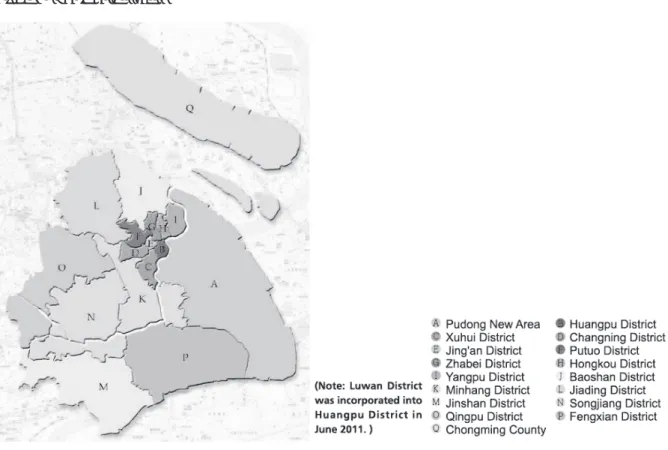
Shanghai is the one of the biggest transportation hubs in China. It has geographic advantages owing to its location at the sea and river ports (Shanghai literature and art publishing group 2011). Shanghai is adjacent to Jiangsu and Zhejiang provinces and has the East China Sea on the east and Hangzhou Bay on the south. The Yangtze River, in the north of the city, pours into the East China Sea. Shanghai is located in the center of China’s coastline (Shanghai literature and art publishing group 2011; JETRO 2013a) (see Figure 5).
Shanghai handles 736 million tons of cargo and 32.5294 million TEUs of containers (Shanghai statistic website;
JETRO 2013a). It has two airports: Shanghai Pudong International Airport and Shanghai Hongqiao International Airport.
Shanghai Pudong International Airport, which is located about 30 km away from the city’s downtown, is the one of the world’s major aviation hubs and is the mid-point of Asian and European-American aviation routes. Its expansion plan, including airport construction, air traffic control and refueling facilities, will be completed in 2015. Once it is completed, it will be able to handle 60 million passengers, 4.2 million tons of cargo, and 490,000 planes per year. With regard to rail transport, Shanghai had 12 metro lines with 292 stations and a network totaling 439 km by March 7, 2013. There are plans to extend the metro line to 530 km by 2015 and by 970 km in the future (Shanghai metro net ; JETRO 2013a). In addition, a maglev line extends for 30 km between Shanghai Pudong International Airport and Longyang Road Station. Shanghai has also invested in urban construction, such as hub-oriented, functional and network infrastructure to further improvement the city’s investment environment, to open up more to the outside world, and to enhance its comprehensive functions. As a part of the project, Shanghai-Hangzhou passenger railway has already completed a project to connect the two cities.
Figure 5: Shanghai’s location
Source: Shanghai Basic facts (2011) “Shanghai’s location on the National Map” p.5.
5.4. The economic development zone in Shanghai
The China (Shanghai) pilot free trade zone was formally approved on August 22, 2013. It is chiefly associated with the Shanghai total free trade zone, which was established in 2009. The national strategy seeks to upgrade mainly the Shanghai Waigaoqiao free trade zone, Yangshan deep-water port, and Shanghai Pudong total free trade zone to world free trade zone standards (Ikegami 2013; JBIC 2013; Shen 2013).
China has tackled open policy through various strategies, such as the establishment of economic development zones, actively seeking foreign capital, introducing capitalist economy, and joining the World Trade Organization (WTO). Since the 2008 global financial and economic crisis, Chinese exports to developed countries, especially the United States and Europe, have been sluggish. This affects Chinese imports as well. Because of China’s rapid and continuous high economic growth, the country’s aims toward open policy have weakened these days (Shen 2013); however, China also faces the stagnation of its domestic reform. As the world’s economies attempt to overcome recession, they are striving to conclude trading partnerships, such as free trade agreements (FTAs), economic partnership agreements (EPAs), or the Trans-Pacific Strategic Economic Partnership Agreement (TPP). However, China has not participated in FTAs with Western countries or TPP dialogs. Instead, China is opening the China (Shanghai) free trade zone as a window for foreign countries to further enhance free trade (Ikegami 2013; JBIC 2013; Shen 2013). To do so, it attempts to get to grips with the new Chinese way of open policy and models, and then, to rapidly enhance the government function and administration system. In addition, as mentioned in 12th Five-year Plan, China expects to trigger the establishment of an international financial center, international trade center, and international logistics center in Shanghai by 2020 (Shen 2013). As a result, it expects to transform the Chinese economic development model and economic structure. Once this effort is successful, the related regulations, measures, experiences, and know-how will be extended to the whole of China, as a model. Even if this fails, it is a “pilot” free trade zone, which means the negative impact will be limited. However, if it is successful, domestic consumption will expand in the area, acting as a new growth point of economic development. In this manner, the China
(Shanghai) free trade zone plays a significant role for China’s further sustainable and rational economic growth (JBIC 2013).
6 . Hangzhou at the Yangtze River Delta
The development plan for the Yangtze River Delta has been released by National Development and Reform Commission (NDRC 2010). It consists of an introduction and 12 chapters as main principles and emphasizes three major roles: (1) the sub-region is a key international gateway for Asia and Pacific regions, (2) it is a center for a modern service industry and a global center of advanced manufacturing, and (3) as a group of global cities, it will be internationally competitive. The following discussion expands on these roles.
To establish centers of international economic, financial, trade, and water transportation in Shanghai, the Yangtze River Delta is required to construct international financial service systems, international business service systems, and an international logistics network system that greatly influence the world. The NDRC calls for the establishment of an industrial structure centered on the service industry in the Yangtze River Delta. The construction of a district that accumulates a modern services industry is also required. Moreover, it needs to enhance the improvement of the industrial level, especially for manufacturing companies. There are plans to construct advanced manufacturing clusters of global size and quality as well. In the Yangtze River Delta, Shanghai represents a global city for both domestic and foreign countries. Neighboring cities, such as Nanjing, Suzhou, Wuxi, Hangzhou, and Ningbo, are all required to improve their international standing as a city group. To do so, China aims to connect cities via networks within the area. As a result, the Yangtze River Delta will be the most energetic city group in China in terms of global competitiveness (Harner 2011).
Based on the development plan for the Yangtze River Delta, Hangzhou has its own role to play. First, Hangzhou is historically and culturally more outstanding than Shanghai. It has a good environment for living, as described above.30 Second, China’s central government has not decided on the particular regions that will fulfill its aims for China’s seven strategic emerging industries; thus, each region can freely compete in these industries, and Hangzhou and Shanghai generally complement each other. For instance, in the advanced IT industry, Hangzhou competes with Shanghai and Suzhou. Particularly, Shanghai has advantages based on the development of its IT infrastructure, and is able to attract further global business by providing offices for capital trade, business trade and information exchange required for international business. Third, in terms of finance, Shanghai is the financial center for the whole of China. Alongside this, Shanghai has implemented an industry reallocation policy. Therefore, the functions of commerce and housing are concentrated in the center of Shanghai, and other industries are relegated to the rural areas. On the other hand, Hangzhou is regarded as the financial center for Zhejiang province, can provide land, and invite human resources for the financial institutions by for example, offering cheaper housing. For companies with strong credentials, it provides other incentives as well. As a city function, Hangzhou would appear to be a viable alternative to Shanghai.
To sum up, in the Yangtze River Delta, Shanghai plays the core role as the international economic, finance, trade, and water transportation center based mainly on improvement of its service and its advanced manufacturing industries. At the same time, the whole Yangtze River Delta is striving to form an industrial structure centered on the services industry.
Moreover, by reinforcing innovation and utilizing the advantages of the whole Yangtze River Delta district, Shanghai is able to strengthen its international competitiveness. As a network of cities, several belts connect the cities in the Yangtze River Delta. For the connection between Hangzhou and Shanghai especially, there is a belt that aims to enhance city efficiency and improve innovation ability. Furthermore, the two cities are attempting to jointly address issues such as environmental pollution, control of resource dependence industry, protection of the ecological environment, and improvement of the living environment. For this belt, the main industries are high-tech, advanced manufacturing, and 30 Refer to the interviews of (1) Hangzhou economic and information committee and Hangzhou people s committee and (2) Hangzhou
National High-tech industrial development park (Bingjian).
services. However, it does not form the high city concentration area at the international level, and thus, may struggle to lead not only the Yangtze River Delta but also for China’s economic growth in general (Harner 2011).
7 . Conclusion
One of China’s most significant issues now is generating a domestic income core from global opening via internal economic growth linkages, so-called “globally opened domestic income core of the internal economic growth linkage”
(Kawamura 2011). This paper discussed Hangzhou city and Shanghai city as case studies (see Figure 6). It reveals that regardless of whether each city and economic development zone understands exactly the central government’s policies, contents, and directions, they have strived to develop at each level, based on their strengths and advantages. China has much land and a wealth of diversity in terms of social and economic differences between provinces and cities, and the central government has not been able to control and manage all of them. Thus, local governments have already made certain interventions. Moreover, since there are conventional laws and regulations, not all government roles and functions can be taken over instantly by private companies or institutions. Therefore, it can be seen that the local government will henceforth have certain roles and power (Kato 2003, pp.195).
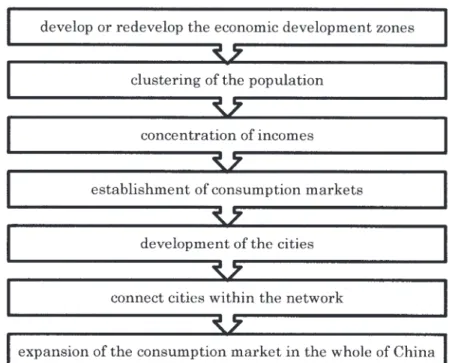
In this context, each development zone plays a role as a leader, model, or trigger to create clustering of its population.
Once the population grows, it leads to an increase and concentration of incomes. To achieve this, cities are developed and with the development of transportation infrastructure, the networks among cities are improved. As a result, the Chinese consumption market will expand toward the whole of China (see Figure 7). However, recently China has reinitiated plans Figure 6: Comparison between Shanghai and Hangzhou in 2012
Shanghai Hangzhou
GDP (billion yuan) 2010.133 780.398
The sales value of super-scale industrial enterprises (billion yuan) 3132.757 1272.367 Total investment in fixed assets (billion yuan) 525.438 372.275 Total retail sales of consumer goods (billion yuan) 738.732 294.463 Total import and export value (USD billion) 436.758 61.683
Local fiscal revenue (billion yuan) 374.371 85.999
Per capita disposal income for urban residents (yuan) 40188 37511 Per capita net income of rural residents (yuan) 17401 17017 Proportion of the three industries (%) 0.6:39.4:60.0 3.3:46.5:50.2
Export Value (Custom) (USD billlion) 206.807 41.262
FDI (USD billion) 15.116 4.961
to establish economic development zones, not only in Shanghai but also in other cities across China. In so doing, there may be an overlap in cities’ plans, which may make it hard to distinguish them from each other. Thus, a significant issue henceforth is how each city can describe its development strategy effectively and with unique differences to survive in a
“free trade” world (JBIC 2013).
From the case study of Hangzhou city, in particular, it is clear that development zones are the driving forces behind the rapid industrialization of the past two decades. The role of the development zone makes has brought about remarkable Source: Prepared by author with data from the Hangzhou government website, Shanghai statistical yearbook, and Shanghai statistic bureau website.
progress in Hangzhou city’s development.
In the future, after passing the economic turning point of the Chinese economy, three main points need to be focused on as further research concerns: (1) the impact of Hangzhou city and its development on the turning point of the Chinese economy, (2) how Hangzhou city will transform as a sub city of the global city, Shanghai, and (3) the possibility of Hangzhou becoming a global city. Shanghai, however, has a unique characteristic as a global city since China tries to establish an “inward link” from Chinese global cities. In addition to Hangzhou city’s case, other cities and development zones require further research for deeper understanding of the overall global city functions in China.
References Chinese
[1] The Central People’s Government of the People’s Republic of China (2012) “12th Five-Year Plan for National Economic and Social Development (full text)”, 2011 Annual Session of the National People’s Congress and the Chinese People’s Political Consultative Conference, Retrieved January 24, 2012 from http://www.gov.cn/2011lh/
content_1825838_6.htm
[2] China customs statistics yearbook December 2012 (2012)
[3] National Bureau of Statistics of China (2011) “China Statistical Yearbook”
[4] The National Development and Reform Commission (NDRC) (2010) “The Yangtze River Delta development plan”, from http://www.sdpc.gov.cn/zcfb/zcfbtz/2010tz/t20100622_355748.htm
[5] The National Development and Reform Commission (NDRC) Retrieved October 20, 2013 from http://www.sdpc.gov.cn/zcfb/zcfbtz/2010tz/t20100622_355748.htm
[6] Shanghai Statistical Bureau (2011) “Shanghai statistical year book 2011”
[7] Shanghai Statistical Bureau (2012) “Shanghai statistical year book 2012”
[8] Shanghai Statistical Bureau, Retrieved October 20, 2013 from http://www.stats-sh.gov.cn/
[9] Shanghai metro net, Retrieved October 20, 2013 from
Figure 7: The system of the expanding the consumption market
Source: Prepared by the author with reference to Kawamura (2011).
http://www.shmetro.com/node41/node45/200809/con100270.htm
[10] Shanghai Statistical net, Retrieved October 20, 2013 from http://www.stats-sh.gov.cn/
[11] Zhejiang province government’s official website, Retrieved October 20, 2013 from http://www.zhejiang.gov.cn/
English
[1] Gu, Felicity Rose and Zilai, Tang (2002) “Chapter 10 Shanghai: Reconnecting to the Global Economy”, in Sassen, Saskia, Global networks, Linked cities, New York-London: Routledge, pp.273-307
[2] Office Information Processing Center, CPC Hangzhou Committee and Hangzhou Municipal Government (2012)
“Development Strategies Introduction to Development Zones”, Retrieved January 24, 2012 from http://eng.hangzhou.
gov.cn/
[3] Reich, R.B (1991)“The work of nations: Preparing ourselves for 21st-century capitalism”, New York: Alfred A. Knopf [4] Sassen, Saskia (ed.) (2001) “The Global City: New York, London, Tokyo”, 2nd edition. Princeton: Princeton University
Press
[5] Shanghai literature and art publishing group (2011) “Shanghai Basic facts 2011”
[6] Wei, Y.D. and Leung, C.K. (2005) “Development Zones, Foreign Investment, and Global City Formation in Shanghai,”
Growth and Change, 36(1):16-40
[7] Zhejiang province government’s official website, Retrieved October 20, 2013 from http://english.zj.gov.cn/col/col11078/index.html
Japanese
[1] China Press (2012) “Hangzhou gold fish electrical appliances Co., Ltd; extend joint-venture contract for 20 years more” , Retrieved January 24, 2012 from http://www.chinapress.jp/13/24627/
[2] Hangzhou Economic and Technological Development Zone (2012) “Hangzhou Economic and Technological Development Zone, Retrieved January 24, 2012 from http://www.hedagov.jp/ and http://www.xitong.net/heda/
[3] Hangzhou city government website, Hangzhou statistic investigation information HP, Retrieved September 28, 2013, from www.hzstats.gov.cn
[4] Harner, Stephen Michael (ed.) (2011) “Understand at a first glance Shanghai economic district market development chart”, 21 Century China Soken
[5] Ikegami, Ryusuke (2013) “Trend of China (Shanghai) pilot free trade zone”, BTMU China monthly report No.90, July 2013, pp.1-5
[6] The Japan Institute for Labour Policy and Training (2011) “Increase mainly in coastal and east areas –the minimum wages of 2011”
[7] The Japan Research Institute Limited (2011) “Chinese economic development strategy in the 12th Five-year Plan” Asia Monthly, June 2011
[8] JBIC (2013) “China Report July-August 2013”
[9] JETRO (2012a) “Information about Economic Development Zones, Economic Development Zone in Shanghai”, Retrieved January 24, 2012 from
http://www.jetro.go.jp/world/asia/cn/central_east/shanghai_zone/
[10] JETRO (2012b) “China’s preferential treatments for foreign capital, types of industries, details”, Retrieved January 24, 2012 from http://www.jetro.go.jp/world/asia/cn/invest_03/#block2
[11] JETRO (2013a) “Outline of Shanghai”, Retrieved October 1, 2013 from http://www.jetro.go.jp/world/asia/cn/katoh/pdf/overview_shanghai_2012.pdf [12] JETRO (2013b) “World Trade and Investment White Paper 2013”
[13] Kato, Hiroyuki (2003) “Series Modern Chinese Economics 6 Regional Development,” Nagoya University Press
[14] Kato, Makiko (2013) “China’s economic turning point: Business development and issues for Japanese MNCs”, Economics Magazine, Vol 48, Graduate School of Economics, Hosei University
[15] Kawamura, Tetsuji (2003a) “Modern American Economy”, Yuhikaku
[16] Kawamura, Tetsuji (2003b) “Chapter 12: Economic development of China and Taiwan and Japanese local subsidiaries”, in Yamaguchi (ed.) Eastern Asian market economy-diversification and possibility, Ochanomizushobo [17] Kawamura, Tetsuji (2005) “Chapter12: Japanese local subsidiaries in South China and Pearl River Delta-focus on
electrical machinery and electronics industries”, in Kamiyama and JMNESG (ed.) Gigantic Chinese economy and Japanese hybrid factory, Jitsugyononihonsha
[18] Kawamura, Tetsuji (2008) “Chapater1: American long-term boom and New Economy in the 1990s”, SGIME (ed.) Global capitalism and economic circulation. Ochanomizushobo
[19] Kawamura, Tetsuji (2011) “Chapter 6: Progress of economic globalization and issues of Chinese economy (in Japanese),” pp.137-176 in Sugawara (ed.) The presence of Chinese socialistic market economy, Ochanomizushobo [20] Kawamura, Tetsuji and Hirogane, Kenji (2009) “American Economics for beginners” Gentosha
[21] Ke, Long (2011) “Chinese transformation and enhancement of industrial structure” China Think Tank, July 2011 [22] Kubo, Shinichi (2009) “Transformation of China’s policy for foreign capital and its background”, Keizaikei Vol 240,
pp.33-44, Kantogakuin University
[23] Marukawa, Tomoo (2013) “Modern Chinese Economy” Yuhikaku
[24] Matsuno, Yutaka (2011) “China’s coming turning point and its important policy, Japanese business chances from the policy of structural transformation,” Creativeness of Intellectual property
[25] Ministry of Economy, Trade and Industry (2011) “Trade White Paper 2011”
[26] Mitsui Global Strategic Studies Institute (2011) “12th Five-year plan was started in China,” World and Regional Analysis Report
[27] Mitsubishi Tokyo UFJ Bank (2011) “The minimum wages of Chinese main cities (November, 2011)
[28] The Mizuho Research Institute (2011) “China’s new industrial policy strategy, and strategic emerging industries and business chances for Japanese firms – Can China’s national policy of strengthening innovation be a business chance?”
Mizuho Report
[29] The Mori Memorial Foundation, Institute for Urban Strategies (2011) “Global power city index”
[30] Nikkei BP (2012) “Support middle and small enterprises with ‘High-tech incubator’ HEDA, Zhang Xuening”, Tech- On!, Retrieved January 24, 2012 from
http://techon.nikkeibp.co.jp/article/INTERVIEW/20120120/203773/?P=1
[31] Sano, Atsuya (2011a) “Asia’s point of view China attempts to transform its economic development model,” Pacific Ocean Business Information, pp.122-136
[32] Sano, Atsuya (2011b) “China attempts to transform its economic development model: The Pearl River Delta- For unification of 9 cities and strengthening main industries’ competitiveness,” Pacific Ocean Business Information, RIM11(42) pp.21-43
[33] Seki, Mitsuhiro and Fan, Jianheng (2003) “Localization of Japanese firms in China”, Shinpyouron [34] Shen, Caibin (2013) “Why is China in a hurry to establish a pilot free trade zone in Shanghai?”
[35] Wu, Jinglian (2007) “Economic reform of modern China”, NTT Publishing Co., Ltd
46
Appended chart: Relevant destinations
Cities
Economic Development Zones and government affiliated organizations
Foshan
Shenzhen Guangzhou Zhuhai
Wuxi
Firms Xi’an
Shunde Shenzhen
Guangzhou Zhuhai Guangzhou
Hangzhou
Date of visit
August 23, 2011 August 23, 2011 August 24, 2011 August 26, 2011 August 26, 2011 August 30, 2011 August 30, 2011 August 30, 2011 September 2, 2011 September 3, 2011 September 5, 2011 September 7, 2011 September 8, 2011 September 9, 2011 September 9, 2011 September 9, 2011 September 13, 2011
September 14, 2011 September 19, 2011 September 20, 2011 September 20, 2011
August 22, 2011 August 25, 2011 August 25, 2011 August 27, 2011 August 29, 2011 August 29, 2011 August 30, 2011 August 31, 2011 September 1, 2011 September 1, 2011 September 2, 2011 September 3, 2011 September 5, 2011 September 6, 2011 September 7, 2011 September 8, 2011 September 8, 2011 September 9, 2011 September 10, 2011 September 12, 2011 September 12, 2011 September 12, 2011 Destinations
Xi'an Development and Reform Commission Xi'an High-tech Development Zone
Xi'an Chanba Ecological Zone Management Committee Chengdu Investment Promotion Commission
Chengdu Hi-tech Development Zone Foshan Hi-tech Development Zone JETRO (Guangzhou office)
Investment Promotion Centre for the Guangzhou Development Zone Shenzhen Hi-tech Development Zone
Guangzhou Academy of Social Sciences Zhuhai High-tech Industrial Development Zone JETRO (Shanghai office)
Shanghai Zhangjiang Hi-Tech Industrial Development Zone Wuxi Development and Reform Commission
Suzhou Development and Reform Commission Suzhou National Hi-Tech Industrial Development Zone Hangzhou Economic and Information Technology Commission;
Hangzhou Municipal Government Committee Hangzhou High-tech Industrial Development Zone JETRO (Beijing office)
Development and Reform Commission Zhongguan Village Management Committee
Fujitsu
Sichuan FAW Toyota Co., Ltd.
Chengdu Kobelco Construction Machinery Co., Ltd.
Chengdu Ito-Yokado Fan Yu Olympus Guangzhou Toyota Motor
Dongfeng Nissan Passenger Vehicle Company Foshan Shunde Yazaki Auto Parts Co., Ltd.
Olympus (Shenzhen) Industrial Co., Ltd.
Alpine Electronics Hong Kong Ltd.
East Light
Guangzhou Wanshun Auto Parts Co., Ltd.
Zhuhai Jinli Waterproof Technology Co., Ltd.
Matsushita Electric Works・Wanbao Electrical Appliances Shanghai General Motors Co., Ltd. (Shanghai GM) Fujitsu Semiconductor (Shanghai) Co., Ltd.
Fujitsu Information Systems (Shanghai) Co., Ltd.
Hangzhou Yazaki Parts
Ningbo Mold City Management Committee Electronics-related top enterprises
Automobile-related top enterprises
Ningbo Gongjin Motor Co. (Japanese precision machinery) Xi’an
Chengdu
Guangzhou
Shanghai
Suzhou Hangzhou
Beijing
Chengdu
Guangzhou
Dongguan
Shanghai
Ningbo