Japanese and Korean Loanwords in a Far East Russian Variety:
Human Mobility and Language Contact in Sakhalin
FAJST, Valeriya
The University of Tokyo
MATSUMOTO, Kazuko
The University of Tokyo
This paper explores the language contact history of Sakhalin island, Russia by examining a wide range of historical and demographic data from official governmental and academic resources written in Russian, Japanese, and Korean. It then investigates the incorporation and localization of Japanese and Korean loanwords into the Sakhalin variety of the Russian language. 92 Japanese and 177 Korean loanwords collected from 256 Sakhaliners by a means of an internet-based questionnaire were analyzed by employing the “contact- induced borrowing scale” (Thomason 2001), the concept of “borrowability” (e.g., Poplack et al. 1988; van Hout and Muysken 1994), and the typology of semantic change (e.g., Daulton 2008) as theoretical frameworks. The results demonstrate some evidence of dialectal influences from both Japanese and Korean at the phonological level, the Russianization of Japanese and Korean loanwords at the morphological and semantic levels, and linguistic innovation in the form of loan-blends between Japanese and Korean and between Korean and Russian. The results also support the applicability and usefulness of the “contact-induced borrowing scale” to Japanese and Korean loanwords in Sakhalin Russian, which enables us to identify Japanese loanwords as falling into only the lowest category of borrowing types, i.e., “casual contact (category 1)”, and Korean loanwords as falling into the category of “more intense contact (category 3)”, as basic vocabulary, such as body parts, nursery, and sensory words, have been adopted only from Korean. Overall, this paper highlights the importance of investigating human mobility, which has played a crucial role in determining the language and dialect contact and its subsequent loanwords on Sakhalin.
Keywords: Sakhalin, Russian language, Korean loanwords, Japanese loanwords, language contact
1. Introduction
2. History of language contact in Sakhalin 3. Data and methodology
4. Analytical framework 5. Data analysis
6. Conclusions and further research
FAJST, Valeriya and MATSUMOTO, Kazuko 2020. “Japanese and Korean Loanwords in a Far East Russian Variety:
Human Mobility and Language Contact in Sakhalin”. Asian and African Languages and Linguistics 14. pp.155–195.
https://doi.org/10108/94522.
This work is licensed under a Creative Commons Attribution 4.0 International (CC BY 4.0) License.
https://creativecommons.org/licenses/by/4.0/
1. Introduction
The southern part of Sakhalin island, also known in Japanese as “Karafuto,” was a Japanese territory from 1905 to 1945. During that period, not only did numerous Japanese settlers arrive, but Korean workers also migrated or sometimes were forced to move to Karafuto, as Korea was annexed by Japan at that time. Japanese was then the dominant language in the society, which resulted in a high Japanese proficiency among Korean workers as well as Indigenous residents (e.g., Nivkhs, Uilta). After the end of World War II when South Sakhalin became the Soviet Union’s territory, almost all of the more than 380,000 Japanese settlers were repatriated to Japan. However, more than 40,000 Korean workers were not allowed to return to Korea or Japan, since Korea was no longer annexed by Japan, and the diplomatic relations between the Soviet Union and Korea were not yet established at that time. Only after the break-up of the Soviet Union were Korean survivors allowed to visit and eventually repatriate to Korea, although many of them chose not to do so.
Currently in Sakhalin more than 5% of the population are ethnically Korean. Korean speech communities in Sakhalin consist of not only (a) those who migrated to Sakhalin and their descendants; but also (b) those who were mobilized as manual laborers by Japan; (c) those who were sent to Sakhalin from Central Asia (Korean people were displaced from the border between Korea and Russia to Central Asia by Stalin in 1937); (d) indentured laborers from North Korea; and (e) recent expats and their family who have moved from South Korea for business reasons.
The Japanese speech community, on the other hand, consists of (a) a small number of Japanese settlers who remained in Sakhalin after the war (and their descendants) and (b) elderly Indigenous and Korean people who received Japanese education during the Japanese regime, and hence are fluent in Japanese, though their number is decreasing every year.
In recent years, the language contact on Sakhalin island has received some academic attention in Japan and Korea. Previous studies on Sakhalin examined either the Japanese language (Asahi 2012) or contact between Japanese and Korean, such as code-switching (Kim 2008). However, as yet there have been no studies that focus explicitly on the Russian language, addressing the way in which Japanese and Korean words and phrases have been structurally and semantically adopted and adapted in the local Russian variety. This paper, therefore, investigates the incorporation and localization of Japanese and Korean loanwords into the Russian language in Sakhalin.
2. History of language contact in Sakhalin
This section provides a brief introduction of the history of Sakhalin island, mainly focusing on the language contact between different ethnic groups. It provides a basis for the present research questions as well as for explaining socio-historical and linguistic factors that influence the use of loanwords.
2.1. From Indigenous people to 1905
It has been suggested by historians (Stefan 1973; Vysokov 2008; Zenkoku Karafuto Renmei 1978) that the ancestors of the Indigenous people who live in Sakhalin up to this day come from two migration waves: a mongoloid ethnic group from the continent on the west of the island and another ethnic group from the Japanese islands, later followed by Ainu people. By the 17th century there were four ethnic groups with distinct languages in Sakhalin—Uilta, Nivh, Evenki, and Ainu—who communicated with each other in the Nivh language at first,1 as the Nivh people represented the largest of the four groups, and who later shifted to using the Ainu language due to increasing contact with Japanese fishermen, some of whom were fluent in Ainu (Gruzdeva 1996). There is also evidence that some of the contact between the Japanese and Indigenous people was conducted in a simplified Hokkaidō variety of Japanese (Mamontova 2015). Around the same time Russians also started to take interest in the island (Vysokov 2008) and thus the Russian language also entered the Sakhalin language scene, and might have served as a base for forming a pidgin language as a communication tool between Russians and the Indigenous people (Wurm 1996).
The language situation changed significantly after Sakhalin island became a Russian territory in 1875 as a result of the Treaty of Saint Petersburg. From then up until the end of the Russo-Japanese war in 1905, the island mainly served as an exile colony, thus witnessing an influx of Russian speakers. According to the 1897 Russian Census, there were more than 37 languages spoken by people in Sakhalin, including Ukrainian, Polish, Tatar, and even German (Trojnitskij 1904). Interestingly, listed among the islanders are 67 Koreans, most of whom, according to Kuzin (1998), came from the northern part of the Korean peninsula. These were probably the first Koreans on record to have entered Sakhalin.
However, the Russian language was still dominant in the society. While the majority of Indigenous people still communicated in Ainu, the Russian language began to influence their native languages (Gruzdeva 1996).
1 Burykin (1996), for example, shows a variety of loanwords from the Nivh language to the Evenki language as the result of contact.
2.2. Japanese Sakhalin: Karafuto period, 1905–1945
After the end of the Russo-Japanese war in 1905 the southern part of Sakhalin island became Japanese territory, while the northern part remained Russian (and later became part of the Soviet Union’s) territory.2 Most of the Russians who had lived in South Sakhalin before the Japanese regime began were moved to the northern part or to continental Russia, and by 1906 only 123 Russian nationals remained in the southern part (Vysokov 2008).3 Instead, Japan started resettling its own nationals into its new territory.
Table 1 Population of South Sakhalin by birthplace (by country or region) in 1930 (Based on Karafutochō 1934: 18–19)
Birthplace N %
Japan 213,829 72.4
Karafuto 72,7464 24.6
Korea 7,668 2.59
Taiwan 50 0.002
Kwantung 38 0.001
In the sea 8 0.000
South Pacific islands 2 0.000
Others5 855 0.29
Total population 295,196 100
Table 2 Population of South Sakhalin by birthplace (by prefecture in Japan) in 1930 (Based on Karafutochō 1934: 18–19)
Ranking Prefecture N % Ranking Prefecture N %
1 Hokkaidō 80,979 27.4 14 Shizuoka 2,037 0.7
2 Aomori 23,374 7.9 15 Gifu 2,015 0.7
3 Akita 17,168 5.8 16 Ibaraki 1,849 0.6
4 Yamagata 9,642 3.3 17 Tokushima 1,756 0.6
5 Miyagi 8,745 3.0 18 Hiroshima 1,666 0.6
6 Niigata 8,194 2.8 19 Nagano 1,399 0.5
7 Fukushima 8,056 2.7 20 Tochigi 1,316 0.5
8 Iwate 7,592 2.6
21–47
15 others in Western dialect
area6 12,863 4.4
9 Toyama 6,014 2.0
10 Ishikawa 5,410 1.8 8 others in Kyūshū dialect
area 4,136 1.4
11 Fukui 2,504 0.9
12 Tōkyō 2,204 0.8 4 others in Eastern dialect
area 2,746 0.9
13 Kōchi 2,134 0.7
Total Japan-born population of South Sakhalin 213,829 72.4 Total population of South Sakhalin 295,196 100
2 This is true with the exception of 5 years: northern Sakhalin was occupied by Japan from 1920 to 1925 (Vysokov 2008).
3 On what criteria these 123 Russian nationals were allowed to remain in Karafuto, as well as what sort of background they had, needs to be investigated in the future, as it is those people and the Indigenous people who have experienced both Japanese and Russian domination, and hence who are likely to incorporate Japanese and Korean loanwords into Russian.
4 The number of those born in Karafuto includes not only Indigenous people but also Karafuto-born Japanese settlers.
5 In Karafutochō (1934), no explanation is provided regarding what countries or regions are meant by “others.”
6 The Western dialect area includes Chūbu, Kansai, Chūgoku, and Shikoku. The Kyūshū dialect area includes Kyūshū and Okinawa. The Eastern dialect area includes Hokkaidō, Tōhoku, and Kantō.
Table 1 presents the population of Karafuto by birthplace in 1930. As can be seen from the table, over 200,000 Japanese settlers account for three quarters of the whole population.
Furthermore, the number of those who were born in Karafuto (72,746) includes not only a small number of Indigenous people but also a large number of Karafuto-born Japanese children. Table 2 presents which prefecture of Japan the Japanese settlers came from, whereas Figure 1 illustrates which region of Japan they came from. It clearly shows that most of them were from Hokkaidō and the Tōhoku region7 of Japan. Thus, it can be expected that the Japanese language used in South Sakhalin had some dialectal features of these regions (see below).
Fig. 1 Population of South Sakhalin by birthplace (by region in Japan) in 1930 (Based on Karafutochō 1934: 18–19)
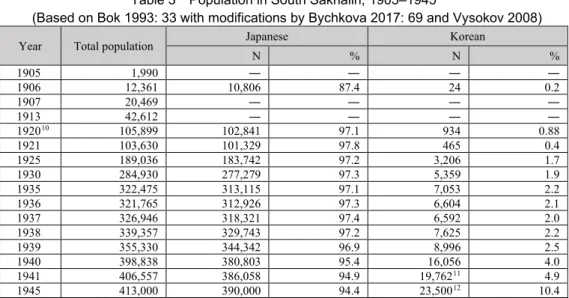
Apart from the Japanese settlers, the population of Karafuto also had a large percentage of Koreans, with an especially dramatic increase seen from 1920 onward (see Table 3). Bok (1993) divides the Sakhalin Koreans of the Karafuto period into four categories: (1) Korean workers and farmers who migrated from the Korean peninsula (often via Japan) in search of a better life, (2) Koreans who migrated from northern Sakhalin during its brief period of Japanese occupation between 1920–1925, (3) Korean political refugees from Korea and Japan, (4) mobilized Korean workers (1939–1945).8 Though the exact figures of Koreans who fall into each category are unknown, rough estimations suggest that those falling into
7 The Tōhoku region consists of 6 prefectures: Aomori, Iwate, Miyagi, Akita, Yamagata, and Fukushima (see Table 2).
8 The exact figures of mobilized workers are controversial among Japanese, Korean, and Russian historians. We will use the number that most Japanese historians agree on, which is around 16,000 (Nakayama 2015).
the categories (1) and (4) were the majority, while those in categories (2) and (3) were the minority in Korean communities in Sakhalin. In terms of the place of origin of these Koreans, Stefan (1973) and Bok (1993) report that most of these Koreans were originally from the southern part of Korea. Thus, we can assume that their Korean language had some of the dialectal features of those regions. Unfortunately, however, no official data have been found that would indicate the exact places of origin of the Koreans who, for various reasons, migrated to Sakhalin.9
Table 3 Population in South Sakhalin, 1905–1945
(Based on Bok 1993: 33 with modifications by Bychkova 2017: 69 and Vysokov 2008)
Year Total population Japanese Korean
N % N %
1905 1,990 ― ― ― ―
1906 12,361 10,806 87.4 24 0.2
1907 20,469 ― ― ― ―
1913 42,612 ― ― ― ―
192010 105,899 102,841 97.1 934 0.88
1921 103,630 101,329 97.8 465 0.4
1925 189,036 183,742 97.2 3,206 1.7
1930 284,930 277,279 97.3 5,359 1.9
1935 322,475 313,115 97.1 7,053 2.2
1936 321,765 312,926 97.3 6,604 2.1
1937 326,946 318,321 97.4 6,592 2.0
1938 339,357 329,743 97.2 7,625 2.2
1939 355,330 344,342 96.9 8,996 2.5
1940 398,838 380,803 95.4 16,056 4.0
1941 406,557 386,058 94.9 19,76211 4.9
1945 413,000 390,000 94.4 23,50012 10.4
Japanese was the dominant language in Karafuto society and was used in all educational institutions (Mamontova 2015). It has been documented that the Japanese language used in Karafuto had features of the Hokkaidō and Tōhoku region dialects (Hirayama 1957).
Moreover, even nowadays in Sakhalin, similar features, such as accentuation patterns, have been found in the Japanese speech of Indigenous people who grew up in Sakhalin during that period (Asahi 2009a, 2009b). Mamontova (2015) observes that most of the Indigenous people retained their native languages while learning Japanese. Some Indigenous children
9 The official population statistics, according to Karafutochō (1934, 1943), provide the number of Japanese settlers by place of origin (by prefecture in Japan), but for foreign settlers, only the number of residents of each nationality is recorded, with no information about their birthplace in their home county.
10 The data from 1920 are taken from Bychkova (2017: 69), as Bok (1993) did not have this year’s data.
11 Stefan (1973) notes that in 1941 there were 150,000 Koreans in South Sakhalin, whereas Rybakovsky (1990) gives a much smaller number—19,800. Karafutochō (1943) gives the number as 19,768. Considering the numbers in the previous and following years, there is a high probability that there was a typographical error in Stefan (1973).
12 This number is taken from Vysokov (2008); Nakayama (2015) also gives a similar number—24,000. Bok’s (1993) data for 1945 are contradictory (he states that there were 43,000 Koreans, which, if added to the Japanese population, would exceed his total population figure). It is not clear where Bok’s (1993) data for the Korean population in 1945 come from.
were attending Japanese schools, while there were also schools specifically for Indigenous children. At the same time, the Japanese language was generally used as a language at home, if one of the spouses was Japanese (Mamontova 2015). By the end of the war, many of the Korean adults had gained a high Japanese language ability. Partly because Korean children were attending the same Japanese schools as Japanese children, and partly because using the Korean language was forbidden (Kuzin 1998), some of these children were not able to natively speak Korean (Kim 2008). However, the Korean language was often spoken with family members at home, so that it was generally maintained until after the end of the war (Kuzin 1998; Kim 2008).
In contrast, the northern part of Sakhalin had a significantly smaller population compared to the southern part (21,000 in 1928; 106,000 in 1941), consisting of predominantly Russians by ethnicity (Rybakovsky 1990; Vysokov 2008). In the meantime, Stalin’s order
“About the Deportation of the Korean Population from the Border Regions of the Far Eastern Krai” was implemented in 1937, which displaced an entire Korean population13 of more than 171,000 people from the Russian Far East to present-day Kazakhstan and Uzbekistan. Among these people were 1,155 Koreans from northern Sakhalin (Bok 1993:
97). As discussed below, 2,000 out of these 171,000 deported Koreans ended up settling in Sakhalin after WWII.
2.3. Russian Sakhalin: Through the Soviet Union to modern-day Sakhalin
In 1945 the southern part of Sakhalin was officially returned to Soviet Union, and most of the Japanese population, 357,000 people, were repatriated to Japan by 1949, while people from all corners of the Soviet Union started to migrate to Sakhalin (Vysokov 2008;
Rybakovsky 1990; Stefan 1973). Due to the significant increase in the Russian-speaking population, the Russian language soon became the dominant language in the society (Mamontova 2015). Among Indigenous people, the majority of the Ainu people and some of the Uilta and Nivhs people were moved to Japan as well (Vysokov 2008). The Korean population, however, was not allowed to return to Korea or go to Japan; these people and their descendants constitute most of the Korean population in Sakhalin today. In the next sections we will sum up the development of the Korean, Japanese, and Indigenous languages in Sakhalin after World War II, up to the present day.
2.3.1. The Korean language
As explained above, there is no official data from the Japanese government that shows the places of origin of the Koreans who, willingly or forcedly, moved to Sakhalin during the Karafuto period. Some historical accounts suggest that Koreans at that time mostly
13 Most of these deported Russian Koreans, known as корё сарам (koryo saram, 고려사람, ‘Korean people’), were North Korean farmers and their descendants, who had been relocating to the Russian Far East starting at the end of the 19th century due to harsh living conditions in their home country (Lankov 2010).
came from the southern parts of the Korean peninsula (Bok 1993; Park 1990). Collecting testimonies from Sakhalin Koreans, indicating where their ancestors came from, will be one of the tasks of our future fieldwork.
After WWII, there were two new waves of Korean migrants in addition to those who already lived in Sakhalin: (1) Koreans from Central Asia (see above) who were brought as teachers for Sakhalin Korean schools (approximately 2,000 were categorized into this group as of 1946; Lankov 2010), and (2) North Korean workers who filled in the labor shortages on the island (6,891 were categorized into this group as of 1957; Bok 1993).
Korean schools were established by the Soviet government for Korean children who did not speak Russian or who wanted to study in their mother tongue. There were 41 Korean schools in Sakhalin in 1958 (Bok 1993). There was also a Korean newspaper, Korean radio station, and numerous Korean libraries, which helped maintain the use of the Korean language. Although Russian was the society’s dominant language, Korean was also maintained in the home, as endogamy was common among Korean immigrants (Kuzin 1998). It is worth noting that the Korean language used in the home was predominantly from South Korean varieties, since their ancestors originally came from the southern part of the Korean peninsula, whereas the language of instruction in Korean schools was from the northern variety, since the teachers were descendants of North Koreans. Thus, there might be evidence of dialect contact between the different varieties of the Korean language.
However, due to the introduction of a policy promoting the Russian language by the Soviet Union, all Korean schools were closed in 1964 (Bok 1993; Lankov 2010). Language shift towards Russian was inevitable. By 1989, only 35.7% of Koreans referred to Korean as their native language (Bok 1993), whereas in 2010 this number dropped to 8.9% (Russia Census 2010).14
2.3.2. The Japanese language
Most of the Japanese settlers were repatriated by the 1950s and the dominant language in the society switched to Russian. However, the Japanese language in Sakhalin was, to some extent, maintained by the Korean and Indigenous people who grew up during the Karafuto period.
There were also a number of Japanese people who had no choice but to remain in Sakhalin after the war. The majority were Japanese women who had already married Koreans, and their children; hence they were not allowed to repatriate to Japan at that time.
After the Soviet-Japan Joint Declaration of 1965 was made, 766 Japanese women and 1,541 of their Korean spouses and children returned to Japan between 1957 and 1959 (Hyun and Paichadze 2016: 231). However, some of them still remained in Sakhalin: according to the
14 As of 2010, the Korean population was 24,993 people, which constitutes 5% of Sakhalin’s population (Russia Census 2010).
Soviet Union Census of 1959, there were 679 people of Japanese ethnicity in Sakhalin (Demoscope Weekly, n.d.). According to the Japan Ministry of Health, Labour and Welfare (1996,15 as cited in Tominari and Paichadze 2019: 7), however, an additional 100 Japanese people returned to Japan between 1963 and 1994. Thus, there is no longer a large number of Japanese people and their descendants still remaining on Sakhalin.
According to Kim (2008), nowadays it is not uncommon for Indigenous people or second-generation Koreans to be able to speak Japanese. It is important to note, however, that this is applicable to a very limited number of people. According to the 2010 Russia Census, there were only 1,566 people who claimed that they could speak Japanese (which was 0.3% of the total population, 497,973, at the time) (Russia Census 2010) and only 219 people who claimed to be ethnically Japanese. It is unclear whether these people were descendants of Karafuto Japanese or more recent expats and their family members, who moved from Japan for business reasons. Even if some were the former, it is not clear to what extent they maintained the Karafuto variety of the Japanese language, since the Japanese people who remained in Sakhalin after the war tended to integrate into the culture and language of a much larger ethnic group on the island: Korean (Tominari and Paichadze 2019: 7). We also have to take into account the influence of modern Japanese culture, such as anime and J-pop, as well as the new economic relationship formed after the fall of the Soviet Union between Sakhalin and Japan, which might have facilitated the spread of a contemporary Japanese variety.
2.3.3. Indigenous languages
The Indigenous people who stayed in Sakhalin gradually shifted to using the Russian language, as it was the most prestigious in the Soviet Union and indispensable in Soviet society (Mamontova 2015). Indigenous languages in Sakhalin are now considered endangered. As of 2010, the Indigenous population of Sakhalin included: 2,290 Nivh, 259 Uilta, 209 Evenki, and 148 Nanai16 residents (Russia Census 2010). Among them only 5.1%
(N=118), 3.5% (N=9), 8.1% (N=17), and 7.4% (N=11), respectively, speak their ethnic language (Mamontova 2015: 212).
2.4. Research questions
Based on the history of language contact in Sakhalin and taking into account the current language situation on the island, this paper addresses the following research questions:
1. To what extent does the Korean language influence the local Russian variety in the form of loanwords? Do Korean-origin loanwords retain some dialectal features? If
15 However, the Japan Ministry of Health, Labour and Welfare was established in 2001, thus Tominari and Paichadze (2019) perhaps meant Japan Ministry of Labour or Ministry of Health and Welfare, that existed in 1996.
16 The Russian Census (2010) records no Ainu residents in Sakhalin as of 2010.
so, which regional dialects do they reflect? Given that there were several waves of Korean immigration into Sakhalin, do they reflect the dialects spoken in the areas where they originally came from (i.e., dialects spoken in South Korea) or the dialects taught by teachers in the Korean schools (i.e., dialects spoken in North Korea)?
2. To what extent does the Japanese language influence the local Russian variety in the form of loanwords? Do Japanese-origin loanwords retain some dialectal features? If so, which regional dialects do they reflect? Furthermore, given the popularity of modern Japanese pop-culture, have modern Japanese words and phrases been newly adopted as loanwords into the local Sakhalin variety of Russian?
3. To what extent and in what way have Korean and Japanese loanwords been adapted and nativized into Russian at the levels of morphology and semantics?
3. Data and methodology
This section describes the kinds of data collected and how the data were collected for this research, and explains the reasons for these choices. The section begins with a brief review of different approaches taken in the literature on loanwords, discussing the pros and cons of a language questionnaire. It then explains the designing of questions in our survey, clarifying what each question attempts to address. The third sub-section will describe our data collection methods as well as the data obtained.
3.1. A language questionnaire
The main data analyzed by previous research on loanwords can be divided into three categories: (1) media data, such as from newspapers (Hashimoto 2007) and television (Ishii 2007); (2) databases, such as corpora (Calude et al. 2017) and dictionaries (together with interviews and observations by Matsumoto 2016 and Matsumoto and Britain 2019); (3) small-scale data collected by researchers, such as interviews (together with observations by Kuyama 2000) and a language questionnaire (together with observations by Nomura 2003).
Analysis based on media and various databases can be useful when dealing with loanwords widely used in a language as a whole. However, the focus of our research is on the local Sakhalin variety of the Russian language, rather than Russian in general, as the history of language contact described above affected specifically the southern part of Sakhalin island. We could not, however, find any dictionary of the Sakhalin dialect of Russian on which to base our analysis. According to the local information obtained, most of the loanwords are thought to be used in oral and informal situations. This means that the use of media as primary sources of data, such as newspapers and television, would not be appropriate for a study of the Japanese and Korean loanwords on Sakhalin. We concluded,
therefore, that as a pilot explanatory study before conducting field research, the most appropriate method would be to use an online questionnaire, as it would help generate a list of loanwords and enable us to observe the general tendencies in the use of loanwords as well as to establish connections with potential research participants for our future fieldwork.
One main advantage of conducting a questionnaire is that it allows us to collect data from a large number of the respondents for a relatively short period of time. The advantage of administering it “online,” on the other hand, is that it does not require us to travel to geographically remote locations, i.e., Sakhalin.
Questionnaires are, needless to say, not without their drawbacks (see Matsumoto 2001 for a detailed discussion). The most serious problem lies in the inaccuracy of responses;
respondents do not, or are not able to, always accurately report on their own language behavior. Gumperz (1982: 62), Milroy (1987: 187), Gibbons (1987: 13), and Labov (1996) all report that, at a practical level, respondents simply may not be aware of the totality of, or certain aspects of, their language behavior which interest linguists.
The second problem concerns the fact that questions dealing with language are often not factual questions, but rather may be questions about subjective experiences that involve the respondents’ beliefs, feelings, and opinions. Therefore, questionnaire answers tend to represent subjective self-judgments of what they think that they do, including what they think they should do and what they wish that they did, rather than objective self-reports of what they actually do (Matsumoto 2001: 91–92).
Online questionnaires also have some disadvantages. For instance, we cannot fully control who is going to respond, so the data obtained through the internet may not be well- balanced in terms of age, ethnicity, gender, and so forth. In particular, the elderly and the poor may not have access to the internet, and hence it could be expected that only a smaller number of these people would participate in our online questionnaire.
To sum up, although we are very much aware of their limitations, questionnaires appeared to be the best option for our purpose, given that there were no existing data on which to base our research. Using the methodology of a questionnaire, in effect, enabled us to collect a large number of Japanese and Korean loanwords from Sakhalin which have never been reported before. We hope this will serve as a useful base for our future research.
3.2. Questionnaire design
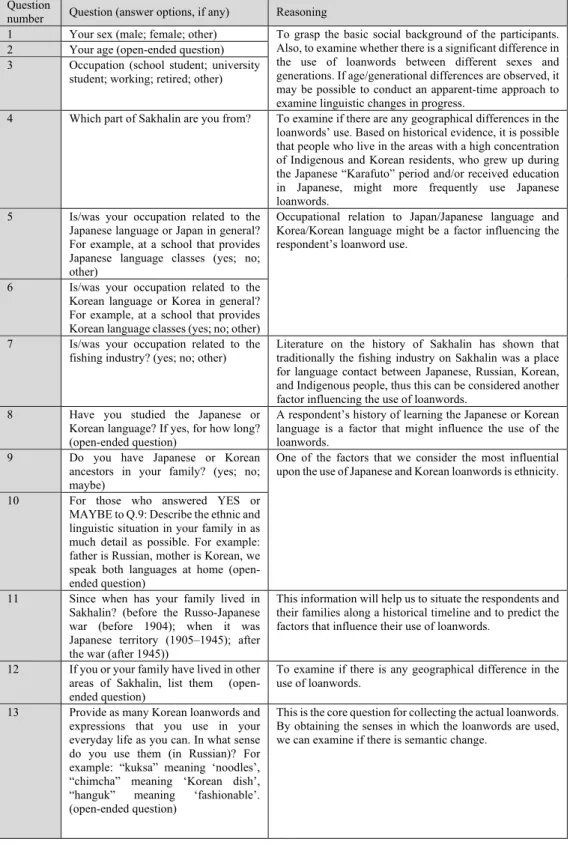
This section provides the list of questions that constituted our internet questionnaire together with our reasoning for choosing these questions. The questionnaire was originally written in Russian as it was aimed at Russian native speakers (see Appendices A and B for the original Russian questionnaire and its English translation, respectively). The questions and the reasoning behind each of the questions are summarized in Table 4.
Table 4 Survey questions and their reasoning Question
number Question (answer options, if any) Reasoning
1 Your sex (male; female; other) To grasp the basic social background of the participants.
Also, to examine whether there is a significant difference in the use of loanwords between different sexes and generations. If age/generational differences are observed, it may be possible to conduct an apparent-time approach to examine linguistic changes in progress.
2 Your age (open-ended question) 3 Occupation (school student; university
student; working; retired; other)
4 Which part of Sakhalin are you from? To examine if there are any geographical differences in the loanwords’ use. Based on historical evidence, it is possible that people who live in the areas with a high concentration of Indigenous and Korean residents, who grew up during the Japanese “Karafuto” period and/or received education in Japanese, might more frequently use Japanese loanwords.
5 Is/was your occupation related to the Japanese language or Japan in general?
For example, at a school that provides Japanese language classes (yes; no;
other)
Occupational relation to Japan/Japanese language and Korea/Korean language might be a factor influencing the respondent’s loanword use.
6 Is/was your occupation related to the Korean language or Korea in general?
For example, at a school that provides Korean language classes (yes; no; other) 7 Is/was your occupation related to the
fishing industry? (yes; no; other) Literature on the history of Sakhalin has shown that traditionally the fishing industry on Sakhalin was a place for language contact between Japanese, Russian, Korean, and Indigenous people, thus this can be considered another factor influencing the use of loanwords.
8 Have you studied the Japanese or Korean language? If yes, for how long?
(open-ended question)
A respondent’s history of learning the Japanese or Korean language is a factor that might influence the use of the loanwords.
9 Do you have Japanese or Korean ancestors in your family? (yes; no;
maybe)
One of the factors that we consider the most influential upon the use of Japanese and Korean loanwords is ethnicity.
10 For those who answered YES or MAYBE to Q.9: Describe the ethnic and linguistic situation in your family in as much detail as possible. For example:
father is Russian, mother is Korean, we speak both languages at home (open- ended question)
11 Since when has your family lived in Sakhalin? (before the Russo-Japanese war (before 1904); when it was Japanese territory (1905–1945); after the war (after 1945))
This information will help us to situate the respondents and their families along a historical timeline and to predict the factors that influence their use of loanwords.
12 If you or your family have lived in other areas of Sakhalin, list them (open- ended question)
To examine if there is any geographical difference in the use of loanwords.
13 Provide as many Korean loanwords and expressions that you use in your everyday life as you can. In what sense do you use them (in Russian)? For example: “kuksa” meaning ‘noodles’,
“chimcha” meaning ‘Korean dish’,
“hanguk” meaning ‘fashionable’.
(open-ended question)
This is the core question for collecting the actual loanwords.
By obtaining the senses in which the loanwords are used, we can examine if there is semantic change.
14 Provide examples of phrases in which you use Korean loanwords. For example: “We often eat kuksu17”, “We don’t have chimchi at home”. (open- ended question)
To examine how loanwords are adapted into the Russian language. For example, loanwords that have entered Russian recently and are still considered foreign would not be either accompanied by Russian noun endings or change depending on the inflection/conjugation. Likewise, loanwords that have been established as a part of Russian would have Russian endings in different case inflections.
15 In what situations do you use Korean loanwords? For example: “kuksa”—in everyday life, “hanguk”—at school with classmates who understand Korean (open-ended question)
To observe the social settings and situations where loanwords are used, and to identify some of the social factors involved in the loanword use.
16 If Korean loanwords have an alternative in Russian, why do you use Korean loanwords? (open-ended question)
To examine what motivates the respondents to use loanwords.
17 Provide as many Japanese loanwords and expressions that you use in your everyday life as you can. In what sense do you use them (in Russian)? For example: “sempai”—senior student,
“kawaii/kawainyj”—cute (open-ended question)
Same as Q.13
18 Provide examples of phrases in which you use Japanese loanwords. For example: “I don’t have any sempayev”,
“I bought several kawainyh stickers”
(open-ended question)
Same as Q.14
19 In what situations do you use Japanese loanwords? For example: “sempai”—at school, “kawaii/kawajnyj”—at school with classmates who understand Japanese language (open-ended question)
Same as Q.15
20 If Japanese loanwords have an alternative in Russian, why do you use Japanese loanwords? (open-ended question)
Same as Q.16
21–27 Choose the most appropriate option for each word:
21. “akiadzi/akiyadzi” (type of fish).
22. “kamikiri” (type of fish)
These questions will reveal if any of those fish-related loanwords that might have entered Indigenous languages as a result of language contact between different ethnicities in the fishing industry survive in the local variety of Russian.18
17 As explained below (see Section 4), Russian elements are represented in italics in this article.
18 Related to Q.7, Asahi (2012: 90) claims that 20 Japanese words related to the fishing industry (mostly the names of local fish) have entered the Indigenous languages in Sakhalin, quoting three previous studies on the culture and language of the Uilta and Nivh people, namely Hattori (1952), Yamamoto (1968) and Tangiku (2001). Our meticulous examination of the three sources written in Japanese reveals that that none of them describe these words as Japanese loanwords used in the Indigenous languages. The focus of Hattori (1952), Tangiku (2001), and Yamamoto (1968) in the studies previously referred to was on the Indigenous names of local fish; so, the Japanese names of given fish were simply provided as “those of equivalent fish in Japanese”. In addition to his notes on the Indigenous names of fish, however, Yamamoto (1968) explains that six Japanese fish names (only 3 out of 6 are included in the list by Asashi 2012) are dialectal forms used generally in Sakhalin. As the director of the Karafuto Museum, Yamamoto resided in Sakhalin and conducted fieldwork during the Karafuto regime. Therefore, it seems reasonable to assume that he familiarised himself with a Japanese variety spoken in Sakhalin through his social life during his residency on the island.
This implies that he would have been familiar enough to know that these Japanese fish names were coined and used generally in a Japanese variety of Sakhalin, rather than in the Indigenous languages. While it is possible that Japanese language vocabulary items for local fish were coined in Sakhalin during the period of the Japanese Karafuto regime (see 2.2) or, given the intensive contact between Sakhalin’s Indigenes, Ainu and Japanese through fishing, even before 1905 (see 2.1), it does not automatically follow that such words replaced, or coexisted alongside the indigenous names,
23. “hanare” (related to fishing) 24. “horiba” (related to fishing) 25. “goso-goso-garei/gosyo-garei”
(type of fish)
26. “bajya/ban’ja” (related to fishing) 27. “yakeboshi/yakebushi” (type of fish)
(have never heard; heard, but don’t know what it means; know what it means, but don’t use; use)
28 If you have any ideas that were not covered in this survey, write them here (open-ended question).
To eliminate the possibility of losing any aspects of loanwords or factors influencing the loanwords’ use that were not considered by the authors.
29 If you agree to cooperate in further research on this subject, write your name and e-mail here.
To establish connections with potential research participants for our future fieldwork.
3.3. Data collection
Initially, the authors had only one connection in Sakhalin: a friend of the first author who was born and raised in Sakhalin and who is ethnically Russian. Before we distributed our online questionnaire, we asked her and her friend of Korean descent to fill out our trial questionnaire and give us feedback. Accordingly, some of the questions were refined in order to reflect the local context, while some example responses were added in order to encourage the respondents to answer the questions.
We then conducted our online survey from September 23 to October 23, 2018. Our questionnaire was created in Google Forms and sent out to several different websites, which Sakhaliners are thought to use. The main service used was http://vk.com,19 particularly the communities of Sakhaliners on that website. Another service was http://sakh.com/—a forum that is actively used in Sakhalin. After one month, we obtained 261 responses.
However, five responses were identified as invalid due to two reasons: the same person answering twice (2 cases) and the questionnaire being filled in with clearly wrongful information, most probably as a joke (3 cases). Therefore, these responses were excluded from our analysis. Thus, 256 valid responses are analyzed in this paper.
and continue to be used in the island’s Indigenous languages. Unfortunately, however, it is not clearly stated whether Asahi (2012) collected his own data and empirically confirmed the use of these Japanese names of local fish as loanwords in Indigenous languages: neither the data nor methodology on loanwords are mentioned in his book.
However, even if these Japanese fish names were adopted as loanwords in the Indigenous languages, whether they have been transferred to Russian has yet to be investigated. Therefore, we decided to examine these six words in order to verify whether or not Japanese words related to the fishing industry entered the Russian language as the result of historical contact between Sakhalin’s Indigenes, Ainu and Japanese through fishing during the Karafuto regime or even before 1905. We have added one more word, bajya/ban’ya listed in Asahi (2012: 90) but not found in any of these three mentioned studies, because the archaic Japanese word ban’ya ‘fishing house’ is often mentioned in historical accounts of Sakhalin. Thus, these seven words are examined in our survey questions 21–27.
19 This is a Russian social media site, similar to Facebook.
4. Analytical framework
This paper employs the following analytical frameworks. First, Thomason and Kaufman (1988) and Thomason (2001) introduce the concept of a “contact-induced borrowing scale,” which provides a framework for identifying the degree of borrowing depending on the intensity of the language contact. They divide the intensity of language contact into four stages: (1) casual contact—only non-basic vocabulary borrowed (most often nouns, but also verbs, adjectives, and adverbs); (2) slightly more intense contact—still non-basic vocabulary borrowed (content/function words); slightly structural borrowing (new phonemes realized by new phones, but in loanwords only); (3) more intense contact—basic vocabulary also borrowed; moderate structural borrowing (addition of new phonemes even in native vocabulary; syntax; morphology); and (4) intense contact—continuing heavy lexical borrowing in all sections of the lexicon; heavy structural borrowing (Thomason 2001: 70–71).
In terms of the ease of borrowing, the scale moves from lexical items through phonology to syntax, with morphology the most difficult to borrow (Thomason 2001: 96–97) (cf.
Romaine 1995). Important to our analysis is that: (a) among lexical items, nouns are most easily borrowed; this is also known as “borrowability” (van Hout and Muysken 1994), which claims that in the process of borrowing from one language to another, the part of speech that is the most easily borrowed is nouns, followed by verbs and adjectives. And (b) the distinction between categories 2 and 3 for lexical borrowing concerns whether basic vocabulary is borrowed (category 3) or not (category 2). Here “basic vocabulary” refers to
“the kinds of words that tend to be present in all languages” (Thomason 2001: 70) such as body parts, numbers, words that express feelings and senses, and baby talk.
In their studies of Japanese loanwords in other former Japanese territories in the Pacific, Matsumoto (2016) and Matsumoto and Britain (2019) categorize Japanese loanwords in Palauan into the third category of Thomason’s (2001) contact-induced borrowing scale, given that some basic vocabulary (e.g., body parts, nursery words, and words that express feelings and senses) have been borrowed. In their studies of Korean loanwords used by Korean immigrants and their descendants in Japan, on the other hand, Kim (2001) and Kim (2005) point out that loanwords related to Korean food and culture (e.g., funerals, address terms for family and relatives, etc.) have been used in Japanese conversation. This paper applies both the concepts of “contact-induced borrowing scale” and “borrowability” to loanwords in Sakhalin Russian in order to examine what types of loanwords occur (for example, food-related borrowings or whether core basic vocabulary has been borrowed or not) as well as what parts of speech are borrowed (for instance, whether only nouns or also other parts of speech have been borrowed).
Second, Daulton (2008) provides four directions of semantic shift that can happen during the process of borrowing: a word can (1) expand its meaning, (2) narrow it down, (3) acquire a negative meaning, or (4) acquire a positive meaning. These directions are called (1) semantic broadening (extension), (2) semantic narrowing (restriction/
specialization), (3) semantic pejoration (downgrading), and (4) semantic amelioration (upgrading), respectively. This paper investigates whether and in what way the semantic meanings of Japanese and Korean loanwords have been changed in the local context.
Third, the phenomenon of hybridization, also known as loan-blending, is when a word borrowed from another language is mixed together with a word from the target language and is used as a compound (Daulton 2008). This paper considers whether loan-blends are observed, and if so, what language combinations they have come from (i.e., between Japanese and Korean, between Japanese and Russian, between Korean and Russian, or among these three languages). Note that in cases where Russian noun endings, which change depending on the case inflection, have been combined with Korean or Japanese loanwords, this paper shows them in italics (see also footnote 17).
5. Data analysis
In this section we will first describe the background of the respondents in order for us to analyze the data on loanwords in relation to the users’ background. This is an important step since although we often analyze language as if it were “an entity independent of its speakers and writers,” it is actually “speakers and writers” who “change the way they use the language,” rather than the “language itself chang[ing]” (Holmes and Wilson 2017: 214).
Thus, it is crucial to identify who uses Korean and Japanese loanwords. We will then both qualitatively and quantitatively examine the use of Korean and Japanese loanwords in the Sakhalin variety of Russian, incorporating information on users’ backgrounds.
5.1. Analysis of the respondents’ backgrounds
Before analyzing the data on loanwords themselves, it is important to examine the backgrounds of the respondents: namely, information about their age, place of residence, occupation, ethnicity, connection to Japan and Korean (i.e., experience of learning these languages, the use of them at work), and the recentness of their residency in Sakhalin (i.e., whether they experienced the Japanese Karafuto regime or moved to Sakhalin after the war).
We will analyze the backgrounds of the 256 Sakhaliners who filled out our questionnaire.
5.1.1. Age, place of residence, and occupation
Figure 2 illustrates the age distribution of the respondents. It ranges from 16 to 80 years old, with more than half of the respondents in the 20- to 39-year-old age groups. This was expected, as these age groups tend to be heavy internet users. The small number of the
elderly (those older than 70) means that our data may not include those who have firsthand experience with the Japanese administration of the southern part of Sakhalin. Additionally, about 70% (N=180) of the respondents were female and almost 30% (N=75) male. There was no significant difference in the use of loanwords between the female and male population or between people of different age groups.
Fig. 2 Number and proportion of respondents by age
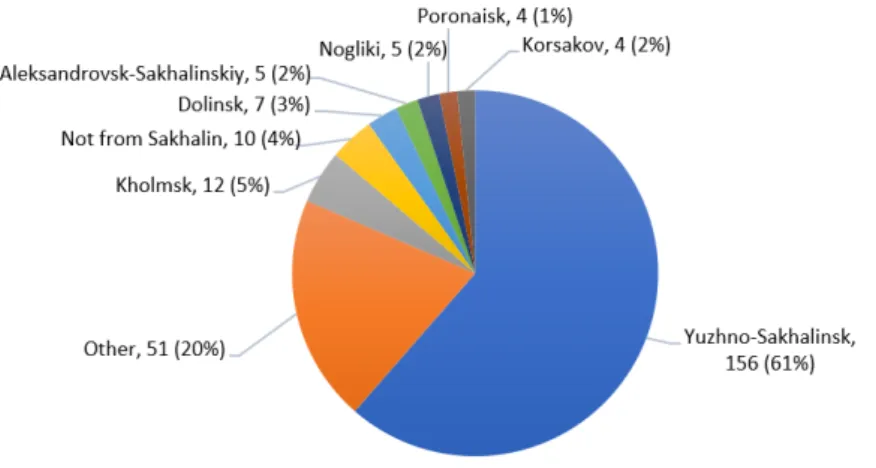
Fig. 3 Number and proportion of respondents by place of residence
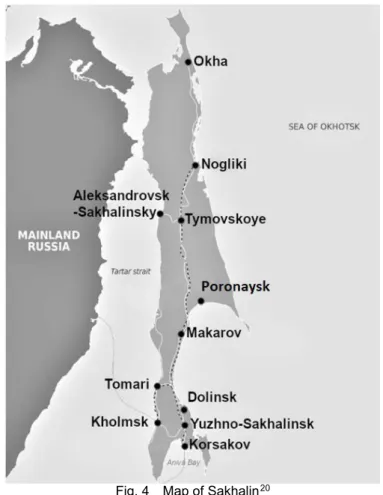
Fig. 4 Map of Sakhalin20
Figure 3 presents the distribution of the respondents’ places of residence. More than 60%
(N=156) of the respondents are from the regional capital—Yuzhno-Sakhalinsk, and the majority are from the southern part of the island (see also Figure 4). Furthermore, 82.3%
(N=215) of the respondents are working, while less than 7% (N=18) are university or school students.
One of the hypotheses we had before conducting the survey was that people who come from places with a high concentration of the Indigenous population will use more Japanese loanwords, given that the Indigenous people stayed in Sakhalin during Karafuto period.
However, this hypothesis did not show to be true in our data, most probably due to its scarcity: although a village Nogliki is said to have large population of Indigenous people (Mamontova 2015), there were only five respondents from that village and no difference was found between the use of Japanese loanwords among these respondents compared to others.
20 Created by the authors based on https://commons.wikimedia.org/wiki/File:Sakhalin_map.svg (Accessed: 2019-08- 26)
5.1.2. Ethnicity, connection to Japan and Korea, migration to Sakhalin
Figure 5 illustrates that nearly 40% (N=98) of the respondents have studied either Japanese or Korean, which is quite high compared to other regions of Russia. Furthermore, 16% (N=41) of respondents reported having a connection to Japan or the Japanese language in their occupation (at school or at work), and 17% (N=43) to Korea or the Korean language.
This can be explained by the geographical, historical, and cultural closeness of Sakhalin to both countries.
Fig. 5 Number and proportion of respondents by experience with studying Japanese and/or Korean
Fig. 6 Number and proportion of respondents by ethnicity
As can be seen from Figure 6, 17% (N=43) of our respondents are ethnically Korean, while 3% (N=7) are mixed Korean and Japanese. This number is higher than the percentage of Koreans living in Sakhalin according to the 2010 Russian Census, 5% (N=24,993),
which can be attributed to the Korean population having a greater interest in filling out this questionnaire due to its subject matter.
In terms of the time of migration to Sakhalin, 77% (N=197) of respondents claimed to have moved to Sakhalin after the war. This means that most of the respondents have no firsthand experience with the Japanese regime on the island. Among those who answered
“during the Karafuto period” or “before 1905,” most of these respondents are of Korean ethnicity. This shows that such sociohistorical factors as ethnicity and period of migration go hand in hand.
5.2. Analysis of loanwords
Through the online questionnaire, which received 256 valid responses, 177 Korean- originated and 92 Japanese-originated words were identified.21 Interestingly, only 5 of the 256 respondents claimed not to use any Korean words, while more than half of the respondents (N=140) answered “I do not use Japanese loanwords.” These findings suggest that Korean loanwords have been more widely accepted by Sakhaliners than Japanese loanwords. This makes sense given the history of almost all former Japanese settlers having been expatriated to Japan while in contrast most of the Korean immigrants have remained on the island. Furthermore, it is natural that the demographics of the respondents from whom data were collected influenced the results. As pointed out above, the distributions of the respondents’ age, ethnicity, and place of residence all indicate that our respondents may not include the Indigenous residents who have experienced the Japanese Karafuto period.
Therefore, again, it is reasonable to expect a smaller number of Japanese loanwords as well as a large number of non-users of Japanese loanwords. Thus, although previous sociolinguistic research on Sakhalin was rather restricted to Japanese language contact (e.g., Asahi 2012), this suggests that it is fruitful for researchers to expand their scope to include the Korean language contact in Sakhalin if one wishes to fully understand Sakhalin’s history of language contact and its linguistic outcomes.
5.2.1. Analysis of Korean loanwords
When we considered all social factors investigated in this study, ethnicity and the period of migration to Sakhalin turned out to be the most powerful factors influencing the use of Korean loanwords. To be more precise, Figure 7 shows that (a) Sakhaliners with Korean
21 Korean and Japanese loanwords that had different spellings but the same meaning were considered variants of the same word (e.g., мёгкук (myogkuk), миеккуг (miyokkug), and миенгук (miyenguk), all meaning ‘a Korean soup with seaweed’). However, the same word was counted twice if 1) the difference in spelling was seen as having dialectal influence (e.g., хальмони (hal’moni), хальмуни (hal’muni) meaning ‘grandmother’) or if 2) two different meanings were given by two different people, as they could be analyzed as belonging to different semantic categories or domains of use (e.g., хангук (hanguk) meaning ‘a fashionable person’ and meaning ‘a Korean person’).
ancestors whose families came to Sakhalin during the Karafuto period22 tend to use a larger number of Korean loanwords than people of other ethnicities, while Figure 8 illustrates that (b) this group also uses a much wider variety of Korean loanwords in terms of the range of semantic domain (within one domain and between different domains), compared to Sakhaliners with non-Korean ancestors.
Fig. 7 Number of Korean loanwords provided by respondents according to ethnicity
Fig. 8 Distribution of Korean nominal loanwords23 provided by Korean and non-Korean Sakhaliners, by semantic category24
22 Among our respondents there were no recent expats from South Korea due to two reasons: (1) the questionnaire was in Russian so there is a high possibility that recent Korean expats would not have been able to respond, and (2) all Sakhaliners with Korean ancestors claimed that their families came to Sakhalin during the Karafuto period in Q.11.
23 We chose to analyze the semantic categories of nouns only, due to other parts of speech being difficult to put into the same semantic categories.
24 The words in the category “other” were попо (popo, ‘kiss’), урималбасон (urimalbason, ‘Korean TV program’), сомбэ (sombe, ‘senior’), хангул (hangul, ‘Korean alphabet’), and тон (ton, ‘money’) which did not fit into any other category.
First, there is a clear difference in the semantic domains where the Korean loanwords are used among Korean versus non-Korean Sakhaliners: non-Korean Sakhaliners mainly use words that refer to Korean dishes and cuisine, while Korean Sakhaliners use words referring to Korean cuisine, as well as household items and names of relatives. Interestingly, this tendency accords with the findings of previous studies that Korean cuisine and address terms for relatives are borrowed into the Japanese conversation of Korean immigrants and their descendants in Japan (Kim 2001, and Kim 2005).
Moreover, the vast majority of non-Korean Sakhaliners (94%, N=194) claimed to use Korean loanwords in their everyday life, while only a small number of them (5%, N=7) reported using them only at home with family or with people who understand Korean. In contrast, a large number of Korean Sakhaliners (56%, N=28) claimed to use Korean loanwords mainly at home or with people who understand Korean, while approximately the other half (44%, N=22) use them in everyday life.
Figures 9 and 10 illustrate that there is also a difference in what parts of speech the Korean loanwords derive from between ethnic groups: non-Korean Sakhaliners mostly gave examples of nouns (N=38), with only 3 interjections, 1 adverb, 1 adjective, and no verbs. Korean Sakhaliners, on the other hand, gave more examples of adjectives (N=7), adverbs (N=2), verbs (N=5), and interjections (N=12) than non-Korean Sakhaliners, although they also use nouns the most (N=81). This suggests that within Sakhalin, there may be different degrees of the “borrowability” (van Hout and Muysken 1994) of Korean loanwords depending upon the speakers’ ethnicity.
Fig. 9 Distribution of Korean loanwords25 provided by Korean Sakhaliners, by part of speech
25 Here and in Figure 10, all of the variants of the same word (variations in meaning or spelling) were counted as one word (as they belong to the same part of speech and are used in the same way in a sentence); hence the different total compared with the total number of Korean loanwords, 177 (see Section 5.2.).
Fig.10 Distribution of Korean loanwords provided by non-Korean Sakhaliners, by part of speech
Below are some examples of words used by Korean and non-Korean Sakhaliners:
Example 1: Korean loanwords from Korean Sakhaliners
куксу26 (kuksu) бабсот (babsot) немси (nemsi) абуди (abudi) 국수 (kuksu)27 밥솥 (bapsot) 냄시 (naemsi) 아부지 (abuji) ‘noodle’ ‘rice cooker’ ‘smell’ (n.) ‘father’
мощиссо (moshisso) айгу (aigu) теба- (teba) оппа (oppa) 멋있어 (meosisseo) 아이구 (a-i-goo) 대박(daebak) 오빠 (oppa)
‘cool’28 ‘oh’ ‘Awesome!’ ‘older brother’29
Example 2: Korean loanwords from non-Korean Sakhaliners кукса (kuksa) чимча (chimcha)
국수 (kuksu) 짐치 (jimchi) ‘noodles’ ‘kimchi’
Another significant finding was the presence of dialectal features in some Korean loanwords in Sakhalin. For example, different respondents provided two variants of the word ‘grandfather’, namely (a) харабоди (harabodi) and (b) харабуди (harabudi). In
26 From here on, we present loanword examples in the following manner: loanword in Russian (reading in the Roman alphabet), original Korean word (reading in the Roman alphabet), ‘English translation of the meaning of the original Korean word.’
27 For the transliteration of Korean words we used the Revised Romanization of Korean (see
https://web.archive.org/web/20070916025652/http://www.korea.net/korea/kor_loca.asp?code=A020303). (Accessed:
2019-08-26)
28 The word 멋있어 refers to ‘cool’ as in ‘cool person,’ not ‘cool air.’
29 오빠 (oppa) is often used to refer to K-pop idols or to a male who is older than a young female.
Standard Korean, it is hal-abeoji (할아버지), while in southern dialects of South Korea (used, for example, in Gyeongsang, Gyoonggi, Chungcheong, and Jeolla provinces) it is hal-abuji (할아부지) according to the National Institute of the Korean Language (n.d.).
There were also four variants (two pairs) of the word meaning ‘kimchi’: (a) чимча (chimcha)/чимчи (chimchi)—one of either of these variants was mentioned by 126 respondents, and (b) кимча (kimcha)/кимчи (kimchi)—one of either of these variants was mentioned by 80 respondents. In Korean, the standard variant of this word is 김치 (kimchi), with 짐치 (jimchi) being a dialectal variant spoken in Gangwon, Gyeongsang, Gyoonggi, Jeolla, Chungcheong, and North Hamggyong provinces on the Korean peninsula (the southern and northeastern parts of South Korea and the northeast parts of North Korea).
Чимча (chimcha) and кимча (kimcha) are thought to be the “Russianized variants”, as they have a female noun ending -a.30
The Korean loanword that means ‘noodles’ and that is widely used in Sakhalin (71%, N=183) of respondents gave it as an example of a Korean loanword) also had two variants:
one is the Russianized word кукса (kuksa), given by 175 respondents, and the second is куксу (kuksu), given by 8 respondents. The original Korean word is 국수 (kuksu), which is similar to the latter variant.
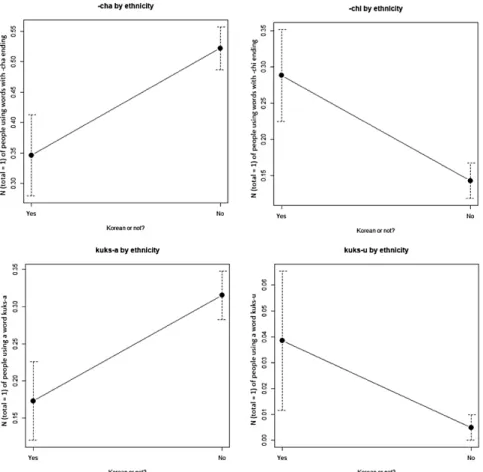
The preliminary results from our analysis of the four variants of “kimchi” and two variants of “kuksu” by age, gender, and ethnicity show that there is a significant difference31 in the use of the “non-Russianized” variants (кимчи (kimchi), чимчи (chimchi), and куксу (kuksu)) and the “Russianized” variants (кимча (kimcha), чимча (chimcha), and кукса (kuksa)) between different ethnic groups. Korean Sakhaliners preferred to use the former type, while non-Korean Sakhaliners prefer the latter (see Figure 11).
These potential variants of the names of these two food items have great value for further research of Sakhalin’s language situation. Though the answers to our online questionnaire are written in Russian, we can observe that there is variation in the orthography of Korean loanwords. However, it is not certain how these words are actually pronounced by Sakhaliner speakers with different ethnic backgrounds. Our future fieldwork will (a) investigate the place of origin of ethnically Korean residents who arrived in Sakhalin at different points in time during the course of Sakhalin’s language contact history, which, it is hoped, will make this unfortunate gap in the historical data smaller; and (b) collect actual speech data from both Korean and non-Korean residents on Sakhalin to analyze Korean dialect contact and its linguistic outcomes.
30 Kimchi in Russian can be translated as ‘pickled cabbage’, with cabbage being a female noun. In the Russian language it is not uncommon to transfer the female gender endings to loanwords.
31 We conducted a t-test in R, P=0,036.
Fig. 11 Difference in use of “Russianized” variants and “non-Russianized” variants by ethnicity
5.2.2. Analysis of Japanese loanwords
When we considered all social factors investigated in this study, in the case of Japanese loanwords, a slight difference was found between the respondents who have studied Japanese and those who have not: those who have studied Japanese responded with 2.6 words on average (N=25), whereas people who have not gave 1.1 words on average (N=163).
As Figure 12 illustrates, what was clearly noticeable was that most of the Japanese loanwords were connected to traditional Japanese culture (e.g., кимоно, kimono, 着物,
‘kimono’), Japanese manga and anime (e.g., отаку, otaku, オタク, ‘nerd’), or Japanese cuisine (e.g., катцудон, katsudon, カツ丼, ‘rice bowl with pork cutlet’).