Identifying Policy Puzzles for Discourse Analysis: The Vision of Education in the Promotion of International Development
Ian Wash
Abstract
This research brief outlines how I identified a policy puzzle that initiated a political discourse analysis. The brief, inspired by interpretive policy analysis that uses unexpected discoveries in policy fields as a precursor to deployment of the discursive approach, is divided into two parts. First, it shows how background research into a question about the ability of education to resolve development issues and reduce poverty in poor countries allowed me to unearth a policy dilemma in the field of international education. Driven by the question of whether education is a ‘magic bullet’
for development, I explore a critical debate about the methodological and theoretical basis of a dominant argument.
Placed in the wider context of institutional goals, I explain how this conflicted dispute led me to an unanticipated discovery: that the vision of international education, previously thought of as a harmonious liberal pact, could actually be a narrative riven by tension over whether education was an economic good. The final part summarises the discoveries made and reflects on my breakthrough as a result of answering the initial question. I conclude by using the identified puzzle to generate a research question capable of guiding a discourse analysis into the torn vision of international education.
Keywords: applied linguistics, discourse analysis, international education, policy analysis
Introduction
The relatedness of language and politics has become more apparent through the field of discourse studies: an interdisciplinary juncture where the political-turn in linguistics meets the ideational turn in policy research. A prerequisite to undertaking a robust political discourse analysis is the identification of a significant policy puzzle. Yanow (2000) makes the point that puzzles often rest on the difference between what a researcher expects to find and what they actually experience from their primary contact with the policy field (p. 8). In other words, it is the dilemma that comes to light when the observed reality appears ‘different’ from that originally perceived. This article explains the initial research process I went through to discover such a mismatch in the literature on education for development. First contact with the puzzle was made whilst seeking an answer to a question that troubled me: What are some reasons why education might not be a ‘magic bullet’ for development and poverty reduction?
My expectation was that it would be difficult to find any logical explanations to contradict the notion of education as panacea for socio-economic problems in poorer countries. My previous reading of policy reports by international organizations and donor agencies seemed only to confirm what I thought was a global consensus: that education was a ‘magic bullet’ for national development.
However, the challenge of the ‘magic bullet’ question forced me to take a critical view of these reports and explore a limited body of background literature. Answering the question enabled me to engage with two unforeseen aspects of the field of study. Firstly, that unquestioned support for education as a
‘magic bullet’ was in fact misguided. Secondly, and perhaps most importantly, that these ‘differences’
were part of a wider and more fascinating policy puzzle about the vision of international education that
could potentially be resolved through discourse analysis.
This essay is divided into two parts. The first part attempts to answer the ‘magic bullet’ question by surveying a small sample of institutional and academic research. It takes a careful examination of why arguments in support of education as a development remedy may in fact be mistaken, and critically assesses the empirical evidence that warned against educational expansion in low-income countries. The theoretical basis of the debate is critically examined along with relevant institutional issues that cast doubt on education as a ‘magic bullet.’ Part two reflects on how, in answering this question, my expectations of what I thought I would find were proven wrong. It also describes how this reconsideration of what I originally thought was ‘right’ generated a research question to guide a piece of discourse analytical research.
Answering the ‘Magic Bullet’ Question
Proponents of education as a ‘magic bullet’ provide a range of evidence for investment in schooling that is seemingly difficult to argue against given the moral nature of the issue. Improved productivity, increases in national income, economic growth, technological advances, and lower levels of inequality are all put forward as advantages of more education (Birdsall, Ross, & Sabot, 1995, p.
502). In addition, Rose (2006) suggests that education delivers a range of social benefits such as better health and reduced fertility rates (p. 163).
Claims that education can resolve poverty issues and boost development through economic growth are contested. At the heart of this controversy is the way that Rates of Return (RoR) analysis, a form of cost-benefit analysis commonly used by policy analysts, tends to produce evidence that contradicts the ‘magic bullet’ argument. Returns analysis is a favored analytical tool of researchers who explain education through Human Capital Theory (HCT), defined as the acquisition of skills and knowledge by individuals resulting in greater productivity that subsequently raises incomes and increases economic growth (Woodhall, 2001, p. 6951). That the policies of international institutions such as the World Bank and UN agencies are largely influenced by HCT is reflected in way they base investment decisions on economic reasoning (Bennell, 1996, p. 184).
Bullet Stuck in the Chamber: RoR
A major challenge to the ‘magic bullet’ argument questions the supposed impact of education on economic growth. This section examines how RoR analysis contributes towards doubts over whether education could resolve development and poverty issues.
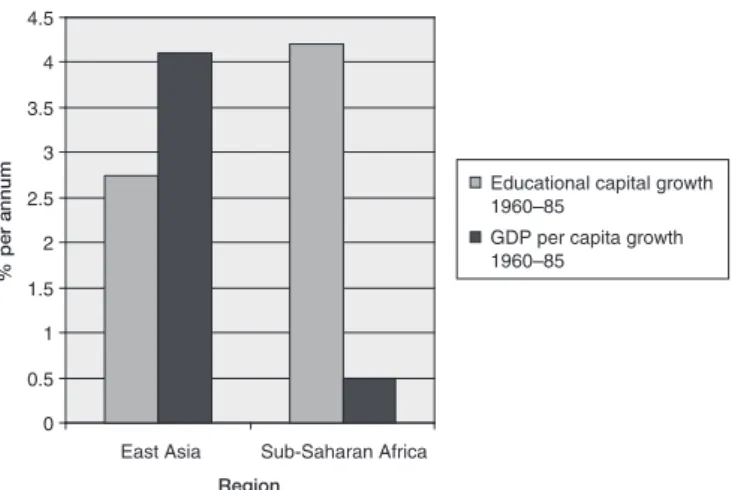
Pritchett uses regression analysis to show that the estimated impact of years of schooling on GDP growth per worker is in fact small and negative (Pritchett, 1997, p. 6). These findings weaken the link between education and economic growth (Bils & Klenow, 2000, p. 1160). This trend was especially prevalent in the context of Sub-Saharan Africa where investment in education has not stimulated growth, as highlighted in literature that draws comparisons with the experience of East Asia. As Easterly (2002) points out, it is in this contrast that the lack of association between education and GDP per capita growth becomes most evident (p. 73). Figure 1 illustrates this comparison by presenting statistics for both regions. It shows that despite a huge education expansion in Sub- Saharan Africa relative to East Asia between 1960 and 1985, the former experienced only a fraction of the growth enjoyed by the latter.
Central to this argument is the distinction between the private and social returns to schooling
which questions continued public investment in post-primary education. To return to Pritchett, RoR
analysis indicates that higher levels of education lead to higher wages but do not increase output or productivity and therefore will not result in GDP growth (Pritchett, 1997, p. 29). Therefore, although education attainment increases consumption and demand for consumer goods, a highly-skilled labor force will not be utilized to drive productivity and supply unless it can be put to work by a dynamic, entrepreneurial, and diverse economy. Education economists at the World Bank have used this evidence as justification to withhold donor funding beyond basic education in poorer countries (Psacharopoulos & Patrinos, 2002, p. 1). Such empirical evidence, supportive of HCT, enables the governments of powerful Western donors and international organizations to legitimise reductions in public spending on schooling, often accompanied by the promotion of private sector provision.
Empirical evidence produced by RoR analysis challenged the conventional wisdom that education was a ‘magic bullet’ for promoting development. However, the validity and reliability of data used in returns estimates were themselves a source of controversy and brought these findings into dispute.
Dislodging the Jammed Bullet: Problems With RoR
Sampling errors, methodological discrepancies, and data reliability issues in returns analysis contribute towards undermining the above claim that education is not a remedy to underdevelopment.
Since returns analysis is consulted in the policymaking process, it is only right that the validity of RoR and investment decisions based in these estimates be scrutinized.
In macro-level studies, the sampling frame can skew data and distort findings on returns to education. In many studies, a representative population sample at the household level was preferred to measure RoR. Although in reality, sampling procedures were often prone to an urban bias as they targeted large firms which resulted in the wages recorded being significantly greater than the average market wage (Psacharopoulos & Patrinos, 2002, p. 2). Many influential studies employing RoR that guided policy decision making repeated such sampling errors. Wages were further distorted in the way that formal sector employees contacted in samples only represented a small proportion of the overall labor market (Bennell, 1996, p. 188). Informal workers that made up the majority of the labor market in developing country studies were largely excluded. Furthermore, samples that focused purely on the formal sector tended to exclude female workers in low-income countries, many of whom are unwaged or work in the informal sector (Schultz, 2002, p. 208).
Methodological discrepancies have also been flagged up as being potential culprits of distortion, especially when estimating private returns to education. Mainstream education economists
Figure 1. Where did all the education go in Sub-Saharan Africa? Source: Easterly (2002, p. 75).
0 0.5 1 1.5 2 2.5 3 3.5 4 4.5
% per annum
Sub-Saharan Africa East Asia
Region
Educational capital growth 1960–85
GDP per capita growth 1960–85