Tank-Experiment on the Biting Behaviour of
Fish in Response to the Inedible Lure
Permeated with the Extract of Food
著者
KAWAMURA Gunzo, KAWASHIMA Yoshinori
journal or
publication title
鹿児島大学水産学部紀要=Memoirs of Faculty of
Fisheries Kagoshima University
volume
22
number
1
page range
143-146
別言語のタイトル
餌エキス付き擬餌に対する魚の食いつき行動
Vol. 22, No. 1, pp. 143—146 (1973)
Tank-Experiment on the Biting Behaviour of Fish in Response
to the Inedible Lure Permeated with the Extract of Food
Gunzo KAWAMURA and Yoshinori KAWASHIMA*
Abstract
1) The biting behaviour of sweep-lips in response to the inedible lure, small ball made with red cloth, permeated with the extract of small shrimp, was visually observed in the tank.
2) In case of the lure not permeated with the extract, either it was merely pecked or as soon as it was taken into the mouth of the fish, it was spewed out immediately. In that of the lure permeated with
the extract, the fish took and kept it in their mouth for comparatively long time, showing swallowing
behaviour. So it was considered that chemoreceptor played some important role for the fish in discrimi nating the edibles from the inedibles.
3) It was discussed that lure with extract of food may be of mush availability in getting good
catch in line fishing, and the reason why the catch was poor when the lure was used in tuna
long-line fishing, was inferred in the discussion.
Introduction
Many kinds of lures have been developed and used in commercial fishery 1}. And some of
them have provided fishermen with as many catch as the natural baits have. In recent years,
though many kinds of lures for tuna long-line fishing have been developed 2_8), they have not
been used in commercial fishing because of their catch which is poorer than that of the natural
baits.Tester et al9) and Tester 10) reported that tuna positively responsed to the extract of
food. But in the fishing tests, using the lures with extract of foods in tuna long-line fishing,
poor catches were got3_5). Catch wold be depending on the psycho-physiological condition of
fish and physical and chemical nature of a lure, therefore, it may not be easy to judge the
availability of extract permeated in an inedible lure from the catch data only. Therefore it
becomes necessary for us to get further information both on the attracting factor of the food
and on the biting behaviour of fish in response to the lure. In this paper the authors report
the biting behaviour of fish in response to the inedible lure with the extract of food.
Materials and Methods
Fish used in this experiment were 30 sweep-lips Plectorhynchus cinctus, which were
caught by small seine net in the mouth of Ichiki River of Kagoshima Prefecture in July 1971,
and were kept for two weeks prior to the test in the glass-fronted wooden tank measuring 128
X122 X126cm, containing seawater at temperature ranging 22-23°C. Prior to, and during the
test period, fish were led to take foods thrown on to the watersurface, in order to elicit some
* Laboratory of Fishing Gear and Technology, Faculty of Fisheries, Kagoshima University. Kagoshima,
144 Mem. Fac. Fish., Kagoshima Univ. Vol. 22, No. 1 (1973)
behaviour in response to small materials slowly sinking from water surface. Before the test no food was given to fish for a day.
The lure used were 100 small balls made with red cloth, mean diameter was 6.6±0.1 mm and the sinking velocity in the sea water was 11. 4±0. 2cm/sec. Half of these lures were soaked in the tank water after being washed in the running tap water for a day, and were used for the test as the control lures. And the others were soaked in the extract of small shrimp for five hours, and were used in the test as the lures with extract of food.
These two kinds of lures were given alternately from a vinyl pipe suspended at the center of the tank, the lower end of the pipe being in 10cm water depth. The inside of the tank was
illuminated by the sunlight penetrating from the windows of laboratory and by two 40W fluo rescent lamps set on the both side-walls of the tank, the illumination in the tank being 220-140
lux.
Observation of the fish behaviour was visually carried out from the glass-front of the tank. Normally, fish distributed in the tank from the bottom to about 50cm depth. When the lures were given, fish swam ascending in response to them appearing from the lower end of a pipe. The fish-behaviour in response to the lures at this time can be devided into four types; 1) fish orientate toward a lure, 2) fish orientate and swimm toward a lure and turn on the way to the lure, 3) fish swim toward the lure and peck it, 4) fish take the lure in their mouth. In this experiment only the last two types, 3) and 4), were observed as biting behaviour. The time from the appearance of a lure out of the lower end of a pipe to pecking it by fish, and the time from the taking of a lure by fish to the spewing it by fish were measured in second with the stop watch of the observer, as they were a good measure for assessment of the vigor of the response.
As a result, the time measured distributed positively, it was transformed by using the sim ple logarithmic formula T = log(l-K), where t is the actual time measured.
Result
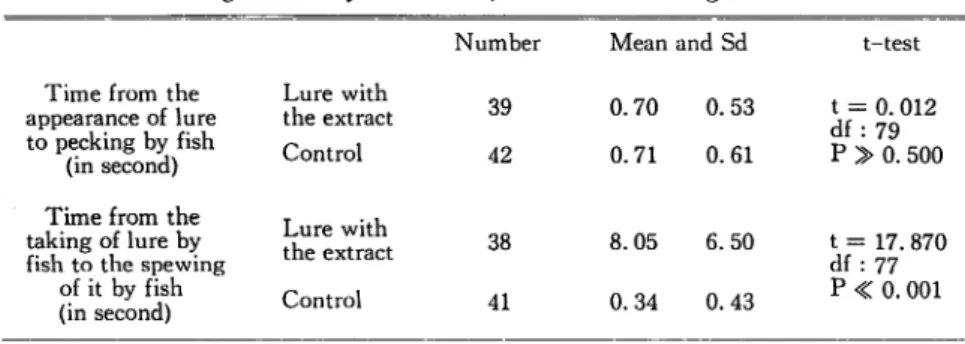
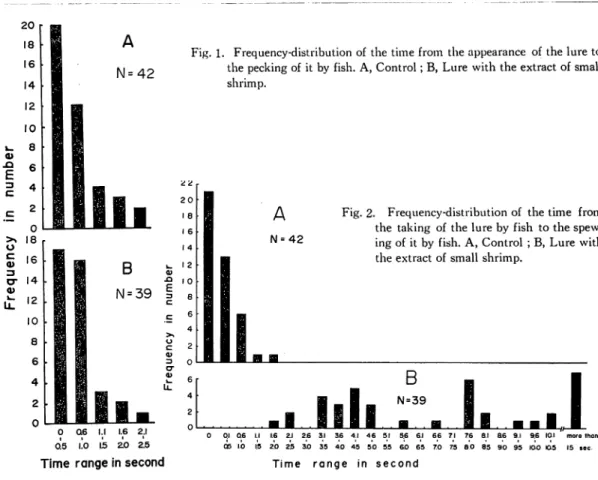
Biting behaviour of fish was elicited by 42 control-lures and 39 lures with the extract out of 50 lures used. The results were shown in Fig. 1, Fig. 2 and Table 1. Most of these lures were pecked within a second, and there was no significant time difference between the two kinds of lures (t = 0.012, df : 79, P > 0. 500). When only the control lures were thrown, fish
Table 1. Summary of the statistical analysis. The time measured was logarithmically transformed, the differences being tested.
Number Mean and Sd t-test
Time from the Lure with ft A _ n
appearance of lure
the extract
39
°-70
°-53
df 79
^Tn^efond/1811
Contro1
42
°'71
°'61
P>0.500
Time from theLure with
taking of lure by
£ ™ t
38
8.05
6.50
t = 17.870
fish to the spewing at : 77
ofit by fish
c
j
P« 0.001
range in second
Fig. 1. Frequency-distribution of the time from the appearance of the lure to the pecking of it by fish. A, Control; B, Lure with the extract of small shrimp.
A
N = 42
Fig. 2. Frequency-distribution of the time from the taking of the lure by fish to the spew ing of it by fish. A, Control ; B, Lure with the extract of small shrimp.
B
-•
lill , i
1.6 2.1 2.6 3.1 36 4.1 46 51 5.6 6.1 66 71 76 8.1 B6 9.1 9.6 10.1 2.0 25 3j0 35 40 45 50 5.5 60 65 7.0 75 80 85 90 95 KM) KX5
Time range In second
more than
15 sec.
seldom took them. But when two kinds of lures were thrown alternately, the half out of the 42 control lures were taken in, and all of the 39 lures with the extract were taken in (Fig. 2). The biting behaviour of fish was clearly affected by the chemical stimuli of the extract of small shrimp. Although the control lures were spewed as soon as fish took them in their mouth, the lures with the extract were kept for comparatively long time in fish's mouth (t = 17. 870, df : 77, P < 0. 001), and it appeaed that fish tried to swallow them, and in one case more than one minute was passed before the spewing.
Discussion
Van Weel u) studied chemoreception in both yellowfin and little tunny in the concrete tank. He found that both fish had a well-developed sense of smell or taste whereby they were
attracted to certain food substances. And according to further experiments of many observers,
there is no doubt that tuna are attracted to food substances. These results may suggest that it will be available to use the extract of food to the inedible lure for tuna long-line fishing. But,
hitherto, very poor catch has been got by all the trials to catch tuna by inedible lure with or
without the extract of food. There is a case, experienced by the authors, that a piece of pick
led radish was found in the stomach of tuna, and there appeared the doubt why tuna should not
146 Mem. Fac. Fish., Kagoshima Univ. Vol. 22, No. 1 (1973)
to this question.
Although fish behaviour in relating to food, depends on fish species, it is certain that some
chemical stimuli elicit certain feeding behaviour to some fishes 12). In the other experiment, the
authors ascertained that sweep-lips could discriminate a bag with food from the bag without
food in the dark. And so it is considered that chemical cues play some important role in the
food-finding in sweep-lips as well as in tuna. And since sweep-lips spews eninedible lure with
extract of food, tuna may be assumed to spew as soon as it takes it in.
Regretfully, we have no evidence to support above assumption. This assumption must be
ascertained in the further experiment. And on the other hand, the mechanism of discrimination
of edibles from inedibles must be studied.
References
1) YAMASHITA, N. (1966) : "Atarashii Tsurigyogyo no Gijyuisu" pp. 191, (Sobunsha, Tokyo, Japan) (in Japanese).
2) Kanagawa Prefectural Fisheries Experimental Station (1969) : Observation on the Baits for Tuna
Long-Line. Data Rep. Kanagawa Pre. Fish. Exp. St., 1-22 (in Japanese).
3) HARADA, M. and T. KONAGAYA (1971) : Studies on the Bait of Tuna Long-Line Fishing. Bull.
Shizu-oka Pre. Fish. Exp. St., 4, 1-18 (in Japanese).
4) Faculty of Fisheries, Hokkaido University (1966) : Data on Tuna Long-Line Fishing Fxperiments Using Three Kinds of Bait (Saury, Squid and False-Saury). Data Rec. Oceanogr. Obs. Expl. Fish., 10,
86-92.
5) KOYAMA, T. (1957) : Study on Bait for Tuna Long-Line-I. An Artificial Bait of Latex-Sponge Shaped
Like a Spuid. Bull. Tokai Reg. Fish. Res. Lab., 15, 89-94 (in Japanese).
6) YADA, S., S. ABE, S. INOUE and Y. AKISHIGE (1969) : On the Hooked-Rates of Tuna in Tuna
Long-Line Fishiing with Luminous Baits and Non-Luminous Ones. Bull.Faz. Fish. Nagasaki Umv., 27, 95-99 (in Japanese).
7) TSURUDOME, S. (1970) : On the Bait for Tuna Long-Line-I. An Artificial Bait of Vinyl Chloride Shaped like a Flying Fish. This Bull, 19, 81-91 (in Japanese).
•8) SHIMADA, S. and M. TSURUDOME (1971): On the Bait for Tuna Long-Line-II. On the Saury,Mackerel
and Mackerel Scad Baite for Tuna Fishing. Ibid., 20, (1), 119-130 (in Japanese).
9) TESTER, A .L., H. YUEN and M. TAKATA (1953) : Reaction of Tuna to Stimuli. U. S. Fishand Wild
life Service, Spec. Sci. Rep. -Fish 134, 1-33.
10) TESTER, A. L. (1959) : Summary of Experiments on the Response of Tuna to Stimuli. "Modern Fish ing Gear of the World. Part 1." 538-542, (Fishing News Books Ltd., London, England).
11) VAN WEEL P. B. (1951) : Reaction of Tuna to Stimuli-II. Observations on the Chemoreception of Tuna. U. S. Fish and Wildlife Service, Spec. Sci. Rept. -Fish 91, 8-35.
12) UMEZU, T. (1966) : Behavioural Responses of Fishes to Chemical Stimuli. Bull. jap. Soc. Sci. Fish., 32