Variation in the Encoding of Motion Events in Turkish
著者(英) Naonori NAGAYA, Yui SUZUKI, Emi ENOMOTO journal or
publication title
NINJAL Research Papers
number 19
page range 1‑30
year 2020‑07
URL http://doi.org/10.15084/00002827
Variation in the Encoding of Motion Events in Turkish
NAGAYA Naonoria SUZUKI Yuib ENOMOTO Emic
aThe University of Tokyo / Project Collaborator, NINJAL
bGraduate Student, The University of Tokyo
cUndergraduate Student, Tokyo University of Foreign Studies
Abstract
The NINJAL project on Motion Event Descriptions Across Languages (MEDAL) is a collab- orative research project on crosslinguistic and intralinguistic variations in motion event descrip- tions. One of the purposes of this project is to investigate how Path of motion is coded across languages by conducting a video-based production experiment. This paper reports the results of Experiment C undertaken on Turkish, an allegedly prime example of a verb-framed language.
One of our important findings is that Turkish displays considerable variations in Path cod- ing across different types of Path. A head Path-coding (≈ verb-framing) pattern is found to be dominant for the Path types of FROM, TO.OUT, TO.IN, THROUGH, PAST, VIA.UNDER, VIA.BETWEEN, AROUND, ACROSS, UP, and DOWN. In contrast, a head-external Path- coding (≈ satellite-framing) pattern is found to be preferred for the Paths ALONG, TO, and TOWARD. Rather than simply assuming a consistent “verb-framed” pattern, we claim that a more nuanced generalization is required for Path-coding patterns in Turkish and that more attention should be paid to variations in Path coding among different types of Path. We further make a crosslinguistic comparison of Turkish with other languages supposedly of the same typo- logical type such as Japanese and Spanish.*
Key words: Turkish, motion event, verb-framed, head Path-coding, video-based experiment
1. Introduction
Turkish has long been considered a prototypical example of a verb-framed language (Slobin and Hoiting 1994, Özçalışkan and Slobin 1999, Allen et al. 2007, Özçalışkan 2013). In Talmy’s typology of motion event descriptions (Talmy 1991, 2000), languages of the world are catego- rized into two major types, satellite-framed and verb-framed languages, in terms of how Path
* This paper began as a seminar project at Tokyo University of Foreign Studies in Fall AY 2018–2019 and we’d like to acknowledge our seminar participants: Yua Amano, Mona Fukuhara, Keika Okubo, Akane Sawamura, Azusa Takahashi, Shun Takahashi, Katsunori Tanaka, Mizuki Tanigawa, and Akari Yamada.
Part of an earlier version of this paper was presented in the Prosody and Grammar Festa 3 at the National Institute for Japanese Language and Linguistics, Tachikawa, Tokyo on February 16–17, 2019 (Nagaya et al.
2019). We are grateful to Yo Matsumoto, Ryuichi Taki, Mizuki Tanigawa, and Kyosuke Yamamoto, who helped us in writing the current improved version. Naonori Nagaya is happy to acknowledge the support of JSPS KAKENHI Grant Numbers JP17H02331, JP17H02333, JP18K12366, and JP19H01264. Last but not least, this paper represents the research results of the NINJAL collaborative research project “Cross- linguistic Studies of Japanese Prosody and Grammar” (project leader: Haruo Kubozono) and its subproject
“Verb Semantics” (project leader: Yo Matsumoto).
of motion is expressed within a single clause.1 In satellite-framed languages such as Germanic languages, Path is expressed by prepositions or satellites, while Manner is realized by verbs. An English example is given in (1).2
(1) The man ran into the house.
In verb-framed languages, in contrast, Path is coded by (main) verbs rather than satellites, as in the Turkish example in (2).
(2) Adam koş-arak ev-e gir-di.
man run-cvb house-dat enter-pst
‘The man ran into the house.’ (lit. ‘The man entered the house running.’)
(Slobin and Hoiting 1994: 496; glossing is ours) In (2), the Path of motion, TO.IN, is expressed by the Path verb gir ‘enter’ in the main predi- cate position, while the Manner of motion, RUN, is realized as a converb form of the Manner verb koş ‘run’. Compare the Turkish example in (2) with the English one in (1). Both sentences can be used to describe the same situation, but Path of motion is expressed quite differently in different syntactic positions in English and Turkish.
To explore such crosslinguistic similarities and differences in motion event descriptions, sev- eral different approaches have been proposed in the literature (Talmy 1991, 2000, Slobin 1996, 2004, to name a few). In this paper, we follow the framework developed by Matsumoto (2003, 2017),3 namely, the typology of motion event descriptions in terms of coding positions of Path.
In this framework, motion event descriptions are characterized in terms of whether Path of motion is coded in the head position or in head-external positions. The head position refers to (the root of) a main verb, while head-external positions include adnominals (case affixes, adpo- sitions, local nouns, etc.) and adverbals, being more inclusive than Talmy’s satellites. Thus, the English sentence in (1) exhibits a head-external Path-coding pattern because the Path concept of TO.IN is expressed in the preposition into, while the Turkish example in (2) represents a head Path-coding pattern because TO.IN is coded in the main verb gir ‘enter’.4
1 In Talmy’s framework of motion event descriptions, motion events are conceived as consisting of several semantic components, such as “Figure” (the entity whose motion is at issue), “Motion” (the presence per se of motion), “Path” (the path of motion of the Figure), “Ground” (the entity with respect to which the Fig- ure’s Path is characterized), and “Manner” (a separate event that cooccurs with the motion of the Figure).
2 Abbreviations used in this paper are: abl-ablative, cvb-converb, dat-dative, loc-locative, nom-nomina- tive, pl-plural, poss-possessive, prs-present, pst-past, sg-singular, top-topic, 3-third person.
3 This is partially because the experiments of the MEDAL project were designed within Matsumoto’s framework, but also because this framework accounts for the Turkish facts we present later in Section 4.
4 Roughly speaking, head Path-coding corresponds to verb-framed, and head-external Path-coding, to satellite-framed, in Talmy’s (1991, 2000) framework. However, there are two major differences between the two approaches. First, Matsumoto’s (2003, 2017) typology is not a typology of event integration but of the coding positions of Path. Its scope includes not only the Macro events examined in Talmy’s typology of event integration but also cases where Path and Manner are not integrated into a single event or where only Path is expressed. In addition, Deixis is treated separately from Path. Deixis and Path are coded differently in different positions in languages like Japanese and Newar (Matsumoto 2018).
In this paper, we provide another look at the Path-coding patterns in Turkish by examin- ing the results of a video-based experiment designed for the NINJAL project on Motion Event Descriptions Across Languages (MEDAL Experiment C). To be more specific, we exam- ine a database of 560 motion event descriptions that 20 native speakers of Turkish produced after watching a set of video stimuli featuring fourteen different types of Path: ALONG, TO, TOWARD, FROM, TO.OUT, TO.IN, THROUGH, PAST, VIA.UNDER, VIA.BETWEEN, AROUND, ACROSS, UP, and DOWN.5
We make four main claims in this paper. First, Turkish displays variations in the encod- ing of Path across different Paths. Although our experiment empirically confirms that Turkish has a strong preference for a head Path-coding pattern, there are several Path types that are exceptions to this generalization. To be more specific, in the descriptions of the video clips /TO/, /TOWARD/, and /ALONG/, the main verb position is unexpectedly occupied by verbs of Manner or Deixis rather than Path. Second, in Turkish, Path is also expressed by adnomi- nals such as case suffixes, local nouns, and postpositions, resulting in multiple Path marking for some types of Path. Third, our results highlight crosslinguistic variations between Turkish and Japanese: although both are verb-framed languages with basic SOV word order, Japanese and Turkish differ with regard to the usage of Deictic verbs and the availability of the combination of Manner verbs with Goal phrases. Last, our findings can be well accounted for by means of the Scale-sensitivity Hypothesis of Path-coding positions, an independently proposed hypothesis on the typology of Path coding (Matsumoto 2019, Matsumoto et al. 2019).
This paper is organized as follows: Section 2 introduces preliminary information on Experiment C for the MEDAL project, an experiment carried out for this paper. In Section 3, a general overview of motion expressions in Turkish is provided. Section 4 presents the results of the experiment, which are discussed in Section 5. Section 6 concludes the paper.
2. Experiment C of the MEDAL Project
The NINJAL project on Motion Event Descriptions Across Languages (MEDAL) is a cross- linguistic collaborative project on motion event descriptions. The project features a video-based experimental method: a set of video stimuli is employed to systematically collect production data from native speakers of target languages. Speakers of the target languages are asked to produce descriptions of video stimuli after watching them on a web browser. The same set of video stimuli is employed across target languages, but experiment instructions are localized for each target language.
At this stage, there are three sets of video stimuli, Experiments A, B, and C. Experiment A is designed to investigate interactions among Manner, Path, and Deixis and is targeted not only at self-motion but also at caused and visual motion. Experiment B focuses on Deixis. This experi- ment is intended to examine how Deictic verbs are used with special reference to the notion of Speaker territory.
This paper presents the results of Experiment C. This experiment focuses on the differences among types of Paths, featuring the 14 Paths listed in (3). For each type of Path, two types of
5 Throughout this paper, Paths are written in all capital letters; the video clips are named according to the Path featured in them with the Path placed between slashes.
Manner, WALK and RUN, are included among the stimuli, with only neutral Deixis. The stimuli also include two kinds of complex trajectories, but they are not considered for analysis in this paper. See Figure 1 for samples of the video stimuli for Experiment C.
(3) Path types examined in this paper:
a. Goal: /TO/, /TOWARD/, and /TO.IN/
b. Source: /FROM/ and /TO.OUT/
c. VIA: /ACROSS/, /THROUGH/, /PAST/, /VIA.UNDER/, /VIA.BETWEEN/, /AROUND/, and /ALONG/
d. Directional: /UP/ and /DOWN/
WALK + UP (the stairs) RUN + DOWN (the stairs)
WALK + TO (the table) WALK + TOWARD (the table)
RUN + ALONG (the river) RUN + THROUGH (the gazebo)
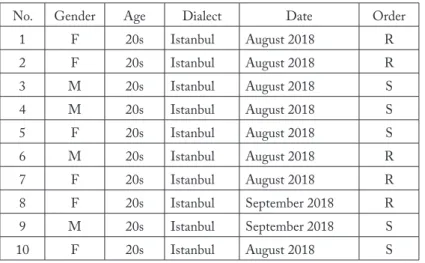
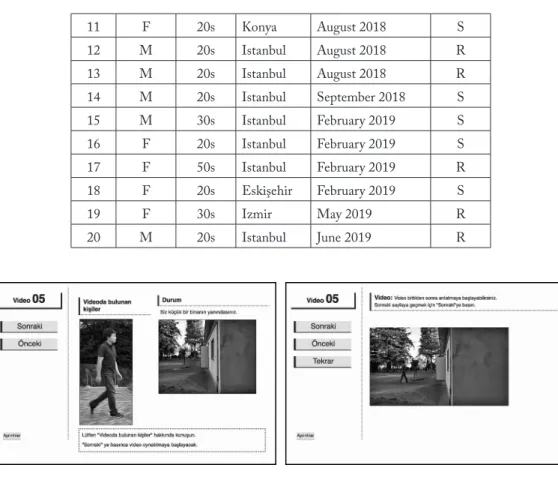
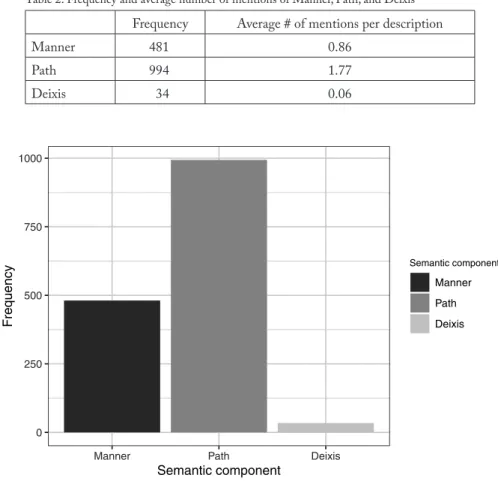
For the purposes of this paper, we have collected production data from 20 native speakers of Turkish (11 females and 9 males). A list of participants is given in Table 1. All participants are native speakers of Turkish, and most participants are college students from Istanbul in their twenties. The experiment was conducted in Istanbul, Turkey (Participants #1–#14) and Tokyo, Japan (Participants #15–#20). In each experiment session, speakers were asked to describe what they saw in the video as if they were in the scene portrayed by the video clips. Video clips were shown in two different orders, S(tandard) and R(everse): the order of the clips was random- ized to create the “Standard” order, so that some subjects saw the Standard order and some the Reverse order. Last, the video clips were presented by means of an experiment kit localized for Turkish (Figure 2).
The experiment sessions were supervised by Suzuki and Enomoto, who had studied Turkish for more than four years and have an intermediate competence in Turkish. The sentences pro- duced by the participants were recorded with a digital solid-state audio recorder and transcribed by the current authors with some assistance from native speakers of Turkish. Data were anno- tated and analyzed using the Excel spreadsheets created for the MEDAL project.
Table 1: List of participants
No. Gender Age Dialect Date Order
1 F 20s Istanbul August 2018 R
2 F 20s Istanbul August 2018 R
3 M 20s Istanbul August 2018 S
4 M 20s Istanbul August 2018 S
5 F 20s Istanbul August 2018 S
6 M 20s Istanbul August 2018 R
7 F 20s Istanbul August 2018 R
8 F 20s Istanbul September 2018 R
9 M 20s Istanbul September 2018 S
10 F 20s Istanbul August 2018 S
WALK + PAST (the mailbox) WALK + VIA.BETWEEN (the trees)
Figure 1: Video stimuli for Experiment C
11 F 20s Konya August 2018 S
12 M 20s Istanbul August 2018 R
13 M 20s Istanbul August 2018 R
14 M 20s Istanbul September 2018 S
15 M 30s Istanbul February 2019 S
16 F 20s Istanbul February 2019 S
17 F 50s Istanbul February 2019 R
18 F 20s Eskişehir February 2019 S
19 F 30s Izmir May 2019 R
20 M 20s Istanbul June 2019 R
Each speaker produced 44 motion event descriptions for 44 video clips, but only the utter- ances that were used to describe the Path types in (3) were selected for analysis.6 To be more specific, the analysis in the rest of this paper considers 560 motion event descriptions (i.e., 20 speakers * 2 Manners * 14 Paths). Note that, throughout this paper, the metadata for each motion event description are provided: speaker number, video clip number, Path featured in the video clip. For instance, “(#19_C1-11_/TO.IN/)” in example (5) indicates that the description was produced by speaker #19, the example was used to describe video clip 11 in Experiment C ver- sion 1, and the Path type depicted in video clip 11 is /TO.IN/. Examples with no identifier are nonexperimentally elicited sentences.
3. Motion event expressions in Turkish
This section provides a preliminary overview of motion event expressions in Turkish, illustrating the encoding of Path, Manner, and Deixis with the data obtained from our video-based experiment.
We discuss how Path is coded in Section 3.1, Manner in Section 3.2, and Deixis in Section 3.3.
6 For explanatory purposes, in (8), (19), (22), and (49), we use motion descriptions that do not correspond to the Path types in (3).
Figure 2: Experiment kit localized for Turkish
3.1 Path
Path is expressed by verbs (Section 3.1.1), case suffixes (Section 3.1.2), local nouns (Section 3.1.3), postpositions (Section 3.1.4), or their combinations.
3.1.1 Path verbs
As a prime example of a verb-framed language, Turkish has a rich inventory of Path verbs. A rep- resentative list of Path verbs in Turkish is given in (4). Note that çık has two meanings, ‘ascend’
and ‘exit’, and that geç ‘move via, past’ covers a broad range of Paths such as VIA, THROUGH, and ACROSS.
(4) ayrıl ‘leave/depart’, bat ‘sink’, çık ‘ascend/exit’, dön ‘turn’, geç ‘move via’, gerile ‘move back’, gir
‘enter’, ilerle ‘proceed’, in ‘descend’, kavuş ‘reach’, ulaş ‘arrive/reach’, uzalaş ‘move away’, var
‘arrive’, yaklaş ‘approach’, yanaş ‘approach’, yönel ‘direct oneself toward’, and yüksel ‘ascend’
(adopted from Özçalışkan and Slobin 1999: 547) In motion event descriptions, Path verbs can be employed as main verbs, as in (5), where gir
‘enter’ functions as a main verb and expresses the Path TO.IN.
(5) Adam bina-ya gir-di.
man building-dat enter-pst
‘The man entered the building.’ (#19_C1-11_/TO.IN/)
Path verbs can be used with Manner verbs (Section 3.2.1) within a single sentence, in which case the former almost always occupies the main verb position, whereas the latter takes a converb form (i.e., as a subordinate clause), as in (6) (cf. (32)).
(6) Adam koş-arak ev-e gir-di.
man run-cvb house-dat enter-pst
‘The man entered the house running.’ (#9_C1-12_/TO.IN/)
In (6), the Path verb gir ‘enter’ occupies the main verb position in the main clause, while the Manner verb koş ‘run’ is in a subordinate clause. This is a head Path-coding pattern, as we have already observed in (2).
3.1.2 Case suffixes
Turkish has three nominal cases for expressing Path, as shown in (7). Note that suffixes in Turkish have several allomorphs due to vowel harmony and consonant alternation (Lewis 2000, Göksel and Kerslake 2005). Allomorphs are represented in parentheses.
(7) a. Dative -a (-e): a goal of motion (TO) b. Ablative -dan (-den, -tan, -ten):
(i) a source of motion (FROM) (ii) a route of motion (VIA)
c. Locative -da (-de, ta, te): a place of motion (AT)
See (8) and (9) for examples with a dative NP and an ablative NP. In (8), the NP masa ‘table’
takes the ablative case, marking the source of motion, while the NP bank ‘bench’ appears in the dative case, marking the goal of motion. In (9), the ablative NP is used to express ACROSS in combination with the dative NP.
(8) Adam masa-dan bank-a atla-dı.
man table-abl bench-dat jump-pst
‘The man jumped from the table to the bench.’ (#11_C1-35_/DOWN_OFF_ONTO/) (9) Adam koş-arak karşı-dan karşı-ya geç-ti.
man run-cvb other.side-abl other.side-dat move.via-pst
‘The man moved from one side to the other side running’ (#12_C1-18_/ACROSS/)
The ablative case has two meanings in motion event descriptions: it designates not only a source of motion but also the concept of VIA. The ablative NP in (8) expresses a source par- ticipant. By contrast, the one in (10) has a VIA meaning, expressing a scene in which a Figure moves through the space between the trees.
(10) Adam ağaç-lar-ın ara-sı-ndan yürü-yor.
man tree-pl-poss between-3sg-abl walk-prs
‘The man is walking between trees.’ (#20_C1-29_/VIA.BETWEEN/)
Last, the locative case -da introduces a spatial setting element in most cases. But when used with motion verbs, it can have a Path interpretation. Compare the Location -da in (11) and the Path -da in (12).
(11) Adam dere kenar-ı-nda oyn-uyor.
man river side-3sg-loc play-prs
‘The man is playing beside the river.’
(12) Adam dere kenar-ı-nda yürü-yor.
man river side-3sg-loc walk-prs
‘The man is walking along the river.’ (#5_C1-15_/ALONG/)
The NP dere kenarında ‘beside the river’ only has a locational meaning in (11). But it has a Path interpretation, ALONG, in (12) when it occurs in combination with the Manner verb yürü
‘walk’.
3.1.3 Local nouns
We have already observed in (12) that local nouns in Turkish can express Path when they are employed in combination with case suffixes. A list of such local nouns is given in (13).
(13) Local nouns:
iç ‘inside’, dış ‘outside’, içeri ‘inside’, dışarı ‘outside’, üzer ‘on’, alt ‘under’, yıkarı ‘up’, aşağı
‘down’, ara ‘between’, yan ‘side’, etraf ‘periphery’, ön ‘front’, etc.
Local nouns express Path in combination with case suffixes, as in (14), in which the local noun iç ‘inside’, marked in the dative case, expresses the Path TO.IN. These local nouns were often employed by participants to distinguish different kinds of VIA in Experiment C, as dis- cussed in Section 4.3.2.
(14) Delikanlı yürü-yerek bina-nın iç-i-ne gir-di.
man walk-cvb building-poss inside-3sg-dat enter-pst
‘The man entered the building walking.’ (#1_C1-11_/TO.IN/)
Note that içeri ‘inside’, dışarı ‘outside’, yıkarı ‘up’, and aşağı ‘down’ in their bare form can be used as adverbals indicating the direction of motion (Göksel and Kerslake 2005: 234). See Section 4.3.3.
3.1.4 Postpositions
Path can be expressed by postpositions, too, such as those shown in (15). These postpositions, which take a dative NP, are used to express the Paths TOWARD and AS.FAR.AS, respectively.
(15) a. NP (dative) + doğru: ‘toward’
b. NP (dative) + kadar: ‘as far as’
The examples in (16) and (17) illustrate the use of each postposition in (15).
(16) Adam masa-ya doğru koş-tu.
man table-dat toward run-pst
‘The man ran toward the table.’ (#8_C1-06_/TOWARD/) (17) Adam masa-nın yan-ı-na kadar yürü-dü.
man table-poss side-3sg-dat as.far.as walk-pst
‘The man walked as far as the side of the table.’ (#2_C1-01_/TO/) 3.2 Manner
In Turkish, Manner is lexicalized in verbs (Section 3.2.1) and/or adverbals (Section 3.2.2).
3.2.1 Manner verbs
In most cases, Manner verbs are realized as converbs, i.e., subordinate clauses. Manner con- verbs are formed with the converb suffixes -arak ‘simultaneous events/co-events’ or -ip ‘successive events’. Examples are given in (18) and (19), respectively.
(18) Genç adam koş-arak masa-nın yan-ı-na gel-di.
young man run-cvb table-poss side-3sg-dat come-pst
‘The young man came to the side of the table running.’ (#15_C1-2_/TO/) (19) Top yuvarlan-ıp gölet-e düş-tü.
ball roll-cvb pond-dat fall-pst
‘The ball fell in the pond, after rolling.’ (#5_C1-39_/DOWN_TO.IN/)
In some exceptional cases, Manner verbs can also occur in the main verb position, yielding a head-external Path-coding pattern. Consider (20). We return to this pattern in Section 5.1.
(20) Adam masa-ya doğru koş-uyor.
man table-dat toward run-prs
‘The man is running toward the table.’ (#19_C1-06_/TOWARD/) 3.2.2 Adverbals
A variety of Manners can also be expressed by adverbals (i.e., adverbs and adverbal phrases), such as hızlıca ‘quickly’ and yavaşça ‘slowly’. See (21), for example.
(21) Bir adam bina-nın iç-i-nden hızlıca çık-tı.
one man building-poss inside-3sg-abl quickly exit-pst
‘A man exited the building quickly.’ (#10_C1-14_/TO.OUT/)
With the utterances in (21), a Turkish speaker described a scene in which a man was running out of a building. The Manner of motion is expressed by the adverb hızlıca ‘quickly’, while the Path of motion is encoded by the main verb çık ‘exit’.
3.3 Deixis
Turkish has two Deictic verbs, git ‘go’ (andative) and gel ‘come’ (venitive). The motion event descriptions in (22) and (23) respectively illustrate examples of these verbs.
(22) Köpek kulübe-si-ne git-ti.
dog hut-3sg-dat go-pst
‘The dog went to the hut.’ (#12_C1-44_/TO.OUT_TO.IN/) (23) Adam masa-nın yan-ı-na gel-di.
man table-poss side-3sg-dat come-pst
‘The man came to the side of the table.’ (#12_C1-1_/TO/) 4. Results
This section presents the results of the video-based experiment outlined in Section 2. First, we present the frequency and average number of mentions of Manner, Path, and Deixis (Section 4.1) and the frequency and percentage of Manner, Path, and Deixis in the main verb position (Section 4.2). Section 4.3 then discusses in which position Path is encoded: the frequency and average number of mentions of relevant Path per video clip are examined with regard to verbs (Session 4.3.1), adnominals (Section 4.3.2), and adverbals (Section 4.3.3). A brief summary of the section is given in Section 4.4.
4.1 Frequency and average number of mentions of Manner, Path, and Deixis
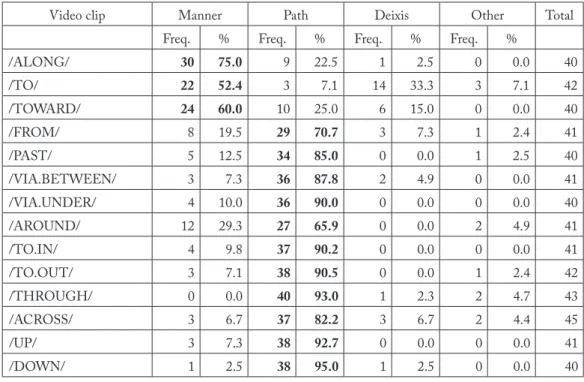
Table 2 and Figure 3 summarize the frequency and average number of mentions of Manner, Path, and Deixis in the database of 560 sentences. Any mention of them is counted here, whether or not they appear in the main verb position. As shown in Table 2, Manner of motion was mentioned 481 times, Path of motion 994 times, and Deixis 34 times.
Considering that the Turkish speaker participants produced 560 motion event descriptions in total, they mentioned Manner of motion almost once per description (0.86 times per descrip- tion), while they coded Path of motion almost twice per description (1.77 times per description).
The reason for this high frequency of Path elements is that, in Turkish, Path of motion tends to be coded twice, both verbally and adnominally (see Sections 4.3 and 5.2 for details).
It should be also noted that Deixis was mentioned only 34 times (0.06 times per description).
This means that Turkish speakers rarely employed Deictic expressions in this experiment, which featured only Deixis-neutral scenes. The low frequency of Deixis in Turkish in this experiment stands in stark contrast with other verb-framed SOV languages such as Japanese (Section 5.3).
Table 2: Frequency and average number of mentions of Manner, Path, and Deixis Frequency Average # of mentions per description
Manner 481 0.86
Path 994 1.77
Deixis 34 0.06
4.2 Frequency and percentage of Manner, Path, and Deixis in the main verb position
Table 3 presents the frequency and percentage of Manner, Path, and Deixis in the main verb position per video clip. These percentages were calculated by dividing the number of mentions of each semantic component by the total number of main verbs used for each video clip. The total number of main verbs varies from one video clip to another, because some motion event descrip- tions include more than one main verb due to clausal juxtaposition, as in (24).
0 250 500 750 1000
Manner Path Deixis
Semantic component
Frequency
Semantic component Manner Path Deixis
Figure 3: Frequency of mentions of Manner, Path, and Deixis
(24) Genç kadın çimen-ler-den çık-tı, yol-un karşı-sı-na geç-ti.
young woman grass-pl-abl exit-pst street-poss opposite-3sg-dat move.via-pst
‘The young woman exited the grass field (and) moved to the other side of the street.’
(#15_C1-17_/ACROSS/) Also, note that, in Table 3, the category “Other” indicates that non-motion verbs, for exam- ple, dur ‘stop’, were employed. The highest percentage across each row is highlighted in boldface.
Table 3: Manner, Path, and Deixis in the main verb position for each video clip
Video clip Manner Path Deixis Other Total
Freq. % Freq. % Freq. % Freq. %
/ALONG/ 30 75.0 9 22.5 1 2.5 0 0.0 40
/TO/ 22 52.4 3 7.1 14 33.3 3 7.1 42
/TOWARD/ 24 60.0 10 25.0 6 15.0 0 0.0 40
/FROM/ 8 19.5 29 70.7 3 7.3 1 2.4 41
/PAST/ 5 12.5 34 85.0 0 0.0 1 2.5 40
/VIA.BETWEEN/ 3 7.3 36 87.8 2 4.9 0 0.0 41
/VIA.UNDER/ 4 10.0 36 90.0 0 0.0 0 0.0 40
/AROUND/ 12 29.3 27 65.9 0 0.0 2 4.9 41
/TO.IN/ 4 9.8 37 90.2 0 0.0 0 0.0 41
/TO.OUT/ 3 7.1 38 90.5 0 0.0 1 2.4 42
/THROUGH/ 0 0.0 40 93.0 1 2.3 2 4.7 43
/ACROSS/ 3 6.7 37 82.2 3 6.7 2 4.4 45
/UP/ 3 7.3 38 92.7 0 0.0 0 0.0 41
/DOWN/ 1 2.5 38 95.0 1 2.5 0 0.0 40
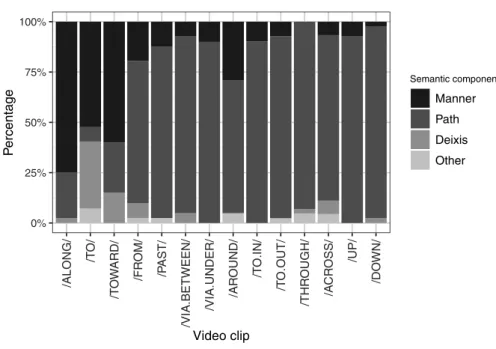
As seen in Table 3, for most of the Path types, Turkish speakers preferred head Path-coding patterns. Namely, they tend to code Path in the main verb position. For example, for the video clip /THROUGH/, a Path verb was used in the main verb position 93.0% of the time, and Manner verbs were never used in the main verb position. See (25), for example.
(25) Adam çardağ-ın iç-i-nden koş-arak geç-ti.
man gazebo-poss inside-3sg-abl run-cvb move.via-pst
‘The man moved through inside the gazebo running.’ (#14_C1-22_/THROUGH/) In (25), the main verb position is occupied by the Path verb geç ‘move via’, yielding a head Path- coding pattern. The Manner verb koş ‘run’ is used, but as a converb rather than as the main verb.
This result is as expected based on the previous studies on Turkish motion event descriptions summarized in Section 1. More examples of head coding of Path are given in (26) through (30).
(26) Kadın yürü-yerek posta kutu-su-nun ön-ü-nden geç-ti.
woman walk-cvb post box-3sg-poss front-3sg-abl move.via-pst
‘The woman moved past the mailbox walking.’ (#5_C1-19_/PAST/) (27) Adam masa-dan ayrıl-ıyor.
man table-abl go.away-prs
‘The man is going away from the table.’ (#9_C1-03_/FROM/) (28) Adam koş-arak bina-ya gir-di.
man run-cvb building-dat enter-pst
‘The man entered the building running.’ (#18_C1-12_/TO.IN/) (29) Genç kadın merdiven-ler-den çık-tı.
young woman stair-pl-abl ascend-pst
‘The young woman ascended the stairs.’ (#15_C1-7_/UP/) (30) Ağac-ın etraf-ı-nda tırla-dı.
tree-poss periphery-3sg-loc move.around-pst
‘(He) moved around the tree.’ (#7_C1-28_/AROUND/)
Crucially, however, Turkish speakers preferred head-external coding of Path when they described the video clips /ALONG/, /TO/, and /TOWARD/. For example, for the video clip /ALONG/, the main verb position was occupied by a Manner verb 75% of the time, by a Path verb 22.5% of the time, and by a Deictic verb 2.5% of the time (see Table 3 again).
Turkish speakers tended to use a head-external Path-coding pattern to describe the video clip /ALONG/, as exemplified in (31).
(31) Adam dere kenar-ı-nda koş-uyor.
man river side-3sg-loc run-prs
‘The man is running along the river.’ (#19_C1-16_/ALONG/)
In (31), the Path ALONG is expressed by means of the local noun kenar ‘side’, while the main verb position is occupied by the Manner verb koş ‘run’. Compare the head-external Path-coding pattern in (31) with the head Path-coding pattern in (25) through (30).
To summarize, we found a sharp contrast between the two types of Path of motion with regard to their coding positions. The main verb position was often occupied by Manner verbs in descriptions of the video clips /ALONG/, /TO/, and /TOWARD/ but by Path verbs for the other video clips. These results are illustrated in Figure 4.
4.3 Path and coding positions
This section investigates in which positions Turkish speakers expressed different Paths in the dif- ferent video clips. In particular, it examines which coding position (verb, adnominal, or adverbal) tended to be used to express a designated Path for each video clip. By examining these patterns, we aim to figure out crosslinguistic correlations between Path types and coding positions (see Section 5.4).
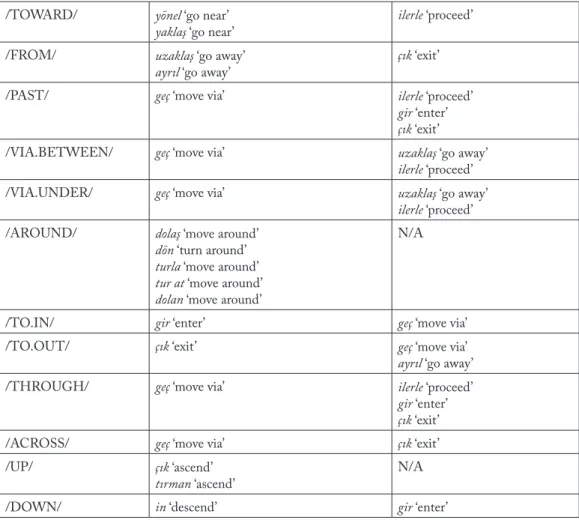
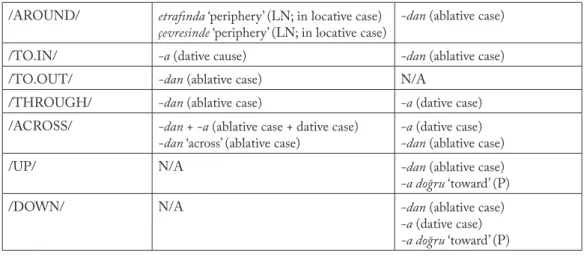
For the purposes of this section, we calculated only “relevant Path.” By “relevant Path,” we mean those Paths that are designated for the Path described in each video clip. In other words, we exclude from these calculations those Path expressions that were not used for the intended purposes of the experiment. For example, the Path verb geç ‘move via’ is relevant to the Path ALONG described in the video clip /ALONG/, while ilerle ‘proceed’ is not.
See Table 4 (relevant verbs), Table 5 (relevant adnominals), and Table 6 (relevant adverbals) for the list of relevant Path expressions employed for the calculations in this section. “LN” and
“P” stand for “local noun” and “postposition,” respectively. “N/A” means that no Path expression was attested in our data.
Table 4: Relevant Path verbs
Video clip Relevant Path verbs Irrelevant Path verbs
/ALONG/ geç ‘move via’ ilerle ‘proceed’
/TO/ N/A ilerle ‘proceed’
0%
25%
50%
75%
100%
/ALONG/ /TO/ /TOWARD/ /FROM/ /PAST/ /VIA.BETWEEN/ /VIA.UNDER/ /AROUND/ /TO.IN/ /TO.OUT/ /THROUGH/ /ACROSS/ /UP/ /DOWN/
Video clip
Percentage
Semantic component Manner Path Deixis Other
Figure 4: Manner, Path, and Deixis in the main verb position for each video clip
/TOWARD/ yönel ‘go near’
yaklaş ‘go near’ ilerle ‘proceed’
/FROM/ uzaklaş ‘go away’
ayrıl ‘go away’ çık ‘exit’
/PAST/ geç ‘move via’ ilerle ‘proceed’
gir ‘enter’
çık ‘exit’
/VIA.BETWEEN/ geç ‘move via’ uzaklaş ‘go away’
ilerle ‘proceed’
/VIA.UNDER/ geç ‘move via’ uzaklaş ‘go away’
ilerle ‘proceed’
/AROUND/ dolaş ‘move around’
dön ‘turn around’
turla ‘move around’
tur at ‘move around’
dolan ‘move around’
N/A
/TO.IN/ gir ‘enter’ geç ‘move via’
/TO.OUT/ çık ‘exit’ geç ‘move via’
ayrıl ‘go away’
/THROUGH/ geç ‘move via’ ilerle ‘proceed’
gir ‘enter’
çık ‘exit’
/ACROSS/ geç ‘move via’ çık ‘exit’
/UP/ çık ‘ascend’
tırman ‘ascend’ N/A
/DOWN/ in ‘descend’ gir ‘enter’
Table 5: Relevant Path adnominals
Video clip Relevant Path adnominals Irrelevant Path adnominals /ALONG/ kenarında ‘periphery’ (LN; in locative case)
yanında ‘beside’ (LN; in locative case) boyunca ‘along’ (P)
-dan (ablative case)
-a (dative case)
/TO/ -a (dative case)
-a doğru ‘toward’ (P) N/A
/TOWARD/ -a (dative case)
-a doğru ‘toward’ (P) N/A
/FROM/ -dan (ablative case) -a doğru ‘toward’ (P)
/PAST/ -dan (ablative case) -a doğru ‘toward’ (P)
/VIA.BETWEEN/ arasından ‘between’ (LN; in ablative case) N/A /VIA.UNDER/ altında ‘under’ (LN; in locative case)
-dan (ablative case) -a (dative case)
/AROUND/ etrafında ‘periphery’ (LN; in locative case)
çevresinde ‘periphery’ (LN; in locative case) -dan (ablative case)
/TO.IN/ -a (dative cause) -dan (ablative case)
/TO.OUT/ -dan (ablative case) N/A
/THROUGH/ -dan (ablative case) -a (dative case)
/ACROSS/ -dan + -a (ablative case + dative case)
-dan ‘across’ (ablative case) -a (dative case) -dan (ablative case)
/UP/ N/A -dan (ablative case)
-a doğru ‘toward’ (P)
/DOWN/ N/A -dan (ablative case)
-a (dative case) -a doğru ‘toward’ (P)
Table 6: Relevant Path adverbals
Video clip Relevant Path adverbals Irrelevant Path adverbals
/TO.IN/ içeri ‘inward’ N/A
/TO.OUT/ dışarı ‘outward’ N/A
/UP/ yukarı ‘upward’ N/A
/DOWN/ aşağı ‘downward’ N/A
Four notes regarding Tables 4, 5, and 6 are in order. First, only the expressions that were actu- ally used by Turkish speakers are listed in Tables 4, 5, and 6. For example, the Path verbs such as kavuş ‘reach’ and ulaş ‘arrive/reach’ can be used for expressing the Path TO but are not listed in Table 4, because they were not employed by participants in this experiment.
Second, unlike in Table 3 in Section 4.2, the syntactic status of Path expressions does not matter for the calculations of the coding positions of relevant Paths here. In other words, Path verbs were included in these calculations, whether they appeared in main clauses or in subordi- nate clauses. Here we pay attention only to the coding positions of Path. For example, the Path verb çık ‘exit’ in (32) was counted in Table 7 below (but not in Table 3).
(32) Adam-ın bir-i, tahta merdiven-ler-den koşar adımlarla çık-arak yürü-yor.
man-poss one-3sg wood stair-pl-abl in.a.hurry ascend-cvb walk-prs
‘A man is walking ascending the wood stairs in a hurry.’ (#14_C1-08_/UP/)
Third, in the case of /ACROSS/, here we have counted the ablative case when it is used to express the concept of the Path ACROSS in combination with the dative case, as in (33), and when it expresses the Path ACROSS by itself, as in (34).
(33) Kadın karşı-dan karşı-ya geç-ti.
woman side-abl side-dat move.via-pst
‘The woman moved from one side to the other side.’ (#7_C1-17_/ACROSS/)
(34) Asphalt yol-un üzer-i-nden bir tane adam koş-arak geç-iyor.
asphalt street-poss on-3sg-abl one piece man run-cvb move.via-prs
‘A man is moving running across the asphalt street.’ (#16_C1-18_/ACROSS/)
Last, attention should be paid to the fact that some Path expressions are relevant to more than one video clip. In Table 4, the verb geç ‘move via’ expresses a broad range of motion events in which a Figure moves via a specific area or location, ranging from ALONG to PAST, VIA.
BETWEEN, VIA.UNDER, THROUGH, and ACROSS. This is also the case with the ablative case in Table 5, which not only designates FROM but also different kinds of VIA concepts.
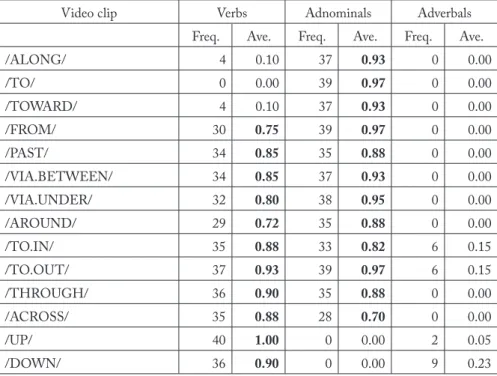
Now consider Table 7. This table presents the frequency and average number of verbs, adnominals, and adverbals that were used to express relevant Paths per video clip.
Table 7: Frequency and average number of relevant Path verbs, adnominals, and adverbals per video clip
Video clip Verbs Adnominals Adverbals
Freq. Ave. Freq. Ave. Freq. Ave.
/ALONG/ 4 0.10 37 0.93 0 0.00
/TO/ 0 0.00 39 0.97 0 0.00
/TOWARD/ 4 0.10 37 0.93 0 0.00
/FROM/ 30 0.75 39 0.97 0 0.00
/PAST/ 34 0.85 35 0.88 0 0.00
/VIA.BETWEEN/ 34 0.85 37 0.93 0 0.00
/VIA.UNDER/ 32 0.80 38 0.95 0 0.00
/AROUND/ 29 0.72 35 0.88 0 0.00
/TO.IN/ 35 0.88 33 0.82 6 0.15
/TO.OUT/ 37 0.93 39 0.97 6 0.15
/THROUGH/ 36 0.90 35 0.88 0 0.00
/ACROSS/ 35 0.88 28 0.70 0 0.00
/UP/ 40 1.00 0 0.00 2 0.05
/DOWN/ 36 0.90 0 0.00 9 0.23
In the rest of this section, we discuss how each video clip was described by Turkish speakers by focusing on the coding positions of relevant Path expressions.
4.3.1 Path verbs
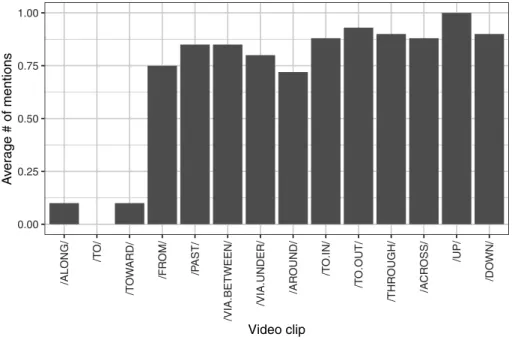
Table 7 and Figure 5 present the frequency and the average number of relevant Path verbs employed to describe the video clips. Again, this result confirms the huge discrepancy between descriptions of the Paths ALONG, TO, TOWARD and those of other Path types. In the former, few Path verbs for the designated Path types were employed. For example, in order to describe the /ALONG/ scene, the relevant Path verb geç ‘move via’ was found only in four pro- duced descriptions. This means it occurred only 0.10 times per video clip on average.
In the Paths other than ALONG, TO, TOWARD, in contrast, head Path-coding was perva- sive, as expected from the literature. For instance, the Path verb çık ‘ascend’ was used as the main verb 40 times out of 40 descriptions to describe the /UP/ scene, i.e., it was used one time per video clip on average. The contrast between the descriptions of ALONG, TO, TOWARD and those of the other Paths is very clear.
4.3.2 Path adnominals
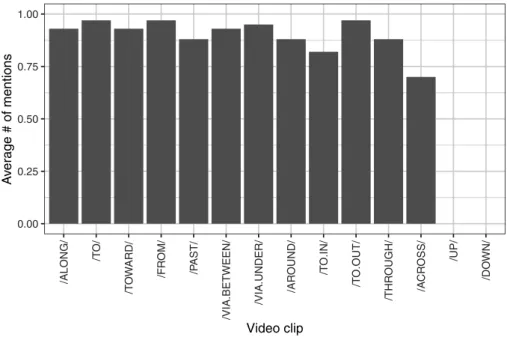
By “adnominals” we mean any Path-coding elements adjacent to nouns, such as case suffixes, local nouns, and postpositions (see Table 5). Table 7 (above) and Figure 6 indicate how frequently the relevant Path in each video clip is realized by adnominals. These results highlight a distinction between the Paths UP and DOWN and the other Paths. Most relevant Paths were frequently expressed by adnominals, but adnominals were not employed for UP or DOWN.
0.00 0.25 0.50 0.75 1.00
/ALONG/ /TO/ /TOWARD/ /FROM/ /PAST/ /VIA.BETWEEN/ /VIA.UNDER/ /AROUND/ /TO.IN/ /TO.OUT/ /THROUGH/ /ACROSS/ /UP/ /DOWN/
Video clip
Average # of mentions
Figure 5: Average number of relevant Path verbs per video clip
When this is taken together with our findings on Path verbs in Section 4.3.1, we can identify three classes of Paths in Turkish. To begin with, for ALONG, TO, and TOWARD, the Path of motion is expressed almost exclusively by adnominals. This means that the main verb position is nearly always occupied by verbs other than Path verbs, as in (35).
(35) Bir adam park-taki masa-ya doğru yürü-dü.
one man park-loc table-dat toward walk-pst
‘A man walked toward the table in the park.’ (#17_C1-05_/TOWARD/)
In (35), the Path TOWARD is expressed by the postposition doğru ‘toward’. The main verb position is taken by the Manner verb yürü ‘walk’, resulting in a typical head-external Path-coding pattern.
In addition, in the case of FROM, PAST, VIA.BETWEEN, VIA.UNDER, AROUND, TO.IN, TO.OUT, THROUGH, and ACROSS, the Path of motion is expressed by both Path verbs and adnominals. Consider the example in (36), which was used to describe the /VIA.
UNDER/ scene.
(36) Bir adam koş-arak köprü-nün alt-ı-ndan geç-ti.
one man run-cvb bridge-poss under-3sg-abl move.via-pst
‘A man moved through (the area) under the bridge running.’ (#19_C1-26_/VIA.UNDER/) In (36), the Path of motion is coded both by the Path verb geç ‘move via’ in the main verb position and by the local noun alt ‘under’ in the adnominal position. This results in the combination of a head Path-coding pattern with a head-external Path-coding pattern, representing multiple Path
0.00 0.25 0.50 0.75 1.00
/ALONG/ /TO/ /TOWARD/ /FROM/ /PAST/ /VIA.BETWEEN/ /VIA.UNDER/ /AROUND/ /TO.IN/ /TO.OUT/ /THROUGH/ /ACROSS/ /UP/ /DOWN/
Video clip
Average # of mentions
Figure 6: Average number of relevant Path adnominals per video clip
coding (see Section 5.2).
Last, only Path verbs are employed to express the Paths UP and DOWN. For example, con- sider the sentences in (37) and (38).
(37) Kadın merdiven-ler-den çık-ıyor.
woman stair-pl-abl ascend-prs
‘The woman is ascending the stairs.’ (#13_C1-07_/UP/) (38) Adam koş-arak merdiven-ler-den in-di.
man run-cvb stair-pl-abl descend-pst
‘The man descended the stairs running.’ (#3_C1-10_/DOWN/)
The examples in (37) and (38) were produced as descriptions of the video clips /UP/ and /DOWN/, respectively. In these examples, the relevant Path verbs occupy the main verb posi- tion, expressing the Paths UP and DOWN. The ablative case is employed for expressing a route through which a Figure moves, not UP or DOWN.
4.3.3 Path adverbals
In Turkish, some local nouns without a case suffix, such as içeri ‘inside’, dışarı ‘outside’, yıkarı
‘up’, and aşağı ‘down’, can be used as adverbals to indicate the direction of motion (Section 3.1.3;
Table 6). Now consider Table 7 (above) and Figure 7, which show how many times adverbals were used to express the relevant Path of motion. The local nouns içeri ‘inside’, dışarı ‘outside’, yıkarı ‘up’, and aşağı ‘down’ were used as adverbals in descriptions of the video clips /TO.IN/, /TO.OUT/, /UP/, and /DOWN/, respectively. This was observed only several times. For exam- ple, for the video clip /TO.IN/, içeri ‘inward’ was used as an adverbal in (39).
(39) Adam kapı-dan içeri gir-di.
man door-abl inward enter-pst
‘The man entered through the door.’ (#13_C1-11_/TO.IN/)
4.4 Summary
The results of our experiment can be summarized as follows. First, Turkish speakers men- tion Path more frequently than Manner. Second, there is a sharp contrast between the TO, TOWARD, and ALONG Paths versus the other Paths. For the former, head-external Path- coding is dominant; for the latter, in contrast, head Path-coding is pervasive. Third, adnominals are employed to express TO, TOWARD, and ALONG, and they are used in combination with Path verbs in the case of FROM, TO.OUT, TO.IN, THROUGH, PAST, VIA.UNDER, VIA.
BETWEEN, AROUND, and ACROSS. But adnominals are not used in descriptions of UP or DOWN. Last, adverbals are rarely employed for Path coding in Turkish.
5. Discussion
In this section, we discuss general issues regarding the results of the Path-coding patterns in Turkish presented in Session 4: variation in Path coding in Turkish (Section 5.1), multiple Path coding (Section 5.2), crosslinguistic variation between Turkish and Japanese (Section 5.3), and the Scale-sensitivity Hypothesis of Path-coding positions (Section 5.4).
5.1 Variation in Path coding in Turkish
An obvious yet important conclusion we can draw from the results of Experiment C is that Turkish has a strong preference for head Path-coding. As observed in Section 4.2, Turkish speak- ers demonstrated a strong tendency to express Path of motion in the main verb position across most of the different Paths examined. Of course, there have been a number of studies that have shown that Turkish is a verb-framed language. But this study has empirically confirmed that Turkish displays this tendency across different Path types.
Importantly, however, the results of this experiment have also revealed that there are three
0.00 0.25 0.50 0.75 1.00
/ALONG/ /TO/ /TOWARD/ /FROM/ /PAST/ /VIA.BETWEEN/ /VIA.UNDER/ /AROUND/ /TO.IN/ /TO.OUT/ /THROUGH/ /ACROSS/ /UP/ /DOWN/
Video clip
Average # of mentions
Figure 7: Average number of relevant Path adverbals per video clip
Paths that are exceptions to the above-mentioned general observation: TO, TOWARD, and ALONG. As shown in Table 3 and Figure 4 (Section 4.2), when Turkish speakers described the video clips representing these three Paths, they chose to express Manner of motion, rather than Path, in the main verb position more than 50% of the time. In other words, for these Paths, Turkish speakers unexpectedly displayed a head-external Path-coding pattern. Consider the examples in (40), (41), and (42), which were produced as descriptions of the /TO/, /TOWARD/, and /ALONG/ scenes, respectively.
(40) Masa-ya doğru koş-tu.
table-dat toward run-pst
‘He ran toward the table.’ (#18_C1-02_/TO/) (41) Adam masa-ya doğru koş-uyor.
man table-dat toward run-prs
‘The man is running toward the table.’ (#19_C1-06_/TOWARD/) (42) Adam dere-nin kenar-ı-nda yürü-yor.
man river-poss side-3sg-loc walk-prs
‘The man is walking along the river.’ (#2_C1-15_/ALONG/)
Attention should be paid to the fact that Deictic verbs such as gel ‘come’ were often employed in the main verb position in descriptions of the video clip /TO/ (14 times, 33.3%; see Table 3), despite the fact that Deictic verbs were rarely used throughout the experiment (Section 4.1). See (43), for example.
(43) Adam masa-nın yan-ı-na gel-di.
man table-poss side-3sg-dat come-pst
‘The man came to the side of the table.’ (#12_C1-01_/TO/)
Here, we can identify the dynamic interaction between Path types and Path coding. For most of the Paths examined in this experiment, the main verb position is the locus for expressing Path of motion.7 Manner verbs and Deictic verbs are unlikely to appear in that position because it is already occupied by a Path verb. Thus, Turkish speakers prefer a head Path-coding pattern for most Paths. As an exception, however, the Paths TO, TOWARD, and ALONG are most likely to be coded by adnominals and least likely to be coded by main verbs. This head-external coding of the Paths TO, TOWARD, and ALONG invites Manner verbs and Deictic verbs to occupy the main verb position, possibly yielding a satellite-framing pattern.
Therefore, in order to account for this exceptional head-external coding pattern in Turkish, it is necessary to recognize variations in Path coding across different Paths. In Section 5.4, we dis- cuss the implications of this conclusion for the typology of motion event descriptions.
7 Note that we obtained this generalization because this experiment features Deixis-neutral scenes. Deictic verbs may take the main verb position for descriptions of other scenes (e.g., a scene in which a Figure is ap- proaching the Speaker).
5.2 Multiple Path coding
Another important fact about Turkish Path coding is that the Path of motion can be expressed not only in the main verb position but also by adnominal elements, such as case suffixes, local nouns, and postpositions (Session 4.3.2; cf. Ibarretxe-Antuñano 2009). For instance, the examples in (44), (45), and (46) were produced as descriptions of the /TO.IN/, /ACROSS/, and /AROUND/ scenes, respectively.
(44) Adam yürü-yerek ev-in iç-i-ne gir-di.
man walk-cvb house-poss inside-3sg-dat enter-pst
‘The man entered the house walking.’ (#4_C1-11_/TO.IN/) (45) Adam koş-arak asfalt-tan geç-iyor.
man run-cvb asphalt-abl move.via-prs
‘The man is moving across the asphalt (i.e., pavement) running.’ (#2_C1-18_/ACROSS/) (46) Adam ağac-ın etraf-ı-nda dön-üyor-du.
man tree-poss periphery-3sg-loc move.around-prs-pst
‘The man was going around the tree.’ (#15_C1-27_/AROUND/)
In (44), (45), and (46), the Path of motion is coded not only by the respective main verbs gir
‘enter’, geç ‘move via’, and dön ‘move around’ but also by the local noun iç ‘inside’, the ablative case suffix -tan, and the local noun etraf ‘periphery’, respectively, yielding a multiple Path-coding pattern.
5.3 Crosslinguistic variation between Turkish and Japanese
It has been assumed that Turkish and Japanese are typologically similar. They share typological characteristics such as agglutinative morphology and SOV word order to the extent that some scholars even lump the two languages together under the rubric of “Altaic.” Motion event descriptions are no exception. Both languages have been considered verb-framed languages. As illustrated by (47), Japanese expresses Path of motion in the main verb position.
(47) Otoko=ga hasit-te ie=ni hait-ta.
man=nom run-cvb house=dat enter-pst
‘The man ran into the house.’ (lit. ‘The man entered the house running.’)
Compare the Japanese example in (47) with its Turkish translational equivalent in (2), repeated here as (48). It is clear from (47) and (48) that the two languages encode motion events in a similar way.
(48) Adam koş-arak ev-e gir-di.
man run-cvb house-dat enter-pst
‘The man ran into the house.’ (lit. ‘The man entered the house running.’)
(Slobin and Hoiting 1994: 496; glossing is ours) However, the results of our study highlight some substantial differences in the encoding of motion events between Turkish and Japanese. Here we point out two major differences between
the two languages. First, Deictic verbs were employed much less frequently in Turkish than in Japanese. Japanese speakers prefer to employ Deictic verbs in the main verb position across dif- ferent Paths (Matsumoto 2017, 2018, Koga 2019), while Turkish speakers do not. Table 8 and Figure 8 show the Japanese language results of Experiment C (the results of 15 speakers as of December 2018; data courtesy of Yuko Yoshinari, a member of the MEDAL project), repre- senting what semantic component was used in the main verb position and how often. These results clearly show that, in Japanese, Deictic verbs were employed across all Path types except for AROUND. In Turkish, by contrast, Deictic verbs were only frequently employed in descrip- tions of the video clip /TO/ (Section 5.1). Compare Figure 8 (Japanese) with Figure 4 (Turkish), repeated below as Figure 9.
Table 8: Manner, Path, and Deixis in the main verb position for each video clip (Japanese)
Video clip Manner Path Deixis Other Total
Freq. % Freq. % Freq. % Freq. %
/ALONG/ 17 56.7 0 0.0 13 43.3 0 0.0 30
/TO/ 3 10.0 4 13.3 23 76.7 0 0.0 30
/TOWARD/ 11 36.7 2 6.7 17 56.7 0 0.0 30
/FROM/ 1 3.3 0 0.0 29 96.7 0 0.0 30
/PAST/ 5 16.7 6 20.0 19 63.3 0 0.0 30
/VIA.BETWEEN/ 3 10.0 9 30.0 18 60.0 0 0.0 30
/VIA.UNDER/ 7 22.6 4 12.9 20 64.5 0 0.0 31
/AROUND/ 17 56.7 13 43.3 0 0.0 0 0.0 30
/TO.IN/ 0 0.0 4 13.3 26 86.7 0 0.0 30
/TO.OUT/ 1 3.3 0 0.0 29 96.7 0 0.0 30
/THROUGH/ 0 0.0 12 35.3 22 64.7 0 0.0 34
/ACROSS/ 1 3.3 16 53.3 13 43.3 0 0.0 30
/UP/ 0 0.0 15 50.0 15 50.0 0 0.0 30
/DOWN/ 0 0.0 11 36.7 19 63.3 0 0.0 30
Second, Turkish allows the use of Manner verbs with Goal phrases under certain circumstances. For example, in (49), the Goal of the motion is expressed by the dative case, while the main verb position is occupied by the Manner verb koş ‘run’. As already mentioned in Section 4.3.2, this type of head- external Path-coding is common in descriptions of the Path TO as well as TOWARD and ALONG.
0%
25%
50%
75%
100%
/ALONG/ /TO/ /TOWARD/ /FROM/ /PAST/ /VIA.BETWEEN/ /VIA.UNDER/ /AROUND/ /TO.IN/ /TO.OUT/ /THROUGH/ /ACROSS/ /UP/ /DOWN/
Video clip
Percentage
Semantic component Manner Path Deixis
Figure 8: Manner, Path, and Deixis in the main verb position for each video clip (Japanese)
0%
25%
50%
75%
100%
/ALONG/ /TO/ /TOWARD/ /FROM/ /PAST/ /VIA.BETWEEN/ /VIA.UNDER/ /AROUND/ /TO.IN/ /TO.OUT/ /THROUGH/ /ACROSS/ /UP/ /DOWN/
Video clip
Percentage
Semantic component Manner Path Deixis Other
Figure 9: Manner, Path, and Deixis in the main verb position for each video clip (Turkish) (= Figure 4)
(49) Köpek direk kulübe-ye koş-tu.
dog straight cage-dat run-pst
‘The dog ran straight to the cage.’ (#4_C1-44_/TO.OUT_TO.IN/)
In contrast, Japanese is famous for disallowing such combinations (Yoneyama 1986, Matsumoto 2017, 2018). For instance, the Path postpositional phrase eki=ni ‘to the station’ is not allowed when the main verb is a Manner verb, as in (50).
(50) ?? Hanako=wa eki=ni arui-ta.
Hanako=top station=dat walk-pst
‘Hanako walked to the station.’ (adopted from Matsumoto 2017: 266) The Turkish translational equivalent of the Japanese example in (50) is totally grammatical, as in (51).
(51) Hanako istasiyon-a yürü-dü.
Hanako station-dat walk-pst
‘Hanako walked to the station.’
It has long been assumed that the combination of a Manner verb with a Goal phrase is not preferred or allowed in verb-framed languages like Japanese and Turkish (Slobin and Hoiting 1994). Our experimental study, however, revealed that this pattern is allowed in Turkish in the case of the Path TO. Although sentences with this construction pattern have already been touched upon in some works on Turkish,8 we have successfully attested them through our experimental study, demonstrating that Turkish and Japanese display quite different Path-coding patterns despite the apparent typological similarities between them.
5.4 Scale-sensitivity Hypothesis of Path-coding positions
Based on the results of the MEDAL project Experiment C (for English, French, Hungarian, Italian, Japanese, Kupsapiny, Russian, Sidaama, Tagalog, and Thai), Matsumoto (2019) and Matsumoto et al. (2019) proposed the Scale-sensitivity Hypothesis of Path-coding positions, which proposes that Paths differ in terms of their likelihood of being expressed in the main verb position. The likelihood in question can be represented as the Scale of Path Categories in Figure 10. In this scale, different Paths are plotted according to semantic features such as boundary- crossing and telicity. The Paths that are more likely to be coded by adnominals are located on the left side, while those that tend to be expressed in the main verb position are on the right side. As indicated by the arrow below, Paths are more likely to be coded in the main verb position and less likely to be coded in adnominals as one goes to the right of the scale, while they are more likely to be coded in adnominals and less likely to be coded in the main verb position as one goes to the left of the scale.
Although it was developed independently from Turkish data, this Scale of Path Categories 8 For example, such constructions are mentioned in Taylan’s (2002) work on aspect in Turkish (cf. Matsu- moto 2018: 284).