A Study of Efficient Pairing Computation Algorithm Using KSS Curves
March, 2019
Md. Al-Amin K HANDAKER
Graduate School of
Natural Science and Technology (Doctor’s Course)
O KAYAMA U NIVERSITY
D OCTORAL T HESIS
A Study of Efficient Pairing Computation Algorithm Using
KSS Curves
Author:
Md. Al-Amin K
HANDAKERSupervisor:
Yasuyuki N
OGAMICo-supervisors:
Nobuo F
UNABIKISatoshi D
ENNOA dissertation submitted to
O KAYAMA U NIVERSITY
in fulfillment of the requirements for the degree of Doctor of Philosophy in Engineering
in the
Faculty of Engineering
Graduate School of Natural Science and Technology
March 8, 2019
iii
T O W HOM I T M AY C ONCERN
We hereby certify that this is a typical copy of the original Doctoral dissertation of
Md. Al-Amin K
HANDAKERThesis Title:
A Study of Efficient Pairing Computation Algorithm Using KSS Curves
Seal of Supervisor
Professor Yasuyuki NOGAMI
Official Seal
Graduate School of Natural Science and Technology
v
Declaration of Authorship
This dissertation and the work presented here for doctoral studies were con- ducted under the supervision of Professor Yasuyuki Nogami. I, Md. Al- Amin KHANDAKER, declare that this thesis titled, “A Study of Efficient Pair- ing Computation Algorithm Using KSS Curves” and the work presented in it are my own. I confirm that:
• The work presented in this thesis is the result of original research car- ried out by myself, in collaboration with others, while enrolled in the Faculty of Engineering at Okayama University as a candidate for the degree of Doctor of Philosophy in Engineering.
• This work has not been submitted for a degree or any other qualifica- tion at this University or any other institution.
• Some of the previously published works presented in this dissertation listed in “Research Activities”.
• The published work of others cited in this thesis is clearly attributed.
Where I have quoted from the work of others, the source is always given. With the exception of such quotations, this thesis is entirely my own work.
• I have acknowledged all main sources of help to pursue this work.
• My coauthor’s contribution is acknowledged in all works.
• The experiments and results presented in this thesis and in the articles where I am the first author were conducted by myself.
Signed: Md. Al-Amin KHANDAKER Student number: 51427351 Date: March 8, 2019
vii
“We live on an island surrounded by a sea of ignorance. As our island of knowledge grows, so does the shore of our ignorance.”
John Archibald Wheeler
ix
Abstract
Md. Al-Amin KHANDAKER
A Study of Efficient Pairing Computation Algorithm Using KSS Curves
Pairing-based cryptography over the elliptic curves is a relatively new paradigm in public key cryptography (PKC). It originates many novel cryptographic protocols that were not possible without pairing. Among these protocols, ID-Based encryption can be interesting for IoT security since it can support a device’s ID as a public key. It can be helpful in the scenario where key- generation is computationally expensive for small devices. On the other hand, homomorphic encryption can realize strong security and more con- crete privacy of patient’s information while working with encrypted medical data stored in a cloud data-server.
In general, pairing calculation involves a particular elliptic curve named pairing- friendly curve defined over a finite extension of prime field. By definition, pairing is a bilinear map from rational points of two additive groups to a mul- tiplicative group. Two mathematical tools named as Miller’s algorithm and final exponentiation are mostly involved in pairing calculation. However, most protocols also require two more operations in pairing groups named as scalar multiplication and exponentiation in the multiplicative group. The above-mentioned mathematical tools are the major bottlenecks for the effi- ciency of pairing-based protocols.
Since its inception at the advent of this century, pairing-based cryptography brings a remarkable amount of research. The results of this vast amount of research brought some novel cryptographic applications which were not pos- sible before pairing-based cryptography. However, the computation speed of pairing was very slow to consider them as a practical option. Years of research from the mathematicians, cryptographers and computer scientists improve the efficiency of pairing.
The security of pairing-based cryptography does not rely on the intractabil- ity of elliptic curve discrete logarithm problem (ECDLP) of additive elliptic curve group only but also on the discrete logarithm problem (DLP) of the multiplicative group. It is known that the "key" size in cryptography based on ECDLP requires fewer bits than cryptography based on DLP. Therefore, it is crucial to maintaining a balance in parameter sizes for both additive and multiplicative groups in pairing-based cryptography. In CRYPTO 2016, Kim and Barbulescu showed a more efficient version of the number field sieve
x
algorithm named as Extended Tower Number Field Sieve (exTNFS) to solve DLP. This new attack makes all previous parameter settings to update.
This thesis has presented several improvement techniques for pairing-based cryptography over two ordinary pairing-friendly curves, i.e., Kachisa-Schaefer- Scott (KSS) KSS-16 and KSS-18. The motivation behind to work on these curves, particularly KSS-16 is, it has not been widely studied in the literature compared to other pairing-friendly curves. Moreover, after the exTNFS algo- rithm, the security level of the widely used pairing-friendly curves was in a challenge.
We have proposed several improvements for sparse multiplication for both curves which reduce the number of finite field operation in Miller’s algo- rithm of Optimal-Ate pairing. Our optimization of line evaluation for Optimal- Ate pairing in KSS-16 curve is state-of-the-art. We have also proposed the efficient scalar multiplication by adapting GLV-based decomposition. We have derived the fundamental relation for applying the GLV decomposition in KSS-16 curve.
In the thesis, we have suggested that the 6-dimension GLV for KSS-18 and 4-dimension GLV for KSS-16 can achieve optimal calculation cost. We have substantiated our proposal with detailed theoretic explanations and experi- mental implementations. We have bundled our implementation into an in- stallable shared software library.
There are several scopes to improve our techniques. As a future work, we can apply our proposed techniques to other pairing-friendly curves as well. We would like to use our improvements in some real pairing-based application such as ID-Based encryption and group signature.
We are confident that our proposed methods can substantially improve pair- ing calculation. Therefore, our research contributes to committing high-level security for sophisticated pairing-based protocols for IoT and security and privacy of medical data in the cloud by using pairing-based homomorphic encryption.
xi
Acknowledgements
The last 3 and a half year was one of the best time of my life that I would cherish forever. I am immensely blessed throughout this period for which I have many people to thank. I’m grateful to many people who have directly and indirectly helped me finish this work.
This work would not be possible without the unceasing supervision, innu- merable counseling and unrelenting persuasion of my Ph.D. advisor Profes- sor Yasuyuki Nogami. I am indebted toNogami Sensei for having me in his lab (Information Security Lab.) as a doctoral student and mentoring me on this work. He taught me how to analyze complex problems from different per- spectives and express the ideas from pen and papers to a fully publishable article. I enjoyed his insightful comments on the research topics during our discussions. Sometimes his in-depth queries bewildered me and influenced my ideas in this thesis. He guided me in different ways to approach a prob- lem and the need to be persistent to accomplish my goal. His presence and off-work discussion make the lab more than a workplace.
I’m also very grateful to my doctoral course co-supervisors Professor Nobuo Funabiki (Distributed Systems Design Lab.) and Professor Satoshi Denno (Mul- timedia Radio Systems Lab.) for having their time to read my thesis draft. Their insightful comments and helpful advice helped to shape the thesis into this state. I must recall my experience of taking the “Theory of Distributed Algo- rithm” course taught by Professor Nobuo Funabiki. His strong passion for algorithmic problem solving during the lectures was not only inspiring but also contagious.
I reminisce my encounters with Professor Satoshi Denno during my days at Secure Wireless System lab. He provided me with the deep-seated idea of the research works and Japan life. His questions and suggestions for the time of half yearly progress meetings were very intuitive.
I am very grateful to Associate Professor Nobumoto Yamane (Information Transmission Lab.) for providing essential comments at progress meetings.
I want to express my gratitude to Senior Assistant Professor Takuya Kusaka (Information Security Lab.) for the in-depth discussion of scientific topics. His strong work ethic and passion for research helped us to publish some of the remarkable collaborative works. He was always there to help while any dif- ficulty arose from attending a conference to publishing a paper.
xii
I express my gratitude to Senior Assistant Professor Hiroto Kagotani of (In- formation System Design Lab.) for employing me as a research assistant for a quarter. His comments during the progress report were enlightening.
I am also grateful to Assistant Professor Kengo Iokibe (Optical and Electromag- netic Waves Lab.) for the collaborative work we had on side-channel analysis of raspberry pi.
I am thankful to Professor Masaaki Shirase of Future University Hakodate for collaborating with my research.
I would like to express my gratitude of Professor Sylvain Duquesne of Univ Rennes, France for having me at IRMAR as a short-term researcher and al- lowing me to present my work in front of some brightest audiences. My sin- cere gratitude to post-doctoral fellow Dr. Loubna Ghammam at Normandie University, France for her persistent guidance. Our collaboration with Pro- fessor Duquesne and Dr. Loubna helps me to work on the diverse area of mathematical aspects of cryptography.
I am also thankful to Professor Howon Kim of Pusan National University, South Korea and his Ph.D. student Taehwan Park for great research collabo- ration on IoT security.
My gratitude to the IoT security expert Professor Hwajeong Seo of Hansung University, South Korea for being a co-author in my first significant confer- ence paper.
Thanks to MEXT, Japan for the scholarship which fulfilled my dream to pur- sue the doctoral study in Japan. I sincerely acknowledge all the funds that afforded me to join several international conferences and conduct research activities.
I am also grateful to all administrative officers of the Faculty of Engineering who directly or indirectly made an impact on my doctoral course studies. My special thanks to Ms. Yumiko Kurooka for her kind support in administrative works.
Special thanks also to my seniors, juniors, and friends in the laboratory for creating a great work atmosphere and their generous support. Thanks to pairing team members of my lab who are one of the brightest minds I’ve worked with.
I can not thank enough to my wife Shama for her sacrifices and generous supports to my bread and butter. I would like to take the opportunity to ap- preciate my parents Ms. Nasima Akter and Mr. Md. Ali-Azzam Khandaker for their understanding, and encouragements.
So far so general we all are standing on the shoulders of the giants for our works. My profound gratitude to all great cryptographers, cryptographic en- gineers, and researchers whose works keep inspiring students like me. I’m indebted to all my research collaborator, co-authors, and reviewers for mak- ing my doctoral voyage engaging.
xiii
Contents
Declaration of Authorship v
Abstract ix
Acknowledgements xi
Contents xiii
List of Figures xix
List of Tables xxi
List of Notations and Symbols xxiii
Research Activities xxvii
1 Introduction 1
1.1 Cryptology . . . 1
1.1.1 Symmetric/Private-Key Cryptography . . . 3
1.1.2 Public-key Cryptography . . . 3
1.1.3 Pairing-Based Cryptography . . . 4
1.2 Problem Outline and Motivation . . . 5
1.3 Contribution . . . 8
1.4 Thesis Outline . . . 10
2 Fundamental Mathematics and Notation 13 2.1 Modular Arithmetic . . . 13
2.2 Group, Ring, Field . . . 14
2.2.1 Group . . . 14
2.2.2 Homomorphism in Groups . . . 17
2.2.2.1 Types of Homomorphism . . . 17
2.2.3 Ring . . . 17
2.2.4 Field . . . 18
2.3 Extension Field . . . 19
xiv
2.4 Frobenius Map . . . 20
2.5 Quadratic Residue/Quadratic Non-residue, and Cubic Residue/Cubic Non-residue . . . 20
2.6 Elliptic Curve . . . 21
2.6.1 Additive Group over Elliptic Curve . . . 21
2.6.2 Scalar Multiplication in Elliptic Curve . . . 22
2.6.3 Frobenius Map on Elliptic Curve Groups . . . 23
2.7 Pairing over Elliptic Curve . . . 23
2.7.1 Definition of Pairing . . . 23
2.7.2 Properties of Pairing . . . 25
2.7.3 Pairing-Friendly Curves . . . 25
2.7.3.1 KSS-Curve . . . 25
2.7.4 Twisted Elliptic Curves . . . 26
2.7.5 Ate Pairing . . . 28
2.7.6 Miller’s Algorithm . . . 28
2.7.7 Final Exponentiation . . . 29
2.8 Summary . . . 30
3 Mapping over Quartic and Sextic Twisted KSS Curves 31 3.1 Introduction . . . 31
3.1.1 Background and Motivation . . . 31
3.1.2 Related Works . . . 32
3.1.3 Contribution . . . 32
3.2 Fundamentals . . . 33
3.2.1 Kachisa-Schaefer-Scott (KSS) Curve Family . . . 33
3.2.2 Extension Field Construction for KSS Curves . . . 34
3.2.2.1 Towering ofFp18 Extension Field . . . 34
3.2.2.2 Towering ofFp16 Extension Field . . . 34
3.2.3 G1,G2andG3Groups . . . 34
3.2.4 Twist of KSS Curves . . . 35
3.2.4.1 Sextic Twist of KSS-18 Curve . . . 35
3.2.4.2 Quartic Twist of KSS-16 Curve . . . 35
3.3 Isomorphic Map betweenQ andQ0 . . . 36
3.3.1 Sextic twisted Isomorphic Mapping betweenQ ∈G2 ⊂ E(Fp18)andQ0 ∈G02 ⊂E0(Fp3) . . . 36
3.3.1.1 Q toQ0Mapping in KSS-18 . . . 37
3.3.1.2 Q0toQ Mapping in KSS-18 . . . 38
3.3.2 Quartic Twisted Isomorphic Mapping . . . 38
xv
3.4 Result Analysis . . . 39
3.5 Summary . . . 42
4 Improved Optimal-Ate Pairing over KSS-18 Curve 43 4.1 Introduction . . . 43
4.1.1 Background and Motivation . . . 43
4.1.2 General Notation . . . 43
4.1.3 Contribution . . . 44
4.1.4 Related Works . . . 44
4.2 Preliminaries . . . 45
4.2.1 KSS Curve of Embedding Degreek =18 . . . 45
4.2.2 Towering Extension Field . . . 45
4.2.3 Sextic Twist of KSS-18 Curve . . . 46
4.2.4 Isomorphic Mapping betweenE(Fp)and ˆE(Fp) . . . 46
4.2.5 Pairing over KSS-18 Curve . . . 46
4.2.5.1 Ate Pairing . . . 46
4.2.5.2 Optimal-Ate Pairing . . . 47
4.2.6 Sparse multiplication . . . 47
4.2.6.1 Step 3: Elliptic curve doubling phase (T =Q) 47 4.2.6.2 Step 5: Elliptic curve addition phase (T ,Q) . 48 4.3 Improved Optimal-Ate Pairing for KSS-18 Curve . . . 48
4.3.1 Pseudo 12-sparse Multiplication . . . 49
4.3.2 Line Calculation in Miller’s Loop . . . 49
4.3.2.1 Step 3: Doubling Phase (T =Q) . . . 50
4.3.2.2 Step 5: Addition Phase (T ,Q) . . . 51
4.4 Cost Evaluation and Experimental Result . . . 51
4.4.1 Parameter Settings and Computational Environment . 51 4.4.2 Cost Evaluation . . . 52
4.4.3 Experimental Result . . . 52
4.5 Summary . . . 53
5 ImprovedG2Scalar Multiplication over KSS-18 Curve 55 5.1 Introduction . . . 55
5.1.1 Background and Motivation . . . 55
5.1.2 Contribution . . . 56
5.1.3 Related Works . . . 57
5.2 Preliminaries . . . 57
5.2.1 Elliptic Curve . . . 57
5.2.2 KSS Curve of Embedding Degreek =18 . . . 57
xvi
5.2.3 Fp18 Extension Field Arithmetic . . . 58
5.2.4 Frobenius Mapping of Rational Points inE(Fp18) . . . . 58
5.2.5 Sextic Twist of KSS-18 Curve . . . 59
5.3 Improved Scalar Multiplication forG2 . . . 59
5.3.1 Overview of the Proposal . . . 59
5.3.2 G1,G2andG3Groups . . . 60
5.3.3 Isomorphic Mapping betweenQ andQ0 . . . 60
5.3.3.1 MappingQ = (Avθ,Bv) to the Rational Point Q0=(x0,y0) . . . 61
5.3.4 z-adic Representation of Scalars . . . 62
5.3.5 Reducing Elliptic Curve Doubling in[s]Q0. . . 63
5.3.6 Skew Frobenius Map ofG2Points in KSS-18 Curve . . 65
5.3.7 Multi-Scalar Multiplication . . . 65
5.3.7.1 Re-mapping Rational Points from E0(Fp3) to E(Fp18) . . . 66
5.4 Simulation Result . . . 66
5.5 Summary . . . 69
6 Efficient Optimal-Ate Pairing at 128-bit Security 71 6.1 Introduction . . . 71
6.1.1 Notation Overview . . . 71
6.1.2 Related Works . . . 71
6.1.3 Motivation . . . 72
6.1.4 Contribution . . . 72
6.2 Fundamentals of Elliptic Curve and Pairing . . . 73
6.2.1 Kachisa-Schaefer-Scott (KSS) Curve of Embedding De- greek =16 . . . 73
6.2.2 Extension Field Arithmetic and Towering . . . 73
6.2.2.1 Towering ofFp16 Extension Field . . . 74
6.2.2.2 Towering ofFp12 Extension Field . . . 74
6.2.2.3 Extension Field Arithmetic ofFp16 andFp12 . . 74
6.2.3 Ate and Optimal-Ate On KSS-16, BN, BLS-12 Curve . . 75
6.2.4 Twist of KSS-16 Curves . . . 76
6.2.4.1 Quartic Twist . . . 77
6.3 Proposal . . . 77
6.3.1 Overview: Sparse and Pseudo-Sparse Multiplication . 77 6.3.2 Pseudo 8-Sparse Multiplication for BN and BLS-12 Curve 79 6.3.2.1 Sextic twist of BN and BLS-12 curve: . . . 79
xvii
6.3.3 Pseudo 8-sparse Multiplication for KSS-16 Curve . . . 80
6.3.3.1 Isomorphic map ofP = (xP,yP) →P¯ =(xP¯,yP¯). 82 6.3.4 Final Exponentiation . . . 84
6.4 Experimental Result . . . 86
6.5 Summary . . . 88
7 Optimal-Ate Pairing Using CVMA over KSS-16 Curve 89 7.1 Introduction . . . 89
7.1.1 Motivation . . . 89
7.1.2 Contribution . . . 89
7.1.3 Chapter Outline . . . 90
7.2 Fundamentals of Elliptic Curve and Pairing . . . 90
7.2.1 Extension Field Arithmetic for Pairing . . . 90
7.2.1.1 Type-I Towering . . . 91
7.2.1.2 Type-II Towering . . . 91
7.2.1.3 Field Arithmetic ofFp16 . . . 91
7.2.2 Optimal-Ate Pairing on KSS-16 Curve . . . 92
7.3 Finding Efficient Line Evaluation in Type-II Towering and Sparse Multiplication . . . 93
7.3.1 Fp4 arithmetic in Type-II Towering . . . 94
7.3.1.1 Multiplication inFp4 using CVMA . . . 94
7.3.1.2 Squaring inFp4 using CVMA . . . 96
7.3.1.3 Frobenius mapping inFp4 using CVMA . . . 97
7.3.1.4 Inversion inFp4sed in [San+16] . . . 97
7.3.1.5 OptimizedFp4nversion using CVMA . . . 97
7.3.1.6 Calculation overFp2 based on towering Eq.(7.2) 98 7.3.1.7 Frobenius mapping inFp16 using CVMA . . . 99
7.3.2 Quartic Twist of KSS-16 Curves . . . 99
7.3.3 Overview: Sparse and Pseudo-Sparse Multiplication . 100 7.3.4 Pseudo 8-sparse Multiplication for KSS-16 Curve using Type-II Towering . . . 102
7.3.4.1 Isomorphic map ofP = (xP,yP) →P¯ =(xP¯,yP¯). 102 7.3.4.2 Skew Frobenius Map to Compute[p]Q¯0 . . . . 105
7.3.5 Final Exponentiation . . . 105
7.4 Experimental Result . . . 107
7.4.1 Experiment Environment and Assumptions . . . 107
7.4.2 Result and Analysis . . . 109
7.5 Summary . . . 112
xviii
8 EfficientG2Scalar Multiplication in KSS-16 Curve 115
8.1 Introduction . . . 115
8.1.1 Background and Motivation . . . 115
8.1.2 Contribution . . . 116
8.1.3 Related Works . . . 116
8.2 Fundamentals . . . 116
8.2.1 Gallant, Lambert, and Vanstone (GLV) Decomposition 116 8.3 Proposed GLV technique forG2Rational Point on KSS-16 Curve117 8.3.1 Quartic Twist of KSS-16 Curves . . . 117
8.3.2 Elliptic Curve Operation in Twisted CurveE0 . . . 118
8.3.3 Finding Endomorphism betweenpandu . . . 118
8.3.4 GLV for the Group Having Orderr(u) . . . 120
8.3.4.1 Dimension 8 GLV Decomposition . . . 120
8.3.4.2 Dimension 4 GLV Decomposition . . . 121
8.3.4.3 Dimension 2 GLV Decomposition . . . 121
8.3.4.4 Dimension 2 GLV with Joint Sparse Form . . 122
8.3.5 Applying Straus-Shamir Simultaneous Multi-Scalar Mul- tiplication Technique . . . 122
8.3.5.1 2-Split and 4-Split Scalar Multiplication . . . 122
8.3.5.2 8-Split Scalar Multiplication . . . 122
8.3.6 Skew Frobenius Map to Compute[p]Q¯0 . . . 123
8.4 Experimental Result Analysis . . . 124
8.5 Summary . . . 126
9 Conclusion and Future Works 127 A Software Library 129 A.1 ELiPS Library . . . 129
Bibliography 131
Biography 141
xix
List of Figures
1.1 Exchanging shared secret key using DH-key exchange. . . 4
1.2 Challenges in pairing computation. . . 5
1.3 Bilinearity of pairing. . . 6
1.4 Pairing friendly curves. . . 7
2.1 Cyclic group. . . 16
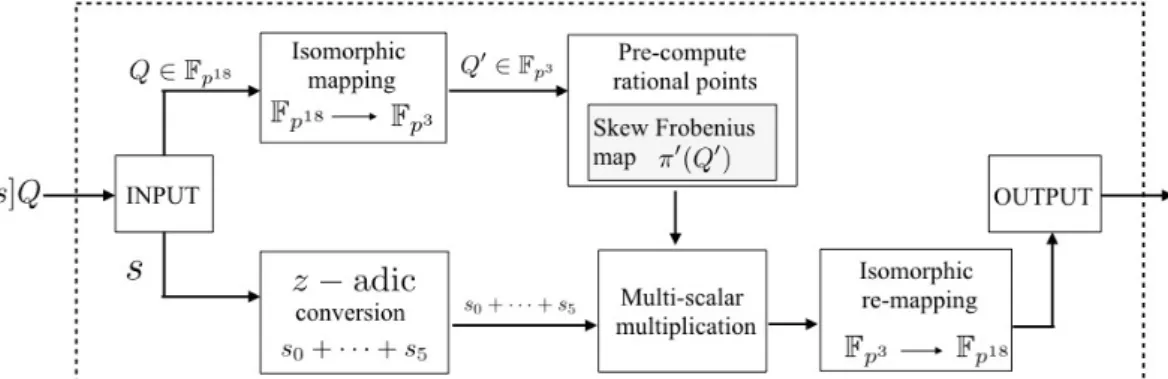
3.1 sextic twistin KSS-18 curve. . . 36
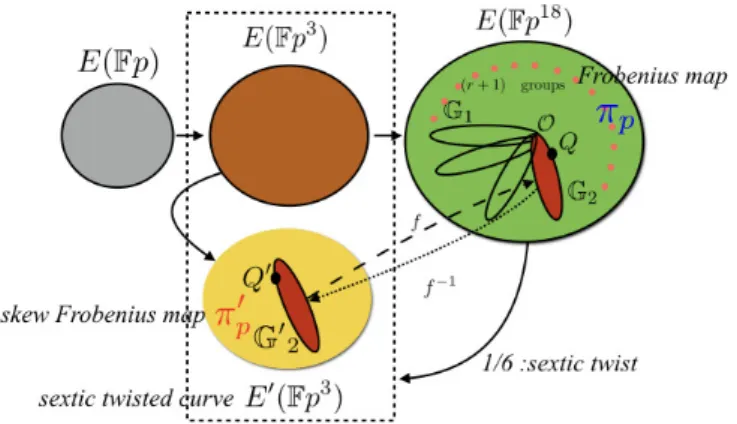
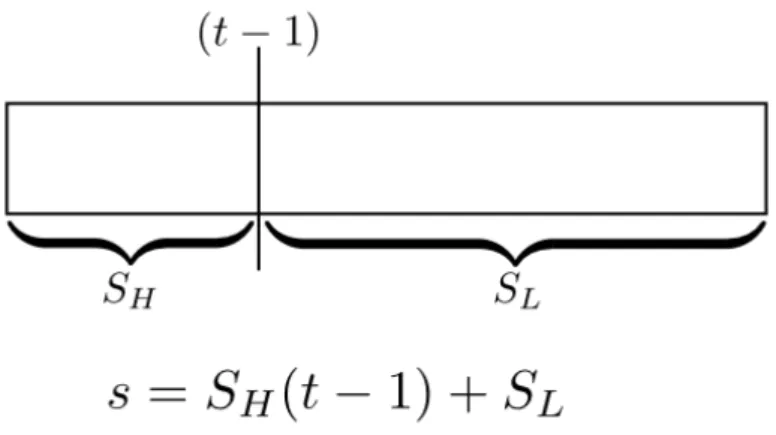
5.1 Overview of the proposed scalar multiplication for KSS-18 curve. 59 5.2 Q ∈ Fp18 and its sextic twisted isomorphic rational pointQ0 ∈ Fp3 structure in KSS-18 curve. . . 61
5.3 (t−1)-adic representation of scalars. . . 62
5.4 z-adic and(t−1)-adic representation of scalars. . . 63
5.5 Multi-scalar multiplication ofs with Frobenius mapping. . . . 66
6.1 Overview of the twisting process to get pseudo sparse form in KSS-16 curve. . . 85
7.1 Skew Frobenius mapping in 2 KSS-16 curve. . . 106
8.1 (a) Pre-computation of rational points for dimension 8 GLV. (b) Computation of SCM for dimension 8 GLV. . . 123
xxi
List of Tables
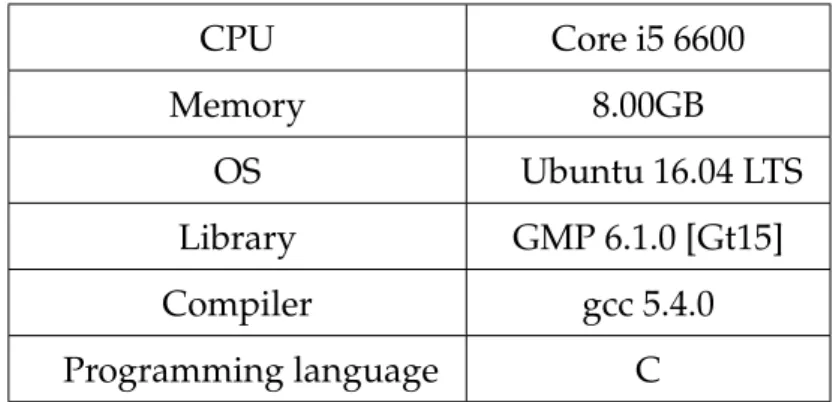
2.1 Notations used inAlgorithm4,Algorithm5 andAlgorithm6 30 3.1 Vector representation ofQ =(xQ,yQ) ∈ Fp16. . . 38 3.2 KSS-18 parameters. . . 40 3.3 KSS-16 parameters. . . 40 3.4 Computational environment. . . 41 3.5 Additional settings used in the experiment. . . 41 3.6 Comparative result of average execution time in [ms] for scalar
multiplication. . . 42 4.1 Parameters for Optimal-Ate pairing over KSS-18 curve. . . 51 4.2 Computing environment of Optimal-Ate pairing over KSS-18
curve. . . 52 4.3 Operation count of line evaluation. . . 52 4.4 Operation count of multiplication. . . 52 4.5 Calculation time of Optimal-Ate pairing at the 192-bit security
level. . . 53 5.1 13 pre-computed values of rational points. . . 64 5.2 Parameter settings used in the experiment. . . 67 5.3 Computational environment. . . 67 5.4 Comparison of average number of ECA and ECD forG2SCM
in KSS-18. . . 68 5.5 Comparison of execution time in [ms] for scalar multiplication
in KSS-18 curve. . . 68 6.1 Number of arithmetic operations inFp16 based on Eq.(6.3). . . 74 6.2 Number of arithmetic operations inFp12 based on Eq.(6.4). . . 75 6.3 Optimal-Ate pairing formulas for target curves. . . 76 6.4 Vector representation ofQ =(xQ,yQ) ∈ G2 ⊂E(Fp16). . . 77 6.5 Vector representation ofQ =(xQ,yQ) ∈ G2 ⊂E(Fp12). . . 79 6.6 Exponents of final exponentiation in pairing. . . 86 6.7 Computational environment. . . 86
xxii
6.8 Selected parameters for 128-bit security level [BD17]. . . 86 6.9 Comparative results of Miller’s algorithm in [ms]. . . 87 6.10 Complexity of this implementation inFpfor Miller’s algorithm
[single pairing operation]. . . 87 6.11 Final exponentiation time (not state-of-art) in [ms]. . . 87 6.12 Complexity comparison of Miller’s algorithm between this im-
plementation and Barbulescu et al.’s [BD17] estimation [Mul- tiplication + Squaring inFp]. . . 88 7.1 Number of arithmetic operations inFp16 based on Type-I tow-
ering Eq.(7.1). . . 91 7.2 Number ofFp operations in the fieldFp4 based on Type-I and
Type-II towering. . . 94 7.3 The detailed cost of a multiplication inFp4 using CVMA tech-
nique. . . 96 7.4 The detailed cost of a squaring inFp4 using CVMA. . . 96 7.5 Final Exponentiation with reduced temporary variables of [GF16a].108 7.6 Computational environment. . . 109 7.7 Selected parameters for 128-bit security level according to [BD17].110 7.8 Operation count in Fp for extension field operations used in
pairing. . . 111 7.9 Miller’s algorithm (MA) operation comparison with respect to
Fp addition. . . 112 7.10 Comparison in terms of operation count for Pseudo 8-sparse
multiplication. . . 112 7.11 Comparison in terms of operation count for Final exponentia-
tion (FE). . . 113 7.12 Time comparison in millisecond [ms] of CVMA vs Karatsuba
based implementation of Pseudo 8-sparse Optimal-Ate. . . 113 8.1 Curve parameters. . . 125 8.2 Experimental Implementation Environment. . . 125 8.3 Maximum length of scalars after GLV decomposition in dif-
ferent dimensions. . . 125 8.4 ECD and ECA cost inE0(Fp4). . . 126 8.5 Comparative result of average execution time in [ms] for scalar
multiplication. . . 126
xxiii
List of Notations and Symbols
Notation Description
p p > 3 is an odd prime integer in this thesis.
x modp Modulo operation. the least nonnegative residue ofx modulop.
Fp Prime field. The field of integers modp.
F∗p The multiplicative group of the fieldFp.
b·c The floor of·is the greatest integer less than or equal to·. For example, b1c =1 andb6.3c =6.
Fpk The extension overFp of degree.k E Elliptic curve group.
E(Fp) Elliptic curve group over prime field.
E(Fpk) Elliptic curve group over extension field.
#E(Fpk) Group order of elliptic curve groupE over extension field.
O Additive identity of elliptic curve group.
F(p3)2 ToweringFp6 extension field.
Fpk/d Extension field with twist degreed.
E0() Tiwsted elliptic curve.
G1 Additive subgroup over prime fieldFp. G2 Additive subgroup over extension fieldFpk. G3 Multiplicative subgroup over extension fieldFpk. r(u) Order of parameterized pairing-friendly curve.
p(u) Characteristics of parameterized pairing-friendly curve.
t(u) Frobenius trace of parameterized pairing-friendly curve.
πp Frobenius mao over prime field elements.
ψ4 Quartic twist map.
xxv
Dedicated to the people I owe the most. To my parents who
brought me to this world and to my wife who sacrificed the
most during my Ph.D. journey.
xxvii
Research Activities
Peer-Reviewed Journal Papers (First author)
1. Md. Al-Amin Khandaker and Yasuyuki Nogami. “An Improvement of Scalar Multiplication by Skew Frobenius Map with Multi-Scalar Mul- tiplication for KSS Curve”. In: IEICE Transactions 100-A.9 (2017), pp.
1838-1845. DOI: 10.1587/transfun.E100.A.1838.
2. Md. Al-Amin Khandaker, Taehwan Park, Yasuyuki Nogami, and Howon Kim. “A Comparative Study of Twist Property in KSS Curves of Em- bedding Degree 16 and 18 from the Implementation Perspective”. In:
J. Inform. and Commun. Convergence Engineering15.2 (2017), pp. 97-103.
DOI: 10.6109/jicce.2017.15.2.97.
Peer-Reviewed International Conference Papers (First author)
LNCS Proceedings:
3. Md. Al-Amin Khandaker, Yuki Nanjo, Loubna Ghammam, Sylvain Duquesne, Yasuyuki Nogami, and Yuta Kodera. “Efficient Optimal Ate Pairing at 128-Bit Security Level”. In: INDOCRYPT 2017. Ed. by Arpita Patra and Nigel P. Smart. Vol. 10698. LNCS. Springer, Heidelberg, Dec.
2017, pp. 186–205. DOI: 10.1007/978-3-319-71667-1_10. (Acceptance rate 19/75≈25%)
4. Md. Al-Amin Khandaker, Hirotaka Ono, Yasuyuki Nogami, Masaaki Shirase, and Sylvain Duquesne. “An Improvement of Optimal Ate Pair- ing on KSS Curve with Pseudo 12-Sparse Multiplication". In: ICISC 2016. Ed. by Seokhie Hong and Jong Hwan Park. Vol. 10157. LNCS.
Springer, Heidelberg, Nov. 2016, pp. 208–219. DOI: 10.1007/978-3-3195 3177-9_11. (Acceptance rate 18/69≈26%)
5. Md. Al-Amin Khandaker, Yasuyuki Nogami, Hwajeong Seo, and Syl- vain Duquesne. “Efficient Scalar Multiplication for Ate Based Pairing over KSS Curve of Embedding Degree 18”. In: WISA 2016. Ed. by Dooho Choi and Sylvain Guilley. Vol. 10144. LNCS. Springer, Hei- delberg, Aug. 2016, pp. 221–232. DOI: 10.1007/978-3-319-56549-1_19. (Acceptance rate 31/61≈51%)
xxviii
IEEE Xplore indexed:
6. Md. Al-Amin Khandaker, Yuki Nanjo, Takuya Kusaka, and Yasuyuki Nogami. “A Comparative Implementation of GLV Technique on KSS- 16 Curve.” In: Sixth International Symposium on Computing and Net- working, CANDAR 2018, Gifu, Japan, Nov. 2018, pp. 106–112. DOI: 10.1109/CANDAR.2018.00021. (Acceptance rate 28/77≈36%)
7. Md. Al-Amin Khandaker and Yasuyuki Nogami. “Isomorphic Map- ping for Ate-Based Pairing over KSS Curve of Embedding Degree 18”.
In: Fourth International Symposium on Computing and Networking, CAN- DAR 2016, Hiroshima, Japan, Nov. 2016, pp. 629–634. DOI: 10.1109/
CANDAR.2016.0113.
8. Md. Al-Amin Khandaker and Yasuyuki Nogami. “A consideration of towering scheme for efficient arithmetic operation over extension field of degree 18”. In: 19th International Conference on Computer and Informa- tion Technology, ICCIT 2016, Dhaka, Bangladesh, Dec. 2016, pp. 276–281.
DOI: 10.1109/ICCITECHN.2016.7860209.
9. Md. Al-Amin Khandakerand Yasuyuki Nogami. “An improvement of scalar multiplication on elliptic curve defined over extension field Fq2”.
In: IEEE International Conference on Consumer Electronics-Taiwan, ICCE- TW 2016, Nantou, Taiwan, May. 2016, pp. 1–2. DOI: 10.1109/ICCE-TW.
2016.7520894.
IEICE/IEIE sponsored:
10. Md. Al-Amin Khandakerand Yasuyuki Nogami. “Frobenius Map and Skew Frobenius Map for Ate-based Pairing over KSS Curve of Embed- ding Degree 16 ”. In: 32nd International Technical Conference on Circuits / Systems, Computers and Communications, ITC-CSCC 2017, Busan, Korea, Jul. 2017, pp. 599-602, IEIE, CD-ROM (OS22-5).
xxix
Peer-Reviewed Journal Papers (Co-author)
11. Yuki Nanjo, Md. Al-Amin Khandaker, Takuya Kusaka, and Yasuyuki Nogami. “Efficient Pairing-Based Cryptography on Raspberry Pi”. In:
Journal of Communications (JCM)13.2 (2018), pp. 88–93.DOI: 10.12720/
jcm.13.2.88-93.
12. Yuta Hashimoto, Md. Al-Amin Khandaker, Yuta Kodera, Taehwan Park, Takuya Kusaka, Howon Kim, and Yasuyuki Nogami. “An Imple- mentation of ECC with Twisted Montgomery Curve over 32nd Degree Tower Field on Arduino Uno”. In: International Journal of Networking and Computing (IJNC)8.2 (2018), pp. 341–350. DOI: 10.15803/ijnc.8.2_341. 13. Yuta Kodera, Takeru Miyazaki,Md. Al-Amin Khandaker, Ali Md. Ar-
shad, Takuya Kusaka, Yasuyuki Nogami, and Satoshi Uehara. “Distri- bution of Digit Patterns in Multi-Value Sequence over the Odd Char- acteristic Field”. In: IEICE Transactions 101-A.9 (2018), pp. 1525–1536.
DOI: 10.1587/transfun.E101.A.1525.
14. Shunsuke Ueda, Ken Ikuta, Takuya Kusaka,Md. Al-Amin Khandaker, Ali Md. Arshad, and
Yasuyuki Nogami. “An Extended Generalized Minimum Distance De- coding for Binary Linear Codes on a 4-Level Quantization over an AWGN Channel”. In: IEICE Transactions 101-A.8 (2018), pp. 1235–1244. DOI: 10.1587/transfun.E101.A.1235.
15. Shoma Kajitani, Yasuyuki Nogami, Shunsuke Miyoshi, Thomas Austin, Md. Al-Amin Khandaker, Nasima Begum, and Sylvain Duquesne.
“Web-based Volunteer Computing for Solving the Elliptic Curve Dis- crete Logarithm Problem”. In: International Journal of Networking and Computing (IJNC)6.2 (2016), pp. 181–194.DOI: 10.15803/ijnc.6.2_181.
Peer-Reviewed International Conference Papers (Co-author)
LNCS Proceedings:
16. Yuki Nanjo,Md. Al-Amin Khandaker, Masaaki Shirase, Takuya Kusaka, and Yasuyuki Nogami. “Efficient Ate-Based Pairing over the Attractive Classes of BN Curves”. In: WISA 2018. [To appear in LNCS, Springer, Heidelberg], Aug. 2018. (Acceptance rate 22/44 = 50%)
17. Takuya Kusaka, Sho Joichi, Ken Ikuta, Md. Al-Amin Khandaker, Ya- suyuki Nogami, Satoshi Uehara, Nariyoshi Yamai, and Sylvain Duquesne.
“Solving 114-Bit ECDLP for a Barreto-Naehrig Curve”. In: ICISC 2017.
Ed. by Howon Kim and Dong-Chan Kim. Vol. 10779. LNCS. Springer, Heidelberg, Oct. 2017, pp. 231–244. DOI: 10.1007/978-3-319-78556-1_13. (Acceptance rate 20/70≈29%)
xxx
18. Taehwan Park, Hwajeong Seo, Garam Lee, Md. Al-Amin Khandaker, Yasuyuki Nogami, and Howon Kim. “Parallel Implementations of SI- MON and SPECK, Revisited". In:WISA 2017. Ed. by Brent ByungHoon Kang and Taesoo Kim. Vol. 10763. LNCS. Springer, Heidelberg, Aug.
2017, pp. 283–294. DOI: 10.1007/978-3-319-93563-8_24. (Acceptance rate 27/53≈51%).
IEEE Xplore indexed:
19. Yuki Nanjo, Md. Al-Amin Khandaker, Takuya Kusaka, and Yasuyuki Nogami. “Consideration of Efficient Pairing Applying Two Construc- tion Methods of Extension Fields.” In: Sixth International Symposium on Computing and Networking, CANDAR 2018, Gifu, Japan, Nov. 2018, pp.
445–451. DOI: 10.1109/CANDARW.2018.00087.
20. Yuta Hashimoto, Md. Al-Amin Khandaker, Yuta Kodera, Taehwan Park, Takuya Kusaka, Howon Kim, and Yasuyuki Nogami. “An ECC Implementation with a Twisted Montgomery Curve over Fq32 on an 8- Bit Microcontroller”. In:Fifth International Symposium on Computing and Networking, CANDAR 2017, Aomori, Japan, Nov. 2017, pp. 445–450.
DOI: 10.1109/CANDAR.2017.90.
21. Yuta Kodera, Takuya Kusaka, Takeru Miyazaki, Md. Al-Amin Khan- daker, Yasuyuki Nogami, and Satoshi Uehara. “An Efficient Imple- mentation of Trace Calculation over Finite Field for a Pseudorandom Sequence”. In: Fifth International Symposium on Computing and Network- ing, CANDAR 2017, Aomori, Japan, Nov. 2017, pp. 451–455. DOI: 10.1109/CANDAR.2017.86.
22. Taehwan Park, Hwajeong Seo, Md. Al-Amin Khandaker, Yasuvuki Nogami, and Howon Kim. “Efficient Parallel Simeck Encryption with GPGPU and OpenCL”. In: IEEE International Conference on Consumer Electronics-Taiwan, ICCE-TW 2018, Taichung, Taiwan, May 2018, pp.
1–2. DOI: 10.1109/ICCE-China.2018.8448768.
23. Yuta Kodera, Takeru Miyazaki, Md. Al-Amin Khandaker, Ali Md Ar- shad, Yasuyuki Nogami, and Satoshi Uehara. “Distribution of bit pat- terns on multi-value sequence over odd characteristics field”. In: IEEE International Conference on Consumer Electronics-Taiwan, ICCE-TW 2017, Taipei, Taiwan, Jun. 2017, pp. 137-138. DOI: 10.1109/ICCE-China.2017.7 991033.
24. Akihiro Sanada, Yasuyuki Nogami, Kengo Iokibe,Md. Al-Amin Khan- daker. “Security analysis of Raspberry Pi against Side-channel attack with RSA cryptography”. In: IEEE International Conference on Consumer Electronics-Taiwan, ICCE-TW 2017, Taipei, Taiwan, Jun. 2017, pp. 287 - 288. DOI: 10.1109/ICCE-China.2017.7991108.
xxxi
IEICE/IEIE sponsored:
25. Ken Ikuta, Sho Joichi, Kazuya Kobayashi, Md. Al-Amin Khandaker, Takuya Kusaka, and Yasuyuki Nogami. “A Study on the Parameter Size of the Montgomery Trick for ECDLP”. In: International Symposium on Information Theory and its Applications, ISITA 2018, Singapore, Oct.
2018, pp. 655 - 659, IEICE, CD-ROM.
26. Ken Ikuta, Sho Joichi, Kazuya Kobayashi, Md. Al-Amin Khandaker, Takuya Kusaka, and Yasuyuki Nogami. “A Study on the Parameter of the Distinguished Point Method in Pollard’s Rho Method for ECDLP”.
In: International Symposium on Information Theory and its Applications, ISITA 2018, Singapore, Oct. 2018 pp. 660 - 664, IEICE, (CD-ROM).
27. Ken Ikuta, Takuya Kusaka,Md. Al-Amin Khandaker, Yasuyuki Nogami, and Thomas H. Austin. “Estimation of computational complexity of Pollard’s rho method based attack for solving ECDLP over Barreto- Naehrig curves”. In: 32nd International Technical Conference on Circuits / Systems, Computers and Communications, ITC-CSCC 2017, Busan, Korea, Jul. 2017, pp. 592-595, IEIE, CD-ROM (OS22-3).
Domestic conferences (First author)
28. Md. Al-Amin Khandaker, Hirotaka Ono, Yuki Nanjo, Takuya Kusaka and Yasuyuki Nogami. “Efficient Optimal-Ate Pairing on BLS-12 Curve Using Pseudo 8-Sparse Multiplication”. In: Computer Security Sympo- sium (CSS), 2017, Yamagata, Oct. 2017, CD-ROM (3E1-4).
29. Md. Al-Amin Khandaker and Yasuyuki Nogami. “Efficient Scalar Multiplication by Skew Frobenius Map with Multi-Scalar Multiplica- tion for KSS Curve”. In: Symposium on Cryptography and Information Security (SCIS), 2017, Okinawa, Jan. 2017, CD-ROM (B1-3).
Domestic conferences (Co-author)
30. Yuki Nanjo,Md. Al-Amin Khandaker, Masaaki Shirase, Takuya Kusaka, and Yasuyuki Nogami. “Attractive Classes of KSS Curves for Efficient Pairing”. In: Symposium on Cryptography and Information Security 2019 (SCIS), Shiga, Jan. 2019.
31. Yuki Nanjo,Md. Al-Amin Khandaker, Takuya Kusaka, Yasuyuki Nogami. “A Study on a Construction Method of Degree 18 Extension Field for Efficient Pairing over KSS Curves”. In: Computer Security Sym- posium (CSS), 2018, Nagano, Oct. 2018, CD-ROM (2A3-1).
xxxii
32. Yuki Nanjo,Md. Al-Amin Khandaker, Masaaki Shirase, Takuya Kusaka, and Yasuyuki Nogami. “Determining BLS Curves for Pairing over Ef- ficient Tower of Extension Field”. In: Technical Committee on Information Security (ISEC ), Tokyo, May 2018, IEICE Tech. Rep., vol. 118, no. 30, ISEC2018-2, pp. 9-16, May 2018.
33. Hirotaka Ono, Md. Al-Amin Khandaker, Yuki Nanjo, Toshifumi Mat- sumoto, Takuya Kusaka and Yasuyuki Nogami. “An Implementation and Evaluation of ID-based Authentication on Raspberry Pi with Pair- ing Library”. In: Symposium on Cryptography and Information Security (SCIS), 2018, Niigata, Jan. 2018, CD-ROM (4D2-1).
34. Yuki Nanjo, Md. Al-Amin Khandaker, Yuta Kodera and Yasuyuki Nogami. “Implementation method of the pairing over BN curve us- ing two type of extension fields”. In: Symposium on Cryptography and Information Security (SCIS), 2018, Niigata, Jan. 2018, CD-ROM (4D2-3).
35. Norito Jitsui, Yuki Nanjo, Md. Al-Amin Khandaker, Takuya Kusaka and Yasuyuki Nogami. “Efficient Elliptic Scalar Multiplication for Pairing- Based Cryptography over BLS48”. In: Symposium on Cryptography and Information Security (SCIS), 2018, Niigata, Jan. 2018, CD-ROM (3B4-1).
36. Yuki Nanjo, Md. Al-Amin Khandaker, Takuya Kusaka, and Yasuyuki Nogami. “The relation between the efficient sextic twist and constant of the modular polynomial for BN curve”. In: Computer Security Sym- posium (CSS), 2017, Yamagata, Oct. 2017, CD-ROM (3E1-3).
1
Chapter 1
Introduction
This chapter introduces the related literature review, problem outline, moti- vation, and goals of the undertaken research. The chapter begins with a brief preface of cryptology and its importance in the era Internet of Things (IoT) and Big Data.
1.1 Cryptology
Cryptography is the science of communicating with the authentic receiver through an insecure channel in secret. Cryptanalysis is the techniques of breaking secret communications. Cryptology is the combination of these two domains.
The history of cryptography dates back to the time of the Greek and Roman empire. Julius Caesar used a simple shift and substitute system. Up until the early ’70s of the last century, cryptology was evolved mostly for military pur- poses. The cryptography got its first democratic form in 1975 when Diffie and Hellman invented the concept of public-key cryptography [DH76]. The idea was first realized as practical cryptosystem by the works of Rivest, Shamir and Adleman (RSA) in 1977 [RSA78]. At the same time in 1977, National Bu- reau of Standards published a cryptosystem intended for the governmental agencies and banks named Data Encryption Standard (DES). From then, a new era of cryptography known asModern cryptography was initiated. The well-organized procedures called protocols is the basis of Modern cryptogra- phy. One of the most elegant features of modern crypto-protocols is that their inner algorithms are not secret yet withstand cryptanalysis from experts/at- tackers. More importantly, these protocols are easy to use for people with no understanding of the underlying principles. For example, paying by credit cards or withdrawing money using debit cards with a personal identification number (PIN) is doable without concerning what is going on under the hood.
The little basic functionality of modern cryptosystem is to enable a sender (Alice 1) to convert a message (plaintext) into a cipher (ciphertext) before sending to a legitimate receiver (Bob) over the public communication media.
1Alice and Bob are fictional characters first used by Rivest, Shamir and Adleman in [RSA78] as placeholder name in cryptology.
2 Chapter 1. Introduction The receiver can convert the cipher back into the original message using se- cret information named as a key. An adversary (Eve) eavesdrops in the mid- dle of the conversation to retrieve information from the cipher. The cipher is safe from to the adversary until the key is not compromised.
The security of modern cryptosystems depends not on the secrecy of the encryption algorithms but the difficulty of one-way problems. Such prob- lems are easy to calculate in one direction but practically impossible to cal- culate in reverse direction in a reasonable amount of time using reasonable resources. For example, let us consider a ciphertextCand a plaintextP and a 128-bit key K. The encryption scheme E takes input P and K and out- put C = E(P,K). To obtain the key K from the (P,C) pair, we need to try 2128 = 340, 282, 366, 920, 938, 463, 463, 374, 607, 431, 768, 211, 456 ≈ 3.4×1038 (39 decimal digits) combination of 128-bit keys. The most potent supercom- puter to this date can compute 122.3 PETA (1015) floating-point operations per second (PFLOPS). Let us consider an optimistic assumption that 1000 (FLOPS) is required to check one key combination. Under this assumption, the supercomputer can compute 122.3.×1015/1000 = 122.3×10¹² key com- binations per second. Then it will take about 3.4×1038/((122.3×1012)(365× 24×60×60)) ≈ 8.8×10¹⁶ earth years. According to the standard model of physical cosmology [Ade+16] the age of our universe is 13.89 or 13.8 billion years. It means finding a key using brute force search will require 6.3 million years more than the age of the universe. We can imagine how big the number 2128is from this comparison.
Cryptography became more important as individuals and business increas- ingly depend on the Internet as a channel for communication. Therefore, the following four properties are the basis of a cryptosystem.
• Data confidentiality: This property ensures that confidential informa- tion such as bank transactions or medical data and so on are secret from unauthorized entities.
• Data integrity: When data is stored, this property ensures that it not only kept secret (Data confidentiality) but also not rigged. Confiden- tiality and integrity are enforced by encryption.
• Authentication: In connection-oriented communication, authentication proves both parties identity before communication begins. The digital signature is used for this purpose to sign a message electronically. It shields the legitimate party against masquerader from impersonating as a trusted party. This property gives the receiver a confidence to be- lieve that the actual signee indeed sends the message over the insecure channel.
• Non-repudiation: Non-repudiation (with proof of origin and with proof of receipt) ensures that the sender and receiver can not deny having taken part in communication. Non-repudiation is essential for many cases especially e-commerce while communicating over the Internet.
The modern crypto-protocols fall into the following two major categories.
1.1. Cryptology 3
1.1.1 Symmetric/Private-Key Cryptography
Private-Key Cryptography, also known as Symmetric Cryptography is the technique where both the sender and the receiver use the samekeyor easily derivable from one another to encrypt and decrypt a message. This type of cryptography has an ancient history.
Modern cryptosystems offer efficient symmetric cryptography algorithms, e.g Advanced Encryption Standard (AES) [DR02]. Such cryptography has two main obstacles i.e. Key management and key establishment. Since the keys are same, they need to keep private (Key management) in both ends and should be shared securely beforehand (Key establishment) without physically meeting.
The Public-key Cryptography offers the solution forKey establishmentapply- ing Diffie-Hellman key exchange. This work primarily focuses on a specific type of Public-key Cryptography. The subsequent chapters will describe in details.
1.1.2 Public-key Cryptography
The inception of public-key cryptography solved the problem of key dis- tribution of Symmetric-key cryptography. It is also known as Asymmetric Cryptography. The basic idea of public-key cryptography is to use two dif- ferent keys for each communicating party. One key is public-key which can be used by anyone to encrypt the message. The receiver needs the correlated private key to decrypt the message. From a given public key and ciphertext it is asymptotically difficult to obtain the private key.
As aforementioned, In 1976, Whitfield Diffie and Martin Hellman published their monumental work as a key exchange protocol [DH76].Figure1.1 shows a simple overview of the Diffie-Hellman Key Exchange (DHKE). The prob- lems of key distribution and storage associated with symmetric cryptogra- phy were the motivation behind the concept of Asymmetric Cryptography, also referred to as Public- Key Cryptography.
In brief, the protocol has two public parameters, the prime numberp and a generatorд known to all the parties involved in the communication. The main idea of this protocol is based on the difficulty in solving the one-way function, i.e., discrete logarithm. Let’s say, it is easy to calculate Alice public keykA using Alice private keykAd askA = дkAd(modp). However, it will be difficult to obtainkAd fromkA,д andp. In other words, it is easy to calculate the public key from the private key, but the reverse process is practically impossible. Using this key-exchange, we establish a shared secret which we can use for further encrypted communication.
Rivest, Shamir, and Adleman (RSA) realized this protocol in 1977 and pub- lished their magnum opus which is widely known as RSA cryptosystem [RSA78]. The security of the RSA depends on the difficulty of factorization of a larger integer into its two prime factors and the trapdoor permutation for
4 Chapter 1. Introduction
FIGURE 1.1: Exchanging shared secret key using DH-key ex- change.
encryption. Let us denote two large primesp andq(in practice about 1000- bit). It is easy to calculate their product to getn = pq. The reverse process that is for a given integern it will be arduous to retainp and q. Using the state-of-the-art integer factoring algorithmgeneral number field sieve (GNFS), it will take approximately 290basic operation to factor a 2048-bit integer. Af- ter more than 40 years of the RSA breakthrough, it is still standing as an epitome of public key cryptography. Besides encryption, RSA also enables digital signaturewhere the sender uses his private key to sign a message, and the receiver verifies the signature by the sender’s public key. Verification of a digitally signed message gives the receiver the confidence that a senders private key is tied to his public key. It is done to prevent forgery and holds Non-repudiationproperty.
In the mid 80’s the independent work of Miller [Mil86] and Koblitz [Kob87]
began the journey of elliptic curve cryptosystems (ECC). The security of el- liptic curve cryptography protocols depends on the difficulty in solving the elliptic curve discrete logarithm problem. The mathematical details of this problem appear in Chapter 2. ECC provides a shorter key length for the same level of security than RSA which makes ECC popular among the re- searchers. Compared to RSA, ECC has other advantages. While RSA pro- vides encryption and digital signature; ECC has a family of algorithms for encryption, signature, key agreement and some advanced high-level crypto- graphic protocols such as ID-based encryption [BLS01], where user’s unique ID, e.g., email address, can be used as a public key. The high-level crypto- graphic functionalities are provided by pairing over elliptic curves [EM17]
which brings a new paradigm in cryptography called pairing-based cryptog- raphy.
1.1.3 Pairing-Based Cryptography
Since the inception by Sakai et al. [Sak00], the pairing-based cryptography has gained much attention to cryptographic researchers as well as to mathe- maticians. It gives flexibility to protocol researcher to innovate applications
1.2. Problem Outline and Motivation 5
FIGURE1.2: Challenges in pairing computation.
with provable security and at the same time to mathematicians and cryptog- raphy engineers to find efficient algorithms to make pairing implementation more efficient and practical.
Definition and Notation
Generally, a pairing is a bilinear mape typically defined asG1×G2 → G3, whereG1andG2are additive cyclic sub-groups of orderr on a certain elliptic curveEover a finite extension fieldFpk andG3is a multiplicative cyclic group of orderr inF∗pk.
Let E(Fp) be the set of rational points over the prime field Fp which forms an additive Abelian group together with the point at infinity O. The total number of rational points is denoted as #E(Fp). Here, the orderr is a large prime number such thatr|#E(Fp)and gcd(r,p) =1. The embedding degreek is the smallest positive integer such thatr|(pk −1).
1.2 Problem Outline and Motivation
This section outlines the overall motivation behind the undertaken works. In this course, some mathematical notations will appear without detailed defi- nitions. The subsequent chapters will define them with further elaboration.
Pairing computation is mathematically exhaustive. Several factors challenge efficient pairing operation.Figure1.2 shows some of the challenges. Most of the problems are interconnected and challenge efficient pairing operation.
Properties
Two fundamental properties of pairing are
• bilinearity is such that ∀Pi ∈ G1 and ∀Qi ∈ G2, where i = 1, 2, then e(Q1+Q2,P1)=e(Q1,P1).e(Q2,P1)ande(Q1,P1+P2)=e(Q1,P1).e(Q1,P2),
• and e is non-degenerate means∀P ∈ G1 there is a Q ∈ G2 such that e(Q,P),1 and∀Q ∈G2there is aP ∈G1such thate(P,Q), 1.
6 Chapter 1. Introduction
FIGURE1.3: Bilinearity of pairing.
Such properties allow researchers to come up with various cryptographic ap- plications including ID-based encryption [BF01], group signature authenti- cation [BBS04], and functional encryption [OT10], homomorphic encryption [OU98; NS98; OT08]. However, pairing groupsG1G2andG3needs to be cal- culated over the extension field( extension field is introduced in Chapter 2).
Therefore, it is essential to construction efficient extension field for pairing.
Security and Parameter of Pairing
The security of pairing-based cryptosystems depends on
• the difficulty of solving elliptic curve discrete logarithm problem (ECDLP) in the groups of orderr overFpk,
• the infeasibility of solving the discrete logarithm problem (DLP) in the multiplicative groupG3∈Fp∗k,
• and the difficulty of pairing inversion.
Therefore, maintaining the same security in the pairing groups is another important challenge.
To maintain the same security level in both groups, the size of the orderr and extension fieldpk is chosen accordingly. For a security levelλ,G1should have order of size log2r ≥ 2λ due to Pollard’s rho algorithm [Pol78]. In the case of parameterized curves, to balance the security and efficiency of pairing implementation, a ratio index denoted asρ = log2p/log2r is often used. It’s value ranges 1 ≤ ρ ≤ 2, yet ρ = 1 is sought after for efficiency purpose. In practice, elliptic curves with small embedding degreesk and highest twist degree d are desired. For the case of a KSS-16 elliptic curve, ρ is equal to
≈1.25.
In general, to obtain 128-bit AES level security, it is expected that the orderr ofG1 should be equal to 2λ(256-bit prime). Then the field size ofG1 should be at leastρ∗256 = 320-bit and the lower limit of extension field size ofG3
should be about ρ∗k ∗256 = 5120-bit. Since,d = 4 is the maximum twist
1.2. Problem Outline and Motivation 7
FIGURE1.4: Pairing friendly curves.
degree for KSS-16, hence the field size ofG2 ⊂ E0(Fpk/d)after twist is equal to 5120/d =1280-bit, where,E0is the twist curve ofE.
Types of Pairing
Galbraith et al. [GPS08] have classified pairings as three major categories based on the underlying group’s structure as
• Type 1, whereG1=G2, also known as symmetric pairing.
• Type 2, whereG1 , G2, known as asymmetric pairing. There exists an efficiently computable isomorphismψ : G2 → G1 but none in reverse direction.
• Type 3, which is also asymmetric pairing, i.e., G1 , G2. But no effi- ciently computable isomorphism is known in either direction between G1andG2.
This thesis focuses on one of the Type 3 variants of pairing named as Optimal- Ate [Ver10].
Pairing-Friendly Curves
Pairing cannot be computed over random curves since random curves em- bedding degreek ≈p. To compute pairing, we need elliptic curves that sup- port small embedding degree and large twist degree. Such curves are known as pairing-friendly curves. In this thesis, we focus on the Type 3 pairing. The Type 3 pairing needs curves with embedding degreek ≤ 50.
Figure1.4 shows a tree of pairing-friendly curves.
Selection of the curve depends on the balanced parameter and security. Su- persingular curves have small embedding degreek ≤ 6. However, their se- curity is broken over small characteristics field. Families of ordinary pairing- friendly curves are suitable for Type 3 pairing since their embedding degree
8 Chapter 1. Introduction isk ≤ 50. Some ordinary pairing-friendly curves such as Barreto-Naehrig (BN) [BN06] , Barreto-Lynn-Scott (BLS-12) [BLS03] are well studied in litera- ture [Nog+09] [Sak+08]. Comparatively Kachisa-Schaefer-Scott (KSS) [KSS07]
family is a relatively new type of curves and less studied in the literature.
Moreover, the recent development of NFS by Kim and Barbulescu [KB16] re- quires updating the parameter selection for all the existing pairings over the well known pairing-friendly curve families such as BN [BN06], BLS [FST06]
and KSS [KSS07]. The most recent study by Barbulescu et al. [BD17] have shown the security estimation of the current parameter settings used in well- studied curves and proposed new parameters, resistant to small subgroup attack.
Barbulescu and Duquesne’s study finds that the current parameter settings for 128-bit security level on BN-curve studied in literature can withstand for 100-bit security. Moreover, they proposed that BLS-12 and surprisingly KSS- 16 are the most efficient choice for Optimal-Ate pairing at the 128-bit security level. Therefore, this thesis focuses on the efficient implementation of the less studied KSS curves of embedding degreek = 16, 18 for Optimal-Ate pairing by applying the most recent parameters.
Besides pairing, protocol researchers try to bypass the pairing operation with other operation such as scalar multiplication inG1orG2and exponentiation inG3. Among them, scalar multiplication is used in most protocols. There- fore, this thesis also tries to improve the scalar multiplication inG2for KSS curves.
1.3 Contribution
As discusses above, pairing is a bilinear map from two groupsG1andG2to a groupG3, where they have respectively same prime orderr. In detail,G1
andG2respectively becomes a subgroup in an elliptic curve groupE(Fq)and E(Fqk), and G3 becomes a subgroup in Fqk, whereq is a power ofp and an extension degreek is especially called theembedding degree.
In pairing-based cryptography, there exist several effective operations which are the bottleneck for any pairing-based protocols. These operations are Miller’s algorithm, final exponentiation in G3, scalar multiplications in G1
andG2, and exponentiation inG3. The calculation costs of pairing and scalar multiplication inG2 are the significant costs among the operations required for pairing-based cryptographies. Therefore, efficient Miller’s algorithm and scalar multiplications in G2 can reduce the total cost of pairing-based cryp- tography. In this work, we focus on these operations especially Miller’s al- gorithm and scalar multiplications inG2.
In this thesis, we focus on Type 3 pairing that is asymmetric pairing such as Ate [Mat+07] and Optimal-Ate [Ver10] pairing. Therefore, we have not efficient homomorphic map fromG1toG2. Generally, in asymmetric pairing
1.3. Contribution 9 the scalar multiplication is carried out over efficiently calculable group G1
and then the result is mapped toG2.
Theembedding degree is an important parameter that determines the security level of pairing-based cryptographies. Therefore, to achieve efficient pair- ing on ordinary curves whoseembedding degreeare flexibly selectable are re- quired. This thesis targets Ate andtwistedAte pairings because they are ef- ficiently calculated on normal pairing-friendly curve Kachisa-Schaefer-Scott (KSS) [KSS07]. Ate and Optimal-Ate are use calculated over certain elliptic curve groupsG1 andG2. In this thesis, we accelerate scalar multiplications inG2group which can be extended inG1
In the case of scalar multiplication, we reduce the number of elliptic curve doubling by decomposing a scalar with an essential relation for KSS curves.
Besides, we proposed state-of-the-art Miller’s algorithm calculation at the 128-bit security level.
Our proposed methods can substantially improve pairing calculation. There- fore, our research contributes to committing high-level security for sophisti- cated protocols, e.g., ID-based or Homomorphic encryption.
Use Case of Our Contribution
Let us consider the following two cases.
Case 1: IoT Security
Human civilization is moving to a direction where data generated from the devices used in our daily life will define how smart our society will be. In technical jargon, we define that IoT (Internet of Things) era controlled by Data Science. Some data can be mundane with no purpose, and some data can be extraordinarily important. Let us imagine a case where the adversary takes controls heartbeat monitor sensor of our smartwatch or control sensors of a self-driving car. The outcome of the damage is unimaginable. There is no alternative to protect this data from unwanted access. The challenge is that most of the IoT devices are equipped with small sensors. Such devices are computationally resource constrained. In some devices, it is somewhat im- practical to generate key pairs for widely practiced security protocols. There are several innovative solutions such as Identity-based encryption that can use the device’s unique ID as a key. The applications mentioned above stand on a compelling branch of cryptography named pairing-based cryptography over elliptic curve.
Case 2: Security of Medical Data in Cloud
Modern medical diagnosis depends on medical examination that produces a vast amount of data ranges from patients personal information to diag- nosis reports and images. Most of the data are stored in large cloud-based databases. For the privacy of the patient, they should be encrypted before
10 Chapter 1. Introduction stored. By analyzing such medical data, it is possible to predict the proba- bility of a patient’s vulnerability to a particular disease. However, it is not always the doctor who examined the patient can do that. Sometimes third- party researchers are interested in such data-set. However, the identity of the patient should not be obtained by any third-party using that data. One solution for this case is any third party can search for data and perform the mathematical operation in the encrypted database without decrypting the data. This scenario can be realized by using homomorphic encryption which is also powered by pairing-based cryptography.
However, pairing-based cryptography is a complex mathematical process.
To practically apply it, we need to carry out its fundamental algorithms more efficiently. In this thesis, our objective is to improve and find out more effi- cient algorithms that can realize high-level of security protocols.
1.4 Thesis Outline
This thesis is organized as follows:
In Chapter2, we briefly discuss the mathematical concepts that are related to understanding the concepts of this thesis. We also define the pairing in general. Besides, a target class of pairing-friendly elliptic curves is shown.
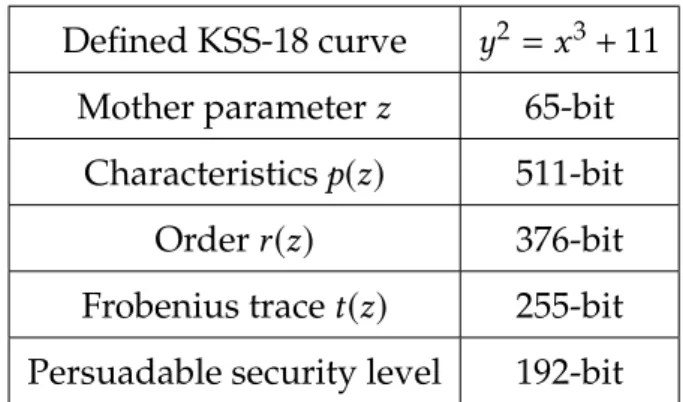
InChapter3, we derived twist property for target elliptic curves for the192- bit security level and compared their performances concerning scalar multi- plication. This thesis shows that sextic twist over KSS-18 curve has an ad- vantage over quartic twist in KSS-16 curve.
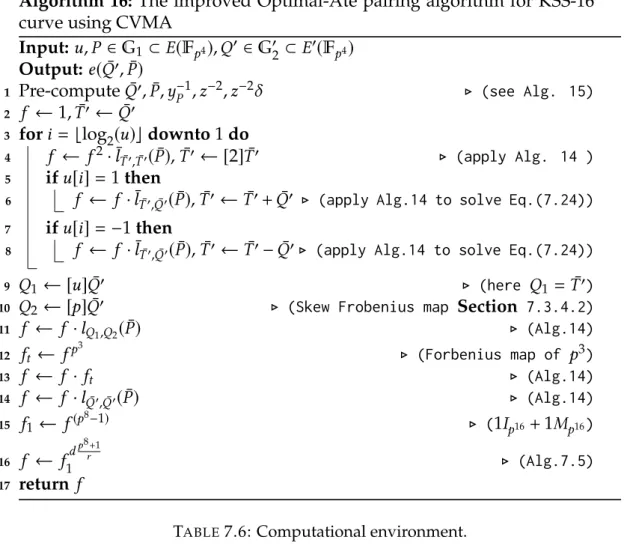
Chapter4 proposes an efficient Optimal-Ate pairing for KSS-18 curve. We improved Miller’s algorithm of Optimal-Ate pairing by proposingpseudo 12- sparse multiplication multiplication. To evaluate our theoretic proposal, we also include some experimental results with recommended parameter set- tings.
Chapter5 proposes a technique that will accelerate scalar multiplications in G2 over KSS-18 curve. It is crucial to derive efficiently computable endo- morphisms for accelerating scalar multiplication. The target G2 group has a property that specific scalar multiplication can utilize Frobenius endomor- phism that is efficiently computable. Focusing on this property, we derive an essential relation available for scalar multiplication inG2from the struc- tural features of the target elliptic curve. Then, using the relation, efficient scalar multiplication is proposed together with multi-scalar multiplication.
Besides, from the experimental results, we show that the proposed scalar multiplication is about 60 times faster than the conventional method.
Chapter 6, shows the state-of-the-art improvement of Optimal-Ate pairing over KSS-16 curve at the 128-bit security level. We adopted the most re- cent parameter and theoretically derived most efficient pairing calculation.
Besides, we also showed experimental implementation and compared our result with other pairing-friendly curves.