国立国語研究所学術情報リポジトリ
Real‑time and Apparent‑time Changes in
Semantics : Japanese Classifiers Tested across Generations and after a Quarter Century
著者(英) Yasuyo Ichikawa(Yoshida), Yo Matsumoto journal or
publication title
ICU Working Papers in Linguistics
number 10
page range 37‑44
year 2020‑03
URL http://doi.org/10.15084/00003050
Real-time and Apparent-time Changes in Semantics:
Japanese Classifiers Tested across Generations and after a Quarter Century
Yasuyo Ichikawa (Yoshida) Yo Matsumoto
Nishinomiya, Japanb NINJAL
1 Introduction
1Japanese numeral classifiers are undergoing change (Sanches 1977, Downing 1996, Shimojo 1997). This paper demonstrates the ongoing changes pointed out by previous studies by two types of experimental investigations. In one study we compare generation differences in the use of classifier -ko as reflections of ongoing changes, in an attempt to apply Labov’s (1963, 1966) apparent-time hypothesis to semantic change, which has rarely been made (Bailey 2004: 319). In another study, we examine how the acceptability ratings of the classifier -hon for various objects have changed in real time by comparing the results of the same experiment conducted with the same speakers in two different periods (in 1987 and 2011) as well as the results from a younger generation in 2011. We argue that 1) the generational differences can be observed in the use of -ko and -hon, which appear to reflect ongoing changes, and 2) the speakers tested a quarter-century ago retain older uses of -hon not favored among present-day younger speakers, but have acquired some new uses, providing caution in treating generation differences as a reflection of semantic changes.
2 Japanese classifiers and their changes
Numeral classifiers are a set of morphemes that occur primarily with numerals and are selected in accordance with the nature of the objects counted (Allan 1977, Craig 1986, Aikhenvald 2000). Examples from Japanese are given in (1).
(1) a. Ringo-ga ni-ko aru.
apple-Nom two-CLASS there.be “There are two apples.”
b. Empitsu-ga ni-hon aru.
pencil-Nom two-CLASS there.be “There are two pencils.”
Each classifier is used for a set of objects, which form a semantic category. Some, such as -ko (a classifier for three-dimensional concrete objects) in (1a), are used for a wide range of entities, while others, such as -joo (a classifier for medical tablets) are used for a very specific set of objects (see Matsumoto 1993, Downing 1996).
The semantics of Japanese classifiers has been studied by many scholars (Matsumoto 1993, Downing 1996, Mano and Yonezawa 2013). Classifiers are known to form prototype-based categories (Lakoff 1987, Matsumoto 1993):
members belonging to a classifier category are not equal in status, with some members more prototypical than others. The relative prototypicality of classifier category members can be judged by acceptability ratings of various objects as referents of the classifier (see Matsumoto 1986, 1988).
Changes in the use of Japanese classifiers have been noted. Sanches (1977) observed that many of the specific classifiers are going out of use partly because of the changes in the referential domains: classifiers for specific object categories are going out of use as the referents are going out of use (see also Downing 1996). Yoshida
*This is a revised version of the paper presented at the Linguistic Society of Japan meeting in 2011. We would like to thank
Changes in Japanese Classifiers
38 Ichikawa (Yoshida) and Matsumoto
(2013) observes that classifiers with a very specific referential domain are declining even if their referents are not being lost. Others have noted a wider use of the classifier -ko outside its original referential domain in recent years (Shimojo 1997, Mano 2007).
The present study looks at how the semantic categories of two classifiers, -ko and -hon, are changing, based on real-time and apparent-time data. We will adopt an experimental method of acceptability ratings used in Matsumoto (1986, 1988).
3. The semantic changes of -ko: An apparent-time study
3.1 The semantic structure of the classifier -ko The category of the classifier -ko has been analyzed by Matsumoto (1993), Shimojo (1997) and Mano (2004). Matsumoto identifies some necessary conditions as well as typicality conditions for this classifier (typicality conditions are those which do not have to be satisfied but which are satisfied by prototypical members). The necessary conditions he identified are SPATIALLY INDEPENDENT,
SOLID, VISIBLE (CONCRETE), and a typicality condition THREE-DIMENSIONAL. He adds, however, that the conditions of SPATIAL INDEPENDENT, SOLID,and VISIBLE are losing the status of necessary conditions. Shimojo (1997) states that -ko has distinctive semantic properties for its central members: SOLID, THREE-DIMENSIONAL, and HAND-SIZED (or MANIPULABLE). Some have noted that -ko can be used for certain abstract entities as well.
Mano (2004) examines the use of this classifier for abstract entities. She argues that those abstract entities that are figuratively regarded as solid objects have high acceptability of -ko, with figurative solidness tested by the applicability of adjectives such as katai ‘hard’ or katameru ‘solidify’ (e.g., kesshin o katameru ‘solidify one’s determination’).
We posit the following four typicality conditions for -ko in addition to the condition CONCRETE: THREE-
DIMENSIONAL, MOVABLE, SMALL (CAN BE HANDLED),and SOLID. We will see that prototypical members of -ko are those which satisfy all these conditions. The four conditions are also metaphorically interpreted, and we will see that those objects that metaphorically satisfy these conditions are more acceptable than those which do not.
3.2 Experiment Experiment A, conducted in 2011, tested the use of the classifier -ko in younger and older speakers. If the change pointed out in previous researches is actually in progress, this change is expected to appear as a difference between generations (Labov’s (1963, 1966) apparent-time hypothesis). In other words, it is expected that younger speakers will identify more objects than older speakers as -ko referents.
Subjects were 82 Japanese speakers, divided into 44 younger speakers (average age: 20.9; age range: 14 to 35), and 38 older speakers (average age: 51.9; age range 36 to 76). The subjects are further divided into four age groups in the result section below. We presented our subjects with sentences such as “Koko ni ringo ga niko arimasu (Here are two apples),” and rate the acceptability of the sentences on a scale from 1 to 5 (1 is completely unacceptable, 5 is completely acceptable).
We presented the nouns for 27 concrete objects and 18 abstract entities for -ko. Concrete objects can be categories according to whether or not they satisfy the conditions THREE-DIMENSIONAL, MOVABLE, SMALL (CAN BE HANDLED),and SOLID. Abstract entities are classified according to how the above conditions for concrete entities are metaphorically realized. Metaphorical three-dimensionality was tested by whether or not those nouns can be modified by ookii ‘big’ and chiisai ‘small’. Metaphorical movability is tested by whether (causative) motion verbs such as dasu ‘take out’ can be applied. Metaphorical smallness can be tested by whether the entity has the image of being smaller than human beings. Metaphorical solidity is tested by whether the nouns can be used with words referring to hardness or solidity (e.g., katai ‘hard’ and katameru ‘harden, solidify’, or verbs like tsukamu ‘grab’).
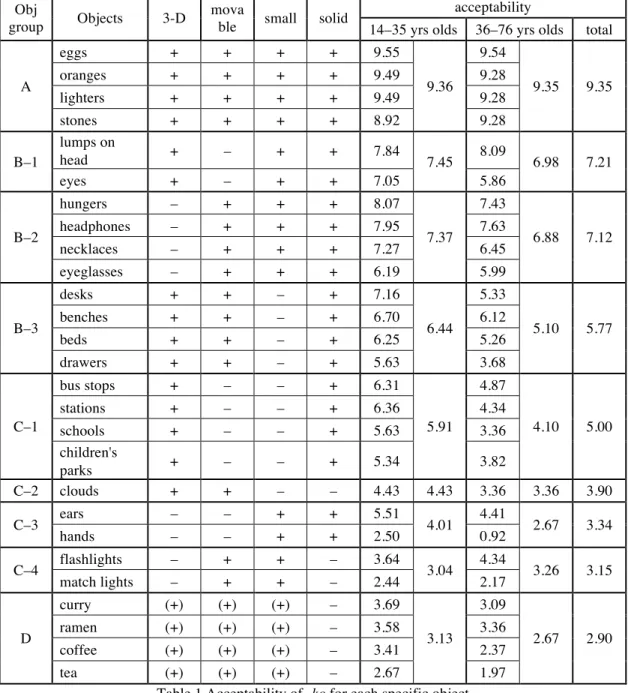
3.3 Results 1: Concrete objects Table 1 shows the average percentages of acceptability ratings of each group of concrete objects satisfying different sets of conditions posited for the meaning of -ko.
The results show that the more conditions that an object satisfies, the higher the acceptability, confirming the prototype structure based on the four conditions. This tendency is found in both younger and older speakers. There is no large difference in acceptability between the two age groups regarding objects satisfying all four conditions.
Generation differences are found for objects in which fewer conditions are satisfied, and the values tend to be higher in younger speakers than in older speakers.
Obj
group Objects 3-D mova
ble small solid acceptability
14–35 yrs olds 36–76 yrs olds total
A
eggs + + + + 9.55
9.36
9.54
9.35 9.35
oranges + + + + 9.49 9.28
lighters + + + + 9.49 9.28
stones + + + + 8.92 9.28
B–1
lumps on
head + – + + 7.84
7.45 8.09
6.98 7.21
eyes + – + + 7.05 5.86
B–2
hungers – + + + 8.07
7.37
7.43
6.88 7.12
headphones – + + + 7.95 7.63
necklaces – + + + 7.27 6.45
eyeglasses – + + + 6.19 5.99
B–3
desks + + – + 7.16
6.44
5.33
5.10 5.77
benches + + – + 6.70 6.12
beds + + – + 6.25 5.26
drawers + + – + 5.63 3.68
C–1
bus stops + – – + 6.31
5.91
4.87
4.10 5.00
stations + – – + 6.36 4.34
schools + – – + 5.63 3.36
children's
parks + – – + 5.34 3.82
C–2 clouds + + – – 4.43 4.43 3.36 3.36 3.90
C–3 ears – – + + 5.51
4.01 4.41
2.67 3.34
hands – – + + 2.50 0.92
C–4 flashlights – + + – 3.64
3.04 4.34
3.26 3.15
match lights – + + – 2.44 2.17
D
curry (+) (+) (+) – 3.69
3.13
3.09
2.67 2.90
ramen (+) (+) (+) – 3.58 3.36
coffee (+) (+) (+) – 3.41 2.37
tea (+) (+) (+) – 2.67 1.97
Table 1 Acceptability of -ko for each specific object
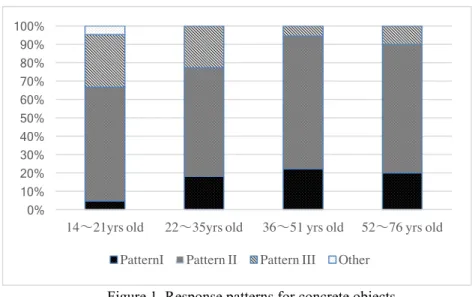
An individual analysis was conducted, in which we looked at which group of concrete objects are included in their category of -ko. Four response patterns are recognized based on whether or not a speaker has rated all objects within each object group higher than 6.50. Pattern I: only objects in group A are highly rated; Pattern II:
objects in group A and one to four more group(s) are highly rated; Pattern III: objects in six groups (A, B-1, B-2, B-3, C-1, and C-2 or C-4) are highly rated. The patterns found are shown in Figure 1, in which four age groups are compared.
Changes in Japanese Classifiers
40 Ichikawa (Yoshida) and Matsumoto
Figure 1. Response patterns for concrete objects
The results suggest that speakers in younger generations accept the use of -ko for a wider range of objects.
3.4 Results 2: Abstract entities Table 2 shows the average percentages of acceptability ratings of each group of abstract entities satisfying different sets of conditions posited for the meaning of -ko.
entity
group entities meta.
3-D
meta.
mova ble
meta.
small
meta.
solid
acceptability
14-35 yrs olds 36-76 yrs olds total
A
issues + + + ++ 8.47
6.89
5.86
4.84 5.87
evidence + + + ++ 7.44 5.53
reason + + + ++ 7.05 4.28
idea + + + ++ 6.19 4.34
contract + + + ++ 5.28 4.21
B
fascination + + +/– +/– 5.00
5.76
4.28
4.89 5.33
mystery + + +/– +/– 6.65 5.86
information + + +/– +/– 5.63 4.54
C
kind ? ? +/– – 4.60
4.47
4.08
3.73 4.10
result ? + +/– – 4.43 4.21
lawsuit + + +/– – 4.38 2.89
D rumor ? + – +/– 3.41 3.41 2.89 2.89 3.15
E
sport game + + – – 4.26
2.93
3.68
2.75 2.84
wedding + + – – 3.18 2.89
turmoil + + – – 2.44 3.03
medical
operation + + – – 1.82 1.38
F schedule – + – + 2.22
1.77 1.58
1.29 1.53
direction – + – + 1.31 0.99
Table 2 Acceptability of -ko for each abstract entity
Both younger and older speakers tend to rate objects higher if the objects satisfy more conditions (such as metaphorical solidity). Those entities which satisfy all four conditions are rated higher than the other entities, and the ratings are higher in younger speakers than in older speakers. Younger speakers also tend to rate entities satisfying fewer conditions somewhat higher than older speakers.
An individual analysis was conducted, in which we looked at which groups of abstract entities are included in their category of -ko. Four response patterns are recognized based on whether or not a speaker has rated all
0%
10%
20%
30%
40%
50%
60%
70%
80%
90%
100%
14~21yrs old 22~35yrs old 36~51 yrs old 52~76 yrs old PatternⅠ Pattern II Pattern III Other
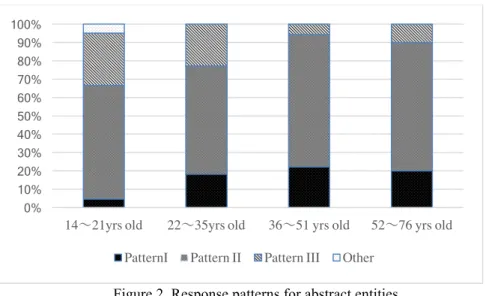
objects within each entity group higher than 6.50. Pattern I: entities in no groups are highly rated; Pattern II:
entities in group A only are highly rated; Pattern III: entities in group A and at least one more group are highly rated. The patterns found are shown in Figure 2, in which four age groups are compared.
Figure 2. Response patterns for abstract entities
The figure shows that the speakers that do not accept abstract entities as referents of -ko (Pattern I) are more common in the older three groups. Two younger groups include more groups of abstract entities in the category of -ko.
3.5
Discussion
It was found that there was a difference between generations as to the abstract referents of the classifier -ko. Older speakers tend to accept only restricted groups of objects as the -ko referents, especially those which satisfy the typicality conditions identified. Younger speakers, on the other hand, can include a wider range of objects in the -ko category. In addition, for many speakers in the older age group, the referents of -ko include only restricted groups of abstract entities, especially those entities which metaphorically satisfy the conditions identified. Younger speakers, on the other hand, tend to include a wider range of entities. Based on this, we can say that the concreteness condition on the referents of the -ko is weakened in the younger speakers, allowing more entities as the referents of -ko. Such generation differences are in accord with what has been claimed as ongoing historical changes.
4. Changes in the use of -hon: An apparent-time and real-time study
The apparent-time research as exemplified above has a limitation in that one has to establish the assumption of older speakers retaining older uses without being affected by new uses. Can speakers change their semantic categories based on the uses of younger speakers? This can be examined in a real-time change study, testing the same speakers at two different periods. In this section, we compare the results of the experiment conducted in 1987 with the results of the same experiment conducted with the same speakers after a quarter-century, as well as the results from new young speakers.
4.1 The semantics of -hon The referents of -hon must be SALIENTLY ONE-DIMENSIONAL (Matsumoto 1986, 1993). Atypical members of this category include 1) relatively less noticeably one-dimensional objects, such as pants, 2) one-dimensional objects which are rolled (e.g., cassette tapes), 3) large one-dimensional objects such as bridges, and 4) metaphorically one-dimensional entities such as homeruns in baseball (see Lakoff 1987). Atypical status of such objects can be captured by the typicality conditions such as RELATIVELY SMALL and NOT ROLLED, as well as the non-necessary status of concreteness. An interesting observation made by Matsumoto (1993) is that membership decisions of atypical members are largely determined by the conventions of a language, and speakers have to be exposed to the atypical use in order to learn the conventional use of the classifier in such cases. He observes that this is true of atypical referents of -hon noted above. This predicts that if the frequency of use of classifiers for atypical referents decreases due to the disappearance of the referents (or the nouns) from the society, the atypical referents are likely to be removed from the category, since speakers would not be exposed to the uses
0%
10%
20%
30%
40%
50%
60%
70%
80%
90%
100%
14~21yrs old 22~35yrs old 36~51 yrs old 52~76 yrs old PatternⅠ Pattern II Pattern III Other
Changes in Japanese Classifiers
42 Ichikawa (Yoshida) and Matsumoto
4.2 Experiment Experiment B is an acceptability test of several classifiers for 55 concrete objects, 25 of which are typical and atypical referents of -hon. The experiment was initially conducted in 1987 with young speakers at that time. In 2011, the same experiment was conducted with a subset of the speakers who participated in 1987, as well as with a new group of younger speakers. Participants are as follows:
A-1987: 23 young speakers tested in 1987 (ages: 22 in their 20s, 1 in their 30s as of 1987) A-2011: 11 participants of A-1987 tested in 2011 (ages: 2 in their 40s, 9 in their 50s as of 2011) B-2011: 20 younger speakers tested in 2011 (ages: 1 teenager, 18 in their 20s, 1 in their 30s as of 2011)
Similarly to Experiment A, our participants were presented with sentences such as “Koko ni empitsu ga ni- hon arimasu (Here are two pencils)”, and were asked to rate the acceptability on a scale from 1 to 7 (1 is completely unacceptable, 7 is completely acceptable).
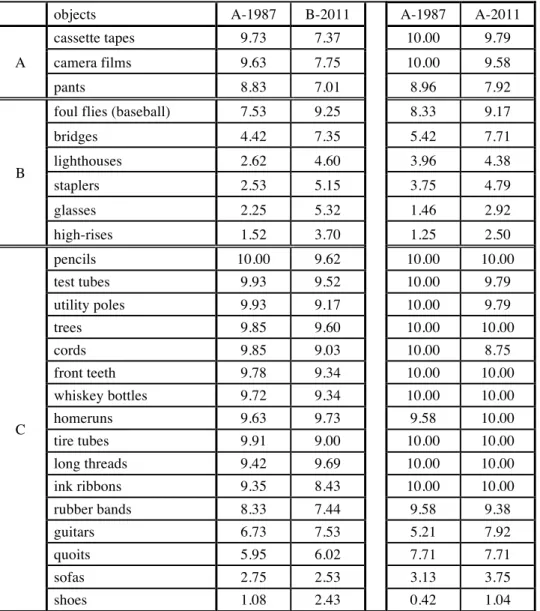
4.3 Results We will examine the results concerning the use of -hon only. Results from A-1987 and B-2011 are compared on the left side of Table 3, and those from A-1987 and A-2011 on the right side. The acceptability ratings in the table have been converted to rage from 0.00 to 10.00. 25 objects are divided into three, depending on whether there is a significant difference in acceptability between A-1987 and B-2011. The objects in Group A are those items in which the rating by A-1987 was significantly higher than B-2011 (p < 0.05 by the t-test); those in Group B are those in which the rating by B-2011 was significantly higher than A-1987 (p < 0.05 by the t-test);
no significant difference was found between A-1987 and B-2011 in the Group C (p < 0.05 by the t-test).
objects A-1987 B-2011 A-1987 A-2011
A
cassette tapes 9.73 7.37 10.00 9.79
camera films 9.63 7.75 10.00 9.58
pants 8.83 7.01 8.96 7.92
B
foul flies (baseball) 7.53 9.25 8.33 9.17
bridges 4.42 7.35 5.42 7.71
lighthouses 2.62 4.60 3.96 4.38
staplers 2.53 5.15 3.75 4.79
glasses 2.25 5.32 1.46 2.92
high-rises 1.52 3.70 1.25 2.50
C
pencils 10.00 9.62 10.00 10.00
test tubes 9.93 9.52 10.00 9.79
utility poles 9.93 9.17 10.00 9.79
trees 9.85 9.60 10.00 10.00
cords 9.85 9.03 10.00 8.75
front teeth 9.78 9.34 10.00 10.00
whiskey bottles 9.72 9.34 10.00 10.00
homeruns 9.63 9.73 9.58 10.00
tire tubes 9.91 9.00 10.00 10.00
long threads 9.42 9.69 10.00 10.00
ink ribbons 9.35 8.43 10.00 10.00
rubber bands 8.33 7.44 9.58 9.38
guitars 6.73 7.53 5.21 7.92
quoits 5.95 6.02 7.71 7.71
sofas 2.75 2.53 3.13 3.75
shoes 1.08 2.43 0.42 1.04
Table 3 Comparisons between A-1987 and B-2011 and between A-1987 and A-2011
The right side of Table 3, which shows the results of 11 informants who participated in both 1987 and 2011, reveals that the acceptability of the objects in Group A has hardly declined, while that of the objects in Group B has increased.
4.4 Discussion
The results show that there are (apparent-time) changes in the acceptability of -hon for certain objects. The results above are consistent with the findings of Yoshida (2013), in which a larger number of participants were tested for their use of -hon for a more selected number of objects. Yoshida found that in a production task fewer young speakers chose -hon as classifiers for pants, cassette tapes and ink ribbons than old speakers, and that younger speakers rated -hon lower for pants and rubber bands in an acceptability judgement task.
Of the objects whose acceptability as -hon referents was lower in B-2011 than in A-1997, cassette tapes and camera films were atypical members, and those referents are currently going out of use. Another object in this category, pairs of pants are certainly not disappearing, but the noun zubon used in this experiment to refer to pants is now falling out of use, replaced by pantsu and surakkusu. The lower rating in a new generation of speakers can be ascribed to the fewer chances those younger speakers have presumably had in hearing the nouns referring to them co-occurring with -hon to learn the conventional decision on the membership of those items as the -hon referents.
The higher ratings of large one-dimensional objects such as bridges, lighthouses, and high-rise buildings in B-2011 suggests that the condition of RELATIVELY SMALL has been weakened.
A comparison of A-1987 and A-2011 shows that those speakers have retained older uses of -hon not favored among present-day younger speakers (for object group A) and have adjusted to some new uses now more common among younger speakers (for object group B).
5. General discussion
From the above results, the following can be said about semantic changes. First, semantic changes involve the notion of the prototype structure. In the change of the classifier -ko, peripheral membership has changed by the weakening of typicality conditions. Also, in the change of the classifier -hon, the judgment of the atypical members of the semantic category has changed. These changes are good examples of semantic changes occurring on the basis of the prototype structure of a category.
Second, the present study helps to evaluate the effectiveness of the apparent-time study. As a method of investigating ongoing semantic changes, the results of -ko support the validity of the apparent-time investigation on semantic changes, which has rarely been conducted (Bailey 2004: 319). On the other hand, our results on -hon suggest that although the speakers maintain the older uses that are no longer favored in younger speakers, they can adjust to new uses. This provides causation against using generation differences as reflections of ongoing changes.
References
Aikhenvald, Alexandra Y. (2000) Classifiers: A typology of noun categorization devices. Oxford: Oxford University Press.
Allan, Keith. (1977) Classifiers. Language 53, 285-311.
Bailey, Guy. (2004) Real and Apparent Time. In J. K. Chambers, Peter Trudgill and Natalie Schilling-Estes (eds.) The Handbook of Language Variation and Change, 312-332. Oxford: Blackwell Publishing.
Craig, Colette (ed.). (1986) Noun classes and categorization: Proceedings of a symposium on categorization and noun classification, Eugene, Oregon, October 1983. Amsterdam: John Benjamins.
Downing, Pamela A. (1996) Numeral classifier systems: The case of Japanese. Amsterdam: John Benjamins.
Fillmore, Charles J. (1982) Towards a descriptive framework for spatial deixis. In Robert J. Jarvella and Wolfgang Klein (eds.) Speech, place, and action: Studies in deixis and related topics, 31-59. Chichester: John Wiley.
Labov, William. (1963) The social motivation of a sound change. Word 19: 273-309.
Labov, William. (1966) The social stratification of English in New York City. Washington DC: Center for Applied Linguistics.
Lakoff, George. (1987) Women, fire, and dangerous things; what categories reveal about the mind. Chicago:
University of Chicago Press.
Mano, Miho. (2004) Ruibetsushi -tsu to -ko ni ninchiteki koosatsu [Cognitive analysis of classifiers -tsu and -ko].
In Yoshihiro Nishimitsu and Shinobu Mizuguchi (eds.) Ruibetsushi-no taishoo [A contrastive study of
Changes in Japanese Classifiers
44 Ichikawa (Yoshida) and Matsumoto
Matsumoto, Yo. (1986) The Japanese classifier -hon: A prototype semantic analysis. Sophia Linguistica 20/21, 73-81.
Matsumoto, Yo. (1988) The Japanese classifiers -ken and -mune: prototypicality and background of existence.
Sophia Linguistica 23/24, 19-29.
Matsumoto, Yo. (1993) Japanese numeral classifiers: A study of semantic categories and lexical organization.
Linguistics 31, 667-713.
Sanches, Mary. (1977) Language acquisition and language change: Japanese numeral classifiers. In Ben G. Blount and Mary Sanches (eds.), Sociocultural dimensions of language change, 51-62. New York: Academic Press.
Shimojo, Mitsuaki. (1997) The role of the general category in the maintenance of numeral classifier system: The case of tsu and ko in Japanese. Linguistics 35, 705-33.
Yoshida, Yasuyo. (2013) Kinnen ni okeru nihongo-ruibetsushi taikei no henka. [Changes in the system of Japanese numeral classifiers in recent years]. Master’s thesis submitted to Kobe University.