フィールドサイエンス
Journal of Field Science
ISSN 1347-3948
Journal of Field Science
No. 11 Mar, 2013
FIELD SCIENCE CENTER, TOKYO UNIVERSITY OF AGRICULTURE AND TECHNOLOGY
Fuchu, Tokyo 183-8509, Japan
Review
1 Cognitive Aspects in Human-Animal Relationships / S. TAKEDA
Originals
7 Availability of Several Phosphorus Resources for Crop Growth / M. Myint AYE, S. MATSUMURA
Research materials
15 First record ofArmadillidium vulgare(Crustacea, Isopoda) from Sakishima Islands, Southern Japan / S. KARASAWA
19 Effect of social breeding environment to the body size of ants : a test of epigenetic effects using inter- specific cross-fosterling experiments / Y. YOSHIHARA, S. KOYAMAand T. SATOH
31 Macroinvertebrates in headwater streams of Japanese cypress and Japanese cedar forests : A case study in Field Museum Karasawayama / Y. WATANABE, T. GOMI, M. NUNOKAWAand M. SAKAI
フィールドサイエンス
ISSN 1347-3948
No. 11 2013
東 京 農 工 大 学 農 学 部 附 属 広 域 都 市 圏 フィールドサイエンス教育研究センター
J.FIELDSCIENCENo.112013東京農工大学農学部附属FSセンター
平成25年3月
フィールドサイエンス 第11号
目 次
総 説
1 人と動物の関係の認知科学的理解/武田庄平
原 著
7 数種リン資源の作物生育に対する有効性/ミントゥ ミントゥ エイ・松村昭治
研究資料
15 先島諸島からのオカダンゴムシの初記録/唐沢重考
19 社会的養育環境がアリの体サイズに与える影響:異種間ブルード交換実験によるエピジェネティッ ク効果の検証―アリにおけるエピジェネティック効果―/吉原由紀子・小山哲史・佐藤俊幸
31 スギ・ヒノキ人工林渓流における水生生物の生息状況―東京農工大学フィールドミュージアム唐沢 山における事例―/渡邉祐介・五味高志・布川雅典・境 優
フィールドサイエンス編集委員会
編集委員長 島田 順 東京農工大学農学部 FS センター長,教授
編 集 委 員 松田 和秀 FS センター准教授
渡辺 直明 FS センター助教
鈴木 馨 FS センター准教授(編集幹事,[email protected])
伴 琢也 FS センター准教授
松村 昭治 FS センター准教授
金勝 一樹 生物生産学科准教授
川合 伸也 応用生物科学科准教授
伊豆田 猛 環境資源科学科教授
白木 克繁 地域生態システム学科准教授
藤川 浩 共同獣医学科教授
事 務 局 五十嵐 明 府中地区事務部事務長補佐(FS 担当)
Editorial Committee of Journal of Field Science
Editor-in-Chief
Jun SHIMADA Director of Field Science Center, Professor of Tokyo University of Agriculture and Technology
Editorial Board
Kazuhide MATSUDA Associate Professor of Field Science Center Naoaki WATANABE Assistant Professor of Field Science Center
Kaoru SUZUKI Associate Professor of Field Science Center(Managing Editor, [email protected])
Takuya BAN Associate Professor of Field Science Center Shoji MATSUMURA Associate Professor of Field Science Center Motoki KANEKATSU Associate Professor, Dept. of Biological Production Shinya KAWAI Associate Professor, Dept. of Applied Biological Science
Takeshi IZUTA Professor, Dept. of Environmental and Natural Resource Sciences Katsushige SIRAKI Associate Professor, Dept. of Ecoregion Science
Hiroshi FUJIKAWA Professor, Cooperative Dept. of Veterinary Medicine
Management Office
Akira IGARASHI Chief of Field Science Center Office
平成25年3月5日 印刷 平成25年3月12日 発行
発 行 所 東京農工大学農学部附属 FS センター
183―8509 府中市幸町3―5―8 042―367―5798
印 刷 所 電 算 印 刷 株 式 会 社
390―0821 松本市筑摩1―11―30 0263―25―4329
フィールドサイエンスVol.11/表紙Vol.11/背幅3ミリ 2019.06.06 13.07.50 Page 2
総 説
人と動物の関係の認知科学的理解
武田 庄平
Cognitive Aspects in Human-Animal Relationships
Shohei TAKEDA
私たち人間は生物学的には人間以外の生き物とつ ながった存在である。私たちは生き物であり,その 意味で他の生物と同様に自然の体系の中の一生物と して捉えることが可能である。私たちと他の生物と はつながっているのだから,私たち人間は自分達以 外の相手を理解し得るのだろうか。例えば,私たち 人間は人間以外の存在を認識できているのだろう か。また人間以外の存在の意味を理解できるのだろ
うか。私たち人間は自分達を取り巻く他者(人間・
動物・植物)と理解しあえるのだろうか。私たち人 間は人間以外の存在と何かを共有し得るのだろう か。そして人間同士でも,異文化を認識し,理解し 得るのだろうか,などなどと素朴な疑問はいくつで も尽きることなく沸いてくる。
また,人間と自然との共生とか人間と人間との共 生といったことをよく耳にするし口にするが,共生 Human-animal relationship is one of the medium for Human-human relationship. We usually relate to other peoples via medium ; this relation is called as triad relationship. Triad relationship is made up of social intelligence and technical intelligence. Our human’s Umwelt is not same as other live’s Umwelt, but we are comprehensible to other live’s Umwelt with a medium of theory of mind. These human’s higher cognitive abilities are based on our huge cerebral cortex, which adapted and still remain at the hunter-gatherer period of 12 thousand years ago. We live in latest world with older style of cognition, so we must relate to with other to think globally.
Key words: human-animal relationships, social intelligence, triad relationships, theory of mind, Umwelt
人と動物の関係性について考えることは,人と人との関係を考えるための媒介項である。このことは,人 と動物と人との三項関係性においてどのようにうまく関わるかという社会的知性および技術的知性という知 性を用いてうまく動物と関わることを通じて他者との関係性をもうまくやって行くことで理解される。また 私たち人間にとって意味ある環境は他の生物と必ずしも共有している訳ではないことを環世界概念を援用す ることで認識し,そのような認識をもてるのはごくわずかな生物種に過ぎないが,その一つが私たち人間で あり,そのことを可能にしているのが私たちが有するこころの理論というものである。こころの理論によっ て私たちは,他の生物の立場に立って考えることもできる。このようなことを可能にしている基礎は私たち の大きな大脳皮質ではあるが,私たちの大脳皮質は狩猟採集時代からほとんど変化していない古い認知機能 のままであり,私たちが無理なく認識できる集団のサイズも150人程度のごく小さな集団であり,地球規模 での思考をするには無理があるが,個別の地域的な思考を繋いでいくことで人類としての可能性は示唆され る。
キーワ-ド:人と動物の関係,社会的知性,三項関係,こころの理論,環世界
2012.12.17受付;2012.12.19受理
東京農工大学大学院農学研究院 〒183―8509 東京都府中市幸町3―5―8:Institute of Agriculture, Tokyo University of Agriculture and Technology
とは一体何であろう。誰かと仲良くすることなのだ ろうか。共生ということばを文字通り捉えれば,共 に生きるないし生かすこととなる。いずれにせよ,
共にあることが前提となるが,この共にあるという ことは,単に同時的に無関係に存在するということ ではなく,お互いに何らかの関係をもって存在する ということに違いない。つまり共生とは,二者間以 上での関係性あるいは相互作用を意味していると捉 えられる(武田,2007)。つまり共生とは,私たち 人間とそれ以外の生物とが相互に認識し理解しあっ ていることを前提とした概念であると言える。
共生とは,同種個体間での関係性,即ち人間と人 間―つまり私とあなた(自己と他者)―との関係性 が基本となり,この人間同士での関係性を成立させ る媒介的関係として人間と自然との共生という関係 性があるといえる(武田,2007)。つまり,自然は 人間と人間とをつなぐための媒介項としての機能を 有し,自然は人間同士の相互作用あるいはコミュニ ケ-ションのための社会的道具として位置づけられ る。社会的道具とは,食物などの物に対して働きか けるために使用される道具ではなく,他者への働き かけという社会的な文脈で使用される道具を指す
(松沢,1999)。私たち人間は他者との関係性とい う文脈に従って,このような道具をいろいろと使い こなしている。例えば,盆暮れの進物は,相手構わ ず他者に施しをするのではなく,贈る側にとっては 自分が相手とよい関係を保とうとする意図的な行為 の道具として使用されている。もちろん,そんな媒 介項を使用せずとも,よき関係を築き得ると思える だろうが,現実には色々なモノが私たちの関係性に 介在している。人間の社会関係においてはモノを二 者間に介在させることで,両者間の関係はモノを介 しての間接的な関係になり一見複雑化するように思 えるが,実はモノという共通項を両者が共有し,そ れを媒介とすることにより,両者の関係性はより明 確になる。このように,自己と他者の間にモノを介 在させる関係を,三項関係(triad relationships)
という。松沢(1999)は,知性(インテリジェンス,
intelligence)を環境に適応するように生物がその 行動を調整する能力として定義し,三項関係を用い て知性を捉えるための図式を提唱した(図1)。こ の図式では,素朴に自己中心的な世界としての自己 と外界を設定し,さらに細かくは自己と他者(自己 にとっての同種他個体)と物体(生物・非生物を含 めた他者以外の存在)の三者を設定する。そして,
自己が他者や物体を知覚しそれに働きかける,その かかわり方として知性を捉えた。知性は自己と他者 のかかわり方としての社会的知性と,自己と物体の かかわり方としての技術的知性に大別される。
社 会 的 知 性 の 進 化 を,Byrne と Whiten は,マ キャベリ的知性(Machiavellian intelligence)仮説
(Byrne & Whiten, 1988 ; Whiten & Byrne, 1997)
として説明している。この仮説によれば,私たちを 含めた霊長類の知性は,競合的な場面で他者を欺い たり,操ったり,出し抜いたりすることを通じて進 化したと考えられ,その意味で知性の根源は,権謀 術数にあると言える。つまり社会的知性の発生過程 を調べることは,知性の発生過程を調べることとな ると言えるほど社会的知性は私たち人間にとっては 重要な知性であると言える。
社会的知性は,もちろん他者と競合する場面で は,駆け引きすることや欺くことや出し抜くことと して発揮されるが,一方で他者と協力する場面でも 発揮され,例えば相手を手伝ったり思い遣ったり利 他的な行動として発揮される。そしてそれだけでな く,もっと複雑な場面として競合する相手とも別の 競合相手を倒すために同盟関係を結ぶという打算を も生み出す知性でもある。そして,いずれの場面に おいても他者の行動を予想することを必要とする。
要するに社会という枠組みでいかにうまく振る舞っ ていけるかという生存をかけた知性である。
人間と人間の共生,人間と自然の共生とは,まさ に人間としての自己と人間としての他者との共生と いう関係(かかわり方)であり,人間としての自己 と自然としての物体との共生という関係(かかわり 図1.知性を自己・他者・物体の三項関係で捉える図式
(松沢,1999)
フィールドサイエンス 11号 2
方)に違いない。その意味で,共生という概念はま さしく自己と他者や自然とのかかわり方としての知 性を意味している。
共生ということを考える際,社会的な生き物とし ての人間というものを前提とする限りにおいて最も 肝要なことは,人間と人間の共生である自己と他者 とのかかわり方としての知性であると考える。この 知性は,自己と自然とのかかわり方を他者が理解す ること,他者と自然とのかかわり方を自己が理解す ることといった他者の知性に関する知性を通じて,
自己=自然=他者という三項関係を成立させる。つ まり,自己と他者との自然とのかかわり方の互いに 共有された知性として人間と自然の共生というもの を成立させることとなる。また,人間と自然の共生 を通したフィードバック的関係として,自己=他者 のかかわり方としての知性としての人間と人間の共 生は質的変貌をとげると考えられる。
このような図式に基づいて,私たち人間同士と自 然との関係性を捉えると,図2のような関係性を描 出することができないだろうか。つまり畜産農家 は,牛や豚や鶏などの家畜動物(野生動物ではない が,広い意味で自然的存在と捉えられうる)を飼育 し,それらを牛肉・豚肉・鶏肉・鶏卵等に加工され たものを消費者たる私たちは購入し食べる。畜産農 家は自身が飼育する家畜動物をできるだけ高品質な 商品として市場に送出するために家畜を飼育すると いう技術的知性による関わりを行い,その関わりを 通じて畜産農家から直接食肉を買い取る業者がお り,その業者が何らかの加工を行った食肉製品をさ らに次の卸業者が買い取り,その後その業者が直接 消費者に販売する精肉店やスーパ-等の小売業者に 納入し,その肉を商品として消費者は購入する。直 接的関係としては,商品としての精肉を媒介項とし て小売業者と消費者との関係性が成立し,さらに直 接的ではないが,数珠つなぎ的あるいは入れ子的関 係で生産者である畜産農家と消費者との関係性も生 じる。その際の媒介項は見た目の形態は変容すれど も家畜そのものである。
また媒介項が動物園や水族館で飼育展示されてい る動物(展示動物)であったならどうであろう。動 物園・水族館の動物を飼育展示している動物園・水 族館の経営者や運営者は,それら動物を観覧しにく る来園者に対して何らかのメッセ-ジを発信してい る。それは理想的には自然や生命に対する理解であ ろうが,時に単なる珍しいものの展示にとどまる場
合もある。しかしいずれにせよ,展示動物という媒 介項を通じて動物園と来園者の関係性は,単に施設 運営者と利用者というだけのものでなく,メッセ-
ジの発信者と受信者という有機的関係性を構築する ことになるし,うまくすれば来園者は動物園をはる かに通り越して遠くアフリカの草原や南アメリカの 熱帯雨林へと,その思いが飛ぶことさえある。
さらに,製薬会社や化粧品会社の新製品開発のた めの実験に供されているいわゆる実験動物について 考えると,薬や化粧品の消費者である私たちと実験 動物とは直接には関わらないが,製品化された商品 には彼らの見えない存在がある。そのような形で私 たちと関係性を結ばせているのは,企業等の実験研 究施設で動物実験を行う研究者の技術的知性によ る。この知性とは,例えば実験動物にある薬剤を投 与して生起させる生理的反応である。この生理的反 応性をさらに敷衍して最終的には私たち人間に投与 すべき薬剤や化粧品が開発され,それを消費者たる 私たちは購入し利用している。
私たちが無理なく自然な存在であると認識しやす い野生動物と私たちとの関係性はどうであろう。野 生動物は,広い意味では保護・保全すべき自然であ ろうが,局地的にみると必ずしもそうとも言えな い。野生動物による耕作物の食害等の被害にあって いる農家にとっては,たとえそれが天然記念物で あっても稀少動物であっても駆除すべき有害鳥獣以 外の何者でもない。だから地元では駆除するか,で きなければいかに里に来させないかに頭を悩ませ る。これはこれで技術的知性として捉えられる。一 方で,そのような直接的被害にはあっていない都市 生活者にとっては,天然記念物も希少動物手も当然 守るべき自然であり,現代においては生物多様性保 全という錦の御旗もあり,そのようなものをいかに 守るべきかについて頭を悩ませる。それはそれで別 の技術的知性であるが,地元にとっては迷惑な話か もしれない。その齟齬のある関係性においてどう やってうまくやっていけるのかというのが社会的知 性である。
私たちと生活空間を共有するいわゆるペット動物 も単に家庭内での存在として収まっているのではな く,都市生活者の私たちを相互につなぐ役割を果た している。私たちの家庭にいる犬の朝晩の散歩は,
単に屋外での運動や排泄を行わせるという目的にと どまらず,散歩ルート上で出会う別の犬やその飼い 主との交流や時には回避もあろう。いずれの場合で
あっても,自分たちが犬を飼っていなければ,出会 わないし,例え道端で出会ったとしても見ず知らず の他人として一瞥もくれない相手であろう。それが 犬という媒介項を介して全くの他人が挨拶し会話す る関係を結ぶ。地域的つながりが弱いと言われがち な都会地にあってペットなる存在は私たち人間を互 いにつなぐボンドの役割をも担っていると言える。
このような私たち人間同士をつないでくれる存在 は単にそれにとどまるものではなく,もちろんそれ 自体として独立した一つの個を成立させるものでも ある。その個という存在を私たち人間以外にも明確 に意識させることになる概念として,フォン・ユク ス キ ュ ル と ク リ サ-ト(von Uexküll, J. & Kriszat, G.,1934)が提唱した「環世界(Umwelt)」という ものがある。環世界とは,主体が知覚できる外界に 作用することと,外界が主体に作用することとに よって生み出される相互作用的な統一体のことを指 す。生物それぞれに主体というものを認め,それぞ れの主体はいわゆる環境(Umgebung)の中の諸物 に意味を与えることによりそれぞれの環世界を構築 するのである。つまり,ある主体にとっての環世界 は,その主体が知覚できない外界を含めたいわゆる 環境(Umgebung)の部分に過ぎないのである。そ れゆえ環世界と環境とは異なり,環境とは,ある主 体のまわりに単に存在している客観的に記述されう る世界であるとされる。
この立場に立つと,主体としての私たち人間は,
人間的環世界に住んでおり,私たち人間が知覚でき ない環世界に住んでいる主体もいるということを認 めなければならない。つまり,それぞれの生物にそ れぞれの主体を認めることになる。これは一見公平 で簡単そうなことだが,私たち人間は放っておけば ともすると自分達を中心にして物事を捉えるので,
よほど意図的に人間以外の生物に主体を認めなけれ ば,意外に困難なことであると言える。そして,あ る意味人間中心主義的自然観といえるかもしれない が,主体を人間にのみ認めると,私たち人間の環世 界にその他の生物の環世界は内包されることにな り,私たちの環世界が全ての生物の環世界を代表す るので,私たち中心で物事を考えることでも特に問 題はないとも言える。一方で,ある意味自然(非人 間)中心主義的自然観では,それぞれの生物に主体 を認める。そうすると,人間の環世界とその他の生 物の環世界とはそれぞれに別個のものとして捉えら れ,それぞれの生物にそれぞれの環世界というもの があるということになり,私たち人間にとっては直 接には認識できないような世界を認めなければなら ない。これらのことをまとめると図3のような関係 として捉えられる。
とは言え,私たち人間にそれぞれの生物主体がど のような環世界を構築しているのかを一体どのよう にして知り得ることができるのかという疑問が生じ る。
少なくとも人間や類人猿(特にチンパンジー,ボ ノボ,ゴリラ,オランウータンなど)は,その程度 の差こそあれ「心の理論(Theory of Mind)」とい うものをもっているといわれている。このことを最 初に提唱した Premack & Woodruff(1978)によれ ば,自己および他者の目的・意図・知識・信念・思 考・疑念・推測・ふり・好みなどの内容が理解でき るのであれば,その動物または人間は心の理論をも つといえる。少なくとも私たち人間は他者的立場に 立って考えてみることが可能である。ということは もちろん心の理論を有するといえるし,それゆえ人 間以外の生物の環世界についても理解を示すことが できるともいえる。もちろんたとえ理解できるとし ても,自分自身が他者を理解しようとする態度をと 図3.人間と人間以外の生物の環世界の捉え方
図2.動物を媒介項とした人間と人間との関係性(社会 的知性)の図式
フィールドサイエンス 11号 4
れるかどうかは別問題である。そして,たとえその ような態度をとってみても,やはりそれぞれにそれ ぞれの環世界に住んでいることには何の変わりもな い。しかもそれは,人間とそれ以外の生物との間に あるばかりではなく,実は同じ人間同士にも見られ る。例えば,私たちにはどうしても納得できない異 文化の習慣があったり,使用する言語が違うだけで 互いに理解しあえない場合もある。それでも私たち 人間同士は互いにうまくやっていこうとする傾向が ある。このような傾向は,まさに前述の社会的知性 が発揮される場面であろう。
ところで,私たち人類の認知能力は約一万年前と なんら変わっていないと言われている。約一万年前 といえば,農耕定住生活が始まったとされる時代で ある。一説によれば,もっと旧く約3万年前には狩 猟採集の片手間に小規模な農耕は既に開始されてい たとも言われている(Tudge,1998)が,いずれに せよ非定住型の小集団による狩猟採集生活中心の時 代に比べると,農業のおかげで年間を通じて安定的 に食料資源を確保できるようになったために,集団 の 規 模 も 人 口 も 格 段 に 増 大 し て い っ た。Tudge
(1998)によれば,1万年前の世界の人口はわずか 800万人程度であったであろうと考えられるのが,
紀元前後には1億から3億人の間に増大した。そし て西暦2000年頃には60億人に,さらに2012年には71 億人に迫る勢いで指数関数的に増加している。
集団規模が大きくなる,人口が増えるということ は,生物の環境に対する適応という観点からみると 正しく適応的であると言えるので,人類の発展を意 味していたことは確かである。その観点からだけ農 業を捉えると農業は人類発展の立役者であったと言 える。とは言え,物事は一面的にだけ捉えられるも のではないので,農業は人類がそれまでみられな かった規模で計画的に環境を制御することの始まり であり,今日的な環境問題とりわけ自然破壊の原罪 であるとも言える。そればかりではなく,農業は男 尊女卑の起源ともされる。Fisher(1992)は,農業 の始まりが,狩猟採集生活では相応の役割を担って いた女の地位を落としめるものであり,とりわけ鋤
(すき)の発明が女の地位の失墜に拍車をかけたと 主張している。その理由は,鋤は女の力で扱える道 具ではないため,生活の第一の担い手は男となり,
女は二次的な仕事に甘んじなければならなくなった とされる。しかし現代においては,農業に限らずあ らゆる労働の場面においては,技術の力によって身
体的力を必要とせず,男女の差異はなくなったと言 える。人類史において,女性はその地位を一度失っ たと言えるが,男女に存在する差異は生物学的機能 差に過ぎず,それは社会的優劣の問題には何ら反映 され得ないものである。
さて,この農業による定住がもたらした人口の爆 発的増大による集団規模の大型化は私たち人間社会 に問題をもたらしたと言える。
Dunbar(1996)は,霊長類の脳の特に新皮質と 呼ばれる部分の脳全体に占める体積比と群れの規模 とが相関関係にあることを見出した。つまり新皮質 の体積比が大きければ大きいほどその種の群れのサ イズは大きいとうことである。これを人類に当ては めると,人類の新皮質は全体の80%を占めていて,
体積比は4:1になる。霊長類での結果からシュミ レ-トすると,人類の集団サイズは約150人という ことになる。この150人という数字は,現代都市生 活者の感覚では予想外に小さいと言えるが,これは 都市全体の人口の問題なのではなく,自身が属して いる集団で,互いに顔と名前が判別できる顔見知り 集団のサイズを指す。そう考えると私たちの社会に おける集団規模は意外にも150人を大きく超えるも のは少ない。例えば,学校や組織,家庭などの単位 集団では,150人よりも大きなサイズになると,大 抵は学校の学級編成や会社の部課などの小さな下位 集団が形成される。
このように私たち人間の集団サイズの認知特性は 約1万年前の狩猟採集生活から農耕定住生活への移 行期から変わることなく続いている。狩猟採集生活 の集団に適応したそのままを引き継いでいると考え られるかなり古い認知様式で,現代の大規模社会に 生きていることになる。
“Think global, act locally”という地球環境問題 に対する標語があるが,上述の通り私たちが無理な く認識できる範囲はたかが150人程度の小規模集団 でありごく狭い範囲の地域である。地球規模での認 知能力はない。このままではただの謳い文句で終 わってしまう。私たちは,local(“そう広くはない 地域社会”とこのことばを捉えておく)には活動で きるし,そういう範囲のことについての認知能力は 十分あるといえる。だから,地に足の着いた地域で の活動を重ねること,他者のそれと繋げることで,
結果的には地球規模でものを考えることにつながっ ていくのではないか。その意味でこの標語は,“Act and think locally, think global”(地域で考え活動す
れば,地球規模で考えることになる)と言い換える のが,私たち人間の認知能力を反映した現実的な標 語であるといえるだろう。個人では能力の限界があ るが,私たちには個人をつないでいく力がある。そ の力を発揮すれば,私たちは,例え行ったこともな い地球の反対側で起こっている問題に対しても対処 することができるだろう。そのような能力を私たち は有している。それをいかにうまく発揮していくこ とができるのかが,私たちに課せられた課題であ り,その課題を解いていかなければ,私たち人類の 将来には希望が見えないものとなる。
引用文献
Byrne, R. and Whiten, A. : Machiavellian Intelli- gence : Social Expertise and the Evolution of Intellect in Monkeys, Apes, and Humans. Ox- ford Science Publications, UK, 1988(藤田和生・
山下博志・友永雅己(監訳)『マキャベリ的知 性と心の理論の進化論』,ナカニシヤ出版,
2004)
Dunbar, R. : Grooming, Gossip and the Evolution of Language. Faber & Faber, 1996.(松浦俊輔・服 部清美(訳)『ことばの起源』,青土社,1998)
Fiher, H. E. : Anatomy of Love. W. W. Norton, NY, 1992.(吉田利子(訳)『愛はなぜ終わるのか』,
草思社,1993)
松沢哲郎:心の進化;比較認知科学の視点から.科 学,Vol.69,No.4:323-332,1999.
Premack, D. and Woodruff, G. : Does the Chimpan- zee Have a Theory of Mind? Behavioral and Brain Sciences, 1 : 515-526. 1978.
武田庄平:認知科学的「共生」論,『共生社会シス テム学序説』,矢口・尾関(編),青木書店,65-
88,2007.
Tudge, C. : Neanderthals, Bandits and Farmers ; How Agriculture Really Began. Orion Publish- ing, UK, 1998(竹内久美子(訳)『農業は人類の 原罪である』,新潮社,2002)
von Uexküll, J. and Kriszat, G. : Streifzuge durch die Umwe1ten von Tieren und Menschen. S.
Fischer Verlag GmbH , Frankfurt am Main , 1934(日高敏隆・野田保之(訳)『生物から見 た世界』,思索社,1970,新訳(岩波文庫版);
日 高 敏 隆・羽 田 節 子(訳)『生 物 か ら 見 た 世 界』,岩波書店,2005)
Whiten, A. and Byrne, R. : Machiavellian Intelli- gence Ⅱ: Extensions and Evaluations . Cam- bridge University Press, UK, 1997(友永雅己・
小田 亮・平田 聡・藤田和生(監訳)『マキャ ベリ的知性と心の理論の進化論Ⅱ』,ナカニシ ヤ出版,2004)
フィールドサイエンス 11号 6
原 著
数種リン資源の作物生育に対する有効性
ミントゥ ミントゥ エイ*1・松村 昭治*2†
Availability of Several Phosphorus Resources for Crop Growth
Myint Myint AYE*1,Shoji MATSUMURA*2†
The use of commercially available phosphorus (P) fertilizers is limited in developing countries due to their prohibitive cost. It is important to examine the availability of various P sources, including materials recov- ered from wastewater and crop residue, to meet crops’requirement. A greenhouse pot experiment was con- ducted at the Field Science Center, Tokyo University of Agriculture and Technology. Upland rice (Oryza sa- tivaL. cv. Norin No.1) and tomato (Lycopersicon esculentum Mill. cv. Momotaro T93) were grown in volcanic ash soil (Silic Andosols, Melanudands, pH 6.04). Four sources of P were used : calcium dihydrogenphosphate monohydrate (Ca-P), ammonium magnesium phosphate hexahydrate (MAP), aluminum phosphate (Al-P), and plant residue (Re-P) of crotalaria (Crotalaria spectabilisRoth.). In consideration of evaluating the availability of poorly-soluble compounds, MAP and Al-P, the former three sources were mixed with soil at a rate of 750 mg P2O5pot-1, which corresponds to 750 kg P2O5ha-1, but Re-P was applied at a rate of 108 mg P2O5pot-1due to large residue volumes. Duplicate plant and soil samples were collected at 40, 70 and 100 days after planting (DAP), and plant phosphorus content and available soil phosphorus were determined. Phosphorus recovery rates (PRR) were then calculated. Growth responses of upland rice to P-sources were in the sequence Ca-P>
Al-P>MAP>Re-P>control, while the tomato’s responses were in the sequence Ca-P>MAP>Al-P>Re-P>con- trol. Through the three sampling times, the sequences of P uptake by upland rice and tomato from the amendments and soil were the same as their growth response sequences. Remaining available P in soil de- creased inversely related to the increase of crop-absorbed P. Ca-P and Re-P were higher than MAP and Al-P in PRR for both crops across the three sampling events. It was concluded that although Ca-P was the most effective source for both crops, MAP, Al-P, and Re-P sources were also available for crops’growth. It be- came clear that upland rice and tomato had different compatibilities to the P sources. Upland rice has a higher capacity to take up and use Al-bound P than tomato ; however, tomato was more efficient in absorb- ing and using MAP than upland rice. Ca-P and Re-P sources were more useful than MAP and Al-P for crop P recovery. From a standpoint of efficient use of various P resources, in addition to the direct use of waste- derived P, developing the P recycling system, in which farmers can use the accumulated P in soil by incorpo- rating the crop residues like upland rice and tomato that have characteristic abilities of P uptake, is ex- pected.
Key words: phosphorus availability, aluminum phosphate, MAP, crop residue phosphate, upland rice, tomato
開発途上国においてはリン酸肥料は高価格であるために使用量は十分でない。そこで,下水からの回収リ
Received : Sep. 5, 2012 ; Accepted : Dec. 4, 2012
*1 東京農工大学大学院農学府,現在:44, Kanthaya Road, YanKyaw Quarter, Magway, Myanmar
*2 東京農工大学農学部 Faculty of Agriculture, Tokyo University of Agriculture and Technology
† 連絡担当著者:松村昭治 Correspondence to : Shoji MATSUMURA, Faculty of Agriculture, Tokyo University of Agri- culture and Technology, 3―5―8 Saiwai-cho, Fuchu, Tokyo 183―8509, Japan
INTRODUCTION
The use of commercially available phosphorus (P) fertilizers in developing countries is limited by their prohibitive cost (Hammond et al.1989). The average recovery of P fertilizer through cropping is very low, ranging between 15 and 20% (Krishna 2003). P is a relatively immobile soil macronutrient, and its use for plant growth is therefore dependent on its solubility, and soil and plant properties. It is impor- tant to examine the availability of various phospho- rus resources, including materials recovered from wastewater and crop residues , to meet crop re- quirements.
Adequate P supplied to plants stimulates early plant growth and hastens maturity. The rate of P uptake appears to have a marked influence on the plant growth rate at deficient to optimum P concen- trations in soil solution (White 1971 ) . Soil P tests alone are insufficient in determining responses, be- cause their empirical values may only reflect nutri- ent availability indirectly. Soil P value is useful only when they are correlated with crop responses (Sanchez 1976).
Ammonium magnesium phosphate hexahydrate (MAP) is one form of phosphate recovered from sewage or food industry wastewater. It is desirable to use such recovered phosphorus, and necessary to
optimize agroecosystems to be less dependent on high inputs while maintaining productivity and soil fertility , to minimize negative environmental ef- fects.
In arable soils, especially volcanic ash soils that have large amounts of aluminum-bound phosphorus (Al-P), the physicochemical Al-P combination has lit- tle availability to plants. Only some kinds of plant root exudates can dissolve Al-P to take it up. Avail- ability of such a water-insoluble phosphate may be associated with crop uptake ability. In tropical crop- ping systems, a better understanding of P transfor- mations and short-term P cycling during decompo- sition of incorporated residues is pertinent (Salas et al. 2003). Crop residues are particularly beneficial for maintaining or increasing soil organic matter (SOM) content and for enhancing soil biological ac- tivity . Incorporation of residues from plants that dissolve and uptake Al-P may directly shift the equilibrium between soil P fractions towards plant- available fractions (Horst et al. 2001). Applications of commercial P fertilizer is impossible for the most resource-poor farmers in the tropics and subtropics, especially on soils with high P retention . Under such conditions , integration of such crop species and/or cultivars and fertilizer application is a key element of sustainable cropping systems ( Lynch 1998).
ンや作物残渣中のリンのような様々なリン資源の有効性を検討することが重要である。この目的のために,
東京農工大学農学部 FS センタ-のビニールハウスにおいて,黒ボク土(Silic Andosols, Melanudands, pH 6.04)を用い,陸稲(Oryza sativaL. cv. Norin No.1)とトマト(Lycopersicon esculentumMill. cv. Momotaro T93)のポット栽培試験を行った。試験区には4種類のリン資源を用いた;リン酸二水素カルシウム(Ca- P),アンモニウムマグネシウムリン酸(MAP),アルミニウムリン酸(Al-P),およびクロタラリア(Crota-
laria spectabilisL.)作物残渣(Re-P).難溶性である MAP と Al-P の肥効を評価することを考慮して,前3
者の施用量は750mg P2O5pot-1(750kg P2O5ha-1に相当)としたが,Re-P は含有率が低いために108mg P2
O5pot-1とした。播種後40,70および100日目に作物と土壌を採取し,乾物重,リン含有率および土壌の可給 態リンを測定した。陸稲の生育は Ca-P≧Al-P>MAP>Re-P>対照区の順であったが,トマトでは Ca-P≧MAP
>Al-P>Re-P>対照区となり,いずれの資材もリン資源としての効果は認められたが,陸稲とトマトで資材 に対する反応が異なることが明らかとなった。土壌の可給態リンは作物による吸収量が多いほど低下してい た。施肥リンの回収率の点からみると,Ca-P と Re-P が MAP や Al-P よりも高かった。資源有効利用の観点 からすれば,廃棄物回収リンの直接利用に加え,陸稲やトマトのようなリン吸収力に特徴のある作物を栽培 して土壌蓄積リンを吸収させ,その残渣を積極的に利用するリン循環利用システムの技術開発が望まれる。
キーワード:リンの有効性,アルミニウムリン酸,MAP,作物残渣含有リン酸,陸稲,トマト フィールドサイエンス 11号
8
Our knowledge of the behavior of different plant species in response to various P resources, includ- ing materials recovered from waste water and crop residues, is still limited. The objectives of this study were (1) to evaluate the availability of various P re- sources including crop residue to crop growth, and (2) to study the ability of crops to take up and use P from the various sources.
MATERIALS AND METHODS Location and soil
A greenhouse pot experiment was conducted at the Field Science Center, Tokyo University of Agri- culture and Technology (TUAT). Volcanic ash soil (Silic Andosols, Melanudands) was collected from TUAT experimental fields , air-dried , and passed through a 2 mm sieve. Each plant pot received 400 g of the soil. Soil pH was measured in distilled water (1 : 2.5) and available soil-P was determined by the Bray’s method (Olsen and Sommers 1982). Soil pH and the available soil P were 6.04 and 3.8 mg P kg-1, respectively.
Materials and growing condition
Four P sources were used : calcium dihydrogen phosphate monohydrate [Ca(H2PO4)2・H2O] (Ca-P), ammonium magnesium phosphate hexahydrate [ NH4MgPO4・6 H2O ] ( MAP ) , aluminum phosphate [AlPO4] (Al-P), and the residue of a green manure (Re-P) ; a control (C) without P was included. Re-P was prepared in 1 cm lengths by cutting the tops of crotalaria (Crotalaria spectabilis Roth), which were harvested from TUAT experimental fields . Neubauer pots, 112 mm in inner diameter and 66 mm in depth, were used for the experiment. Four days prior to planting, in consideration of evaluating the availability of poorly-soluble compounds, MAP and Al-P , the former three sources were mixed with soil at a rate of 750 mg P2O5pot-1, which corre- sponds to 750 kg P2O5ha-1, but Re-P pots were ap- plied with crotalaria residue at a rate of 108 mg P2O5
pot-1due to the low P concentration resulting in
vegetation's large volume. And then nitrogen and potassium were applied at the rate of 750 mg N pot-1as (NH4)2SO4and 750 mg K2O pot-1as K2SO4to the pots of Ca-P, MAP and Al-P treatments. For Re- P, (NH4)2SO4and K2SO4were amended at the rate of 359 mg N pot-1and 698 mg K2O pot-1, respectively, considering the residue N and K2O contents . All amendments were mixed with 400 g of air-dried soil in each pot.
Two kinds of crops, upland rice (Oryza sativa L.
cv. Norin No.1) and tomato (Lycopersicon esculentum Mill. cv. Momotaro T-93) were sown in six pots for each treatment . These two crops were used be- cause rice is staple food of Myanmar, and tomato is also an important horticultural crop in the country.
Five seeds of each crop were grown in each pot.
This high density was adopted so that available phosphorus derived from the materials was imme- diately and thoroughly absorbed. Soil moisture was maintained at near field capacity by adding 100 ml of distilled water whenever the soil surfaces dried.
Sampling and analyses
Duplicate plant and soil samples were taken at 40, 70 and 100 days after planting (DAP). At each sam- pling event, all plants were photographed for visual assessment, and then plant samples were removed and roots were washed carefully of soil, before be- ing oven-dried at 60℃ for 48 hours and then their dry weights measured. Dry samples were milled to powder and decomposed by the Kjeldhal method (Mizuno and Minami 1980), and the P concentration was determined by the Vanadate-molybdate method. Absorbed P from soil and the amendments was estimated by subtracting seed P content from the whole P content of pot plants.
After the plant samples were removed, soil from each pot was air-dried and the remaining available P in (RAP) was determined by the Bray’s method.
The crop phosphorus recovery rate (PRR, %) was calculated as :
PRR(%)=(Absorbed P from an amended pot)-(Absorbed P from the control pot)
(Amount of added P) ×100
0 20 40 60 80
40 70 100
Days After Planting
Dry Weight (g pot-1) ControlCa-P
MAP Al-P Re-P
aa
bc d A
0 20 40 60 80
40 70 100
Days After Planting
Dry Weight (g pot-1 ) ControlCa-P
MAP Al-P Re-P
aa
bb d B
B. Tomato A. Upland rice
Analysis of variance and comparison of means be- tween treatments were conducted using statistical methods and analyses advocated by Chao (1969).
The relationship between P absorbed by crops and RAP was determined using nonlinear regression and correlation analysis (Gomez and Gomez 1984).
RESULTS
Crops’ dry weight and phosphorus uptake re- sponses to various phosphorus resources
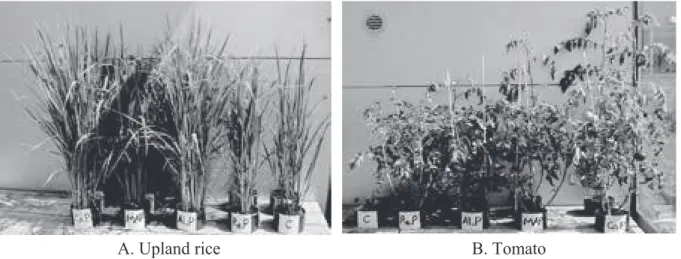
The difference in upland rice growth response to the tested materials became clear at 70 DAP, and was more pronounced at 100 DAP (Fig. 1A, Fig. 2 A). In Ca-P plots, upland rice grew well at 40-100 DAP. Although the initial growth at 40 DAP in Al-P plots was inferior to that of Ca-P plots, the growth rate increased gradually and the dry matter be- came equivalent to that of Ca-P plots at 100 DAP.
The growth of upland rice in MAP plots was signifi-
cantly inferior to those of Ca-P and Al-P plots. The growth of upland rice in Re-P plots was lowest ex- cept for control, but it cannot be compared simply with the others, since there were only small P dos- ages in the plots. The upland rice grew gradually even in the control.
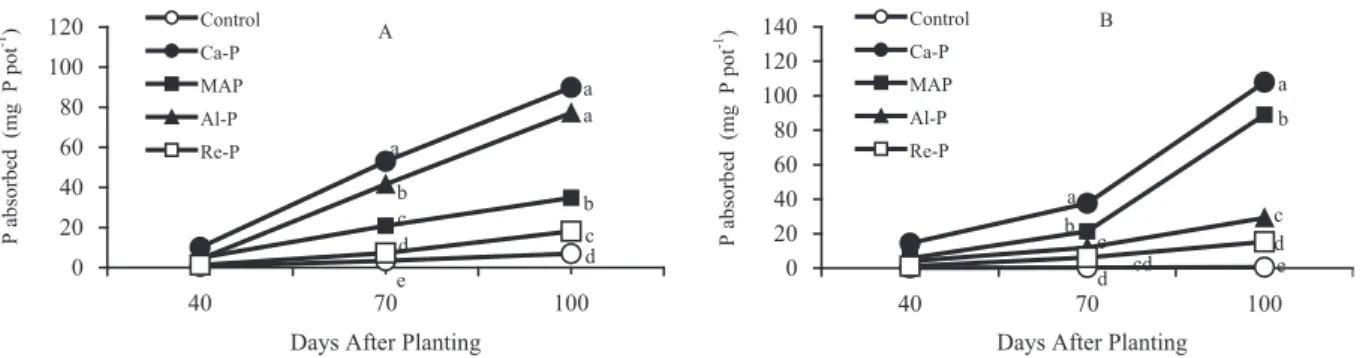
P uptake by upland rice approximated the dry matter transition (Fig. 3A). Uptake in Ca-P and Al-P plots similarly changed with time and culminated at 100 DAP. On the other hand, P uptake in MAP and Re-P plots at 70 and 100 DAP was significantly lower than that in the former two plots.
The dry matter of tomato supplied with various P sources changed in the sequence Ca-P>MAP>Al-P
>Re-P>Control. There was no significant difference between Ca-P and MAP (Fig. 1B) through 100 DAP.
Tomato P uptake from the various sources showed a similar trend to that of the dry matter, and as a re- sult shows that tomato absorbed P from MAP as
Fig. 1 Effects of various phosphorus sources on the dry weight of upland rice (A) and tomato plants (B). C ; control, Ca-P ; calcium dihydrogenphosphate monohydrate, MAP ; ammonium magnesium phosphate hexahydrate, Al-P ; aluminum phosphate, Re-P ; crotalaria residue. Different letters indicate significant difference atP<
0.05 (Fisher’s PLSD)
Fig. 2 Visual observations of growth of upland rice (A) and tomato (B) at 100 days after planting. C ; control, Ca- P ; calcium dihydrogenphosphate monohydrate, MAP ; ammonium magnesium phosphate hexahydrate, Al-P ; aluminum phosphate, Re-P ; crotalaria residue
フィールドサイエンス 11号 10
0 20 40 60 80 100 120
40 70 100
Days After Planting
P absorbed (mg P pot-1) Control
Ca-P MAP Al-P
Re-P a
aa
b cd bc
d e A
0 20 40 60 80 100 120 140
40 70 100
Days After Planting
P absorbed (mg P pot-1) Control
Ca-P MAP Al-P Re-P
a
a b
e c b d
c cd d B
much as from Ca-P (Fig. 3B). P uptake from Al-P was significantly lower than Ca-P and MAP. For Re- P plots, the growth of both crops was low, but this does not necessarily mean that the effectiveness of Re-P is also low because the application rate was small due to the low P content, as mentioned above.
Recovery rate of phosphorus from various phos- phorus sources
Although the P recovery rate (PRR) from Ca-P by upland rice was remarkably high at 40 DAP , the rate from Al-P increased rapidly at 70 DAP , and that from Re-P also increased at 100 DAP and then
these further increased to > 20% except for MAP (Table 1). PRR from MAP by upland rice was sig- nificantly low.
For tomato , PRR at 40 DAP was significantly high only in the Ca-P plot, but the Re-P plot caught up the Ca-P plot at 70 DAP (Table 2). In addition, PRR from MAP increased rapidly at 100 DAP, and all reached to about 30% except for the Al-P plot.
PRR from Al-P by tomato was significantly low . The PRR from Re-P was second highest after Ca-P.
Remaining available phosphorus(RAP)in soil af- ter harvest
For both crops, the soil RAP concentrations were over 80 mg P kg-1at 40 DAP in each treatment ex- cept for control , and then decreased gradually , while in the control plot it was<12 mg P kg-1over 100 days (Fig. 4A, 4B). For upland rice RAP was highest (160 mg P kg-1), in Al-P plot at 40 DAP, but it decreased quickly below that of MAP plot at 70 DAP (Fig. 4A). Conversely, RAP of Ca-P plot was al- ready low (80 mg P kg-1), at 40 DAP. RAP in upland rice plots decreased rapidly at 70 DAP (Fig. 4A), but a similar change was not seen for tomato(Fig. 4B).
DISCUSSION
Difference of plant compatibility to P forms
Upland rice absorbed a lot of P from Al-P as much as Ca-P (Fig. 3A). It is well known that upland rice has the ability to absorb P combined with alu- minum (Al-P). For example, it is reported that Al-P had high availability in upland rice cultivation (Otani and Ae 1996 ; Prochnow et al. 2003). In our experiment, every phosphorus source was effective Table 2. Phosphorus recovery rate (%) by tomato plant
from different phosphorus sources
P-sources Days after planting
40 70 100
Ca-P 3.86 a 10.1 a 32.77 a
MAP 1.48 b 5.5 b 27.03 c
Al-P 1.01 c 3.05 c 8.73 d
Re-P 1.81 b 10.92 a 31.37 b
Different letters in a row indicate significant differences at 5% level.
Table 1. Phosphorus recovery rate (%) by upland rice from different phosphorus sources
P-sources Days after planting
40 70 100
Ca-P 2.58 a 14.72 a 25.32 a
MAP 1.14 bc 4.63 d 8.5 c
Al-P 0.97 c 10.62 b 21.43 b
Re-P 1.42 b 7.34 c 23.65 ab
Different letters in a row indicate significant differences at 5% level.
Fig. 3 Phosphorus uptake from soils applied with various phosphorus sources by upland rice (A) and tomato (B) C ; control, Ca-P ; calcium dihydrogenphosphate monohydrate, MAP ; ammonium magnesium phosphate hexahydrate, Al-P ; aluminum phosphate, Re-P ; crotalaria residue. Different letters indicate significant difference atP<0.05 (Fisher’s PLSD)
0 40 80 120 160
40 70 100
Days After Planting Available P (mg P pot-1)
Control Ca-P MAP Al-P a Re-P
c a bc d b
c d a
cb
d c b
A
0 40 80 120 160
40 70 100
Days After Planting
Available P (mg P pot-1 ) Control
Ca-P MAP Al-P Re-P a
a ab c b a
b c a
cb
d
c b
B
for the growth of upland rice, with Ca-P and Al-P having the largest effects. On the other hand, it is noteworthy that the effectiveness of MAP is equivalent to Ca-P for tomato growth (Fig. 1B) and P uptake (Fig. 3B). No reference was found about this finding, although there was a report that the other kind of sewage-derived product, the recycled calcium phosphate, showed almost the same effect as Ca-P on the P uptake of maize grown in Andosol and Red soil (Tsujimoto et al. 2007).
The upland rice grew slightly even in the control, but the control tomato showed typical symptoms of P deficiency (Fig. 2B) , confirming that tomato is very sensitive to P content of the growing medium.
It is clear that the P supply was a limiting factor for growth in both crops, because the correlation coeffi- cientR2between dry matter and the P absorption of all plots is0.938for upland rice and0.979for to- mato.
Despite both Al-P and MAP were water- insoluble, the former led to a fertilizer response in upland rice equivalent to superphosphate, and the latter stimulated tomato growth . However , the early growth in Al-P and MAP plots was inferior to that in Ca-P. Tisdale and Nelson ( 1975 ) reported that a high solubility in water may be desirable for establishment and early growth stages of crops. As Russell (1973) reported, it may take time to trans- form insoluble forms of phosphate to labile phos- phate pool in soil.
Although superphosphate, in which P is water- soluble, has been used generally in crop cultivation,
it has a disadvantage in that it reacts rapidly with aluminum or iron in soil where the phosphate ad- sorption force is strong, and P becomes unavailable by next growing season. The result of our experi- ment suggests that crops are able to use efficiently water-insoluble P which is more stable than super- phosphate, although the efficiencies depend on the kind of crop. The delay in early growth can be over- come by addition of small amounts of superphos- phate at planting time.
P recovery rate(PRR)from plant residue
The PRR from Re-P was second highest after Ca- P (Table 2). We suggest that the high PRR from Re- P was due to the slow release of P from the incorpo- rated crop residue, being mineralized by soil micro- organisms , and the quick uptake before the re- leased P is adsorbed to soil particles. If crop roots are in the organic matter, slowly-released P will be absorbed easily rather than being adsorbed onto soil particles. When the residues are placed on the soil surface as a mulching material instead of incor- poration , the decomposition rate further slows down and PRR will become much higher (Friesen et al . 1997 ) . As the effective mechanism of organic matter, Ghosal et al. (2011) discussed that organic matter on decomposition releases organic mole- cules, which form complexes with Fe and Al ions thereby blocking the sites which are mainly respon- sible for fixation of phosphorus. Some kinds of plant with high P retention might absorb P from poorly soluble forms in soil. The further development of technologies to exploit green manure residues as a Fig. 4 Changes in available phosphorus in soil applied with various phosphorus sources affected by the cultivation of
upland rice (A) and tomato (B). C ; control, Ca-P ; calcium dihydrogenphosphate monohydrate, MAP ; ammo- nium magnesium phosphate hexahydrate, Al-P ; aluminum phosphate, Re-P ; crotalaria residue. Different let- ters indicate significant difference atP<0.05 (Fisher’s PLSD)
フィールドサイエンス 11号 12
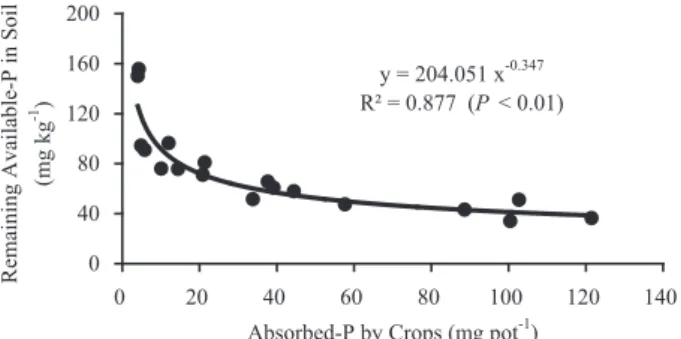
y = 204.051 x-0.347 R² = 0.877 (P < 0.01)
0 40 80 120 160 200
0 20 40 60 80 100 120 140
Absorbed-P by Crops (mg pot-1) Remaining Available-P in Soil (mg kg-1)
P resource for succeeding crops is expected.
Relationship between RAP in soil and P uptake by crops
Since the above-ground dry matter and the P up- take of upland rice at 100 DAP were high in both Ca-P and Al-P plots, we suggest that P in the Al-P plot existed in available form at the beginning of the experiment and then immobilized gradually, while from the beginning of the experiment in the Ca-P plot upland rice had rapidly absorbed P from soil- fixed P. Upland rice could have taken up P from re- action products such as Al-P or Fe-P.
The result of Fig. 4 suggests that upland rice ab- sorbed much higher amounts of Al-P than did to- mato. Since the maximum RAP at 100 DAP was re- corded in the MAP plot for both crops, the P avail- ability of MAP seems to last for a relatively long pe- riod.
RAP in Re-P plot decreased gradually and the changing patterns and levels accorded well with P uptake for both crops (Fig. 4). In the soil condition where available P was not in excess, it seems that the mineralized P derived from crop residues via microorganisms is effectively taken up by crops be- fore it adsorbs onto soil particles.
The relationship between RAP and crop P up- take can be represented as an exponential function, with a significant correlation coefficient (R2=0.877, P<0.01)(Fig. 5). As P uptake increased, RAP de- creased. However, Fig. 5 also shows that low levels of RAP (<30 mg P kg-1) cannot be absorbed, sug- gesting that not all P fractions extracted by the Bray’s method can be absorbed. This discrepancy may be due to the difference in the chemical extrac- tion method and the plant physiological absorption
mechanisms.
CONCLUSION
Although Ca-P had the highest availability in the cultivation of upland rice and tomato over 100 days, we showed that MAP , Al-P and Re-P were also available to crops to some extent . The recovery rate of Re-P in particular was high after Ca-P. It is important that Re-P remains in soil, and a part of it may derive from fixed P which is in an unavailable form to general crops. In this experiment, we tested crotalaria residue, Re-P, as a green manure. If an- other type of residue, which has stronger affinity for P, were used, it could absorb unavailable P be able to supply succeeding crops. This is the most cost-effective application in the study region , in which a lot of P accumulates in soil, and it would be an effective method not only in the area where the phosphate adsorption force is strong in the volcanic ash soils, but also in regions where fertilizers cannot be used economically, such as in developing coun- tries.
The effectiveness of the tested P sources differs according to the type of crop. We showed that up- land rice has remarkably high ability to take up Al- combined P compared with tomato, while tomato is sensitive to P deficiency but it has the strong ability to absorb P from MAP.
From a standpoint of efficient use of P resources, the use of recovered P sources such as Re-P and MAP should be applied widely. Utilization of the re- covered resources will reduce production costs and facilitate environmental preservation. To promote such a move, further research is necessary on the relationship between the characteristics of crop species (e. g. the difference between upland rice and tomato), and the types and properties of the recov- ered P resources.
Acknowledgment : The author, Aye, is immensely grateful to Japan International Cooperation Agency (JICA) and Japan International Cooperation Center (JICE) for a financial assistance in the form of a scholarship.
Fig. 5 Relationship between remaining available phos- phorus in soils and phosphorus uptake by crops
REFERENCES
Chao LL (1969) Statistical inference-hypothesis test- ing. In : Statistics methods and analyses. Inter- national student edition, McGraw-HILL, NY, pp 215-237
Friesen DK, Rao IM, Thomas RJ, Oberson A, Sanz JI (1997) Phosphorus acquisition and cycling in crop and pasture system in low fertility soils.
In : Ando T, Fujita K, Mae T, Matsumoto H, Mori S, Sekiya J (ed) Plant nutrition - for sus- tainable food production and environment. Klu- wer Academic Publishers, the Netherlands, pp 493-498
Ghosal P, Chakraborty T, Banik P (2011) Phospho- rus fixing capacity of the oxic rhodustalf alfisol soil in the Chotanagpur plateau region of East- ern India. Agricultural Sciences 2 (4) : 487-490 Gomez KA, Gomez AA (1984) Statistical procedures
for agricultural research. Wiley & Sons, Singa- pore, pp 388
Hammond LL, Chien SH, Roy AH, Mokwunye AU (1989) Solubility and agronomic effectiveness of partially acidulated phosphate rocks as influ- enced by their iron aluminum oxide contents.
Fertilizer Research 19 : 93-98
Horst WJ, Kamh M, Jibrin JM, Chude VO (2001) Ag- ronomic measures for increasing P availability to crops. Plant Soil 237 : 211-223
Krishna, KR (2003) The agrosphere ‐nutrient dy- namics , ecology and productivity ‐ . Science Publishers, Inc, Plymouth, UK, pp 18-19
Lynch J (1998) The role of nutrient-efficient crops in modern agriculture. Crop Production 1 : 241- 264
Mizuno N, Minami M (1980) A rapid pretreatment method by using sulfuric acid-hydrogen perox- ide for determining N, K, Mg, Ca, Fe, Mn in
crops . Japanese Journal of Soil Science and Plant Nutrition 51 : 418-420 (in Japanese) Olsen SR, Sommers LE (1982) Phosphorus. In : Page
AL, Miller RH, Keeney DR (ed) Methods of soil analysis, Part 2. Second edition, American Soci- ety of Agronomy, Madison WI, pp 416-418 Otani T, Ae N (1996) Phosphorus (P) uptake mecha-
nisms of crops grown in soils with low P status.
I. Screening of crops for efficient P uptake. Soil Science and Plant Nutrition 42 : 155-163
Prochnow LI, Chien SH, Taylor RW, Carmona G, Henao J, Dillard EF (2003) Characterization and agronomic evaluation of single superphos- phates varying in iron phosphate impurities . Agronomy Journal 95 : 293-302
Russell EW (1973) The residual value of phosphatic fertilizers. In : Soil conditions and plant growth.
Tenth edition, Longman Group Limited, Lon- don, pp 594-602
Salas AM, Elliott ET, Westfall DG, Cole CV, Six J (2003) The role of particulate organic matter in phosphorus cycling . Soil Science Society of America Journal 67 : 181-189
Sanchez PA ( 1976 ) Soil fertility evaluation . In : Properties and management of soils in the trop- ics. Wiley-Interscience, NY, pp 295-335
Tisdale SL , Nelson WL ( 1975 ) Soil and fertilizer phosphorus . In : Soil fertility and fertilizers . Macmillan Publishing Co., NY, pp 233
Tsujimoto R, Noami Y, Ikumi Y, Suzuki T, Ae N (2007) Phosphorus availability of recycled cal- cium phosphorus produced from sewage sludge . Japanese Journal of Soil Science and Plant Nutrition 78 : 245-252
White RE (1971) Studies on mineral ion absorption by plants. II. The interaction between meta- bolic activity and the rate of phosphorus up- take. Plant Soil 38 : 509-523
14
研究資料
先島諸島からのオカダンゴムシの初記録
唐沢 重考
First record of Armadillidium vulgare (Crustacea, Isopoda) from Sakishima Islands, Southern Japan
Shigenori KARASAWA
はじめに
先島諸島は,沖縄県の宮古島列島以南の島々の総 称で,代表的な島として宮古島,石垣島,および,
西表島などが挙げられる。おおよそ北緯24度から26 度あたりに位置するこれらの島々は,1月の平均最 低気温(1981~2010年)が16度以上と温暖な地域で あり(気象庁 HP ; http : //www.jma.go.jp/jma/
index.html),森林生態系にはシイ類やカシ類を優 占種とした亜熱帯林が成立する(Kira,1991)。ま た,これら先島諸島とその北の沖縄島の間には,ケ ラマギャップと呼ばれる水深1000m の深みがある ため,第四期の氷期の海水面の低下した時期におい てもこれらの島々は陸続きしなかったと考えられて いる(木村,2002)。そのため,先島諸島の生物相 は,その多様性が高いだけでなく,沖縄島以北の生 物相と は 異 な る こ と が 知 ら れ て い る(太 田・高 橋,2006)。したがって,先島諸島の生物を保全し
ていくことは,琉球列島全体の生物多様性を保全す る上で極めて重要である。
人為的に自然分布域以外に持ち込まれた生物は外 来生物と呼ばれ,在来の生態系や生物多様性,さら には人の健康や生産活動に望ましくない影響を及ぼ すことがある(多紀,2008)。周囲を海に囲まれ生 物の交流が妨げられることで独自の生物が進化した 先島諸島の島々においても,近年の交通網の発達に より,様々な外来生物が持ち込まれつつあり,それ らによる在来の生物相への悪影響が懸念されてい る。例えば,石垣島には,特定外来種に指定されて いるオオヒキガエルBufo marinusが定着しているが
(多紀,2008),その胃からは200種以上の無脊椎動 物や小型脊椎動物が確認され(太田,2001),在来 生物の絶滅が危惧されている。したがって,豊かな 自然の残る先島諸島の生態系と生物多様性を保全す る上で,外来種の侵入,定着,および,在来生物へ の影響を正確に把握し,適切な処置を行うことは緊 This study is the first record ofArmadillidium vulgarefrom Sakishima Islands, Southwestern Japan.A. vul- gare has been found on Miyako Airport in Miyakojima Island only, although I have collected isopods from 134 sites in Sakishima Islands. This species may be introduced into Miyako Airport by airplanes from Oki- nawajima Island.
Key words: introduced species,Armadillidium vulgare, Sakishima Islands
日本の南西端に位置する先島諸島においてオカダンゴムシが初めて確認されたので報告を行った。これま でに先島諸島134地点においてワラジムシ類の採集を行った結果,宮古島の宮古空港内でのみオカダンゴム シの分布が確認された。本種の宮古空港への侵入経路としては,近年,定着が確認された沖縄島から飛行機 により運ばれたことが考えられる。
キーワード:外来種,オカダンゴムシ,先島諸島
2012.10.10受付;2012.11.19受理
福岡教育大学 〒811―9142 福岡県宗像市赤間文教町1―1:Fukuoka University of Education