Evaluation of Selenium and Zinc Levels in Seropositive HIV Individuals in a Tertiary Hospital in Osogbo, Osun State, Nigeria
1 Akinjinmi AA, 2,3 Akingbade OA, 4 Okerentugba PO, 4 Okonko IO
1Department of Chemical Pathology, Federal Medical Centre, Idi Aba, Abeokuta, Nigeria E-mail: [email protected], 08060706263
2Department of Microbiology, Federal Medical Centre, Idi Aba, Abeokuta, Nigeria
3Department of Microbiology, Federal University of Agriculture, Abeokuta, Ogun State, Nigeria E-mail: [email protected], [email protected], 08063529234
4Medical Microbiology Unit, Department of Microbiology, University of Port Harcourt, P.M.B. 5323, Choba, East- West Road, Port Harcourt, Rivers State, Nigeria;
[email protected], [email protected]; Tel.: +234 803 538 0891
Abstract: Selenium (Se) and zinc (Zn) are the key trace elements which serve as antioxidants, and play a role in HIV disease progression. This study was designed to evaluate serum levels of selenium and zinc in HIV seropositive patients with those of the sex and aged match healthy subjects. Ten milliliters (mL) of fasting blood sample were collected from the participants. Serum level of selenium and zinc were measured by graphite furnace atomic absorption. When compared with the healthy control group, the serum level of selenium in the human immunodeficiency virus infected subjects were significantly lower while the Zinc serum level were significantly higher. HIV seropositive patients, who were on combination therapies showed significantly (P<0.05) high Zn serum level compared to those who were not on any form of antiviral therapy. But there was no significant difference in the serum selenium level between HIV-positive patients who were on the combination therapies and HIV-positive patients who were not on any form of antiviral therapy in this study. Low serum selenium levels are found to be prevalent in human immunodeficiency virus infected individuals in this study. In conclusion, the decrease in antioxidant micronutrient selenium that accompanies HIV infection suggests a potentially important role of nutritional supplementation and good nutrition in proper management of HIV/AIDS. Thus, early evaluation of nutritional status of these subjects and providing appropriate nutritional support and mineral supplementation along with the specific anti-retroviral treatment are highly recommended.
[Akinjinmi AA, Akingbade OA, Okerentugba PO, Okonko IO. Evaluation of Selenium and Zinc Levels in Seropositive HIV Individuals in a Tertiary Hospital in Osogbo, Osun State, Nigeria. Academ Arena 2013;5(9):17-21] (ISSN: 1553-9865) http://www.sciencepub.net/academia. 4
Keywords: Selenium, Zinc, Seropositive, HIV individuals
1. Introduction
Trace elements especially selenium (Se) and zinc (Zn) is important for maintaining a healthy immune system. Selenium and zinc are chemical elements that are commonly used in nutritional supplements. While selenium is known for its antioxidant qualities (reducing the oxidation of fats in your blood) and for its ability to fortify the body against free radicals (potentially harmful, highly reactive uncharged molecules), zinc is best known for its ability to stabilize cell structures. The combination of these two elements can have a number of effects on the body (Edeas et al, 1996; Stambullian et al, 2007).
Selenium assists with the functioning of many immune system mechanisms, including T lymphocytes, macrophages and neutrophils. Because of this, supplemental intake of selenium may help reduce the risk of cancer and has also been linked to inhibiting the progression of HIV and AIDS.
According to the National Institutes of Health, due to zinc's ability to regulate the cell structures of various
enzymes and proteins, it can help increase the responsiveness of the immune system. Zinc has been shown to help reduce the development of infections and prolong the survival rates of individuals. Trace metals are necessary part of good nutrition, although they can be toxic if excess quantities are ingested. It has been shown that micronutrient deficiencies are common among HIV-infected persons, especially in those who are underprivileged and undernourished [Allardet al, 1998; Bogden et al, 2000].
HIV infection could impair nutritional status by causing a reduced intake and absorption and/or increasing utilization of nutrients. Deficiencies in antioxidants during HIV infection facilitate the development of oxidative stress and may contribute to immune deregulation and HIV replication (Cunningham-Rundles et al, 2005). Human Immunodeficiency Virus (HIV) infection is a major health problem in the world [Dudgeon et al., 2006;
Colecraft, 2008]. Functional status and survival of HIV-infected patients are affected by their nutritional
conditions (Knox et al, 2003]. The critical role of nutritional support and highly active anti-retroviral therapy (HAART) in HIV-infected individuals has been approved. American Dietetic Association recommends nutritional support as a part of the care provided to HIV-infected patients. Zinc deficiency can declines T cells generation and depresses humoral and cell-mediated immunity [Edeas et al, 1996;
Stambullian et al, 2007]. Selenium deficiency also has several medical implications including impaired immune response [Sprietsma, 1997]. The aim of this study is to evaluate the Se and Znserum levels in HIV seropositive patientswith those of healthy individuals.
2. Materials and Method 2.1. Study area and Population
This study was a six months cross-sectional, analytical laboratory-based study conducted in LadokeAkintola University of Technology Teaching Hospital, Osogbo,Osun State. The study groups are HIV infected adult males and females whose infection were confirmed with the anti-HIV antibody tests (ELISA and Western-blot). The control subjects were age matched healthy males and females individuals, without any medical problem at the time of the study or history of any chronic disease and with negative anti-HIV antibody test.
2.2. Blood collection
Ten milliliters (mL) of fasting blood sample were collected and distributed into an appropriate bottle for the evaluation of trace metals (Se and Zn) from 50 HIV-infected individuals {(25 HIV-positive patients who were not on any form of antiviral therapy (PRE- HAART individuals ) and 25 who were on the combination therapy (HAART individuals)}and healthy subjects (25control group,randomly selected age)under trace elements free conditionwho showed no serological evidence for HIV and/or HCV infection and no abnormal laboratory findings. Blood samples were centrifuged at 4000 revolution per minutefor ten minutes. The collected serum was stored at - 20°C until analysis. All glassware and bottles used for separation of serum and further analysis were previously soaked in 10% nitric acid and rinsed thoroughly with de-ionized water.
2.3. Detection of Zinc and Selenium
Serum Zn and Se levels were measured using atomic absorption spectrophotometer (Atomic absorption spectrophotometer Shimadzu, AA-680, Japan). Samples and standards concentrations were read in duplicate.
The study was approved by the university ethic committee. Informed consent was obtained from each participant after the protocol of the study was explained to them in the language they understood.
following therapies: generic fixed-dose combination of zidovudine +lamivudine+nevirapine. For this study, Zn deficiency was defined as a serum level < 67 mcg/dL, using the cut-off referenced by Bender and Bender for normal plasma Zn (67–183 mcg/dL) [Bender and Bender, 1997]. Selenium deficiency was defined as a level < 85 mcg/L, which is a cut-off associated with increased mortality [Bender and Bender, 1997].
2.3.1. Principle and procedure
In the flame AAS, the principle is based on the dissociation of the element from its chemical bonds.
This is then placed in an unexcited or ground state (neutral atom). Thus, the neutral atom is at a low energy level in which it is capable of absorbing radiation at a very narrow bandwidth corresponding to its own line spectrum. The amount of radiant energy absorbed at a characteristic wavelength in the flame is proportional to the concentration of the element present in the sample.
2.3.2. Zinc (Zn)
The serum was diluted 1:4 with water and aspirated to AAS. Standards and blanks were prepared by diluting with 5% glycerin (series of standards 1, 3 and 6 were recommended, however, 1 and 3 ppm were enough which have comparable concentration with sample).
2.3.3. Selenium (Se)
This element was read from samples prepared for Zn analysis. Standards and blanks were prepared accordingly.
2.4. Statistical analysis
The SPSS software package was used for statistical analysis and values obtained from this study were expressed as mean and standard deviation when compared using the independent t-test and results were regarded as significant at P<0.05.
3. Results
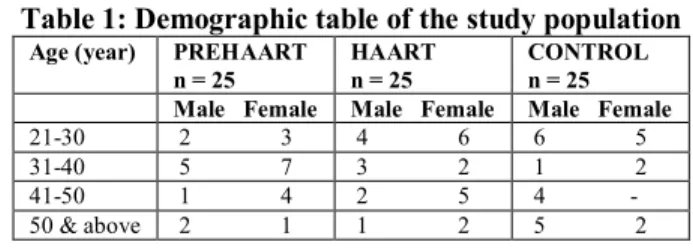
The mean age of all HIV-positive patients was not significantly (P>0.05) different from those of the control group in table 1.
Table 1: Demographic table of the study population
Age (year) PREHAART n = 25
HAART n = 25
CONTROL n = 25 Male Female Male Female Male Female 21-30 2 3 4 6 6 5 31-40 5 7 3 2 1 2 41-50 1 4 2 5 4 - 50 & above 2 1 1 2 5 2
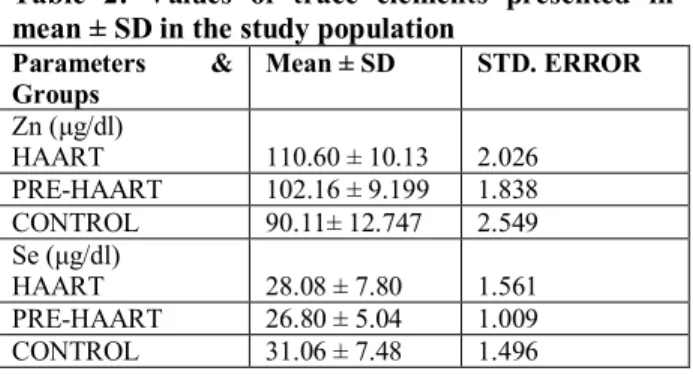
The mean serum levels of biochemical variables in the three groups are shown in table 2. Zinc (Zn) (μg/dl): HAART patients 110.60 ± 10.132, PREHAART patients 102.16 ± 9.189 and control
patients 28.076 ± 7.8055, PREHAART patients 26.800 ± 5.0454, and control 31.064 ± 7.4819.
Table 2: Values of trace elements presented in mean ± SD in the study population
Parameters &
Groups
Mean ± SD STD. ERROR
Zn (μg/dl)
HAART 110.60 ± 10.13 2.026 PRE-HAART 102.16 ± 9.199 1.838 CONTROL 90.11± 12.747 2.549 Se (μg/dl)
HAART 28.08 ± 7.80 1.561 PRE-HAART 26.80 ± 5.04 1.009 CONTROL 31.06 ± 7.48 1.496
Patients on HAART had higher mean levels (P<0.05) of Zn compared to PREHAART. On the other hand, there was no significant (P<0.05) difference between the mean levels of Se in HAART patients compared to PREHAART patients (Table 3).
Table 3: Comparison of mean ± SD of variables between PREHAART and HAART subjects Parameters/
Groups
Mean ± SD STD.
ERROR Zn (μg/dl)
HAART 110.60 ± 10.13 2.026
PRE-HAART 102.16 ± 9.199 1.838 Se (μg/dl)
HAART 28.08 ± 7.80 1.561
PRE-HAART 26.80 ± 5.04 1.009 Patients on PRE-HAART had higher (P<0.05) levels of Zn compared to control subjects.The mean serum concentrations of Se was significantly (P<0.05) lower in PREHAART patients compared to control subjects (Table 4).
Table 4: Comparison of mean ± SD of variables between control and PREHAART subjects
Parameters/ Groups Mean ± SD STD.
ERROR Zn (μg/dl)
PRE-HAART 102.16 ± 9.199 1.838
CONTROL 90.11± 12.747 2.549
Se (μg/dl)
PRE-HAART 26.80 ± 5.04 1.009
CONTROL 31.06 ± 7.48 1.496
Patients on HAART had higher (P<0.05) levels of Zn compared to control subjects. On the other hand, the mean serum level of Se was significantly (P<0.05) decreased in HAART patients in comparison to control subjects (Table 5).
Table 5: Comparison of mean ± SD of variables between control and HAART subjects
Parameters/
Groups
Mean ± SD STD.
ERROR Zn (μg/dl)
HAART 110.60 ± 10.13 2.026
CONTROL 90.11± 12.747 2.549
Se (μg/dl)
HAART 28.08 ± 7.80 1.561
CONTROL 31.06 ± 7.48 1.496
4. Discussion
Selenium and zinc are two of the most important nutrients for strengthening the immune system. This study evaluates trace elements (Zn and Se) in HIV- infected subjects attending LAUTECH teaching hospital, Osogbo, Nigeria. The mean serum concentrations of seleniumobtained was significantly (P<0.05) lower in PREHAART and HAART patients compared to control subjects in this study. The result showed that HIV infection decreasesselenium and antiretroviral therapy did not significantly improve them. This is similar to the findings of Graham et al.
[1991] and Zamrzly et al. [2004] that observed serum level Se in HIV-infected individuals to be significantly lower than the healthy group.
Micronutrients are essential for maintaining immunological function however; deficiencies of certain minerals have been associated with impaired functions. For instance, selenium deficiency negatively impacted on proper functioning of the neutrophils and T-lymphocytes [Percival 1998; Fraker et al, (2000); Ferencík and Ebringer (2003). Studies have shown that low or deficient serum concentrations of selenium are common among HIV-positive persons not receiving HAART. Low or deficient serum concentration of selenium is associated with either advanced HIV-related diseases or increased disease progression and mortality [Abrams et al, 1993; Tang et al, 1993].
HAART became the new standard for HIV treatment in 1996 [Yeni et al, 2002] and initiation is generally recommended for patients with HIV-related opportunistic infections or a CD4+T-cell count <200 cells/mm3. HAART may restore immunological function [Autran et al, 1997] but does not eliminate weight loss and wasting [Wanke et al, 2000] which continue to be strong independent predictors of mortality. It is thought that because low micronutrient concentrations are caused by similar mechanisms and several micronutrient concentrations are lower among individuals with HIV wasting syndrome, micronutrient deficiencies may also persist in the era of HAART [Coodley et al, 1993]. In a study of 35 HIV adults receiving HAART, there was no significant difference
in serum selenium between those on HAART and control group [Batterham et al, 2001].
In this study, the level of zinc was significantly higher in HIV-infected persons on HAART compared with control group and this agrees with the report of Arinola et al. [2004]. The increased level of zinc in HIV-infected and even in HAART patients compared with controls may possibly reflect an unregimented measure to manage this disease in this environment.
Most infected individuals accept all forms of unorthodox treatment, part of which usually include the use of herbs and dietary advice. Some of these may be a source of zinc thus contributing to the total pool of zinc in the serum of the study population. High zinc level in these patients could be beneficial since zinc could be both an inhibitor of reverse transcriptase and activator of the ‘tat protein’. As earlier documented, most trace element studies are usually linked directly or indirectly with several metallo - enzymes having antioxidant activities. The differences in micronutrient levels between PREHAART and HAART patients may be explained by their nutritional status. Zinc deficiency has been reported to decrease lymphocyte concentrations (Percival 1998; Fraker et al, 2000;
Ferencík and Ebringer, 2003).
Serum Zn and Se levels may not be the best indicator of total stores for these trace elements in the body and cellular concentrations or related enzymes activity may be more reliable. Based on World Health Organization nutritional recommendations for HIV infected persons, adequate nutrition is critical for health and survival for all subjects regardless of HIV infection condition [Zmarzly et al, 2004]. It is important that these patients should be taking daily recommended of relevant micronutrients through diet or supplements.
In conclusion, the decrease in antioxidant micronutrient selenium that accompanies HIV infection suggests a potentially important role of nutritional supplementation and good nutrition in proper management of HIV/AIDS. Therefore, early evaluation of nutritional status of these subjects and providing appropriate nutritional support and mineral supplementation along with the specific anti-retroviral treatment are recommended.
Correspondence to:
Iheanyi O. Okonko
Department of Microbiology, University of Port Harcourt, Choba,
PMB 5323 Port Harcourt, Rivers State, Nigeria;
E-mail: [email protected];
[email protected] Tel.: +234 803 538 0891
References
1. Abrams B, Duncan D, Hertz-Picciotto I (1993) A prospective study of dietary intake and acquired immune deficiency syndrome in HIV- seropositive homosexual men. J Acquir Immune DeficSyndr 6: 949-958.
2. Allard JP, Aghdassi E, Chau J, Salit I, Walmsley S (1998) Oxidative stress and plasma antioxidant micronutrients in humans with HIV infection.
Am J ClinNutr 67: 143-147.
3. Arinola OG, Adedapo KS, Kehinde AO, Olaniyi JA, Akiibinu MO (2004) Acute phase proteins, trace elements in asymptomatic human immunodeficiency virus infection in Nigerians.
Afr J Med MedSci 33: 317-322.
4. Autran B, Carcelain G, Li TS, Blanc C, Mathez D, (1997) Positive effects of combined antiretroviral therapy on CD4+ T cell homeostasis and function in advanced HIV disease. Science 277: 112-116.
5. Batterham M, Gold J, Naidoo D, Lux O, Sadler S, et al. (2001) A preliminary open label dose comparison using an antioxidant regimen to determine the effect on viral load and oxidative stress in men with HIV/AIDS. Eur J ClinNutr 55: 107-114.
6. Bender D, Bender A: Vitamin A and carotenes.
In Nutrition: A Reference Handbook. New York, Oxford University Press; 1997::228-244.
7. Bogden JD, Kemp FW, Han S, Li W, Bruening K, et al. (2000) Status of selected nutrients and progression of human immunodeficiency virus type 1 infection.Am J ClinNutr 72: 809-815.
8. Colecraft E (2008). HIV/AIDS: nutritional implications and impact on human development.
ProcNutrSoc, 67:109-113.
9. Coodley GO, Coodley MK, Nelson HD, Loveless MO (1993) Micronutrient concentrations in the HIV wasting syndrome.
AIDS 7: 1595-1600.
10. Cunningham-Rundles S, McNeeley DF, Moon A. (2005). Mechanisms of nutrient modulation of the immune response.The Journal of allergy and clinical immunology. Jun;115(6):1119–28. quiz 29.
11. Dudgeon WD, Phillips KD, Carson JA, Brewer RB, Durstine JL, Hand GA: Counteracting muscle wasting in HIV-infected individuals. HIV Med 2006, 7:299-310.
12. Edeas MA, Peltier E, Claise C, Khalfoun Y, Lindenbaum A: Immunocytochemical study of uptake of exogenous carrier-free copper- Znsuperoxidase dismutase by peripheral blood lymphocytes. Cell MolBiol 1996, 42:1137-1143.
13. Ferencík M, Ebringer L (2003) Modulatory effects of selenium and zinc on the immune system. Folia Microbiol (Praha) 48: 417-426.
14. Fraker PJ, King LE, Laakko T, Vollmer TL (2000) The dynamic link between the integrity of the immune system and zinc status. J Nutr 130:
1399S-1406S.
15. Graham NM, Sorensen D, Odaka N, Brookmeyer R, Chan D, et al. (1991) Relationship of serum copper and zinc levels to HIV-1 seropositivity and progression to AIDS. J Acquir Immune DeficSyndr 4: 976-980.
16. Knox TA, Zafonte-Sanders M, Fields-Gardner C, Moen K, Johansen D, Paton N: Assessment of nutritional status, body composition, and human immunodeficiency virus-associated morphologic changes. Clin Infect Dis 2003, 36:S63-68.
17. Percival SS (1998) Copper and immunity.Am J ClinNutr 67: 1064S-1068S.
18. Sprietsma JE: Zn-controlled Th1/Th2 switch significantly determines development of diseases. Med Hypotheses 1997, 49:1-14.
19. Stambullian M, Feliu S, Slobodianik NH:
Nutritional status in patients with HIV infection and AIDS. Br J Nutr 2007, 98:S140-143.
20. Tang AM, Graham NM, Kirby AJ, McCall LD, Willett WC, et al. (1993) Dietary micronutrient intake and risk of progression to acquired immunodeficiency syndrome (AIDS) in human immunodeficiency virus type 1 (HIV-1)-infected homosexual men. Am J Epidemiol 138: 937-951.
21. Wanke CA, Silva M, Knox TA, Forrester J, Speigelman D, et al. (2000) Weight loss and wasting remain common complications in individuals infected with human immunodeficiency virus in the era of highly active antiretroviral therapy. Clin Infect Dis 31:
803-805.
22. Yeni PG, Hammer SM, Carpenter CC, Cooper DA, Fischl MA, et al. (2002) Antiretroviral treatment for adult HIV infection in 2002:
updated recommendations of the International AIDS Society-USA Panel. JAMA 288: 222-235.
23. Zmarzly A, Simon K, Krause K, Rotter K, Gasiorowski J: Zn status in ex-intravenous drug users infected by HIV, without clinical presentation of AIDS. WiadLek 2004, 57:249- 254.
9/03/2013