Antibiotic Resistance Pattern of Salmonella enterica serovar Typhimurium Isolated from Locally Processed Dairy Products in Ekiti State, Nigeria
1Olawale, Adetunji Kola, 1Abosede, Temitope Favour, 1Isitua, Chinwe Cristy. 1Oyinloye, Mofoluwaso Adedeji, and
2Anibijuwon, Ibikunle Ibitayo. 3Osuntoyinbo, Richard Tope, 4Oje, Opeyemi James.
1Department of Biological Sciences, Microbiology unit, Afe-Babalola University, Ado-Ekiti. Nigeria
2Department of Microbiology, University of Ilorin, P.M.B 1515. Ilorin. Nigeria.
3Department of Microbiology, Waterford Regional Hospital, Waterford, Ireland
4Department of Food Technology, Federal Polytechnic, Ado-Ekiti, Nigeria [email protected]
Abstract : Salmonella enterica serovar Typhimurium belongs to the group of pathogens causing non-typhoidal infections. The presence of pathogenic bacteria in raw milk and its products have been reported to be a major threat to human health. This study therefore, aimed at determining the antibiotic resistance pattern of Salmonella enterica serovars Typhimurim isolates from locally processed dairy products. One hundred and twenty (120) dairy product samples (“wara” and “nono”) from major towns in Ekiti State were examined for Salmonella contamination. Isolates were tested for antibiotic susceptibility by disc diffusion methods. A total of 81(67.50%) of the samples were found contaminated with Salmonella, of which 38 (46.90%) were identified to be Salmonella enterica serovars Typhimurium. Ado had the highest number of contaminated samples with (53.09%), while Ido had the least contaminated samples with (25.49%). The result reveals high percentage of antibiotic resistance (34.21%) against Streptomycin, while ciprofloxacin had the highest susceptibility frequency (89%). Results of antibiotic susceptibility pattern of isolates from different towns revealed that S. Typhimurim isolates of Ado origin had the highest resistance pattern with (55.64%). Multiple antibiotic resistance result indicates that 2 (11.11%) of isolates from Ado resisted all (10) antibiotics tested. The highest multiple antibiotic resistance recorded for Ikere isolates was 5, while Ido isolates shown the least resistance to 4 antibiotics. There was high occurrence of antibiotic resistance S. Typhimurim in ready-to-eat foods sold in the study areas which can poses a great health risk for the consumers. Hence, there is need to educate and monitor the food handlers to comply with good hygiene practices.
[Olawale, Adetunji Kola, Abosede, Temitope Favour, Isitua, Chinwe Cristy. Oyinloye, Mofoluwaso Adedeji, and Anibijuwon, Ibikunle Ibitayo.Osuntoyinbo, Richard Tope, Oje, Opeyemi James.. Antibiotic Resistance Pattern of Salmonella enterica serovar Typhimurium Isolated from Locally Processed Dairy Products in Ekiti State, Nigeria. Academ Arena 2017;9(8):27-33]. ISSN 1553-992X (print); ISSN 2158-771X (online).
http://www.sciencepub.net/academia. 4. doi:10.7537/marsaaj090817.04.
Key words: Salmonella enterica, Typhimurim, antibiotic resistance, dairy products, hygiene practice.
Introduction
Salmonellosis is the most common food-borne bacterial disease worldwide. With increased outbreaks of human salmonellosis in most parts of the world resulting from food contamination, the prevention and control of salmonella infections originating from food have become a global issue, as this has been established as the main source of outbreaks in humans (Fyrouz et al., 2011; WHO. 2015).
Food-borne diseases are among the most serious health problems affecting public health and development worldwide. Industrialization, mass food production, decreasing trade barriers, and human migration have disseminated and increased the incidence and severity of food-borne diseases worldwide (Eleni et al., 2006). Among the various pathogenic bacteria known to cause mass food poisoning incidents, the most notorious are members of the genus Salmonella. They are highly adaptive and
potentially pathogenic to humans and animals. These intracellular pathogens cause typhoid fever in humans, enteric fevers, gastroenteritis and septicemia which are of both socio-economic and public health importance (Okeke et al., 2014).
Food borne salmonellosis has remained a neglected zoonosis in Nigeria and other developing countries of the world, despite an upsurge of cases reported. Raw milk and milk products are increasingly becoming important sources of human infection with Salmonella. Food vehicles implicated in most food- borne disease outbreaks is often consumed or discarded before clinical symptoms develop in the exposed individual (Karshima et al., 2013).
Majowicz et al. (2010), estimated that approximately 80.3 million of 93.8 million human Salmonella-related gastroenteritis cases that occur globally each year to be food-borne, thus representing approximately 86% of human salmonellosis cases [5].
Another study by Hossein et al. (2013), estimated that approximately 55% of human Salmonella cases were food-borne, 14% were travel-related, 13% were acquired through environmental sources, 9% occur due to direct human-to-human transmission and 9%
were attributable to direct animal contact (Majowicz et al., 2010).
Milk is also an excellent culture medium for many kinds of microorganisms. Fresh milk drawn from a healthy cow normally contains a low micro activity particularly with bacterial load of less than 103cfu/ml, but the load may increase up to 100 fold or more once it is stored for sometime at ambient temperature. Dairy products such as butter, cream and cheese are all susceptible to microbial contamination.
Some of the factors that increase the bacterial activity in raw milk and its products include health of the animal, cleanliness of animal housing area, nature of feed, water used at farm, milk vessels or utensils for storage and essentially the hygiene of the milk handler. The presence of pathogenic bacteria in raw milk and its products have been reported to be a major threat to human health especially those who drink raw milk and also reduce the keeping quality of milk (Egwaikhide et al., 2014).
‘Wara’ is a Nigeria soft white unripe milk coagulated or curded into cheese, usually boiled or fried, Nunu is locally prepared diluted milk which originates from Fulani cattle rustlers in the northern part of the country. It is commonly produced by Fulani and the Northern sect at large. These dairy products were produced from unpasteurized cow milk and sold along the major streets of Nigeria (Falegan and Akere 2014).
Street sold foods are appreciated for their unique flavors and convenience. They also assure food security for low income urban population and livelihood for a significant proportion of the population in many developing countries. However, the unhygienic conditions in which these foods are prepared, stored and served raise a question regarding their microbiological quality. Researchers have investigated the microbiological quality of street vended foods in different countries; high bacteria counts and a high incidence of food-borne pathogens in such foods have been reported (Fyrouz et al., 2011;
Mirriam et al., 2012; Falegan and Akere, 2014).
Milking and milk handling practices in the informal sector are done commonly without observing hygienic practices. It is a common practice to vend milk in inappropriate milk holding and storage equipment. Such practice possesses a threat to public health as chances of consuming unsafe milk are very high. It is a common experience that in Northern part of Nigeria that direct consumption of locally processed raw milk in both cities and rural areas is much
frequent and more popular than consumption of pasteurized milk because it is believed, especially in rural areas, that locally processed raw milk and its by- products have nutritional advantages over the pasteurized one (Egwaikhide et al., 2014).
However, consumption of raw milk and its by- products is considered potentially hazardous and has been associated with several types of infections including brucellosis, tuberculosis, salmonellosis, yersiniosis, Escherichia coli O157 and Staphylococcal enterotoxin poisoning. With the concern for quality of traditionally fermented dairy product like nono in northern Nigeria, it is imperative to ascertain a routine quality of this product consumed. Since it is locally processed and perhaps there is no microbial limit that has been established in this country for consumption of such kind of locally processed dairy product, the risk is food borne infections are inevitable (Egwaikhide et al., 2014; Owa et al., 2017).
Significant morbidity and mortality is associated with this disease possibly affecting over 90 million people globally each year. The risk of acquiring typhoid fever is increased among children and those in the informal sector. Due to the rapid and widespread emergence of salmonella serotypes with resistance to multiple antibiotics and changing modes of bacterial presentation, typhoid fever is becoming increasingly difficult to diagnose and treat (Robert et al., 2014).
Virulence is the degree of damage a microbe can cause to its host. Virulence factors are those factors that enable microbes to replicate and disseminate within a host in part by subverting or eluding host defenses.
Virulence factors of Salmonella grow with the ongoing gain of knowledge on the molecular mechanism behind its pathogenicity (Alpons et al., 2005). Molecular analysis is known to give a better picture to the epidemiology of infectious diseases.
Among the various pathogenic bacteria known to cause mass food poisoning incidents, the most notorious are members of the genus Salmonella (Hossein et al., 2013; Robert et al., 2014). The prevalence of the disease is increasing as a result of selective pressure, imposed by the use of antimicrobials in both human and veterinary Medicine which promotes the spread of multiple antimicrobial resistances resulting in the growing problem of Salmonella infections that are difficult to treat.
Monitoring the presence and antimicrobial resistance of bacteria are necessary to understand the trends and magnitude of food related pathogens, and to plan an effective health management intervention. This study therefore, examined the antibiotic resistance pattern of Salmonella enterica serovars Typhimurim isolated from locally processed dairy products “wara” and
“nono” street vended delicacies consumed in Ekiti State, Nigeria.
Materials And Methods Sample Collection:
120 samples of dairy products were bought from different retailers in selected towns from 3 senatorial districts (Ado, Ikere and Ido) of Ekiti State, Nigeria.
The samples were collected aseptically, into sterilized specimen bottles and transported in an ice-packed container to the Microbiology laboratory Afe Babalola University Ado-Ekiti, for analysis (Olawale et al., 2010).
Microbial isolation:
Isolation of Salmonella was carried out (using the pre-enrichment method by Richter et al. (2000).
25g of each food sample was homogenized in 225ml of water, and enriched by inoculating 10ml of the same (homogenized mixture) into 100ml of selenite enrichment broth and incubated at 37ºC for 24 hours.
Then a loopfull from the enriched selenite broth was streaked onto Salmonella Shigella agar (SS agar) and incubated for 24 hours at 37ºC. Suspicious colonies of salmonella appeared transparent and colorless with a dark center on SS agar media and pure strains of the microorganisms were obtained by successive streaking (Sharmina et al., 2015).
Antibiotic susceptibility Test:
Disc diffusion method was used to examine the antibiotic resistance pattern A suspension for each of the test bacterium was prepared by adjusting the turbidity in comparison with 0.5 McFarland standard solutions (Scott, 2011). Suspension of the isolated bacteria (Salmonella spp.) was separately spread evenly over the Muller-Hinton agar to prepare the uniform lawns. The antibiotic discs were applied aseptically on the surface of the inculcated plates at appropriate spatial arrangement by means of a sterile forceps. Susceptibility towards the specific antibiotic was interpreted by the presence of clear zone around the disc.
Results
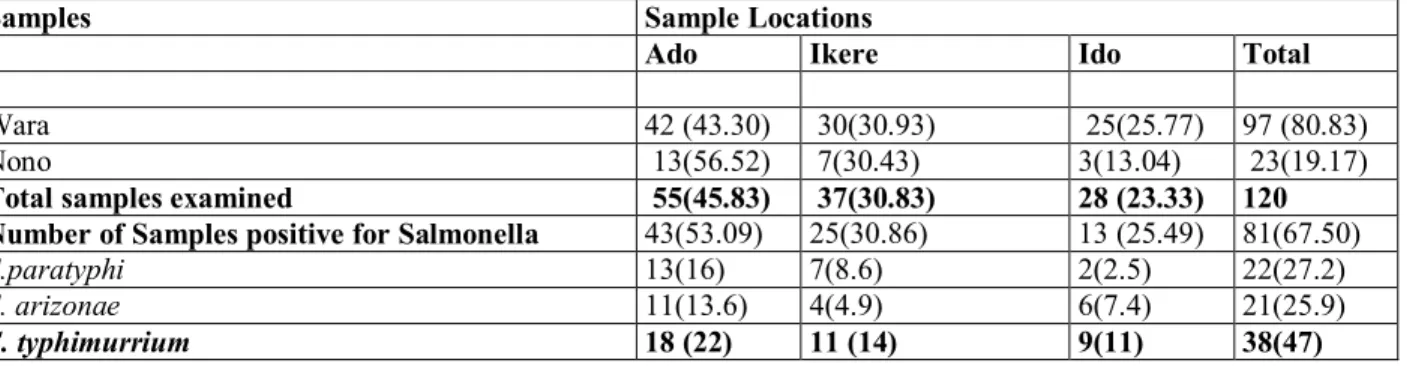
Sixty seven percent (67.50%) of the 120 dairy product samples examined were found to be contaminated with Salmonella, indicating high level of food contamination in the study area. Also, finding from this study shows that wara samples had the highest number of contamination (79%) in comparison to nunu (21%). However, 17(73.9%) of the 23(19.2%) nono samples were found positive for Salmonella which establishes that contamination occurs at different stages of the processing. Ado dairy products samples had the highest number of contamination (53.09%), followed by (30.86%) in Ikere samples and the least (25.49%) was recorded in Ido samples.
Antibiotic susceptibility result revealed two isolates (SWA7 and SND1) with 100% resistance to all antibiotics used, while others shown different
patterns of resistance. The result also reveals high percentage (34.21%) of antibiotic resistance against Streptomycin. Ciprofloxacin had the highest antibiotic susceptibility frequency (89%). Results of antibiotic susceptibility pattern of isolates from different locations reveal that Salmonella enterica serovars Typhimurim isolates of Ado origin had the highest resistance pattern with (55.64%) among others. The result of multiple antibiotic resistance indicates that 2 (11.11%) of isolates from Ado resist all ten antibiotics tested, highest multiple antibiotic resistance in Ikere samples was to 5 antibiotics and Ido shown the least resistance to 4 antibiotics.
Discussion
Findings of this study that show sixty seven percent (67.50%) of the total dairy product samples examined were contaminated with Salmonella, indicating high level of food contamination in the study areas. This may be due to poor hygiene and poor sanitary practices of the food handlers in the selected towns. Contamination of dairy may occur at different stages; primary production, processing and from handlers (Sharmila, 2011). Dairy products were mostly produced and handled by Fulani women with little or no education about hygiene and regulated production processes and the risk of contamination may be inevitable and this was in line with the research carried out by Ogah et al. (2015), which reveals that uneducated food handlers may pose as potential risk to food safety due to their low educational background and hence, may have a little or no understanding of the risk of microbial or chemical contamination of food or how to avoid them.
Finding from this study shows that wara samples had the highest number of contamination (79%) in comparison to nunu (21%). This corroborates the findings of Olufemi and lawal (2016), which concluded that due to the use of contaminated water, unclean utensils and poor hygiene environment in which the milk is being extracted and processed into wara, high levels of contamination is bound to occur.
Meanwhile the fermentation involved in the production of nunu may be an added advantage against contamination as this affects the survival of Salmonella in the milk. According to the study carried out by Gregory and Eric (1992), the survival of salmonella in fermented milk was dependent on its ability to adapt in acidic conditions. Consequently, acid-injured cells may not be quantitatively recovered when plated. Obadina et al. (2013), reported that fermentation lowers pH of milk thereby increasing its acid content. However, 17(73.9%) of the 23(19.2%) nono samples were found positive for Salmonella which establishes that contamination occurs at different stages of the processing.
An additional practice that may increase contamination of dairy products was according to Obadina et al. (2013), addition of untreated water to milk after fermentation to maximize profit. In the processing of nono, fermented milk is usually added to the raw fresh milk as starter culture to gives it a sour yoghurt taste. The result of study carried out by Okeke (2014 ), shows that addition of fermented milk to fresh milk as starter culture could be a source of contamination with food-borne pathogens and may constitute a risk to human health if used unpasteurized.
The Salmonella contamination of milk and milk products has been reported in several parts of world confirming its grouping as a neglected zoonotic pathogen (Karshima et al., 2013). This result tallies with the findings of Falegan and Akere (2014), who reported the occurrence of 60% salmonella isolates from wara amongst other microorganisms in Ekiti State. This incidence of Salmonella spp. in dairy products samples was high and can pose health risk for the consumers. All salmonellae are of public health concern having the ability to produce infection ranging from a mild self-limiting form of gastroenteritis to septicemia and life threatening typhoid fever (Laba and Udonsek, 2013). The presence of Salmonella in milk and milk products is intolerable by microbiological food standards as it is an indication of unsanitary production and improper handling of either the food or processing utensils (Olufemi and lawal, 2016).
The result of multiple antibiotic resistance indicates that 2 (11.11%) of isolates from Ado resist all antibiotics (10) tested, highest multiple antibiotic resistance in Ikere samples was 5 and Ido shown the least resistance to 4 antibiotics. This could be due to
different levels of indiscriminate usage of antibiotics in the various towns by the people in treating their diseases or of their animals (Tamb et al., 2016).
According to the study carried out by Kivaria (2006), suggest that the primary source of antimicrobial- resistant Salmonella infection was from foods of animal origin. Antibiotic resistance can also occur due to; the use of weakened or outdated antibiotics, using antibiotics for inappropriate conditions such as common colds, failing to complete ones regimen and using someone’s left over regimen (Tortoria, 2006).
Antimicrobial resistance arises in several ways, including acquisition of resistance genes via horizontal gene transfer and selection of resistant variants in the population. In the case of Salmonella, the situation is more complicated, because of the use of antibiotics for therapeutic and preventive purposes in veterinary medicine and also as growth promoters in animal feed may result in the emergence of resistance, thereby presenting a potential risk to public health from zoonotic infections (Orwa et al., 2017). Food contaminated with antibiotic resistant bacteria is a major threat to public health as it can be transferred onto other bacteria.
Conclusion
We reported high levels of antibiotic resistant Salmonella enterica serovar Typhimurium contamination in wara and nunu sold to the public in Ado, Ikere and Ido in Ekiti State. The occurrence of Salmonella in ready-to-eat foods poses a great health risk for the consumers. Hence, the need to monitor and educate the food handlers in the study areas about strict adherence to good hygiene practices.
Table 1: Distribution of samples collected and samples and S. typhimurium recovered from selected towns in Ekiti State
Samples Sample Locations
Ado Ikere Ido Total
Wara 42 (43.30) 30(30.93) 25(25.77) 97 (80.83)
Nono 13(56.52) 7(30.43) 3(13.04) 23(19.17)
Total samples examined 55(45.83) 37(30.83) 28 (23.33) 120
Number of Samples positive for Salmonella 43(53.09) 25(30.86) 13 (25.49) 81(67.50)
S.paratyphi 13(16) 7(8.6) 2(2.5) 22(27.2)
S. arizonae 11(13.6) 4(4.9) 6(7.4) 21(25.9)
S. typhimurrium 18 (22) 11 (14) 9(11) 38(47)
Figure 1: Antibiotic susceptibility frequency of S. typhimurium isolates in percentage (%)
Key: AU- Augumentin, CN- Gentamycin, PEF- Pefloxacin, OFX- Ofloxacin, S- Streptomycin, SXT- Septrin, CH- Chloramphenicol, SP- Sparfloxacin, CPX- Cirpfloxacin, AM- Amoxicillin.
Figure 2: Resistance pattern of S. typhimurium to various Antibiotics in the selected Town Key: AU- Augumentin, CN- Gentamycin, PEF- Pefloxacin, OFX- Ofloxacin, S- Streptomycin, SXT- Septrin, CH- Chloramphenicol, SP- Sparfloxacin, CPX- Cirpfloxacin, AM- Amoxicillin.
0 10 20 30 40 50 60 70 80 90 100
AU CN PEF OFX S SXT CH SP CPX AM
R S
0 10 20 30 40 50 60
AU CN PEF OFX S SXT CH SP SPX AM
Ado Ikere Ido
Table 2. Multiple antibiotic resistance pattern of S. typhimurium isolates from dairy products Isolates perTown Number of Antibiotics Isolates Resisted
10 9 8 7 6 5 4 3 2 1 0
Ado=18 2 0 1 0 1 1 2 2 2 2 5
Ikere=11 0 0 0 0 0 1 0 0 1 2 7
Ido=9 0 0 0 0 0 0 1 0 2 2 4
Total=38 2 0 1 0 1 2 3 2 5 6 16
Corresponding Author:
Dr. Olawale, Adetunji Kola
Department of Biological Sciences, Afe Babalola University, P.M.B. 5454, Ado-Ekiti. Nigeria
Telephone: +234 7063871007
E-mail: [email protected]
References
1. Alpons JA, van Asten MJ and van Dijk E.
Distribution of classic virulence factors among Salmonella spp. FEMS Immunology and Medical Microbiology 2005;44: 251-259. DOI:
https://doi.org/10.1016/ j.femsim. 2005.02.002.
2. Egwaikhide PA, Malu PS, Lawal A, Adelagun RO and Andrew C. Physico-Chemical and Microbiological Analysis of Fermented Cow Milk (Nono) Consumed within Kaduna Town, North-Western Nigeria. Food science and quality management 2014;V-29. http://www.iiste.org/
Journals/index.php/FSQM/article/ view/14167.
3. Eleni G, Danilo MA, Wong LF, Mary EP, Norma B, Anna C, Thongchai CH, Awa AK, Andrea E, Frederick JA, and Henrik CW. World Health Organization Global Salm-Surv. Web-based Surveillance and Global Salmonella Distribution
2006.123: 78-86.
https://wwwnc.cdc.gov/eid/article/ 12/3/ 05- 0854-f2.
4. Falegan CR and Akere GA. Isolation of Salmonella spp in ‘wara’ (local cheese). From three differentlocations in Ado-Ekiti, Ekiti State, Nigeria. International Journal 2014;23(4):1628-
1634. http://www.
experimentjournal.com/expadmin/pdf_files/exp_
23.4_1628-1634.
5. Fyrouz A, Hassan M, Eman R and Rabiee S.
Studies on Pathogens Causing Low Hatchability in Eggs and the Effect of Lactobacillus Acidophilus on Controlling of Salmonella Typhimurium and Proteus. Report and Opinion 2011;3(2):8-13]. (ISSN: 1553-9873).
http://www.sciencepub.net.
6. Gregory JL and Eric AJ. Acid Adaptation Promotes Survival of Salmonella spp. in Cheese.
Applied and environmental microbiology 1992;
58:2075-2080.
7. Hossein R, Hamidreza AA, Kaveh A, Mina A, Shima HN, Minoo A, Hedieyeh R, Sadolla P and Soghra A. Detection, isolation and assessment of Salmonella entiritidisin milk by conventional culture methods and real-time PCR in Iran.
American Journal of Research Communication 2013;1:81-97. http://www.usa-journals.com/wp- content/uploads/2013/07/Rastegar_Vol18.pd 8. Karshima NS, Pam VA, Bata SI, Dung PA and
Paman ND. Isolation of Salmonella Species from Milk and Locally Processed Milk Products Traded for Human Consumption and Associated Risk Factors in Kanam, Plateau State, Nigeria, Journal of Animal Production 2013;3:69-74.
http://www.s copemed. org/?mno =34914. doi:
10.5455/japa.20130330124355.
9. Kivaria FM, Noordhuizen JPTM and Kapanga AM. Evaluation of the hygienic quality and associated public health hazards of raw milk marketed smallholder dairy producers in the Dares Salaam region, Tanzania. Journal of Tropical Animal Health Production 2006;
38:185-194. https://www.ncbi. nlm. nih.
gov/pubmed/16986766.
10. Laba SA and Udonsek CE. Bacteriological Quality and Safety Evaluation of Raw Cow Milk in Ilorin, North Central Nigeria. Nature science
2013; 11: 73-79.
http://www.sciencepub.net/nature/ ns1110/012_
20464 ns1110_ 73_ 79.pdf.
11. Majowicz SE, Musto J, Scallan E, Angulo FJ, Kirk M, O'Brien SJ, Jones TF, Fazil A and Hoekstra RM. International Collaboration on Enteric Disease 'Burden of Illness' Studies. The global burden of non-typhoidal Salmonella gastroenteritis. Clinical Infectious Disease 2010;50:882-889. https://www. ncbi.
nlm.nih.gov/pubmed /20158401.
DOI:10.1086/650733.f.
12. Mirriam EN, Collins EO, Nicoline F, Ezekiel G and Roland NN. Foodborne Pathogens Recovered from Ready-to-Eat Foods from Roadside Cafeterias and Retail Outlets in Alice, Eastern Cape Province, South Africa: Public Health Implications. International Journal of Environmental Research and Public Health 2012;
9. 2608-2619. doi: 10.3390/ijerph9082608.
13. Obadina AO, Akinola OJ, Shittu TA and Bakare HA. Effect of Natural Fermentation on the Chemical and Nutritional Composition of Fermented Soymilk Nono.Nigerian food Journal 2013; 31:91-97. https://doi. org/ 10.1016/S0189- 7241(15)30081-3.
14. Ogah JO, Adekunle OC and Adegoke AA.
Prevalence of Salmonellosis among Food Handlers and the Health Implications on the Food Consumers in Lagos State, Nigeria. J Med Microb Diagn. 2015;4: 187. doi:
10.4172/21610703.1000187.
15. Okeke KS, Abdullahi IO and Makun HA.
Microbiological Quality of Dairy Cattle Products. British Microbiology Research Journal 2014;4: 1409-1417. http://www.
sciencedomain.org/abstract/5600. DOI: 10.9734 /BMRJ/2014/11112.
16. Olawale AK, Akintobi AO and Famurewa O.
Prevalence of Antibiotic Resistant Enterococci in Fast food Outlets in Osun State, Nigeria. New York Science Journal 2010;3:70-75. http: //www.
Sciencepub.net /newyork /0207/13_1051.
17. Oluwafemi F and Lawal S. Hygienic Status of Cow Milk and Wara from Local Fulani Herdsmen in two Western States of Nigeria.
British microbiology research Journal 2016;
5:389-39. DOI: 10.9734/ BMRJ /2015 /13469.
18. Orwa JD, Matofari JW and Muliro PS. Handling practices and microbial contamination Sources of raw milk in rural and peri urban small holder Farms in Nakuru County, Kenya. International Journal of livestock Production 2017;8:5-11.
DOI: 10.5897/ IJLP2016.0318.
19. Richter J, Becker H and MaÈrtlbauer E.
Improvement in Salmonella detection in milk and dairy products: comparison between the ISO method and the Oxoids print Salmonella test 2000. https:// www.ncbi. nlm.nih. gov/
pubmed/11123553.
20. Robert L, Francis S and Athanasia M. Prevalence of Salmonella spp. and Escherichia coli in raw milk value chain in Arusha, Tanzania. American Journal of Research Communication 2014;29:1- 13. www.usa-journals.com, ISSN: 2325-4076.
21. Sharmina Y, Shahana P, Sakil M and Rashed N.
Detection of Salmonella spp. and Microbiological Analysis of Milk and Milk Based Products Available within Dhaka Metropolis, Bangladesh. British Microbiology Research Journal 2015;5:474-480. DOI:
10.9734/BMRJ/2015/11010.
22. Scott S. Determination of Inoculum for Microbiological Testing. Journal of GXP
Compliance 2011;15:49-53.
http://search.proquest.com/openview/f42d06f2e0 1a24c868 bfd62a7ad10ab4/1? pq- origsite=gscholar & cbl= 52720.
23. Sharmila J. Street Vended Food in Developing World: Hazard Analyses. Indian journal of microbiology 2011;51: 100-106.
doi: 10.1007/s12088-011-0154-x.
24. Tamb Z, Bello M and Raji MA. Occurence and antibiogram of Salmonella spp. In raw and fermented milk in zaria and environs.
Bangladesh society for veterinary medicine 2016; 14:103-107. DOI: http: //dx. doi. org/
10.3329/bjvm.v14i1.28850.
25. Tortorla F. Antimicrobial drugs. Microbiology 10thed Pearson Education, Inc., publishing as
Benjamin Cummings 2006.
http://lpc1.clpccd.cc.ca.us/lpc/zingg/Micro/lectur e% 20notes/M_T_Ch20_Antimicrobial
%20Drugs_ SS10_s.pdf.
26. World Health Organization. Food safety:
Advancing food safety initiatives. 2015.
http://www.who.int/ mediacentre/ factsheets/
fs399/en/.
8/25/2017