
N N N
N H
NH
21. Introduction
Gas generating agents are used for air bag system worldwide. Research on the application of gas generating agents in pyrotechnic devices is under progress
1),2),3). Therefore, the demands for gas generating agents is expected to remain high.
Gas generating agents usually contain metal compounds to promote gas generating reactions based on the charge- transfer interaction between metal catalysts and energetic materials
4). However, a drawback of this process is that after the reaction is over the metal compounds in agent produce residue which can cause adverse effects on passenger health as well as increase the weight of the agent. Therefore, another method to control the pyrolysis behaviour without the use of metallic agents needs to be explored for gas generating systems.
Pyrolysis behaviour is related to the electronic circumstances of the molecules of the gas generating agents
5), which are changed by the interactions with the metal compounds. Since electronic circumstances can be controlled even by the interaction with organic substances
6), an investigation is required to understand
the effect of electronic interaction on the pyrolysis behaviour of gas generating agent.
For the purpose, the pyrolysis behaviour of adenine, and its mixtures with dinitrobenzene was investigated and is reported in this study.
Adenine was selected for investigation as a gas generating agents because of its high nitrogen content, however, it did not pyrolyze under the designed experimental conditions in a previous study
7).
On the other hand, adenine is expected to donate electron relatively easily to the surrounding chemical species, and can change electronic circumstances depending on the ionization potential of the concerned
Electronic interaction and pyrolysis behaviour of adenine and dinitrobenzene mixture
Kohei Sasahara
*, Mieko Kumasaki
*†, Mitsuo Koshi
*, and Hideaki Yoshitake
**
Graduate School of Yokohama National University
795 Tokiwadai Hodogaya ward Yokohama city Kanagawa, 2408501, JAPAN Phone : +81453393994
†
Corresponding author : [email protected]
Received : June 22, 2014 Accepted : October 29, 2014
Abstract
This present study aims to investigate the effects of electrostatic interactions between organic substances on the reactions of gas-generating agents. The interactions were investigated with samples prepared from equimolar mixtures of adenine and
!-dinitorbenzene (mDNB) or"-dinitrobenzene (pDNB). Ultraviolet-visible spectra and
ab initioquantum calculations showed charge displacement from adenine to mDNB or pDNB. The thermal behavior of the individual compounds and their mixtures was observed with differential scanning calorimetry, and the mixtures was found to react at lower temperature than individual compounds. The results indicated that while adenine itself does not decompose exothermically, interactions with dinitrobenzene led to the exothermic reaction of adenine in the mixtures. The analysis of reaction products suggested that the adenine/mDNB mixture has a different pyrolysis mechanism from the adenine/
pDNB mixture. The interactions affect the reaction mechanisms within the adenine and dinitrobenzene mixture.
Keywords : pyrolysis behaviour, electrostatic interaction, dinitrobenzene, adenine
Research paper
Figure1 Molecular structure of adenine.
3000 3100
3200 3300
3400 3500
Adenine/pDNB Adenine/mDNB Adenine
pDNB mDNB
Wavenumber [cm
-1]
Abso rbance [-]
species
8). Ionization potential is the energy required to remove an electron from a molecules while electron affinity is the energy released when an electron is added to a molecule. Electronic interactions are supposed to be influenced by the ionization potential and the electron affinity of each independent molecule.
This paper reports the effect of electrostatic interactions on the pyrolysis of adenine. To examine the effect of electron affinity,
$-Dinitrobenzene (pDNB) and
#-dinitrobenzene (mDNB) were used to change the
electrostatic circumstances of adenine. The electron affinities of pDNB and mDNB are 2.00 and 1.65 eV, respectively
9)while their decomposition mechanism are quite similar
10),11). The difference in the electron affinities of the two isomers enables us to carry out the experiments to understand the effects of electrostatic interactions on the pyrolysis mechanism of the adenine/DNB mixture.
2. Experimental method 2.1 Samples
All the samples were purchased from Wako pure chemical Ltd. pDNB or mDNB was dissolved completely in methanol, mixed with adenine-methanol solution and dried in an evaporator.
2.2 Analysis of electronic interaction
The existence of electronic interactions was investigated with ultraviolet-visible spectroscopy using JASCO V-550 spectrometer equipped with an ISV-469 (diameter
!"!mm) integrating sphere to measure the solid samples. The measurement wavelength range was 200700 nm. Infrared spectroscopy was carried out with a JASCO FT/IR-420 spectrometer using KBr method in the wavenumber range 4000400 cm
−1to investigate the effect of the molecular structures of DNB on its interaction with adenine.
Ab initio
quantum calculations were performed to estimate electronic charge distribution. Gaussian 09 software package was used for the calculation
12). Structural calculations were for 1 : 1 complexes of adenine /mDNB and adenine/pDNB. Molecular arrangements of adenine and each DNB were optimized at B3LYP/6311G (2d,d,p). No imaginary frequency was found for any of the optimized structures. For the electron population analysis, ChelpG charge
13)was applied. For the 1 : 1 complex, the ChelpG charge is allocated on each atom comprising the complex and sum of all the charges should be zero. The molecular ChelpG charge is defined as the sum of all the atomic ChelpG charges in a molecule. If adenine works as an electron donating substance in the complex, its ChelpG charge would be positive. The large difference in the ChelpG charges between the adenine and the DNB molecule in the complex implies the presence of distinct electronic interaction.
2.3 Analysis of thermal behavior
To observe the effect of electronic interactions on the thermal behaviour of the mixtures,
"$%#and the amount of heat (!
$%#) were measured with a Mettler Toledo DSC
827e instrument.
"$%#was obtained as a temperature at which an extrapolated straight baseline and an extrapolated tangential line of the slope of a curve intersect.
!$%#was calculated by integrating the area of the exothermic peak. SUS303 cells purchased from Seiko Instruments were used for the measurement. First, 12 mg of the samples was sealed in a cell under air. The samples were heated at a heating rate of 10 K·min
−1over the measurement range 30500
οC. The sealed sample cells were weighed both before and after each measurement to make sure that no leakage of decomposition products occurred.
2.4 Analysis of pyrolysis products
Reaction mechanism can be understood by an analysis of the pyrolysis products. The samples were prepared in amounts larger than that required for DSC so as to collect the reacted gases and solid products. Fifty mg of the adenine/DNB mixture was maintained for 60 min before collecting the gas in closed spherical vessel. According the results of DSC, the mixture was kept at 350
οC for the completion of the decomposition process. The gas was analysed by a JASCO FT/IR-420 spectrometer equipped with a gas cell. Soluble solid reaction products were extracted in benzene and the solvent was removed at 60
οC. The dried samples from the solution were analysed by JASCO FT/IR-420 with KBr method. The sample and KBr were mixed in the ratio of their weights, 1 : 100.
3. Result and discussion
3.1 Analysis of electronic interaction
The infrared spectra around 35003000 cm
−1are shown in Figure 2.
The absorption around 3300 cm
−1was caused by the secondary amine of adenine. The absorption of amine is known to be affected easily by electrostatic interactions
14). Compared to the unmixed adenine, the absorption peak originating from the secondary amine shifted by about 10
15 cm
−1in the spectrum of both mixtures. The change should be originated in electrostatic interaction among molecules.
There was a possibility that the two compounds might have reacted with each other and their chemical structures changed during the mixing process. The
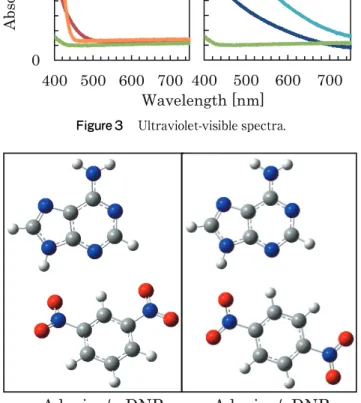
Figure2 Infrared spectra.
4
0
1
400 500 600 700 Adenine/pDNB pDNB
0 0.5 1
400 500 600 700 Adenine/mDNB mDNB
Adenine
Abs o rbance [-]
Wavelength [nm]
Adenine/mDNB Adenine/pDNB
0 100 200 300 400 500 10 [W
䡡g
-1]
Temperature [
oC]
He at Flo w [W
䡡g
-1]
mDNB pDNB Adenine Adenine/pDNB Adenine/mDNB
hypothesis was rejected because both compounds were found intact in the IR spectra even after the extraction of mixtures with benzene. No substance was found except the precursors in the IR experiments.
Figure 3 shows the ultraviolet-visible spectra indicating this result.
The absorption peak originating from mDNB in the adenine/mDNB mixture was observed to be shifted from that of the independent mDNB towards the longer wavelength region. While pDNB had a shoulder-like absorption peak around 450 nm, the peak disappeared in the adenine and pDNB mixture (adenine/pDNB) spectrum.
The change in these spectra implied the presence of interactions between adenine and DNB in the mixture changing the electronic transitions.
To further verify the interactions, ab initio quantum calculations were done for the most stable structure of the 1 : 1 complexes.
In the complex, the hydrogen atom at secondary amine was drawn by DNB. CheplG charge of the independent adenine molecular was 0. The total ChelpG charge of adenine molecule in the adenine/pDNB and adenine/
mDNB were 0.039 and 0.021, respectively. DNB decreases the electron density in adenine, and pDNB, which works
as a stronger electron acceptor than mDNB. DNB decreases the electron density in adenine, and pDNB, which works as a stronger electron acceptor than mDNB.
The quantum calculation implied that DNB and adenine interact via the secondary amine and nitro group.
3.2 Analysis of pyrolysis behavior
Figure 5 shows the DSC curves of the samples.
&(,'and
%(,'
are given in Table 1.
%23/.of mixtures was defined as the heat calculated by the summation of the heat generated from each independent molecule in the mixture containing equal moles of adenine and DNB (1 : 1). In this calculation,
%(,'of adenine was defined as 0, because adenine itself didnʼt show exothermic reaction in DSC measurement.
%23/.of the equal molar mixture was given by Equation (1). In Equation (1),
+(*&is the amount of heat generated from mDNB or pDNB. M means molecular weight ()
(*&#!$%!!,
#-./101/#!"#!!).
%,-)(# #"$!"%"$!
#"$!!#'()+*+)
(1)
The endothermic peak appearing at 86
οC in mDNB indicated the melting of the sample. pDNB showed its melting point at 170
οC.
&(,'decreased in the following order, : DNB, adenine/mDNB, and finally adenine/pDNB.
mDNB and pDNB had almost the same
&(,'. In the mixture with adenine, the isomerization of DNB affected the
&(,'.
Adenine itself did not react exothermically, but melted and decomposed around 350
οC. The exothermic reaction around 300
οC indicated that adenine contributed to the heat generation by the mixture. The contribution of the
Table1 &(,',%(,'and%23/.of each sample.
Sample &(,' %(,' %23/.
name [℃] [kJ·mol−1] [kJ·mol−1]
mDNB 390 2.7
pDNB 390 3.9
Adenine/mDNB 310 2.2 1.5
Adenine/pDNB 280 2.3 2.2
Figure3 Ultraviolet-visible spectra.
Figure4 The molecular arrangements in the optimised structures of 1 : 1 complex.
Figure5 DSC curves.
500 1000
1500 2000
2500
Abs o rbance [- ]
CO
2CO NH
3NH
3HCN CO
2Wavenumber [cm
-1]
Figure 6 Infrared spectra of pyrolysed gas Adenine/pDNB
Adenine/mDNB Adenine
500 1000 1500 2000 2500 3000 3500 4000
Abso rbance [ -]
Wavenumber [cm
-1] Adenine/pDNB
Adenine/mDNB
mDNB pDNB
DNB decomposition to the heat generation has been neither clear nor ruled out although independent DNB decomposes at higher temperature.
The
!"#!values of the adenine/pDNB and adenine/
mDNB mixtures were greater than the
!&'%$values. This result shows, however, that adenine reacted and generated heat when it constituted the mixture.
The sealed-vessel analysis provided gas and residue to reveal the decomposition mechanism. According to the analysis of the pyrolysis gas by infrared spectrometer, pyrolysis of adenine produced CO, CO
2, NH
3, and HCN.
pDNB and mDNB decomposed into CO, CO
2, and NH
3. The spectra of the adenine/pDNB and adenine/mDNB mixtures did not show the absorption peak of HCN. The chemical structure shows adenine could produce HCN although HCN was not found. The reason has not been clear while the decomposition products or polymerisation might have influenced on the disappearance.
The samples were separated from the solid residue by solvent extraction with benzene. In the products extracted from the pyrolysis residue of the adenine/
mDNB, only unreacted mDNB was detected by infrared spectrometry.
pDNB and other products were observed in the pyrolysis residue of the adenine/pDNB mixture.
According to previous studies
10),11), mDNB and pDNB release one nitro group during the triggering of the decomposition reaction and generate the same intermediate (nitrobenzene cation). The difference in the product obtained might be due to the variance of the interactions of the interactions of adenine with and
undecomposed mDNB or pDNB.
4. Conclusion
The present study focused on the effect of electrostatic interactions on the pyrolysis of mixtures of organic molecules. Equimolar mixtures of adenine and pDNB or mDNB were analysed to understand the interactions and pyrolysis behaviour. The changes in the electrostatic circumstances of molecules were detected by ultraviolet- visible spectroscopy of solid samples.
Ab initioquantum calculation showed that pDNB has higher capacity to withdraw electrons from adenine than mDNB, which led to the difference in the strength of their electrostatic interactions with adenine.
The mixtures underwent pyrolysis at lower temperature than either DNB or adenine. The temperature of the adenine/pDNB mixture was lower than that of the adenine/mDNB mixture. These results implied that stronger electrostatic interactions allows the substances to react easier. The mixtures showed a higher
!"#!
than the calculated heat generation based on the
precursors. The exothermic reaction was promoted in the mixture than in the precursor. The analysis of the pyrolysis products showed that the difference between the interaction of mDNB or pDNB with adenine affects the pyrolysis products. These results suggested that the strength of the interactions affects to the pyrolysis mechanism.
Acknowledgement
This study was funded by the 40 th Foundation for the Promotion of the Industrial Explosives Technology. The authors are grateful for the support.
Reference
1) G. Steinhauser and T. M. Klaptke, Angew. Chem. Int. Ed., 47, 33303347 (2008).
2) T. M. Klaptke, J. Stierstorfer, K. R. Tarantik, and I. D.
Thoma, Z. Anorg. Allg. Chem., 634, 27772784 (2008).
3) T. Imaidzum, Y. Sato, D. Ding and T. Yoshida, Japan explosive society, May 2425, Yokohama, Japan, 19 (2012).
4) M. Kumasaki, R. Miyasaka, H. Kiuchi, Y. Wada, M. Arai, and M. Tamura, Kayaku Gakkaishi (Sci. Tech. Energetic Materials), 62, 109116 (2001).
5) Y. Ohno, Y. Akutsu, M. Arai, M. Tamura, and T. Matsunaga, Kayaku Gakkaishi (Sci. Tech. Energetic Materials), 60, 212
219 (1999).
6) R. S. Mulliken, J. Chem. Physics., 23, 18331840 (1955).
7) K. Aoki, Y. Kobayashi, M. Arai and M. Tamura, Japan explosive society, May 1415, Tokyo, 107 (1998).
8) Japan chemical society, 5th edition Kagaku-Binran Kisohen II, 768 (2004).
9) E. K. Fukuda, and R.T. McIver Jr., J. Am. Chem. Soc., 107, 22912296 (1985).
10) E. K. Fields and S. Meyerson, J. Org. Chem., 37, 38613866 (1972).
11) G. Fayet, L. Joubert, P. Rotureau and C. Adamo, J. Phys.
Chem. A, 112, 40544059 (2008).
12) M. J. Frisch, G. W. Trucks, H. B. Schlegel, G. E. Scuseria, M.
A. Robb, J. R. Cheeseman, G. Scalmani, V. Barone, B.
Figure6 Infrared spectra of pyrolysed gas.
Figure7 Infrared spectra of extracted solid residue.
4
0
1
Mennucci, G. A. Petersson, H. Nakatsuji, M. Caricato, X. Li, H. P. Hratchian, A. F. Izmaylov, J. Bloino, G. Zheng, J. L.
Sonnenberg, M. Hada, M. Ehara, K. Toyota, R. Fukuda, J.
Hasegawa, M. Ishida, T. Nakajima, Y. Honda, O. Kitao, H.
Nakai, T. Vreven, J. A. Montgomery, Jr., J. E. Peralta, F.
Ogliaro, M. Bearpark, J. J. Heyd, E. Brothers, K. N. Kudin, V.
N. Staroverov, R. Kobayashi, J. Normand, K. Raghavachari, A. Rendell, J. C. Burant, S. S. Iyengar, J. Tomasi, M. Cossi, N.
Rega, J. M. Millam, M. Klene, J. E. Knox, J. B. Cross, V.
Bakken, C. Adamo, J. Jaramillo, R. Gomperts, R. E.
Stratmann, O. Yazyev, A. J. Austin, R. Cammi, C. Pomelli, J.
W. Ochterski, R. L. Martin, K. Morokuma, V. G. Zakrzewski, G. A. Voth, P. Salvador, J. J. Dannenberg, S. Dapprich, A. D.
Daniels, Ö. Farkas, J. B. Foresman, J. V. Ortiz, J. Cioslowski, and D. J. Fox, in Gaussian 09, Revision A.1,2009, Gaussian, Inc., Wallingford CT.
13) C. M. Berneman and K.B.Wiberg, J.Comput. Chem., 11, 361
373 (1990).
14) A. Ikehata, Bunseki 5,250 (2009).
![Figure 6 Infrared spectra of pyrolysed gasAdenine/pDNBAdenine/mDNBAdenine 5001000150020002500300035004000Absorbance [-] Wavenumber [cm -1 ]Adenine/pDNBAdenine/mDNBmDNBpDNB](https://thumb-ap.123doks.com/thumbv2/123deta/7285248.2413349/4.892.75.435.82.308/infrared-gasadenine-pdnbadenine-mdnbadenine-absorbance-wavenumber-pdnbadenine-mdnbmdnbpdnb.webp)
