1. Problématique
The 21st century has seen the rise of globalization, connecting countries and cultures across the world. Despite various different ideologies and the antagonisms that these can cause, after the 20th century, “the century of wars”, the world seems to be seeking mutual cooperation in a wide range of global concerns, such as politics, economics, health, and welfare.
In addition, as the human race has being enjoying the benefits of the technological age brought about by advanced science and technological innovation, such rich living has itself caused significant problems, such as the environmental problems arising from human-caused climate change. Regardless of these concerns, however, as human beings are bent on establishing a globally sustainable world, globalization should be perceived as a significant step forward toward a human coexistence with nature. Yet, we must not ignore the fact that there are diverse cultures and civilizations, each of which is dealing with their own climatic problems based on their own customs and lifestyles, and each of which is, therefore, between two worlds—one which retains their own identity and the other which follows globalization. However, it could be said that this diversity could be considered a key element in the maintenance of global sustainability.
Generally, however, these two worlds could be perceived to be in conflict. The problem which confronts us is the maintenance of these diverse identities while promoting globalization worldwide, which could be considered an antithesis to such diversity. However, questions arise regarding why it is necessary or important to maintain diversity in the face of globalization and how these two directions could be perceived to be congruent. One solution is to increase the dialogue between the various civilizations and cultures. Modern civilization has developed, in a sense, under the influence of the modern European mind. It is certainly true that there have been some advances in the United States in and after the 20th century, but modern civilization was founded essentially on post 17th century European modern philosophy. Therefore, we can say that globalization has developed under a type of Eurocentrism.
For example, Japan, through the two restoration periods at the beginning of the Meiji era and at the end of the World War II, was influenced by European and American thinking when seeking to modernize. This can be especially seen at the beginning of Meiji era when the Japanese abandoned their traditional way of life through the discontinuance of their beliefs in the Samurai spirit and culture. Therefore, modern Japanese, while maintaining their traditional consciousness deeply hidden, attempted to embrace the European (or occidental) spirit and sense of values and consequently, formed a modern Japanese society influenced by the Occident. With this background in mind, this study seeks to examine the concept of a “Civilization Dialogue” in relation to Japan and Europe, from a “human and society” or “natural environment” perspective. Such a collaboration can lead to a reexamination of the features of the civilizations in each region and simultaneously, enable us to clarify the meaning and the raison dʼêtre for the influence of European civilization on Japanese society. We hope that this discussion can also make us rethink about the dualities inherent in globalization and the maintenance of diversity for a sustainable world.
Based on such a background, we, Tokai University Institute of Civilization Research, have been engaged in research on various aspects of human civilizations. Human civilizations should be considered a result of human activities. Therefore, it is of great significance to investigate and discuss the civilization that existed and also investigate the changes that have occurred and are expected to occur from the past to the present and even to the future, as this could provide us the opportunity to predict the features of a future society. However, such research
「文明」No.20, 2015 5-10
A Note on the Possibility of a “Civilization Dialogue”:
From a Trans-Disciplinary Humanities Perspective
Yoichi Hirano
Tokai Universityis quite difficult to realize, as the study of civilizations encompasses a wide range of disciplines, which need to be synthesized toward a common focus. One way to proceed with such a review is to assume a “Trans-Disciplinary Humanities” perspective.
From this perspective, by providing concrete and theoretical examples, we can discuss how a Civilization Dialogue can be used as a tool to enable the coexistence of cultural diversity and globalization and ensure the future sustainability of our world.
2. Development of the Sciences and Eurocentrism1
As mentioned above, most of present civilizations have developed under Eurocentrism. Modern science and technology supported such a development after the rise of the Scientific Revolution (in the 17th century) and the Industrial Revolution (in the 18th century), both of which were focused on modern scientific development and thinking in Europe and led to the rise of modern European thinking. Especially, as a result of a fusion of Descartesʼ mechanics and Newtonʼs natural philosophy, reductionist thinking arose, which allowed for the development of modern scientific logic and deductive rationality, from which all of todayʼs modern science and technologies have developed.
Recently, however, there has been an increasing interest in research on ethnoscience as a method for understanding the various aspects of science. Ethnoscience is a discipline which recognizes how “science” relates to each region in relation to the existing culture and the respective civilization. Such research on this relationship between science and the culture in each region is important for the identification of different modes of thought that have led to the development of different forms of science. This approach also needs to include research from an epistemological viewpoint.
Let us think about the history of the sciences. Scientific historians seek to discuss and examine the various aspects of scientific theories, the scientistsʼ ideas, and even the sciences existing in life and culture. Naturally, most scientific historians consider that the chief aim is to analyze and to clarify the theoretical developments underlying scientific developments, as such research can be useful for the historians themselves and even for the scientists.
However, we need to reflect on what type of science history would be meaningful to all people. All that human beings have built should be considered a civilization, and therefore, the sciences, which are a product of human wisdom, must also be a type of civilization. When we consider the sciences to be a key element in understanding our modern civilization, we need to understand the role they play in an integrated multicultural society, which also requires the recognition of the influence of culture, life-styles, and technology. Therefore, in addition to a synthetic perspective, to seek an answer to the question raised above, research from an ethnoscientific perspective is important as this allows us to thoroughly investigate the history of the sciences.
One of the most typical examples is the development of mathematics. Nowadays, mathematics is considered to be universal, which was a result of the way Descartes developed mathematics in the 17th century—as a universal conceptual system. Today, all people across the world share almost the same mathematics, and globalization has been very important in further developing our scientific and technological civilizations. However, when thinking about the historical development of mathematics in general, universality has not always been the aim. When we look at mathematics from a macroscopic perspective, for example, there have been three typical periods of abstraction: ancient Greece, the 17th century, and the 19th century. This gives us a very simple picture to understand; as such historical developments can be seen to be Eurocentric, the modern-day mathematics has primarily developed around Europe.
After the Scientific Revolution, the human thinking framework has maintained a certain universality based on the “new scientific thinking” of the 17th century; thus, even today, we can find the features in the extensions to this thinking that were realized throughout the 18th century. Mathematics as well as the other sciences have
evolved in each period in each community, but generally speaking, this has been an internal theoretical evolution which has not strongly affected the way of thinking, which has remained essentially unchanged. In other words, under Eurocentrism, the basic structure of mathematics has not greatly changed or reformed since the scientific revolution.
Why is mathematics considered a universal discipline? Naturally, this kind of mathematics is convenient for mathematicians and scientists but not always so comprehensible to the public. Despite the fact that mathematics became increasingly complex over time in each culture and civilization, we generally perceive mathematics to be a conceptual discipline which has developed through a reduction in concrete human–cultural considerations by rearranging the remaining conceptual parts into a logical, concise system. In brief, the universal mathematics formed under Eurocentrism has lost those features related to human life and cultures.
Such a discussion can also be applied to all sciences and even to all civilizations. It is certainly important to develop universal sciences today. Universality can provide a wider and more general knowledge. However, when we think of the significance of the sciences in relation to human activities, to employ them in our daily lives, we find ourselves struggling with many factors, such as the historical process in the development of the sciences in each community and cultural understandings regarding nature and its various phenomena. Such an approach demands that we consider a variety of perspectives as each community has as an integrated system with multicultural dimensions. Finally, a synthesis of these perspectives becomes necessary and important, and it is at this point that using a Trans-Disciplinary Humanities approach is useful.
3. Diversity of culture and civilization2
Why is the maintenance of diverse cultures and civilizations necessary and important? To answer this question, first, we should discuss what is meant by culture and civilization.
Theoretically, the following proposition is set as a hypothesis about human activity and culture:
Prop. I Culture (and also Civilization) is fundamentally a result of a confrontation with nature.
If it is postulated that a communityʼs culture develops from its activities (their thoughts and behaviors) and that these activities are fundamentally generated from a relationship with nature, then the proposition is considered to be true. Whenever people are confronted with nature, all clothing, food, and housing come from “a desire for living”, and the activities are oriented by such a desire.
Then, what is the nature that the communities are confronted with in the process of the formation of their culture and civilization? Here, we cannot deny the existence of science, even if this science is based on indigenous knowledge. Scientific investigations certainly elucidate the various aspects of nature. However, science can only clarify the part of nature that people are able to perceive or comprehend; thus, it does not encompass the whole concept of nature. Therefore, people form cultures by confronting the part of nature they understand and can use.
With this consideration, proposition I should be rewritten as proposition II:
Prop. II The culture of a community is fundamentally the result of a confrontation with the part of nature that the community can perceive.
In specific, this indicates that there might be some parts of nature which human beings have not yet perceived or are unable to perceive or comprehend.
On the other hand, culture and civilization are considered a domain within which human activities occur and
which corresponds with that part of nature that the community has the ability to grasp—a mapping from the domain onto nature (Fig.1). Therefore, culture and civilization correspond with the part of nature projected by human activities. Here, the following proposition is presented:
Prop. III Culture corresponds with the part of nature that is projected by human activities.
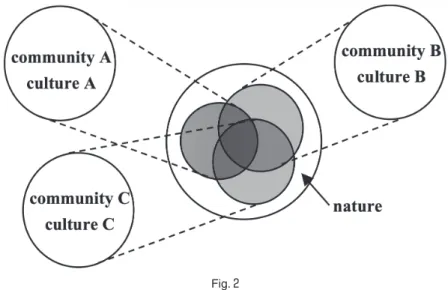
Since different communities can form distinctive cultures through the same process, the culture and civilization of each community would have a different projection of the mapping onto nature, which may not always be in accord, even though they may have some intersections (Fig.2).
Fig. 2 implies that different communities form and have their own different cultures and civilizations by using or understanding different parts of nature, and it is here that the structure of cultural diversity can be found.
By understanding that each community is confronted with its own part of nature and that each community is involved in different human activities, we can observe that cultural diversity can be defined from the perspective of the relationship between human activities and nature. Simultaneously, these activities are supported by the indigenous knowledge stored historically through their experiences, in other words, the community “science.” From this perspective, a set of communities or cultures in the figures can be substituted with a science set. Finally, these different indigenous “sciences,” generated by the confrontation with nature, are projected into different parts of nature. Or we can say, in other words, that the boundary of the part of nature could be determined by the indigenous “science” of each community.
Then, of these sets projected by the different “sciences,” which set is the most extensive and influential? The
Fig. 2 Fig. 1
major set would be a projection of the modern science developed under Eurocentrism, but there is also a minor set.
This minor set is divided into two parts: one which intersects with a part of the major set and the other which is outside the major set. The former belongs to modern universal science as a conceptual discipline with a logical and concise system, but the latter is a concrete human-culture part, which has been isolated from a universal development process (Fig.3).
However, in each community, people attempt to connect their knowledge to their “science” when reacting to the diverse natural environment, even if this science is indigenous. A communityʼs “science” is the result of wisdom gathered from the continual confrontation with nature. Therefore, it cannot be denied that in the minor set, there are some elements which enable us to understand more about nature to sustain our natural environment for the future. Thus, we should be prudent before rejecting these indigenous “sciences.”
Through the discussion, the importance of the “Civilization Dialogue” has been highlighted. Modern civilization is a set in which various kinds of human wisdom coexist. Therefore, to maintain global sustainability, humankind has to maintain this diversity along with the universality through a “Civilization Dialogue.”
4. Further discussion
Finally, we raise another related issue. Throughout this article, we have discussed the possibility of a “Civilization Dialogue” by indicating the problems between “indigenous knowledge and universal science” and “globalization and diversity.” The question is which kind of dialogue allows us to best understand our culture and civilization?
The first example we discuss here is Wasan3. Wasan is a mathematical system that developed outside any western influences in Japan in the Edo era (from the 17th century until 19th century). It comprised various theoretical developments, many of which were similar to developments in European mathematics. For example, Seki Takakazu and his disciple, Takebe Katahiro (18th century), both attempted to calculate the numerical value of Pi (π), and their results were considered to be equivalent to the European mathematics of that time. However, Wasan was different from European mathematics in that it lacked logic and demonstration, though complex techniques were developed to solve complex community problems.
Wasan did not develop under academia and was considered a type of art or technique rather than a discipline.
The results obtained by each mentor were passed down to initiated disciples as secrets of the art. Generally, Wasan was a type of mathematics developed to deal with the simple and complex problems related to everyday life and culture in those days. However, Wasan seems to be considered an antithesis to European mathematics. To analyze Wasan, we need to have two kinds of dialogues: one between European mathematics and the historically regional mathematics and the other between mathematics and human daily activities.
Fig. 3
From a perspective of the universality of mathematics under eurocentrism, Wasan is certainly of only ethnological interest. However, such ethnologies can also be found in the development of European mathematics, as in the second example of Galois, who introduced the notion of groups4. When Galois presented his ideas, why were they not understood by many French mathematicians but were understood by German mathematicians? Was this because of the differences in the attitude toward mathematics research, the educational subjects at universities, or the regional technological needs? This can be perceived to be a problem related to the concept of Ethnomathematics;
as such a problem can be clarified by examining the needs of the communities at that time. Inevitably, there was the need for a dialogue which gave rise to the mathematics developed in each community.
Thinking of these two examples, the point at issue is not only scientific but also encompasses peopleʼs thinking, the social systems under which they were raised, and the historical traditions that pervade communities. Therefore, this problem is concerned with an understanding of human culture and civilization. To discuss such a problem, a synchronic perspective is required. We have to discuss the meaning and the style of mathematics expected and needed in each community through an analysis of the situation in each community. For such a study, various perspectives are needed from a wide range of disciplines, such as history, philosophy, art, religion, epistemology, science, and technology. This is why a true and deep analysis requires a synthesis of diverse disciplines, a field of study we have named Trans-Disciplinary Humanities.
We, Tokai University Institute of Civilization Research, believe that the “Civilization Dialogue” is of great merit and importance. Through such a “Civilization Dialogue,” we can foster mutual understanding and learn to use the diversity of human culture and civilization. Such activities would enable us to find the sustainable path that guarantees the future of mankind
Notes
1) This subject was discussed in the following article and is rearranged here with some revise and expansion:
Hirano, Y.: Note on Ethnomathematics from the viewpoints of the History of Mathematics, Proceeding of the International Conference on Mathematics Education, History of Mathematics, Cultural History of Mathematics, informatics, and Learning Disabilities, Beijing Academy of Educational Sciences, 2000, pp.127-132.
2) This subject was discussed in the following article and is rearranged here with some revision and expansion about scientific development and cultural diversity:
Takatori, Y. and Hirano, Y.: Why should Linguistic and Cultural Diversity be important? “BUNMEI”, Tokai University Institute of Civilization Research, No.19 (2014), pp.23-34.
3) Cf. see the following article:
Hirano, Y.:『Trans-Disciplineから見た科学・数学』, “BUNMEI”, Tokai University Institute of Civilization Research, No.7 (2006), pp.52-59 (in Japanese).
4) This subject was first discussed in the following article:
Hirano, Y.: Note sur les diffsions de la théorie de Galois – Première clarification des idées de Galois par Liouville -, Historia Scientiarum, The History of Science Society of Japan, 27 (1984), pp.27-41.