STOCHASTIC GRADIENT VARIATIONAL BAYES FOR DEEP LEARNING-BASED ASR Andros Tjandra 1 , Sakriani Sakti 2 , Satoshi Nakamura 2 , Mirna Adriani 1
1 Faculty of Computer Science, Universitas Indonesia, Indonesia
2 Graduate School of Information Science, Nara Institute of Science and Technology, Japan
[email protected], [email protected], {ssakti,s-nakamura}@is.naist.jp
ABSTRACT
Many successful methods for training deep neural networks (DNN) rely on an unsupervised pretraining algorithm. It is particularly effective when the number of labeled training samples is not large enough, because pretraining method helps to initialize the parameter values in the appropriate range near a local good minimum, for further discriminative finetuning. However, while the improvement is impressive, training DNN is difficult because the objective function of DNN is highly non-convex function of the parameters. To avoid placing the parameter that generalizes poorly, a robust generative modelling is necessary. This paper explore an al- ternative of generative modelling for pretraining DNN-based acoustic modelling using Stochastic Gradient Variational Bayes (SGVB) within autoencoder framework called Varia- tional Bayes Autoencoder (VBAE). It performs an efficient approximate inference and learning with directed proba- bilistic graphical models. During fine-tuning, probabilistic encoder parameters with latent variable components are then used in discriminative training for acoustic model. Here, we investigate the performances of DNN-based acoustic model using the proposed pretrained VBAE in comparison with widely used pretraining algorithms like Restricted Boltz- mann Machine (RBM) and Stacked Denoising Autoencoder (SDAE). The results reveal that VBAE pretraining with Gaus- sian latent variables gave the best performance.
Index Terms— acoustic model, deep neural network, variational bayes, autoencoder
1. INTRODUCTION
Automatic Speech Recognition (ASR) has changed dramat- ically in recent years. Previously, the standard ASR frame- work used Hidden Markov Model (HMM) to model the speech state transition/sequence [1] and Gaussian Mixture Model (GMM) to model each acoustic state on HMM from speech features [2]. GMMs hold such advantages as being easily fit into data using EM algorithms (especially with diag- onal covariance matrix) and if they have enough parameters, they can approximate any distribution very well. However, GMMs also have disadvantages which is statistically ineffi-
cient for modelling highly correlated data due to the indepen- dent assumption of diagonal covariance. Furthermore, EM algorithms for GMM often suffer from overfitting when the component number is not adequate with the data amount.
Various state-of-the-art performances produced by deep learning have revitalized the use of various kinds of neural network architecture in ASR. A Deep Neural Network (DNN) based ASR has gained popularity in recent years, driven by bigger performance improvements than such to the previous common methods like GMM/HMM [3]. As DNNs are less sensitive to data correlation and the increase in the input di- mensionality than GMMs, they allow us to exploit complex data features [4]. Many successful methods for training DNN rely on an unsupervised pretraining algorithm. It is particu- larly effective when the number of labeled training samples is not large enough, because pretraining method helps to initial- ize the parameter values in the appropriate range near a local good minimum, for further discriminative finetuning.
Therefore, the resurgence of deep learning also made
generative modelling for pretraining deep neural network ar-
chitecture become interesting topic to be explored. The major
motivations behind generative pretraining is that if we have
the good representation for modelling our data, then those
representation should also be good for modelling probabil-
ity class given those data [5]. There are several generative
model which based on neural network and can be extended
for deep neural network architecture. For example, Restricted
Boltzmann Machine (RBM) [6] is an undirected graphical
model with a form of Markov Random Field (MRF). Later,
Deep Boltzmann Machine (DBM) [7] was invented with
deeper model compared standard RBM and resulting better
performance. But the main disadvantages from undirected
graphical model such as RBM and DBM still exists where
the exact parameter estimation is intractable and need to be
approximate. Another approach for pretraining use autoen-
coder architecture called Stacked Denoising Autoencoder
(SDAE) [8] trained by injecting some noise into input layer
and minimize the reconstruction error against the clean in-
put to help the model give better performance and robust
under the corruption of input and unseen data. However,
using reconstruction error is not enough for learning useful
representation [9].
This paper explore an alternative of generative mod- elling for pretraining DNN-based acoustic modelling using Stochastic Gradient Variational Bayes (SGVB) [10] within autoencoder framework called Variational Bayes Autoen- coder (VBAE). It perform an efficient approximate infer- ence and learning with directed probabilistic models. VBAE objectives contained a regularization term, therefore regu- larization hyper-parameter from autoencoder model such as denoising and sparsity is not necessary anymore. During fine-tuning, probabilistic encoder parameters with latent vari- able components are then used in discriminative training for acoustic model. We compare the results with other widely used unsupervised pretraining algorithms for DNN, such as RBM and SDAE and purely supervised DNN-ReLU with dropout regularization.
2. RELATED WORKS
Using a Bayesian framework, we involve the prior distribu- tion over the parameters of the component distributions. By conditioning on the observed data, the posterior distribution over the component parameters will find the best general- ization over all possible values. However, true posterior distribution is intractable and we need an efficient approach for approximate the true posterior. As an alternative, the Vari- ational Bayesian (VB) method for training GMMs acoustic model [11] and incorporated for model selection [12, 13]
was explored for speech recognition. Compared with classic EMs for training GMMs, VB estimation provides information about the model quality during training and is less affected by overfitting because of the regularization from integrating priors.
Variational inference was first considered for neural net- work by Alex Graves [14] as an optimization of the Mini- mum Description Length (MDL) [15] loss function to opti- mize the prediction accuracy and the model complexity at the same time. This study perform Bayesian inference on neural network which estimates directly the posterior distribution of the network weights given the observed data. Therefore, the weights from neural networks have a prior probability which acts as regularization from a variational perspective.
Recently, SGVB was proposed to learn generative model with latent variables using neural network [10]. It combine both concepts of variational inference and neural network into a single framework. Since it consists of probabilistic encoder and decoder for approximate the latent variable distribution, this model was known as VBAE. It has been explored for modelling image transformation, in which SGVB was applied to CNN architecture, and the model learns an interpretable representation of images with respect to rotation and lighting variations [16]. In addition to a generative model, SGVB can also be used for semi-supervised learning [17] using the vari- ational autoencoder to generate latent variables as features for a classifier or by jointly modelling datasets with class and la-
tent variables as a generative model.
To the best of our knowledge, SGVB-VBAE has not been explored for ASR tasks. In this preliminary study, however, instead of applying VBAE directly as feature generator, we attempt to utilize it for pretraining DNN-based acoustic mod- elling. This way we could learn a good representation for modelling our data and those representation can be integrated for discriminative task in ASR.
3. VARIATIONAL BAYES AUTOENCODER FOR GENERATIVE MODEL
Variational Bayes Autoencoder (VBAE) is an alternative for performing efficient approximate inference and learning with directed probabilistic models [10]. With Stochastic Gra- dient Variational Bayes (SGVB) algorithm, the parameters for approximate posterior was effectively learned end-to-end without using such an expensive sampling method as Markov Chain Monte Carlo (MCMC). Typically, we have dataset X = {x
(i)}
Ni=1with N samples where x
i∈ R
D, which are observable variables. We assume the data are generated under some random process involving by a latent continuous random variable z. Value z
(i)which corresponds to data x
(i), is generated from prior distribution p
θ∗(z), and value x
(i)is generated from conditional distribution p
θ∗(x|z). To simplify the problem, we assume prior p
θ∗(z) and likelihood p
θ∗(x|z) come from the parametric families of distribution p
θ(z) and p
θ(x|z) whose PDFs can be optimised w.r.t. both parameter θ and variable z. However, true parameters θ
∗and latent variables z
(i)need to be approximated. Sev- eral limitations such as the intractability of the integral of the marginal likelihood towards all possible latent z values p
θ(x) = R
p
θ(x|z)p
θ(z)dz and sampling based solutions like Monte Carlo would be too slow for large datasets.
To overcome these limitation, we used approximate distri- bution q(z|x) for modelling true posterior p
θ(z|x). In VBAE, neural network was used for approximate distribution q(z|x) and called as a probabilistic encoder. In a similar term as probabilistic encoder, the value z would be used for recon- struct input with conditional distribution p
θ(x|z) as a prob- abilistic decoder. Using same approach as probabilistic en- coder above, p
θ(x|z) computed from z by using a neural net- work.
The marginal likelihood from individual datapoints can be represented by the sum of the log marginal likelihood:
log p
θ(x
(1), ..., x
(N)) =
N
X
i=1
log p
θ(x
(i)), (1)
and the marginal likelihood for each datapoint x
(i)can be
simplified into two terms:
log p
θ(x
(i)) =
D
KL(q
φ(z|x
(i))||p
θ(z|x
(i))) + L
θ, φ; x
(i), (2) where the left term is written as the KL-divergence between the approximate and true posterior distributions and is non- negative and the right term denotes the variational lower bound to the marginal likelihood, which can be expanded
log p
θ(x
(i)) ≥ L(θ, φ; x
(i))
= E
qφ(z|x)[− log q
φ(z|x) + log p
θ(x, z)]
= −D
KL(q
φ(z|x
(i))||p
θ(z)) + E
qφ(z|x(i))h
log p
θ(x
(i)|z) i .
(3)
By maximizing lower bound L(θ, φ; x
(i)) w.r.t parameters θ and φ, we can build good approximation for our dataset log p(x
(i)). In VBAE, the approximate posterior (probabilis- tic encoder) q
φ(z|x) represented by a DNN. For example, if we are using approximate Gaussian with diagonal covariance q
θ(z|x
(i)) = N (z; µ
(i), σ
2(i)I), mean µ
(i)and s.d. σ
(i)are outputs from DNN.
4. UTILIZING VBAE FOR ACOUSTIC MODELS Standard dataset D = {x
(i), y
(i)}
Ni=0consists of a pair of context window of consecutive feature vectors and acous- tic labels/states. First, we do unsupervised training for the VBAE to maximize marginal likelihood log p
θ(x). The fea- ture vectors are usually represented by the transformed speech signals by standard feature extraction for acoustic features like MFCC, Fourier-based filterbank and fMLLR. Those fea- ture extractions output real values. In this case, we must reparametrize our probabilistic decoder to output Gaussian parameters such as vector of mean µ
decand diagonal s.d σ
dec:
log p(x|z) = log N (x; µ
dec, σ
2decI) (4) µ
dec= f
linear(W
µdech
2+ b
µdec)
log σ
dec= f
linear(W
σdech
2+ b
σdec) h
2= f
tanh(W
h2z + b
h2).
With same approach as the probabilistic decoder, the proba- bilistic encoder parameters can be computed by DNN from z
i. We use Gaussian distribution to approximate posterior distri- bution q
φ(z|x), so we need to reparameterize the probabilistic encoder to output Gaussian parameters µ
encand σ
enc:
z = µ
enc+ σ
encwhere ∼ N (0, I) (5) µ
enc= f
linear(W
µench
1+ b
µenc)
log σ
enc= f
linear(W
σench
1+ b
σenc) h
1= f
tanh(W
h1x + b
h1).
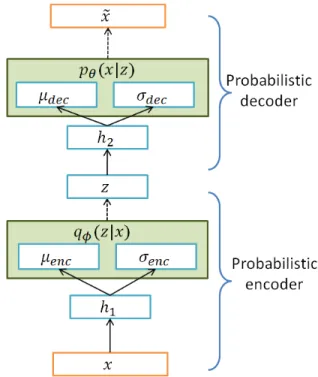
Fig. 1 show the architecture of Gaussian VBAE probabilistic encoder and decoder.
After determining which approximate distribution that we will use to model latent variable z (in this case Gaussian dis- tribution), we can rewrite Eq. 3:
L(θ, φ; x
(i)) = 1
2
J
X
j=1
(1 + log((σ
(i)enc j)
2) − (µ
(i)enc j)
2− (σ
(i)enc j)
2)
+ 1 L
L
X
l=1
− log σ
(i,l)dec√
2π
−
x
(i)− µ
(i,l)dec22σ
(i,l)dec2
. (6) To optimize Eq. 6 w.r.t. probabilistic encoder and decoder
Fig. 1. For generative modelling acoustic features, VBAE uses a Gaussian probabilistic encoder and decoder because the speech features represented by continuous real number. In a probabilistic encoder, we conditionally sample z ∼ q
φ(z|x) from Gaussian distribution with µ
encand σ
enc. The z value passed through probabilistic decoder, and we conditionally sample ˜ x ∼ p
θ(x|z) from Gaussian distribution with µ
decand σ
dec.
parameters, we can use a stochastic gradient method, such
as SGD, Adagrad [18] and Adadelta [19]. In practice, our
experiment use Adagrad for optimizing the VBAE parame-
ters. After several iterations and when marginal log likeli-
hood log p(x) has converged or stabilized, we can use either
the latent variable z from q(z|x) which conditionally sampled from µ
encand σ
encas features for a classifier or integrating the entire probabilistic encoder with pretrained parameter and add another DNN with softmax layer on the top of µ
encand σ
enc. Fig. 2 illustrates how we constructed a discriminative DNN using VBAE’s pretrained probabilistic encoder for ex- tracting latent variable and end-to-end fine-tuning from the negative log-likelihood loss function from the softmax layer.
This stage which is usually called as discriminative finetun- ing, is generally done for classification tasks by several un- supervised pretraining algorithms such as RBM and SDAE.
Fig. 2. We constructed discriminative DNN to output acoustic state probability by removing the probabilistic decoder from VBAE and put randomly initialized hidden and softmax lay- ers. µ
encand σ
encare connected into randomly initialized hidden layer with softmax layer on the top of the neural net- work and optimized for acoustic modelling task
5. EXPERIMENTAL SETUP 5.1. Dataset
All the phoneme recognition experiments were performed on the TIMIT corpus dataset
1. All the SA records were removed from the experiment. The training set contains 3696 sentences from 462 speakers. Development set was taken from another 50 sets of speakers. Evaluation was done by evaluating our model into core test set that consisted of 192 sentences from 24 different speakers.
1