日本機械学会2001年度 年次大会(2001.8.27-30)
多目的最適化問題のための多目的GAと単一目的GAの分散協力型モデル
Distributed Cooperation model of MOGA and SGA for Multiobjective Optimization Problems
正 廣安 知之( 同志社大工) 正 三木 光範( 同志社大工)
○学 奥田 環( 同志社大院) 学 渡邉 真也( 同志社大院)
Mitsunori MIKI, Doshisha University, Tatara Miyakodani 1-3, Kyo-Tanabe, Kyoto Tomoyuki HIROYASU, Doshisha University, [email protected]
Tamaki OKUDA, Graduate School of Engineering, Doshisha University Shinya WATANABE, Graduate School of Engineering, Doshisha University
In this paper, a new algorithm of Genetic Algorithm for Multi objective Optimization Problems, called Dis- tributed Cooperation model of MOGA (DCMOGA), is proposed. In the proposed algorithm, there are some sub populations. One of them is finding a Pareto optimum set and the other is finding an optimum solution of one of objectives. These sub populations sometimes exchange their searching information respectively. The proposed algorithm is applied to three types of knapsack test problems. Comparing to the conventional multi objective optimization methods, the proposed model found the good and widespread Pareto solutions.
Key word: Multiobjective Optimization Problems, Evolutionary Computation, Genetic Algorithms,
1
多目的遺伝的アルゴリズム
一般に,多目的最適化問題は下記のように定式化でき る.すなわち次式で表せる制約条件
gi(x)≤0 (1,2, . . . , m) (1)
を満足し ,複数の目的関数fi(x)が
min[f1(x), f2(x), . . . , fn(x)] (2)
となるような設計変数X ∈ Fを求める問題
多目的最適化問題においては,目的関数間にトレード オフの関係がある場合,唯一の最適解を得ることは難し く,パレート最適解集合を探索することが一つの目標と なる.
近年,多目的最適化問題に遺伝的アルゴリズム(Genetic Algrithms: GA)を適用する,多目的GAに関する研究 が数多く行われている1,2) .その理由は,GAが多点探 索であり,一度の探索でパレート解集合が求まることに ある.
一般的に多目的GAでは,解の優劣関係に基づいてラ ンクを定めるパレートランキング法を用い,多目的性を 明示的に扱いながら,パレート 解の探索を行う.多目的 GAにおいて,得られた解が解空間上の広範囲かつ真のパ レート解付近に求まっていることは最も重要な要素とい える.しかし ,目的関数空間が大きくなるにつれて,こ のようなパレート最適解を求めることが困難になる.
2
分散協力型モデル
前節の問題に対して本研究では,明示的な解の広がりを 持ったパレート最適解の探索を目的とし,各目的関数の最 適値の探索とパレートフロントの前進を同時に行う多目 的GAと単一目的GAの分散協力型モデル(Distributed
Cooperation model of MOGA and SGA:DCMOGA)の 提案を行う.
DCMOGA で は 多 目 的 GA を 行 う 従 来 の 個 体 群
(MOGA個体群)と,各目的間数における最適解を探索 する個体群(SGA個体群)を用いてパレート最適解の探 索を行う.すなわち,目的関数数+1の個体群が存在する.
まず,それぞれの個体群が独立して探索を行う.一定 の評価計算回数後,SGA個体群とMOGA個体群は個体 情報を送受信し ,この操作を移住と呼ぶ.移住では,目 的関数Fiの探索を行うSGA個体群が,個体群内の最適 解ISをMOGA個体群に送信し ,MOGA個体群は,群 内でFiの最良値を持つ最適解IM を送信する.この際,
目的関数FiのISの値がIM よりも優る場合,Fiを探索 するSGA個体群における次回の移住までの評価計算回 数を減少させ,MOGA個体群の評価計算回数を増加させ る.この操作はすべてのSGA個体群とMOGA個体群間 で行う.これにより,解探索が進んでいない個体群の評 価回数が増加し ,他個体群の評価回数が減少する.本手 法の2目的の場合の概念図を図 1に示す.
Migration Migration
Simple GA Poplation Set
Simple GA Poplation Set
Multiobjective GA Population Set
図1: DCMOGA
DCMOGAは並列処理に拡張可能である.しかしなが
ら,上記のアルゴ リズムでは,移住を行う際に同期をとる 必要がある.各個体群の移住までの評価計算回数は毎回 25
日本機械学会2001年度 年次大会(2001.8.27-30)
変化し,評価計算回数,評価計算時間は各個体群によって 異なるため,ロード バランスが悪いという問題が生じる.
そこで,評価計算回数を変化させるのではなく,MOGA 個体群やSGA個体群をそれぞれ複数個用意し,個体群の 役割を変化させる,つまり,MOGA個体群がSGA個体 群に変化する.またはその逆の変化をするようなモデル を使用する必要がある.
3
数値実験
本研究では,提案するDCMOGAを実際に幾つかの対 象問題に適用し ,従来手法との比較を通じてDCMOGA の有効性の検証を行う.従来の手法として,パレートラン キング法に,パレート 保存戦略を組み合わせたもの( 以 下: MOGA)を用いる.対象問題には,多目的0/1ナッ プサック問題を用いている3) .この問題は,重さと利益 を持つ荷物のセットから利益が最大になる荷物の組み合 わせを求める問題である.本研究では,荷物数の異なる3 つの問題を対象とし ,荷物数が増加するに従って問題の 難易度も増す.
3.1 GAパラメータ
数値計算で使用したそれぞれの手法におけるGAパラ メータを表 1に示す.
表1: Used Parameter in Knapsack Ploblems
MOGA DCMOGA
SGA MOGA Population Size 200 4 200
Crossover Rate 1.0
Mutation Rate 0.01 1/L 0.01 L:染色体長
3.2 数値実験結果
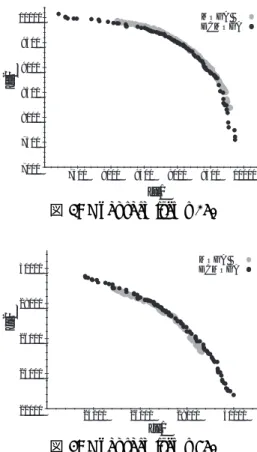
10試行の内,最も平均的と思われるパレート最適解集 合のプロット図を図 2,図 3,図 4に示す.得られた結 果は以下の通りである.
3000 3200 3400 3600 3800 4000 4200 4400
fx2
3200 3400 3600 3800 4000 4200 4400
fx1
MOGA DCMOGA
図2: Knapsack items 100
7000 7500 8000 8500 9000 9500 10000
fx2
7500 8000 8500 9000 9500 10000
fx1
MOGA DCMOGA
図3: Knapsack items 250
22000 24000 26000 28000 30000
fx2
24000 26000 28000 30000
fx1
MOGA DCMOGA
図4: Knapsack items 750
• DCMOGAがより広範囲に分布するパレート最適解
を得られている.
• 特に,1つの目的関数値が良い( パレート 解集合の 両端)パレート解が求まっている.
• 対象問題が難易度が増加しても,広範囲に分布する パレート最適解を得られている.
• 対象問題が容易な場合には,MOGAでも幅広く分布 するパレート最適解が得られた.
• 両手法において精度は,ほぼ同等である.
このように提案したDCMOGAは,従来型のMOGA と比較して非常に優れたモデルである.
参考文献
1) 廣安知之,三木光範,渡邉真也. 領域分割型多目的遺伝 的アルゴ リズム. 情報処理学会論文誌, Vol. 41, . 2) J. D. Schaffer. Multiple objective optimization with
vector evaluated genetic algorithms. In Proceedings of 1st International Conference on Genetic Algo- rithms and Their Applications, pp. 93–100, 1985.
3) E. Zitzler and L. Thiele. Multiobjective evolution- ary algorithms: A comparative case study and the strength pareto approach. IEEE Transactions on Evolutionary Computation, Vol. 3, No. 4, pp. 257–
271, 1999.
26