
講義の概要
• 概要編
• ディープラーニング概要
• 自然言語処理におけるニューラルネットワークの分類
• 技術編
• ニューラルネットワーク技術詳細
ディープラーニングとは?
• 機械学習の一分野
機械学習(
Machine Learning)
機械学習
101 (教師あり学習)
事例からの学習
4Dog
Not dog
…
学習
𝑓 image
→ {Dog, Not dog}
訓練データ (正解)
学習結果
ディープラーニングとは
à深い階層を持
つ人工ニューラルネットワークの学習
Q: XXサービスを
𝑾
𝑾
𝑾
𝑾
𝑾
𝑾
𝑾
𝑾
Dog or not
A B C
𝑾
新規 解約
音声認識
画像認識
質問分類
𝑾
𝑾
𝑾
ニューラルネットの表現能力
•
2次元入力、4隠れ変数の例à4本の直線で2次元空間を分割
àパラメータ数に対して指数的な領域を表現可能
6
ディープラーニングの工学的な
利点
• これまでの機械学習の課題
: 入力の表現方法
• ベクトル表現する方法(特徴抽出)をうまく選ぶ必要がある
• データごとに特徴抽出のパラメータをチューニングする必要性
à特徴抽出のチューニング次第で精度は大きく異なる
• 代表的な特徴抽出手法
• 画像: SIFT, HoG, Textons, Spin image, RIFT, GLOH, …
• 音声: Spectrogram, MFCC, Flux, ZCR, Rolloff, …
• テキスト: TF/IDF, N-gram, POS Tagging, Syntactic/Semantic parsing, …
• 利点
: タスク解決と特徴抽出の同時学習
• 素の入力形式(
RGB, Sound wave, Character sequence, etc.)
• タスクを解くために必要な特徴量抽出も同時学習
• 特徴抽出個別のチューニングがニューラルネットのチューニングと一体化
学習された階層的な特徴抽出(画
像)
上層になるほど抽象的な特徴が学習されている
• 図は
M.D. Zeiler, R. Fergus, “Visualizing and
Understanding Convolutional Networks” ECCV 2014
より引用
8隠れ層
1
(エッジ)
隠れ層
(コーナー、等高線)
2
隠れ層
3
(パーツ)
出
力
画
像
ラ
ベ
ル
入力画像
なぜ今ディープラーニングなのか
• 大規模データの出現
大規模正解付き画像データセット
ImageNet
•
1400万枚のラベルつきデータ
•
ImageNet Large-scale Visual Recognition Challenge
•
ImageNetの一部のデータ(1000クラス・120万枚)
•
http://www.image-net.org/challenges/LSVRC/
• 写真は
http://www.image-net.org/
より引用
10Avocado
Horse
大規模書き起し音声データ
データセット
タイプ
時間
話者
WSJ
読み上げ
80
280
Swithboard
会話
300
4000
Fisher
会話
2000
23000
Baidu
読み上げ
5000
9600
音声検索
5780
N/A
Youtube
1400
N/A
表の数値は以下の論文より引用
http://arxiv.org/pdf/1412.5567v2.pdf
コンシューマサービスを通して生成
される膨大なデータが訓練データと
しても利用可能に
12訓練データ
クリックログ
,
修正ログ
, etc.
高速計算モジュールのコモディティ
化により大規模なニューラルネット
ワークの学習が可能に
• 図は
http://on-
demand.gputechconf.com/gtc/2015/presentation/S5818-Keynote-Andrew-Ng.pdf
より引用
ディープラーニングの学習は
HPCへ
14
データセンターでの運用に向け
て低消費電力にも焦点
Microsoft ResearchによるFPGA/GPUの分類速度・消費電力の比較
表は
Accelerating Deep Convolutional Neural Networks Using Specialized
Hardware
http://research.microsoft.com/pubs/240715/CNN%20Whitepaper.pdf
より引用
GPUs
FPGAs
ディープラーニング専用集積回路
(
ASIC)
•
Google Tensor Processing Unit (TPU)
• 図は
https://cloudplatform.googleblog.com/2016/05/Google-
supercharges-machine-learning-tasks-with-custom-chip.html
より
• データセンターで運用中
•
Web Search
•
Street View
•
AlphaGo
音声認識における発展
• 図は
http://www.iro.umontreal.ca/~bengioy/talks/KDD2014-tutorial.pdf
より引用
18単語誤認識率
(小さい方がよい)
ディープラーニングによる音声認
識
(Baidu)
• 図は
http://on-demand.gputechconf.com/gtc/2015/presentation/S5818-Keynote-Andrew-Ng.pdf
より引用
IBMのディープラーニング音声認
識システム
• 表は
Soan et al., ”The IBM 2015 English Conversational
Telephone Speech Recognition System”, 2015より引用
28% 26% 16% 12% 7% 3.57% 152 40 60 80 100 120 140 160 0.1 0.15 0.2 0.25 0.3 #L ay er s To p-5 Cla ss ific at io n Er ro r (S m al l i s be tt er )
画像認識では
150層以上
•
ImageNet Large Scale Visual Recognition Challengeの1000クラス分類タスクのエ
ラー率の推移
• 数値は
http://image-net.org/challenges/talks/ILSVRC2015_12_17_15_clsloc.pdf
より
ディープラーニング
ImageNet Large Scale Visual
Recognition Challengeは人でも難し
い課題
• 図は
Russakovsky et al., ImageNet Large Scale Visual Recognition Challenge. IJCV,
2015. より
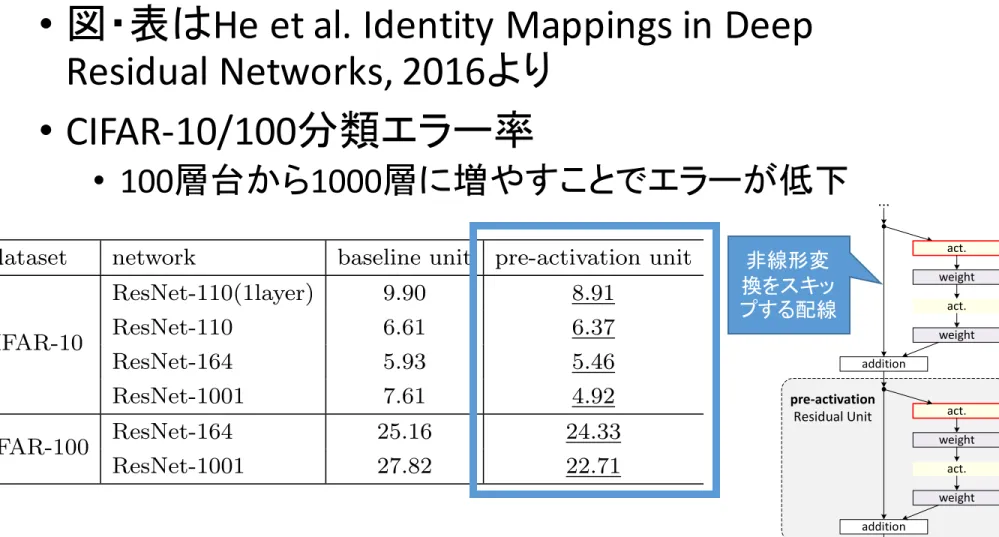
22…画像認識では1000層以上
• 図・表は
He et al. Identity Mappings in Deep
Residual Networks, 2016より
•
CIFAR-10/100分類エラー率
•
100層台から1000層に増やすことでエラーが低下
10 original Residual Unit act. weight weight addition act. act. act. weight weight addition act. ... ... (a)adopt output activation only to weight path
equivalent to act. weight weight addition act. act. weight weight addition ... act. ... (b) asymmetric output activation pre-activation Residual Unit act. weight weight addition act. act. weight weight addition ... act. ... (c)
Figure 5. Using asymmetric after-addition activation is equivalent to constructing a pre-activation Residual Unit.
Table 3. Classification error (%) on the CIFAR-10/100 test set using the original Residual Units and our pre-activation Residual Units.
dataset network baseline unit pre-activation unit CIFAR-10 ResNet-110(1layer) 9.90 8.91 ResNet-110 6.61 6.37 ResNet-164 5.93 5.46 ResNet-1001 7.61 4.92 CIFAR-100 ResNet-164 25.16 24.33 ResNet-1001 27.82 22.71
The distinction between post-activation/pre-activation is caused by the pres-ence of the element-wise addition. For a plain network that has N layers, there
are N 1 activations (BN/ReLU), and it does not matter whether we think of
them as post- or pre-activations. But for branched layers merged by addition, the position of activation matters.
We experiment with two such designs: (i) ReLU-only pre-activation (Fig. 4(d)), and (ii) full pre-activation (Fig. 4(e)) where BN and ReLU are both adopted be-fore weight layers. Table 2 shows that the ReLU-only pre-activation performs very similar to the baseline on ResNet-110/164. This ReLU layer is not used in conjunction with a BN layer, and may not enjoy the benefits of BN [8].
10
original Residual Unit act. weight weight addition act. act. act. weight weight addition act. ... ...(a)
adopt output activation only to weight path
equivalent to
act. weight weight addition act. act. weight weight addition ... act. ...(b)
asymmetric output activation pre-activation Residual Unit act. weight weight addition act. act. weight weight addition ... act. ...(c)
Figure 5. Using asymmetric after-addition activation is equivalent to constructing a
pre-activation Residual Unit.
Table 3. Classification error (%) on the CIFAR-10/100 test set using the original
Residual Units and our pre-activation Residual Units.
dataset network baseline unit pre-activation unit
CIFAR-10 ResNet-110(1layer) 9.90 8.91 ResNet-110 6.61 6.37 ResNet-164 5.93 5.46 ResNet-1001 7.61 4.92 CIFAR-100 ResNet-164 25.16 24.33 ResNet-1001 27.82 22.71
The distinction between post-activation/pre-activation is caused by the
pres-ence of the element-wise addition. For a plain network that has N layers, there
are N
1 activations (BN/ReLU), and it does not matter whether we think of
them as post- or pre-activations. But for branched layers merged by addition,
the position of activation matters.
We experiment with two such designs: (i) ReLU-only pre-activation (Fig. 4(d)),
and (ii) full pre-activation (Fig. 4(e)) where BN and ReLU are both adopted
be-fore weight layers. Table 2 shows that the ReLU-only pre-activation performs
very similar to the baseline on ResNet-110/164. This ReLU layer is not used in
conjunction with a BN layer, and may not enjoy the benefits of BN [8].
Somehow surprisingly, when BN and ReLU are both used as pre-activation,
the results are improved by healthy margins (Table 2 and Table 3). In Table 3 we
report results using various architectures: (i) ResNet-110, (ii) ResNet-164, (iii)
a 110-layer ResNet architecture in which each shortcut skips only 1 layer (i.e.,
非線形変 換をスキッ プする配線
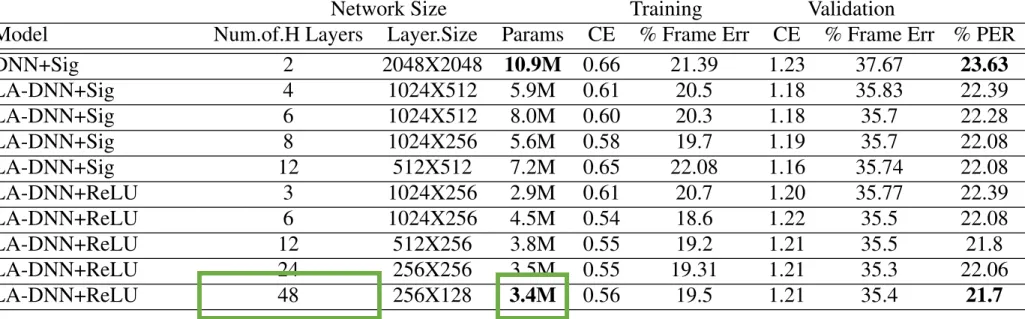
音声認識でも約
50層
• 表は
Ghahremani et al. ”LINEARLY AUGMENTED
DEEP NEURAL NETWORK“, 2016より
• 深くすることでエラー低下とともにパラメータ数を減
らせた
Network Size Training Validation
Model Num.of.H Layers Layer.Size Params CE % Frame Err CE % Frame Err % PER
DNN+Sig 2 2048X2048 10.9M 0.66 21.39 1.23 37.67 23.63 LA-DNN+Sig 4 1024X512 5.9M 0.61 20.5 1.18 35.83 22.39 LA-DNN+Sig 6 1024X512 8.0M 0.60 20.3 1.18 35.7 22.28 LA-DNN+Sig 8 1024X256 5.6M 0.58 19.7 1.19 35.7 22.08 LA-DNN+Sig 12 512X512 7.2M 0.65 22.08 1.16 35.74 22.08 LA-DNN+ReLU 3 1024X256 2.9M 0.61 20.7 1.20 35.77 22.39 LA-DNN+ReLU 6 1024X256 4.5M 0.54 18.6 1.22 35.5 22.08 LA-DNN+ReLU 12 512X256 3.8M 0.55 19.2 1.21 35.5 21.8 LA-DNN+ReLU 24 256X256 3.5M 0.55 19.31 1.21 35.3 22.06 LA-DNN+ReLU 48 256X128 3.4M 0.56 19.5 1.21 35.4 21.7
Table 1. Results on TIMIT using different models.
Network Size Training Validation
Model Num.of.H Layers Layer.Size Params CE Frame Err CE Frame Err WER
DNN+Sigmoid 6 2048X2048 37.62M 1.46 37.83 2.11 49.3 31.67 DNN+Sigmoid 6 1024X1024 12.52M 1.59 40.75 2.13 50.0 32.43 DNN+ReLU 6 1024X1024 12.52M 1.45 37.8 1.98 47.2 31.54 LA-DNN+Sigmoid 6 2048X512 18.4M 1.35 35.3 31.88 LA-DNN ReLU 6 1024X512 10.5M 1.34 35.77 2.02 47.3 30.68 Spliced-DNN+Sigmoid 4 1024X512 10M 1.53 39.2 2.08 49.13 31.86 Spliced-DNN+ReLU 6 1024X512 13.1M 1.42 37.0 1.95 46.8 30.44
Table 2. Results on AMI using different models.
Network Size Training Validation
Model Num.of.H Layers Layer.Size Params CE % Frame Err CE % Frame Err % WER
DNN+ReLU 6 1024X1024 12.52M 1.45 37.8 1.98 47.2 31.54 LA-DNN+ReLU 3 2048X512 12.1M 1.34 35.57 2.03 47.8 31.5 LA-DNN+ReLU 6 1024X512 10.5M 1.34 35.76 2.00 47.3 30.68 LA-DNN+ReLU 12 1024X256 8.9M 1.319 35.15 2.01 47.2 30.41 LA-DNN+ReLU 12 512X512 9.6M 1.34 35.77 1.98 46.9 30.22 LA-DNN+ReLU 24 512X256 8.2M 1.34 35.7 2.00 47.01 30.18 LA-DNN+ReLU 48 256X256 7.9M 1.35 35.9 1.97 47.01 29.98 LA-DNN+ReLU 48 512X256 14.4M 1.25 33.9 2.00 46.7 29.7
Table 3. Results on AMI using LA-DNN model with different number of layers. 6. CONCLUSION
In this work, we presented some promising results on using new pro-posed LA-DNN model for speech and phoneme recognition tasks. We show that we can get better results using a smaller network that converges faster than the baseline DNN model. More interestingly, we show that we can train very deep networks without pre-training, which is not possible using the regular DNN architecture. This ca-pability in modeling deeper network with smaller number of param-eters gives us the possibility to investigate the effect of depth and to construct a more abstract and generalized model.
7. REFERENCES
[1] Geoffrey Hinton, Li Deng, Dong Yu, George E Dahl, Abdel-rahman Mohamed, Navdeep Jaitly, Andrew Senior, Vincent Vanhoucke, Patrick Nguyen, Tara N Sainath, et al., “Deep neu-ral networks for acoustic modeling in speech recognition: The shared views of four research groups,” Signal Processing Mag-azine, IEEE, vol. 29, no. 6, pp. 82–97, 2012.
[2] Yoshua Bengio, Aaron Courville, and Pierre Vincent, “Rep-resentation learning: A review and new perspectives,” Pattern Analysis and Machine Intelligence, IEEE Transactions on, vol. 35, no. 8, pp. 1798–1828, 2013.
[3] Yoshua Bengio, Pascal Lamblin, Dan Popovici, Hugo Larochelle, et al., “Greedy layer-wise training of deep net-works,” Advances in neural information processing systems, vol. 19, pp. 153, 2007.
[4] Chen-Yu Lee, Saining Xie, Patrick Gallagher, Zhengyou Zhang, and Zhuowen Tu, “Deeply-supervised nets,” arXiv preprint arXiv:1409.5185, 2014.
[5] Ian J Goodfellow, David Warde-Farley, Mehdi Mirza, Aaron Courville, and Yoshua Bengio, “Maxout networks,” arXiv preprint arXiv:1302.4389, 2013.
[6] Adriana Romero, Nicolas Ballas, Samira Ebrahimi Kahou, An-toine Chassang, Carlo Gatta, and Yoshua Bengio, “Fitnets: Hints for thin deep nets,” arXiv preprint arXiv:1412.6550, 2014.
[7] Dong Yu, Frank Seide, Gang Li, and Li Deng, “Exploit-ing sparseness in deep neural networks for large vocabulary speech recognition,” in Acoustics, Speech and Signal Process-ing (ICASSP), 2012 IEEE International Conference on. IEEE, 2012, pp. 4409–4412.
[8] Jian Xue, Jinyu Li, and Yifan Gong, “Restructuring of deep neural network acoustic models with singular value decompo-sition.,” in INTERSPEECH, 2013, pp. 2365–2369.
企業が大物教授を次々と迎える
• 写真は
http://www.kdnuggets.com/wp-content/uploads/photo.jpg
より
引用
Yann LeCun
(Facebook AI
Research &
NYU)
Geoffrey E.
Hinton (Google
& Toronto大学)
Yoshua Bengio (Montreal大学)
à
IBM Reasearch/Watson Groupと協業
http://asmarterplanet.com/blog/2015/07/promise-deep-learning.htmlAndrew Ng
(Baidu / 元
Stanford大学)
自然言語処理における
ディープラーニングの現状
• 機械学習コミュニティから自然言語処理が注目されている
•
Christopher D. Manning. 2015. Last Words. Computational
Linguistics より引用
•
Yann LeCun: ディープラーニングの次のターゲットは自然言語理解である。
単語だけでなくパラグラフや文を理解することを目指す。
•
Geoff Hinton: ディープラーニングで次の5年で最もエキサイティングな領
域はテキストとビデオの理解だ。
5年後にYoutubeビデオを見て説明する仕
組みが出てきていなかったとしたら残念だ。
•
Yoshua Bengio: 機械翻訳システムなど言語処理に向けたディープラーイ
ング研究を促進している
• Michael Jordan: もし10億ドルあったら何をしますか、と尋ねられたら自
然言語処理に特化したNASA規模のプログラムを作ると答えるだろう
• ニューラルネットワークを用いた手法が多く発表されている
• à画像認識や音声認識ほど大成功を収めているとは言えない
• 多くのタスクで既存手法と同等または若干上回る程度自然言語処理
(Natural Language
Processing; NLP)の特徴 -画像認識・
音声認識との比較
-• 離散入力
• テキストは記号列 (「あ」と「い」の距離は定義されない
vs 画像の
RGB)
• 典型的には疎な離散値ベクトルとして入力を表現
• 離散であるため組み合わせ特徴量の構成が直感的で比較的構成
しやすい
•
E.g. “New” ∧ “York” à “New York”
• 課題: 組み合わせ特徴量は指数的に増大
• 可変長入出力
• テキストは可変長
• 課題1: 機械学習アルゴリズムで扱うためには、入力テキストを固
定長の特徴ベクトルで表現する必要がある
• 翻訳・要約・質問応答などの応用では、出力もテキスト(入力と出
力の長さは普通異なる)
• 課題
2: 可変長記号列を出力する必要性
ネットワーク構造に基づく自然言語
処理におけるディープラーニング適
用の分類
• フィードフォワードニューラルネットワーク
(Feed-forward
Neural Networks)
• リカレントニューラルネットワーク
(Recurrent Neural
Networks; RNNs)
• 畳み込みニューラルネットワーク
(Convolutional Neural
Networks; CNNs)
• 再帰ニューラルネットワーク
(Recursive Neural Networks)
フィードフォワードニューラルネット
ワーク
(Feed-forward Neural Networks)
• フィードフォーワードニューラルネットワークの例
•
x: 入力ベクトル
•
y: 予測
•
l: 階層インデックス
•
h: 隠れ変数ベクトル
•
W: 重み行列
•
f: 活性化関数(シグモイドなど)
フィードフォワードニューラルネットワー
クの応用例
• 言語モデル
[Bengio et al., 2003]
• 次の単語を予測するモデル
• 文の生成などに利用される
•
1層目で窓幅の単語を個別に非線形変換
• 機械翻訳
[Devlin et al., 2014]
• 原言語と対象言語両方を入力
• 品詞タグ付
[Ma et al., 2014] [Tsuboi, 2014]
• 構文解析
[Chen and Manning, 2014]
• 利点: 明示的に組み合わせ特徴量を使うことなく、暗に特徴量の組み合わせを考慮でき
る
• 課題: 固定長の入力を得るために試行錯誤が必要
リカレントニューラルネットワーク
(Recurrent Neural Networks; RNNs)
• 双方向
RNN
の例
• 課題
: 入力と
出力の長さ
が
同じであるこ
とが必要
ß前向き走査
ß後向き走査
言葉を生成するための
RNN
• リカレントネットワークによる言語モデル
[Mikolov et al.,
2013]
32
発展
: 入力列のエンコーダと出力列のデコー
ダを接続し可変長出力に対応
1. エンコーダの末尾状態を
デコーダの先頭に接続
[Sutskever et al., 2014]
2. エンコーダの末尾状態を
デコーダのすべての点で参照
[Cho et al., 2014]
3. エンコーダの各点の状態を
重みつき線形和したベクトルを
デコーダのすべての点で参照
a.k.a. ソフトアテンションモデル)
(1)
(2)
エンコーダには教師信号が直接入
らないため
RNNsに長期記憶を持た
せるための手法が併用される
•
Multiplicative Gate Units
•
Figures from (Chung et al., 2014)
(Hochreiter and
Schmidhuber , 1997)
(Cho et al., 2014)
•
Figures from (Mikolov et al., 2015)
(scalar)
(Matrix)
structurally constrained
recurrent nets (SCRN)
画像エンコーダ(
CNN)とテキストデコーダ(RNN)
Figure from the original paper [Show and Tell: A Neural Image Caption Generator
(Vinyals et. al., 2014)]
動画の説明文生成
36
機械翻訳コンペティション
(
IWSLT2015)英独翻訳で圧勝
• 上図:
http://workshop2015.iwslt.org/
downloads/IWSLT_Overview15.
より引用
•
2位以下を大きく離して圧勝
• 下図:
http://workshop2015.iwslt.org/
downloads/IWSLT15_ThangLuo
ng.pdf
より引用
• 分野適応:WMTデータ 4.5M で
学習したモデルを
IWSLTデータ
0.2M(TED talk)で再学習 (再学
習は初期学習率
=1.0から2epoch
対話生成
(1)
•
IT Helpdeskデータで学習した対話生成例: 例は Vinyals and Le, “A
Neural Conversational Model”, ICML Deep Learning Workshop 2015 より
引用
•
Describe your problem: i am having issues accessing vpn
•
Machine: could you please let me know what are the operating systems you are
using ?
•
Human: i am using linux
•
Machine: ok it was in the ssl vpn on which you stated it was broken
•
Machine: please check if you are logged in to corp network
•
Machine: what is the error that you are running please
•
Human: i am seeing an error related to vpn
•
Machine: what is the error message that you are getting when connecting to
vpn using network connect ?
•
Human: connection refused or something like that
•
Machine: may i know the version of network connect you connect ? ….
38人の発話(入力)
システムからの発話(出力)
対話生成
(2)
• 対話を真似るように学習しただけだが、タスク解決でき
ているように見える
•
….
•
Machine: try this
•
Machine: goto <URL> page and enter your
•
name and password
•
Human: done
•
Machine: try logging in with <NAME> and
•
check if its working fine now
•
Human: yes , now it works !
•
Machine: great
•
(<URL> は実際にVPNの情報を含んでいるURLを含んでいる)
• 模倣学習の利点:数値的に達成度が図りにくいタスク
メール自動返答生成
• エンコーダ・デコーダアプローチによりメールへの
返答候補を自動生成
• スマートフォンのメールアプリ(
Inbox)で試用中
• 図は以下より引用
http://googleresearch.blogspot.jp/2015/11/computer-respond-to-this-email.html
画像列からアクション列の生成
•
V. Mnih et al., "Human-level control through deep
reinforcement learning“, Nature, 2015
•
Silver et al., “Mastering the game of Go with deep
neural networks and tree search”
• 自動運転などへの応用にも期待
畳み込みニューラルネットワーク
(Convolutional Neural Networks; CNNs)
•
1次元畳み込み(窓幅w)
畳み込みニューラルネットワークの応用
• 基盤処理タスクをマルチタスク学習(品詞タグ付け,句構造チャンキング,固有
表現抽出,意味ラベル付与タスク)
[Collobert et al., 2011]
• 当時の最先端の性能に肉薄
• 文字単位での
CNN: 未知語に対応可能
• 単語
&文字CNN: 活用形が多い言語の処理やテキストに頑健
[Santos and Zadrozny, 2014] [Santos and Gatti, 2014]
•
Bag of 文字N-gram: 部分文字列でハッシング [Gao et al., 2014]
• 文字
CNN: 9層の深いネットワークを実現 [Zhang and LeCun, 2014]
• 動的
k最大値プーリング[Kalchbrenner et al., 2014]
• 上位
k個のzを上位層に上げる。
•
Kは入力長Tに比例して決める
(仮定: 長い入力は情報量が多い)
• 評判分析では最大値プーリングが、トピック分類では平均
CNNエンコーダとRNNエンコーダによ
る翻訳
[Nal and Blunsom, 2013]
•
Figures from the original paper
CNNs
RNNs
再帰ニューラルネットワーク
(Recursive Neural Networks)
•
RNNの一般化(Sequence à DAG)
• 自然言語処理では構文解析結果の木構造を使い、文や句
のベクトル表現を得る
[Socher, 2014]
•
2分木を仮定すると:
再帰ニューラルネットワークの応
用
• 評判分析
: 句のレベルで好評・不評を判定 [Socher et al.,
2013]
• 質問応答
: 質問文をベクトル表現し、該当する回答に分類
[Iyyer et al., 2014]
• 長い依存関係が必要なタスクで有効
[Li et al., 2015]
• 評判分析・質問応答・談話構造解析では
RNNsと差がない(または
劣る)
• 意味関係解析では再帰ニューラルネットワークが勝る(名詞と名詞
の間の主語が重要なタスク)
• 空間的にも深い
再帰ニューラルネットワーク
[Irsoy and Cardie, 2014]
前半のまとめ
• 自然言語処理の特徴
• 入力が離散
• 入出力が可変
• ネットワーク構造による分類
• フィードフォワードニューラルネットワーク: 線形モデルの置き換え
• リカレントニューラルネットワーク
: 可変長入出力が可能。
• 畳み込みニューラルネットワーク
: 文字単位の研究では先行
• 再帰ニューラルネットワーク
: 文法構造を活用できる
• 自然言語処理のパイプライン処理を置き換える可能性
•
End-to-endで学習できることが強み
• さまざまな前処理(品詞タグ付・構文解析等)が不要になる?
• 自然言語処理以外の似た特徴を持つタスクにも適用可能
になる可能性
• 入力列が離散
(例: 商品の購買履歴)
• 入出力長が可変
(例: アミノ酸配列)
参考文献
•
Dzmitry Bahdanau, Kyunghyun Cho, and Yoshua Bengio. Neural machine
translation by jointly learning to align and translate, 2014. arXiv:1409.0473.
•
Jiwei Li, Dan Jurafsky and Eduard Hovy. When Are Tree Structures Necessary for
Deep Learning of Representations, 2015. arXiv:1503.00185
•
Jianfeng Gao, Patrick Pantel, Michael Gamon, Xiaodong He, Li Deng, Yelong Shen.
Modeling Interestingness with Deep Neural Networks, In Proceedings of the
Conference on Empirical Methods in Natural Language Processing (EMNLP),
2014.
•
Rie Johnson and Tong Zhang. Effective Use of Word Order for Text Categorization
with Convolutional Neural Networks, , In Proceedings of the Conference of the
North American Chapter of the Association for Computational Linguistics
(NAACL), 2015.
•
Yoshua Bengio, R´ejean Ducharme, Pascal Vincent, and Christian Janvin. A
neural probabilistic language model. Journal of Machine Learning Research, Vol.
3, No. 19, pp. 1137–1155, 2003.
•
Danqi Chen and Christopher Manning. A fast and accurate dependency parser
using neural networks. In Proceedings of the Conference on Empirical Methods
in Natural Language Processing (EMNLP), pp. 740–750, 2014.
参考文献
• Kyunghyun Cho, Bart van Merrienboer, Caglar Gulcehre, Dzmitry Bahdanau, Fethi Bougares,
Holger Schwenk, and Yoshua Bengio. Learning phrase representations using RNN encoder– decoder for statistical machine translation. In Proceedings of the Conference on Empirical
Methods on Natural Language Processing (EMNLP), pp. 1724–1734, 2014.
• Ronan Collobert, Jason Weston, L´eon Bottou, Michael Karlen, Koray Kavukcuoglu, and Pavel P.
Kuksa. Natural language processing (almost) from scratch. Journal of Machine Learning Research, Vol. 12, pp. 2493–2537, 2011.
• Jacob Devlin, Rabih Zbib, Zhongqiang Huang, Thomas Lamar, Richard Schwartz, and John
Makhoul. Fast and robust neural network joint models for statistical machine translation. In Proceedings of the Annual Meeting of the Association for Computational Linguistics (ACL), pp. 1370–1380, 2014 • Cicero Dos Santos and Bianca Zadrozny. Learning character-level representations for part-of-speech tagging. In Proceedings of the International Conference on Machine Learning (ICML), pp. 1818–1826, 2014. • Cicero Dos Santos and Maira Gatti. Deep Convolutional Neural Networks for Sentiment Analysis of Short Texts. In Proceedings of the International Conference on Computational Linguistics (COLING), pp. 69--78, 2014. • Sepp Hochreiter and Jurgen Schmidhuber. Long short-term memory. Neural Computation, Vol. 9, No. 8, pp. 1735–1780, 1997.
参考文献
• Mohit Iyyer, Jordan Boyd-Graber, Leonardo Claudino, Richard Socher, and Hal Daum´e III. A
neural network for factoid question answering over paragraphs. In Proceedings of the
Conference on Empirical Methods in Natural Language Processing (EMNLP), pp. 633–644, 2014.
• Nal Kalchbrenner and Phil Blunsom. Recurrent continuous translation models. In Proceedings of
the Conference on Empirical Methods in Natural Language Processing (EMNLP), pp. 1700–1709, 2013. • Nal Kalchbrenner, Edward Grefenstette, and Phil Blunsom. A convolutional neural network for modelling sentences. Proceedings of the Annual Meeting of the Association for Computational Linguistics (ACL), 2014. • Andrej Karpathy and Li Fei-Fei. Deep visual semantic alignments for generating image descriptions, 2014. arXiv:1412.2306. • Yoon Kim. Convolutional neural networks for sentence classification. In Proceedings of the Conference on Empirical Methods in Natural Language Processing (EMNLP), pp. 1746–1751, 2014. • Ji Ma, Yue Zhang, Tong Xiao, and Jingbo Zhu. Tagging the Web: Building a robust web tagger with neural network. In Proceedings of the Annual Meeting of the Association for Computational Linguistics, Proceedings of the Conference (ACL). The Association for Computer Linguistics, 2014.
参考文献
• Tomas Mikolov, Martin Karafi´at, Lukas Burget, Jan Cernock´y, and Sanjeev Khudanpur. Recurrent neural network based language model. In Proceedings of the Annual Conference of the International Speech Communication Association (INTERSPEECH), pp. 1045–1048, 2010. • Tomas Mikolov, Wen tau Yih, and Geoffrey Zweig. Linguistic regularities in continuous space word representations. In Proceedings of the Conference of the North American Chapter of the Association for Computational Linguistics: Human Language Technologies (NAACL-HLT), pp. 746– 751, 2013. • Richard Socher. Recursive Deep Learning for Natural Language Processing and Computer Vision. PhD thesis, Stanford University, 2014.• Richard Socher, Andrej Karpathy, Quoc V. Le, Christopher D. Manning, and Andrew Y. Ng.
Grounded compositional semantics for finding and describing images with sentences. Transactions of the Association for Computational Linguistics, 2014. • Richard Socher, Alex Perelygin, Jean Wu, Jason Chuang, Chris Manning, Andrew Ng, and Chris Potts. Recursive deep models for semantic compositionality over a sentiment treebank. In Proceedings of the Conference on Empirical Methods on Natural Language Processing (EMNLP), pp. 1631–1642, 2013. • Martin Sundermeyer, Tamer Alkhouli, Joern Wuebker, and Hermann Ney. Translation modeling with bidirectional recurrent neural networks. In Proceedings of the Conference on Empirical Methods in Natural Language Processing (EMNLP), pp. 14–25, 2014.
![Figure from the original paper [Show and Tell: A Neural Image Caption Generator (Vinyals et. al., 2014)]](https://thumb-ap.123doks.com/thumbv2/123deta/5777474.531634/35.1080.30.1066.99.609/figure-original-paper-neural-image-caption-generator-vinyals.webp)
