RIMS-1715
Decentralized Market Processes to Stable Job Matchings with Competitive Salaries
By
Bo CHEN, Satoru FUJISHIGE, and Zaifu YANG
March 2011
R ESEARCH I NSTITUTE FOR M ATHEMATICAL S CIENCES
KYOTO UNIVERSITY, Kyoto, Japan
Decentralized Market Processes to Stable Job Matchings with Competitive Salaries ∗
Bo Chen
†, Satoru Fujishige
‡, and Zaifu Yang
§March 05, 2011
Abstract
We analyze a decentralized trading process in a basic labor market where heterogeneous firms and workers meet directly and randomly, and negotiate salaries with each other over time. Firms and workers may not have a com- plete picture of the entire market and can thus behave myopically in the pro- cess. Our main result establishes that, starting from an arbitrary initial market state, there exists a finite sequence of successive myopic (firm-worker) pair im- provements, or bilateral trades, leading to a stable matching between firms and workers with a scheme of competitive salary offers. An important implication of this result is that a general random process where every possible bilateral trade is chosen with a positive probability converges with probability one to a competitive equilibrium of the market.
Keywords: Decentralized market, job matching, random path, competitive salary, stability.
JEL classification: C62, D72.
∗We are deeply grateful to Vince Crawford, Chiaki Hara, Jean-Jacques Herings, Atsushi Ka- jii, Patrick Legros, Rudolf Muller, Al Roth, Larry Samuelson, and seminar participants at Keio University, Kyoto University, Maastricht University, Universit´e Libre de Bruxelles, Yokohama Na- tional University and Zhejiang University for their very helpful feedback. The usual disclaimer applies. Chen wishes to thank Kyoto Institute of Economic Research and Maastricht University for their hospitality while part of this research was conducted. Fujishige’s research is supported by a Grant-in-Aid of the Ministry of Education, Culture, Sports, Science and Technology of Japan. Yang gratefully acknowledges financial support by the University of York, by the Ministry of Education, Culture, Sports, Science and Technology of Japan, #22530176, and by the National Natural Science Foundation of China, #10771042.
†Department of Economics, Southern Methodist University ([email protected]).
‡Research Institute for Mathematical Sciences, Kyoto University ([email protected]).
§Department of Economics and Related Studies, University of York ([email protected]).
Every individual endeavors to employ his capital so that its produce may be of greatest value. He generally neither intends to promote the public interest, nor knows how much he is promoting it. He intends only his own security, only his own gain. And he is in this led by an invisible hand to promote an end which was no part of his intention. By pursuing his own interest he frequently promotes that of society more effectually than when he really intends to promote it.
—Adam Smith (1776), The Wealth of Nations.
1 Introduction
Adam Smith’s proclamation has captured the self-regulating nature of an uncoor- dinated market where self-interested market participants, who make independent decisions freely, can settle the market on a competitive equilibrium outcome. His remarkable insight about the functioning of market mechanisms has inspired many generations of economists. The objective of this paper is to develop and analyze a decentralized market process for a basic labor market with finitely many heteroge- neous firms and workers. This process intends to mimic and reflect the decentralized decision making process in real competitive labor markets, where firms and workers meet directly and randomly, and negotiate salaries with each other over time. Here agents may not have a complete picture of the entire labor market and can thus be- have myopically. Using this framework, we investigate the market outcomes of such decentralized and random processes.
The theoretical literature on market processes has predominantly focused on and has also been remarkably successful in analyzing and designing centralized processes for various markets.1 Nevertheless, many competitive markets, labor markets be- ing a leading example, feature bilateral (job) offers and are typically decentralized (see e.g., Roth and Vande Vate (1990), Samuelson and Nordhaus (2010)). Indeed, it is widely observed in labor markets that a worker sequentially works for several employers because a latter employer offers a better salary than a previous employer does; and conversely, a same firm hires different workers over time for the same po- sition as workers who come later may either work more efficiently or demand lower salaries. In addition, it is not uncommon to see that a worker eventually returns to
1See for example, Gale and Shapley (1962) for marriage matching problems; Shapley and Scarf (1974) for housing markets; Crawford and Knoer (1981), Kelso and Crawford (1982), and Crawford (2008) for job matching problems; Demange, Gale and Sotomayor (1986), Gul and Stacchetti (2000), Milgrom (2000), Ausubel (2006), Sun and Yang (2009) for auction markets; Roth (1984), Roth and Sotomayor (1990) for the US medical residency match; Abdulkadiro˘glu and S¨onmez (2003), Abdulkadiro˘glu, Pathak and Roth (2005) for school choice problems; and Ostrovsky (2008) for supply chain network. Stock markets and auction markets are typically centralized. AEA annual meeting provides a place for junior economists to meet their future potential academic employers.
But this is not a centralized market.
her previous employer but with a different contract. In a labor market where many firms and workers are matched randomly and dynamically, and each agent makes her own decisions independently, possibly by only looking at myopic gains, a natural and important question is then “will such seemingly chaotic, random and dynamic decentralized processes eventually lead the market to an equilibrium state in which a system of competitive salaries exists and simultaneously meets the needs of both firms and workers?”As far as we are aware, such model has not yet been studied.
This paper attempts to resolve the above question in the affirmative. Briefly speaking, we consider a labor market with finite and heterogeneous workers and firms.
Each worker can be matched with a firm, generating a joint surplus, which can be split freely between the two agents (interpreted as salaries). Given an allocation which consists of a matching between the firms and workers and a scheme of salary offers, a firm and a worker, currently not matched with each other, can block the allocation, resulting in a salary offer which makes both better off and at least one of them strictly so. Such a procedure is called a pair improvement of the allocation, which can be intuitively regarded as a particular form of bilateral trade arising from the previous allocation. Like a bilateral transaction, a pair improvement, while beneficial for the pair involved, may hurt other agents, resulting in a decrease in total welfare of the market. In this framework, we establish that, starting from an arbitrary initial market state (an allocation), there exists a finite sequence of successive myopic pair improvements leading to a stable matching between firms and workers with a scheme of competitive salary offers. An important implication of this result is that a general random process where every possible pair improvement is chosen with a positive probability converges with probability one to a competitive equilibrium of the labor market.
The general random process is permissive in that it allows for random, chaotic and cyclical bilateral trading scenarios where firms’ and workers’ behavior might be only myopically oriented, and partnerships between firms and workers can be formed hastily and can also dissolve instantly whenever better opportunities arise. In our opinion, such a random market process presents a satisfactory illustration of the trad- ing behavior in a real uncoordinated market. In addition, myopic pair improvements (bilateral trades) before reaching stability can be interpreted as haggling activities where workers retain offers or sellers hold their goods without committing themselves until equilibrium (stability) is reached. Alternatively, these pair improvements can also be regarded as transactions that take place in real-time, where workers move from job to job and firms terminate existing employment relationships and create new job offers.
The current study is most closely related to the seminal work by Crawford and Knoer (1981) and Roth and Vande Vate (1990). Crawford and Knoer (1981) ana- lyzed a labor market with finitely many self-interested and heterogeneous firms and workers. They proposed a centralized market process — a salary adjustment process which always converges to a stable assignment of workers to firms with a scheme of
competitive salaries. Our model is similar to theirs in the sense that both are com- petitive equilibrium models but our goal and results differ essentially from theirs in that our process is decentralized and the associated algorithm finds an equilibrium in finitely many steps, whereas theirs is centralized and approaches an equilibrium through a limiting argument.2 Roth and Vande Vate (1990) reexamined the marriage matching model of Gale and Shapley (1962) and developed a decentralized process that finds a stable matching between men and women.3 Our study differs from Roth and Vande Vate’s in three crucial aspects: first, unlike ours their model is not an equilibrium model and does not involve money or prices;4 second, their solution of stability is weaker than our solution of stability which coincides with competitive equilibrium; third, in our model because salaries are flexible and need to be fully competitive in the end, it is crucial to make judicious choices of both blocking pairs and surplus division rules in the process.
Our analysis also bears some similarity with the literature on tˆatonnement pro- cesses, which studies equilibrium stability and how market-clearing prices and efficient allocations are reached with the coordination of a fictitious market maker. Since the first tˆatonnement process formulated by Leon Walras in 1874, the study of such pro- cesses has been a major issue of economic research. Some of the early contributions on tˆatonnement processes include Samuelson (1941), Arrow and Hurwicz (1958) and Scarf (1960, 1973). Compared with tˆatonnement processes, our analysis provides an arguably more satisfactory market process toward equilibrium allocations and prices in real economic systems in that our market process is random and decentralized, and that agents could trade on markets sequentially and trade could take place all the time, even at disequilibrium prices. In particular, our market processes do not exclude chaotic and cyclical behavior commonly observed in real economic systems.
In earlier related literature, Koopmans and Beckmann (1957) and Shapley and Shubik (1972) examined the existence and structure issues of competitive equilibrium in assignment markets without discussing any market process. Feldman (1974) and Green (1974) studied similar problems and obtained convergent processes for certain subclasses of NTU games. But their approaches do not apply to the labor market or matching models where significant indivisibility is involved.
2Crawford and Knoer (1981) first proved that their process always converges to a core element in finitely many steps. Then they showed by a limiting argument that their process approaches a strict core element (i.e., an equilibrium). Notice that their process can find an allocation that is as close to an equilibrium as one wishes in finite time.
3Gale and Shapley (1962) showed the existence of a stable marriage matching via a centralized process. For models closely related to Roth and Vande Vate (1990), see Chung (2000), Diamantoudi, Miyagawa and Xue (2006) for roommate matching problems; Klaus and Klijn (2007) for matching problems with couples; Kojima and ¨Unver (2008) for many-to-many matching problems; Ackermann et al. (2011) for examining the convergence of random myopic matching. These models, however, differ critically from ours in that they are not competitive equilibrium models and do not permit side payments.
4It is well-known that the marriage matching model generally does not have competitive prices to support the stable matchings, see Quinzii (1984).
The rest of the article proceeds as follows. Section 2 presents the model. Section 3 provides preliminary results concerning weak stability. The main results towards stability are established in Section 4. Concluding remarks are provided in Section 5.
Omitted proofs are relegated to an Appendix.
2 The Model
Consider a labor market with finitely many heterogeneous firms and workers. For- mally, let F and W be two finite disjoint sets of agents, containing |F| firms and
|W| workers, respectively. We assume that each firm hires at most one worker and each worker accepts at most one job.5 A matchingµin the labor market is simply a one-to-one mapping fromF∪W to itself such that (i)µ(µ(x)) =xfor allx∈W∪F, and (ii) each agent is either self-matched (µ(x) = x), or is matched to a member of the other side (for x ∈ W, µ(x) 6= x implies µ(x) ∈ F, and for x ∈ F, µ(x) 6= x implies µ(x)∈W), in which caseµ(x) is said to be a partner of x.
Denote V(f, w) and s(f, w), respectively, as worker w’s productivity and salary at firm f. When a worker w does not work for any firm, his utility is represented by V (w, w), while if a firm f does not hire any worker, her productivity or utility is denoted by V(f, f). For any agent x ∈ F ∪W, value V (x, x) can be alterna- tively interpreted as agent x’s outside options (e.g., firms’ idle values and workers’
unemployment benefits) when x is self-matched.6 Notice that we allow for heteroge- neous outside options for the agents. Salaries, together with the parametersV (f, w), V (w, w) and V (f, f), are paid in terms of an indivisible commodity, called money.
As a result, worker w’s total utility at firm f is V(f, w)−s(f, w). We assume that valuesV(f, w),V(w, w) andV(f, f) are integers for allf ∈F andw∈W. These val- ues are measured in monetary units and hence are naturally assumed to be integers.
We denote this labor market by (F, W, V).
Given a matchingµ, letI(µ) ={h∈F∪W |µ(h) = h}be the set of members who are self-matched atµ. We call the quantity of P
f∈F\I(µ)V(f, µ(f)) +P
i∈I(µ)V(i, i) the market value associated with the matching µ. Moreover, we say that a matching µ is efficient if it holds, for an arbitrary matching ρ, that
X
f∈F\I(µ)
V(f, µ(f)) + X
i∈I(µ)
V(i, i)≥ X
f∈F\I(ρ)
V(f, ρ(f)) + X
i∈I(ρ)
V(i, i).
If µ is efficient, then we call quantity P
f∈F\I(µ)V(f, µ(f)) +P
i∈I(µ)V(i, i) the ef- ficient market value , or the efficient value, of the labor market and denote it by V(F ∪W), which is the same for all efficient matchings.
5This is theunit-demand assumption, which has been employed in Shapley and Shubik (1972), Crawford and Knoer (1981), Demange, Gale and Sotomayor (1986) and others.
6When a worker (resp., a firm) stays idle, then the worker gets no salary from any firm (resp., the firm pays nothing to any worker).
An economic outcome, or simply an allocation, of the labor market consists of a matchingµand a payoff vectoru∈RF∪W such thatu(x) =V(x, x) for anyx∈I(µ);
andu(x)+u(µ(x)) =V(x, µ(x)) for anyx /∈I(µ).7 An allocation (µ, u) isindividually rational if u(x)≥V(x, x) for allx∈F ∪W. Notice that for each allocation (µ, u) in a labor market (F, W, V), the payoff vectoruuniquely defines a salary vectorswhere s(µ(w), w) = u(w), for matched/employed worker w, and s(µ(w), w) =V (w, w), i.e., w’s unemployment benefit, for self-matched/unemployed worker w. With this convention, it is thus sufficient for us to employ the utility vector u in lieu of the description of the salary vector s for each allocation hereafter.
A natural notion of solution for our setting is that of stability. An allocation (µ, u) is stable or a strict core allocation if u(f) +u(w) ≥V(f, w) for all f ∈ F, w∈ W, andu(x)≥V(x, x) for allx∈F∪W. Namely, an allocation is stable if every worker (firm) has the option of remaining idle and the allocation is not blocked, to be defined shortly, by any pair of firm and worker. It is easy to show that if (µ, u) is a stable allocation and ρis an efficient matching, then (ρ, u) is stable and µis also efficient.
We now introduce two notions of blocking pairs: weakly blocking pairs and strongly blocking pairs. A pair (f, w) of firm f and worker w weakly blocks an allocation (µ, u) if firmf and workerware not matched underµbut both canweakly improve their well-being by matching with each other and abandoning their partners at µ. Namely, there are rf ∈ R and rw ∈ R such that rf + rw = V (f, w) and rw ≥ u(w) and rf ≥ u(f) with at least one strict inequality. For our purpose, we also say that (µ, u) is weakly blocked by a pair of (x, x) ifx∈F ∪W is not matched to herself at µ but prefers being single to being matched with µ(x), i.e., x 6= µ(x) but rx =V(x, x)> u(x).
A pair (f, w) is said to strongly block an allocation (µ, u) if firm f and worker w are not matched under µbut both canstrictly improve their well-being by matching with each other and abandoning their partners at µ. Namely, there are rf ∈R and rw ∈ R such that rf +rw = V(f, w) and rf > u(f) and rw > u(w). Similarly, we also say (µ, u) is strongly blocked by a pair of (x, x) if x∈F ∪W is not matched to herself at µ but prefers being single to being matched with µ(x), i.e., x 6= µ(x) but rx =V(x, x)> u(x).
Given the definitions of blocking pairs, we can alternatively say that an allocation (µ, u) is stable if there is no pair that weakly blocks (µ, u). Similarly, we call an allo- cation (µ, u) weakly stable ora core allocation if there is no pair that strongly blocks (µ, u). By definition, a weakly stable allocation is weaker than a stable allocation, in that there might be efficiency losses in a weakly stable allocation compared with a stable one.
Evidently, the above model of a labor market can also be regarded as a general assignment market with finitely many buyers and sellers and integral valuations.
7In our setting, salaries and values are naturally measured in integral monetary units. However, in defining a competitive equilibrium or core allocations (and the associated notions, such as blocking pairs), the appropriate domain we should focus on isthe reals. See page 8 for a detailed discussion.
Here, each seller is in possession of an indivisible good, which is valued possibly differently by the buyers. Given this specification, V (i, j) is then interpreted as the net monetary surplus associated with the partnership of buyer i and seller j, while s(i, j) is simply the price that buyer iis charged for seller j’s good.
It is well known in the literature (e.g., Shapley and Shubik (1972), Crawford and Knoer (1981), Demange, Gale and Sotomayor (1986)) that a job assignment market including the current labor market has at least one competitive equilibrium, and that the set of stable allocations (i.e., strict core) coincides with that of competitive equilibria.8 An additional important feature of the labor market is that as all values V (f, w),V (f, f) andV (w, w) are integers, and the structure of the market is totally unimodular, the market must have at least one stable outcome with an integral payoff vector u ∈ ZF∪W, which implicitly defines an integral salary scheme s ∈ ZW. We can therefore restrict ourselves solely to the domain of integer payoffs. Namely, it is sufficient to consider only weakly (strongly) blocking pairs with integer payoffs.
Henceforth, all values and salaries to be discussed will be integral.
As a blocking pair may result in multiple allocations, arising from different spec- ifications of wages or surplus division rules, we define an additional basic concept of pair improvement so as to fully describe the process from a blocking pair. In gen- eral, let (f, w) be a blocking pair of an allocation (µ, u). Introduce a new allocation (µ0, u0) via the blocking pair (f, w) such that (1) µ0(x) = µ(x) and u0(x) =u(x) for any x∈(F ∪W)\ {f, w, µ(f), µ(w)}, (2) under µ0,f and ware matched, while µ(f) and µ(w) are self-matched, and (3) u0(f) = rf and u0(w) = rw such that rf +rw = V (f, w), while u0(µ(f)) = V (µ(f), µ(f)) and u0(µ(w)) = V (µ(w), µ(w)). We say that (µ0, u0) is a pair improvement of (µ, u) through the blocking pair (f, w). We also distinguish weak pair improvements from strong pair improvements, depending on whether the associated blocking pair (f, w) is weak or strong.9
A pair improvement mimics a real transaction between a firm and a worker and can thus be naturally interpreted as a specific form of bilateral trade. Hereafter, we sometimes state a pair improvement as, more intuitively, a bilateral trade in our discussion. Indeed, in reality, when a firm hires a new employee or a worker joins a new firm, both parties are better off but the abandoned parties are usually worse off
8Lets∈RW be a salary vector whereswis the salary allocated to workerw. Fors∈RW, define the demand set of firmf ∈F by
Df(s) = {w|V(f, w)−sw≥V(f, f) andV(f, w)−sw≥V(h, f)−sh,∀h∈W}
∪{f |V(f, f)≥V(h, f)−sh,∀h∈W}.
A pair (µ, s) isa competitive equilibrium if (1)µ(h)∈Dh(s) for all h∈F; (2)sw≥V(w, w) for all w∈W, and µ(w) =wimpliessw=V(w, w) for all w∈W.
It is easy to show that (µ, s) is a competitive equilibrium if and only if (µ, u) is stable, where u(w) = sw for all w∈ W, u(f) = V(µ(f), f)−sµ(f) for all f ∈ F withµ(f) 6=f, and u(f) = V(f, f) for allf ∈F withµ(f) =f.
9A pair improvement from a weakly or strongly blocking pair initiated by a single agent can be defined in an analogous way.
at least for a certain period of time. Namely, when an employee moves to another firm for a better offer, the abandoned firm needs time to find a new replacement; or when an employee is fired, he/she needs time to find a new job. A pair improvements thus features opposing effects on the parties involved (Example 1 below illustrates this point more clearly).
As stated before, our central objective is to analyze the market outcomes of a de- centralized and random process where firms and workers meet directly and randomly, and negotiate salaries with each other over time. For this purpose, the first issue we have to deal with is the existence of a finite sequence of successive bilateral trades toward a stable allocation from any initial allocation. The following examples demon- strate that an arbitrary sequence of successive weak or strong pair improvements may induce trading cycles.
First consider the case of weak pair improvements. A very simple example of this is a labor market (F, W, V) whereF ={t} , W ={x, y},V (t, x) =V (t, y) = 2, and V (i, i) = 0 for all i∈F ∪W. Consider an initial allocation
µ0, u0
=
t1, x
1
,
y
0
, y
0
,
where we list the agents’ (integral) payoffs below the matching. Now (µ0, u0) is weakly blocked by the pair (t, y), which when satisfied yields
µ1, u1
=
t1, y
1
,
x0, x
0
,
while (µ1, u1) is further weakly blocked by (t, x), which leads to exactly (µ0, u0), completing the cycle.
Our next example shows that cycles may also arise under strong pair improve- ments. Notice in particular that this example also demonstrates that the market value maynot be monotonic along a path of pair improvements.
Example 1 Consider a labor market (F, W, V) with F = {a, b}, W = {x, y}, and V (i, i) = 0, ∀i∈F ∪W, V (a, i) = 4 and V (b, i) = 6, ∀i∈W.
We start with an initial allocation(µ0, u0)withµ0 ={(a, x),(b, b),(y, y)andu0(a) = u0(x) = 2 and u0(i) = 0 otherwise.
Choose the first strongly blocking pair to be (b, x), resulting in µ1, u1
=
a0, a
0
,
b3, x
3
,
y
0
, y
0
.
Now b and y can form the next strongly blocking pair, leading to µ2, u2
=
a0, a
0
,
b4, y
2
,
x0, x
0
.
We then choose (a, y) as the next blocking pair, leading to µ3, u3
=
a1, y
5
,
b0, b
0
,
x0, x
0
.
Finally, (a, x) is the next blocking pair, which when satisfied, gives µ4, u4
=
a2, x
2
,
b0, b
0
,
y
0
, y
0
,
completing the cycle.
Both examples illustrate the complexity of finding a deterministic path of pair improvements toward (weak) stability in that the choices of both surplus division rules and blocking pairs are important. In addition, the examples show that an arbitrary decentralized market process does not guarantee convergence to (weak) stability.
3 A Preliminary Result on Weak Stability
To help the reader to build up intuition, we begin with a preliminary result on the existence of a finite path of (strong) pair improvements toward weakly stable alloca- tion, starting from an arbitrary allocation of the labor market. A direct consequence of this result is that the random process where each possible strong pair improvement is chosen with positive probability eventually converges to a weakly stable allocation of the market.10
As demonstrated in Example 1, each pair improvement only results in payoff improvements for the players involved in the blocking pair associated with the pair improvement. This indicates that the market value may decrease after a pair im- provement as the abandoned partner’s payoff will most likely decrease. As a result, cycles may arise. Hence, to establish the existence of a finite path toward weakly stable allocation, the key issue is to make sure that the trading process consisting of myopic bilateral trades will not be stuck in some endless cycles. Here the major difficulty lies in how to properly choose blocking pairs and divide the joint surplus for the pair.
Our next result shows that starting with an arbitrary market state, there exists a finite sequence of strong pair improvements leading to a weakly stable allocation.
The theorem is proved via a constructive algorithm which prescribes proper rules for dividing surplus and choosing strongly blocking pairs. Our theorem and our algorithm extend those of Roth and Vande Vate (1990) from their marriage matching
10This is an immediate corollary of Proposition 1 in Section 4.
setting without money to the current labor market with flexible wages. As a result, in our method, judicious choices of both blocking pairs and wage specifications are crucial. As will be seen shortly, even for weak stability, such a construction is fairly involved and intricate. For the existence of a finite path of weak pair improvements toward stability, however, the construction is considerably more sophisticated and more demanding in tackling trading cycles that arise in the process.
Theorem 1 Consider a labor market (F, W, V) with an arbitrary initial allocation (µ0, u0). There exists a finite number of consecutive strong pair improvements which lead to a weakly stable allocation (µ∗, u∗).
To prove the theorem, we first present the Basic Algorithm, which carries an arbi- trary individually rational allocation to a weakly stable allocation in the labor market (F, W, V).
Basic Algorithm
Step 1: If (µ0, u0) is weakly stable, stop with output (µ0, u0). Otherwise, there is a strongly blocking pair (f1, w1) with V (f1, w1) ≥ u0(f1) +u0(w1) + 2. Match f1 with w1. DefineK(1) to be{(f1, w1)}and let the updated allocation be (µ1, u1). In addition, let u1(f1) = u0(f1) + 1, u1(w1) = V (f1, w1)−u1(f1);µ0(i), i∈ {f1, w1}, if any, obtainsu1(µ0(i)) =V (µ0(i), µ0(i)); and for all otherx, let u1(x) = u0(x).11 Define an index n and put n←1.
Step 2: If (µn, un) is weakly stable, then stop. Otherwise, there is a blocking pair (fn, wn) of (µn, un) such that (fn, wn)∈/ K(n).12 Distinguish three cases:
Case 1. If wn ∈ K(n) (hence fn ∈ (F ∪W)\K(n)), then fn is the initiator of the next blocking pair, who chooses wn where wn ∈ arg maxw∈K(n)[V (fn, w)- un(fn)-un(w)] (choose arbitrarily if there are several such wn’s). Update the alloca- tion to be (µn+1, un+1) so that fn is matched with wn; un+1(wn) = un(wn) + 1 and un+1(fn) = V (fn, wn) − un+1(wn); un+1(x) = un(x) for unaffected x and un+1(y) = V (y, y) for self-matched y. Let K(n+ 1) = K(n) ∪ {fn}. Analyze two further sub-cases:
• If µn(wn) = wn or if µn(wn) 6= wn and ∀w ∈ K(n), (µn(wn), w) is not a weakly blocking pair of (µn+1, un+1), then return (µn+1, un+1) and K(n+ 1).
Putn ←n+ 1.
• Ifµn(wn)6=wn and there is a blocking pair (fn+1, wn+1) of (µn+1, un+1) where (fn+1, wn+1) ∈ K(n+ 1) and fn+1 = µn(wn). Let fn+1 initiate the next
11The (initial) wage specification betweenf1andw1is inessential: any rule such that bothf1and w1are strictly better off than before will do.
12Here, (fn, wn) ∈/ K(n) implies that not both fn and wn are in K(n). With some abuse of notation, we denote both a single agent and a pair of agents as elements ofK(n) orF∪W\K(n) hereafter.
blocking pair, choosing wn+1 where wn+1 ∈ arg maxw∈K(n+1)[V (fn+1, w) − un+1(fn+1)− un+1(w)]. Match fn+1 with wn+1 and update the allocation to be (µn+2, un+2) with un+2(wn+1) = un+1(wn+1) + 1 and un+2(fn+1) = V (fn+1, wn+1)−un+2(wn+1). Similarly, un+2(y) = V (y, y) for unmatched y and un+2(x) = un+1(x) for all other x.
Repeat this process until we reach an allocation µn+k, un+k
such thatK(n+ 1) contains no strongly blocking pair of µn+k, un+k
. Rename µn+k, un+k
as (µn+1, un+1) and put n ←n+ 1.
Case 2. wn ∈(F ∪W)\K(n) and fn∈K(n). This is analyzed similarly as inCase 1, with the roles of firms and workers being switched in initiating blocking pairs. This finally yields some (µn+1, un+1) whereK(n+ 1) =K(n)∪ {wn}contains no blocking pair of (µn+1, un+1). Put n←n+ 1.
Case 3. If every existing strongly blocking pair of (µn, un) is such that (fn, wn) ∈ (F ∪ W)\K(n), or no agent in (fn, wn) is in K(n), then construct K(n+ 1) as K(n+ 1) = K(n)∪ {(fn, wn)}. Let (µn+1, un+1) be the updated allocation so that fn is matched with wn;un+1(fn) =un(fn) + 1,un+1(wn) = V (fn, wn)−un+1(fn);
and un+1(y) =V (y, y) for unmatched y and un+1(x) =un(x) for all other x.13 Put n←n+ 1.
Step 3: If allocation (µn, un) contains no strongly blocking pair, then return (µn, un), which is weakly stable. Otherwise, go to Step 2.
(End)
In the algorithm, to construct an “internally (weakly) stable” set K(n) (with its members’ associated payoffs), we specify that the newly introduced agent, say, a firm, is the initiator of the next blocking pair and the initiator obtains “the lion’s share of the resulting surplus.” Such a specification excludes cases where a single blocking pair breaks multiple existing pairs, ensuring payoff monotonicity of workers inK(n) along the sequence of strong pair improvements in the process. Such payoff monotonicity is crucial for the process to terminate in finite steps.
We now present Example 2. The first part of the example shows that if the surplus division rule is specified differently, then two existing pairs of firms and workers in K(n) can be broken simultaneously by a single blocking pair in the process, disrupting monotonicity. The second part of the example illustrates the Basic Algorithm.
Example 2 Consider a market withF ={a, b}, W ={x, y}, V (i, i) = 0,∀i∈F ∪W, and
V (a, x) = 5, V (b, x) = 5, V (a, y) = 6, V (b, y) = 7.
13The wage specification between fn and wn can again be arbitrary here, so long as consistent with the strongly blocking pair (fn, wn).
Suppose that currently µ = {(a, y),(x, x),(b, b)} with u(a) = 4, u(y) = 2, u(b) = u(x) = 0 and K = {(a, y),(x, x)}. Now introduce firm b, who can form a strongly blocking pair with either x or y. Suppose we choose (b, x) and let the initiator b obtain an additional payoff of 1 after forming the blocking pair. The resulting allocation is µ0 =K0 = {(a, y),(b, x)} with u(a) = 4, u(b) = 1, u(x) = 4, u(y) = 2. The next blocking pair is then (b, y) , which inevitably breaks both (a, y) and (b, x), and results in a payoff of 0 for workerx, upsetting the monotonicity of workers’ payoffs in the process.
We next employ the Basic Algorithm to produce a weakly stable allocation for this labor market, starting with an initial allocation (µ0, u0) with µ0 = {(a, a), (b, b), (x, x), (y, y)} and u0(i) = 0 ∀i∈F ∪W.
Pick an arbitrary blocking pair, say, (a, x), to form K(1), so that µ1, u1
=
a1, x
4
,
b0, b
0
,
y
0
, y
0
and K(1) ={(a, x)}.
Introduce worker y, who initiates the next blocking pair (a, y), resulting in µ2, u2
=
a2, y
4
,
b0, b
0
,
x0, x
0
and K(2) ={(a, y),(x, x)}.
After two consecutive strong pair improvements from pairs(a, x) and (a, y), we obtain µ4, u4
=
a4, y
2
,
b0, b
0
,
x0, x
0
,
and K(2) ={(a, y),(x, x)}, which contains no strongly blocking pair of(µ4, u4).
Rename (µ4, u4) as (µ2, u2) and introduce firm b, who can form a strongly blocking pair with eitherx or y. For future illustration, we analyze the two cases separately.
• The next strongly blocking pair is (b, x). By the algorithm, we have µ3, u3
=
a4, y
2
,
b4, x
1
, and K(3) ={(a, y),(b, x)}.
Allocation(µ3, u3)is only weakly stable with(b, y)being a weakly blocking pair.
• The next strongly blocking pair is (b, y), which, when satisfied, leads to µ3, u3
=
a0, a
0
b4, y
3
,
x0, x
0
,
and K(3) ={(a, a),(b, y),(x, x)}. Then let firma initiate the next blocking pair (a, x), resulting in
µ4, u4
=
a4, x
1
,
b4, y
3
, and K(3) ={(a, x),(b, y)}. Observe that allocation (µ4, u4)is weakly stable, as well as stable.
4 Main Results
In this section we address our central question of whether decentralized and random processes can lead the market to a stable outcome, i.e., a competitive equilibrium.
For this purpose, it is important to show that starting from any initial allocation, there exists a finite sequence of successive myopic bilateral trades toward a stable allocation. This result then implies that the process of choosing each pair improve- ment with positive probability from any unstable allocation converges to stability with probability one.
We have demonstrated in Section 3 that from any initial allocation there are finite successive strong pair improvements leading to a weakly stable allocation in the market. The result is not entirely satisfactory as the market value in a weakly stable allocation can be strictly less than the efficient value, rendering the market in a state of inefficiency and disequilibrium. To attain market efficiency and equilibrium, we now strengthen the previous result to show that given any initial allocation of a labor market, there is a finite sequence of successive weak pair improvements that results in a stable allocation, which is also a competitive equilibrium of the market.
Example 2 in the previous section illustrates that the Basic Algorithm may also result in a stable allocation. This might lead to a conjecture that one can probably modify the Basic Algorithm by employing weakly blocking pairs and imposing more detailed surplus specifications in choosing weakly blocking pairs so as to achieve stability. However, a first difficulty of this approach is that the occurrences of multiple blocking pairs and the specification of a “correct” blocking pair are endogenous and typically depend on the status quo configuration and the overall market structure.
Moreover, the design of a different set of surplus division rules and the possibility of cycles pose additional challenges. Consequently, the approach of directly generalizing the Basic Algorithm by specifying more detailed choices in blocking pairs is difficult, if not impossible.
We therefore take a different route. The basic idea is to construct an “internally stable” set likeK(n) that expands strictly asnincreases. The crucial step is to adjust this set to be “internally stable” after the addition of new members. In contrast to the case of weak stability where the Basic Algorithm prevents cycles from happening by maintaining payoff monotonicity of one side of the market during the adjustment, cycles typically arise along a path toward stability. The reason is that with weak pair improvements, we do not have the luxury of always having additional payoffs to make some members in one side of the market strictly better off during the adjustments.
We develop a novel and systematic approach to deal with cycles in a way that once the agents arrive in a cycle, a path of successive “bilateral trades” is carefully constructed so as to lead the process out of the cycle, with an additional feature that the agents will not enter exactly the same cycle afterwards. In the sequel, to ease exposition, we proceed in two steps: In the first, we consider a simple and “almost stable”
market and present an algorithm that generates a finite path of successive weak pair
improvements towards stability (Theorem 2). We then use this result to prove a complete paths-toward-stability theorem for the general labor market (Theorem 3).
The process of the sequence of successive weak pair improvements we construct is very closely related to the algorithms of Crawford and Knoer (1981) and Demange, Gale and Sotomayor (1986) in demonstrating that the set of competitive equilibria is always non-empty. The major difference is that their mechanisms are centralized and also have to start with some specific market state, while ours is decentralized and can begin with an arbitrary market state. Another noteworthy difference is that their centralized mechanisms generate payoff monotonicity for each side of the market in opposite directions, whereas our decentralized mechanism creates cyclical phenomena.
First, consider the followingrestricted situation/market: For an individually ratio- nal allocation (µ, u) whereuis an integral payoff vector, there exists a workerw0 such thatw0is self-matched atµand such that (µ, u) restricted toF∪(W\{w0}) is stable.
We now design an algorithm which finds a finite sequence of weak pair improvements leading (µ, u) to a stable allocation. We start with several key definitions:
Given allocation (µ, u), define, for eachw∈W,
Fw(u) = {f ∈F |V(f, w)−u(f) = max{V(f0, w)−u(f0)|f0 ∈F}} (1) and let Lw be a list (linear ordering) of elements of Fw(u). We fix such lists Lw for all w ∈ W whenever Fw(u) remains the same, and, starting from its first element, each list Lw is used cyclically in the sense that the first element of Lw becomes the next firm when we reach the end of Lw.
An alternating path for an allocation (µ, u) from w0 is an alternating sequence of unmatched and matched firm-worker pairs
(f1, w0),(f1, w1=µ(w1)),(f2, w1),(f2, w2 =µ(f2)),· · · ,(fl−1, wl−1 =µ(fl−1)),(fl, wl−1) for an integerl ≥1 such that (i) all the participating agentsfi’s andwi’s are distinct, (ii) fi ∈Fwi−1(u)\ {µ(wi−1)} for all i= 1,· · · , l, and (iii) fi’s are not self-matched.
For l ≥2, we also call such a sequence with the last pair (fl, wl−1) being deleted an alternating path. An unmatched pair fk, wk−1
, k ≥ 0, in an alternating path can be interpreted as that if worker wk−1 breaks up with her currently matched firm (if any), she would then “point to” firm fk, indicating her preferences of the next firm she would like to be matched with.
In dealing with weakly blocking pairs, cycles typically arise. The above definitions serve as key tools in treating such cycles in a systematic way. Roughly speaking, Fw(u) serves as a “depository” of firms from which workerw draws a firm to form a weakly blocking pair. Lw serves as an “index”, indicating the order w should follow in drawing firms from Fw(u). Finally, an alternating path is a device we use to spin the process out of a cycle when the latter arises so that each adjustment is consistent with weak pair improvements. The specific roles of these tools will be seen more clearly in the Main Algorithm.
Now consider the following algorithm which returns a stable allocation from an initial allocation (µ, u) in the restricted situation as described previously.
Main Algorithm
Step 0: If (µ, u) is stable, then return (µ, u) and stop. Otherwise, put µ0 ← µ and u0 ← u. Given (µ0, u0), for each matched w under µ0, reset the list Lw cyclically so that the very first firm in Lw is the one that is matched with w in µ0. For self- matched w, that is, for w0, such adjustment is unnecessary and Lw0 can be the one constructed initially. Letf0 be the first element of listLw0, and put k ←0.
Step 1: Iffk is self-matched atµk, then matchfk withwk. Letµk+1 be the updated matching, and put uk+1(wk) = V(fk, wk)−uk(fk) and uk+1(x) = uk(x) for other x∈F ∪W. Return (µk+1, uk+1) and stop.
Step 2: If fk is not self-matched at µk, then match fk with wk (hence µk(fk) becomes self-matched). Let µk+1 be the updated matching, and put uk+1(wk) ← V(fk, wk)− uk(fk), uk+1(µk(fk)) ← V(µk(fk), µk(fk)), and uk+1(x) ← uk(x) for other x∈F ∪W. Also put wk+1 ←µk(fk).
If (µk+1, uk+1) is stable, then return (µk+1, uk+1) and stop. Otherwise, definefk+1 as follows:
If list Lwk+1 is treated for the first time, then let fk+1 be the second element of Lwk+1; otherwise letfk+1 be the firm next to the last matched firm in list Lwk+1. Put k ←k+ 1.
Step 3: If (µk, uk) = (µk0, uk0) for some integer k0 with 0≤k0 < k, we have got into a cycle and go to Step 4; otherwise go to Step 1.
Step 4: Let FQ be the set of firms f whose matched workers µ(f) change at least once during the cycle according to the updating of µ. Starting from the current al- location (µk, uk), put F∗ ← ∅ and let w∗ be the self-matched worker that appeared when µk was updated. While F∗ 6=FQ, execute the following (*):
(*) Let (µ, u) be the current allocation. Find an alternating path for allocation (µ, uk) from w∗ to a firm f∗ ∈ FQ \F∗ such that all the non-terminal firms belong toF∗.14
Carry outAugment.
Augment: Proceeding in the reversed order of the alternating path, for each unmatched firm-worker pair (f, w) in the alternating path do the following (1) and (2):
14Recall that uk is the payoff vector appearing in Step 3, so that we should find an alternating path with respect to Fw uk
. Also, given an alternating path f1, w0=w∗
, f1, w1=µ f1
, ..., fl−1, wl−1=µ fl−1
, fl, wl−1
, we call fl the terminal firm and f1, f2, ..., fl−1 non-terminal firms. Notice that if l = 1, then f1 is the terminal firm andf1∈FQ\F∗.
(1) Makef matched towand letµ0 be the updated matching (by construction of the alternating path, µ(f) becomes self-matched and unless w = w∗, µ(w) also becomes self-matched).
(2) Putu(w)←V(f, w)−uk(f)−1,u(f)←uk(f)+1,u(µ(f))←V(µ(f), µ(f)), and unless w=w∗, put u(µ(w))←V(µ(w), µ(w)).
Proceed until we complete (1) and (2) for the first unmatched pair that involves w∗. Put w∗ ←µ(f∗), µ←µ0, and F∗ ←F∗ ∪ {f∗}.
Step 5: Denote the current allocation by (µ, u) again and let w0 be the self-matched worker that appeared at the last updating of µ. Update lists Lw of Fw(u) for all w∈W. Go toStep 0.
(End)
We briefly illustrate the essential idea of the Main Algorithm as follows:
Given the restricted market structure, all possible weakly blocking pairs have to involve the current self-matched worker. In Step 1 and Step 2, we always let the current self-matched worker initiate the next weakly blocking pair. Each self- matched workerwchooses, according to the listLw, a firm that generates the highest net surplus, which is entirely awarded to the worker. Such an arrangement rules out cases where several existing pairs are broken by a single weakly blocking pair, disrupting certain monotonicity property as previously.
Next, such a “greedy” behavior of the self-matched workers raises the possibility of a cycle, where several workers “compete” for the same set of firms. We denote this set of firms in the cycle as FQ. Intuitively, firms in FQ are over-demanded by the competing workers in the cycle, which is collected in set WQ. Observe that by the specification of lists{Lw}w∈W
Q in Step 0, at the end of the cycle, workers inWQ face exactly the same configuration of {Lw}w∈W
Q as in µ0 — that is, every w , w ∈ WQ, has gone through multiple integer rounds of Lw entirely, and each w∈WQ has been matched with every firm in Lw at least once during the cycle.
The remaining part of the Main Algorithm serves to spin the process out of the cycle in a consistent way. To this end, we increase the payoffs of the over- demanded firms in FQ, the adjustment being the smallest increment of 1. This payoff adjustment is completed systematically using alternating paths, as shown in (*) of Step 4. Specifically, starting from the self-matched workerw∗ appearing at the end of the cycle, construct an alternating path “(f1, w0 =w∗), (f1, w1 =µ(f1)),...,
fl−1, wl−1 =µ fl−1
, fl, wl−1
” such that all firms exceptfl are inF∗, a set con- structed to temporarily collect firms inFQ that have already been treated with payoff increases. Augment in Step 4 presents formal procedures to conduct payoff increases of firms in FQ so that each adjustment is consistent with weak pair improvement.
Notice that set F∗ is initially empty and hence the very first alternating path has length 1. Alternating paths after the first execution of Augment may, however, have
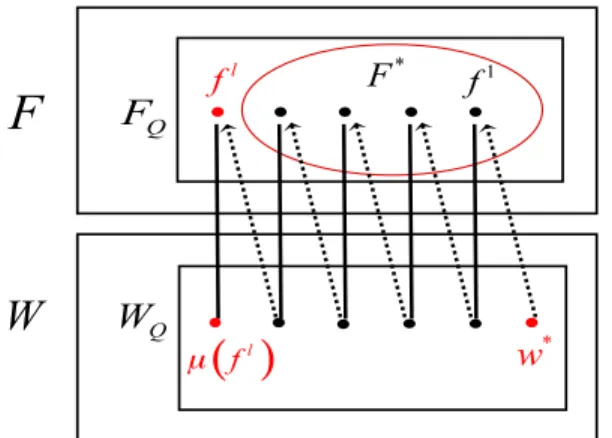
Figure 1. An Alternating Path fromw∗ toflin the Execution of Augment.
lengths more than 1.15
Figure 1 shows an alternating path from w∗ to a firm fl ∈ FQ\F∗. The dotted arrows connect currently unmatched pairs of firms and workers, indicating the next firm a worker would point to if the worker becomes self-matched, while the solid lines connect currently matched pairs of firms and workers in the alternating path. In exe- cuting Augment, we start with the last unmatched pair fl, wl−1
, and match every pair connected by dotted arrows sequentially until we reach the pair with (f1, w∗).
After one round of Augment, an additional firmflis treated with the payoff increase and is then added to setF∗. Moreover, workerµ fl
becomes the unmatched worker w∗, who initiates the next alternating path for the next round of Augment if the updated F∗ is not equal to FQ.
Intuitively, the complex nature of the Main Algorithm, especially in Augment, is a direct consequence of the constraint that every involved adjustment has to be consistent with weak pair improvements. We are now ready to prove the convergence of the Main Algorithm.
Theorem 2 For any individually rational allocation(µ, u)that satisfies the restricted situation, the Main Algorithm always finds a stable allocation after a finite number of weak pair improvements.
Proof. If Step 4 is not executed throughout the algorithm, then it is easy to see the validity of the algorithm. We next prove the validity of Step 4 when cycles arise.
Suppose that Step 4 is executed. Let FQ (resp., WQ) be the set of firms f (resp., workers w) whose matched partners change at least once during the cycle according to the updating of µ. We first show that whenever F∗ 6= FQ, there exists a desired alternating path from w∗ to a firm fl ∈ FQ\F∗ and that all other firms involved in the alternating path are in F∗. Suppose by way of contradiction that there does
15Indeed, it is possible that all alternating paths in the execution of (*) may have length 1. We show in Example 4 that for some asymmetric markets, alternating paths with length more than 1 might have to be employed.
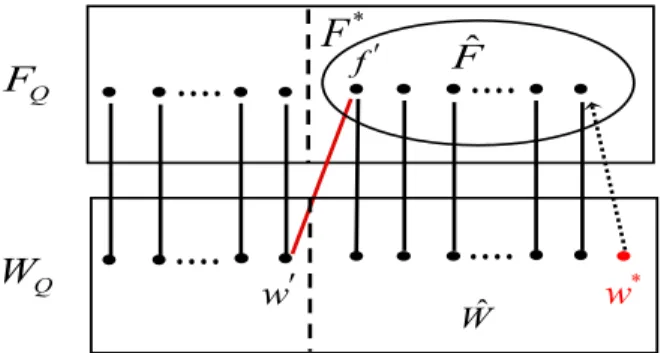
not exist any such alternating path for (µ, uk) from w∗ to FQ \F∗. Let ˆF and ˆW, respectively, be the set of all firms and that of all workers inFQ∪WQ reachable from w∗ by alternating paths for (µ, uk).16 Notice that by our construction of the cycle and the assumption of no legitimate alternating path from w∗ to FQ\F∗, we have Fˆ ⊆ F∗ ⊂ FQ and ˆW ⊂ WQ. Namely, all agents reachable from w∗ by alternating paths for (µ, uk) have to be in FQ∪WQ.
Given such ˆF and ˆW and the assumption of non-existence of desired alternating paths, we have
|Fˆ|+ 1 =|Wˆ|, |FQ\Fˆ|=|WQ\Wˆ|>0 (2) and
∃/matched (f, w) :w∈W ,ˆ f ∈(FQ\Fˆ)∩Fw uk
, (3)
where observe thatFw is defined with respect touk. Condition (2) is derived from the definition of ˆF and ˆW, as well as the fact that we start from the restricted situation with only one self-matched worker and every matching arising in the cycle has only one self-matched worker. According to (3), no worker in ˆW can be matched with firms in (FQ\Fˆ).17 Notice in particular that (2) and (3) jointly imply that matched pairs in ˆF ∪Wˆ are disjoint from those in
FQ\Fˆ
∪
WQ\Wˆ
in the sense that no agent in ˆF ∪Wˆ is matched with an agent in
FQ\Fˆ
∪
WQ\Wˆ .
Now during the cycle, we have a matching that matches all f ∈ FQ to workers.
Equation (3) and the fact of all agents inFQ∪WQ being involved in the single cycle then jointly imply that there must exist a matched pair (f0, w0) such that f0 ∈ Fˆ and w0 ∈ WQ \ Wˆ. (Notice that (i) because the cycle uses lists Lw (w ∈ WQ) and each Lw has been exhausted entirely at least once during the cycle, we have FQ = ∪w∈WQFw uk
, and (ii) worker w ∈ WQ\Wˆ cannot point to a firm f ∈ Fˆ either as this contradicts the fact that ˆW is the set of all workers in WQ reachable from w∗ by alternating paths for (µ, uk).) However, f0 cannot be matched to w0 since FQ\Fˆ must be matched to WQ\Wˆ due to (2) and (3).18 This contradiction establishes the existence of a desired alternating path in the execution of (*).
We next show that every adjustment executed in Augment is consistent with weak pair improvements. Let (f1, w0=w∗), (f1, w1=µ(f1)), (f2, w1), (f2, w2=µ(f2)),· · ·, (fl−1, wl−1=µ(fl−1)), (fl, wl−1)) be an alternating path found in (*) in Step 4 for some positive integer l. (Note that µ(fl) becomes the unique self-matched worker after Augment, which is precisely the w∗ for the next round of Augment.)
16Here, an agent (a firm or a worker) is reachable fromw∗if the agent is a member in a legitimate alternating path originates fromw∗. By definition,w∗∈Wˆ.
17In addition, for unmatched pairs in the alternating paths, all workers in ˆW can only “point” to firms in ˆF as well. See Figure 2 for a graphical illustration.
18Alternatively, if f0 ∈Fˆ is matched withw0 ∈WQ\Wˆ, we then cannot have that|FQ\Fˆ|=
|WQ\Wˆ|>0 and that firms inFQ\Fˆ are exactly matched with workers inWQ\Wˆ.