INVITED PAPER
Special Section on Advanced Log Processing and Office Information SystemsToward More Secure and Convenient User Authentication in Smart Device Era
Yasushi YAMAZAKI†a)andTetsushi OHKI††,Members
SUMMARY With the rapid spread of smart devices, such as smart- phones and tablet PCs, user authentication is becoming increasingly im- portant because various kinds of data concerning user privacy are processed within them. At present, in the case of smart devices, password-based au- thentication is frequently used; however, biometric authentication has at- tracted more attention as a user authentication technology. A smart device is equipped with various sensors, such as cameras, microphones, and touch panels, many of which enable biometric information to be obtained. While the function of biometric authentication is available in many smart devices, there remain some problems to be addressed for more secure and conve- nient user authentication. In this paper, we summarize the current problems with user authentication on smart devices and propose a novel user authen- tication system based on the concept of context awareness to resolve these problems. We also present our evaluation of the performance of the system by using biometric information that was acquired from smart devices. The evaluation demonstrates the effectiveness of our system.
key words: smart device, user authentication, biometrics, context aware- ness, environment recognition
1. Introduction
Smart devices, such as smartphones and tablet PCs, are con- sidered to be the most influential information and communi- cation devices from the viewpoint of their growing number and the data traffic they produce in the Internet of Things (IoT) era[1]. Moreover, they are also the most familiar and interactive devices in our daily life. For such smart devices, the implementation of information security functions, such as encryption and user authentication, is indispensable be- cause various kinds of data concerning user privacy, such as lifelogs, are frequently processed within them. At present, password-based authentication is primarily used for smart devices; however, active utilization of biometric authenti- cation[2],[3], which has advantages over password-based authentication in terms of security and convenience, should also be taken into account considering the possibility of de- veloping various smart-device-specific user services in the near future. Recently, the function of biometric authenti- cation, such as fingerprint recognition, has been provided for many smart devices; however, its use is still limited compared with password-based authentication. To further spread the use of biometric authentication on smart devices,
Manuscript received February 3, 2017.
Manuscript revised June 9, 2017.
Manuscript publicized July 21, 2017.
†The author is with The University of Kitakyushu, Kitakyushu- shi, 808–0135 Japan
††The author is with Shizuoka Univerisy, Hamamatsu-shi, 432–
8011 Japan
a) E-mail: [email protected] DOI: 10.1587/transinf.2016OFI0002
we should solve the following technical problems.
The first problem is that the variation in usage envi- ronments influences the authentication performance when using a biometric authentication function on smart devices.
The characteristics of biometric information fluctuate even in the same person, so various algorithms that allow for this fluctuation have been proposed. However, comparing smart devices with other devices, the former has a tendency of showing more obvious variation in biometric information.
For example, in the case of handwritten signatures, which are one biometric modality, the capture environment, such as the input means, e.g., fingers or a pen, writing posture, e.g., standing position or sitting position, and device posi- tion, e.g., held in the hand or put on a table, can frequently fluctuate in user authentication. Our recent study[4] re- vealed the fact that such variation in usage environments in the authentication process has no small effect on authentica- tion performance. High flexibility in usage environments is one of the most attractive characteristics of smart devices;
however, the variation in usage environments, which is dif- ficult to control on the system side, seriously affects the per- formance of biometric authentication, so the consideration of effective countermeasures becomes increasingly impor- tant.
The second problem is security issues that occur when using biometric information on smart devices. Nowadays, one of the biggest problems is the leakage of personal in- formation from smart devices whose users are not always highly security conscious. Unlike password-based authen- tication, biometric authentication, the security strength of which is not affected by a user’s security awareness, is an appropriate means of protecting personal information on smart devices. However, biometric information itself is the ultimate personal information, and once leaked, it cannot be changed unlike passwords, which is a biometric-specific vulnerability. Therefore, various methods for establishing the security of biometric templates[5]have been proposed.
However, many of them are based on sophisticated crypto- graphic algorithms that require a high computational com- plexity or high communication cost. As far as we know, few template protection methods have been proposed that are suitable for smart devices in which the computational complexity or memory capacity is limited. Therefore, there is an urgent need to develop a technology for protecting bio- metric information that is suitable for smart devices.
The third problem is that smart devices have various limitations compared with conventional PCs in terms of Copyright c⃝2017 The Institute of Electronics, Information and Communication Engineers
available resources, such as processor performance, mem- ory size, battery capacity, and physical size. In conventional PC-based biometric authentication, biometric data are usu- ally obtained from the stand-alone sensors and processed by using a PC. Small numbers of discussions have been made on the sizes of the sensors or the resources required for au- thentication processing. This discussion is inevitable when biometric authentication is applied to smart devices. It is controversial whether the conventional technologies can be applied to smart devices as they are. In some biometric au- thentication technologies that have already been provided for smart devices, it is true that the above problem has been partially cleared; however, more discussion on the resources of smart devices is needed to provide various biometric au- thentication functions to smart devices.
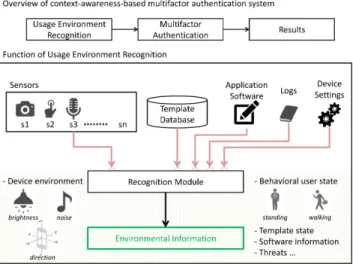
It is indispensable to address all these problems to es- tablish more secure and convenient user authentication for the coming smart device era; however, this would exceed the scope of this paper since the problems cover a very broad range of research topics. Therefore, in this paper, we pri- marily pay attention to how to balance security and conve- nience in smart-device-specific user authentication, which is mainly related to the first problem, and propose a novel user authentication system. An overview of our proposal is illus- trated in Fig.1. We call it a “context-awareness-based multi- factor authentication system.” In our approach, we focus on the concept of “context awareness,” which is detailed in the subsequent section, and develop a multifactor user authen- tication system by combining different kinds of authentica- tion factors, such as passwords and a few kinds of biometric information. As shown in Fig.1, the system recognizes its surrounding environment autonomously by using multiple sensors in the system and authenticates a user by selecting an appropriate authentication method adaptively, which en- hances not only the security but also the convenience of the system. The proposed system, detailed in the subsequent section, is an extension of our work[6],[7]and improves it in several ways.
Fig. 1 Overview of context-awareness-based multifactor authentication system
The remainder of the paper is organized as follows.
Related work is introduced and discussed in Sect. 2. Our approach is described in Sect. 3. Experimental results are shown in Sect. 4. We then conclude our work in Sect. 5.
2. Related Work
This section is a review of related work on context aware- ness, the main concept of our system.
To the best of our knowledge, the first appearance of the term “context awareness” dates back to the 1990’s in[8]
by Schilit et al. They defined context as the knowledge on a user’s and IT device’s state, including the surroundings, sit- uation, and, to a lesser extent, location. They classified con- text in terms of where you are, who you are with, and what objects are around you. Subsequently, many researchers have given various definitions to the term, as shown in[9]–
[12]. For example, Dey et al. [11]defined it as follows.
“Context is any information that can be used to characterize the situation of an entity. An entity is a person, place, or ob- ject that is considered relevant to the interaction between a user and an application, including the user and applications themselves.” They classified context in terms of location, identity, activity, and time.
The term “context awareness” is also defined in the above pieces of literature. Schilit et al. [8] defined it in terms of proximate selection, automatic contextual reconfig- uration, contextual information and commands, and context- triggered actions. Dey et al. [11]defined that a system is context-aware if it uses context to provide relevant informa- tion and/or services to the user, where relevancy depends on the user’s task. Chen et al.[12]defined it in terms of active and passive context awareness.
After the proposal by Schilit et al. [8], the main target of research on context awareness continued to be context recognition, whose purpose is to provide user services ac- cording to the context. Here, it should be noted that an appli- cation of context awareness for user authentication in terms of information security was not found until around 2005.
After the appearance of smartphones that contain sophisti- cated sensors such as accelerometers and global positioning system (GPS) functionality, the trend of applying context awareness in the research field of user authentication began to take place. Typical examples are shown in the application of recognizing gait with an accelerometer on a smartphone while considering the position the smartphone is being held in[13]–[16]. In these examples, the difference in authentica- tion accuracy was evaluated in specific usage environments, namely, different holding positions; however, the idea of the context awareness shown in [12], where an authentication algorithm is adjusted in accordance with a user’s context, has still yet to be reached. Some examples of authentica- tion algorithms that consider context awareness are shown in[17],[18]. Primo et al. [18]focused on 55 features that can be obtained from an accelerometer on a smartphone and clarified the effective features corresponding to the holding positions of the smartphone and showed that highly reliable
authentication can be achieved by selecting the appropriate features for each holding position. Moreover, Hayashi et al.
[17]proposed a scheme for selecting an appropriate authen- tication method to meet security demands. They focused on an authentication system that requires a user to input not a short PIN but a long password when he/she uses the system in a different place than usual or is in a crowd and defined it in a probabilistic framework.
Our approach to context awareness is related to the work of[17]and[18]. In particular, in the work of Hayashi et al. [17], they proposed context-aware scalable authenti- cation (CASA), which is not a specific but a general authen- tication framework, where the authentication methods are changed depending on the context. Their concept partially includes our idea; however, there are some differences as follows.
• Only the change of authentication methods is consid- ered, and an extension to multifactor authentication has yet to be done.
• The framework is proposed; however, experiments are conducted by using only PINs, passwords, and coarse positioning information as the context, and extension to biometric authentication is not discussed.
• As for security issues, only having the information on the context is discussed, yet security risks due to the invalid input of context or biometric information are not discussed.
Our approach is also related to current user authenti- cation methods, such as multifactor authentication, multi- modal biometric authentication, and risk-based authentica- tion, each of which is focused on enhancing security under the assumption of threats of forgery. In user authentication on smart devices that are highly portable and user oriented, it is important to maintain convenience while enhancing se- curity. Stable authentication even during vast changes in usage environments is considered to be an important fac- tor in deciding the level of convenience. However, in many cases, users are prone to use the same predetermined authen- tication method regardless of the usage environment, which means that current methods are not always appropriate for user authentication on smart devices in terms of coping with changes in usage environments. The originality of our ap- proach especially lies in selecting an optimal authentication method while enhancing convenience as well as security.
3. Context-Awareness-Based Multifactor Authentica- tion[6],[7]
In this section, we give an overview of our proposed method.
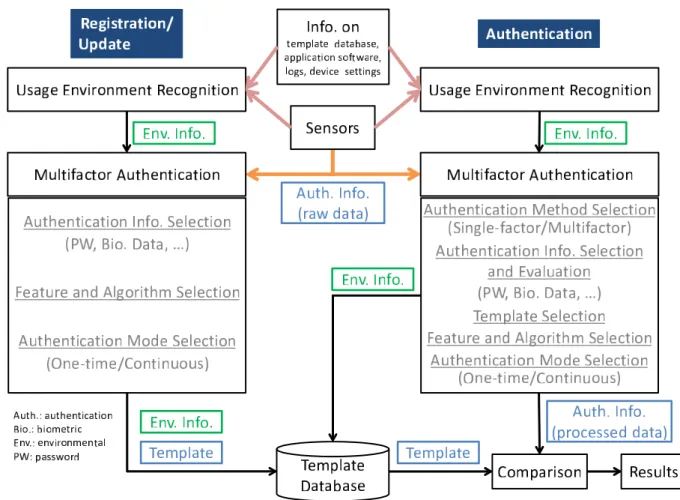
The proposed context-awareness-based multifactor authen- tication system is illustrated in Fig.2.
In our proposal, the concept of context awareness is included in the module of usage environment recognition shown in the same figure. The function of this recognition is detailed as follows.
• Recognition of device environment
The environment surrounding the device, e.g., bright- ness and noise, or the environment of the device itself, e.g., the direction the device is facing, is recognized by using sensors in the device. The recognition results are used, for example, as the information used by the system to decide that voice should not be used as au- thentication information when the device is used in a noisy place.
• Recognition of behavioral user state
The behavioral user state, e.g., resting state or walking state, is recognized by using sensors on the device. The recognition results are used, for example, as the infor- mation used by the system to decide that handwriting should not be used as authentication information when the user is walking because it would be difficult to write while walking.
• Acquisition of template state information
Information on the kind and number of biometric tem- plates registered in the system database or a lapse of time from the registration or the last update of a tem- plate is acquired. The acquired information is used, for example, by the system to decide that the system re- quires the user to update biometric information when a period of time has passed since the last update.
• Acquisition of application software information Information on the application software used or being used is acquired. The acquired information is used, for example, by the system to decide whether the system should conduct voice-based continuous user authenti- cation[3]when the user is activating verbal communi- cation software, such as voice chat.
• Acquisition of operation, usage, and behavioral logs Information on the operation log of a device, the usage log of application software, and the behavioral log of a user is acquired for the purpose of demanding user authentication when the user operates the device in a different manner than usual.
• Detection of threats
Threats against the device by a malicious third party, e.g., the invalid operation against sensors, are detected.
The detected information is used, for example, by the system to decide whether the system should stop using a face image temporarily for authentication informa- tion when it is clear that an attacker has tried to alter the measurement value of illuminance around the de- vice invalidly by shading a brightness sensor intention- ally in the authentication process.
• Acquisition of security/usability level
Information is acquired on the desired preset security level for each piece of application software and on the usability level regarding the level of convenience in au- thentication, which is set by a user. The acquired infor- mation is used, for example, by the system to decide the appropriate authentication method for a device un- lock application, a money transfer application, and so on.
Fig. 2 Context-awareness-based multifactor authentication system
In the proposed method, the registration/update pro- cess and authentication process are conducted by using envi- ronmental information that is generated by using the above function of usage environment recognition.
In the registration/update process, authentication infor- mation is selected and input, and templates are registered or updated. In this paper, we call such information that is input by a user and used for authentication “authentication information.” A password or a piece of biometric data are both examples of authentication information. Moreover, au- thentication information, especially that for registration in a template database, is called a “template.” In the initial regis- tration, a user inputs his/her authentication information, the type of which is selected by the system on the basis of the environmental information. The system registers both the template and the corresponding environmental information in the template database. For example, when the type of au- thentication information is a face image, the extracted fea- tures of a user’s face image are regarded as a template, and the measurement value of the illuminance around the system at the moment the face image is input is regarded as the en- vironmental information. Here, it should be noted that when the type of authentication information is biometric data, the feature and the algorithms of preprocessing and feature ex- traction are also selected on the basis of the environmental
information with a view toward enhancing the verification accuracy. After the initial registration, the user conducts an additional registration and update of templates upon notifi- cation by the system when the system decides that those are necessary on the basis of the result of recognizing the usage environment. As mentioned above, the system requests the user to input the least amount of authentication information during the initial registration and also requests him/her to add and update the templates on a timely basis in the process of using the system, which avoids degrading convenience by letting the user input all the authentication information at the same time.
In the authentication process, authentication informa- tion is selected and input, then the information and tem- plates are compared. First, on the basis of the result of recognizing the usage environment, the system selects the authentication method. In this process, the system decides on either single-factor authentication, which uses a single kind of authentication information, or multifactor authenti- cation, which uses multiple different kinds of authentication information. Moreover, in the case of multifactor authen- tication, the system also evaluates the types and reliability (weights) of the authentication information used. With these mechanisms, the system tries to keep the authentication ac- curacy high in various usage environments and optimize the
amount of authentication information needed. Next, the user sequentially inputs the authentication information that was requested by the system, and the system selects the optimal template that corresponds to the most similar environmental information from the template database with a view toward enhancing the verification accuracy and outputs the authen- tication results by comparing the authentication information with the selected template.
Furthermore, the proposed system can be operated in a continuous authentication mode[3] as well as a conven- tional one-time authentication mode. Currently, most smart devices employ a one-time user authentication scheme in which an authentication system only authenticates a user when he/she tries to login or unlock the device. However, this scheme is not always good enough for securing smart devices when we consider that various kinds of data con- cerning user privacy are frequently processed within them.
To overcome this problem, many continuous authentication methods that continuously authenticate a user the entire time that the user is operating a device have been proposed[3].
In continuous authentication, acquiring authentication in- formation while the user is unaware is a key requirement;
however, in the case of smart devices, this is often difficult due to the variation in usage environments, which causes the verification accuracy to degrade. To address this problem, we tried to extend our former system to be able to conduct continuous authentication with a view toward enhancing the verification accuracy by using the function of usage envi- ronment recognition[19].
4. Experiments
In this section, we present our evaluation of the performance of the proposed system, especially focusing on the effective- ness of recognizing the usage environment in terms of con- text awareness.
4.1 Template Selection
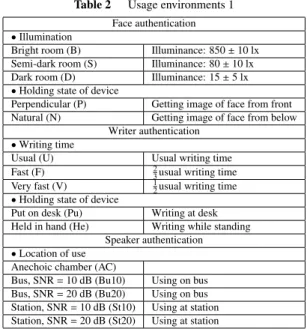
First, we evaluated the effectiveness of selecting an appro- priate template on the basis of the result of recognizing the usage environment. In this subsection, we briefly quote our main results described in [7]. In the experiment, we re- garded face, signature, and voice, which can be acquired with most smart devices, as authentication information and assumed that such templates that correspond to different us- age environments have already been registered along with environmental information in the template database shown in Fig.2. Moreover, the system selects the template that cor- responds to the most similar environmental information and compares the authentication information with the selected template. Table 1 lists the experimental conditions, and Ta- ble 2 lists the usage environments we evaluated.
Table 3 lists the verification accuracies of multifactor authentication in various usage environments. The left part of the table shows the combination of usage environments used in the authentication process. The right part shows
the verification accuracies in terms of the equal error rate (EER). Both shown in the same table are the EER with and without usage environment recognition and the EER with a weight that corresponds to the verification accuracy in a certain modality. The best cases (No.1–No.5) and the worst (No.6–No.10) in terms of EER are extracted from all of the
Table 1 Experimental conditions 1
Face auth. Writer auth. Speaker auth.
Device Apple iPad Air, MD789J/A
# of subjects 10
Specification Face image from front
Japanese signature Japanese speech Input means Built-in camera
(1.2 Mpixel)
Finger (200 Hz, 0.01 mm)
Built-in mic.
(44.1 kHz, 16 bit) Features LBP[20],
ILBP[21]
(x,y) time series,
# of pen-ups
MFCC[22]
Comparison Bhattacharyya distance
DTW[23],
∆# of pen-ups
Euclidean distance
# of intrap.
comparison 150
# of interp.
comparison 1620
Fusion Z-score
auth.: authentication, mic.: microphone LBP: local binary pattern, ILBP: improved LBP
MFCC: mel-frequency cepstrum coefficients, DTW: dynamic time warping intrap.: intrapersonal, interp.: interpersonal,∆: difference
Table 2 Usage environments 1 Face authentication
•Illumination
Bright room (B) Illuminance: 850±10 lx Semi-dark room (S) Illuminance: 80±10 lx Dark room (D) Illuminance: 15±5 lx
•Holding state of device
Perpendicular (P) Getting image of face from front Natural (N) Getting image of face from below
Writer authentication
•Writing time
Usual (U) Usual writing time
Fast (F) 23usual writing time Very fast (V) 12usual writing time
•Holding state of device
Put on desk (Pu) Writing at desk Held in hand (He) Writing while standing
Speaker authentication
•Location of use Anechoic chamber (AC)
Bus, SNR=10 dB (Bu10) Using on bus Bus, SNR=20 dB (Bu20) Using on bus Station, SNR=10 dB (St10) Using at station Station, SNR=20 dB (St20) Using at station
Table 3 Verification accuracy of multifactor authentication
Usage environment EER (%)
No. Face Writer Speaker W/o recog. With recog. With weight
1 BP HeV AC 0.00 1.38 0.00
2 BP PuU Bu20 0.00 1.38 0.00
3 BP HeU St20 0.00 1.35 0.06
4 BP PuV Bu10 0.00 1.35 0.00
5 BP PuF Bu20 0.00 1.35 0.00
6 DN PuF St10 26.39 1.31 0.00
7 DN HeF St10 27.28 1.35 0.00
8 DN HeV St10 27.52 1.35 0.00
9 DN PuV St10 28.20 1.31 0.00
10 DP HeV St10 27.92 0.12 0.00
Avg. of all 180 environments 9.90 0.72 0.09 Max. of all 180 environments 28.20 2.72 1.44
Min. of all 180 environments 0.00 0.00 0.00
recog.: recognition
results. As shown, the proposed system improved the ver- ification accuracy by selecting an appropriate template and weighting on the basis of using the function of environment recognition.
4.2 Feature/Algorithm Selection
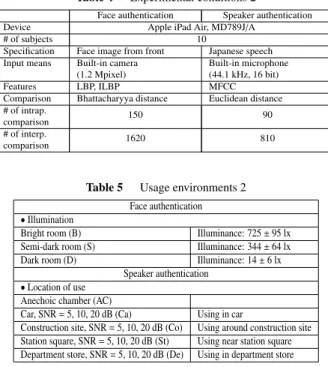
Next, we evaluated the effectiveness of selecting an appro- priate feature and algorithm on the basis of the result of rec- ognizing the usage environment. As clarified in the former subsection, selecting an appropriate template improves the verification accuracy; however, more improvement can be expected by selecting an appropriate feature and algorithm on the basis of the recognition result. In this subsection, we briefly quote our main results described in[24]. The following was clarified from preliminary experiments. For face authentication, there was a tendency for the verifica- tion accuracy to be high when using the local binary pat- tern (LBP)[20]as the feature under the condition that there exist some templates that were generated in a similar us- age environment. In contrast, the verification accuracy was high when using an improved LBP (ILBP)[21]as the fea- ture under the condition that there exists no template that was generated in a similar usage environment. Since ILBP can further emphasize the edges of an image compared with LBP, it is considered that the verification accuracy was high when the difference in luminance between two images was large, and the verification accuracy was low when the differ- ence in luminance was small. Therefore, in the experiment, we calculated the difference in luminance between a tem- plate and a piece of authentication information input in the authentication process, and we used LBP when the differ- ence was not greater than 0.1, or we otherwise used ILBP. In comparison, in speaker authentication, there was a tendency for the verification accuracy to be improved when spectral subtraction (SS)[25], which is a typical method for noise reduction in speech engineering, was applied to speech data including human voice as background noises. Therefore, in the experiment, we calculated the rate of spectral intensity ranging from 0.4 to 4 kHz, which corresponds to the voice frequency band. We used SS when the rate was not less than 0.2; otherwise, we did not apply noise reduction. In the experiment, we regarded face and voice as authentica- tion information. Table 4 lists the experimental conditions, and Table 5 lists the usage environments we evaluated. As shown in the table, there existed a combination of usage en- vironments, such as “bright room” and “dark room,” whose luminances were quite different, and also some usage envi- ronments, such as “station square” and “department store,”
which included human voice as background noises.
Table 6 lists the verification accuracies of authentica- tion with feature/algorithm selection in terms of the EER averaged over different usage environments. As shown in the table, the proposed system improved the verification ac- curacy by selecting an appropriate feature and algorithm on the basis of environment recognition.
Table 4 Experimental conditions 2
Face authentication Speaker authentication
Device Apple iPad Air, MD789J/A
# of subjects 10
Specification Face image from front Japanese speech Input means Built-in camera
(1.2 Mpixel)
Built-in microphone (44.1 kHz, 16 bit)
Features LBP, ILBP MFCC
Comparison Bhattacharyya distance Euclidean distance
# of intrap.
comparison 150 90
# of interp.
comparison 1620 810
Table 5 Usage environments 2 Face authentication
•Illumination
Bright room (B) Illuminance: 725±95 lx Semi-dark room (S) Illuminance: 344±64 lx Dark room (D) Illuminance: 14±6 lx
Speaker authentication
•Location of use Anechoic chamber (AC)
Car, SNR=5, 10, 20 dB (Ca) Using in car
Construction site, SNR=5, 10, 20 dB (Co) Using around construction site Station square, SNR=5, 10, 20 dB (St) Using near station square Department store, SNR=5, 10, 20 dB (De) Using in department store
Table 6 Verification accuracy of authentication with feature/algorithm selection
Modality Feature/algorithm EER (%)
Face LBP (fixed) 16.1
ILBP (fixed) 8.4
proposal 7.5
Voice w/o noise reduction (fixed) 8.1
SS (fixed) 8.2
proposal 6.8
4.3 Continuous Authentication
Finally, we evaluated the possibility of continuous authen- tication on the basis of the result of recognizing the usage environment. In this subsection, we briefly quote our main results described in [19]. In the experiment, we regarded face, flick operation, and voice as authentication informa- tion. Table 7 lists the experimental conditions, and Table 8 lists the usage environments we evaluated. The biometric data in Table 7 were collected in a manner much similar to a real continuous authentication scenario.
Table 9 lists the recognition and verification accuracies for continuous authentication under various usage environ- ments. For face authentication, the recognition rate was the highest when a user was standing and holding the device naturally and the lowest when the user was sitting and plac- ing the device on the desk. Apparently, one of the reasons for the former case being outperformed lies in the distance between the face and the device. In the former case, the dis- tance was large to some extent, which enabled a whole face image to be captured clearly. In the latter case, however, the distance was small in some cases, which lead to failure in capturing the whole face image. These results suggest that, if the system recognizes the behavioral user state and
Table 7 Experimental conditions 3
Face auth. Writer auth. Speaker auth.
Device Asus Zenfone 2 Laser Arrows NX F-04G Asus Zenfone 2 Laser
# of subjects 10
Specification Face image from front
(6 times every 2 sec.)
Flick operation (10 times upward)
Japanese speech (6 times,∼2.4 sec.
per sentence) Sensor Built-in camera
(5.0 Mpixel)
Touch panel (1440×2560 pix- els)
Built-in mic.
(44.1 kHz, 16 bit)
Features LBP, ILBP Features in[26] MFCC
Comparison Bhattacharyya distance
Normalized Euclidean distance
Euclidean distance
# of intrap.
comparison 90 150 360
# of interp.
comparison 540 3240 3240
Table 8 Usage environments 3 Face authentication
•Holding state of device
Sitting (Si) Sitting and holding naturally Placing (Pl) Sitting and placing on desk Standing (St) Standing and holding naturally Walking (Wa) Walking and holding naturally
Writer authentication
•Application software information WWW browser (W) Browsing web pages Photo viewer (P) Browsing photos
Speaker authentication
•Holding state of device
Sitting (Si) Sitting and holding naturally Walking (Wa) Walking and holding naturally
Table 9 Recognition/verification accuracy for continuous authentication Performance
Modality Environment Recog. rate EER
(%) (%)
Face Si 71.7 —
Pl 35.0 —
St 88.3 —
Wa 75.0 —
Flick W — 8.0
P — 4.6
Voice Si — 14.9
Wa — 20.2
selects a stable usage environment, such as (St) in Table 8, by using the function of usage environment recognition, the verification performance is expected to be improved. For writer authentication, the verification accuracy was higher when a user was browsing photos than when the user was browsing web pages. We believe that this is because the flick operation is prone to being more constant and stable in photo browsing than in web browsing because the types of content are different; the former contains only photos, and the latter contains various kinds of characters and pictures, which may further affect the finger movement of the user.
These results also suggest that, if the system acquires in- formation on application software being used and selects a stable usage environment, such as (P) in Table 8, by using the function of usage environment recognition, the verifica- tion performance is expected to be improved. For speaker authentication, the verification accuracy was more degraded
when a user was walking than when the user was sitting.
The reason is considered to be that stable collection of voice was difficult when the user was walking due to the oscilla- tion of the device. Again, these results suggest that, if the system recognizes the behavioral user state and selects a sta- ble usage environment, such as (Si) in Table 8, by using the function of usage environment recognition, the verification performance is expected to be improved.
5. Conclusion
In this paper, we summarized the current problems with user authentication on smart devices and proposed a novel user authentication system based on the concept of context awareness to address these problems. We also presented our evaluation of the performance of the system by using bio- metric information that was acquired from smart devices.
The evaluation demonstrated the effectiveness of our sys- tem. The full realization of a context-awareness-based mul- tifactor authentication system that satisfies all the require- ments described in the first section will be our principal area of study.
Acknowledgments
Part of this work was supported by JSPS KAKENHI Grant Number JP16K00190. The authors would like to thank the laboratory students for their support.
References
[1] T. Barnett Jr., A. Sumits, T. Khurana, U. Andra, and R. Pepper,
“Cisco visual networking index: Global mobile data traffic forecast update, 2015–2020,” Cisco Public, 2016.
[2] L.M. Mayron, “Biometric authentication on mobile devices,” IEEE Security & Privacy, vol.13, no.3, pp.70–73, 2015.
[3] V.M. Patel, R. Chellappa, D. Chandra, and B. Barbello, “Continu- ous user authentication on mobile devices — Recent progress and remaining challenges,” IEEE Signal Process. Mag., vol.33, no.4, pp.49–61, 2016.
[4] S. Onoda, Y. Goubaru, and Y. Yamazaki, “A study on the perfor- mance of a mobile terminal-based signature verification system un- der different writing environments (in Japanese),” IEICE Trans. Fun- damentals (Japanese Edition), vol.J98-A, no.12, pp.664–667, 2015.
[5] K. Nandakumar and A.K. Jain, “Biometric template protection:
Bridging the performance gap between theory and practice,” IEEE Signal Process. Mag., vol.32, no.5, pp.88–100, 2015.
[6] R. Okabe, T. Higashi, Y. Yamazaki, and T. Ohki, “A smart device- based multifactor authentication system based on context awareness (in Japanese),” IEICE Technical Report, BioX2015-47, pp.37–42, 2016.
[7] R. Okabe, T. Higashi, Y. Yamazaki, and T. Ohki, “A study for a con- text awareness-based multifactor authentication system using smart devices (in Japanese),” IEICE Trans. Fundamentals (Japanese Edi- tion), vol.J99-A, no.12, pp.467–470, 2016.
[8] B. Schilit, N. Adams, and R. Want, “Context-aware computing ap- plications,” IEEE Workshop on Mobile Computing Systems and Ap- plications, pp.85–90, 1994.
[9] P.J. Brown, J.D. Bovey, and X. Chen, “Context-aware applications:
From the laboratory to the marketplace,” IEEE Pers. Commun., vol.4, no.5, pp.58–64, 1997.
[10] N. Ryan, J. Pascoe, and D. Morse, “Enhanced reality fieldwork: The
context-aware archaeological assistant,” Computer Applications in Archeology, 1997.
[11] A.K. Dey and G.D. Abowd, “Towards a better understanding of con- text and context-awareness,” Workshop on the What, Who, Where, When, and How of Context-Awareness, as part of the 2000 Confer- ence on Human Factors in Computing Systems (CHI 2000), 2000.
[12] G. Chen and K. David, “A survey of context-aware mobile com- puting research,” Dartmouth Computer Science Technical Report, TR2000-381, 2000.
[13] E. Vildjiounaite, S.M. M¨akel¨a, M. Lindholm, R. Riihim¨aki, V.
Kyll¨onen, J. M¨antyj¨arvi, and H. Ailisto, “Unobtrusive multimodal biometrics for ensuring privacy and information security with per- sonal devices,” 4th Intl. Conf. on Pervasive Comput., pp.187–201, 2006.
[14] J.R. Kwapisz, G.M. Weiss, and S.A. Moore, “Cell phone-based bio- metric identification,” 2010 Fourth IEEE International Conference on Biometrics: Theory Applications and Systems (BTAS), pp.1–7, 2010.
[15] T. Kobayashi, K. Hasida, and N. Otsu, “Rotation invariant feature extraction from 3-D acceleration signals,” 2011 IEEE Intl. Conf. on Acoustics, Speech, Signal Process. (ICASSP), pp.3684–3687, 2011.
[16] J.X. Felix, C. Bhagavatula, A. Jaech, U. Prasad, and M. Savvides,
“Gait-id on the move: Pace independent human identification us- ing cell phone accelerometer dynamics,” 2012 Fifth IEEE Interna- tional Conference on Biometrics: Theory Applications and Systems (BTAS), pp.8–15, 2012.
[17] E. Hayashi, S. Das, S. Amini, J. Hong, and I. Oakley, “CASA:
Context-aware scalable authentication,” Symposium on Usable Pri- vacy and Security (SOUPS) 2013, pp.1–10, 2013.
[18] A. Primo, V.V. Phoha, R. Kumar, and A. Serwadda, “Context- aware active authentication using smartphone accelerometer mea- surements, CVPR 2014, pp.98–105, 2014.
[19] T. Higashi, T. Agawa, R. Okabe, Y. Yamazaki, and T. Ohki, “A study on continuous user authentication for smart devices considering us- age environment (in Japanese),” SCIS2017, 3D4-2, 2017.
[20] T. Ojala, M. Pietik¨ainen, and D. Harwood, “A comparative study of texture measures with classification based on feature distributions,”
Pattern Recognit., vol.29, no.1, pp.51–59, 1996.
[21] H. Jin, Q. Liu, H. Lu, and X. Tong, “Face detection using improved LBP under Bayesian framework,” Proc. Third International Confer- ence on Image and Graphics (ICIG’04), pp.306–309, 2004.
[22] L. Rabiner and B.H. Juang, “Fundamentals of speech recognition,”
Prentice Hall, 1993.
[23] H. Sakoe and S. Chiba, “Dynamic programming algorithm optimiza- tion for spoken word recognition,” IEEE Trans. Acoust., Speech, Signal Process., vol.26, no.1, pp.43–49, 1978.
[24] T. Higashi, R. Okabe, Y. Yamazaki, and T. Ohki, “A study on im- proving authentication accuracy for a multifactor authentication sys- tem considering usage environment (in Japanese),” IEICE Technical Report, BioX2016-29, pp.67–72, 2016.
[25] S. Boll, “Suppression of acoustic noise in speech using spectral subtraction,” IEEE Trans. Acoust., Speech, Signal Process., vol.27, no.2, pp.113–120, 1979.
[26] Y. Matsubara, H. Nishimura, T. Samura, H. Yoshimoto, and R.
Tanimoto, “A new biometrics technique with flick operation on elec- tronic device (in Japanese),” IEICE Technical Report, BioX2015-39, pp.91–96, 2015.
Yasushi Yamazaki received the BE and ME degrees in electronics and communication engi- neering from Waseda University, Tokyo, Japan, in 1993 and 1995, respectively, and the PhD de- gree in electronics, information and communi- cation engineering from Waseda University in 1998. He is currently an associate professor in the Department of Information and Media Engi- neering at the University of Kitakyushu, Fuku- oka, Japan. His research interests include bio- metrics, information security, and pattern recog- nition.
Tetsushi Ohki received the BE and ME degrees in electronics and communication engi- neering from Waseda University, Tokyo, Japan, in 2002 and 2004, respectively, and the PhD degree in engineering from Waseda University in 2010. He is currently a lecturer in the Fac- ulty of Informatics, Shizuoka University, Japan.
His research interests include biometrics, pat- tern recognition, information security and pri- vacy.