IEICE TRANS. FUNDAMENTALS, VOL.E104–A, NO.1 JANUARY 2021
343
LETTER
Unsupervised Deep Embedded Hashing for Large-Scale Image Retrieval ∗
Huanmin WANG†a),Member
SUMMARY Hashing methods have proven to be effective algorithm for image retrieval. However, learning discriminative hash codes is challenging for unsupervised models. In this paper, we propose a novel distinguishable image retrieval framework, named Unsupervised Deep Embedded Hashing (UDEH), to recursively learn discriminative clustering through soft clus- tering models and generate highly similar binary codes. We reduce the data dimension by auto-encoder and apply binary constraint loss to reduce quantization error. UDEH can be jointly optimized by standard stochastic gradient descent (SGD) in the embedd layer. We conducted a comprehen- sive experiment on two popular datasets.
key words: hashing, unsupervised learning, deep learning
1. Introduction
Recently, in order to solve the problem of retrieval in large-scale images [19], the computer vision community has focused on hashing algorithm which learns similarity- preserving binary codes. Encoding a high-dimensional im- age descriptor into a compact binary codes can improve storage efficiency and computational efficiency of similar searches, and can be implemented using data structures and algorithms that are simpler than other large-scale retrieval methods. The existing unsupervised hashing algorithms can be simply classified into two main types according to whether similarity information is precomputed before training. The first class usually directly employs deep neural networks to generate binary codes with some external constraints. For example, Deep Hashing (DH)[2] and Deepbit [3] exploit evenly distribution loss and the quantization loss to optimize the generated binary codes, which can only preserve the vari- ance of binary codes but cannot obtain the real distribution of the raw data. To preserve more information through deep models without pre-computed similarities, some researchers leverage self-supervised algorithms such as reconstruction [4]or discriminator[5], which can help to improve the re- trieval performance. However, they still have the common issues as DH and Deepbit and the performance is limited.
Methods of the second type try to conserve the simi- larities of the original data. Anchor Graph Hashing (AGH) [6] utilize the dense anchor map to obtain low rank adja-
Manuscript received May 19, 2020.
Manuscript revised June 15, 2020.
Manuscript publicized July 14, 2020.
†The author is with the Mechanical and Electronic Technology Institute of Lanzhou Jiaotong University, China.
∗This work was supported by the National Natural Science Foundation of China (No. 61563027).
a) E-mail: [email protected]
DOI: 10.1587/transfun.2020EAL2056
cency matrices and discover neighborhoods in the training data, but AGH contains all the similarity values of the whole datasets and some of them might be redundant, which of- ten leads to performance degradation. Pseudo label based methods[7],[8]convert the unsupervised learning into su- pervised manner by generating pseudo labels for training data. They apply clustering methods to generate pseudo la- bels, which can avoid useless similarity as they only preserve part of such information before training. However, most of them are sensitive to the pre-defined class number[9], which greatly limits their applications. Pseudo pair based methods generate similar and dissimilar pairs to avoid the problem of class number setting [10], [11], but it still need to de- fine the threshold of similarity for pair generation. Besides, these methods usually compute the pseudo labels or pseudo pairs in the high-dimensional visual feature space, which is computationally complex.
In order to solve the above problem, in this paper, we introduce a novel end-to-end deep hashing algorithm for im- age retrieval, namely Unsupervised Deep Embedded Hash- ing (UDEH), which is capable of iteratively learn to cluster in the network and yield binary codes with preserving the structures of the input data distributions. Our contributions can be summarized as follows: (1) We propose a novel hash- ing framework that imposes constraints on the clustering space. The generated binary code has spatial structure pro- tection; (2) Our UDEH is an end-to-end deep network where all objective functions can be optimized together by using a stochastic gradient decent (SGD) with mini batches, and our algorithm does not rely on pre-calculation.; (3) We conduct experiments on two challenging datasets (i.e., CIFAR-10[1], NUS-WIDE[12]), and the results show that our UDEH con- sumes very short runtime and has superior Mean Average Precision (MAP).
2. Unsupervised Deep Embedded Hashing Method Our task is to process a set of training samples X = {x1,x2,· · ·,xi,· · ·,xn} ∈ Rd×n, without labels, where d is the dimension of the image sample and nis the number of image samples. The purposed algorithm is to learn a set of compact binary codes B ={b1,b2,· · ·,bi,· · ·,bn} ∈ {−1,+1}r×n, which preserves the semantic similarity of the original data. Therefore, we need a valid hash function H : x → bto map the data to the low-dimensional Ham- ming space.
In order to learn the discriminative hash code, we assign Copyright © 2021 The Institute of Electronics, Information and Communication Engineers
344 IEICE TRANS. FUNDAMENTALS, VOL.E104–A, NO.1 JANUARY 2021
Fig. 1 An illustration of the proposed framework.
the hash layer after the reduced dimension to thek cluster centers. To solve this problem, Unsupervised Deep Embed- ded Hashing (UDEH) is designed to learn nonlinear hash functions with the following characteristics: t-distribution and binary quantization of learning image data. The entire learning framework consists of a feature extraction module, a pre-training module, and a model training module, as shown in Fig. 1. In the feature extraction module, we will generate a 4096 dimensional feature representation of the VGG-16 [13]model, Which has been pre-trained by imagenet. The parameters of the pre-training model are then initialized us- ing an auto-encoder consisting of four encoder layers and an equal number of decoder layers. The parameters of the pre- training model will then be transferred for use in a hashing model with the same auto-encoder structure. After perform- ing the automatic encoder pre-training, we obtain an initial estimate of the encoder’s nonlinear mapgθ. Inspired by DEC [14], we introduced the auxiliary distribution µj, which is initialized by the k-means algorithm. Students t-distribution like DEC is used to measure code pointziand centroidµj:
qi j = (1+kzi−µjk2)−1 P
j0(1+kzi−µj0k2)−1, (1)
We use the k-meas algorithm to initialize the centroidµjand iteratively optimize it like DEC[14]. In order to train the neural network, we need to introduce the target distribution instead of the ground truth. The target distribution can be represented as:
pi j = qi j2/sj
P`q2i`/s`, (2) where, sj = P
iqi j is the soft cluster frequency. Since it is known thatqi j represents for the probability of assigning data pointito class j, it should fall in the interval of [0,1].
The unknown ground truth forqi j is 0/1, thus, in order to bring the results closer to 0/1, an effective way is to square qi j and normalize it. After the process of Eq. (2), pi j is much closer to 0/1 than qi j, thence it can satisfy the first two properties. In addition,pi j is also the probability, so it should fall in the interval of [0,1] too. Thus, normalization in Eq. (2) can enhance the data assignment to centroid with high confidence, and normalize loss contribution of each
centroid to avoid over clustering in hidden code space. KL divergence is used to measure the similarity between two probability distributions, our effective loss function with KL divergence can be written as follows:
Lc=−1 n
Xn
i
Xk
j=1
pi jlogpi j
qi j; (3)
As our UDEH is a data-dependent approach, the clustering is required finding out the most suitable clusters while pre- serving the spatial structures of the raw data distribution.
The embedded pointzialso needs to be iterative for the clus- tering. To overcome this challenge, we exploit a decoder to reconstruct the input featurexi, where the reconstruction loss is measured by Mean Squared Error (MSE):
Lr = 1 n
n
X
i
kfi−gθ00(gθ(fi))k2, (4) where,gandg0are encoder and decoder respectively,firep- resents the 4096-dimensional VGG-16 feature of the sample andθandθ0are their corresponding network parameters.
3. Binary Quantization
In order to get the binary code, it is necessary to reduce the quantization error. Specifically, we use thetanhactivation function to constrain the intermediate layerzi such that the value of zi is in the interval [−1,1]. In addition, to further reduce the quantization error, we introduce the following loss function,
Lb=1 n
Xn
i
kzi−bik2, s.t. bi ∈ {−1,1}`
(5)
where,bi =sign(zi). The final loss function is defined as:
L=Lc+λ1Lr+λ2Lb
=−1 n
Xn
i
Xk
j=1
pi jlogpi j
qi j +λ1kfi−gθ00(gθ(fi))k2 +λ2kzi−bik2,
(6) 4. Optimization
We fixed the target distribution pi j and then calculated the gradient of Lcrelative to each projection data point zi and each cluster centerµj as:
∂L
∂zi =2
k
X
j=1
(1+kzi−µjk2)−1×(pi j−qi j)(zi−µj) +2λ1
n (fi−gθ00(zi))∂gθ00(zi)
∂zi +2λ2
n (zi−bi), (7)
LETTER
345
and each cluster centerµj are computed as,
∂L
∂ µj =−2 Xn
i=1
(1+kzi−µjk2)−1×(pi j−qi j)(zi−µj).
(8) The above gradient ∂∂zLi is passed down to the neural net- work and used to calculate its parameters in standard Back- Propagation (BP) Gradient ∂L∂θ, then θ can be used with θ=θ−η1∂L∂θ, whereη1is the learning rate.
5. Performance Analysis
Evaluation Metrics: The indicator for evaluating these al- gorithms is mean average precision (mAP). Suppose the re- turned P images has p right results, mAP can be defined as,
m AP= 1 p
p
X
i=1
i
Pi (9)
where,iis thei-th correct retrieved image, andPistands for the position of thei-th correct retrieved image in the returned queue.
We evaluate our UDTH and the baselines on three differ- ent lengths of binary code{16,32,64}. For the cifar dataset, we compute the mAP value from the top 1000 retrieved sam- ples. On NUS-Wide and MIRFLICKR-25k, the number is set as 5000. Besides, the Precision and Recall are also widely used in the field of classification and retrieval to express the performance, their definitions are,
Pr ecision= p
P, Recall= p
Q, (10)
where,Qis the total number of the image which share the same label with the query image in the dataset.
Results: Before discussing the experimental results, we first declare that all comparison experiments have the same input, that is, 4096-dimensional VGG-16 features. On CIFAR- 10, we randomly pick 100 images from each category for training and the left 5,900 images are included in test set.
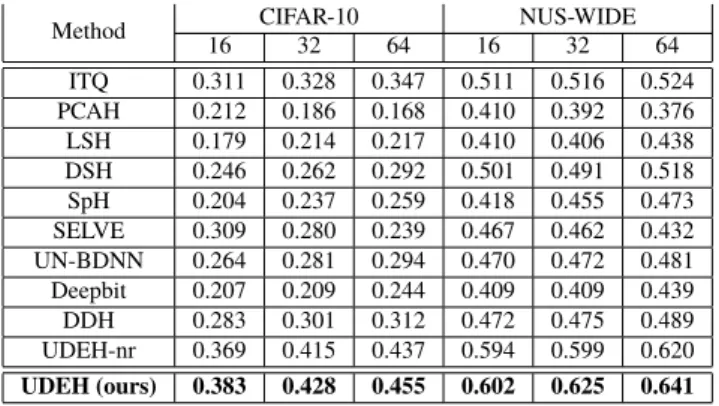
On NUS-WIDE, 2,100 images are randomly selected from the dataset for test and the remaining 157497 images are left for training. Leaing rate is 0.0001,λ1 =0.1 andλ2 =0.1, After learning the fixed-length binary code, our model enters the query image and returns the image from the training set according to the Hamming distance. Table 1 shows the performance of UDEH. We can see that the experimental results of UDEH on all bits are very good. In addition, we can see that as the bit size grows, the value of mAP increases steadily, so we can infer the algorithm to perform better on larger bit sizes. We also compare UDEH-nr (UDEH without Lr), the performance of UDEH-nr is slightly lower. Table 2 shows the advantages of our algorithm in time complexity, including Training time, Generation time and Search time.
From the data in the table, it is not difficult to find that the
Table 1 The following table shows the retrieval performance of 64-bit codes. (MAP@1,000 on CIFAR-10, and MAP@5,000 on NUS-WIDE).
Method CIFAR-10 NUS-WIDE
16 32 64 16 32 64
ITQ 0.311 0.328 0.347 0.511 0.516 0.524 PCAH 0.212 0.186 0.168 0.410 0.392 0.376 LSH 0.179 0.214 0.217 0.410 0.406 0.438
DSH 0.246 0.262 0.292 0.501 0.491 0.518
SpH 0.204 0.237 0.259 0.418 0.455 0.473 SELVE 0.309 0.280 0.239 0.467 0.462 0.432 UN-BDNN 0.264 0.281 0.294 0.470 0.472 0.481 Deepbit 0.207 0.209 0.244 0.409 0.409 0.439
DDH 0.283 0.301 0.312 0.472 0.475 0.489
UDEH-nr 0.369 0.415 0.437 0.594 0.599 0.620 UDEH (ours) 0.383 0.428 0.455 0.602 0.625 0.641
Table 2 The following table shows that our method consumes very little time, and unlike the pseudo-label algorithm, no pre-calculation is required.
Dataset CIFAR-10 NUS-WIDE
MAP 0.5673 0.7357
Training time (s) 561 1195
Generation time (s) 3.68 8.42
Search time (ms) 2.71 3.02
Fig. 2 The precision recall (PR) curve of CIFAR-10 and NUS-WIDE.
346 IEICE TRANS. FUNDAMENTALS, VOL.E104–A, NO.1 JANUARY 2021
algorithm in this paper consumes very little time to train and generate code, and does not require pre-training. Figure 2 shows the Precision Recall (PR) curve of the hash code on the CIFAR-10 and NUS-WIDE datasets. In order to evaluate the effectiveness of the proposed method, we compare the results of the proposed method and the comparison method, including DDH[10], UH-BDNN[4], ITQ[15], AGH[6], SpH[16], PCAH[17], LSH[18]. The length of the hash code in the CIFAR-10 experiment is 64 bits, and the NUS- WIDE experiment is 32 bits. From the curve we can see that the return image with the shortest distance from the query image Hamming has a high accuracy. The curve of our method is much higher than all other comparison methods, which proves the effectiveness of this algorithm.
6. Conclusion
Our proposed Unsupervised Deep Embedded Hashing (UDEH) performs clustering and quantification tasks si- multaneously in a low-dimensional space, and retains the structural information of the raw image with reconstruction loss. Compared with the previous image retrieval methods, UDEH has great advantages in terms of time complexity and retrieval precision.
References
[1] A. Krizhevsky and G. Hinton, “Learning multiple layers of features from tiny images,” Technical Report, Citeseer, 2009.
[2] V.E. Liong, J. Lu, G. Wang, P. Moulin, and J. Zhou, “Deep hashing for compact binary codes learning,” IEEE Conference on Computer Vision and Pattern Recognition, pp.2475–2483, 2015.
[3] K. Lin, J. Lu, C. Chen, and J. Zhou, “Learning compact binary de- scriptors with unsupervised deep neural networks,” IEEE Conference on Computer Vision and Pattern Recognition, pp.1183–1192, 2016.
[4] T.T. Do, A.D. Doan, and N.M. Cheung, “Learning to hash with binary deep neural network,” European Conference on Computer Vision, pp.219–234, 2016.
[5] K. Ghasedi Dizaji, F. Zheng, N. Sadoughi, Y. Yang, C. Deng, and H. Huang, “Unsupervised deep generative adversarial hashing net- work,” IEEE Conference on Computer Vision and Pattern Recogni- tion, pp.3664–3673, 2018.
[6] W. Liu, J. Wang, S. Kumar, and S.-F. Chang, “Hashing with graphs,”
International Conference on Machine Learning, pp.1–8, 2011.
[7] Q. Hu, J. Wu, J. Cheng, L. Wu, and H. Lu, “Pseudo label based unsupervised deep discriminative hashing for image retrieval,” ACM Conference on Multimedia, pp.1584–1590, 2017.
[8] J. Song, L. Gao, Y. Yan, D. Zhang, and N. Sebe, “Supervised hashing with pseudo labels for scalable multimedia retrieval,” ACM Confer- ence on Multimedia, pp.827–830, 2015.
[9] L. Xie, L. Zhu, P. Pan, and Y. Lu, “Cross-modal self-taught hashing for large-scale image retrieval,” Signal Process., vol.124, pp.81–92, 2016.
[10] J. Song, T. He, H. Fan, and L. Gao, “Deep discrete hashing with self- supervised pairwise labels,” The European Conference on Machine Learning and Principles and Practice of Knowledge Discovery in Databases, pp.223–238, 2017.
[11] E. Yang, C. Deng, T. Liu, W. Liu, and D. Tao, “Semantic structure- based unsupervised deep hashing,” International Joint Conferences on Artificial Intelligence, pp.1064–1070, 2018.
[12] T.-S. Chua, J. Tang, R. Hong, H. Li, Z. Luo, and Y. Zheng, “NUS- WIDE: A real-world web image database from national university of singapore,” International Conference on Image and Video Retrieval, 2009.
[13] K. Simonyan and A. Zisserman, “Very deep convolutional net- works for large-scale image recognition,” International Conference on Learning Representations, pp.1–29, 2015.
[14] J. Xie, R. Girshick, and A. Farhadi, “Unsupervised deep embed- ding for clustering analysis,” International Conference on Machine Learning, pp.478–487, 2016.
[15] Y. Gong, S. Lazebnik, A. Gordo, and F. Perronnin, “Iterative quan- tization: A procrustean approach to learning binary codes for large- scale image retrieval,” IEEE Trans. Pattern Anal. Mach. Intell., vol.35, no.12, pp.2916–2929, 2013.
[16] J.P. Heo, Y. Lee, J. He, S.F. Chang, and S.E. Yoon, “Spherical hash- ing,” IEEE Conference on Computer Vision and Pattern Recognition, pp.2957–2964, 2012.
[17] J. Wang, S. Kumar, and S.-F. Chang, “Semi-supervised hashing for large-scale search,” IEEE Trans. Pattern Anal. Mach. Intell., vol.35, no.12, pp.2393–2406, 2012.
[18] M.S. Charikar, “Similarity estimation techniques from rounding al- gorithms,” International Conference on Image and Video Retrieval, pp.380–388, 2002.
[19] J. Chen, W.K. Cheung, and A. Wang, “Learning deep unsupervised binary codes for image retrieval,” International Joint Conference on Artificial Intelligence, pp.613–619, 2018.