International SCI Pain Extended Data Set Version 1.0 – Japanese Version 1 – 2018.8.8
The participators of the Japanese Version of International Spinal Cord Injury Pain Expanded Data Set Version 1.0 were as follows;
Atsushi TAKEOKA M.D., Ph.D.
He is a physician and a researcher of the Center for Health and Community Medicine, Nagasaki University, Japan and the president of the Takeoka Hospital. He is the translator of the Japanese Version of International Spinal Cord Injury Pain Expanded Data Set.
Jun TAYAMA, Ph.D.
He is a clinical psychologist and the associate professor of the Graduate School of Education, Nagasaki University, Japan. He is a specialist of clinical evaluation scale. He is the reviser of the Japanese Version of International Spinal Cord Injury Pain Expanded Data Set.
Kensuke KUBOTA M.D., Ph.D.
He is an orthopedist and the deputy director of the department of rehabilitation of the Spinal Injuries Center, Japan Organization of Occupational Health and Safety, Fukuoka, Japan. He is the examiner of the the Japanese Version of International Spinal Cord Injury Pain Expanded Data Set.
Takeshi MAEDA, M.D., Ph.D.
He is an orthopedist and the director of the Spinal Injuries Center, Japan Organization of Occupational Health and Safety, Fukuoka, Japan. He is one of the reviewers of the Japanese Version of International Spinal Cord Injury Pain Expanded Data Set.
Shinsuke KATOH M.D., Ph.D., Professor
He is the Honorary Secretary of ISCoS, the Executive Director of the Japan Medical Society of Spinal Cord Lesion and the professor of the Department of Rehabilitation Medicine, Tokushima University Hospital, Japan. He is one of the reviewers of the Japanese Version of International Spinal Cord Injury Pain Expanded Data Set.
The process of translation of the Japanese Version of International Spinal Cord Injury Pain Expanded Data Set The translation procedure followed the recommendation: Spinal Cord (2011) 49, 357–360. The initial translation from English to Japanese was performed by Dr. Atsushi Takeoka. The manuscripts were scrutinized by Dr. Jun Tayama and Dr. Kensuke Kubota. Then Dr. Takeshi Maeda made the first review and suggestions and comments, which were evaluated by the initial translators and consensus was obtained, and afterwards professor Shinsuke Katoh had a second review and further comments and suggestions were evaluated by all five translators and reviewers and the final translation was agreed to. Thereafter, back-translated manuscripts were made and we offered Dr. Eva Widerstrom-Noga who is the chair of the ISCIPDS working group to review the evaluation scale part of them. In accordance with her suggestions we ameliorated the original texts and made the final version.
The translation of the Japanese version of the International Spinal Cord Injury Pain Expanded Data Set (ISCIPDS: E) Version 1.0 was performed as a project of the Spinal Injuries Center in Japan and supported by the Japan Medical Society of Spinal Cord Lesion an affiliated society of ISCoS.
国際脊髄損傷疼痛データセット拡張版 ver. 1.0 日本語版 第1版 ISCIPEDS
作業部会委員:
Eva Widerström-Noga, DDS PhD (Chair); Fin Biering-Sørensen, MD, PhD; Thomas N Bryce, MD; Diana D Cardenas, MD, MHA; Nanna Brix Finnerup, MD, PhD; Mark P Jensen, PhD; J Scott Richards, PhD; Elizabeth J Richardson, PhD, MSPH; Philip Siddall, MD, PhD
ISCIPEDS
作業部会について:
我々の学際的な作業部会は、脊髄損傷(spinal cord injury:SCI)関連の疼痛の領域において発表されている 研究の専門知識を備えたメンバーで構成されている。このメンバーは、疼痛の臨床治療、疼痛分類学、疼 痛の精神物理学、疼痛の心理学、疼痛の疫学、疼痛の評価に関する専門家であり、国際脊髄損傷データセ ット委員会(International Spinal Cord Injury Data Sets Committee:国際脊髄学会 [International Spinal Cord Society:ISCoS]/米国脊髄損傷学会 [American Spinal Injury Association/ASIA])および SCI 関連の疼痛に関す る主な団体(すなわち ISCoS、ASIA, Association of Spinal Cord Injury Professionals [ASCIP]、American Pain Society [APS]、International Association for the Study of Pain [IASP])を代表している。委員のほとんどは、こ れらの団体のいくつかに所属する会員である。
SCI
後の疼痛:
持続性のある重度の疼痛は、脊髄損傷(spinal cord injury:SCI)後に発生することが多く(Siddall et al., 2003; Cruz-Almeida et al., 2005)、患者のほとんどは損傷後 1 年の時点で神経障害性疼痛および/または筋骨 格痛を経験する(Finnerup et al., 2014)。 SCI 後の重度の痛みが続くと、抑うつのレベルが高くなり (Wollaars et al., 2007)、有意の心理社会的インパクトがみられ(Richards et al., 1980; Summers et al., 1991; Nicholson et al., 2009; Kennedy et al., 2006) 、社会的活動や仕事を含め、睡眠、気分、日々の活動に影響を及 ぼすことから (Widerström-Noga et al., 2001)クオリティ・オブ・ライフが低下する(Middleton et al., 2007)。
SCI 患者の疼痛は、
侵害受容性
、神経障害性
(損傷のレベル以下)、その他
、または不明
といった幅広いカテゴリーに分類される(Bryce et al., 2012)。SCI 患者の神経障害性疼痛は、異痛症と痛覚過敏を含め、 さまざまな感覚異常をしばしば伴うが(Eide et al., 1996; Finnerup et al., 2001)、研究が示唆するところでは これらの評価が、フェノタイプを定義および/または疼痛の進展あるいは治療反応を予測する際に役立つ可 能性がある(Finnerup et al., 2014; Levitan et al., 2015; Widerstrom-Noga et al., 2015)。
疼痛の多次元性は、疼痛経験の個人差を大きく生み出す生物学的因子、心理的状態、社会的因子、および 文化的因子間の動的な相互作用によって特徴づけられる。生物学的因子が SCI 後の疼痛を引き起こし、持 続させ、変化させるのに対し、心理的要因は疼痛の認識およびインパクトの強力な決定因子となり、また 社会的因子はインパクトやこれらの認識に対する反応を変化させる(Turk, 1996; Jensen et al., 2011)。この ように、持続痛、心理社会的因子、身体的障害、機能性障害の間に存在する重大な相互関係は、疼痛評価、 治療、SCI 後の慢性疼痛経験者のリハビリテーションの多次元アプローチの大切さを明白に示す(Molton et al., 2014; Craig et al., 2015)。実際に、SCI 後に最高のクオリティ・オブ・ライフを達成するには、本人の順 応性や対処スキルが極めて重要であることを SCI に関連した疼痛の慢性度が示唆している(Haythorntwaite & Benrud-Larson, 2000; Molton et al., 2009)。
ISCIPEDS
の説明と背景:
国際脊髄損傷疼痛データセット(International Spinal Cord Injury Pain Data Set:ISCIPDS)には
基本版
(ISCIPBDS)と拡張版
(ISCIPEDS)がある。ISCIPBDS v2.0(Widerstrom-Noga et al., 2014)には、SCI の 専門知識を備えた医療従事者が日々の診療で収集できる疼痛に関して、最低限の量の臨床的に意義のある 情報が含まれている。これは当初の形式(Widerstrom-Noga et al., 2008)から、臨床的有用性を高めて新た な SCI 疼痛分類学(Bryce et al., 2012)を反映させるため、短縮化されたものである。ISCIBPDS は、臨床 SCI 疼痛研究で収集される補足的な/高度に推奨されるデータセットとして、国立衛生研究所(National Institute of Health)、国立神経疾患・脳卒中研究所(National Institute of Neurological Disorders and Stroke: NINDS)、Common Data Elements(CDE)に採択されている。データセット
拡張版
(ISCIPEDS)は、データセット基本版
(ISCPBDS)で特定された疼痛問題をそのまま 基にしており、主な目的は、臨床疼痛試験や治験で疼痛や付随する感覚機能や心理社会的因子の評価に関 する手引きを示すことである。ISCIPEDS の重要な目標の一つが、慢性疼痛を経験する SCI 患者の複数にわ たる重要な領域の評価を促すことである。推奨事項には、費用をかけずに簡単にアクセスできて妥当性の ある多様な慢性疼痛患者集団の心理測定的特性をはじめ、基準に則った計測法や方法が記載されている。 ISCIPEDS のねらいは、SCI で使用されている評価尺度を推奨するだけではなく、ほかの神経障害性疼痛の 患者集団にも役立てられている方法を積極的に利用することを奨励することにある。ISCIPEDS には、同様 の目的と同等の心理測定的特性を備えた領域ごとの複数の評価尺度がある。現在のところ、SCI の疼痛研 究の分野のエビデンスベースは、とりわけ特別な計測法の使用を強く裏付けるものではない。研究用の特 定の計測法は、その研究や調査の目的に基づいて選択すべきである。しかしながら、ISCIPEDS の利用が広 がるにつれ、今後の改正や改訂に向けて、特定の領域や計測法の有用性の新たなエビデンスが組み込まれ るであろう。ISCIPEDS は、NINDS の一般的なデータエレメントの最新のガイドラインと整合する (Biering-Sørensen et al., 2015)。研究において評価尺度を比較できるセットを使用すると、有効性が高ま り、結果の協同研究、翻訳、解釈、応用を進めやすくなる。 ISCIPEDS は、SCI に精通し研究に携わっている研究者または医療従事者が収集することを意図して作られ ている。データは、面接(特定の計測法に推奨されている形式による)と検査によって収集するものとす る。 ISCIPEDS には 4 つのセクションに分かれた重要な評価領域がいくつかある。(1)疼痛の症状:一過性、重症 度、不快感、疼痛の忍容性に関連した個々の変数と、疼痛のタイプや症状の重症度に関連した質問事項が ある。このセクションはさらに以下に分かれる。A. 疼痛の全体の評価を示すことが意図されながらも、個々 の疼痛問題にも活用できる、全体的な疼痛。B. ISCIPBDS で特定された別個の疼痛問題について実施するこ とが意図された評価法からみた、個々の疼痛問題
。 C.特定の目的または関心対象にふさわしい補足情報を
提供することが意図された、推奨質問事項。
(2) 感覚能の評価:神経障害性疼痛がある部位の表在触覚、 ピンプリック、冷覚など、多くみられる感覚異常を検知して定量化する。(3) 治療法:過去 12 ヵ月に、ま た現在進行中で、用量(該当する場合)、治療の頻度、何らかの有害作用、変化の全体的な印象の評価。 (4) 心理社会的領域と共存症:転帰(例:クオリティ・オブ・ライフ、生活に対する満足度)、介在する因 子または共存症(例:抑うつ、不安)。質問項目以外のすべての評価の変数の形式を付録にまとめた。 疼痛の症状および徴候は、疼痛が典型的に異質で持続性があり、重度の場合も多い SCI などの患者集団で は特に重要である。神経障害性疼痛に付随する症状および徴候は、臨床状態の理解を深めるだけではなく、 臨床試験でのサブグループ解析の基盤を示す場合もある。よって、将来的にメカニズムベースの治療介入 が容易になる(Baron et al., 2012; Demant et al., 2014)。ISCIPEDS に含まれる疼痛の症状の評価尺度は、単 純で臨床的に有用であることを目指したものである。推奨されている疼痛の質問項目のセクションもあり、 この質問項目は疼痛の症状の有無と重症度を評価し、SCI 後にそれらを使用する場合の有用性を裏付ける データがある。これらの評価尺度は、特定の目的または関心対象にふさわしい補足情報を提供することを 意図したものである。感覚の評価尺度は、一般に神経障害性疼痛のタイプと関連している機械的アロディ ニア、機械的痛覚過敏、熱アロディニアなどの多く見られる感覚異常を検出して定量化することを意図し たものである。 本人が受けたさまざまな治療介入を含む過去または現在の経験に関する情報は、双方とも臨床試験のプラ ンニングに重要であり、治験の潜在的な参加者のスクリーニングをスムーズにする。ISCIPEDS は、それま で(過去 12 ヵ月)の治療と現在の治療に関する情報をとらえられるようにデザインされている。回想バイ アスの可能性があるため、過去の治療法の効果を詳しくはとらえていないが、本人が治療を過去 12 ヵ月に 受けたか否か、また受けたものが有益であったか否か、あるいは不明か、という点は含まれている。現在 受けている治療法については、用量(該当する場合)、治療の頻度、何らかの有害作用、変化の全体的な 印象など、より詳細にとらえられる(Guy, 1976)。 研究者が SCI の疼痛の研究において評価を考慮する必要がある心理社会的領域には、SCI 関連の疼痛の生物 精神社会的モデルを作成、検証、拡張する場合に関心の対象となる、転帰の変数、介在する変数や併存疾 患が含まれる。ISCIPEDS 作業部会では、 (a) SCI と慢性疼痛を有する患者との関連性、(b) SCI 患者サンプルで評価尺度の妥当性を裏付ける公表済みの調査結果の存在するか否か、そして可能な限り(c)一般性が あるか、という点に着目し領域とそのと測定法を特定した。
神経障害性疼痛の研究(Haanpӓӓ et al., 2011)、特に SCI の疼痛研究(Bryce et al., 2007)への利用が推奨さ れている転帰の評価尺度は非常に幅広くある。このような評価尺度をすべてレビューすることは、
ISCIPEDS の範疇を超える作業である。我々は、研究者に対し、SCI の慢性痛を有する患者集団での有用性 に関して使用する評価尺度の妥当性を綿密に検討することを推奨する。たとえば、疼痛に関連したアウト カムの標準的な評価尺度には、SCI 患者には不適切な内容があったり、評価を推奨するには誤解が生じる 恐れがある内容が入っていたりする(例:異常の感覚能の経験)。ISCIPEDS での計測法は、この問題をあ る程度最小化するために選択されたものである。SCIRE(www.scireproject.com)と NINDS CDEs
(www.commondataelements.ninds.nih.gov/SCI.aspx)には、多数の評価尺度が、その適用性と心理測定的特 性の点から評価されており、参照にしていただきたい。これらの場所でレビューされた評価尺度は、それ 自体は疼痛に重点を置いたものではないが、有効なスケール、特に研究全体での採用が提案される最も有 効なスケールの使用を希望する SCI 研究者に、ほかのリソースを提供する。
Acknowledgements
The authors want to thank the ISCoS, ASIA, and the APS Boards and the IASP NeuPSIG for endorsement. We thank William Bauman, Susan Charlifue, Vanessa Noonan, Anoushka Singh, Michael Feehlings, Greg Nemuniatis, and Lawrence Vogel, for valuable comments and suggestions.
1. 疼痛の症状: A.
全体的な疼痛
(評価はすべての疼痛問題を対象とするが、該当する場合、各疼痛問題(すでに ISCIPBDS によって特定されているもの)を評価することも可能)。 __________________________________________________________________________________ 変数名: 今日を含めてこの 7 日間で痛みがあった日数 説明: この変数は、評価当日を含む過去 7 日間の疼痛の総計を指定するものである。 コード: 0 - なし 1 – 1 日 2 – 2 日 3 – 3 日 4 – 4 日 5 – 5 日 6 – 6 日 7 – 7 日 不明 コメント: 「今日」とは、時刻に関わらず、本人が質問に回答した日である。疼痛が日中に持 続する時間は、この質問に回答する際には重要ではない。 __________________________________________________________________________________ 変数名: 過去 1 週間で最悪の痛み 説明: 過去 1 週間に経験した最悪の痛みの強度の 0~10 の数値的評価スケール(0 =「痛み はまったくない」から最高 10 =「想像できうる中で最も強い痛み」の範囲)。「過 去 1 週間」は、当日を含む過去
7日間
を指す点に留意されたい。 コード: 0, 1, 2, 3, 4, 5, 6, 7, 8, 9, 10 コメント: 痛みの強度は、研究や臨床現場で評価される最も一般的な疼痛の分野である。数値的評価スケール(Numerical Rating Scale:NR)、口頭式評価スケール(Verbal Rating Scale:VRS)、視覚的アナログスケール(Visual Analogue Scale:VAS)など、さま ざまな評価スケールが痛みの強度の評価に有効であると実証されているが、利用で きる尺度の中で 0 ~10 段階の NRS が最も強度があり弱点が少ない(Jensen & Karoly, 2000 ) 。 さ ら に 、 0 ~ 10 の 数 値 的 評 価 ス ケ ー ル は 疼 痛 の 臨 床 試 験 で の 使 用 が IMMPACT コンセンサスグループ(Dworkin et al., 2005)と 2006 NIDRR SCI 疼痛評価 項目コンセンサスグループ(Bryce et al., 2007)によって推奨されている。 タイムフレームについては、通常の痛みをとらえるためには十分な長さの期間で、反 対に記憶をたどる際の正確性を最大限に高めるには十分な短さのタイムフレームで、 疼痛の評価に必要とされるもののバランスをとるように 7 日間を選択した。 使用する指示の言葉とエンドポイントは、疼痛の強度と疼痛の不快感を識別するよ うにデザインされている(Dannecker et al., 2007)。たとえば、疼痛の強度の場合は 疼痛をどのくらい強く感じるか、また、疼痛の不快感の場合、疼痛はどのくらい心 を乱すかという内容である。疼痛の強度と不快感の差について理解を深めるため、 「疼痛」の代わりに「音」を表す言葉を使用してもよい。疼痛の強度は音量に類似 しているが、不快感は音の嫌悪感に似ていても必ずしも音量とは結びつかない。 __________________________________________________________________________________
変数名: 過去 1 週間の痛みに関する平均的不快感 説明: 3 つ(まで)の疼痛問題(回答者が経験する 3 つの最悪の疼痛問題)の平均的な痛み の不快感の 0~10 の数値的評価スケール(0 =「不快感はまったくない」から最高 10 =「想像できうる中で最悪の不快感」の範囲)。「過去 1 週間」は、
当日を含む過去
7日間
を指す点に留意されたい。 コード: 0, 1, 2, 3, 4, 5, 6, 7, 8, 9, 10 コメント: 疼痛は感覚、認識、感情の側面の結果であり、情動的な側面は強度とは別に評価できるものである(Price et al., 1987)。数値的評価スケール(Numerical Rating Scale: NR)、口頭式評価スケール(Verbal Rating Scale:VRS)、視覚的アナログスケール (Visual Analogue Scale:VAS)など、さまざまな評価スケールが痛みの強度の評価 に有効であると実証されているが、利用できる尺度の中で 0 ~10 段階の NRS が最も 強度があり弱点が少ない(Jensen & Karoly, 2000)。
使用する指示の言葉とエンドポイントは、疼痛の強度と疼痛の不快感を識別するよう にデザインされている(Dannecker et al., 2007)。たとえば、疼痛の強度の場合は疼痛 をどのくらい強く感じるか、また、疼痛の不快感の場合、疼痛はどのくらい心を乱す かという内容である。疼痛の強度と不快感の差について理解を深めるため、「疼痛」 の代わりに「音」を表す言葉を使用してもよい。疼痛の強度は音量に類似しているが、 不快感は音の嫌悪感に似ていても必ずしも音量とは結びつかない。 __________________________________________________________________________________ 変数名: 今日を含む過去 7 日間に対処可能な/許容できる痛みを感じた日数 説明: この変数は、評価当日を含む過去 7 日間の疼痛の総計を具体的に示す。 コード: 0 - なし 1 – 1 日 2 – 2 日 3 – 3 日 4 – 4 日 5 – 5 日 6 – 6 日 7 – 7 日 不明 コメント: 「今日」とは、時刻に関わらず、本人が質問に回答した日である。対処可能な/許容 できる疼痛が日中に持続する時間は、この質問に回答する際には重要ではない。 対処可能な/許容できる痛みは Zelman et al.が 2004 年に報告した構成概念であり、SCI 後の疼痛に特有のものではない。フォーカスグループ法が示唆するところでは、対 処可能な/許容できる疼痛とは、疼痛以外のことに集中できる程度の痛みで、おそら く自己流の治療法を使用すれば、疼痛を「鈍らせて」、日々の活動のパフォーマン スを上げられる、または「何かできるようになる」程度の痛みである。対処可能な 疼痛に関連するほかの因子としては、多少ネガティブな気分で、社会で活動するの には十分よい気分で、薬物療法など現在受けている治療法の過剰な有害作用を経験 していないことなどである。 __________________________________________________________________________________
B. 個々の疼痛問題(すでに ISCIPBDS によって特定されている各疼痛問題について評価)。 __________________________________________________________________________________ 変数名: 現時点の痛みの強さ 説明:
3 つ(まで)の疼痛問題(回答者が経験する 3 つの最悪の疼痛問題)の存在す
る痛みの強度の 0~10 の数値的評価スケール(0 =「痛みはまったくない」か
ら最高 10 =「想像できうる中で最も強い痛み」の範囲)。なお、ここでの「現
時点」とは具体的に「今この瞬間
」を指す。 コード: 0, 1, 2, 3, 4, 5, 6, 7, 8, 9, 10 コメント: 痛みの強度は、研究や臨床現場で評価される最も一般的な疼痛の分野である。数値的評価スケール(Numerical Rating Scale:NR)、口頭式評価スケール(Verbal Rating Scale:VRS)、視覚的アナログスケール(Visual Analogue Scale:VAS)など、さま ざまな評価スケールが痛みの強度の評価に有効であると実証されているが、利用で きる尺度の中で 0 ~10 段階の NRS が最も強度があり弱点が少ない(Jensen & Karoly, 2000)。この 0~10 の数値的評価スケールは、IMMPACT コンセンサスグループ (Dworkin et al., 2005)と 2006 NIDRR SCI疼痛評価項目コンセンサスグループ(Bryce et al., 2007)によって疼痛の臨床試験での使用が推奨されている。 __________________________________________________________________________________ 変数名: 通常どのくらいの時間痛みが続きますか? 説明: この変数は、痛みの持続時間の推定値を示す。疼痛のタイプによっては、非常に短 いものもあれば、1 日に数時間感じられる場合もある。この質問は、一つひとつの疼 痛イベントの持続時間を指す。 コード: 1 分以下 1 分を超えるが 1 時間未満 1 時間以上だが 24 時間未満 24 時間以上であるが連続的ではない 絶えずある、または連続的 不明 コメント: 特定の疼痛が予測可能なパターンをたどる場合に疼痛の持続期間を定義できる。特 定の疼痛の予測可能なパターンがない場合、回答は「不明」とする。 変数名: 最も強い痛みは 1 日のうちでいつ発生しますか? 説明: この変数は、疼痛の強度の日周ピークを具体的に示す。 コード: 午前 午後 夕方 夜間 予測不可能―疼痛は常に 1 日のうちの同じ時間に強さを増すわけではない。
コメント: 「朝」は 6:01 から 12:00 まで(06:01~12:00)、「午後」は 12:01 から 6:00 pm (12:01~18:00)、「夕方」は、6:01 pm から 12:00 pm まで(18:01~24: 00)、「夜」は 0:01am から 6:00(00.01~06.00)とする。 __________________________________________________________________________________ C.
推奨されている質問項目
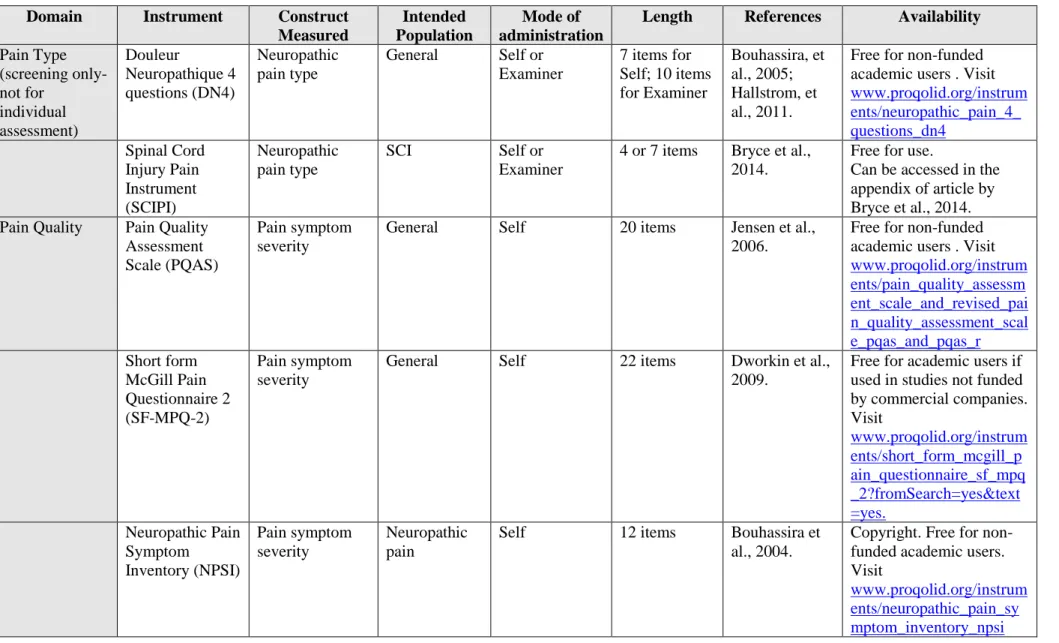
疼痛のタイプまたは疼痛の症状の重症度の評価のための計測法を Table 1 にリストアップした。 侵害受容性疼痛の評価 侵害受容性疼痛の評価は、非 SCI 患者集団と同じように評価する。 __________________________________________________________________________________ 2. 感覚能の評価 ______________________________________________________________________________ 変数名: 表在触覚 説明: 有痛運動域の感覚(損傷のレベル以下)は、正常(罹患していない皮膚領域の対照 領域との比較で)、無感覚(感覚がない)、知覚鈍麻(対照領域に比べて感覚が低 下)、知覚過敏(対照領域に比べて感覚が増大)、異痛症(触れると疼痛を引き起 こす)、その他(それ以外の場合、分類できない感覚の変化)として分けた。異痛 症がみられる場合、0~10 の数値的評価スケール(0 =「痛みはまったくない」から 最高 10 =「想像できうる中で最悪の痛み」の範囲)で評価する。コメント: 約 2cm の綿の塊、脱脂綿チップ、またはブラシ(例:Somedic standardized brush,ス ウェーデン製)などの無害な可動性の刺激物で 1~2cm/秒程度皮膚を軽くなでて評価 する(Rolke et al. 2006)。 __________________________________________________________________________________ 変数名: ピンプリック 説明: 有痛運動域の感覚(損傷のレベル以下)は、正常(罹患していない皮膚領域の対照 領域との比較で)、無感覚(感覚がない)、痛覚鈍麻(対照領域に比べて痛みの感 覚が低下)、痛覚過敏(対照領域に比べて痛みの感覚が増大)、その他(それ以外 の場合、分類できない感覚の変化)として分けた。痛覚過敏がみられる場合、0~10 の数値的評価スケール(0 =「痛みはまったくない」から最高 10 =「想像できうる中 で最悪の痛み」の範囲)で評価する。 コメント: 使い捨ての安全ピンまたは目盛りを入れたモノフィラメントを用いて評価する (Rolke et al., 2006)。 __________________________________________________________________________________ 変数名: 冷覚 説明: 有痛運動域の感覚(損傷のレベル以下)は、正常(罹患していない皮膚領域の対照 領域との比較で)、無感覚(感覚がない)、知覚鈍麻(対照領域に比べて感覚が低 下)、知覚過敏(対照領域に比べて感覚が増大)、異痛症(冷たいと疼痛を引き起 こす)、その他(それ以外の場合、分類できない感覚の変化)として分けた。異痛 症がみられる場合、0~10 の数値的評価スケール(0 =「痛みはまったくない」から 最高 10 =「想像できうる中で最悪の痛み」の範囲)で評価する。
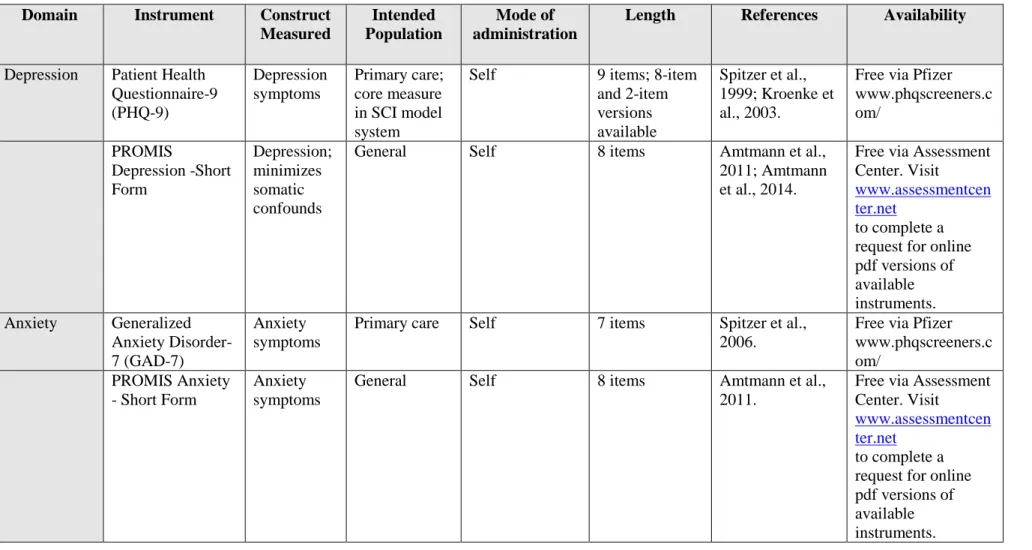
コメント: 20または 25の冷たいサーモロール(Somedic,スウェーデン)、冷えた金属または アセトン液の小滴を使用して評価できる。冷感の検知力と冷覚疼痛の閾値の測定に、 サーモテスター(TSA, Medoc, イスラエル/MSA、Somedic,スウェーデン)を使用し て温度診を実施する(Rolke et al.2006)。 __________________________________________________________________________________ 3. 治療法 __________________________________________________________________________________ 変数名: 過去の治療法 説明: この変数は、過去に受けた疼痛に対する具体的な治療法と治療反応を具体的に示す。 コメント: 自分の痛みに対して過去に受けたことのある治療法をそれぞれ(「チェック」)し て示す。可能であれば、それが役立ったか(「はい」)、役立たなかったか(「い いえ」)も回答する。有効性について覚えていない、または不確かな場合は「不明」 とする。このセクションは、疼痛全体のすべてのタイプまたは特定の疼痛のタイプ の複数の形式について治療と反応を回答するものである。SCI のペインコントロール には、オピオイド、非ステロイド性抗炎症薬、アセトアミノフェン、三環系抗うつ 薬、抗けいれん薬などの薬物療法から、マッサージ、マリファナ、鍼、催眠などの 理学療法や代替治療によるアプローチ(Cardenas & Jensen 2006: Murphy & Reid 2001, Norrbrink Budh & Lundeberg 2004)、さらにはセルフマネジメント(Umlauf 1992)、 リラクゼーション、サイコセラピー、手技的・外科的介入まで、広範囲にわたる治 療法が試みられており、課題があることから、提示されるリストは、ほとんどの可 能性を網羅するため非常に長い。 __________________________________________________________________________________ 変数名: 現在の治療法 説明: この変数は、疼痛に対する現在の治療法、治療のタイミング、反応、副作用を具体 的に示す。 コメント: 疼痛に対する現在の治療法について、用量(「用量」)(投薬の場合)や頻度 (「何回」)を示して回答する。「変化に対する患者の全般的印象」 (Patient Global Impression of Change: PGIC)を使用し、有効性を評価する(Guy, 1976, Bryce et al., 2007)。治療法に関連した何らかの副作用または有害事象(「副作用/有害事象」) も記す。このセクションは、疼痛全体のすべてのタイプまたは特定の疼痛のタイプ の複数の形式について治療と反応を回答するものである。 __________________________________________________________________________________ 4. 心理社会的病態および共存症 多くの心理測定的な計測法は疼痛関連の領域の評価に利用できる。これらを Table 2 にまとめた。 __________________________________________________________________________________
Reference list
Amtmann D, Cook KF, Johnson KL, Cella D. The PROMIS initiative: involvement of rehabilitation stakeholders in development and examples of applications in rehabilitation research. Arch Phys Med Rehabil. 2011;92(10 Suppl):S12-9.
Amtmann D, Kim J, Chung H, Bamer AM, Askew RL, Wu S, Cook KF, Johnson KL. Comparing CESD-10, PHQ-9, and PROMIS depression instruments in individuals with multiple sclerosis. Rehabil Psychol. 2014;59(2):220-9.
Baron, R., Förster, M., Binder, A. Subgrouping of patients with neuropathic pain according to pain-related sensory abnormalities: a first step to a stratified treatment approach. Lancet Neurol. 2012;11(11):999-1005.
Biering-Sørensen F, Alai S, Anderson K, Charlifue S, Chen Y, DeVivo M, Flanders AE, Jones L, Kleitman N, Lans A, Noonan VK, Odenkirchen J, Steeves J, Tansey K, Widerström-Noga E, Jakeman LB. Common data elements for spinal cord injury clinical research: a National Institute for Neurological Disorders and Stroke project. Spinal Cord. 2015;53(4):265-77.
Bouhassira D, Attal N, Fermanian J, Alchaar H, Gautron M, Masquelier E, Rostaing S, Lanteri-Minet M, Collin E, Grisart J, Boureau F. Development and validation of the Neuropathic Pain Symptom Inventory. Pain. 2004;108(3):248-57.
Bouhassira D, Attal N, Alchaar H, Boureau F, Brochet B, Bruxelle J, Cunin G, Fermanian J, Ginies P, Grun-Overdyking A, Jafari-Schluep H, Lantéri-Minet M, Laurent B, Mick G, Serrie A, Valade D, Vicaut E. Comparison of pain syndromes associated with nervous or somatic lesions and development of a new neuropathic pain diagnostic questionnaire (DN4). Pain. 2005;114(1-2):29-36.
Bryce TN, Budh CN, Cardenas DD, Dijkers M, Felix ER, Finnerup NB, Kennedy P, Lundeberg T, Richards JS, Rintala DH, Siddall P, Widerström-Noga E. Pain after spinal cord injury: an evidence-based review for clinical practice and research. Report of the National Institute on Disability and Rehabilitation Research Spinal Cord Injury Measures meeting. J Spinal Cord Med. 2007;30(5):421-40.
Bryce TN, Biering-Sørensen F, Finnerup NB, Cardenas DD, Defrin R, Lundeberg T, Norrbrink C, Richards JS, Siddall P, Stripling T, Treede RD, Waxman SG, Widerström-Noga E, Yezierski RP, Dijkers M. International spinal cord injury pain classification: Part 1. Background and description. Spinal Cord. 2012;50(6):413-7.
Bryce TN, Richards JS, Bombardier CH, Dijkers MP, Fann JR, Brooks L, Chiodo A, Tate DG, Forchheimer M. Screening for neuropathic pain after spinal cord injury with the spinal cord injury pain instrument (SCIPI): a preliminary validation study. Spinal Cord. 2014;52(5):407-12.
Cardenas DD, Jensen MP. Treatments for chronic pain in persons with spinal cord injury: a survey study. J Spinal Cord Med. 2006;29(2):109-17.
Charlifue S, Post MW, Biering-Sørensen F, Catz A, Dijkers M, Geyh S, Horsewell J, Noonan V, Noreau L, Tate D, Sinnott KA. International Spinal Cord Injury Quality of Life Basic Data Set. Spinal Cord. 2012;50(9):672-5.
Connor KM, Davidson JRT. Development of a new resilience scale: the Connor-Davidson Resilience Scale (CD-RISC). Depress and Anxiety. 2003;18(2):76-82.
Craig A, Perry KN, Guest R, Tran Y, Dezarnaulds A, Hales A, Ephraums C, Middleton J. A prospective study of the occurrence of psychological disorders and co-morbidities following spinal cord injury. Br J Health Psychol. 2015;20(4):807-23.
Cruz-Almeida Y, Martinez-Arizala A, Widerström-Noga EG.Chronicity of pain associated with spinal cord injury: A longitudinal analysis.J Rehabil Res Dev. 2005;42(5):585-94.
Dannecker EA, George SZ, Robinson ME. Influence and stability of pain scale anchors for an investigation of cold pressor pain tolerance. J Pain. 2007;8(6):476-82.
Demant DT, Lund K, Vollert J, Maier C, Segerdahl M, Finnerup NB, Jensen TS, Sindrup SH. The effect of oxcarbazepine in peripheral neuropathic pain depends on pain phenotype: a randomised, double-blind, placebo-controlled phenotype-stratified study. Pain. 2014;155(11):2215-17.
Dworkin RH, Turk DC, Farrar JT, Haythornthwaite JA, Jensen MP, Katz NP, Kerns RD, Stucki G, Allen RR, Bellamy N, Carr DB, Chandler J, Cowan P, Dionne R, Galer BS, Hertz S, Jadad AR, Kramer LD, Manning DC, Martin S, McCormick CG, McDermott MP, McGrath P, Quessy S, Rappaport BA, Robbins W, Robinson JP, Rothman M, Royal MA, Simon L, Stauffer JW, Stein W, Tollett J, Wernicke J, Witter J; IMMPACT. Core outcome measures for chronic pain clinical trials: IMMPACT recommendations. Pain. 2005;113(1-2): 9-19.
Dworkin RH, Turk DC, Revicki DA, Harding G, Coyne KS, Peirce-Sandner S, Bhagwat D, Everton D, Burke LB, Cowan P, Farrar JT, Hertz S, Max MB, Rappaport BA, Melzack R. Development and initial validation of an expanded and revised version of the Short-form McGill Pain Questionnaire (SF-MPQ-2). Pain. 2009;144(1-2):35-42.
Eide PK, Jørum E, Stenehjem AE.. Somatosensory findings in patients with spinal cord injury and central dysaesthesia pain. J Neurol Neurosurg Psychiatry. 1996;60(4):411-5.
EuroQol Group. EuroQol--a new facility for the measurement of health-related quality of life. Health Policy. 1990;16(3):199-208.
Finnerup NB, Johannesen IL, Sindrup SH, Bach FW, Jensen TS. Pain and dysesthesia in patients with spinal cord injury: a postal survey. Spinal Cord. 2001;39(5):256-62.
Finnerup NB, Norrbrink C, Trok K, Piehl F, Johannesen IL, Sørensen JC, Jensen TS, Werhagen L. Phenotypes and predictors of pain following traumatic spinal cord injury: a prospective study.J Pain. 2014;15(1):40-8.
Freynhagen R, Baron R, Gockel U, Tölle TR. PainDETECT: a new screening questionnaire to identify neuropathic components in patients with back pain. Curr Med Res Opin. 2006;22(10):1911-20.
Guy W. ECDEU Assessment manual for psychopharmacology, US Government Printing Office; 1976. Rockville, MD.
Haanpää M, Attal N, Backonja M, Baron R, Bennett M, Bouhassira D, Cruccu G, Hansson P, Haythornthwaite JA, Iannetti GD, Jensen TS, Kauppila T, Nurmikko TJ, Rice AS, Rowbotham M, Serra J, Sommer C, Smith BH, Treede RD. NeuPSIG guidelines on neuropathic pain assessment. Pain. 2011;152(1):14-27.
Hallström H, Norrbrink C. Screening tools for neuropathic pain: can they be of use in individuals with spinal cord injury? Pain. 2011;152(4):772-9.
Haythornthwaite JA, Benrud-Larson LM. Psychological aspects of neuropathic pain. Clin J Pain. 2000;16(2 Suppl):S101-5.
Jensen MP, Karoly P. (2000). Self-report scales and procedures for assessing pain in adults, In: Handbook of pain assessment (2nd Edition), Guilford Press, New York.
Jensen MP, Gammaitoni AR, Olaleye DO, Oleka N, Nalamachu SR, Galer BS. The pain quality assessment scale: assessment of pain quality in carpal tunnel syndrome. J Pain. 2006;7(11):823-32.
Jensen MP, Moore MR, Bockow TB, Ehde DM, Engel JM. Psychosocial factors and adjustment to chronic pain in persons with physical disabilities: a systematic review. Arch Phys Med Rehabil. 2011;92(1):146-60.
Kennedy P, Lude P, Taylor N. Quality of life, social participation, appraisals and coping post spinal cord injury: a review of four community samples. Spinal Cord. 2006;44(2):95-105.
Krause SJ, Backonja MM. Development of a neuropathic pain questionnaire. Clin J Pain. 2003;19(5): 306-14.
Kronke K, Spitzer RL, Williams JB. The Patient Health Questionnaire-2: validity of a two-item depression screener. Med Care. 2003;41(11):1284-92.
Levitan Y, Zeilig G, Bondi M, Ringler E, Defrin R. Predicting the Risk for Central Pain Using the Sensory Components of the International Standards for Neurological Classification of Spinal Cord Injury. J Neurotrauma. 2015;32(21):1684-92.
May LA, Warren S. Measuring quality of life of persons with spinal cord injury: substantive and structural validation. Qual Life Res. 2001;10(6):503-15.
May LA , Warren S. Measuring quality of life of persons with spinal cord injury: external and structural validity. Spinal Cord. 2002;40(7):341-50.
Middleton J, Tran Y, Craig A. Relationship between quality of life and self-efficacy in persons with spinal cord injuries. Arch Phys Med Rehabil. 2007;88(12):1643-8.
Molton IR, Terrill AL, Smith AE, Yorkston KM, Alschuler KN, Ehde DM, Jensen MP. Modeling secondary health conditions in adults aging with physical disability. J Aging Health. 2014;26(3):335-59.
Molton IR, Stoelb BL, Jensen MP, Ehde DM, Raichle KA, Cardenas DD. Psychosocial factors and adjustment to chronic pain in spinal cord injury: replication and cross-validation. J Rehabil Res Dev. 2009;46(1):31-42.
Murphy D, Reid DB. Pain treatment satisfaction in spinal cord injury. Spinal Cord. 2001. 2001;39(1):44-6.
Nicholson Perry K, Nicholas MK, Middleton J. Spinal cord injury-related pain in rehabilitation: a cross-sectional study of relationships with cognitions, mood and physical function. Eur J Pain. 2009;13(5):511-7.
Norrbrink Budh C, Lundeberg T. Non-pharmacological pain-relieving therapies in individuals with spinal cord injury: a patient perspective. Complement Ther Med. 2004;12(4):189-97.
Price DD, Harkins SW, Baker C. Sensory-affective relationships among different types of clinical and experimental pain. Pain. 1987;28(3):297-307.
Richards JS, Meredith RL, Nepomuceno C, Fine PR, Bennett G. Psycho-social aspects of chronic pain in spinal cord injury.Pain. 1980;8(3):355-66.
Rolke R, Baron R, Maier C, Tölle TR, Treede RD, Beyer A, Binder A, Birbaumer N, Birklein F, Bötefür IC, Braune S, Flor H, Huge V, Klug R, Landwehrmeyer GB, Magerl W, Maihöfner C, Rolko C, Schaub C, Scherens A, Sprenger T, Valet M, Wasserka B. Quantitative sensory testing in the German Research Network on Neuropathic Pain (DFNS): standardized protocol and reference values. Pain. 2006;123(3):231-43.
Siddall PJ, McClelland JM, Rutkowski SB, Cousins MJ. A longitudinal study of the prevalence and characteristics of pain in the first 5 years following spinal cord injury. Pain. 2003;103(3):249-57.
Spitzer RL, Kroenke K, Williams JB. (1999). Validation and utility of a self-report version of PRIME-MD: the PHQ primary care study. Primary Care Evaluation of Mental Disorders. Patient Health Questionnaire.
Spitzer RL, Kroenke K, Williams JB, Löwe B. A brief measure for assessing generalized anxiety disorder: the GAD-7. Arch Intern Med. 2006;166(10):1092-7.
Summers JD, Rapoff MA, Varghese G, Porter K, Palmer RE. Psychosocial factors in chronic spinal cord injury pain. Pain. 1991;47(2):183-9.
Turk DC. Biopsychosocial perspective on chronic pain. In: R Gatchel, DC Turk eds. Psychological approaches to chronic pain management: a clinician’s handbook. New York: Guilford Press. 1996:3-33.
Umlauf RL. Psychological interventions for chronic pain following spinal cord injury. Clin J Pain. 1992;8(2):111-8.
Vlaeyen JW, Kole-Snijders AM, Boeren RG, van Eek H. Fear of movement/(re)injury in chronic low back pain and its relation to behavioral performance. Pain. 1995;62(3):363-72.
Ware JE, Snow KK, Kosinski M, Gandek B. (1993). SF-36® Health Survey Manual and Interpretation Guide. Boston, MA: New England Medical Center, The Health Institute.
Watson D, Clark LA, Tellegen A. Development and validation of brief measures of positive and negative affect: the PANAS scales. J Pers Soc Psychol. 1998;54(6):1063-70.
Weathers FW, Litz BT, Keane TM, Palmieri PA, Marx BP, Schnurr PP. (2013). The PTSD Checklist for DSM-5 (PCL-5). Scale available from the National Center for PTSD at www.ptsd.va.gov.
Whiteneck GG, Charlifue SW, Gerhart KA, Overholser JD, Richardson GN. Quantifying handicap: a new measure of long-term rehabilitation outcomes. Arch Phys Med Rehabil. 1992;73(6):519-26.
Widerström-Noga EG, Felipe-Cuervo E, Yezierski RP. Chronic pain after spinal injury: interference with sleep and daily activities. Arch Phys Med Rehabil. 2001;82(11):1571-7.
Widerström-Noga E, Biering-Sørensen F, Bryce T, Cardenas DD, Finnerup NB, Jensen MP, Richards JS, Siddall PJ. The international spinal cord injury pain basic data set. Spinal Cord. 2008;46(12):818-23.
Widerström-Noga E, Biering-Sørensen F, Bryce TN, Cardenas DD, Finnerup NB, Jensen MP, Richards JS, Siddall PJ. The International Spinal Cord Injury Pain Basic Data Set (version 2.0). Spinal Cord. 2014;52(4):282-6.
Widerstrom-Noga E, Felix ER, Adcock JP, Escalona M, Tibbett J. Multidimensional neuropathic pain phenotypes after spinal cord injury. J Neurotrauma. 2015 Sep 28. [Epub ahead of print]
Wollaars MM, Post MW, van Asbeck FW, Brand N. Spinal cord injury pain: the influence of psychologic factors and impact on quality of life. Clin J Pain. 2007;23(5):383-91.
Zelman DC, Smith MY, Hoffman D, Edwards L, Reed P, Levine E, Siefeldin R, Dukes E. Acceptable, manageable, and tolerable days: patient daily goals for medication management of persistent pain. Journal of pain and symptom management 2004;28:474-87.
Table 1. Instruments for determining pain type and/or pain symptom severity.
Domain Instrument Construct
Measured
Intended Population
Mode of administration
Length References Availability
Pain Type (screening only- not for individual assessment) Douleur Neuropathique 4 questions (DN4) Neuropathic pain type General Self or Examiner 7 items for Self; 10 items for Examiner Bouhassira, et al., 2005; Hallstrom, et al., 2011.
Free for non-funded academic users . Visit www.proqolid.org/instrum ents/neuropathic_pain_4_ questions_dn4 Spinal Cord Injury Pain Instrument (SCIPI) Neuropathic pain type SCI Self or Examiner
4 or 7 items Bryce et al., 2014.
Free for use.
Can be accessed in the appendix of article by Bryce et al., 2014. Pain Quality Pain Quality
Assessment Scale (PQAS)
Pain symptom severity
General Self 20 items Jensen et al., 2006.
Free for non-funded academic users . Visit www.proqolid.org/instrum ents/pain_quality_assessm ent_scale_and_revised_pai n_quality_assessment_scal e_pqas_and_pqas_r Short form McGill Pain Questionnaire 2 (SF-MPQ-2) Pain symptom severity
General Self 22 items Dworkin et al., 2009.
Free for academic users if used in studies not funded by commercial companies. Visit www.proqolid.org/instrum ents/short_form_mcgill_p ain_questionnaire_sf_mpq _2?fromSearch=yes&text =yes. Neuropathic Pain Symptom Inventory (NPSI) Pain symptom severity Neuropathic pain
Self 12 items Bouhassira et al., 2004.
Copyright. Free for non-funded academic users. Visit
www.proqolid.org/instrum ents/neuropathic_pain_sy mptom_inventory_npsi
Neuropathic Pain Questionnaire (NPQ) Pain symptom severity Neuropathic pain
Self 12 items Krause & Backonja, 2003.
Free for use. Can be accessed in the appendix of article by Krause and Backonja, 2003. PainDETECT (PD-Q) Pain symptom severity Neuropathic pain
Self 10 items Freynhagen et al., 2006.
Copyright. Free. See www.pfizerpatientreported outcomes.com/therapeutic -areas/pain/neuropathic-pain
Table 2. Psychosocial instruments available for assessing pain relevant domains.
Domain Instrument Construct
Measured
Intended Population
Mode of administration
Length References Availability
Depression Patient Health Questionnaire-9 (PHQ-9) Depression symptoms Primary care; core measure in SCI model system
Self 9 items; 8-item and 2-item versions available Spitzer et al., 1999; Kroenke et al., 2003.
Free via Pfizer www.phqscreeners.c om/ PROMIS Depression -Short Form Depression; minimizes somatic confounds
General Self 8 items Amtmann et al., 2011; Amtmann et al., 2014.
Free via Assessment Center. Visit
www.assessmentcen ter.net
to complete a request for online pdf versions of available instruments. Anxiety Generalized Anxiety Disorder-7 (GAD-Disorder-7) Anxiety symptoms
Primary care Self 7 items Spitzer et al., 2006.
Free via Pfizer www.phqscreeners.c om/ PROMIS Anxiety - Short Form Anxiety symptoms
General Self 8 items Amtmann et al., 2011.
Free via Assessment Center. Visit
www.assessmentcen ter.net
to complete a request for online pdf versions of available instruments.
Tampa Scale of Kinesiophobia (TSK) Fear of pain/re-injury Developed for low back pain by Miller, Kopri, and Todd, in 1991; used across chronic pain populations
Self 17 items Vlaeyen et al., 1995.
Items can be found in the article by Vlaeyen et al., 1995 PTSD Checklist – Civilian Version (PCL-C) PTSD symptoms
General Self 20 items Weathers et al., 2013.
To obtain this scale, visit the VA
National Center for PTSD website to complete the online request form:www.ptsd.va.g ov/professional/asse ssment/adult-sr/ptsd-checklist.asp Quality of Life/ Satisfaction with Life Short-Form-36 (SF-36) Perceived functional health and well-being General medical Self or Examiner 36 items; 8 sub-scales
Ware et al., 1993. To obtain licensing, visit: www.sf-36.org EuroQoL-5 Dimension Questionnaire (EQ-5D) Health-related quality of life General medical
Self 5 items EuroQol Group, 1990.
To register study and submit licensing fees (if applicable): www.euroqol.org Quality of Life
Index (QLI) - SCI version Satisfaction and quality of life Spinal cord injury Self or Examiner
37 items May & Warren, 2001; May & Warren 2002.
For direct access: www.uic.edu/orgs/ql i/questionaires/quest ionnairehome.htm
International SCI Basic Data Set - QoL items General quality of life; satisfaction with physical and mental health Spinal cord injury
Self 3 Charlifue et al., 2012.
Items can be found in the Charlifue et al. article.
Resilience Connor Davidson Resilience Scale (CD-RISC)
Psychologic al resilience
General Self 25 items; 10-item, 2-item versions available Connor & Davidson, 2003. To obtain any version of the scale, a request form can be found at: www.cd-risc.com/ Mood Positive and
Negative Affect Schedule (PANAS) positive and negative affect
General Self 20 items Watson et al., 1998.
Can be accessed in the appendix of the original article by Watson et al.
Participation Craig Handicap Assessment and Reporting Technique (CHART) – SF Community integration and independenc e Variety of physical rehabilitation populations Self or Examiner 19 items for CHART-SF Whiteneck et al., 1992.
Available via Craig Hospital website: www.craighospital.o rg/repository/docum ents/Research%20In struments/CHART% 20Manual.pdf
国際脊髄損傷データセット
疼痛に関する拡張データ – FORM – Version 1.0
<項目A> 痛み症状 A. 全体的な痛みについて 今日を含めてこの 7 日間で痛みがあった日数 � 0; � 1; � 2; � 3; � 4; � 5; � 6; � 7; � 不明 過去 1 週間で最悪の痛み 0 = 痛みなし~ 10 = 思い浮かぶ最悪の痛み � 0; � 1; � 2; � 3; � 4; � 5; � 6; � 7; � 8; � 9; � 10 過去 1 週間の痛みに関する平均的不快感 0 = 不快感なし~ 10 = 思い浮かぶ最悪の不快感 � 0; � 1; � 2; � 3; � 4; � 5; � 6; � 7; � 8; � 9; � 10 今日を含む過去 7 日間に対処可能な/許容できる痛みを感じた日数 � 0; � 1; � 2; � 3; � 4; � 5; � 6; � 7; � 不明 B. 個々の疼痛問題 現在の痛みの強さ 0 = 痛みなし~ 10 = 思い浮かぶ最悪の痛み � 0; � 1; � 2; � 3; � 4; � 5; � 6; � 7; � 8; � 9; � 10 通常どのくらいの時間痛みが続きますか: � 1 分以下; � 1 分から 1 時間; � 1 時間から 24 時間; � 24 時間以上; � 常時持続している; � 不明 最も強い痛みは 1 日のうちでいつ発生しますか? � 午前中 (06.01-12.00); � 午後 (12.01-18.00); � 夜 (18.01-24.00); � 深夜 (00.01-06.00) � 予測不能;痛みはいつ何時ひどくなるかわからない <項目B> 感覚能の評価 表在感覚 脊損レベル: �正常; �無感覚; �知覚鈍麻; �知覚過敏; �異痛症;; �その他 異痛症がある場合、その程度:� 0; � 1; � 2; � 3; � 4; � 5; � 6; � 7; � 8; � 9; � 10 脊損レベル以下: �正常; �無感覚; �知覚鈍麻; �知覚過敏; �異痛症;; �その他 異痛症がある場合、その程度:� 0; � 1; � 2; � 3; � 4; � 5; � 6; � 7; � 8; � 9; � 10 ピンプリック 脊損レベル: �正常; �無感覚; �痛覚鈍麻; �痛覚過敏; �その他 痛覚過敏がある場合、その程度:� 0; � 1; � 2; � 3; � 4; � 5; � 6; � 7; � 8; � 9; � 10 脊損レベル以下: �正常; �無感覚; �痛覚鈍麻; �痛覚過敏; �その他 備考:左右の局在などを記載痛覚過敏がある場合、その程度:� 0; � 1; � 2; � 3; � 4; � 5; � 6; � 7; � 8; � 9; � 10 冷覚 脊損レベル: �正常; �無感覚; �知覚鈍麻; �知覚過敏; �異痛症;; �その他 異痛症がある場合、その程度:� 0; � 1; � 2; � 3; � 4; � 5; � 6; � 7; � 8; � 9; � 10 脊損レベル以下: �正常; �無感覚; �知覚鈍麻; �知覚過敏; �異痛症;; �その他 異痛症がある場合、その程度:� 0; � 1; � 2; � 3; � 4; � 5; � 6; � 7; � 8; � 9; � 10 <項目Ⅽ> 治療 過去の治療:この項目では痛み全般もしくは個別の痛みどちらについても記載できます。 過去の治療(直近 12 か月)及び、それが有効であったかについて記載してください。 あなたが受けた全ての治療について記載してください(直近 12 か月) その治療は有効でしたか? ✔ はい いいえ 不詳/不明 理学療法 有酸素運動(軽度~中等度) 受動運動(免荷運動/抵抗運動 例:ストレッチ) 抵抗運動(筋力トレーニング 例:重量トレーニング) 姿勢調整(車いす、ベッドなど) 関節動作/操作(カイロプラクティック、オステオパシーを含 む) その他 受動的および刺激的療法 マッサージ 指圧 経皮電気神経刺激(TES、TNS、TENS) 超音波 レーザー 熱療法(ヒートパック、短波を含む) その他 リラクゼーションと心理療法 バイオフィードバック/リラクゼーショントレーニング 備考:左右の局在などを記載 備考:左右の局在などを記載
リラクゼーション(リラクゼーション法、例:筋弛緩または深い 呼吸) 瞑想(瞑想技術、例:集中的、宗教的) マインドフルネス(マインドフルネスの技法を用いた瞑想) 催眠 認知/行動療法 その他の心理療法 その他 経口および外用薬 抗うつ薬(例:アミトリプチリン、ノルトリプチリン、デュロキ セチン) 抗てんかん薬(例:プレガバリン、ガバペンチン、カルバマゼピ ン) トラマドール オピオイド(例:モルヒネ、オキシコドン、ブプレノルフィン、 フェンタニル) カンナビノイド アセトアミノフェン/パラセタモール NSAID /アスピリン (例:イブプロフェン、ナプロキセン、セ レコキシブ、メロキシカム) ベンゾジアゼピン類 例:ジアゼパム 鎮痙薬 (例:バクロフェン、チザンチジン) 局所麻酔薬 (例:リドカイン/リグノカイン) 局所カプサイシン その他 手技的介入 トリガーポイント注射/ドライニードル 鍼 末梢神経/運動点ブロック(アルコール、フェノール、ステロイ ド、麻酔薬ブロック、ボツリヌス毒素注射を含む) 関節注射(肩、膝、椎間関節、仙腸関節を含む) リドカイン静注 ケタミン静注 硬膜外ブロック 髄腔内ポンプ(モルヒネ、ジコノチド、クロニジン、バクロフェ ンを含む) 脊髄刺激装置 経頭蓋脳刺激(tDCS または rTMS) 経皮末梢神経刺激 その他 外科的介入 脊髄後根進入部破壊術 脊椎手術(安定化、脊柱摘出、脊髄係留解除術、シャント) 脳深部刺激(脳内電極埋め込み) その他 その他の治療
現在の治療:記載例については前項(過去の治療)を参照
治療 用量 頻度 PGIC* 副作用/有害事象
*PGIC:治療の効果について以下の選択肢から 1 つを選んでください。
非常に改善された(1) - 大幅に改善された(2) - 少しだけ改善された(3) - 変化しない(4) 少しだけ悪くなった(5) - かなり悪くなった(6) - 非常に悪くなった(7)