有機金属化学:最新論文からのトピックス②
2019年度
有機金属化学第13回
Origin of the Breakthrough Productivity of Ruthenium
−Cyclic Alkyl Amino Carbene Catalysts in Olefin Metathesis
J. Am. Chem. Soc. 2019, 141, 19236−19240.
Daniel L. Nascimento, Deryn E. Fogg*
ABSTRACT: Examined herein is the basis for the outstanding metathesis productivity of leading cyclic alkyl amino carbene (CAAC) catalysts relative to their important N-heterocyclic carbene (NHC) predecessors, as recently demonstrated in the topical contexts of metathesis macrocyclization and the ethenolysis of renewable oils. The difference is traced to the stability to decomposition of the metallacyclobutane (MCB) intermediate. The CAAC catalysts are shown to undergo little to no β-H elimination of the MCB ring, a pathway to which the H2IMes catalysts are highly susceptible.
Unexpectedly, however, the CAAC catalysts are found to be more susceptible to bimolecular coupling of the key intermediate RuCl2(CAAC)(=CH2), a reaction that
culminates in elimination of the methylidene ligand as ethylene. Thus, an NMR study of transiently stabilized RuCl2(L)(py)(=CH2) complexes (L = CAAC or H2IMes)
revealed bimolecular decomposition of the CAAC derivative within 5 min at RT, as compared to a time scale of hours for the H2IMes analogue. The remarkable
productivity of the CAAC catalysts is thus due to their resistance to β-elimination, which enables their use at part per million loadings, and to the retarding effect of these low catalyst concentrations on bimolecular decomposition.
タイトルとTOCグラフィックから読み取れること
Abstractから追加で読み取れること
・CAAC[cyclic (alkyl)(amino)carbene]配位オレフィンメタセシス触媒の高い生産性の起源について
・CAACが配位したRuメチリデン錯体はオレフィンメタセシス反応の途中で分解するけどRuアルキリデン錯体は分解しない Prof. Deryn Fogg@U of Ottawa postdoc w. R. R. Schrock@MIT
Ph.D. w. B. R. James@U of British Columbia M.Sc.&B.Sc. w. A. J. Canty@U of Waterloo
・CAAC配位の触媒はNHC配位のものよりマクロ環化と加エチレン分解に高活性 ・メタラシクロブタン(MCB)中間体の分解に対する安定性が調査された
・CAAC触媒はNHC触媒で見られるMCB環のβ水素脱離がほとんど起こらず、
Ruメチリデン錯体(Ru=CH2)から二分子カップリングでエチレンを与えることがわかった
・ピリジン配位で一時的に安定化されたRuCl2(L)(py)(=CH2)錯体のNMR追跡でCAACとNHC錯体の分解速度差を観測した
Introduction: オレフィンメタセシスと触媒活性種
Ref 1,2: オレフィンメタセシスに関する本 イントロを読む際の注意点 (1) 参考文献は精読しなくても良いので、そのabstractと絵だけでも見て流れを掴め (2) まとまった本や総説(review)は何のトピックに関する内容なのかだけわかれば良い Ref 3a: オレフィンメタセシスの製薬および 高機能化学品製造への応用をまとめた総説 参考:2005年ノーベル化学賞 オレフィンメタセシス反応の発展 ノーベル財団ウェブサイトより Ref 3b,3c: 閉環オレフィンメタセシスの 製薬工業における大スケール化の総説 Ref 4a: オレフィンメタセシス触媒の 分解と再活性化の反応機構に関する総説 Ref 4b: オレフィンメタセシスの総説 (均一系触媒の本の1章) Ref 5a,b: アクリル酸エステルの オレフィンメタセシスにおける 触媒分解に対するプロトン添加の効果について Ref 5c: ene-yneメタセシスにおいて エチレン雰囲気が触媒の速い分解を抑制する報告 Ref 5d: ene-yneメタセシスにおいて エチレン雰囲気がene-yneの二量化による 触媒の速い分解を抑制する報告 Ref 6: オレフィンメタセシスにおいて メチリデン錯体Ru=CH2の二量化が 触媒の分解プロセスであるという発見 Ref 7: オレフィンメタセシスにおいて 触媒活性種発生、触媒反応そのもの、 触媒の分解速度、を一度に測定して置換基効果の解析Introduction: 反応機構解析続き・CAAC配位Ru触媒
Ref 8a: ルテナシクロブタンのαおよびβ炭素の交換 および外部のエチレンとの交換を 13Cラベル実験によって追跡した論文 Ref 8b: PDF読めず。安定性と分解経路の論文 Ref 8c: オレフィンメタセシスRu触媒において ルテナシクロブタン中間体からのβ水素脱離および 続くアリルRuヒドリドからの還元的脱離が 触媒の分解経路であることを 実験(アルケン検出)およびDFT計算で解明 Ref 8d: オレフィンメタセシスRu触媒において ルイス塩基性の添加剤がメチリデン中間体の分解を誘発 ホスフィン使用の場合はホスホニウムが脱離 NHC配位子の一部プロトンも脱離 Ref 8e: 8dと同様に配位子のプロトンが 触媒の分解を誘発するという報告 Ref 9: NHC上の置換基と生成物遊離速度の関係から 選択性を考察した論文 Ref 10: 第1世代Grubss触媒を用いたオレイン酸エステルの 加エチレン分解における触媒分解経路の速度論解析 Ref 11: 閉環メタセシスにて>400 kgの合成を達成 Ref 12: ref 11と同じ Ref 13: 第二世代Grubbs触媒を用いたメタセシスで 反応器ごとの効率を比較、フローは選択性低下 Ref 14: CAAC配位の高活性メタセシス触媒最初の例 Ref 15: CAAC配位の高活性メタセシス触媒を用いた 種子油の加エチレン分解でTON 340000を達成 Ref 16: 置換基を少し変えたCAACを用いて クロスメタセシスと閉環メタセシス Ref 17: CAACを2つ導入した触媒を用いると さらに高活性な触媒となったRef 18: ref 17の錯体にCuを反応させて余計な
Introduction: 反応機構解析続き・CAAC配位Ru触媒
Ref 19-21: 植物油中の二重結合の加エチレン分解 のためのRuメタセシス触媒の総説 Ref 23: CAAC錯体とNHC錯体でRuメチリデン錯体と アルケン基質の副反応の起こりやすさを比較 CAAC錯体の方が起こりにくいことを示した Ref 22a: オレイン酸エチルの1Lスケールでの 加エチレン分解 Ref 22b: フッ素置換NHCを有するRu触媒を用いた オレイン酸メチルの加エチレン分解 Ref 24a: NHCヒドリド錯体がメタセシス反応の 副反応であるアルケン異性化を起こすと考えられていたが それを否定、配位子が解離した化学種ではないかと提案Origin of the Breakthrough Productivity of Ruthenium
−Cyclic Alkyl
Amino Carbene Catalysts in Olefin Metathesis
Daniel L. Nascimento and Deryn E. Fogg*
Center for Catalysis Research & Innovation, and Department of Chemistry and Biomolecular Sciences, University of Ottawa, Ottawa, K1N 6N5 Ontario, Canada
*S Supporting Information
ABSTRACT: Examined herein is the basis for the outstanding metathesis productivity of leading cyclic alkyl amino carbene (CAAC) catalysts relative to their important N-heterocyclic carbene (NHC) predecessors, as recently demonstrated in the topical contexts of metathesis macrocyclization and the ethenolysis of renewable oils. The difference is traced to the stability to decomposition of the metallacyclobutane (MCB) intermediate. The CAAC catalysts are shown to undergo little to no β-H elimination of the MCB ring, a pathway to which the H2IMes catalysts are highly susceptible.
Unexpectedly, however, the CAAC catalysts are found to be more susceptible to bimolecular coupling of the key intermediate RuCl2(CAAC)(CH2), a reaction that
culminates in elimination of the methylidene ligand as ethylene. Thus, an NMR study of transiently stabilized RuCl2(L)(py)(CH2) complexes (L = CAAC or
H2IMes) revealed bimolecular decomposition of the
CAAC derivative within 5 min at RT, as compared to a time scale of hours for the H2IMes analogue. The
remarkable productivity of the CAAC catalysts is thus due to their resistance to β-elimination, which enables their use at part per million loadings, and to the retarding effect of these low catalyst concentrations on bimolecular decomposition.
R
uthenium-catalyzed olefin metathesis, widely embraced as a core methodology in organic synthesis,1,2 is now beginning to see uptake in pharmaceutical manufacturing.3 The demands of process chemistry are bringing new recognition to long-standing challenges of catalyst productiv-ity.4 While steps can be taken to circumvent decomposition induced by extraneous contaminants,3,5intrinsic decomposition is a more fundamental problem.Two such pathways have been established for the dominant N-heterocyclic carbene (NHC) catalysts: bimolecular coupling of methylidene A (Scheme 1a)6,7 and β-elimination of the ruthenacyclobutane (Scheme 1b).8 Particularly vulnerable to β-elimination is the unsubstituted ruthenacyclobutane B (R = H)9 formed on reaction of A with the ethylene co-product generated in metathesis of terminal olefins. Ethylene has been shown to limit metathesis yields in multiple contexts,10 most prominently process chemistry11,12and continuous-flow meta-thesis.13
Striking, therefore, is the extraordinary productivity demonstrated for metathesis catalysts bearing a cyclic alkyl amino carbene (CAAC; Chart 1) in place of an NHC
ligand.14−18Even in ethenolysis (that is, generation of α-olefins from unsaturated internal olefins of plant or algal origin3a,19−22 under an atmosphere of ethylene), turnover numbers (TONs) as high as 340 000 could be achieved using a CAAC catalyst.15 This represents a level of efficiency 2 orders of magnitude higher than that attained with leading H2IMes catalysts14
under standard conditions of metathesis.
The origin of this remarkable performance has received little study to date. Grubbs and Bertrand proposed that A(C1), the CAAC analogue of intermediate A, may be more stable to insertion of the N-aryl substituent into the RuCH2 bond
(for ligand structures, see Chart 1).15 Lemcoff and
co-Received: October 6, 2019
Published: November 26, 2019
Scheme 1. Intrinsic Decomposition Pathways Established for Phosphine-Free Ru−H2IMes Metathesis Catalysts
Chart 1. Metathesis Catalysts Discussed
Communication
pubs.acs.org/JACS
Cite This:J. Am. Chem. Soc. 2019, 141, 19236−19240
© 2019 American Chemical Society 19236 DOI:10.1021/jacs.9b10750 J. Am. Chem. Soc. 2019, 141, 19236−19240
Downloaded via NAGOYA UNIV on January 14, 2020 at 00:10:23 (UTC).
See https://pubs.acs.org/sharingguidelines for options on how to legitimately share published articles.
一般にNHC-Ru触媒によるメタセシス反応は これら2種の反応で触媒が分解して 別の錯体になると考えられている (a) メチリデン錯体Aの2量化を経由したエチレン生成 (b) メタラシクロブテン錯体Bからの β水素脱離と続く還元的脱離によるアルケン生成 Ref 24b: 第二世代Grubbs触媒は分解してナノ粒子を生成 これが高活性メタセシス触媒として作用すると示した =副反応の原因ではないか? Ref 24c: 閉環メタセシスについて書かれた本(PDF取れず) たぶんRu触媒の分解過程についても書いてあるのだろう
This Work: Ruメチリデン錯体の発生
Chart 1 本研究で対象とする触媒群
Origin of the Breakthrough Productivity of Ruthenium
−Cyclic Alkyl
Amino Carbene Catalysts in Olefin Metathesis
Daniel L. Nascimento and Deryn E. Fogg
*
Center for Catalysis Research & Innovation, and Department of Chemistry and Biomolecular Sciences, University of Ottawa, Ottawa, K1N 6N5 Ontario, Canada
*
S Supporting InformationABSTRACT: Examined herein is the basis for the outstanding metathesis productivity of leading cyclic alkyl amino carbene (CAAC) catalysts relative to their important N-heterocyclic carbene (NHC) predecessors, as recently demonstrated in the topical contexts of metathesis macrocyclization and the ethenolysis of renewable oils. The difference is traced to the stability to decomposition of the metallacyclobutane (MCB) intermediate. The CAAC catalysts are shown to undergo little to no β-H elimination of the MCB ring, a pathway to which the H2IMes catalysts are highly susceptible.
Unexpectedly, however, the CAAC catalysts are found to be more susceptible to bimolecular coupling of the key intermediate RuCl2(CAAC)(CH2), a reaction that
culminates in elimination of the methylidene ligand as ethylene. Thus, an NMR study of transiently stabilized RuCl2(L)(py)(CH2) complexes (L = CAAC or
H2IMes) revealed bimolecular decomposition of the
CAAC derivative within 5 min at RT, as compared to a time scale of hours for the H2IMes analogue. The
remarkable productivity of the CAAC catalysts is thus due to their resistance to β-elimination, which enables their use at part per million loadings, and to the retarding effect of these low catalyst concentrations on bimolecular decomposition.
R
uthenium-catalyzed olefin metathesis, widely embraced as a core methodology in organic synthesis,1,2 is now beginning to see uptake in pharmaceutical manufacturing.3 The demands of process chemistry are bringing new recognition to long-standing challenges of catalyst productiv-ity.4 While steps can be taken to circumvent decomposition induced by extraneous contaminants,3,5intrinsic decomposition is a more fundamental problem.Two such pathways have been established for the dominant N-heterocyclic carbene (NHC) catalysts: bimolecular coupling of methylidene A (Scheme 1a)6,7 and β-elimination of the ruthenacyclobutane (Scheme 1b).8 Particularly vulnerable to β-elimination is the unsubstituted ruthenacyclobutane B (R = H)9 formed on reaction of A with the ethylene co-product generated in metathesis of terminal olefins. Ethylene has been shown to limit metathesis yields in multiple contexts,10 most prominently process chemistry11,12 and continuous-flow meta-thesis.13
Striking, therefore, is the extraordinary productivity demonstrated for metathesis catalysts bearing a cyclic alkyl amino carbene (CAAC; Chart 1) in place of an NHC
ligand.14−18Even in ethenolysis (that is, generation of α-olefins from unsaturated internal olefins of plant or algal origin3a,19−22 under an atmosphere of ethylene), turnover numbers (TONs) as high as 340 000 could be achieved using a CAAC catalyst.15 This represents a level of efficiency 2 orders of magnitude higher than that attained with leading H2IMes catalysts14
under standard conditions of metathesis.
The origin of this remarkable performance has received little study to date. Grubbs and Bertrand proposed that A(C1), the CAAC analogue of intermediate A, may be more stable to insertion of the N-aryl substituent into the RuCH2 bond
(for ligand structures, see Chart 1).15 Lemcoff and
co-Received: October 6, 2019
Published: November 26, 2019
Scheme 1. Intrinsic Decomposition Pathways Established for Phosphine-Free Ru−H2IMes Metathesis Catalysts
Chart 1. Metathesis Catalysts Discussed
Communication
pubs.acs.org/JACS
Cite This:J. Am. Chem. Soc. 2019, 141, 19236−19240
© 2019 American Chemical Society 19236 DOI:10.1021/jacs.9b10750
J. Am. Chem. Soc. 2019, 141, 19236−19240
Downloaded via NAGOYA UNIV on January 14, 2020 at 00:10:23 (UTC).
See https://pubs.acs.org/sharingguidelines for options on how to legitimately share published articles.
workers23 pointed out that the CAAC catalysts cause
significantly less CC migration: as the latter side reaction is promoted by decomposed catalyst,24 this is indirect evidence for the greater stability of the CAAC catalysts. We speculated
that the resistance to CC isomerization, as well as the
remarkable ethenolysis productivity noted above, reports on the capacity of the propagating species to resist the decomposition pathways of Scheme 1. In a study of state-of-the-art CAAC catalysts, we demonstrate that β-elimination is indeed dramatically suppressed, although bimolecular coupling remains operative.
We began by evaluating the susceptibility of nG(C1) to bimolecular coupling. This catalyst was chosen for study given its record-setting productivity in macrocyclic ring-closing
metathesis (mRCM),16−18 and its striking tolerance for the
contaminants present in technical-grade ethylene in ethenol-ysis,18 relative to methyl-substituted C215 (Chart 1). Steric protection by the phenyl group at the quaternary CAAC carbon in the C1 ligand appears to improve its stability to contaminants,18 and we queried whether this might also inhibit bimolecular coupling.
We thus set out to assess the susceptibility to bimolecular
coupling of methylidene intermediate RuCl2(C1)(CH2)
(A(C1)), relative to its H2IMes analogue A. The hallmark for this coupling reaction is release of ethylene. We recently developed a protocol for quantitation of the ethylene product, via synthesis and cryogenic isolation of transiently stabilized pyridine adducts of A (e.g., RuCl2(H2IMes)(py)(CH2), C), and controlled decomposition of the adducts in the presence of an internal standard.6
Accordingly, we undertook synthesis of the CAAC−
methylidene complex C(C1): see Scheme 2. Key precursors
to these complexes are the Piers-class phosphonium alkylidene catalysts (see Ru-3(C1)), which irreversibly eliminate the phosphonium ylide 1 on reaction with ethylene.25 This effects quantitative formation of the metallacyclobutane (MCB), which in turn permits access to the target methylidene species. The recently reported18 indenylidene dimer Ru-1(C1) offers a convenient alternative to the benzylidene complexes typically used to synthesize the carbide precursors to the Piers
catalysts.9,26−28 Treatment of Ru-1(C1) with Feist’s ester
and PiPr3 gave the CAAC carbide Ru-2(C1), which upon
protonation with triflic acid generated the CAAC-Piers catalyst Ru-3(C1).
With Ru-3(C1) in hand, we generated the 14-electron MCB B(C1) in situ, via the methodology developed by Piers for
H2IMes analogue B.27 To guard against premature
decom-position of the MCB, we introduced ethylene at−78 °C, rather
than at −50 °C as in the original report. Nevertheless,
formation of B(C1) was complete within 10 min. Addition of cold py triggered immediate retro-addition, and trapped the methylidene species A(C1) as the py adduct C(C1). The phosphonium salt 1 was then precipitated with cold pentane and filtered off under vacuum, enabling isolation of C(C1) free of both 1 and ethylene.
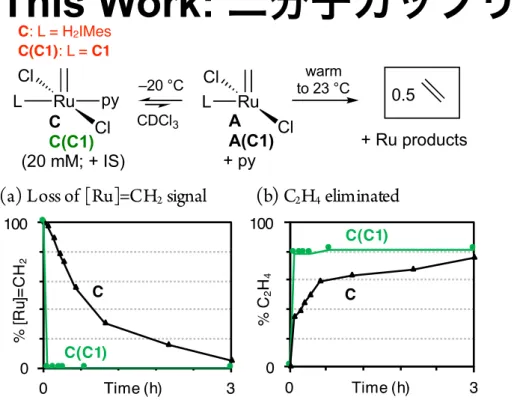
Controlled decomposition of the H2IMes and CAAC
methylidene complexes C and C(C1) (Figure 1) was carried
out in parallel to probe their relative susceptibility to bimolecular coupling under directly comparable conditions. NMR tubes were filled to 80% capacity with the catalyst solutions, to limit volatilization of C2H4.29 After measuring an
initial 1H NMR spectrum at −20 °C (a temperature at which
both complexes are stable), the samples were immediately warmed to 23 °C. Much faster decomposition was observed for CAAC derivative C(C1), with complete disappearance of the alkylidene signal within <5 min (Figure 1a). Decomposition of
the H2IMes analogue C, in comparison, was only 95%
complete after 3 h. Ethylene, the marker for bimolecular coupling, was observed in 81% or 75% yield, respectively (Figure 1b).30 These yields represent lower limits, owing to diffusion of ethylene into the headspace.29 It should be noted that the high Ru concentrations required for rapid NMR analysis (20 mM) accelerate bimolecular reaction, exaggerating absolute rates of decomposition. However, the increased susceptibility of the CAAC catalyst to bimolecular decom-position is maintained under catalytic conditions, at micro-molar Ru concentrations and lower; see later.31
The data of Figure 1 demonstrate that the metathesis-active intermediate A(C1) is not merely susceptible to bimolecular decomposition, but that it is more so than the corresponding H2IMes derivative. This was initially unexpected: given the low
lability of the CAAC catalysts, relative to their H2IMes
analogues,18,32 we anticipated that slower pyridine (py)
dissociation would retard liberation and bimolecular coupling of A(C1). The observed trend implies that the coupling step, rather than py loss, is rate-determining.
The CAAC ligands are both more nucleophilic (σ-donating) and more electrophilic (π-accepting) than
diaminocar-benes.33,34 While the balance between these properties as
Scheme 2. Synthesis of Methylidene Complex C(C1)
Figure 1. Assessing the susceptibility to bimolecular coupling of the CAAC and H2IMes methylidene complexes, C(C1) and C, respectively. IS = internal standard.
Journal of the American Chemical Society Communication
DOI:10.1021/jacs.9b10750
J. Am. Chem. Soc. 2019, 141, 19236−19240
19237 研究の前提 ・配位子C1を有する錯体はH2IMesのものより高活性で C2のものより安定(ref 15-18) →前頁のメチリデン錯体の2量化を抑制している? →合成して2量化を直接比較すれば良い? ・生成するエチレンの定量はref 6にて確立している Ref 25: ホスホニウムアルキリデン錯体から脱離した ホスホニウム置換アルケンはその後のメタセシスに 関与しないことが知られている ref 18 Ref 26: Ruアルキリデン錯体と Feist's esterの反応で Ru carbide錯体が生成する Ref 27: carbide錯体をプロトン化して ホスホニウムアルキリデンRu錯体を合成 次いでRuシクロブタンを合成している Ref 28: ホスホニウムアルキリデンRu錯体から Ruシクロブタン錯体を低温で発生させている
This Work: 二分子カップリングとシクロブタン分解の追跡
workers23 pointed out that the CAAC catalysts cause
significantly less CC migration: as the latter side reaction is promoted by decomposed catalyst,24this is indirect evidence for the greater stability of the CAAC catalysts. We speculated
that the resistance to CC isomerization, as well as the
remarkable ethenolysis productivity noted above, reports on the capacity of the propagating species to resist the decomposition pathways of Scheme 1. In a study of state-of-the-art CAAC catalysts, we demonstrate that β-elimination is indeed dramatically suppressed, although bimolecular coupling remains operative.
We began by evaluating the susceptibility of nG(C1) to bimolecular coupling. This catalyst was chosen for study given its record-setting productivity in macrocyclic ring-closing metathesis (mRCM),16−18 and its striking tolerance for the contaminants present in technical-grade ethylene in ethenol-ysis,18 relative to methyl-substituted C215 (Chart 1). Steric protection by the phenyl group at the quaternary CAAC carbon in the C1 ligand appears to improve its stability to contaminants,18and we queried whether this might also inhibit bimolecular coupling.
We thus set out to assess the susceptibility to bimolecular
coupling of methylidene intermediate RuCl2(C1)(CH2)
(A(C1)), relative to its H2IMes analogue A. The hallmark for this coupling reaction is release of ethylene. We recently developed a protocol for quantitation of the ethylene product, via synthesis and cryogenic isolation of transiently stabilized pyridine adducts of A (e.g., RuCl2(H2IMes)(py)(CH2), C), and controlled decomposition of the adducts in the presence of an internal standard.6
Accordingly, we undertook synthesis of the CAAC−
methylidene complex C(C1): see Scheme 2. Key precursors
to these complexes are the Piers-class phosphonium alkylidene catalysts (see Ru-3(C1)), which irreversibly eliminate the phosphonium ylide 1 on reaction with ethylene.25 This effects quantitative formation of the metallacyclobutane (MCB), which in turn permits access to the target methylidene species. The recently reported18 indenylidene dimer Ru-1(C1) offers a convenient alternative to the benzylidene complexes typically used to synthesize the carbide precursors to the Piers catalysts.9,26−28 Treatment of Ru-1(C1) with Feist’s ester
and PiPr3 gave the CAAC carbide Ru-2(C1), which upon
protonation with triflic acid generated the CAAC-Piers catalyst Ru-3(C1).
With Ru-3(C1) in hand, we generated the 14-electron MCB B(C1) in situ, via the methodology developed by Piers for
H2IMes analogue B.27 To guard against premature
decom-position of the MCB, we introduced ethylene at−78 °C, rather
than at −50 °C as in the original report. Nevertheless,
formation of B(C1) was complete within 10 min. Addition of cold py triggered immediate retro-addition, and trapped the methylidene species A(C1) as the py adduct C(C1). The phosphonium salt 1 was then precipitated with cold pentane and filtered off under vacuum, enabling isolation of C(C1) free of both 1 and ethylene.
Controlled decomposition of the H2IMes and CAAC
methylidene complexes C and C(C1) (Figure 1) was carried
out in parallel to probe their relative susceptibility to bimolecular coupling under directly comparable conditions. NMR tubes were filled to 80% capacity with the catalyst solutions, to limit volatilization of C2H4.29 After measuring an initial 1H NMR spectrum at −20 °C (a temperature at which both complexes are stable), the samples were immediately warmed to 23 °C. Much faster decomposition was observed for CAAC derivative C(C1), with complete disappearance of the alkylidene signal within <5 min (Figure 1a). Decomposition of
the H2IMes analogue C, in comparison, was only 95%
complete after 3 h. Ethylene, the marker for bimolecular coupling, was observed in 81% or 75% yield, respectively (Figure 1b).30 These yields represent lower limits, owing to diffusion of ethylene into the headspace.29 It should be noted that the high Ru concentrations required for rapid NMR analysis (20 mM) accelerate bimolecular reaction, exaggerating absolute rates of decomposition. However, the increased susceptibility of the CAAC catalyst to bimolecular decom-position is maintained under catalytic conditions, at micro-molar Ru concentrations and lower; see later.31
The data of Figure 1 demonstrate that the metathesis-active intermediate A(C1) is not merely susceptible to bimolecular decomposition, but that it is more so than the corresponding H2IMes derivative. This was initially unexpected: given the low lability of the CAAC catalysts, relative to their H2IMes analogues,18,32 we anticipated that slower pyridine (py) dissociation would retard liberation and bimolecular coupling of A(C1). The observed trend implies that the coupling step, rather than py loss, is rate-determining.
The CAAC ligands are both more nucleophilic (σ-donating) and more electrophilic (π-accepting) than diaminocar-benes.33,34 While the balance between these properties as Scheme 2. Synthesis of Methylidene Complex C(C1)
Figure 1. Assessing the susceptibility to bimolecular coupling of the
CAAC and H2IMes methylidene complexes, C(C1) and C,
respectively. IS = internal standard.
Journal of the American Chemical Society Communication
DOI:10.1021/jacs.9b10750
J. Am. Chem. Soc. 2019, 141, 19236−19240
19237
they relate to the Ru catalysts has not yet been examined, strong ligand donicity is central to the high metathesis activity of these carbene catalysts. Of interest is the possibility that the electrophilicity of the Ru center is heightened relative to the H2IMes analogue, promoting bimolecular decomposition (i.e., attack on A(C1) by the dative chloride donors of a second A(C1) unit). Py reuptake would likewise be favored, but this reaction is reversible, whereas dimerization is followed by rapid, irreversible elimination of ethylene (Scheme 1a).6 Steric factors may also be relevant, however. The bulk of the CAAC ligands relative to NHCs is not clear-cut,35 but the extended “wingtips” of H2IMes, with its mesityl p-methyl group, could potentially retard bimolecular coupling.
Of note, early studies of CAAC catalysts revealed incomplete RCM of standard substrates at catalyst loadings of 1−5 mol %.36 This limited performance may reflect the propensity of the CAAC catalysts for bimolecular coupling at high Ru concentrations. Consistent with this inference, two subsequent literature reports reveal increased productivity as CAAC
loadings are reduced.15,18 To probe this point, and to
complement the NMR study above, the productivities of the H2IMes and CAAC catalysts were compared under conditions of catalysis in the self-metathesis of styrene at 50 °C. We find a slight increase in TON for nG when the catalyst loading is increased from 1 to 50 ppm (from 19 300 to 19 600). In contrast, TONs for nG(C1) decline 4-fold (from 27 800 at 1 ppm to 6 500 at 50 ppm). Clearly, both systems participate in bimolecular decomposition, but the CAAC catalyst is significantly more sensitive.
The data so far indicate that the standout performance of the CAAC catalysts does not arise from resistance to bimolecular decomposition. We therefore sought to examine their susceptibility to the second major decomposition pathway discussed above: unimolecular decomposition via β-elimina-tion of the MCB ring (Scheme 1b). In this case, the behavior of the CAAC and NHC derivatives was compared by examining two top-performing CAAC catalysts, nG(C1) and nG(C2), in parallel with the Grela catalyst nG. The latter has long been valued for its outstanding performance in ring-closing and cross-metathesis.1−3 The enhanced lability, and hence enhanced initiation efficiency, conferred by the nitro group para to the ether donor (seeChart 1) is a critical asset in the Ru-CAAC catalyst platform, given the much slower initiation noted above.18,32
Styrene self-metathesis (Figure 2), if carried out at Ru concentrations sufficient for NMR detection, offers an invaluable probe of MCB decomposition.37 β-Elimination of
the MCB ring generates unique propenyl markers (H2C
CHCH2R; R = H, Ph), which are readily distinguished from
the products of metathesis (i.e., RHCCHR) by the odd
number of backbone carbons present. Styrene ensures the validity of this experiment because, unlike most 1-olefins, it cannot isomerize, and is therefore unable to generate “false” propenyl markers via isomerization prior to metathesis.6 In addition, its relatively low reactivity ensures complete catalyst conscription even at 1 mol % Ru,37 maximizing yields of the organic products of decomposition. Filling the NMR tubes to 80% capacity is again important, to limit potential loss of volatile propene to the headspace.
As shown in Figure 2a, and consistent with prior reports for this and related Ru-NHC catalysts,8 nG readily undergoes β-elimination. Propenes were detected in 51% yield relative to the starting charge of nG. (Bimolecular coupling is presumed
to account for the balance, but its ethylene marker is masked by the ethylene liberated in metathesis.) In striking contrast, essentially zero propenes were eliminated from the CAAC catalysts (2% for nG(C1); 0% for nG(C2)). The CAAC ligand thus confers near-complete resistance to β-elimination. We speculate that heightened σ-donicity could potentially stabilize the metallacyclobutane, and hence raise the energy barrier to elimination.
The rapid catalyst decomposition evident in the decay curves of Figure 2b further underscores the ease with which all of these methylidene intermediates undergo bimolecular decomposition at high (20 mM) catalyst concentrations. The slower net disappearance of nG(C2) is an artifact of slower initiation of the dimethyl-CAAC catalysts.17
These findings have several important implications. First, the remarkable productivity of the CAAC catalysts is clearly due to the stability of the ruthenacycle to β-elimination, not to the resistance of the methylidene intermediate to bimolecular coupling. Indeed, the CAAC catalysts are more susceptible to bimolecular decomposition. Importantly, however, because they resist β-elimination, the CAAC catalysts can be used at much lower catalyst loadings, which in turn minimizes bimolecular decomposition. The remarkable productivity of these catalysts thus originates in the fact that at low catalyst loadings, both of the decomposition pathways ofScheme 1 are inhibited.
Fundamental studies now under way seek to deepen our understanding of the factors that influence the stability of the CAAC catalysts to β-elimination, as well as their susceptibility to bimolecular decomposition. Likewise of keen interest is their robustness to Bronsted base, water, and other contaminants to which the NHC catalysts are vulnerable.37−39 Nevertheless, these catalysts hold great promise for the broader implementation of metathesis methodologies, particularly in contexts where ethylene is required or where its removal cannot be efficiently achieved.
Figure 2. Contribution of β-elimination (propene formation) to
catalyst decomposition. Metathesis products (C2H4, stilbene) not
shown.
Journal of the American Chemical Society Communication
DOI:10.1021/jacs.9b10750
J. Am. Chem. Soc. 2019, 141, 19236−19240
19238 C: L = H2IMes C(C1): L = C1 NMR管は80%を溶液で満たした = エチレンの抜ける空間を減らすため Ref 29: ガス共存下での低温での 溶液の安全な取り扱いに関する本 参考:ref 6でも発生したエチレンの 76%が同様の方法で検出されている –20 °CでNMRスペクトルを測定、 次いで23 °Cに上げて反応を追跡 →C(C1)は5分以内に分解 Cは3時間で反応が95%進行 エチレンは81%,75%が検出された (NMR管の上部空間へ一部抜ける) NMR条件ではRu錯体濃度が高く 二分子カップリングが速いが CAACを有するC(C1)の方が明確に速い Note 30: プロピレンは検出されず =Ruシクロブタンからのβ脱離は無し A(C1)は二分子カップリングが遅い =pyの解離と続く二分子カップリングが CAACにより抑制されている? CAACは高いσ供与性とπ受容性を合わせ持つ =二分子カップリングが電子的に加速 CAACの立体が及ぼす影響は不明だが H2IMesのMes基が二分子カップリングを抑制? Ref 33,34: CAACの総説 (電子効果に関する説明あり) Ref 35: CAAC錯体の総説 (buried volumeを用いた 立体効果に関する説明あり) Ref 36: CAAC-Ruでは閉環メタセシスの 活性が低いことを報告 →後にref 15,18で低濃度だと活性上昇 Ref 37: スチレンのメタセシスによる Ruシクロブタンの分解の追跡 nGはβ脱離が速く51%のプロペンを観測 nG(C1), nG(C2)はプロペンほとんどできず →σ供与性がβ脱離を抑制? いずれの錯体も分解は進行 →CAAC錯体が高活性なのは β脱離に強いからであり 二分子カップリングが遅いからではない (ただし低濃度では当然遅い) 他の要因として塩基・水・他の不純物に 対する分解過程が抑えられている可能性あり Ref 38: Ruメタセシス触媒の分解が 塩基により加速される Ref 39: Ruメタセシス触媒の分解が 空気により加速される
Other Experiments and Next Approach
他の実験により何がわかるか?
次のアプローチはどうすべきか?→そのために何を調べてみる?
次週の論文
Si–H Bond Activation with Bullock’s Cationic Tungsten(II) Catalyst: CO as Cooperating Ligand