* 中川 敏,Graduate School of Human Sciences, Osaka University Accepted April 17, 2007
From Paddy to Vanilla, Elephant Tusks to Money
Nakagawa Satoshi*Abstract
This paper aims to describe and analyze the change and continuity of culture over three generations in an Endenese village in eastern Indonesia. In purely economic terms, that is, from an outsider’s point of view, one might be inclined to conclude that big changes have occurred in the village; yet, once one takes the native’s point of view into consideration, the scene takes quite a different shape and one would recognize a defi nite continuity over the said period. I contend that one sphere of the tripartite economy in Ende, the sphere of the market economy, functions so as to absorb the ‘impact’ of the modern capitalist expansion.
In the past, the most important sphere of the tripartite economy, the prestige economy, was supported by the sphere of subsistence economy. Today, the subsistence economy has dwindled to almost nothing, but the market economy has replaced it and supports the prestige economy—money acquired in ‘non-place’ (Malaysia) as well as by ‘non-gift’ (selling of commercial crops) among people with ‘non-kinship’ is ‘dubbed’ as ‘gift’ (bridewealth) and used in ‘place’ among the people with ‘kinship’ ties. Thus, the prestige economy retains the topmost value in the lives of the Endenese people.
1. Introduction
I began my fi eldwork in the Endenese village of Rhepa Dori, in the central part of Flores, eastern Indonesia, in 1979. In the intervening quarter century, there have, indeed, been many visible changes, some of which I addressed in a previous paper [Nakagawa 2003]. Yet, I feel, strongly, the continuity of things—those important elements which comprise what we might call the ‘culture’ of the Endenese people. This paper aims to describe and analyze the (visible) changes and (felt) continuities within Endenese society, focusing on people’s economic activities.
One day during my recent fi eldwork, Pa’o, a villager from Rhepa Dori, complained to me about the recent changes in the village—‘Nowadays, rice comes from the shops in the town of Ende, so we no longer have a fi xed season for the marriage ceremonial feasts (ghoma). It’s so exhausting.’ His
statement expresses the theme of this paper—change and continuity—in a lucid and subtle way. What follows is a commentary upon this statement of his, delving into the details of the villagers’ economic activities.
Let me give some preliminary information to situate this fragment of conversation. In the mountainous part of Ende, one is expected to contribute in one way or another to ceremonial gift exchange according to one’s relationship with the concerned couple—marriage ceremonies are occa-sions of tremendous expense to those involved. Formerly, since there was a sort of fi xed season for feasts, once one went through a hectic month or two, one could live one’s life without much fi nancial anxiety. But, as Pa’o says, ‘there is now no season for the ceremonial feasts’ so one has to prepare for expenses throughout the year, without cease.
1.1 Setting of the Story
I shall compose this paper as a narrative history in three stages.
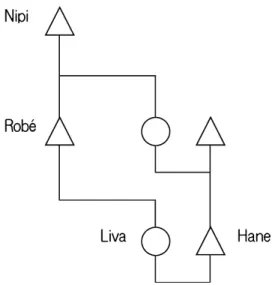
Robé was my main informant through my fi eldwork in the village of Rhepa Dori. He talked much about his renowned father Nipi, who was famous for his wealth. The fi rst stage of my histori-cal narrative deals with the age of Nipi, from before World War II up until the 1960s. Then comes the second stage, the age of Robé, which I myself witnessed, from the 1970s up until the early 1980s. After this comes the present period, from the latter half of the 1980s up to the present, which I dub ‘the age of Hane,’ Robé’s sister’s son as well as Robé’s daughter’s husband (ané) (due to matrilateral cross cousin marriage, which I will discuss shortly).
2. Prestige Economy—‘Bridewealth Exchange’
I would like to begin my argument by introducing the classic study on the impact of the introduction of money on the Tiv people by Patrick Bohannan [Bohannan 1967] and comparing the situation of the Tiv with that of the Endenese. Bohannan divides the three spheres of Tiv economic activity as follows: (1) subsistence (yiagh) (vegetables, chickens, goats, tools etc.); (2) prestige (shagba) (brass pods, slaves, cattle, etc.); and (3) rights on human beings (except slaves), especially on women [Bohannan 1967: 125-126].
2.1 Three Fields of Economic Activity
À la Bohannan, I shall divide the fi eld of Endenese economic activity into three parts. These are the spheres of: (1) the prestige economy (‘bridewealth exchange’ (wai rhaki)); (2) the subsistence economy (‘working in the fi eld’ (kema uma)); and (3) market economy (‘weekly market’ (nerhu)).
The prestige economy (wai rhaki) is the sphere the Endenese people regard as the most impor-tant. When people gather together and chat, it is often ceremonial gift exchange (wai rhaki) and the amount of bridewealth (ngawu) exchanged that they talk about.
2.1.1 Ngawu (bridewealth)
‘Bridewealth’ is my translation of the Endenese word ngawu, which means ‘property’ or ‘wealth’ in general.
The main items of bridewealth are: (1) elephant tusks (toko); (2) gold earrings (wéa); and (3) livestock (éko).
There used to be many elephant tusks fl owing in the sphere of the prestige economy. One was supposed to give tens of elephant tusks as bridewealth.
In the 1970s and 1980s, many tourists came to the island of Flores. Chinese merchants in the town of Ende sold ivory rings and other ornaments to the tourists, which sold well. As the villagers needed cash, they went down to the town of Ende to sell elephant tusks to the Chinese merchants.
Many tusks were sold and there are thus few tusks left in the villages.
Even though there are few elephant tusks, there should be a few, at least one or two, in a set of ngawu paid for a woman. People still claim that they have given, for example, ten tusks as bridewealth even when it was only one or two—the ‘imaginary’ eight tusks were paid in cash. 2.1.2 Cross-cousin marriage
To understand the signifi cance of bridewealth in Ende, we have to grasp one of the most important principles underlying Endenese marriage ideology—what anthropologists have called ‘matrilateral cross cousin marriage.’
Let me explain the ideology in native terms, which are simpler and easier to understand.
The term ‘matrilateral cross cousin marriage’ is the anthropologist’s translation of the Endenese idiom mburhu nduu // wesa senda, ‘tracing the path and connecting the track.’ The path (and the track) refers to a woman’s path from her natal group to her husband’s group.
Thus mburhu nduu // wesa senda refers to another woman’s (the woman’s brother’s daughter) movement tracing the previous path. A woman who came via mburhu nduu // wesa senda is called
tu’a. For example, Robé’s daughter, Liva, is married in this way to Robé’s sister’s son, Hane. So
Hane is not only Robé’s sister’s son but also his daughter’s husband. Liva thus traced the path of her father’s sister’s path to Hane’s family.
For consecutive cross-cousin marriage contracts people say:
Rua tunda // terhu ndeni Let us accumulate (tu’a) twice // pile up thrice
Tuu tunda // nawu ndeni Bring (tu’a) to be accumulated // show in to be piled up
Téta ma’é mbeta // towa ma’é nggéra. May the thread not be cut when we are winding // may the thread not come loose when we are spinning. By this institution, two groups are closely woven and knit into one pattern—one group becomes the wife-giver (ka’é embu) and the other, the wife-taker (weta ané). They are so close that they are, as the Ende say, kombé weta // rhera nara ‘[like] a sister at night and a brother in the daytime,’ and
tona iwa ka ono // bheka iwa ka rina ‘when in want, they do not ask [but just take] // when short,
they do not beg.’
2.2 Function of Bridewealth in Matrilateral Cross Cousin Marriage
Mburhu nduu // wesa senda is sometimes called nai se imu // wa’u se imu, ‘one [person] gets on and
another gets off.’ If a woman (A) marries out of her natal group (wa’u se imu), then the group, or more specifi cally, her father or her brother, gets bridewealth (ngawu) for her. Consequently if a man (B) uses this set of ngawu for his own bridewealth and a new wife enters the group (nai se imu), this series of marriages are referred to as mburhu nduu // wesa senda, since this treatment of bridewealth ensures consecutive marriage—B’s daughter (C) is now obliged to marry A’s son (D).
If A and B are real sister and brother, then A’s son’s marriage with B’s daughter is indeed matrilateral cross cousin marriage. In some cases, though, it may happen that A (the woman for whom the ngawu is paid) and B (the man who pays it) are not real sister and brother. Yet even in these cases, A’s son and B’s daughter are expected to marry and the marriage is conceived as mburhu
nduu // wesa senda. In a way, the path is not so much the path of women as the path of bridewealth
(ngawu). In this fashion, Liva, for example, is described to trace, not the path of her aunt, but the path of the bridewealth (ngawu) paid for her aunt.
Thus the relationships that people often talk about couched in kinship are in most cases relationships accrued from bridewealth transactions (wai rhaki).
In short, in Ende, not only friends make gifts but gifts make friends. Bridewealth transactions create new kinship relations, sometimes between persons without any prior genealogical connec-tions. So important is ngawu, bridewealth, in Ende.
When a marriage ceremony is shortly expected, people grow fi dgety and wonder how they will be involved in the transaction. Villagers talk about past cases of bridewealth transaction. And once one’s role has been defi ned in the coming ceremony, one makes efforts to acquire a reasonable amount of wealth.
These ceremonial feasts are called ghoma, but are often coupled with rugi (thus rugi ghoma). The word rugi means ‘expenses’ or ‘loss’—so burdensome are marriage ceremonies to the households involved. To hold a ghoma as well as to join a ghoma, one needs to prepare large amounts of, amongst others things, paddy. Marriage ceremonies used to be held in a period after the harvest when there was an abundant supply of paddy. Nowadays, as Pa’o said, paddy comes from the shops and ceremonies continue over the whole year.
3. Subsistence Economy—‘Working in the Field’
Rice now comes from the shops in the town of Ende, as Pa’o says. Where did it come from before? It came from the harvest, that is, from the dry fi eld (uma). Now, let me explain how rice came from
the dry fi eld—we shift our attention to the sphere of the Ende subsistence economy.
The Ende people used to be mainly slash and burn agriculturists. To live in a village in mountain Ende was to cultivate a parcel or two of dry fi eld (uma).
The Ende people began opening the forest (ghagha) around September. When the felled woods were dry, they burned (jenggi) the fi eld. When rain came in December, planting (tendo) began. Planting was followed by such arduous labour as weeding, cleaning and guarding the fi eld. The harvest of rice took place around February to March. After the harvest of rice came the harvest of maize and millet. In the harvest season, songga (‘traditional’ type of collaboration) took place in one fi eld or another almost every day. A series of rituals marked the end of the Endenese agricultural year: (1) pesa uta for maize; (2) neté piso for paddy; and (3) kaa uwi for yam, the biggest and most important ritual of all [Nakagawa 1982].
After kaa uwi, people enjoyed a slack period called mera méré, ‘living big.’ This was the ‘fi xed season’ for ghoma implied by Pa’o, when people were busy holding marriage ceremonies. In this time of year, when I walked around the village, people would call me from their dwellings and invite me for dinner—dishes were served full of rice. In a marriage ceremony, moreover, everybody is served generously, so generously that one cannot fi nish one’s dish. All the remaining rice and other dishes are fed to the dogs or sometimes just thrown away.
To grasp the gist of their agricultural activities, let me quote a passage from an Endenese chant at the time of planting (tendo).
Asa usu // wa’u na’u From time immemorial [we] have handed down [the ritual]
Téké dhii // pama pii. We have guarded [the ritual] for generations // defended for layers.
Kajo embu // ema iné Our great grandparents and grandparents // our fathers
and mothers
Ata kafi // ata Endé The Kafi r and the Muslim
Bou si tembo // ingi si rhoo mu Gather your bodies and assemble your trunks
Kema mbo’o // kéwi ’aé . May we work and be satisfi ed // we tap the trunk and the palm yields water.
People treat rice (aré) with the highest regard—guests should be served rice even when there is a scarcity of rice in the household. Yet, they plant various kinds of crops in their fi elds along with paddy—maize (jawa), millet (orho), beans (mbué), pumpkins (bési), cucumbers (timu), cassava (uwi
xai) and many others. Thus:
Jawa padha // aré rasé May maize grow with ears // paddy have bending spikes
Mbué mboko // xorho worhé. Beans grow in plenty // millet have ears.
Like many people in other societies classifi ed as ‘peasants’ (see for another Floresian example, [Metzner 1982: 128]), people in Ende try to spread the risk by planting crops with different moisture requirements.
Every day, as the sun rose, people left the village for the dry fi eld, where they worked all day. As night approached, people would come from their respective fi elds back to the village. Men carried almost nothing; women and children usually carried a lot, over their shoulders, upon their heads, loads such as bundles of vegetables and fi re wood collected in their kopo (permanent garden). These vegetables were to be served at the supper table. In a way, kopo functioned as a sort of convenience store, where one could easily get various foods.
3.1 Harvest
Let me now proceed to describe Endenese agriculture as it was done in Nipi and Robé’s time.
In the 1980s, the staple was cassava as it constituted a large part of the Endenese diet. Yet, when asked about their staple food (‘makanan pokok’ in Indonesian), the Ende people would answer that it was rice. Cassava has no ritual signifi cance and is a newly introduced crop, while rice cultiva-tion is surrounded by ritual activity and regarded highly. People like to talk about the harvest—how big such and such a person’s harvest was, who was the good agriculturalist (kasa ba’i) and who was not. It is always the harvest of rice that matters; nobody cares about the harvest of cassava.
Roughly speaking, one household cultivated around half to one hector of land. My data col-lected in the early 1980s showed the harvest of rice per household ranged from 200 kg to 500 kg— an average harvest, I would say, being around 300 kg.
3.2 Subsistence and Prestige
‘We used to have tons of harvest (nuka ngasu),’ Robé used to say to me. This statement may mean that the land was more fertile before. This may be the case, but more importantly, it suggests that many more people were working on one parcel of land before. Robé described the situation of his father’s household when he was a boy:
My father, Nipi, was very rich (bhanda). We had many elephant tusks (nopo kaju) and gold ear-rings (wéa). Nipi had many wives. Besides, there were many tu’a in our house. All the members
(including tu’a) of the household used to work together. We worked while singing (dowé). We organized a big collaboration (songga). We consumed a number of bamboos of palm wine (moké) and slaughtered two or even three pigs at one songga. Harvest was big (nuka ngasu). Yet, we ate little rice. Most of the harvested paddy was converted into elephant tusks.
There used to be several tu’a in a rich man’s (ata bhanda) household. They were the household’s extra labour and contributed considerably to the harvest of rice.
It is diffi cult to explain the word tu’a. I have already used it in this paper as meaning a ‘married-in woman via matrilateral cross cous‘married-in marriage (mburhu nduu // wesa senda).’ Tu’a here, however, refers to a slightly different category of women. A man without enough bridewealth sometimes ‘sells’ (téka) his sister in order to acquire bridewealth for his own future marriage. A rich man (ata
bhanda) ‘buys’ (mbeta) the woman and gives bridewealth to the poor man for her ‘price.’ Thus, tu’a
means, roughly, a ‘woman bought (mbeta).’ Both usages of tu’a refer to a ‘woman who comes in as
ngawu goes out’ but in one case it is ‘give and take’ (pati and simo), a kind of transaction conducted
between wife-giver and wife-taker par excellence, while in the other, the transaction concerned is ‘sell and buy’ (téka and mbeta), a kind of transaction predominantly conducted between non-kin (ata).
As Robé said, even though paddy was abundant in the household, ‘they ate little rice.’ Paddy was converted into elephant tusks. In the age of Nipi, said Robé, they had a fi xed rate for exchang-ing items of the subsistence economy, paddy, into items of the prestige economy, elephant tusks.
In this way, a rich man would acquire, with his abundant wealth (ngawu), many tu’a; then he would have more labour for his land, resulting in a larger harvest. The surplus rice could be converted into wealth (ngawu) again. And the cycle would close itself and begin again. So the mechanism for rich men was: the more wealth (ngawu), the more tu’a; the more tu’a, the bigger harvest (nuka ngasu); the bigger harvest, the more wealth (ngawu).
The process did not go on forever, though. Some of the acquired wealth was consumed during marriage ceremonies and on other suitable occasions. Nipi was famous for his generosity in paying bridewealth, and Robé was proud of the large number of elephant tusks paid as bridewealth for his wives. It was then, when the harvest was converted and then used in bridewealth transaction, that the subsistence economy supported the prestige economy.
4. Market Economy—‘Selling and Buying’
Now to the third sphere, the Ende market economy.‘traditional’) to denote one of the spheres of the tripartite Ende ‘traditional’ economy, and ‘market economy (c)’ or ‘market (c)’ (‘c’ for ‘capitalist’) to denote the sphere based on the modern, capitalist economy. Let it be noted, however, that the distinction between market (t) and market (c) is made for ‘our’ convenience only, and that both are one and the same for the Ende people, which is the main point of the following argument.
Let me expound on the market economy (t).
An exemplary case of the market (t) is the weekly market (nerhu) usually held in coastal villages. When mountain villagers go to a weekly market, they leave their village when it is still dark (around 4 a.m.) with bananas, rice, maize and other crops. People from the same village tend to gather together in one area of the market place as they are almost strangers (ata) at the market. There they sell (téka) those things carried from the village. With the acquired money, they buy (mbeta) such commodities as fi sh, salt, soap and vegetables unavailable in their mountain area. As they do not expect any social contact at the market, they come back to the village when the planned transactions are fi nished, as early as 10 a.m.
A weekly market is, to quote Augé’s term, a ‘non-place,’ ‘a space which cannot be defi ned as relational, or historical, or concerned with identity [Augé 1992: 77-78].’ It is also, to extend Augé’s terminology, a place for ‘non-kin’ (ata) where ‘non-gift’ transactions (‘selling’ (téka) and ‘buying’ (mbeta)) take place. In short, the market (t) is: (1) a non-place for (2) non-gift exchange among (3) non-kin.
The town of Ende, the northern coast of Flores, Jakarta and Malaysia are other examples of the market (t), or non-places, where many young people go nowadays.
4.1 Subsistence and Market (t)
The subsistence economy is contrasted with the market economy (t) (non-place) so that it becomes an ‘anthropological’ place, a meaningful place concerned with identity and history [Augé 1992]. Land is said to belong to the subsistence economy (kema uma), never to be bought or sold. People say— ‘We work in order to eat and tap the palm tree to drink’ (kema tau kaa // kéwi tau minu).
Kema tau kaa // kéwi tau ’aé We work in the fi eld so as to make food // tap a palm tree so as to sip water.
Powi tau nuwa // pagha tau jangga. We feed ourselves to be satisfi ed // raise ourselves to be tall.
transaction. Land is transferred only through a fi xed scenario of ‘giving to the sister and handing to the sister’s son’ (pati weta // ti’i ané).
Pati weta // ti’i ané [I have] given to my sister // handed to my sister’s son
Pati iwa ka wiki // ti’i iwa ka rhai [I will] never take it away // never retrieve it
Pati wiki // ti’i rhai If ever I give and take away // hand and retrieve
Kojo koé rhia // mbungé tembu rhewu. A crab shall dig a hole // a mushroom shall grow under my house [implying the annihilation of the household]. Thus land, the source of every subsistence economy, is only exchanged through gift-transaction within the sphere of the prestige economy, and never in the sphere of the market economy (t). 4.2 Prestige and Market (t)
So far, I have emphasized the signifi cance of the market (t) (the sphere of ‘non-place’ as well as ‘non-gift’ and ‘non-kin’) in its strict exclusion from the bipartite composition of the so-called ‘anthropological’ place (along with ‘anthropological’ gift and ‘anthropological’ relations) of the subsistence and prestige economies. Here I am going to point to another signifi cance of the market (t): its embeddedness in the tripartite Ende economy.
The market (t) is not always located in far away places. It sometimes manifests itself in the middle of villagers’ everyday lives. Recall the institution of the bridewealth-connected brother and sister. If a man uses, for his marriage, bridewealth paid for a woman, he is regarded as a kind of brother to the woman, to the extent that his daughter has to marry the woman’s son. Say I am on good terms with a man who, even though he plans to marry, happens to have no bridewealth. If I have extra wealth, it may seem quite natural to hand the wealth to him, so that he can carry on with his intended marriage. If it happens that the wealth I transfer to him was what was paid for my daughter, then, according to the ideology of nai se imu // wa’u se imu, his future daughter is destined to marry my daughter’s son. And furthermore, it is not he but I who receives the bridewealth to be paid for her daughter. Thus he has become, in an intricate way, a dependent member of my group.
If everything were arranged in this way, a poor man would be destined to become dependent on the rich man, while the rich man would become even richer. This, however, is not the case. In Ende, there is a channel where one can transact without invoking kinship obligations, that is, the market (t). By using this channel, one does not have to be wholly dependent upon the rich man. It is true that land is never to be transacted through the market (t), but elephant tusks (and gold earrings and livestock) are allowed to be exchanged in this way. Thus, instead of describing the concerned
transaction within the realm of the prestige economy—that is, among others, as ‘give and take’ (pati
simo)—it can be described within the realm of the market (t) economy: ‘sell and buy’ (téka mbeta),
‘borrow and reimburse’ (gadhi nggérhu), etc. So even if a rich man transfers an elephant tusk to a poor man, and this is agreed by both parties to take place within the sphere of the market economy (t), the transaction does not form a ‘path’ which needs to be ‘traced back’ by a woman. The poor man only has to reimburse (nggérhu) the tusk in due course, when he is well off—there will be no path to be traced and no track to be connected.
5. Enter the Market (c)
Now our narrative passes to the age of Hane, beginning in the mid 1980s and reaching to the present. In the middle of the 1980s, from the economist’s point of view, things began to change drasti-cally in the Ende villages. First, in addition to the interculture of several crops, people introduced such new cash crops as vanilla, clove (‘cengkeh’) and cacao (‘coklat’). Second, Endenese youths began to journey to Malaysia as (illegal) labour migrants. Hane himself went to Malaysia and stayed there for a year. Remittances from abroad have fl owed into the villagers’ lives and infl uenced the economy profusely. In short, it was the time when the market (c) entered the scene.
5.1 Subsistence—‘Working in the Field’
Let us pay attention to the ‘economic’ situation in the age of Hane. First, we will look at the subsistence economy (kema uma).
Formerly, kema uma was full of ritual activities (nggua)—beginning from kaki, the opening ceremony of the forest, pa mopo, offerings to the spirits (nitu) of the forest, and ending with pesa uta, a ritual for maize, neté piso, one for paddy, and fi nally kaa uwi, the one for yam.
People used to work in the traditional way of co-operation called songga. In a songga, many people came to the host’s fi eld and worked together. Sometimes they sang a work song (dowé). They had lunch and drank palm wine (moké) in the host’s fi eld. At night after work, they gathered at the host’s house and ate big meals with pigs slaughtered and lots of moké. They usually sat till the dead of the night, talking and drinking.
People perform almost no rituals (nggua) nowadays. Nor is songga carried out as often as before.
As I mentioned above, in the 1980s, the harvest was around 200 to 500 kg per household and before that, in the age of Nipi, a parcel of land (which was bigger than a hector) must have yielded tons of paddy. Every year, from 1997 to 2003, I made a short fi eld trip to Ende and collected data on the paddy harvest for each year. The fi gures never exceeded 200 kg. I was most surprised when
not a few people answered my question by saying that they did not open the fi eld (ghagha) that year. Many people do not plant paddy nowadays.
This is why people today do not perform rituals. They do not perform rituals because they do not cultivate those crops (rice, maize and yam) which need ritual undertakings. They have almost entirely shifted to cash crop cultivation (coconut palm trees, coffee, cacao, vanilla, clove and so on). Permanent gardens (kopo) are still cultivated, but they are planted mostly with cash crops.
One day, I saw Sofi (Robé’s wife) reprimanding her granddaughter, Hestin, age 10 (Hane and Liva’s daughter). I asked Sofi why she was so angry. She replied: ‘I saw Hestin up in a clove tree. The tree is so tall and climbing the tree is so dangerous. I was afraid if she should fall down.’ I then asked Sofi what Hestin was up to. It turned out that Hestin often climbs clove trees and picks a few buds, which she hands over to her grown-up relative to be sold at a weekly market. She asks the relative to buy candies and cookies for her with the money paid for the buds.
The weekly market was, like other non-places, a far away place, not only physically but socially. Mountain people previously did not often go to weekly markets. Nowadays, people go to every weekly market. The market (t) as well as the market (c) is now so close to the villagers that a little girl like Hestin treats it like our ‘convenience store’ where one can buy candies, cookies and such commodities, just like kopo before.
5.2 Development Aid and Cash Crops
Planting cash crops is not a foreign idea to the Ende people. Most of Robé’s coconut palms were planted by Nipi. Yet in the age of Nipi and Robé, cash crops were a mere addition to a household’s fi nances. Many households did well without any cash crops.
In the 1980s people began to introduce new cash crops besides coconut palm. Yet, it was not until the 1990s that cash crops began to play a signifi cant role in the village economy. It was development aid that caused the shift of the planting pattern in Ende.
In December 1992, a large earthquake hit the island of Flores, causing many casualties, especially in the regencies of Ende and Sikka. Aid was sent from around the world to this small island in eastern Indonesia. Various NGOs appeared and functioned as intermediaries between the donors and recepients. Several villagers in Rhepa Dori received a certain amount of money. As was the case with other aid, which I will mention presently, it was meant to be used as microcredit. The idea behind microcredit—the idea of entrepreneurship—was foreign to the villagers. People did not know what to do with the money. Some bought pigs and others bought chickens. Few of them, it seems, were successful.
Funds)1) was set in motion. Every desa (the smallest administrative unit) received 20 million rupiah. The money was then divided among self-help groups at the village level. This was when self-help groups (‘kelompok swadaya masyarakat’ in Indonesian) were formed in the villages. Two such groups (‘kelompok’) were formed in the village of Rhepa Dori. Each kelompok submitted a proposal of what they were going to do with the money and almost automatically received a certain amount. Each member was said to have received from 60,000 to 100,000 rupiah in the fi rst year.
The kelompok formed in 1994 are the groups working together on parcels of land these days, replacing songga. Workers go to the assigned place, each with their own lunch. They work together until the evening with a lunch break around noon. Then in the evening they go back to their respec-tive houses. There is no communal eating, no collecrespec-tive drinking session and no talking-to-the-dead-of-the-night. ‘It is much more effi cient than songga’ people say, sometimes with a tinge of nostalgia.
In 1996, aid came to the village via another NGO. Several villagers received vanilla vines. After being taught how to plant them, they planted vines in one place. As the price of vanilla was low, people were not very enthusiastic; they did not take good care of the seedlings and most vines withered away.
In 1999, cacao seedlings were distributed among the villagers of Rhepa Dori. The seedlings were given to them by the Department of Labour in Jakarta.
2001 witnessed the beginning of PPK (‘Proyek Pengembangan Kecamatan’ or Kecamatan Development Program). It was meant to replace IDT, with a much larger budget. Every kecamatan (an administrative unit one level above desa) now receives about a billion rupiah a year.2) At the village level, via a self-help group (kelompok), one member can receive 2 to 3 million rupiah.
The above examples are suffi ciently convincing, I hope, of the point I am going to make—the shifting pattern of cultivation was, at least partly, caused by the coming of development aid.
In 2003, on my last trip to Ende, villagers were busy planting vanilla because the price of vanilla was shooting through the roof.
5.3 Remittance
Damage caused by a hurricane in Madagascar, the largest producer of vanilla, in 2003 caused the price of vanilla to rise dramatically. A few vanilla planters in Endenese villages received enormous (by villagers’ standards) income. Yet it is uncertain if the price of vanilla will remain so high. If 1) IDT began in 1994 and lasted for three years, and was replaced by PPK (see below). The IDT budget came from an
InPress (Presidential Instruction) fund. 28,223 desa were given 20 million rupiah each.
2) PPK was started by the Indonesian government with a loan of 225 million dollars (US) from the World Bank. The targeted area covered 725 kecamatan (about 9,000 desa). With an approval from a kecamatan level council (UDKP) a self-help group can receive its money, to be directly deposited in its own bank account.
an agriculturalist practices the monoculture of commercial plants, he or she is at the mercy of fl uctuations in the world market. People try to disperse such risk, as they used to do in the old ways of kema uma, by planting various crops; now village youths go to Malaysia for wage labour.
Since the latter half of the 1980s, village youths (mostly men) have been going to Malaysia (mostly to western Malaysia). Currently, there are few men under the age of 50 who have never been there. In most cases, people go to Malaysia and stay there for 2 to 3 years and come back to their villages. People tend to go twice and, sometimes, three times.
Hane himself has been to Malaysia once, in 1994. Before departing, he borrowed Rp. 200,000 from Sale, his wife’s (Liva’s) brother.
As the enterprise concerned labour migration, a transaction of the non-kin type, it did not involve kinship obligations even though the two concerned parties were closely related (mother’s brother’s son and father’s sister’s son as well as wife’s brother and sister’s husband). The only thing Hane had to do was reimburse (nggérhu) the amount later. He borrowed some more from his friends and relatives, some Rp. 800,000.
Hane repaid all his debts by the end of his third month in Malaysia. Then he began his remittances. He sent Rp. 1,000,000 to Liva, who as wife-taker used the amount to contribute to Sale’s marriage transactions. In 1996, Liva’s other brother died. It is a heavy burden for the deceased’s wife-taker to contribute to the funeral. Hane then sent Rp 500,000 to Sale and 200,000 to Liva to be used for the dead brother’s funeral. In 1996, he came back to Rhepa Dori with Rp. 2,5000,000, when his sister was about to marry. The entire amount was used for the preparation of her marriage.
I once asked Hane whether many of his relatives were there working with him in Malaysia, and if it had been diffi cult for him to stick to various rules of kinship. He said to me—‘Once in Malaysia, nobody cares about kinship. We are all equal. We’re busy collecting money.’
In the non-place of Malaysia, Hane was engaged in non-gift transactions, with non-kin around him, and earned, all together, Rp. 4,200,000, all of which was in the long run exchanged into mean-ingful gifts for meanmean-ingful kin in meanmean-ingful places, that is, in the sphere of the prestige economy.
6. Concluding Remarks
Thus ends my story of the history of Ende in economic terms. It is time to add some concluding remarks to the story.
From what one sees, one might conclude that big changes have occurred in the village and al-tered villagers’ lives enormously. Let me employ a device once practiced by Malinowski in his classic
treatise on the economy of the Trobriand Islanders [Malinowski 1922]—and introduce a caricature of an economist. He would say—my conclusion is that ‘the scene changes.’
The changes are obvious—no rituals (nggua) are performed; instead of the traditional, ineffi cient songga, the modern ‘kelompok’ type of co-operation is now in vogue. No subsistence economy is in sight; people plant mostly cash crops in their gardens. In short, the capitalist economy is spreading over the lives of the villagers. There used to be a tripartite economy, consisting of the prestige, the subsistence and the market (t) economies. Now the subsistence economy has dwindled while the market (t) has been replaced by the market (c), the capitalist version of it.
So, in a nutshell, Ende society is simply yet another society which has belatedly come to be involved in the world system as a negligible, peripheral item. As Bohannan says, ‘there is very little doubt about its outcome.’
An economist would say thus. My conclusion, however, is different. I would say, ‘the song remains the same.’
It is true that the tripartite economy has now almost become a bipartite economy. The scene seems to have really changed. But it is because you are looking from the outside. Let us look at the ‘scene’ from the native’s point of view.
It is the prestige economy that matters. People do not care what has become of the subsistence and market (whether it be (t) or (c)) economies, so long as the prestige economy remains unchanged. It was, in the age of Nipi and Robé, the subsistence economy that supported the prestige economy; it is now the market economy that supports the prestige economy.
As Pa’o says, things have indeed changed (‘rice now comes from the shops’) but the point is that the prestige economy keeps going while its importance has actually increased (‘there is no fi xed season for marriage feasts’).
Now, the question remains, how can the Endenese people use money, the all-destructive agent [Bohannan 1967], in their ‘traditional’ gift-exchange system in such a nonchalant way? To under-stand how, let me give you one specifi c Ende device for perceiving, or more precisely, controlling the world—what might be called ‘dubbing.’
As I said earlier, land is something which wife-giver gives to wife-taker. Directions of transfer-ence are predefi ned, not only for land but for other items—pigs are what givers give to wife-takers; other livestock such as cattle, water-buffaloes, dogs are what wife-takers give to wife-givers; rice is what wife-givers give to wife-takers; bananas are what wife-takers give to wife-givers, and so on and on.
sometimes has recourse to ‘non-places’ (the market (t)) so that the transaction does not invoke kinship obligations. A transaction carried out in a non-place is an unencumbered transaction, as it were, a testament to the neutralizing power of the market economy.
There is another way to circumvent these strict rules—by dubbing.
When you receive your wife-giver at home, you have to serve him beef or water-buffalo or horse or dog meat, but never pork. Pork (pig) is what wife-givers are supposed to give to wife-takers; you should never serve pork to your own wife-giver. But it sometimes happens that you only have pork at hand. In such a predicament, dubbing comes to the rescue—you only have to say to the wife-giver, when serving him a dish of pork, ‘this is dog meat.’ Dubbing changes the world and the pork is now dog meat; the guest, your wife-giver, will perhaps say something like ‘Hmm, thank you. This is good dog meat,’ and will start eating without further ado. Thus words change the world.
If you hand an elephant tusk to another person and ‘dub’ the transaction ‘to help’ (rhaka), another piece of ‘non-place’ vocabulary, the transaction becomes part of the market (t) economy and will not invoke kinship obligations. In the same way, if you hand money to another person and ‘dub’ the money as ‘elephant tusk,’ and the transaction as ‘to give,’ then the transaction becomes part of the prestige economy and will invoke kinship obligations in the future. This is the critical difference between the Ende and the Tiv, where ‘Tiv deplore the fact that they are required to ‘sell’ (te) their daughters and ‘buy’ (yam) wives’ [Bohannan 1967: 134]. The simple mechanism of ‘dubbing’ ensures that the transaction is never to be treated as ‘buying and selling,’ even when the medium exchanged is money. One does not have to ‘launder’ money to be used in ceremonial exchange [Toren 1989: 158] as in Fiji, nor does one have to ‘cook’ the money [Carsten 1989: 139] as in Malay fi shing villages.
The only thing one has to do is to ‘dub’ or ‘declare’ in Ende. And it was in this connection, after the outfl ow of elephant tusks, that people were driven to search for ways of making money (such as going to Malaysia and planting cash crops in their gardens), because dubbing ensures that money is to replace, or to take the place of (tau nia), elephant tusks.
Alongside the visible changes in many parts of their lives, the Ende people have managed to retain their ‘culture,’ thanks to various ‘ways of world making’ [Goodman 1978] available to them— ‘dubbing’ as well as the ‘gifts make friends’ principle, and the neatralizing power of the market economy.
Acknowledgments
This paper is a modifi ed version of the paper of the same title presented at the 21 Century COE Program Inter-national Workshop in Jakarta: ‘The Micrology of Indonesian Local Societies’ held at Auditorium Widya Graha, Indonesian Institute of Sciences in Jakarta on 23 March, 2004 (see <http://areainfo.asafas.kyoto-u.ac.jp/index. html>). I am grateful to the participants for their comments. Much of the material used for this paper was collected during research conducted over three years, from 2001 to 2003, within the research project ‘Anthro-pological Study on Indonesian Local Societies after the Downfall of the Suharto Regime’ (representative: Takashi Sugishima), with a grant-in-aid for scientifi c research by the Japan Society for the Promotion of Science, and under research permits from the Indonesian Institute of Sciences. I express my gratitude to these institutions.
References
Augé, M. 1995 (1992). Non-Places: Introduction to an Anthropology of Supermodernity. London, New York: Verso.
Bohannan, P. 1967. The impact of money on an African subsistence economy. In G. Dalton ed., Tribal and
Peasant Economies. Texas and London: University of Texas Press, pp. 123-135.
Carsten, J. 1989. Cooking Money: Gender and the Symbolic Transformation of Means of Exchange in a Malay Fishing Community. In J. Parry and M. Bloch eds., Money and the Morality of Exchange. Cambridge, New York, Port Chester, Melbourne, Sydney: Cambridge University Press, pp. 117-141.
Goodman, N. 1978. Ways of Worldmaking. Indianapolis: Hackett.
Malinowski, B. 1922. Argonauts of the Western Pacifi c. London: Routledge and Kegan Paul.
Metzner, J. K. 1982. Agriculture and Population Pressure in Sikka, Isle of Flores: A Contribution to the Study of
the Stability of Agricultural Systems in the Wet and Dry Tropics. Development Studies Centre Monograph
No. 28. Canberra: The Australian National University.
Nakagawa, S. 1982. Chuubu Flores, Ende zoku ni okeru noukou cycle to kanren sho-girei [Agricultural Cycle and Related Rituals among the Endenese, Central Flores]. Tonan Ajia Kenkyu [Southeast Asian Studies] 20(3): 393-404.
_.2003. On the Endenese labour migrants to Malaysia. In J. Koizumi ed., Dynamics of Cultures and
Systems in the Pacifi c Rim. Osaka: Osaka University Press, pp. 35-50.
Parry, J. and M. Bloch eds. 1989. Money and the Morality of Exchange. Cambridge, New York, Port Chester, Melbourne, Sydney: Cambridge University Press.
Toren, C. 1989. Drinking Cash: The Purifi cation of Money through Ceremonial Exchange in Fiji. In J. Parry and M. Bloch eds., Money and the Morality of Exchange. Cambridge, New York, Port Chester, Melbourne, Sydney: Cambridge University Press, pp. 142-164.