The Japanese Psychonomic Society
NII-Electronic Library Service
The JapanesePsychonomic Society
1'heJapaneseJoumalof Ps,1,chnnomicScience
2010,VoL29,Nu.1,77-78
Summary
ofAwardedPresentation6-109
-AnHardness
perception
in
visual
motion
experimental
investigation
in
penetrating
motion-TomohiroMAsuDA*,
Atsushi
KiMuRA*,
Ndtional
Food
Research
institute*,Sho-ichi
GoTo*2,
andYuji
WADA*
andUheiversity
of
71sukuba*2We investigated the infiueneeof pre-penetrationand penetration velocity changcs
(decelera-tionlconstant velocityfacceleration) on visual hardness
judgments.
Participants were asked tojudge,
using an analog scalc,the
relativehardness
ofthe
penetrated objects compared to astandard pattcrn with no changes
in
acceleration,The
results show thatperceptual hardness washigher when the penetrating object decelerated during pre-penetration,or accelerated during
penetration,
but
wasIower
when the velocity changedfrom
acceleration todeceleration.Our
findings
reveal that the visual perception ofhardness
is
infiuenced
by ve]ocity changes of thepenetratingobject
during
penetration.In
addition.the
current resultsirnply
thatvc]ocity changeduring
pre-penetration,whichis
notdirectly
related toactual penetration in a natural environ-ment, isone factordetermining the visual perception of tcxture,Key words: motion perception,ex,ent perception,non-rigid motion
The act of piercing something iscalled
'"penetra-tion",
Motion
during
penetration varies dependingon the material of the objects involved and the
pene-tration
depth.
In
other words, changesin
theveloc-ity
of thepenetration provide rich cues fordetermin-ingthe texturcof the penetrated object.
Some
researchershave
reported thatwe perceis,ethe various textures of objects based on visual
mo-tion.
For
exarnple, when an ebject moving with arapid change in ve]ocity crosses a border betw・een
different
coloredbackground
areas, observersper-ceive a change
in
textureof the area that the objectpassed
(Levelt,
1962), Thus we expcct thatthetcx-tureof a penetrated object can be perceived from the
visual velocity changes during a penetration evenL
Indeed,
a changein
velocityis
proportional totheforcesacting on theobject,
In the present investigation we examined the
effects of velocity change of a penetrating object on
theperceived texture of the
penetrated
object, Thefirstof two phases was pre-penetration:this ranged
from the approach of a penetrating object to the
object whjch was to
be
penetrated,towhen thesur-*
National
Food
Research
Institute,
2-1-12,
Kannondai, Tsukuba, Ibaraki
305-8642
**
University
of Tsukuba, 1-1-1 Tennodai,
Tsukuba,
Ibaraki
305-8573
e-mail:mastomo@affrc,go.jpface
of thepenetrated object was touched.The
sec-ond phase was the penetration of the object, Itcan
be assumed that: the velocity change in the
first
phase
implied
thestrength of pressure forthepene-tration; and that the velocity change
in
the secondphase
implied
theforce
offricLion
acting on thepenetrating object.
Methods
Participants. Sixhealthy adults participatedinthe
experiment
(average
age=30,33 years,S.D.=5.68L
Thev al] had normal or corrected-to-normal vision,
Visual
patterns.The
visual patterns were pre-sented on a CRT monitor, In thesepatterns,astick-like object
(penetrating
ebjecO approached andpierced a
fixed
object(penetrated
object, see Figure 1),Wc rnanipulated the velocity changes
(deceleration,
constant velocity, acceleration} of thepenetrating
ob-ject
in
two phases(pre-penetration
and penetration),which were
identical
in
duration(1.0
sec) and werepresented sequentially without an intervaL Thus, a
total of nine visual patterns with varied velocity
changes were generated,
The
patterns representingeach condition were presented
in
random order.Procedure. The head of each participantwas fixed
toa chin-rest approximately
114cm
from
theCRT
monitor and thc visual pattcrns were observed
bin-ocularly in a dark room after a dark adaptation
The Japanese Psychonomic Society
NII-Electronic Library Service
The JapanesePsychonomic Society
78
The
Japanese
Journal
ofPsychonomic
Science
Vol.29,
No.
1Table 1. Mean ratings of the surface and
internal
hardness.
Conditions
of velocity change Surfacehardness
Internalhardness
Meant-valueMeant-valueFigure 1. An example of the visual pattern
used
in
thisexperirnent.dec-decdec-const
dec-accconst-dec
const-const const-acc acc-decacc-const acc-acc 5.85** 9.72** 4.37**O.50
o.oo 5.59** O.972.3122.71
O.23O,31 o.ooo.ooO.22O.04
2.352,473.212,34o.ooO.045.383.06O.25
{p<.05,*lp<.Ol
period of IOmin. Each visual stimulus was
pre-sented after the presentation of a standard pattern
that
had
no velocity changes.Participants
wereallowed to observe the stimuli as often as they
wished until they
felt
thatthey eould rate therela-tive hardness of the penetrated objeet as compared
to that of the standard pattern,
They
judged
both
thesurface andinterior
hardness
of each penetratedobjecL When compared to the standard pattern,the
perceived
hardness
was ratedby
using a visualana-logscale forhardness ranging from
"much
lower"to "muchhigher",
Participants
were allowed tocheck
any point on the scale, Using a linearscale,
"much
higher" was assigned a value of 1and "much lower"
was assigned a value of
-1,
withO
indicating
thesamehardness as the standard pattern.
Results
andDiscussion
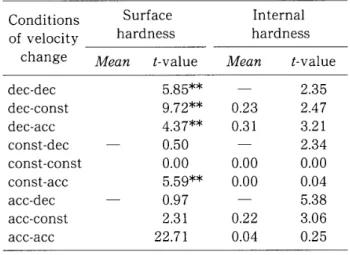
Table 1 displays the mean ratings of the surface
and
internal
hardness
as compared to the standardpattern,and the results ofthe two-tailedt-tests.
The
abbreviations
indicate
the conditions of velocitychange for pre-penetration and penetration
(e,g,,
"acc-const" indicates
acceleration during the
pre-penetration phase and constant velocity
during
thepenetrationphase).
These results indicatethat the surface hardness
was significantly higher than zero under all
pre-penetration
deceleration
conditions and allpenetra-tionacceleration conditions,
The
internal
hardness
was significantly higher than zero under thedec-acc
and the acc-const conditions, and lower than zero under theacc-dec condition.
The results reveal that thesurface of thepenetrated object was perceived as
harder
when the penetratingobject decelerated during pre-penetration or
acceler-ated duringpenetration. The insideof the penetrated
object was
judged
as]ess
hard
when the penetratingobject went from acceleration todeceleration,
Generally,
the motion of penetrationinto
ahard
surface issaliently slowed by the elastic deformation
of thepenetratedsurface priorto
fracture,
after whichthe penetratingobject beginstoaccelerate as it
perfo-rates the penetrated object. On the other hand the
deceleration
of the penetrating object,due
tosurfaceelastic deformation, isslight when the penetrated
ob-ject
has
a soft surface.Taken
together,the currentresults suggest thatthe visual perceptionof the
tex-tureof a penetratedobject isachieved using
naturally-occurring motion cues such as velocity change. In
addition, the current results imply that
pre-penetration velocity change, which
is
notdirectly
re-latedtoactual penetrationinanatural environment, is
one determining factorinvisual texture perception.
References
Levelt,
W.
J.
M,
<1962).
Motion
braking
and thetionof causality, In