A Cooperative and Constructive Book Discussion
多読の動機づけを高めるワールドカフェの実践 : 協同的・建設的な本のディスカッション
Megumi Kobayashi(Seikei University) , Motoko Fukaya(Tsurumi University) , Yuka Kusanagi(Tsurumi University)
成蹊大学一般研究報告 第 50 巻第 6 分冊
平成30 年 2月
BULLETIN OF SEIKEI UNIVERSITY, Vol. 50 No. 6
Using the World Café to Increase Motivation for Extensive Reading: A Cooperative and Constructive Book Discussion
多読の動機づけを高めるワールドカフェの実践: 協同的・建設的な本のディスカッション
Megumi KOBAYASHI(Seikei University),Motoko FUKAYA(Tsurumi University), Yuka KUSANAGI(Tsurumi University)
Abstract
This paper demonstrates how the World Café, a type of discussion format that promotes group dialogue, can be adapted for use in an extensive reading program as a cooperative book discussion activity, and how it affects learners’ interest in reading English. Sixty-six Japanese university students participated in this study; their reflective comments, written/ graphic works, and questionnaire responses indicated that the World Café operated in accordance with Kagan’s (1994) PIES, a useful set of principles that regulate cooperative learning, and increased the students’ interest in and motivation to read English. While the effectiveness of the World Café was enhanced by the measures incorporated to satisfy the PIES principles, the use of interactive writing during discussion, the World Café’s unique format, played a major role in promoting cooperative learning.
1. Introduction
Extensive reading (ER) is a method of learning a language by reading a large number of texts. In contrast to intensive reading, learners typically read self-selected, easy materials for general comprehension and enjoyment. The effectiveness of ER for the improvement of learners’ motivation to read, as well as their language proficiency, has been widely reported (see Day & Bamford, 1998). It has been demonstrated that one of the keys to successful ER is to allocate time for sustained silent reading (SSR) in class, that is, reading books silently and without interruption for a period of time (Pilgreen, 2000; Takase & Otsuki, 2012). On the other hand, it has also been argued that in-class SSR alone is not sufficient to maintain learners’ motivation to continue reading extensively, and
that the implementation of other reading-related activities could improve ER programs (Bamford & Day, 2004; Fukaya, 2015a; Kobayashi, Kawachi, Fukaya, Sato, & Tani, 2010; Kusanagi, 2009; Jacobs & Gallo, 2002; Jacobs & Renandya, 2015). The study presented in this paper forms part of the ongoing effort to promote ER and motivate learners to read more, reporting on how a combination of SSR and the World Café (WC), adapted as a form of cooperative learning (CL), affected learners’ attitudes towards reading and their motivation to read extensively in English.
2. Literature Review
2.1 Cooperative Learning and Extensive Reading
The positive effects of CL have been widely demonstrated in previous studies. A review of the large body of CL studies indicates that, compared to individualistic or competitive approaches, CL has a more positive impact on academic achievement, social relationships, and motivation (Johnson & Johnson, 2009; Slavin, 1995). Proponents of CL point out that simply implementing group work does not guarantee successful CL (Johnson & Johnson, 1993; Kagan, 1994); in fact, group work often fails because members do not participate equally and are not held accountable for their respective contributions. To foster CL, Kagan (1994) argued that four principles, to which he referred with the acronym PIES (for positive interdependence, individual accountability, equal participation, and simultaneous interaction), need to be introduced.
Positive interdependence is a key principle in CL. As aptly captured by Jacobs (cited in Kimura, 2009, p. 13), “All for one, one for all” and “Two (or more) heads are better than one,” group members are expected to help each other, share all ideas presented by each member, and cooperate to achieve a common goal. Furthermore, each needs to have his/her own role and contribute to achieve the common goal in his/her own way; this is individual accountability, the second principle. Individual accountability leads to another principle, namely equal participation, by which all group members are given equal opportunities to participate and then present their ideas. This aims to control the quality of interaction as well as quantity of interaction. Lastly, simultaneous interaction rather than sequential interaction is encouraged; many people may speak at once, rather than one at a time.
On the basis of these principles, CL may seem to be a contradictory approach to ER and in particular to SSR, which is done individually and does not require cooperation. However, Manning and Manning (1984) found that ER accompanied by peer interaction had a substantial effect not only on learners’ reading attitudes but also on their reading
achievement. Moreover, Jacobs and Gallo (2002) analyzed a number of ER activities using Kagan’s (1994) PIES principles and showed the benefits of adding a CL element to ER: “modeling enthusiasm for reading, acting as resources for finding reading materials, creating more reading materials, facilitating comprehension, and serving as an audience for sharing what has been read” (p. 8). Given these studies, the “happy marriage” between SSR and CL could open up a new horizon in ER research and classroom practice.
2.2 The World Café as a Form of Cooperative Learning
The World Café (WC) is a unique type of discussion format conducted in a cozy relaxed atmosphere, as in a café. Typically, groups of four or five people sit together at a table and talk about a common issue for a period of time while casually recording their ideas on a large sheet of paper. Participants then switch tables and discuss the same topic with new group members, building on the previous discussion and adding new insights with the help of the graphic records. Participants have three or more rounds of discussion with different members in order to continue to expand and deepen the discussion.
This discussion format is further enriched by the following seven underlying design principles: (a) clarify the context (the purpose or the goal of discussion);(b) create a hospitable space; (c) explore questions to focus participants’ collective attention; (d) encourage contributions from every member; (e) cross-pollinate and connect participants’ diverse perspectives; (f) listen together for patterns, insights, and deeper questions that emerge through discussion; and (g) harvest and share collective discoveries (Brown, Isaacs, & the World Café Community, 2005). In other words, the WC strives to create a relaxed, non-competitive atmosphere and to promote voluntary participation and cooperation by posing questions that are meaningful to participants. In addition, although the design principles do not make specific reference to the role of writing down ideas on a sheet of paper, interactive writing while talking potentially plays a vital role in the WC, as it can act as a mediator of ideas and create a sense of solidarity among participants.
Since the inception of the WC in 1995, this format has been successfully used in various organizations (The World Café, 2015). For the present study, we adopted the basic WC format and core design principles, and modified it for a book discussion by adding certain procedures and assignments. This was necessary in order to meet the demands of educational requirements, such as the need for evaluation. Below, we present the procedure by which the WC was used in the present study. The elements we added to the standard WC format are indicated in italics.
The WC procedures adapted for a book discussion: 1. Briefing (10 min)
I. Explain what the WC is, its purposes, and the procedure to be followed. 2. Forming the initial groups (5 min)
I. Arrange tables as islands. Place a large piece of paper on each table.
II. Divide into groups of four. Select a “host” student in each group. Host stays at the table for the entire time. Their first table is their “home.”
3. Round one (15 min)
I. Participants at each table write or draw the discussion theme (the title of the text) in the center of the paper.
II. Participants launch the discussion by asking questions they had prepared or presenting brief evaluations in turns. Then, they freely discuss the issues/ topics they find interesting and record (write or draw) key words or expressions that emerge from the discussion, using color markers.
4. Round two (10 min)
I. All the participants except the host leave the table and individually move to any table they wish. The host keeps the paper and continue to use it during subsequent discussions.
II. When a new group is formed, the host gives a brief summary of the previous discussion to the new members. Other members (“travelers”) try to connect what they talked about in the former group with what they hear from the new host and other members in the new group, and add whatever they talk about with the new members to the paper.
III. The teacher walks around the tables to remind the participants to ask the prepared questions or to present brief evaluations in turns.
5. Rounds three and four (10 min each)
I. Participants follow the same procedure as in the previous round. 6. Sharing in a group (10 min)
I. Travelers go home (to their first table).
II. The host at each table serves as a facilitator. In this round, each group shares what was discussed, thought, or felt in the previous rounds.
7. Reflection (10 min)
I. Participants reflect on the ideas and issues they have identified and start writing a reaction paper individually. If they do not finish their paper during class time, they can finish it as homework. The reaction paper is returned to them later with grades and feedback on their writing from the teacher.
I. Close the WC. The teacher gives feedback to the class.
Let us now review the WC from the perspective of CL. Although WC was not based on the principles of CL in its design, WC shares some of the principles of CL, so we have conducted a PIES analysis on the WC, following Jacobs and Gallo (2002). As shown in Table 1, in the standard procedures of the WC format, even though the original design principles are mostly consistent with the spirit of CL exemplified in the PIES principles, there are no overt rules to ensure positive interdependence, individual accountability, and equal participation. However, as also shown in Table 1, the additional measures we incorporated into the WC format for a book discussion helped to ensure and enhance the principles of PIES (Kagan, 2015).
Table 1
WC and PIES (Positive Interdependence, Individual Accountability, Equal Participation, and Simultaneous Interaction) Analysis
WC in its original format and PIES Additional measures and PIES
P ● Participants have a common goal to gain a
deeper understanding of the topic or reach a better solution to the problem discussed. They are expected to encourage reciprocal contributions and respect collective intelligence.
● One of the group members is given the role
of facilitator (host) and is responsible for summarizing the content of the discussion. Other members are dependent on the host to pass on the results of previous discussions but the host is also dependent on other members to provide him/her with different ideas discussed in other groups.
● At the end of the WC, participants realize
that the discovery/solution they reached is the result of all participants’ contributions and cooperation; the results are clearly shown on the papers spread on the discussion tables.
● Assigning a follow-up reaction paper provides
a common goal and the teacher makes sure that participants realize that it is in their interests to engage in active discussion and achieve deeper understanding of the topic in order to complete the additional assignment.
● Furthermore, the teacher explains the
importance of writing while talking; this enhances the feeling of sharing and solidarity, and the paper produced is an accumulation of participants’ collective effort.
I ● All participants are responsible for creating
a hospitable atmosphere, presenting their own ideas, listening to others’ ideas, connecting with them, and harvesting collective discoveries.
● The host and the travelers must fulfill their
respective roles.
● Participants must come prepared for the
WC after reading the text individually. They are also accountable for preparing interactive questions in advance, without which the discussion will not be initiated. They are also responsible for writing a follow-up reaction paper individually.
E ● Participants are expected to maintain a
friendly and respectful manner so that group members feel free to speak up.
● Participants must ask interactive questions
during the discussion session, ensuring each member takes a turn, and to spend roughly equal amounts of time talking about their questions.
● The teacher reminds the participants to
follow this procedure every round.
S ● One participant in each group speaks at a
time, meaning that about 25% of the class is speaking simultaneously at any given time. However, because the other participants can write while one member of their group is speaking, the rate of simultaneous interaction is actually higher.
● No additional measures are necessary.
The PIES analysis in Table 1 demonstrates how the WC format can be fortified as a CL activity by adding certain measures to ensure the application of PIES principles. However, the effectiveness of the WC as a form of CL has not been sufficiently investigated. Moreover, although some studies have shown the benefits of the WC adopted in ER programs (Fukaya, 2015b; Kusanagi, Fukaya & Kobayashi, 2014; Kusanagi & Fukaya, 2015), few have presented quantitative data on its effects. Thus, the current study attempts to examine the effects of implementing the WC as a form of CL in ER classes, using both quantitative and qualitative data. The following research questions were addressed:
1. Does the World Café affect learners’ interest in reading in English?
2. Does the World Café affect learners’ motivation to read extensively in English? 3. What factors contribute to the success of the World Café as a form of CL?
3. The Study
The present study focuses on an ER program designed by Fukaya, and the data collected during her 2014 course described below. Preliminary investigation of the WC, however, was conducted in an ER program implemented at three Japanese universities as part of our ongoing research (Kusanagi et al., 2014; Kusanagi & Fukaya, 2015).1
3.1 Participants
The participants in this study were 66 first-year law majors (51 male, 15 female) in two ER classes at a private university in Japan. The Edinburgh Project for Extensive Reading (EPER) placement test (1992) determined their English level to be upper-elementary to upper-intermediate.2
3.2 Overall Course Design
The classes met once a week for 28 sessions (14 sessions in each semester). In regular sessions, the participants engaged in SSR for about 45 minutes and participated in one of several reading-related activities (e.g., book talk, timed reading, prediction of the plot, reading aloud) for a further 45 minutes. However, the entire class time (90 minutes) was used for SSR without any additional activities four times per semester and for the WC activities twice in the second semester.
The participants had access to a large number of books for ER, including both graded readers and authentic English materials. Each participant kept a reading log and reported the amount of books they had read to the teacher at the end of each semester; The participants read a total of 382,585 words on average over the year-long course (SD=215,087.94).
3.3 The World Café
As explained above, the WC activity was used twice in the second semester of the course. The focus here is on the first session, in which the participants read an English translation of Haruki Murakami’s Super-Frog Saves Tokyo (2002/2000) prior to the lesson. This story was selected because of the potential for multiple interpretations. It describes the daydream-like adventure of a middle-aged man who is asked by a six-foot-tall frog to save Tokyo from a big earthquake caused by a gigantic earthworm. This story does not allow easy, ready-made interpretations of themes or messages. Kirschner, Paas, and Kirschner (2009) pointed out that the complexity of a task is a determining factor for the quality of CL learning outcomes. In other words, CL is especially useful when the text is challenging; the more difficult or vague the narrative, the more likely it is to require cooperation and collective knowledge to be understood. Murakami’s story was judged to be challenging because of the possibility of multiple interpretations, and it was thought that it would encourage WC participants to appreciate different points of view.
As preparation for the WC discussion, the participants were asked to prepare two inferential questions to ask their peers, to identify the most impressive passage in the book, and to prepare a brief evaluation of the story.3 Then, in the WC, they talked about their ideas
in groups. The discussion was conducted in their L1 (Japanese) to encourage them to talk actively in a relaxed mood. After the WC, they were required to give a new evaluation of the story in individual reaction papers.
3.4 Instruments
form of CL in an ER course: (a) participants’ reflective comments after conducting the first session; (b) questionnaire results; and (c) participants’ written and/or graphic records from the first WC session. The methods of data collection and analysis used with each instrument will be explained along with the findings in the next section.
4. Findings
4.1 Participants’ Reflective Comments
After the first session of the WC, the participants were asked to write freely in Japanese to indicate what they felt about the discussion in the WC format. Their comments were then coded in terms of major recurring themes (see Table 2). The inter-coder agreement rate was 93%.
Table 2
Participants’ Comments by Themes
Themes n = 66 %
I was able to…
realize that there are various points of view 30 45%
gain new, different perspectives from others 25 38%
re-appreciate the value of this work/author 11 17%
gain deeper understanding of this work 5 8%
form new ideas through discussion 5 8%
Other 28 42%
No answers 11 17%
Note. As some comments can be categorized into multiple themes, the total number of responses does not add up to 66, the total number of participants.
As Table 2 shows, the most frequent type of comment (n = 30) concerned participants’ ability to appreciate the diversity of viewpoints on the text as a result of the WC. Many stated that they were excited that so many different reactions could emerge from reading a single story.
A similar yet distinct theme was that the WC enabled participants to gain new perspectives that were different from their own (n = 25), as evident in the following comment: “It was interesting to know other people’s ideas because I would not have been able to come up with such ideas by myself” (participant no. 12). Some participants (n = 5) further noted that they were able to formulate new ideas as a result of the discussion: “I
thought sharing various opinions was very important because it became a basis for us to develop more ideas (no.7)”; “I enjoyed the process where a new idea was formed based on everyone’s ideas including mine” (no. 37).
All these comments suggest that the principle of positive interdependence described earlier was active in the WC process. As the comment “I believe that the WC was beneficial not just for me but for others, too” (no. 54) suggests that participants felt they were learning cooperatively as a group.
Various other insightful observations were also found in less frequent comments included within the category “others” in Table 2. For example, some responses made a reference to current social problems and noted the importance of interpreting literary work from a social and historical framework (no. 19, 56, 65). Similarly, one respondent (no.7) observed that having extensive background knowledge and wide reading experience could help appreciate literary work more deeply.
The WC also helped enrich interpersonal relationships by allowing the participants to interact with their peers more (no.2) through multiple round of discussion sessions and get to know them in a new light (no.27). Some even expressed excitement about having a chance to be heard, which was all the more noteworthy because the Japanese are not known for being expressive about their opinions: “I was glad that I was able to voice my own opinion (no. 27),” “I was happy when others appreciated my point of view (no.60).”
Lastly, one of the most noteworthy comments concerned a change in interest in reading. Participant no. 23 stated that she was able to read with increased interest after experiencing the WC, which was what we had hoped to achieve by introducing the WC. Others commented that the WC was “stimulating,” implying increased motivation. Although these comments cannot be taken as evidence that the experience led them to actually read more, they indicate the positive role the WC played to stimulate participants’ interests in reading more.
4.2 Questionnaire Results
1)Questionnaire about in-class activities
The WC was perceived favorably by the participants, but how does it compare to other activities? To examine the relative popularity of the WC, the participants were asked to rate all ER-related activities they experienced on a five-point Likert-type scale (1=least useful, 5=most useful) at the end of the year-long course.4 Table 3 shows the results of this
questionnaire. The mean scores indicate the participants’ evaluation of each activity; the reliability of this measure was found to be adequate (Cronbach’s α= 0.685 for 12 items).
Table 3
Activity Rankings
Activities S/T Skills Books/Stories used n M SD
World Café S (G) S/W(J) “Super-Frog Saves Tokyo” 64 4.48 0.71
World Café S (G) S/W(J) “A Small, Good Thing” 64 4.48 0.67
Book talk (group reading) S (G) S(J) (group selections) 66 4.26 0.79 Discussing predictions S (G) S(J) “A Small, Good Thing” 66 4.03 0.72
Book talk S (P) S(J/E) (student selections) 66 4.09 0.78
Book talk with a POP S (P) S(J/E) (student selections) 66 3.56 1.05
Free writing S (I) W N/A 66 3.99 0.97
Timed reading S (I) R (student selections) 66 3.96 0.83
Reverse prediction S (I) W(J/E) “A Small, Good Thing” 66 3.88 0.89
Prediction S (I) W(J) “How to Tell a True War Story” 65 3.71 0.81
Read aloud T L “A Small, Good Thing” 65 4.04 0.82
Read aloud T L The Giving Tree 64 3.80 0.76
Note. S/T indicates student-centered (S) or teacher-centered (T) activity, and (G), (P), and (I), indicate group, pair, and individual activities respectively. (J) indicates that the activity was conducted in Japanese, and (J/E), in Japanese mixed with English. The number of responses (n) differs slightly due to absence. The mean and standard deviation are rounded off to two decimal places.
As Table 3 clearly shows, the WC was the most highly-regarded activity, scoring 4.48. Table 3 also reveals that there seems to be a general tendency for the participants to prefer group activities more than pair or individual activities. The overall results, thus, seem to confirm the relative success or popularity of group activities and especially of the WC. Of course, this does not mean other activities are less important simply based on the student ratings. After all, all the activities received generally favorable ratings, and each activity has its own aims and roles (e.g., different skills in focus, languages used, scaffolding functions, time invested, etc.). Furthermore, the activities may be as good as the books selected, and some teacher-assigned books were used for multiple activities while student-selected books were featured less in in-class activities. In other words, many factors may have influenced the participants’ perception about each activity.
Still, it is worth exploring why the WC was rated the highest among the group activities since all the group activities involved book discussion. One general trend that can be spotted from Table 3 is that the participants seem to value discussing the same text rather than introducing the text they read individually. For the book talk activity (book talk and book talk with a POP) where participants talked about different texts they read to each other, the ratings were 4.09 and 3.56, but the rating increases to 4.26 for book
talk (group reading) where four participants selected and read the same text together as a group, and finally the rating tops out at 4.48 for the WC where all the participants read the same texts. This may not be too surprising since it is easier to talk about something if they share the same information or common ground (=same text) than to try to relate to something they have not experienced (=different texts) (cf. Stasser, & William,1987; Wittenbaum & Park, 2001).
Also, the participants might have found book talk (with or without a POP) less satisfying because they were instructed to use English as much as possible whereas they were allowed to use Japanese for other group activities. Even though discussion in English offered them an opportunity to practice speaking the target language, the quality of discussion was likely to be not as deep as it would have been in their native language, thus proving intellectually less satisfying.
Although it is unclear whether these tendencies are widespread or limited to the participants in this study, they do seem to explain the popularity of the WC here.
2)Questionnaire about the course
In the questionnaire conducted at the end of the course about the entire ER program, the participants (n = 65) rated various statements/questions on a five-point Likert scale (1 = strongly disagree, 5 = strongly agree).5 This post-course questionnaire about
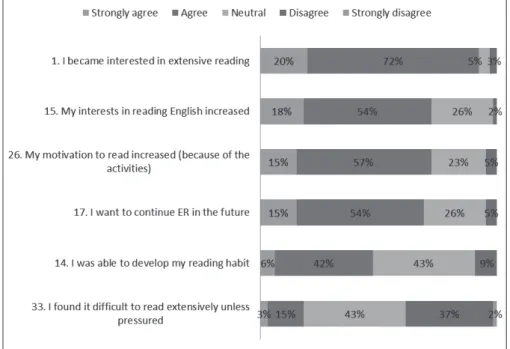
ER contained a total of 38 items, but only the results of the six items related to reading interest, motivation, and reading habits are presented here (see Figure 1).6 Whereas
these questionnaire results cannot be attributed to the effects of the WC alone, they nonetheless offer insight into how participants’ interest and motivation were affected.
As Figure 1 shows, an overwhelming majority of participants (92%) stated that they became interested in ER as a result of this course (item 1, M = 4.22, SD = 0.57). Moreover, 72% said their interest in reading English had increased (item 15, M = 3.89, SD = 0.70). The same proportion also agreed that their motivation to read had increased because of the activities (item 26, M = 3.83, SD = 0.74). Furthermore, approximately 70% of the participants indicated that they would like to continue ER in the future (item 17, M = 3.80, SD = 0.75).
Figure 1. Post-course questionnaire results (n = 65).
Unfortunately, however, increased interest or motivation did not lead to the formation of an actual reading habit: despite the claim that their interest and motivation to read increased, only half of the participants said they were able to actually cultivate a reading habit (item 14, M = 3.45, SD = 0.74), and 18% said that they needed external pressure to read (item 33, M = 2.82, SD = 0.82).
Based on these results, we can safely state that activities do affect learners’ interest and motivation to read. Based on the activity ranking, in turn, the WC presumably had a comparatively strong effect on the improvements of the participants’ interest and motivation to read since it was the highest-ranked activity (See Table 3). This view is also supported by the participants’ direct comments about the role of the WC in increasing their interest and motivation to read. In that sense, research questions 1 (Does the WC affect learners’ interest in reading in English?) and 2 (Does the WC affect learners’ motivation to read extensively in English?) were fulfilled. However, judging from the participants’ responses regarding their reading habits, the interest sparked did not seem to be sufficiently strong to lead the participants to actually read.
4.3 Participants’ Written/Graphic Records
Participants jotted down their ideas with markers on a large piece of paper that were shared by all participants at each discussion table. In order to examine how the WC
worked, two samples of written/graphic records were analyzed by counting how many idea-units (phrases and sentences), illustrations, and other symbols were recorded. In the two examples shown in Figure 2, approximately 80 and 100 idea-unit tokens, including illustrations, were written respectively. This means that more than one idea was being considered by the group per minute on average. The use of arrows, underlines, and circles in these examples (42 tokens in Example A, 62 in Example B) also suggests the participants’ active engagement. Participants connected their own ideas with those of other members, and constructed new ideas as a joint effort.
In fact, these examples demonstrate the expanding nature of idea association. Note that in Example A, there are nine instances of illustration, but no illustration is found in Example B. It seems likely that once the participants see other participants drawing, they start to follow that approach as well, illustrating how some “innovations” catch on. Interestingly, the size of the letter tends to be similar within the same record: although somewhat larger-sized letters are used in Example A than in Example B, the sizes of the letters in each record seem consistent, again showing a kind of mutual influence and synchronization. A closer examination of the records may uncover finer points, but even this basic inspection reveals the cooperative nature of the discussion.
Example A Example B
Figure 2. Examples of the participants’ written/graphic records.
5. Discussion
To recapitulate, the findings above demonstrated the overall effectiveness of the WC as a form of CL. The participants’ comments and written records showed that the principles of PIES were successfully implemented in the WC.
In terms of research questions 1 and 2 about the interest and motivation to read, the participants’ comments and the questionnaire results suggested that the WC did make
a contribution in increasing the participants’ interest in and motivation to read English, thus having a positive influence on ER. However, we cannot make a strong claim about the role of the WC as we had limited evidence focusing on the WC. Furthermore, the questionnaire results demonstrated that activities such as the WC can stimulate learners’ interest in reading but do not necessarily lead them to actually read, suggesting a gap between increased interest and the actual habit of reading.
Turning to research question 3 (What factors contribute to the success of the WC as a form of CL?), we believe that the success of the WC rested on the combination of its format/design principles and the principles (PIES) of CL. First, the non-evaluative atmosphere created by the WC design principles encouraged the participants to engage in discussion. Sharing a large sheet of paper and writing freely created an informal, fun setting, easing participants’ anxiety, creating a sense of solidarity, and helping them talk more. Also, multiple rounds of WC sessions allowed for greater autonomy in terms of group dynamics. The PIES-enhancing measures provided additional incentive to the participants to contribute to the discussion by making the goals and roles of every participant more explicit.
Similarly, the original WC design principles recognize the importance of posing meaningful questions, as good questions have the power to engage participants in genuine conversation (Brown et al., 2005, p. 90). The addition of the question preparation assignment satisfied the principles of individual accountability and equal participation, increasing the likelihood of preparing good questions that would generate productive discussion.
In addition, selection of the book is crucial. According to experienced practitioners of book clubs, books for discussion should have multidimensional, deep messages/issues, or some ambiguity for the readers to ponder about (Pearl, 2013; The Seattle Public Library, 2015). Some of the participants commented that “reading a book is interesting because it allows various interpretations (no. 35)” or more specifically, because Super-Frog Saves Tokyo had many “abstract expressions (no.44)” and was “not straightforward (no.60),” it made the discussion all the more interesting.
Above all, the interactive writing played a significant role in contributing to the success of the WC. What distinguishes the WC format from conventional group discussion is the use of writing during the discussion, and this unique feature of the WC is also an effective vehicle to reinforce the PIES principles, especially that of positive interdependence. As Jacobs, Wang, Li, and Xie (2008) discussed the importance of making one’s thoughts audible and visible, there are many benefits of writing and sharing one’s thoughts. For one thing, writing while talking seems to help participants to come up with more ideas. This may be because they can utilize multiple senses, such as seeing, hearing, and touch
(using a hand to write). In fact, recent studies suggest that handwriting itself enhances idea generation (James & Engelhardt, 2012; Muller & Oppenheimer, 2014). Also, having a real-time written (graphic) record assists participants in remembering, connecting, and analyzing what was discussed, with these pieces of knowledge serving as building blocks to help participants develop new ideas. Furthermore, because the record of discussion is passed on to later groups, discussion is cumulative and beneficial to all, operating under a condition of positive interdependence. Finally, the written records help the instructor to assess what was discussed and possibly be used as part of student evaluation. This should also increase individual/group accountability to produce output more since the quantity and quality of discussion are easily identified on a sheet of paper.
6. Conclusion
In conclusion, the WC as a form of CL can function as a powerful activity for constructive book discussion when the design principles are respected and appropriate assignments and procedures are added to satisfy the PIES principles. The WC offers an opportunity for students to share their thoughts, widen their points of view, and co-construct new ideas from reading the same book, supported by the CL principles, especially that of positive interdependence. This satisfying experience, in turn, may stimulate their interest in reading and motivate them to read, even though the effects of the WC may not be sufficiently powerful to instantly transform learners into regular autonomous readers. Still, an activity like the WC helps to invigorate the entire class by bringing the elements of CL into otherwise largely individualistic ER programs. We believe that in-class activities are an effective forum to support and motivate learners to read extensively, and CL can help bolster the benefits of these activities.
1. The group research was supported by JSPS KAKENHI (Grant-in-Aid for Scientific Research) Grant Number 24520607.
2. The average EPER score (raw score) was 64. EPER is one of the most frequently used level tests for extensive reading (Hill, 2008).
3. Various questions were prepared by the participants, but some of the major questions included: “What do you think the frog and/or the worm symboliz(es)?” “Do you think this story is another example of ‘this was all a dream’-ending? 4. Detailed description of each activity cannot be provided, but the following is a
Book talk refers to a session where students explained about a book they read in pairs; POP is a point-of-purchase advertising devise used widely in Japanese bookstores. Typically, it is a piece of paper pinned to the book shelf that introduces a particular book with thought-provoking phrases and colorful illustrations to attract potential readers. So with book talk with a POP, students talked about a book they read while showing the POP they created; Prediction is an activity where students tried to make predictions about how the story would develop. In reverse prediction, on the other hand, students were told the ending of a story first and were asked to guess how the story began and developed. 5. The number of respondents for the post-course questionnaire is 65, not 66,
because one of the participants was absent on the day the questionnaire was administered.
6. The original item number is retained in the figure and in the following discussion.
References
Bamford, J., & Day, R. R. (Eds.). (2004). Extensive reading activities for teaching language. Cambridge, UK: Cambridge University Press.
Brown, J., Isaacs, D., & the World Café Community (2005). The World Café: Shaping our futures through conversations that matter. San Francisco, CA: Berrett-Koehler Publishers.
Day, R., & Bamford, J. (1998). Extensive reading in the second language classroom. Cambridge, UK: Cambridge University Press.
Edinburgh Project on Extensive Reading. (1992). The EPER guide to organising programmes of extensive reading. Edinburgh, UK: University of Edinburgh Institute for Applied Language Studies.
Fukaya, M. (2015a). The effect of reading guidance in an extensive reading program. The Bulletin of Tsurumi University, 52 (Part 2: Studies in Foreign Languages and Literature), 81–110.
Fukaya, M. (2015b). The use of a literary text in an extensive reading programme: Reading Murakami’s “Super-frog saves Tokyo” in the World Café. In M. Teranishi, Y. Saito, & K. Wales (Eds.), Literature and language learning in the EFL classroom. London, UK: Palgrave Macmillan.
Jacobs, G., & Gallo, P. (2002). Reading alone together: Enhancing extensive reading via student-student cooperation in second-language instruction. Reading Online, 5(6). Retrieved from http://www.readingonline.org/articles/art_index. asp?HREF=jacobs/index.html.
Jacobs, G., & Renandya, W. (2015). Making extensive reading even more student centered. Indonesian Journal of Applied Linguistics, 4(2), 102–112.
Jacobs, G. M., Wang, A., Li, X., & Xie, Y. (2008). Making thinking audible and visible via cooperative learning. In M. H. Chau, & T. Kerry (Eds.), International perspectives on education (pp. 103–117). London, UK: Continuum.
James, K, H., & Engelhardt, L. (2012). The effects of handwriting experience on functional brain development in pre-literate children. Trends in Neuroscience and Education, 1(1), 32-42.
Johnson, D., & Johnson, R. (1993). Implementing cooperative learning. The Education Digest, 58(8), 62–66.
Johnson, D., & Johnson, R. (2009). An educational psychology success story: Social interdependence theory and cooperative learning. Educational Researcher, 38(5), 365–379.
Kagan, S. (1994). Cooperative learning. San Clemente, CA: Kagan Cooperative Learning. Kagan, S. (2015). Structures optimize engagement. Retrieved from
http://www.kaganonline.com/free_articles/dr_spencer_kagan/ASK28.php.
Kimura, H. (2009). Controversy over cooperative learning: An interview with Dr. George M. Jacobs. The Language Teacher, 33(8), 13–16.
Kirschner, F., Paas, F., & Kirschner, P. (2009). A cognitive-load approach to collaborative learning: United brains for complex tasks. Educational Psychology Review, 21, 31–42.
Kobayashi, M., Kawachi, T., Fukaya, M., Sato, T., & Tani, M. (2010). Tadoku de hagukumu eigo-ryoku purasu arufa [The potential of extensive reading: Promoting English learning and much more]. Tokyo, Japan: Seibido.
Kusanagi, Y. (2009). A case study: Japanese university students’ reflective comments on their extensive reading experiences. Akita Prefectural University RECCS Bulletin, 10, 43–54.
Kusanagi, Y., Fukaya, M., & Kobayashi, M. (2014, June). Experiencing shared reading in classroom in the form of World Café. Workshop presented at the 9th General Meeting of the Kanto Branch of the English Literary Society of Japan, Tokyo, Japan.
Kusanagi, Y., & Fukaya, M. (2015, March). Eigo no ehon o yonde World Café [Let’s read an English picture book and join the World Café]. Workshop presented at the 4th Annual
Conference of Japan Association of International Liberal Arts, Okayama, Japan. Manning, G., & Manning, M. (1984). What models of recreational reading make a
difference? Reading World, 23, 375–380. Retrieved from http://www.tandfonline. com/loi/ulri18.
Muller, P. A., & Oppenheimer, D. M. (2014). The pen is mightier than the keyboard: Advantages of longhand over laptop note taking. Psychological Science, 25(6), 1159-1168.
Murakami, H. (2002). Super-frog saves Tokyo. In H. Murakami (J. Rubin, Trans.), After the quake: Stories (pp. 111–140). New York, NY: Alfred A. Knopf. (Original work published 2000).
Pearl, N. (Jan 11, 2013). Check it out with Nancy Pearl: Guidelines for book groups. Retrieved from http://www.publishersweekly.com/pw/by-topic/columns-and-blogs/ nancy-pearl/article/55454-check-it-out-with-nancy-pearl-guidelines-for-book-groups.html.
Pilgreen, J. L. (2000). The SSR handbook: How to organize and manage a sustained silent reading program. Portsmouth, NH: Boynton/Cook Publishers.
Slavin, R. E. (1995). Cooperative learning: Theory, research, and practice (2nd ed.). Boston, MA: Allyn & Bacon.
Stasser, G., & William, T. (1987). Effects of information load and percentage of shared information on the dissemination of unshared information during group discussion. Journal of Personality and Social Psychology, 53(1), 81-93.
Takase, A., & Otsuki, K. (2012). New challenges to motivate remedial EFL students to read extensively. Journal of Applied Language Studies, 6(2), 75–94.
The Seattle Public Library. (2015). Library collection: Books, movies, & music: Book group how-tos. Retrieved from http://www.spl.org/library-collection/books-movies-and-music/book-groups/book-group-how-tos.
The World Café. (2015). History. Retrieved from http://www.theworldcafe.com/about-us/ history.
Wittenbaum, G. M., & Park, E. S. (2001). The collective preference for shared information. Current Directions in Psychological Science, 10, 270-273.
執筆者 小林 めぐみ 成蹊大学経済学部 教 授 深谷 素子 鶴見大学文学部 准教授 草薙 優加 鶴見大学文学部 教 授