Panel Data Research Center, Keio University
PDRC Discussion Paper Series
日本における父親の失業が子どもの学歴に及ぼす影響
佐藤一磨
2020 年 3 月 19 日
DP2019-007
https://www.pdrc.keio.ac.jp/publications/dp/6201/
Panel Data Research Center, Keio University
2-15-45 Mita, Minato-ku, Tokyo 108-8345, Japan
[email protected]
19 March, 2020
日本における父親の失業が子どもの学歴に及ぼす影響 佐藤一磨
PDRC Keio DP2019-007 2020 年 3 月 19 日
JEL Classification: E24
キーワード: 父親の失業;子どもの学歴 【要旨】 ・本稿は、は慶應義塾大学パネルデータ設計・解析センターの「日本家計パネル調査」 (JHPS/KHPS)を用い、父親の失業が子どもの学歴に及ぼす影響を分析した。 ・この分析の結 果、父親の失業は主に子どもの大学進学を抑制する形で子どもの学歴を低下させることがわか った。 ・この影響は、子どもの性別や出生順位別でも同じように観察された。 佐藤一磨 拓殖大学政経学部 〒112-8585 東京都文京区小日向3-4-14 [email protected] 謝辞:本稿の作成に当たり、慶應義塾大学パネルデータ設計・解析センターから「日本家 計パネル調査」(JHPS/KHPS)の個票データを提供して頂いた。慶應義塾大学の樋口美雄特 任教授と山本勲教授からは、改訂に際し有益なコメントを頂戴した。また、本研究は、 (独)日本学術振興会『科学研究費助成事業(科学研究費補助金)特別推進研究』「長寿 社会における世代間移転と経済格差:パネルデータによる政策評価分析」(17H06086)の 助成を受けたものである。以上をここに記して深く謝意を表する次第である。
1
Intergenerational effect of father's job loss on
children's educational attainments in Japan
*Kazuma Sato**
Abstract
This study attempted to explore the impact of the father's job loss on children's educational attainments by using Keio Household Panel Survey (KHPS), which provides representative panel data for Japan. As the intergenerational effect of father's job loss has not been examined in Japan so much because of the data shortage, the results of this study can provide new empirical evidence. The analysis results present four findings. First, the father's job loss has a negative relationship with the children's educational attainments, and it decreases the year of education of children primarily by reducing university graduates. This result is robust, even in using several matching methods. Second, the father's job loss decreases male and female children's educational attainments, mainly through reducing university graduates. The negative effect of the father's job loss is more substantial for the case of women. Third, the father's job loss decreases first and second children's educational attainments mainly through reducing university graduates. Fourth, the negative effect of the father's job loss on children's educational attainments is observed even after the decline of the father's income is taken into accounts.
Key words: Father's job loss, Children's educational attainments
* I appreciate the valuable comments from Yoshio Higuchi and Isamu Yamamoto. The data for this analysis, Japan
Household Panel Survey (JHPS/KHPS), was provided by the Keio University Panel Data Research Center. This work was supported by JSPS Grants-in-Aid for Scientific Research (KAKENHI) in Japan (17H06086).
** * Faculty of Political Science, Takushoku University, Kohinata 3-4-14, Bunkyo-ku, Tokyo 112-8585, Japan or
2
1. Introduction
How will the father's job loss affect the children's educational attainment? This question related to intergenerational effect of job loss is a topic of growing interest1. Father's job loss is considered to harm children's educational attainment through several pathways. First, as the job loss of father, who is the primary earner in the household, brings persistent income fall (Jacobson et al., 1993; Stevens 1997). This income fall makes it difficult for parents to support the pursuits of education of children financially. Second, since parental job loss has negatively associated with not only children's educational performance (Rege et al., 2011), educational ambitions (Andersen, 2013), but also educational outcomes (Brand and Thomas, 2014; Coelli, 2011), the likelihood of further educational attainment of the children can be less likely. Third, parental job loss harms the children's health and wellbeing (Bubonya et al., 2017; Lindo 2011; Kohara et al., 2019; Schaller and Zerpa 2015), time of the children allocated to study might be decline. Lastly, because father's job loss is negatively related with children's non-cognitive skills which are considered to have significant impact on success on the educational achievements and the outcomes in labor market (Cunha and Heckman, 2007; Heckman et al., 2006; Peter 2016), educational performance of the children whose father experienced job loss might be decline. From these results, the father's job loss might harm their children's educational attainment and might increase the disparities in education in the next generation. Several studies have examined the relationship between parental job loss and children's educational attainment empirically and they showed that parental job loss was negatively associated with children's educational attainment in the United States (Page et al. 2009; Kalil and Wightman 2009), Canada (Coelli 2011), and Germany (Lindemann and Gangl 2019). However, most of the empirical results have used data from Western countries, and it remains unclear whether the same results would be obtained in other countries.
By examining the association between father's job loss and children's educational attainments in Japan, this study extends the existing scholarly literature on parental job loss and children's educational achievements in four ways. First, to the best of my knowledge, this is the first study which examines the relationship between father's job loss and children's educational attainments in Japan. Although there are studies which examine the association of parental job loss and health of children (Kohara et al. 2019) and childbirth (Sato 2018), there is no study which investigates the effect of father's job loss on children's educational attainments2 . Thus, the present study contributes to the accumulation of empirical research in the field.
Second, this study uses all experiences of job loss of father after he became 15 years old by utilizing the retrospective school and work history record. The data used in this study is Keio Household Panel
1 There are plenty of studies which examined the relationship between parental earning level and earning level of
children. Solon (1992) and Zimmerman (1992) are examples of representative research, and Solon (1999) and Björklund and Jäntti (2011) provide a comprehensive survey of this field.
2 Nozaki et al. (2018) examined the relationship between parental income and children's educational performance,
3
Data (KHPS), which provides representative panel data for Japan. The advantage of this data is that it surveys school and work history of respondents and their spouses (if present) after 15 years old retrospectively. It enables us to keep track of all experiences of job loss after 15 years old. Besides, the data surveys the final educational background and birth year of all children, including those who do not live together. By linking these variables, the effect of father's job loss on the children's educational attainments is examined. In particular, a variable regarding whether the father experienced job loss by the age of 15 when the child finished compulsory education is utilized in the analysis. By using this variable, the present study focuses on how the father's experience of job loss affects children's decision to go on to higher education after compulsory education.
Third, this study uses not only ordinary least squares (OLS) and logit models but also several matching methods to identify the causal effect of the father's job loss on children's educational attainments. Propensity score weighting (PSW) (Hirano and Imbens 2001), propensity score matching (PSM) (Heckman et al. 1997), and entropy balancing (Hainmueller 2011, 2012; Hainmueller and Xu 2013) are used for the analysis. In comparison with OLS and logit model, these matching methods have an advantage, which allows the researcher to compare educational attainments of children whose father experienced job loss with children whose father did not but had similar attributes. Thus, as matching methods compare children with the same characteristics, the effect of father's job loss can be examined more precisely.
Fourth, the several important determinants of children's educational attainments are controlled to examine the effect of the father's job loss precisely. Educational achievements of parents are controlled because there is a robust intergenerational relationship between the parental level of schooling and children's level of education (Hertz et al. 2007). Besides, educational attainments of grandparents are also used as independent variables to control family background. Thus, the analysis considers the relationship between educational experiences over three generations. While there are restrictions on the variables that can be used because of mainly using the retrospective school and work history record of KHPS, the parental employment statuses when children were 15 years old are also controlled.
The remainder of this paper is organized as follows. The next section describes the data used in this study. Section 3 explains the study’s empirical strategy, Section 4 elucidates the estimation results, and Section 5 provides concluding remarks.
2. Data
The data used in this study is KHPS, which investigates families, income, employment, and type of residence in Japan. The KHPS employs a two-step, stratified sampling method. The survey was first conducted on January 31, 2004 with 4005 male and female respondents aged 20 to 69 years. The survey is conducted annually, with data from 2018 being the latest data available. In 2007 and 2012, new sample cohorts were added to supplement the attrition of samples in a similar survey method.
4 Data from 2004 to 2018 are used in the study.
There are two advantages to using KHPS. First, it surveys the respondents’ school and work history from age 15 to the present retrospectively at the first survey of each cohort3. Respondents select from the following eight choices at each age from 15 to the present4: "attended school", "job seeking", "temporary work", "regular employment", "self-employed or free-lance professional", "working at home", "worker at family business", and "changed job or school". From these choices, if the respondents select “temporary work”, “regular employment”, “self-employed or free-lance professional”, “working at home”, or “worker at family business”, it is defined as working. On the contrary, if the respondents select “job seeking” or “attended school”, it is defined as being in an unemployed state. In addition, it defines that it is in the state of unemployment when neither choice is chosen5 . Of these working states, the case where a married man under 59 shifts from working to unemployment is defined as father’s job loss and used as a key variable6. In particular, this study focusses the father's experience of job loss before children finish compulsory education under the age of 15. Limiting to the above father's job loss allows us to examine how father's job loss affect the children’s decision to advance to further school after completing compulsory education.
In using the father's job loss, the limitation of this variable should be noted. Coelli (2011) and Page et al (2009), which examined the effect of father's job loss on children's educational attainments, used the job loss in case of business closing and layoff. This is because the job loss due to business closing and layoff can be regarded as exogeneous employment shock and it enables to separate the effect of the innate family background characteristics and to examine the causal effect of father's job loss on children's educational attainments. In contrast to this, as school and work history record of KHPS can’t identify the reason of job loss, it is difficult to conduct similar analysis with Coelli (2011) and Page et al (2009). Despite of this limitation, as panel data that provides abundant samples of job loss is rare in Japan, KHPS represents the best option for this study’s analyses.
The second advantage of using KHPS is that it surveys final academic background, birth year, and gender of all children with or without living together in 2017 and 20187. By using this record, all
3 As a similar school and work history record is available for the spouse, the experience of job loss of a spouse is also
used for the analysis. When the respondents are women, the experience of job loss of her spouse is regarded as the father's job loss and utilized for crucial variables.
4 This question was investigated in 2004 at the start of the survey and in 2007 and 2012 when a new cohort was
added.
5 There is no choice to indicate non-labor force in the school and work history record of KHPS. For this reason, the
case where none of the choices was chosen was regarded as a non-labor force. In this case, however, there is a risk that the non-workforce will include no answer. However, Sato (2012, 2018), which used similar job loss by using school and work history record of KHPS and examined the effect of job loss on wife's additional worker effect and childbirth, indicated that husband's job loss stimulated wife to work and decreased the likelihood of new childbirth. As these results are consistent with previous studies, the job loss variable made by the school and work history record can be said to be reliable even if it might include missing values in non-labor.
6 In order to exclude job loss due to mandatory retirement, the sample of father was limited to 59 years or younger. 7 The questionnaire regarding the final educational background can identify whether a child is in school. In case of
5
children who completed their schooling are analyzed. Three dummy variables regarding with final academic background are made: high school graduate, junior college or specialized school graduate, and university graduate or more. When multiple children who completed education were at home, the variables were made for all of them.
The samples included for analysis were limited to respondents for whom no missing values were recorded in the above-mentioned relevant variables. The analysis sample is 1530 children.
3. Estimation methods 3.1 Econometric model
This study attempted to explore the relationship between father’s job loss and children’s educational attainments. The econometric model used to examine the relationship was:
𝐸𝑑𝑢𝑖 = 𝛼 + 𝛽𝐽𝑜𝑏𝑙𝑜𝑠𝑠𝑖+ 𝛾𝑋𝑖+ 𝜀𝑖 (1)
In the above model, 𝐸𝑑𝑢𝑖 represents the final educational background of a child i. In the analysis,
three dummy variables of final educational background of children and year of education of children are used for dependent variables8. 𝐽𝑜𝑏𝑙𝑜𝑠𝑠
𝑖 indicates dummy variable of job loss of father of a child
i. This dummy variable becomes 1 if fathers experienced job loss before the age of 15 when children
finished compulsory education and becomes 0 otherwise9. The coefficients of 𝐽𝑜𝑏𝑙𝑜𝑠𝑠
𝑖 are primary
interest in the examination of whether or not the father's job loss affect the children’s decision to advance to further school after completing compulsory education. 𝑋𝑖 indicates the attributes of
children and household, including gender of children, birth order of children, number of brothers and sisters, birth cohort dummies of children, unemployment rate when children were 15 years old, total years of work experience of father and mother when children were 15 years old, dummy variables of full time employment, part time employment, or self-employment of mother when children were 15 years old, final educational background of parent, and final educational background of grandparent. 𝜀𝑖 indicates error term. Model (1) is estimated by the Logit model and OLS.
In order to check the robustness of the estimated results by model (1), matching methods are also used. When estimating the effects of father's job loss on children's educational attainments, the average treatment effect on the treated (ATT) is as follows.
8 The year of education of children is defined as follows: junior high school graduates are 9 years, high school
graduates are 12 years, junior college or specialized school graduates are 14 years, university graduates are 16 years, and graduates are 18 years.
9 While the analysis using the father's job loss variable which becomes 1 if fathers experienced job loss before
children were 18 and becomes 0 otherwise was also conducted, the estimated results were almost same with Table 2 and Table 3.
6
ATT = E[𝑌1𝑖− 𝑌0𝑖|𝐷𝑖 = 1] = E[𝑌1𝑖|𝐷𝑖= 1] − E[𝑌0𝑖|𝐷𝑖= 1] (2)
In equation (2), 𝑌𝑖 indicates children’s educational attainments, where 𝑌1 indicates the value at
the time when father experienced job loss and 𝑌0 is the value at the time when father did not
experience job loss and continued to work. 𝐷 indicates whether or not father experienced job loss. 𝐷 = 1 indicates father experienced job loss before his children completed compulsory education (treatment group) and 𝐷 = 0 indicates that father did not experience job loss and continued to work (control group). In (2), E[𝑌0𝑖|𝐷𝑖 = 1] is a value that assumes that father experienced job loss, and its
value is counterfactual. PSW solves this problem by using a weighted control group, which can replace E[𝑌0𝑖|𝐷𝑖= 1].
E[𝑌0𝑖|𝐷̂𝑖= 1] =
∑{𝑖|𝐷=0}𝑌0𝑖𝑑𝑖
∑{𝑖|𝐷=0}𝑑𝑖
(3)
In (3), 𝑑𝑖 is the sampling weight for the control group and 𝑑𝑖= 𝑃(𝑋) 1 − 𝑃(𝑋)⁄ . 𝑃(𝑋) indicates
propensity score that is the likelihood to be a treatment group estimated by the logit model which employs attributes of children and household as covariates. In the analysis, PSW is used to examine the effect of father’s job loss on children’s educational attainments. In addition, PSM applying kernel matching is also employed.
In addition to these matching methods, entropy balancing, which controls the differences of attributes of children and household between treatment and control groups by using sampling weight as like PSW, is also used. However, in entropy balancing, sampling weight is induced in the different way from PSW. Sampling weight of entropy balancing is induced by the constraint equations which satisfy an exact balance between the first and second moments of attributes of children and household in treatment and control groups. Both the mean and variance of the attributes among the treatment and control groups are equated by using the first and second attribute moments10. In order to equate the mean and variance among the treatment and control groups, this analysis also utilizes the first and second attribute moments.
3.2 Basic statistics before and after matching
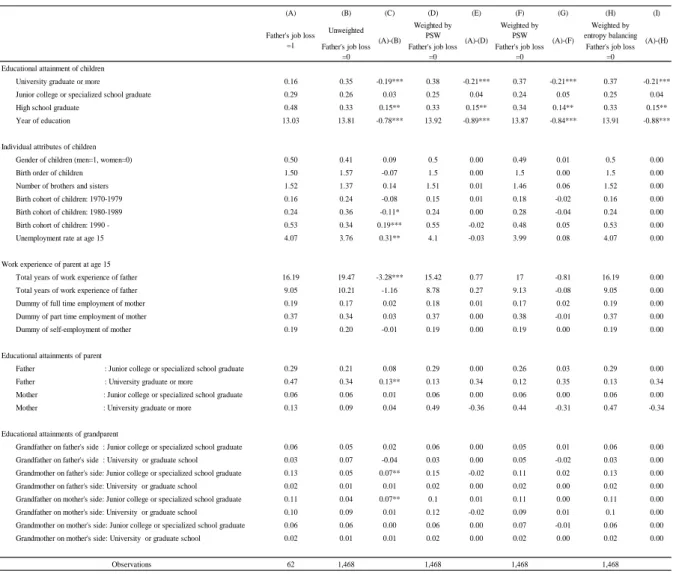
Table 1 indicates the mean values of dependent and independent variables used in the analysis. Column (A) showed the values when fathers experienced job loss (treatment group), column (B)
10 The detailed description about sampling weight of the entropy balancing is available on Hainmueller and Xu
7
indicates the values when fathers did not experience job loss (control group), and column (C) represents the differences of values of column (A) and column (B). While column (D) indicates the mean values of the control group weighted by PSW, column (F) shows those weighted by PSM. Column (H) indicates the mean values of the control group weighted by entropy balancing. Column (E), (G), and (I) show the differences between column (A) and column (D), (F), and (H), respectively. Column (C), which is the difference of column (A) and (B) before matching, represent that significant differences exist in the means of educational attainments of children, birth cohort of children, unemployment rate when children were 15 years old, total years of work experience of father, father's ratio of more than university graduates, proportion of the junior college or specialized school graduates of grandmother on father's side, and rate of the junior college or specialized school graduates of grandfather on mother's side. However, as shown in column (E), (G), and (I), all of the statistically significant differences of the independent variables disappear after matching. This result indicates that matching methods appropriately control for differences in attributes of children and households among the treatment and control group. In contrast, the statistically significant differences of dependent variables among treatment and control group still exist even after matching, indicating that while children whose father experienced job loss are less likely to graduate university, they are likely to complete their education at high school. Thus, it can be said that children's educational attainments tend to be lower when their fathers experienced job loss.
4. Empirical results
4.1 Effect of father’s job loss on children’s educational attainments
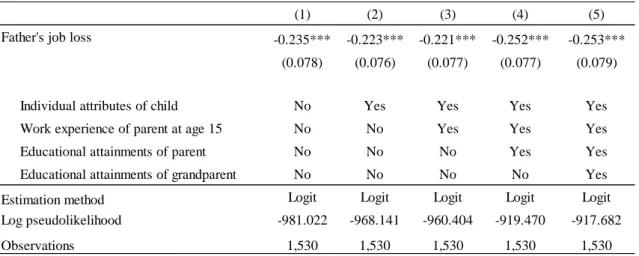
Table 2 indicates the results of logit model and values of Table 2 are the marginal effects11. Panel (A) of Table 2 indicates the estimated results on whether the child graduated from university. All marginal effects of a father's job loss are negatively significant, meaning that children whose father experienced job loss are less likely to graduate university. In contrast, panel (B) of Table 2, which is the estimated results on whether the child graduated from junior college or specialized school, indicates that all marginal effects of father's job loss are not statistically significant. This result reveals that the father's job loss does not affect whether the child graduated from junior college or specialized school. Panel (C) of Table 2, which is the estimated results on whether the child graduated from high school, indicates that all marginal effects of the father's job loss are positively significant. This result shows that children whose father experienced job loss are likely to graduate from high school.
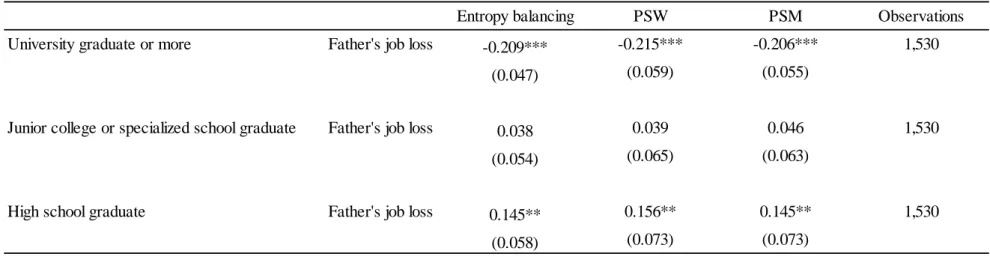
Table 3 indicates the results of matching methods. All of the estimated effects of Table 3 are consistent with the results of Table 2. While the father's job loss has a negative association with children's graduation from university, it has a positive relationship with children's graduation from
8
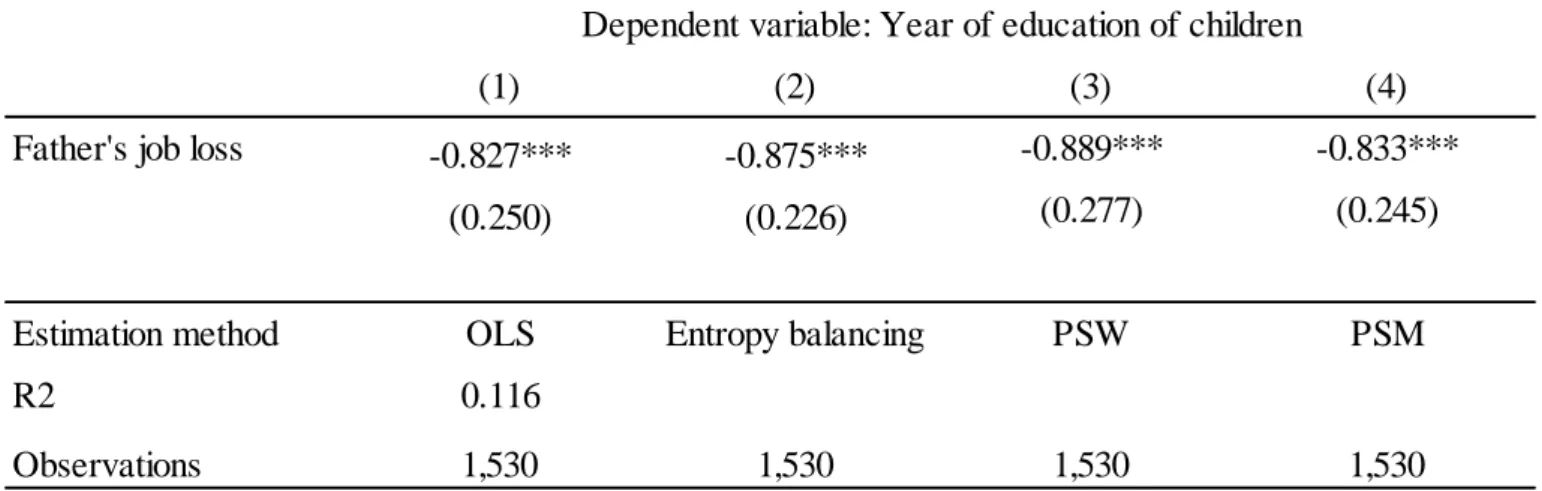
high school. Regarding the junior college or specialized school graduate, the father's job loss is not related to it. Table 4 indicate the results of OLS and matching methods when using the year of education of children as the dependent variable. All coefficients of the father's job loss are negatively significant, indicating that the father's job loss decreases the year of education of children.
Summarizing the above results, it is concluded that the father's job loss has a negative relationship with the children's educational attainments. Father's job loss decreases the year of education of children primarily by reducing university graduates. Although the number of children who graduated high school is increased, it might be because the number of children who gave up going on to university and finished education in high school increased.
4.2 Additional analysis: The impact of the father's job loss by the gender and birth order of children
The results so far clearly show that the father's job loss is negatively related to children's educational attainments. Although it provides new empirical evidence of the intergenerational effect of father's job loss on children's educational attainments in Japan, there are still questions regarding its effect: does the impact of father's job loss depend on gender and birth order of children? To answer this question, the additional analysis which divides sample by gender or birth order is conducted.
Table 5 indicate the estimated results by gender of children. Estimation results of Panel (A) of Table 5 when a child is a man show that father's job loss is negatively associated with the likelihood of graduating university. However, the father's job loss does not have a statistically significant clear relationship with the other educational attainments. These results indicate that the father's job loss mainly deceases children's university graduates when a child is a man. Considering that the father's job loss does not have a definite significant relationship with a year of education of children, its negative impact on educational attainments could be moderate. Estimation results of Panel (B) of Table 5 when the child is a woman show that while father's job loss is negatively related to the likelihood of graduating university, it is positively associated with that of graduating high school. Besides, the father's job loss has a negatively significant association with the year of education. These results reveal that when the child is a woman, father's job loss decreases children's educational attainments because the negative impact of father's job loss on university graduates seems to be larger than the positive effect on high school graduates.
Summarizing the above results, the father's job loss decreases male and female children's educational attainments mainly through reducing university graduates. The relationship between the father's job loss and children's educational attainments is relatively definite in the case of women.
Table 6 indicate the estimated results by birth order of children. The sample is split when the child is the first or second child. Analysis after the third child cannot be conducted due to the small sample size. Estimation results of Panel (A) of Table 6 when the subject is a first child show that a father's job
9
loss is negatively associated with the likelihood of graduating university. However, the father's job loss does not have a statistically significant relationship with most of the other educational attainments. These results indicate that the father's job loss mainly deceases children's university graduates when the subject is a first child. Estimation results of Panel (B) of Table 6 when the subject is a second child show a clear significant relationship between father's job loss and children's educational attainments. While the father's job loss is negatively related to the likelihood of graduating from university, it is positively associated with that of graduating high school. Considering that father's job loss is negatively correlated with year of education, the negative impact of the father's job loss on graduation from university is considered to be relatively large.
Summarizing the above results, father's job loss decreases first and second children's educational attainments mainly through reducing university graduates. The relationship between the father's job loss and children's educational attainments is relatively definite in the case of the second child.
4.3 Additional analysis: The impact of the father's job loss after considering the father's earning
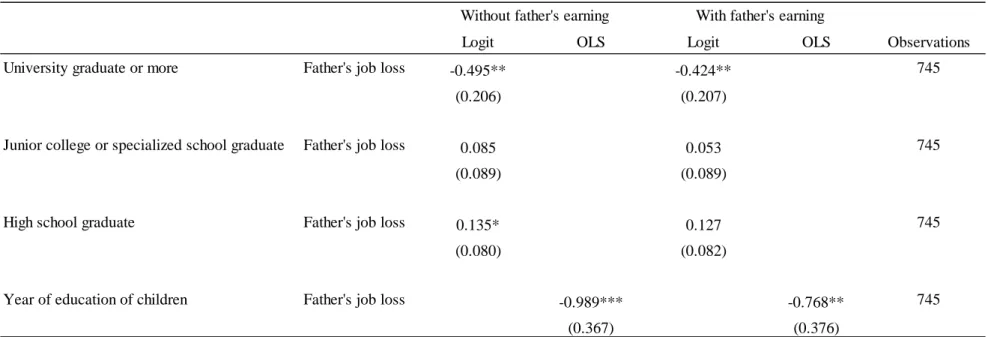
The analysis so far has mainly analyzed the impact of the father's job loss but did not examine the cause of the effect. One of the causes of this effect is considered to be a decrease in the father's income. Financial constraint by the father's job loss is likely to suppress further education attainment of children. An additional analysis which adds the father's earning to the independent variables is conducted to check this point. In the analysis, the period of the analysis is limited from 2004 to 2018 because the father's earning can only be observed after 200412. Besides, as the sample size of the father's job loss is so small at 30 or less, we use the logit model and OLS.
The results of Table 7 estimated by the logit model and OLS show that children whose father experienced job loss are less likely to graduate university even after controlling the father's earning. Besides, the estimated results show that the father's job loss decreases the year of education of children even after controlling the father's earning. These results indicate that the negative effect of the father's job loss on children's educational attainments is caused by not the decline of father's earning but the other factors. As previous studies indicate, other factors are considered to be the decrease in children’s educational performance (Rege et al., 2011) and educational ambitions (Andersen, 2013), deterioration of children’s health, wellbeing, and non-cognitive skill (Bubonya et al., 2017; Lindo 2011; Kohara et al., 2019; Peter 2016; Schaller and Zerpa 2015).
4.4 Robustness check
To check the robustness of the estimated results, the additional analysis which uses the other father’s
12 While the average earning of the father who experienced a job loss is 3.30 million yen, the average earning of the
father who did not experience a job loss is 6.71 million yen. These numbers clearly show that job loss has a negative effect on the father’s income.
10
job loss is conducted. The analysis so far used the father’s job loss, which occurred before children finished their compulsory education. In the analysis, father’s job loss was assumed to cause persistent income decline, decrease in children’s educational performance and educational ambitions, and deterioration of children’s health, wellbeing, and non-cognitive skill, resulting in a decrease in children's educational attainments. However, since father's job loss was caused not only by involuntary reasons but also by voluntary reasons, the effect of the father's job loss might include some bias due to unobserved heterogeneity. To check this, the analysis adding a father's job loss, which occurred after children completed their education is conducted. Most of the children would finish their education until they are 25 years old because the age of graduating from university in Japan is about 22 years old. Thus, the father's job loss, which occurred after children were over 25 years old, would not affect children's educational attainments. However, if it has a significant relationship with children's educational achievements, it can be considered to capture unobserved heterogeneity.
The estimated result including father's job loss which occurred after children finished their education is presented at Table 81314. The models used here are logit and OLS. In the model, the father's job loss occurred before children finished compulsory education, and all independent variables are also included. All coefficients of the father's job loss after children finished education are not statistically significant. This result indicates that the father's job loss after children finished education does not include unobserved heterogeneity. Although the estimation results are not reported in Table 8, the effect of the father's job loss after the child's age is over 24 or 26 years old was also analyzed. Still, in any case, the father's job loss was not statistically significant. These results increase the reliability that the father's job loss variable appropriately captures the decline in income and the negative impact on children.
5. Conclusion
This study attempted to explore the impact of the father's job loss on children's educational attainments by using KHPS. As the intergenerational effect of father's job loss has not been examined in Japan so much because of the data shortage, the results of this study can provide new empirical evidence. The analysis results indicate three points. First, the father's job loss has a negative relationship with the children's educational attainments, and it decreases the year of education of children primarily by reducing university graduates. This result is robust, even in using several matching methods. Second, the father's job loss decreases male and female children's educational attainments, mainly through reducing university graduates. The relationship between the father's job loss and children's educational attainments is relatively definite in the case of women. Third, the
13 In order to check the exogeneity of father's job loss, similar method is employed at Coelli (2011).
14 When father experienced job loss before children finish their compulsory education, father's job loss which
11
father's job loss decreases first and second children's educational attainments mainly through reducing university graduates.
The results of this study clearly showed that the father's job loss could have a negative intergenerational effect on children's educational attainments. As educational attainment is an essential factor for success in the labor market, a father's job loss is also expected to affect children's outcomes adversely in the labor market. This point was examined by Oreopoulos et al. (2008), and they showed that children whose father experienced job loss were likely to earn lower and receive welfare support. In the case of Japan, as the relationship between a father's job loss and children's outcomes in the labor market has not been examined, the next step in this study is to analyze this point.
Comparing with previous studies of Western countries, this study provided new findings. Page et al. (2009) and Kalil and Wightman (2009), which examined the effect of parental job loss by using the Panel Study of Income Dynamics (PSID), showed that parental job loss had a remarkable negative impact on children in case of relatively lower socioeconomic status. In contrast, the present study using Japanese data showed that the father's job loss hurt children's educational attainments averagely. This might be because life-long employment practices remain in Japan, and the negative impact of job loss is prominent, as supported by Sato (2015).
Finally, outstanding issues should be noted. In Japan, student loan for university advancement is widely available, and this can be useful to solve the financial constraints due to the father's job loss. However, as KHPS does not survey whether or not children used student loan, it is difficult to examine how the student loan mitigate the financial constraints. In addition to this, KHPS does not survey children's educational performances at all. As educational achievements are one of the critical determinants, it will be better to include these variables in covariates. Since it may be challenging to deal with these problems in KHPS, re-analysis using other data will be the next step.
12
References
Andersen, S. H., 2013. Common genes or exogenous shock? Disentangling the causal effect of paternal unemployment on children’s schooling efforts. European Sociological Review, 29, 477– 488.
Björklund, A., Jäntti, M., 2012. Intergenerational income mobility and the role of family background. The Oxford Handbook of Economic Inequality, doi:10.1093/oxfordhb/9780199606061.013.0020. Brand, J. E., Thomas, J. S., 2014. Job displacement among single mothers: Effects on children’s
outcomes in young adulthood. American Journal of Sociology, 119, 955–1001.
Bubonya, M., Cobb-Clark, D. A., & Wooden, M. (2017). Job loss and the mental health of spouses and adolescent children. IZA Journal of Labor Economics, 6, 6.
Cunha, F., Heckman, J.J., 2008. Formulating, identifying and estimating the technology of cognitive and noncognitive skill formation. Journal of Human Resources, 43 (4), 738–782.
Coelli, M. B. (2011). Parental job loss and the education enrollment of youth. Labour Economics, 18, 25–35.
Hainmueller, J., 2011. Ebalance: a Stata package for entropy balancing. MIT Political Science Department Research Paper, 24.
Hainmueller, J., 2012. Entropy balancing for causal effects: a multivariate reweighting method to produce balanced samples in observational studies. Political Analysis 20, 25-46.
Hainmueller, J., Xu, Y., 2013. ebalance: A Stata Package for Entropy Balancing. Journal of Statistical Software 54(7), 1-18.
Hirano K., Imbens, G., 2001. Estimation of causal effects using propensity score weighting: An application to data on right heart catheterization. Health Serv Outcomes Res Method, 2(3): 259– 278.
Heckman, J. J., Ichimura, H., Todd, P., 1997. Matching as an Econometric Evaluation Estimator: Evidence from Evaluation a Job Training Programme. Review of Economic Studies 64, 605-654. Heckman, J, J., Stixrud, J., Urzua, S., 2006. The effect of cognitive and noncognitive abilities on labor
market outcomes and social behavior. Journal of Labor Economics. 24(3): 411-482.
Hertz, T., T. Jayasundera, P. Piraino, S. Selcuk, N. Smith, A. Verashchagina., 2007. “The Inheritance of Educational Inequality: International Comparisons and Fifty-Year Trends,” The B.E. Journal of Economic Analysis & Policy: 7(2: Advances): Article 10.
Jacobson, L., R. LaLonde, and D. Sullivan. 1993. ‘‘Earnings Losses of Displaced Workers.’’ American Economic Review 83(4):685–709.
Kalil, A., Wightman, P., 2009. Parental job loss and children's educational attainment in Black and White middle class families. National Poverty Center Working Paper Series No. 09-02. University of Michigan, MI.
13 of The Japanese and International Economies 52: 68–77.
Lindo, Jason M. 2011. “Parental Job Loss and Infant Health.” Journal of Health Economics 30 (5): 869– 79.
Lindemann, K., Ganglb, M., 2019. The intergenerational effects of unemployment: How parental unemployment affects educational transitions in Germany. Research in Social Stratification and Mobility 62: 100410.
Nozaki, K., Higuchi, Y., Nakamuro, M., Seno, W., 2018. Relationship between parents' income and family environment and children's academic ability. NIER Discussion Paper Series No.008 (in Japanese).
Oreopoulos, Philip, Marianne Page, and Ann Huff Stevens. 2008. “The Intergenerational Effects of Worker Displacement.” Journal of Labor Economics 26 (3): 455-83.
Page, M., Stevens, A.H., Lindo, J., 2009. Parental income shocks and outcomes of disadvantaged youth in the United States. In: Gruber, J. (Ed.), The Problems of Disadvantaged Youth: An Economic Perspective. National Bureau of Economic.
Research. University of Chicago Press, Chicago, pp. 213–235.
Peter, F. (2016). The effect of involuntary maternal job loss on children’s behaviour and non-cognitive skills. Labour Economics, 42, 43–63.
Rege, M., Telle, K., & Votruba, M. (2011). Parental job loss and children’s school performance. The Review of Economic Studies, 78, 1462–1489.
Sato, K., 2012. The wife’s employment change before and after the husband’s unemployment. Economic Analysis 186: 116-136 (in Japanese).
Sato, K., 2015. The impact of displacement on earnings losses. Economic Analysis 189: 1-22 (in Japanese).
Sato, K., 2018. Does the husband’s job loss decrease childbirth? Economic Analysis 197: 70-92 (in Japanese).
Stevens, A. 1997. ‘‘Persistent Effects of Job Displacement: The Importance of Multiple Job Losses.’’ Journal of Labor Economics 15(1):165–88.
Schaller, J., & Zerpa, M. (2015). Short-run effects of parental job loss on child health. NBER working paper series.
Solon, G., 1992. Intergenerational Income Mobility in the United States. American Economic Review 82 (3): 393–408.
Solon, G., 1999. Intergenerational Mobility in the Labor Market. In Handbook of Labor Economics, vol. 3, edited by Orley Ashenfelter and David Card, 1761–1800. Amsterdam: Elsevier.
Zimmerman, D. J., 1992. Regression toward Mediocrity in Economic Stature. American Economic Review 82 (3): 409–29.
14
Table 1. Basic statistics
NOTES: *, **, and *** denote significance at the 10%, 5%, and 1% levels, respectively.
(A) (B) (C) (D) (E) (F) (G) (H) (I)
Unweighted Weighted by PSW Weighted by PSW Weighted by entropy balancing Father's job loss
=0
Father's job loss =0
Father's job loss =0
Father's job loss =0 Educational attainment of children
University graduate or more 0.16 0.35 -0.19*** 0.38 -0.21*** 0.37 -0.21*** 0.37 -0.21*** Junior college or specialized school graduate 0.29 0.26 0.03 0.25 0.04 0.24 0.05 0.25 0.04
High school graduate 0.48 0.33 0.15** 0.33 0.15** 0.34 0.14** 0.33 0.15**
Year of education 13.03 13.81 -0.78*** 13.92 -0.89*** 13.87 -0.84*** 13.91 -0.88***
Individual attributes of children
Gender of children (men=1, women=0) 0.50 0.41 0.09 0.5 0.00 0.49 0.01 0.5 0.00
Birth order of children 1.50 1.57 -0.07 1.5 0.00 1.5 0.00 1.5 0.00
Number of brothers and sisters 1.52 1.37 0.14 1.51 0.01 1.46 0.06 1.52 0.00
Birth cohort of children: 1970-1979 0.16 0.24 -0.08 0.15 0.01 0.18 -0.02 0.16 0.00 Birth cohort of children: 1980-1989 0.24 0.36 -0.11* 0.24 0.00 0.28 -0.04 0.24 0.00 Birth cohort of children: 1990 - 0.53 0.34 0.19*** 0.55 -0.02 0.48 0.05 0.53 0.00
Unemployment rate at age 15 4.07 3.76 0.31** 4.1 -0.03 3.99 0.08 4.07 0.00
Work experience of parent at age 15
Total years of work experience of father 16.19 19.47 -3.28*** 15.42 0.77 17 -0.81 16.19 0.00 Total years of work experience of father 9.05 10.21 -1.16 8.78 0.27 9.13 -0.08 9.05 0.00 Dummy of full time employment of mother 0.19 0.17 0.02 0.18 0.01 0.17 0.02 0.19 0.00 Dummy of part time employment of mother 0.37 0.34 0.03 0.37 0.00 0.38 -0.01 0.37 0.00 Dummy of self-employment of mother 0.19 0.20 -0.01 0.19 0.00 0.19 0.00 0.19 0.00
Educational attainments of parent
Father : Junior college or specialized school graduate 0.29 0.21 0.08 0.29 0.00 0.26 0.03 0.29 0.00 Father : University graduate or more 0.47 0.34 0.13** 0.13 0.34 0.12 0.35 0.13 0.34 Mother : Junior college or specialized school graduate 0.06 0.06 0.01 0.06 0.00 0.06 0.00 0.06 0.00 Mother : University graduate or more 0.13 0.09 0.04 0.49 -0.36 0.44 -0.31 0.47 -0.34
Educational attainments of grandparent
Grandfather on father's side : Junior college or specialized school graduate 0.06 0.05 0.02 0.06 0.00 0.05 0.01 0.06 0.00 Grandfather on father's side : University or graduate school 0.03 0.07 -0.04 0.03 0.00 0.05 -0.02 0.03 0.00 Grandmother on father's side: Junior college or specialized school graduate 0.13 0.05 0.07** 0.15 -0.02 0.11 0.02 0.13 0.00 Grandmother on father's side: University or graduate school 0.02 0.01 0.01 0.02 0.00 0.02 0.00 0.02 0.00 Grandfather on mother's side: Junior college or specialized school graduate 0.11 0.04 0.07** 0.1 0.01 0.11 0.00 0.11 0.00 Grandfather on mother's side: University or graduate school 0.10 0.09 0.01 0.12 -0.02 0.09 0.01 0.1 0.00 Grandmother on mother's side: Junior college or specialized school graduate 0.06 0.06 0.00 0.06 0.00 0.07 -0.01 0.06 0.00 Grandmother on mother's side: University or graduate school 0.02 0.01 0.01 0.02 0.00 0.02 0.00 0.02 0.00
Observations 62 1,468 1,468 1,468 1,468
(A)-(B) Father's job loss
15
Table 2. Effect of father’s job loss on children’s educational attainments estimated by Logit model
NOTES: *, **, and *** denote significance at the 10%, 5%, and 1% levels, respectively Panel (A) Educational attainment of child: University graduate or more
(1) (2) (3) (4) (5)
Father's job loss -0.235*** -0.223*** -0.221*** -0.252*** -0.253*** (0.078) (0.076) (0.077) (0.077) (0.079) Individual attributes of child No Yes Yes Yes Yes Work experience of parent at age 15 No No Yes Yes Yes Educational attainments of parent No No No Yes Yes Educational attainments of grandparent No No No No Yes Estimation method Logit Logit Logit Logit Logit Log pseudolikelihood -981.022 -968.141 -960.404 -919.470 -917.682
Observations 1,530 1,530 1,530 1,530 1,530
Panel (B) Educational attainment of child: Junior college or specialized school graduate
(1) (2) (3) (4) (5)
Father's job loss 0.033 0.040 0.031 0.042 0.046 (0.055) (0.055) (0.057) (0.055) (0.056) Individual attributes of child No Yes Yes Yes Yes Work experience of parent at age 15 No No Yes Yes Yes Educational attainments of parent No No No Yes Yes Educational attainments of grandparent No No No No Yes Estimation method Logit Logit Logit Logit Logit Log pseudolikelihood -872.600 -853.230 -850.717 -843.611 -842.771
Observations 1,530 1,530 1,530 1,530 1,530
Panel (C) Educational attainment of child: High school graduate
(1) (2) (3) (4) (5)
Father's job loss 0.143** 0.133** 0.143** 0.161*** 0.148** (0.057) (0.060) (0.060) (0.059) (0.059) Individual attributes of child No Yes Yes Yes Yes Work experience of parent at age 15 No No Yes Yes Yes Educational attainments of parent No No No Yes Yes Educational attainments of grandparent No No No No Yes Estimation method Logit Logit Logit Logit Logit Log pseudolikelihood -974.313 -965.566 -963.685 -948.299 -942.687
16
Table 3. Effect of father’s job loss on children’s educational attainments estimated by PSW, PSM, and entropy balancing
Notes: *, **, and *** denote significance at the 10%, 5%, and 1% levels, respectively.
Entropy balancing PSW PSM Observations University graduate or more Father's job loss -0.209*** -0.215*** -0.206*** 1,530
(0.047) (0.059) (0.055)
Junior college or specialized school graduate Father's job loss 0.038 0.039 0.046 1,530
(0.054) (0.065) (0.063)
High school graduate Father's job loss 0.145** 0.156** 0.145** 1,530
17
Table 4. Effect of father’s job loss on children’s year of education estimated by OLS and matching methods
Notes: *, **, and *** denote significance at the 10%, 5%, and 1% levels, respectively.
(1)
(2)
(3)
(4)
Father's job loss
-0.827***
-0.875***
-0.889***
-0.833***
(0.250)
(0.226)
(0.277)
(0.245)
Estimation method
OLS
Entropy balancing
PSW
PSM
R2
0.116
Observations
1,530
1,530
1,530
1,530
18
Table 5. Effect of father’s job loss on children’s educational attainments: estimates by child gender
Notes: *, **, and *** denote significance at the 10%, 5%, and 1% levels, respectively.
Panel (A) gender of children=men
Logit OLS Entropy balancing PSW PSM Observations
University graduate or more Father's job loss -0.251** -0.163** -0.171** -0.156* 629
(0.113) (0.065) (0.072) (0.080)
Junior college or specialized school graduate Father's job loss 0.114* 0.123* 0.122 0.127 629
(0.066) (0.065) (0.081) (0.095)
High school graduate Father's job loss 0.068 0.020 0.039 0.058 629
(0.085) (0.077) (1.000) (0.110)
Year of education of children Father's job loss -0.608* -0.436 -0.491 -0.306 629
(0.341) (0.318) (0.399) (0.393)
Panel (B) gender of children=women
Logit OLS Entropy balancing PSW PSM Observations
University graduate or more Father's job loss -0.263** -0.231*** -0.221** -0.261*** 901
(0.108) (0.057) (0.088) (0.077)
Junior college or specialized school graduate Father's job loss -0.005 -0.055 -0.062 -0.020 901
(0.086) (0.066) (0.089) (0.091)
High school graduate Father's job loss 0.233*** 0.277*** 0.287*** 0.285*** 901
(0.084) (0.064) (0.099) (0.100)
Year of education of children Father's job loss -1.020*** -1.148*** -1.091*** -1.144*** 901
19
Table 6. Effect of father’s job loss on children’s educational attainments: estimates by birth order of children
Notes: *, **, and *** denote significance at the 10%, 5%, and 1% levels, respectively.
Panel (A) Birth order of children=First child
Logit OLS Entropy balancing PSW PSM Observations
University graduate or more Father's job loss -0.145* -0.142*** -0.142** -0.125* 833
(0.087) (0.051) (0.071) (0.071)
Junior college or specialized school graduate Father's job loss 0.095 0.097* 0.104 0.087 833
(0.065) (0.056) (0.075) (0.084)
High school graduate Father's job loss 0.046 0.029 0.032 0.020 833
(0.076) (0.073) (0.085) (0.092)
Year of education of children Father's job loss -0.338 -0.393 -0.407 -0.412 833
(0.322) (0.283) (0.340) (0.360)
Panel (B) Birth order of children=Second child
Logit OLS Entropy balancing PSW PSM Observations
University graduate or more Father's job loss -0.366** -0.331*** -0.390*** -0.378*** 541
(0.160) (0.060) (0.117) (0.138)
Junior college or specialized school graduate Father's job loss 0.086 0.111 0.093 0.107 541
(0.110) (0.102) (0.137) (0.139)
High school graduate Father's job loss 0.234** 0.297*** 0.305** 0.282* 541
(0.104) (0.066) (0.129) (0.146)
Year of education of children Father's job loss -1.154*** -1.347*** -1.423*** -1.349*** 541
20
Table 7. Effect of the father's job loss on children's educational attainments: estimates after considering the father's earning
Notes: *, **, and *** denote significance at the 10%, 5%, and 1% levels, respectively. The period of the analysis is limited from 2004 to 2018 because the father's earning can only be observed after 2004.
Logit OLS Logit OLS Observations
University graduate or more Father's job loss -0.495** -0.424** 745
(0.206) (0.207)
Junior college or specialized school graduate Father's job loss 0.085 0.053 745
(0.089) (0.089)
High school graduate Father's job loss 0.135* 0.127 745
(0.080) (0.082)
Year of education of children Father's job loss -0.989*** -0.768** 745
(0.367) (0.376)
21
Table 8. Effect of father’s job loss which occurred after children finished their education on children’s educational attainments
Notes: *, **, and *** denote significance at the 10%, 5%, and 1% levels, respectively.
Dependent variable University graduate
or more Junior college or specialized school graduate High school graduate Year of education of children (1) (2) (3) (4)
Father's job loss before children finish compulsory education -0.253*** 0.052 0.143** -0.808***
(0.078) (0.056) (0.060) (0.253)
Father's job loss after children finish education -0.003 0.026 -0.023 0.088
(0.033) (0.030) (0.032) (0.145)
Estimation method Logit Logit Logit OLS
Log pseudolikelihood -911.361 -839.527 -936.215
R2 0.116
22
Appendix A. Effect of father’s job loss on children’s educational attainments: University graduate or more
Notes: *, **, and *** denote significance at the 10%, 5%, and 1% levels, respectively. Dependent variable:University graduate or more (1) (2) (3) (4) (5) Father's job loss -0.235*** -0.223*** -0.221*** -0.252*** -0.253***
(0.078) (0.076) (0.077) (0.077) (0.079) Individual attributes of children
Gender of children -0.044* -0.046* -0.042* -0.042* (0.025) (0.025) (0.024) (0.024) Birth order of children 0.037** 0.042** 0.046** 0.044** (0.018) (0.019) (0.019) (0.019) Number of brothers and sisters -0.017 -0.018 -0.010 -0.013 (0.018) (0.019) (0.018) (0.018) Birth cohort of children:1970-1979 -0.204*** -0.197*** -0.183*** -0.175***
(0.052) (0.051) (0.048) (0.048) Birth cohort of children:1980-1989 -0.178*** -0.168** -0.166*** -0.155**
(0.067) (0.066) (0.064) (0.064) Birth cohort of children:1990- -0.233*** -0.227*** -0.248*** -0.233***
(0.065) (0.065) (0.063) (0.063) Unemployment rate at age 15 0.016 0.016 0.004 0.003
(0.021) (0.021) (0.021) (0.021) Work experience of parent at age 15
Total years of work experience of father 0.002 0.002 0.002 (0.003) (0.003) (0.003) Total years of work experience of father -0.006*** -0.005** -0.005** (0.002) (0.002) (0.002) Dummy of full time employment of mother 0.024 0.022 0.018
(0.044) (0.042) (0.043) Dummy of part time employment of mother -0.015 0.013 0.014
(0.034) (0.033) (0.033) Dummy of self-employment of mother -0.010 0.023 0.021
(0.047) (0.045) (0.045) Educational attainments of parent
Mother: Junior college or specialized school graduate 0.090*** 0.083*** (0.031) (0.032) Mother: University graduate or more 0.233*** 0.224***
(0.042) (0.043) Father: Junior college or specialized school graduate 0.061 0.052
(0.051) (0.051) Father: University graduate or more 0.130*** 0.120***
(0.027) (0.028) Educational attainments of grandparent
Grandfather on father's side: Junior college or specialized school graduate 0.090* (0.051) Grandfather on father's side: University graduate or more -0.005 (0.050) Grandmother on father's side: Junior college or specialized school graduate -0.033 (0.049) Grandmother on father's side: University graduate or more 0.097
(0.104) Grandfather on mother's side: Junior college or specialized school graduate 0.051
(0.056) Grandfather on mother's side: University graduate or more 0.034
(0.044) Grandmother on mother's side: Junior college or specialized school graduate -0.025 (0.051) Grandmother on mother's side: University graduate or more 0.066
(0.093)
Estimation method Logit Logit Logit Logit Logit
Log pseudolikelihood -981.022 -968.141 -960.404 -914.097 -911.366
23
Appendix B. Effect of father’s job loss on children’s educational attainments: Junior college or specialized school graduate
Notes: *, **, and *** denote significance at the 10%, 5%, and 1% levels, respectively. Dependent variable:Junior college or specialized school graduate (1) (2) (3) (4) (5)
Father's job loss 0.033 0.040 0.031 0.042 0.046
(0.055) (0.055) (0.057) (0.055) (0.056) Individual attributes of children
Gender of children -0.040* -0.039* -0.041* -0.039* (0.023) (0.023) (0.023) (0.023) Birth order of children 0.005 0.007 0.007 0.007
(0.016) (0.017) (0.017) (0.017) Number of brothers and sisters 0.036** 0.038** 0.036** 0.036** (0.016) (0.016) (0.016) (0.016) Birth cohort of children:1970-1979 0.274*** 0.271*** 0.264*** 0.263***
(0.072) (0.072) (0.072) (0.072) Birth cohort of children:1980-1989 0.213** 0.204** 0.203** 0.205** (0.083) (0.083) (0.083) (0.083) Birth cohort of children:1990- 0.153* 0.139* 0.138* 0.139* (0.081) (0.081) (0.081) (0.081) Unemployment rate at age 15 0.029 0.030 0.031 0.030
(0.020) (0.020) (0.020) (0.020) Work experience of parent at age 15
Total years of work experience of father -0.003 -0.002 -0.002 (0.003) (0.003) (0.003) Total years of work experience of father 0.002 0.002 0.002
(0.002) (0.002) (0.002) Dummy of full time employment of mother 0.022 0.017 0.021
(0.042) (0.041) (0.041) Dummy of part time employment of mother 0.039 0.028 0.029
(0.032) (0.032) (0.032) Dummy of self-employment of mother -0.004 -0.009 -0.006 (0.043) (0.043) (0.043) Educational attainments of parent
Mother: Junior college or specialized school graduate -0.021 -0.023 (0.029) (0.030) Mother: University graduate or more -0.175*** -0.180***
(0.053) (0.053) Father: Junior college or specialized school graduate 0.092** 0.091** (0.043) (0.044) Father: University graduate or more 0.009 0.009
(0.027) (0.028) Educational attainments of grandparent
Grandfather on father's side: Junior college or specialized school graduate -0.026 (0.059) Grandfather on father's side: University graduate or more 0.012
(0.048) Grandmother on father's side: Junior college or specialized school graduate -0.034 (0.053) Grandmother on father's side: University graduate or more -0.011 (0.104) Grandfather on mother's side: Junior college or specialized school graduate -0.013 (0.058) Grandfather on mother's side: University graduate or more -0.009 (0.045) Grandmother on mother's side: Junior college or specialized school graduate 0.041
(0.050) Grandmother on mother's side: University graduate or more 0.121
(0.083)
Estimation method Logit Logit Logit Logit Logit
Log pseudolikelihood -872.600 -853.230 -841.396 -839.907 -974.313
24
Appendix C. Effect of father’s job loss on children’s educational attainments: High school graduate
Notes: *, **, and *** denote significance at the 10%, 5%, and 1% levels, respectively. Dependent variable:High school graduate (1) (2) (3) (4) (5) Father's job loss 0.143** 0.133** 0.143** 0.161*** 0.148**
(0.057) (0.060) (0.060) (0.059) (0.059) Individual attributes of children
Gender of children 0.055** 0.055** 0.053** 0.048** (0.024) (0.024) (0.024) (0.024) Birth order of children -0.006 -0.012 -0.014 -0.011 (0.019) (0.020) (0.020) (0.020) Number of brothers and sisters 0.009 0.009 0.002 0.006
(0.019) (0.019) (0.019) (0.019) Birth cohort of children:1970-1979 0.065 0.060 0.053 0.051
(0.055) (0.055) (0.051) (0.052) Birth cohort of children:1980-1989 0.045 0.039 0.033 0.024
(0.069) (0.068) (0.066) (0.066) Birth cohort of children:1990- 0.121* 0.121* 0.132** 0.119* (0.068) (0.068) (0.066) (0.067) Unemployment rate at age 15 -0.032 -0.033 -0.024 -0.020 (0.021) (0.021) (0.021) (0.021) Work experience of parent at age 15
Total years of work experience of father 0.002 0.002 0.001 (0.003) (0.003) (0.003) Total years of work experience of father 0.002 0.002 0.002
(0.002) (0.002) (0.002) Dummy of full time employment of mother -0.022 -0.019 -0.019 (0.046) (0.045) (0.045) Dummy of part time employment of mother -0.000 -0.016 -0.019 (0.034) (0.034) (0.034) Dummy of self-employment of mother 0.011 -0.013 -0.015 (0.045) (0.045) (0.045) Educational attainments of parent
Mother: Junior college or specialized school graduate -0.041 -0.044 (0.033) (0.034) Mother: University graduate or more -0.076 -0.068 (0.049) (0.053) Father: Junior college or specialized school graduate -0.132** -0.128**
(0.054) (0.053) Father: University graduate or more -0.131*** -0.130***
(0.028) (0.029) Educational attainments of grandparent
Grandfather on father's side: Junior college or specialized school graduate -0.043 (0.065) Grandfather on father's side: University graduate or more 0.018
(0.056) Grandmother on father's side: Junior college or specialized school graduate 0.111** (0.056) Grandmother on father's side: University graduate or more -0.239 (0.163) Grandfather on mother's side: Junior college or specialized school graduate 0.015
(0.057) Grandfather on mother's side: University graduate or more 0.017
(0.052) Grandmother on mother's side: Junior college or specialized school graduate -0.000 (0.054) Grandmother on mother's side: University graduate or more -0.460**
(0.217)
Estimation method Logit Logit Logit Logit Logit
Log pseudolikelihood -974.313 -965.566 -963.685 -943.993 -936.463