Engineering
Industrial & Management Engineering fields
Okayama University Year 1997
Visual tracking of redundant features
Koichi Hashimoto
Atsuhito Aoki
Okayama University Okayama University
Toshiro Noritsugu
Okayama University
This paper is posted at eScholarship@OUDIR : Okayama University Digital Information Repository.
Visual Tracking of Redundant Features
Koichi Hashimoto, Atsuhito Aoki and Toshiro
Noritsugu
Department of Mechanical Engineering
0
kayama University
3-1-1
Tsushima-naka, Okayama
700JAPAN
Phone: +81-86-251-8062, Fax: +81-86-255-9669
email: koichiQsys.okayama-u.ac.jp
Abstract: This paper presents how the control performance of the feature-based visual servo system is improved by
utilizing redundant features. Effectiveness of the redundant features is evaluated by the smallest singular value of the image Jacobian which is closely related to the accuracy in the world coordinate system. An LQ control scheme is used to resolve the controllability problem. Usefulness of the redundant features is verified by the real time experiments on a PUMA 560 manipulator.
1. Mathematical Formulation: A mathematical description of visual servo system is given [l] and a sufficient condition for image Jacobian to be full rank is presented. With the necessary condition given in [2], this completes a necessary and sufficient condition.
2. Sensitivity: This section gives a definition of sensitivity and a theorem that claims “Closed-loop sensitivity is
reduced by incre ssing the non-degenerated number of feature points.” This theorem shows another criterion of feature point selection [3].
3. Controller: A linear LQ controller that resolves a difficulty of redundancy of features [4] is briefly reviewed.
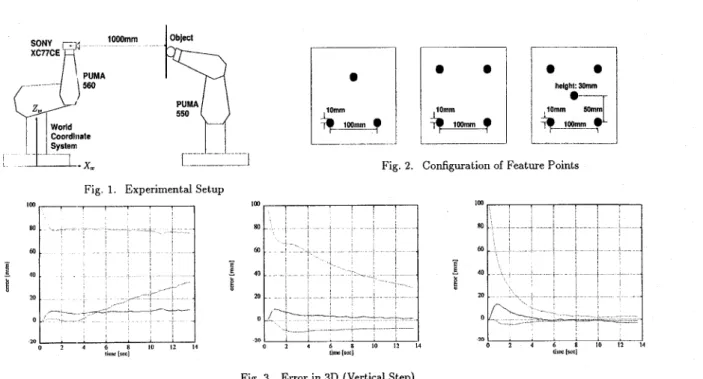
4. Experiments: Experimental results on a PUMA 560 with three, four and five feature points (Figs.1-3) are presented.
They show effectiveness of utilizing redundant features.
REFERENCES
111
. ,
K. Hashimoto et al., “Manipulator control with image-based visual servo,” in IEEE Int. Conf. Robotics and Automation, Sacramento, Calif., 1991, pp. 2267-2272.(21 L 1 H. Michel and I). Rives. “Sinnularities in the determination of the situation of a robot effector from the perspective view . . of 3 points,” Tech. Rep. n. 1850, INRIA, 1993.
IEEE Int. Conf. Robotics and Automation, Scottsdale, Ariz., 1987, pp. 832-837.
Robotics and Automation, vol. 12, no. 5 , pp. 766-774, 1996.
[3] J. T. Feddema, C. S. G. Lee, and 0. R. Michell, “Automatic selection of image features for visual servoing of a robot manipulator,” in
[4] K. Hashimoto, T. Ebine, and K. Kimura, “Visual servoing with hand-eye manipulator -optimal control approach,” IEEE Trans. on
‘
PUMAWorld Coordlnate System
Fig. 1. Experimental Setup
L .j L i
Fig. 2. Configuration of Feature Points
0 2 4 6 8 1 0 1 ! 1 4
U” llLvl
o 1 4 6 8 1 0 1 Z I 4
,I,IL [,*I
Fig. 3. Error in 3D (Vertical Step)
-51-
0 2 4 6 8 1 0 1 2