総
説
悪性腫瘍の最先端
(4)分子標的薬
東京女子医科大学医学部薬理学教室 ツカハラ フ ジ コ マル ヨシロウ塚原富士子・丸
義朗
(受理 平成 30 年 11 月 20 日)Malignant Tumor
(4) Molecular Targeted Drugs
Fujiko TSUKAHARA and Yoshiro MARU
Department of Pharmacology, School of Medicine, Tokyo Women s Medical University
Since the approval and introduction of imatinib as the first molecular-targeted drug for the treatment of
chronic myelogenous leukemia in 2001, more than 50 cancer targeted drugs have been approved in Japan. The
molecular targeted drugs have shown prominent efficacy in several cancers caused by the corresponding target
molecules. Over recent years, development of biomarkers, companion diagnostics, and next generation
sequenc-ing analysis for prediction of clinical outcome facilitated the selection of appropriate drug for patients. The
mo-lecular targeted drugs are classified into two groups, monoclonal antibodies and small molecules, which have
vari-ous mechanisms of action, including inhibition of tyrosine kinases, tumor angiogenesis, and immune checkpoint.
Various mechanisms of action of drugs may also exhibit unique adverse events that have not been previously
ob-served. Continuous changes in cancer genomes lead to tumor heterogeneity, which in turn may fuel drug
resis-tance. To overcome these issues, identification of new therapeutic targets and a large number of clinical trials
with novel designs are in progress for realization of cancer precision medicine. Here, we summarize recent
find-ings of molecular targeted drugs.
Key Words: molecular targeted drugs, precision medicine, adverse drug reaction, drug resistance, companion
di-agnostics
はじめに
1980 年代,分子生物学の発展とともに,がん細胞
の増殖や浸潤・転移に関与する分子やメカニズムの
解明が急速に進展した.これらの科学の進歩に伴い,
2001 年にわが国で慢性骨髄性白血病の治療にイマ
チニブが,分子標的薬の第 1 号として導入され,現
在までに 50 種類以上のがん分子標的薬が認可され
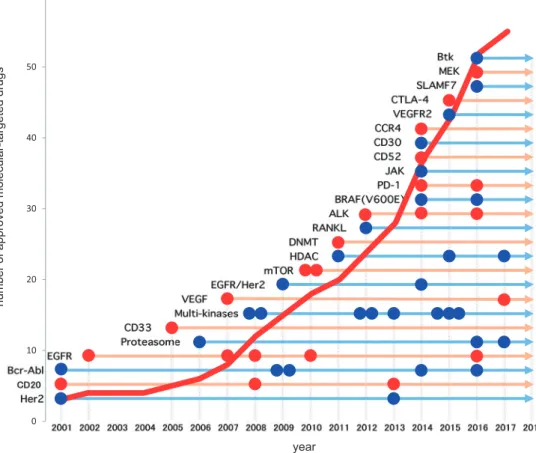
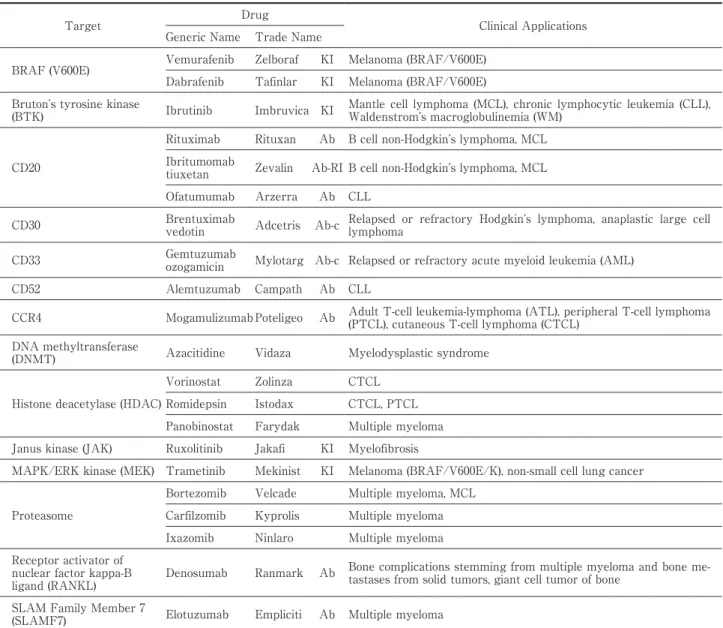
ている(Fig. 1,2,Table 1)
1)2).従来の殺細胞性の抗
がん薬と比較して,分子標的薬は多様な標的分子を
もち,これまで治療法がなかった難治性がんなどの
治療成績が格段に向上した.さらに一部の分子標的
薬は,バイオマーカーとそのコンパニオン診断の開
発や次世代シーケンサーの導入によるゲノム情報に
基づき,特定の対象がん患者のみに適応される「pre-cision medicine(精密医療)」が実現され,有効性,安
全性,費用対効果が向上している.一方,分子標的
:塚原富士子 〒162―8666 東京都新宿区河田町 8―1 東京女子医科大学医学部薬理学教室 Email: [email protected] doi: 10.24488/jtwmu.88.6_129Copyright Ⓒ 2018 Society of Tokyo Women s Medical University
! # $ 東女医大誌 第 88 巻 第 6 号 頁 129∼137 平成 30 年12月 " # %
Fig. 1 Development of molecular-targeted drugs in Japan. Red line shows the total num-ber of approved drugs. Each circle indicates the time of drug approval. The figure was crated based on reference 2.
0 10 20 30 40 50 60 year number of approved mol e cu lar-targeted drugs
薬は多様な作用機序を持つことから副作用も多様化
している.がん細胞は,低酸素,低栄養や薬剤など
の選択圧に曝されることにより常に進化して不均一
性を増し,薬剤耐性を獲得することが治療上大きな
問題となっている.現在,がんゲノム解析の医療実
装とその体制整備が進められ,さらに新たな分子標
的薬の開発が加速化している.本稿では,分子標的
薬に関する最近の知見について概説する.
Precision medicine と分子標的薬
Precision medicine とは,個人の生活スタイルや
環境などにおける個人差も考慮して,患者の個人の
レベルで最適な治療方法を分析し,選択するという
概念であり,2015 年に米国のオバマ前大統領の一般
教書演説において“Precision Medicine initiative”が
発表され,世界的に注目されるようになった
3).がん
はさまざまな要因により体細胞に生じた遺伝子異常
が蓄積することにより発生する疾患である.1 つの
臓器に発生したがんでもその分子メカニズムは多彩
であり,一方,発生臓器が異なるがんでも共通のメ
カニズムに基づいて増殖,浸潤が起きることがある.
さらにがん細胞は,低酸素,低栄養や抗がん薬など
の「選択圧」に曝されるが,その中で細胞が生存し
ていくために常に進化している.近年,次世代シー
ケンサーなどによる遺伝子解析の技術革新および低
価格化が進み,多数のがん臨床検体について,網羅
的に遺伝子を解析して,変異を調べることが可能と
なった.現時点では保険収載されていないが,遺伝
子パネル検査により網羅的にがん関連遺伝子変異を
調べるクリニカルシーケンスに基づき,分子標的薬
を選択して治療する precision medicine を実現する
「がんゲノム医療」の体制整備が急速に進められてい
る.
標的分子の多様化
がん遺伝子の中でもがんの発生・進展に必須の遺
伝子を“ドライバー遺伝子”とよぶ.ドライバー遺
伝子は,低分子阻害薬や抗体薬などの分子標的薬の
標的として有望であり,網羅的ながんドライバー遺
伝子の変異解析と同定が精力的に進められている
4).
がん細胞の増殖に関わる代表的な細胞内情報伝達経
路には,PI3K-AKT-mTOR 経路や Ras-MAP キナー
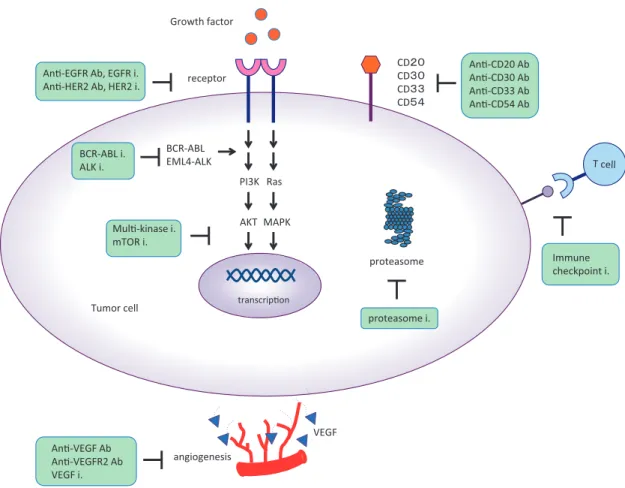
Fig. 2 The mechanism of action of molecular targeted drugs against cancer. Molecular targeted drugs exert anticancer effects through multiple mechanisms. Ab: antibody, i: inhibitor. Growth factor receptor MAPK PI3K AKT BCR-ABL EML4-ALK AnƟ-EGFR Ab, EGFR i.
AnƟ-HER2 Ab, HER2 i.
Ras AnƟ-VEGF Ab AnƟ-VEGFR2 Ab VEGF i. MulƟ-kinase i. mTOR i. angiogenesis
Tumor cell transcripƟon
proteasome i. proteasome BCR-ABL i. ALK i. Immune checkpoint i. CD䠎䠌 CD䠏䠌 CD䠏䠏 CD䠑䠐 AnƟ-CD20 Ab AnƟ-CD30 Ab AnƟ-CD33 Ab AnƟ-CD54 Ab VEGF
ゼ経路などがある(Fig. 2).ドライバー遺伝子産物は
これらの経路を活性化させ,がん細胞の増殖,浸潤,
転移などを引き起こす.BCR-ABL 陽性の慢性骨髄
性白血病に対する ABL 阻害薬(イマチニブなど),
変異 EGFR に対するゲフィチニブ,過剰発現 HER2
に対するトラスツマブなどはいずれもドライバーが
ん遺伝子に対する分子標的薬であり,画期的な治療
効果を発揮している.マルチキナーゼ阻害薬は,1
剤でがん細胞の増殖に関わる細胞内情報伝達経路の
複数のキナーゼ(VEGFR,PDGFR,KIT など)を
阻害する.mTOR 阻害薬は,がん遺伝子 ras やがん
抑制遺伝子 PTEN,TSC1/2 の変異などにより活性
が 亢 進 し て い る PI3K-AKT 経 路 の 下 流 に あ る
mTOR キナーゼを阻害する.キナーゼ以外を標的と
する薬として,プロテアゾーム阻害薬は,細胞内の
シグナル伝達分子や細胞周期制御因子など,さまざ
まな蛋白質の分解に関与している巨大な酵素複合体
であるプロテアゾームを阻害する.細胞周期の進行
には,蛋白質の合成・分解が必要であり,プロテア
ゾーム阻害薬によって細胞周期の進行が阻害される
ことによりアポトーシスなどの細胞死がもたらされ
る.CD20,CD30,CD33 や CD54 を標的とした各種
抗体薬は,造血器腫瘍の細胞表面に表出しているこ
れらの分子を標的とする.
がんの微小環境をターゲットとする分子標的薬と
して,血管新生阻害薬がある.がん細胞は,増殖に
必要な酸素や栄養を得るために血管内皮増殖因子
(VEGF)を 分 泌 す る.血 管 内 皮 細 胞 に 発 現 す る
VEGF 受容体(VEGFR)に VEGF が結合すると血管
新生が促進されるが,VEGF や VEGFR に対する阻
害薬はこれを阻害する.近年,脚光を浴びている免
疫チェックポイント阻害薬は,免疫抑制シグナルを
阻害することにより,免疫機能を活性化してがん細
胞を排除するという新たな治療法である.各分子標
的薬の臨床適応について,Table 1 にまとめた.
抗体薬と低分子化合物
分子標的薬は,抗体薬と低分子化合物に大きく 2
つに分類される.抗体薬は,分子量が大きく,細胞
外や細胞膜上に発現している分子(膜型チロシンキ
ナーゼなど)を標的とし,比較的特異性が高い.抗
Table 1 Clinical applications of molecular targeted drugs
Target Drug Clinical Applications
Generic Name Trade Name
Epidermal growth factor receptor (EGFR)
Gefitinib Iressa KI Non-small cell lung cancer (EGFR mutation-positive)
Erlotinib Tarceva KI Non-small cell lung cancer (EGFR/exon19del, L858R), pancreatic cancer
Cetuximab Erbitux Ab,
KI Colorectal cancer, head and neck cancer
Panitumumab Vectibix Ab,
KI Colorectal cancer
Afatinib Gilotrif KI Non-small cell lung cancer (EGFR /exon19del, L858R) Osimertinib Tagrisso KI Non-small cell lung cancer (EGFR/ T790M)
Human epidermal growth fac-tor recepfac-tor (Her2)
Trastuzumab Herceptin Ab, KI Breast cancer, gastric cancer
Lapatinib Tykerb KI Breast cancer
Pertuzumab Perjeta Ab, KI Breast cancer
Trastuzumab
emtansine Kadcyla Ab-c,
KI Breast cancer
Vascular endothelial growth factor (VEGF)
Bevacizumab Avastin Ab
Colorectal cancer, non-small cell lung cancer, breast cancer, glioblas-toma, renal cell carcinoma, ovarian cancer, malignant glioma, cervi-cal cancer
Ziv-aflibercept Zaltrap Ab-Fc Colorectal cancer Vascular endothelial growth
factor receptor 2 (VEGFR2) Ramucirumab Cyramza Ab,
KI
Gastric or gastroesophageal junction adenocarcinoma, non-small cell lung cancer, colorectal cancer
Multi-kinase (inhibition of vascular endothelial growth factor receptor: VEGFR, platelet-derived growth factor receptor: PDGFR, c-KIT, Fms-like tyrosine kinase 3: Flt-3, RET tyrosine kinase: RET, RAF, fibro-blast growth factor recep-tor: FGFR)
Sorafenib Nexavar KI Renal cell carcinoma, hepatocellular carcinoma, thyroid cancer
Sunitinib Sutent KI Gastrointestinal stromal tumor (GIST), renal cell carcinoma, neuro-endocrine tumors (NET)
Pazopanib Votrient KI Renal cell carcinoma, advanced soft-tissue sarcoma Vandetanib Caprelsa KI Medullary thyroid carcinoma
Axitinib Inlyta KI Renal cell carcinoma
Regorafenib Stivarga KI Colorectal cancer, GIST, hepatocellular carcinoma Nintedanib Vargatef KI Non-small cell lung cancer
Lenvatinib Lenvima KI Thyroid cancer, renal cell carcinoma
BCR-ABL
Imatinib Gleevec KI Chronic myeloid leukemia (CML), Philadelphia chromosome-positive acute lymphoblastic leukemia (Ph+ ALL), GIST
Dasatinib Sprycel KI CML, Ph+ ALL Nilotinib Tasigna KI CML
Bosutinib Bosulif KI CML
Ponatinib Iclusig KI CML, Ph+ ALL (T315I)
Anaplastic lymphoma kinase (ALK)
Crizotinib Xalkori KI Non-small cell lung cancer (ALK/ROS1) Alectinib Alecensa KI Non-small cell lung cancer (ALK fusion gene) Ceritinib Zykadia KI Non-small cell lung cancer (ALK fusion gene)
Mammalian target of rapamycin (mTOR)
Temsirolimus Torisel KI Renal cell carcinoma
Everolimus Afinitor KI Renal cell carcinoma, subependymal giant cell astrocytoma (SEGA), NET, breast cancer, renal angiomyolipoma
Cytotoxic T-lymphocyte
antigen 4 (CTLA-4) Ipilimumab Yervoy Ab Melanoma
Programmed cell death 1 (PD-1)
Nivolumab Opdivo Ab Melanoma, non-small cell lung cancer, renal cell carcinoma, classical Hodgkin s lymphoma, head and neck cancer, urothelial cancer
Pembrolizumab Keytruda Ab
Melanoma, non-small cell lung cancer, head and neck cancer, classi-cal Hodgkin s lymphoma, microsatellite instability-high (MSI-H) / Mismatch repair deficient (dMMR) solid tumor
Target Drug Clinical Applications Generic Name Trade Name
BRAF (V600E) Vemurafenib Zelboraf KI Melanoma (BRAF/V600E) Dabrafenib Tafinlar KI Melanoma (BRAF/V600E) Bruton s tyrosine kinase
(BTK) Ibrutinib Imbruvica KI
Mantle cell lymphoma (MCL), chronic lymphocytic leukemia (CLL), Waldenstrom s macroglobulinemia (WM)
CD20
Rituximab Rituxan Ab B cell non-Hodgkin s lymphoma, MCL Ibritumomab
tiuxetan Zevalin Ab-RI B cell non-Hodgkin s lymphoma, MCL Ofatumumab Arzerra Ab CLL
CD30 Brentuximab
vedotin Adcetris Ab-c
Relapsed or refractory Hodgkin s lymphoma, anaplastic large cell lymphoma
CD33 Gemtuzumab
ozogamicin Mylotarg Ab-c Relapsed or refractory acute myeloid leukemia (AML)
CD52 Alemtuzumab Campath Ab CLL
CCR4 Mogamulizumab Poteligeo Ab Adult T-cell leukemia-lymphoma (ATL), peripheral T-cell lymphoma (PTCL), cutaneous T-cell lymphoma (CTCL)
DNA methyltransferase
(DNMT) Azacitidine Vidaza Myelodysplastic syndrome
Histone deacetylase (HDAC)
Vorinostat Zolinza CTCL
Romidepsin Istodax CTCL, PTCL Panobinostat Farydak Multiple myeloma Janus kinase (JAK) Ruxolitinib Jakafi KI Myelofibrosis
MAPK/ERK kinase (MEK) Trametinib Mekinist KI Melanoma (BRAF/V600E/K), non-small cell lung cancer
Proteasome
Bortezomib Velcade Multiple myeloma, MCL Carfilzomib Kyprolis Multiple myeloma Ixazomib Ninlaro Multiple myeloma Receptor activator of
nuclear factor kappa-B ligand (RANKL)
Denosumab Ranmark Ab Bone complications stemming from multiple myeloma and bone me-tastases from solid tumors, giant cell tumor of bone
SLAM Family Member 7
(SLAMF7) Elotuzumab Empliciti Ab Multiple myeloma
Ab: antibody, Ab-c: antibody-drug conjugate, Ab-RI: radiotherapeutic antibody, Ab-Fc: VEGFR fused to the Fc portion of IgG, KI: kinase inhibitor. The table was created based on reference 2.
Table 1 Clinical applications of molecular targeted drugs (continued)
体薬には,①細胞膜上の受容体とリガンドの結合を
ブロックして受容体の活性化機構を遮断するもの
(抗 EGFR 抗 体,抗 HER2 抗 体,抗 VEGF 抗 体 な
ど),②抗 体―薬 物 複 合 体(antibody-drug
conju-gate:ADC)
(抗 CD30 抗 体 薬 と 抗 CD33 抗 体 薬 に
抗腫瘍薬を結合させたものなど)や抗体薬に放射線
同位元素をつけたもの(イブリツモマブ チウキセ
タンなど),③細胞表面の抗原に結合することによっ
て,抗 体 依 存 性 細 胞 障
害(antibody-dependent-cellular-cytotoxicity:ADCC)や 補 体 依 存 性 障 害
(complement-dependent cytotoxicity:CDC)を 引
き起こすもの(抗 CD20 抗体薬リツキシマブ,抗
CD52 抗体薬など),④がん細胞に特異的な免疫応答
を 活 性 化 さ せ 抗 腫 瘍 効 果 を 発 揮 す る も の(免 疫
チェックポイント阻害薬)がある
5)(Fig. 3).
一方,低分子化合物は,合成や量産が比較的容易
であり,また経口薬が多い.低分子キナーゼ阻害薬
は細胞膜を容易に通過し,細胞内のキナーゼのアデ
ノシン三リン酸(adenosine triphosphate:ATP)結
合部位に競合的に結合することで活性化を阻害して
抗腫瘍効果を発揮するが,抗体薬に比べ特異性がや
や劣る.近年,HTS(ハイスループットスクリーニ
ング)による低分子化合物ライブラリーのスクリー
ニング,コンピューターによる標的分子との結合シ
ミュレーション等を用いて標的候補物質を選定し,
分子機能に対する阻害効果を測定する様々な検出器
Fig. 3 Mechanisms of cancer cell killing by antibody drugs. Antibody drugs can induce cancer cell killing in several ways including inhibition of the receptor-mediated signal transduction, delivery of payload (drug, radio-isotope), immune-mediated killing (antibody-dependent cell cytotoxicity: ADCC, complement-(antibody-dependent cytotoxicity: CDC), and inhi-bition of immune checkpoint. TKI: tyrosine kinase inhibitor.
䐟 signal transduction inhibition and agonist action
receptor
ligand
VEGFR EGFR, HER2 Suppression of cancer cell growthSuppression of intracellular signal Apoptosis signal binding membrane cytoplasm 䐡 ADCC and CDC ADCC CDC C1q NK cell Macrophage Neutrophil FcgRI FcgRIIIa Granzyme perforin
䐢 immune checkpoint inhibition
PD-L1
PD-1
CD8+T cell
Cancer cell presenting cellAntigen
CD80/86
CTLA-4 CTLA-4 Treg
cell
䐠 antibody-drug conjugate (ADC) and radioimmune complex
radionuclide drug release Complement acƟvaƟon
antibody
を使用して,実際に抗がん剤としての効果があるか
どうかをより短時間で検証することが可能となって
きた.
多様な副作用と対策
分子標的薬の標的分子は多様であることから副作
用も多様化しており,従来の抗がん薬ではあまりみ
られない副作用がしばしば認められる.治療強度を
保つためには,それぞれの薬物の副作用を十分に把
握して積極的に対処していくことが重要である
6).
EGFR 阻害薬の一般的な副作用は,皮膚障害,爪囲
炎症,下痢などがあり,特に重篤なものとして,薬
剤性肺障害がある.皮膚障害の対処法として,皮膚
の清潔を保つこと,紫外線,刺激の強い石鹸の使用
を避けること,また予防的に保湿剤,皮膚炎に対し
ては,程度に応じてステロイド外用剤,感染に対し
ては抗菌薬を投与する.軽度の下痢に対しては,下
痢止めなどの対症療法が推奨される.HER2 は,正常
細胞では心筋細胞に発現しているため,HER2 阻害
薬では心毒性を来たしやすいが可逆性であることが
多い.血管新生阻害薬(抗 VEGF・VEGFR 薬)は高
血圧を高頻度で引き起こすが,高血圧が生じた症例
ではより生存期間の延長や奏功率の改善がみられる
ことから抗腫瘍効果のサロゲートマーカーとして注
目されている.その他に糸球体障害,血栓塞栓症,
心機能障害などの副作用がある.近年,心血管系の
副作用に対して,腫瘍専門医と循環器専門医の連携
を目指した onco-cardiology という学際領域が生ま
れ,その体制整備が進められている
7).マルチキナー
ゼ阻害薬では,手足症候群,皮疹,口内炎,下痢,
甲状腺機能低下症,骨髄毒性など多様な副作用が報
告されている.免疫チェックポイント阻害薬は,外
界と接している皮膚や腸管などに過度な免疫反応を
誘発し,今までに経験したことのない免疫関連有害
事象(immune-related adverse event:irAE)と呼ば
れる特有の有害事象を引き起こす.最もよく発現す
る irAE は下痢と皮膚炎であり,その他に腸炎,肝炎
Fig. 4 Tumor heterogeneity contributes to drug resistance. Kinase domain mutations, gene amplification, alternative signaling pathway, and stem cell properties result in drug resistance. TKI: tyrosine kinase inhibitor.
cell survival cell death
Mechanism of drug resistance
1) kinase domain mutation 2) gene amplification
3) alternative signaling pathway 4) stem cell (quiescence, niche) 5) drug influx or efflux
Tumor heterogeneity
Drug resistance Molecular targeted drug
TKI
や内分泌関連の副作用(下垂体機能低下,下垂体炎,
甲状腺機能亢進/低下症など)などがある.市販後調
査では,致死的な毒性として心筋障害が最も高頻度
であることが報告されている
8).
耐性メカニズムとその克服
分子標的薬は,標的分子を有する症例において高
い奏効率を示すが,薬剤耐性を獲得して再発をきた
すことが治療上大きな問題となっている.分子標的
薬に対する耐性の原因として,腫瘍内のがん細胞の
“不均一性”が指摘されている
9)10).がん細胞はその進
化の過程でゲノム変異を蓄積し,腫瘍内不均一性を
生じる.耐性変異は,①もともと耐性変異を有する
がん細胞がごく少数存在し,治療中に徐々に増殖す
る場合と,②治療中に新たに耐性変異を獲得した細
胞が増殖する場合がある
9)10).主な耐性獲得機構とし
て,キナーゼ領域の変異,遺伝子増幅,他の増殖シ
グナル伝達の活性化,がん幹細胞の形質,薬の細胞
内取り込み,排出の変化,などがある(Fig. 4).キナー
ゼ領域の遺伝子変異において,チロシンキナーゼ阻
害薬が結合するポケット(ATP が結合するポケッ
ト)の一番奥の部分に相当する部位に生じるゲート
キーパー変異は,ABL では T315I であり,同様に
EGFR では T790M,ALK では L1196M などが知ら
れている.BCR-ABL 分子標的薬のイマチニブは,
ABL キナーゼ領域の種々の変異に対して耐性を示
す.これに対して第 2 世代のダサチニブ,ニロチニ
ブ,ボスチニブは,イマチニブより阻害活性が強く,
T315I を除く多くの変異 BCR-ABL に有効である.
さらに T315I 変異をもつ CML にも有効な第 3 世代
のポナチニブが開発された.我々は,ABL キナーゼ
阻害薬の結合により BCR-ABL 蛋白質の構造的な安
定化が起こり,蛋白分解の抑制が起こることが耐性
機序の 1 つである可能性を明らかにしている
1).現
在,分子標的薬に対するがん細胞の耐性機構の解明
や耐性を克服するための新たな治療薬の研究開発が
進められている.
バイオマーカーとコンパニオン診断薬
バイオマーカーとそのコンパニオン診断薬の開発
により,一部の分子標的薬は,特定のがん患者のみ
に適応され,有効性,安全性,費用対効果が向上し
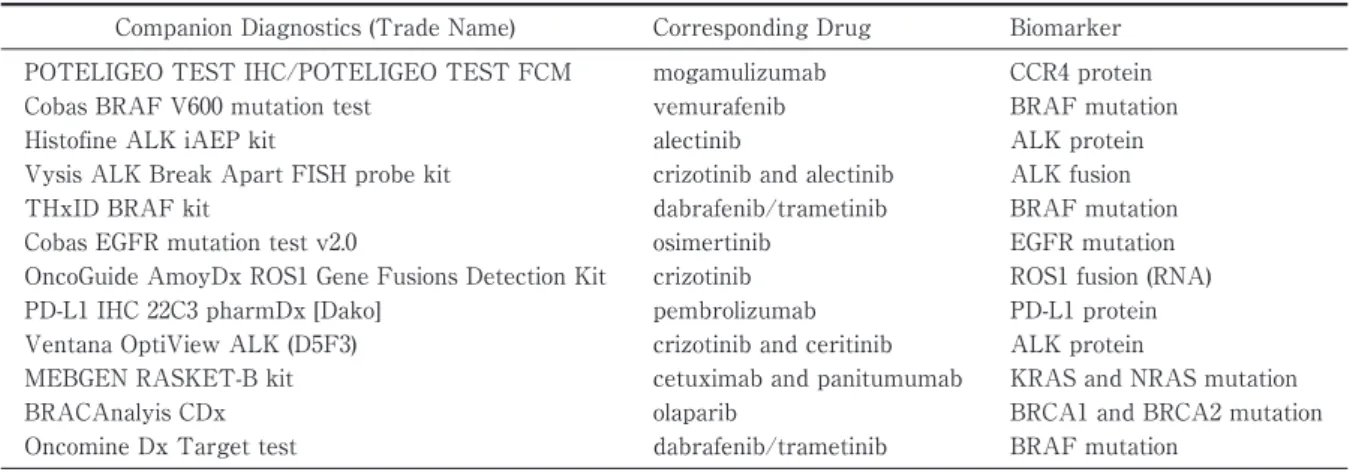
た.2014 年 6 月 30 日以降に申請・承認されたコン
パニオン診断薬を Table 2
11)に示す.EGFR-T790M
肺がんでは,血漿中遊離 DNA を解析する liquid
bi-opsy が保険適用となっている.Liquid bibi-opsy は,患
者への侵襲性が低く,また腫瘍間の heterogeneity
(不均一性)があっても変異を検出できる可能性があ
る.がんにおける liquid biopsy として,血中循環腫
瘍細胞(circulating tumor cell:CTC),血漿中の遊
離 DNA(circulating free DNA:cfDNA または
cir-culating tumor DNA:ctDNA)およびエクソソーム
等を用いた分子異常検出の臨床研究が進められてお
り,分子標的薬の適応患者の選択など個別化医療へ
Fig. 5 Basket and umbrella clinical trial designs. In a basket trial, a targeted therapy is evaluated on patients with a specific mutation in a variety of cancer types. Umbrella trial has various treatment arms in a single type of cancer.
Basket trial
Umbrella trial
mb
1 type of cancer Target B Drug B Control Cancer Type A Cancer Type B Cancer Type C Cancer Type D Cancer Type E Drug A
One common genetic mutation (Marker A)
Different genetic mutations
Target A
Drug A Control Multiple types of cancer
Table 2 Companion Diagnostics approved in Japan June 25, 2018
Companion Diagnostics (Trade Name) Corresponding Drug Biomarker POTELIGEO TEST IHC/POTELIGEO TEST FCM mogamulizumab CCR4 protein
Cobas BRAF V600 mutation test vemurafenib BRAF mutation
Histofine ALK iAEP kit alectinib ALK protein
Vysis ALK Break Apart FISH probe kit crizotinib and alectinib ALK fusion
THxID BRAF kit dabrafenib/trametinib BRAF mutation
Cobas EGFR mutation test v2.0 osimertinib EGFR mutation
OncoGuide AmoyDx ROS1 Gene Fusions Detection Kit crizotinib ROS1 fusion (RNA)
PD-L1 IHC 22C3 pharmDx [Dako] pembrolizumab PD-L1 protein
Ventana OptiView ALK (D5F3) crizotinib and ceritinib ALK protein
MEBGEN RASKET-B kit cetuximab and panitumumab KRAS and NRAS mutation
BRACAnalyis CDx olaparib BRCA1 and BRCA2 mutation
Oncomine Dx Target test dabrafenib/trametinib BRAF mutation
The table was adapted from reference 11.
の応用が期待される.さらに血液以外にも尿や唾液
を用いたより簡便で侵襲性の低い検査方法の開発も
進められている.
臨床試験デザイン
従来の殺細胞性抗がん薬の臨床試験では,登録さ
れた患者全体に対する治療効果(平均)を検証する
ことが一般的であった.しかしながら,ある特定の
遺伝子異常のある患者に対してのみ著効を示す分子
標的薬の場合には,登録された患者全体で薬効を適
切に評価することは困難である.近年,basket trial
や umbrella trials と呼ばれるバイオマーカーを組み
込んだ新しいデザインの臨床試験が実施されてい
る
12)13)(Fig. 5).Basket trial は,複数のがん種横断的
に特定の分子マーカーや遺伝子変異を有する患者を
対象として,分子標的薬の治療効果を評価する試験
である.一方,umbrella trials は,単一のがん種に対
して,遺伝子変異(バイオマーカー)のスクリーニ
ングを行い,遺伝子変異毎に複数の群に分け,薬効
を評価する試験デザインである.薬の特徴を理解し,
薬効評価のための適切なバイオマーカー,適切な試
験デザインを選択することが分子標的薬開発の成功
に繋がる.
おわりに
近年,がんの治療成績は分子標的薬により格段に
向上したが,適切な治療薬に到達できる患者数はま
だ限定的である.多様な副作用や薬剤耐性は,治療
を困難にすることがある.現在,日本では「多遺伝
子パネル」を用いた次世代シーケンサーによるゲノ
ム検査法の保険収載や cancer precision medicine の
実現に向けて,ゲノム医療体制の整備が急ピッチで
進められている.医療従事者には,これまで以上に
分子標的薬に関する高度な専門性や多診療科・多職
種連携による医療協力体制が求められている.今後
さらにレジストリデータベースの構築や人工知能
(AI)などの活用による研究の推進により,新たな標
的分子が同定され,より有効ながん治療薬の開発が
促進されることを期待したい.
開示すべき利益相反状態はない.
文 献1)Tsukahara F, Maru Y: Imatinib: Basic results. In Chemotherapy for Leukemia (Ueda T ed), pp11―31, Springer (2017)
2)水上民生:承認された分子標的抗がん剤一覧.日本 がん分子標的治療学会 JAMTTC News Letter
21-2:4―6,2017
3)南 博信 : Imprecision medicine から precision
medicine へ.がん分子標的治療 15:6―10,2017 4)Bailey MH, Tokheim C, Porta-Pardo E et al:
Comprehensive Characterization of Cancer Driver
Genes and Mutations. Cell 173: 371―385, 2018 5)三嶋雄二:抗体医薬の効果と支える機序.医のあゆ
み 265:5―11,2018
6)南 博信,山口研成,岡野 晋ほか:新しい分子標 的治療の副作用対策.がん分子標的治療 13:72― 78,2015
7)Lenneman CG, Sawyer DB: Cardio-Oncology: An Update on Cardiotoxicity of Cancer-Related Treat-ment. Circ Res 118: 1008―1020, 2016
8)Wang DY, Salem JE, Cohen JV et al: Fatal toxic effects associated with immune checkpoint inhibi-tors : A systematic review and meta-analysis. JAMA Oncol 2018. doi: 10.1001/jamaoncol.2018.3923 9)Dagogo-Jack I, Shaw AT: Tumour heterogeneity and resistance to cancer therapies. Nat Rev Clin Oncol 15: 81―94, 2018
10)Hata AN, Niederst MJ, Archibald HL et al: Tu-mor cells can follow distinct evolutionary paths to become resistant to epidermal growth factor recep-tor inhibition. Nat Med 22: 262―269, 2016
11)Pharmaceuticals and Medical Devices Agency : CDx approved in Japan. https://www.pmda.go.jp/ files/000224585.pdf (accessed on Nov. 20, 2018) 12)田中希世,中村健一,福田治彦:分子標的薬を用い
た臨床試験デザインの特徴:殺細胞性抗がん剤と の違い(総論).がん分子標的治療 16:6―12,2017 13)山口典宏,武部直子:Umbrella trial.がん分子標的