Society of Japan
Vol. 40, No. 4, December 1997
APPLICATION OF PRINCIPAL COMPONENT ANALYSIS FOR
PARSIMONIOUS SUMMARIZATION OF DEA INPUTS
AND/OR OUTPUTS
Tohru Ueda Yoko Hoshiai
Seikei University NTT Laboratories
(Received August 4, 1995; Final June 12, 1997)
Abstract In Data Envelopment Analysis (DEA), when there are more inputs and outputs, there are more efficient Decision Making Units (DMus). For example, if the specific inputs or outputs advantageous for a particular DMU are used, the DMU will become efficient. Usually the variables used as inputs or outputs are correlated. Therefore, the inputs and outputs should be selected appropriately by experts who know their characteristics very well. People who are less familiar with those characteristics require tools to assist in the selection. We propose using principal component analysis as a means of weighting inputs and/or outputs and summarizing parsimoniously them rather than selecting them. A basic model and its modification are proposed.
In principal component analysis, many weights for the variables that define principal components (PCs) have negative values. This may cause a negative integrated input that is a denominator of the objective function in fractional programming. The denominator should be positive. In the basic model, a condition that the denominator must be positive is added. When the number of PCs is less than the number of original variables, a part of original information is neglected. In the modified model, a part of the neglected information is also used.
1.
Introduction
Data Envelopment Analysis (DEA) which was ingeniously developed by Charnes, Cooper and Rhodes
[3]
evaluates the relative efficiency of decision making units (DMU) that have many inputs and outputs. When there are more inputs and outputs, there are more efficient ones. For example, if the specific inputs or outputs advantageous for a particular DMU are used, the DMU will become efficient. Usually the variables used as inputs or outputs are correlated. Nunamaker[6]
says that addition of a highly correlated variable may substan- tially alter the DEA efficiency evaluations. Therefore, the inputs and outputs should be selected appropriately by expert S who know their characteristics very well. People who areless familiar with those characteristics require tools to assist in the selection. We propose using principal component analysis as a means of weighting inputs and/or outputs and sum- marizing parsimoniously them rather than selecting them. However, principal component analysis has two problems which have to be overcome. For these problems, a basic model and a modificaiton of it are proposed.
The first problem is as follows. In principal component analysis, many weights for the variables that define principal components (PCs) take negative values. This may cause a negative integrated input that is a denominator of the objective function in fractional programming.
If
both the numerator and the denominator have negative values, the fraction has a positive value, but it is difficult to compare the value with positive fraction values which are derived from positive numerators and positive denominators.Appl~c;i;~on o f PCA for Parsimonious Summ. 467 In order to overcome this problem, fractions whose denominators and numerators are both negative must be transformed into appropriate forms. We conserve that the smaller inputs are, the better the efficiency is and also the more outputs are, the better the efficiency IS.
Even if denominators become positive by adding the same positive number, ordinal relations among denominators are conserved. When denominators are positive, ordinal relation among fractions can be always decided. From these, denominators must be positive. In the basic model, a constraint which satisfies this condition (Non-Negative Constraint: NNC) is added.
If all inputs are positive, NNC is redundant. However if there are negative inputs, NNC becomes effective. This means that in usual data the basic model is equivalent to models which do not have NNC and it can treat even negative inputs and outputs.
As the second problem, when the number of principal component is less than the number of original variables, a part of original informaiton is neglected as a variation factor. Mardia
51
says that principal component analysis looks for a few linear combinations which can be used to summarize the data, losing in the process as little information as possible. In the modified model, the information neglected in principal component analysis is recovered as much as possible.2.
Parsimonious Summarization of Inputs and/or Outputs (Basic Model)
2.1
Basic model formulation
In this paper, DEA is discussed basically as fractional programming in the following way.
subject to
7;
urOUTrj/
V
V ; I N P ; ;
5
1 ( j = 1 , 2 ,,
n ) , r = li=
lwhere
J
is the objective DMU,I N P i j
is the i-th input of DMUj, andOUTr.
is the r-th output of D M U j( j
= 1 , 2 , ..
,
n ) .First we discuss the input variables. The same discussion applies for t h e outputs. If
INPij
=I N P k j
(i#
k
andV j ) ,
v;
andvk
cannot be determined uniquely in the same way as in regression analysis. Between highly correlated inputs,v;
may b e unstable. Nunamaker[6] says that methods for handling the variable selection are very important. If we use the principal components (PCs) as inputs in equation
(2.1),
they have no correlations. (See [4]etc. for the principal component analysis.)
Let variables which have been usually used as input variables in DEA be
a;;,
and let their k-th PCs bexk.
where G!' and S;(') are the mean and standard deviation of a;/'). In this standardization,
about half of the a;, have negative values, but the inputs used in equation (2.1) are desirable to be positive. It is known t h a t xkj in equations (2.2) and (2.3) do not change even if a constant c, is added to the original inputs a i / ~ ) / s i ( ~ ) . Letting c; equal G{'/si('), the following standardization is proposed instead of equation (2.4).
This is justified because of the coincidence of the origin point.
Let W k t = (wkl, wkb
,
wkm} be the weights used for the k-th principal components xk.The inner products of different weight vectors equal zero. If all elements of w l are positive,
then half the elements of W ^ may be negative. This may result in negative denominators
in equation (2.1). T h e numerators in equation (2.1) are permitted to be negative, but the denominators are not. Thus, a constant CJ is added to the denominators in equation (2.1)
and the following constraints are
added
t o equation(2. l),
where CJ is a constant depending on the objective
DMU
J.
Note that we cannot add the constants
d J
to the numerators in equation (2.1)~ becauseDJ becomes close to one if all Ur and v, are very small and
CJ
= d ~ .A
new formulation asfractional programming for the target D M U J is rnax
subject t o u r ~ r j / ( x vkxkj
+
CJ)5
l ('j = l, 2,.
.,
n),where is the k-th P C of
D M U j
for standardized inputs aij,yrj is the r-th P C of D M U j for standardized outputs bhj, p
(<
m)
is the number of PCs for inputs, andq
(<
S) is the number of PCs for outputs.When the second condition in problem (2.7) is excluded, the following equation (2.8) is
a linear programming formulation of problem (2.7) and is called the output-oriented
BCC
model in Charnes et al.
[2].
P (2-8) min DJ =
X
i ^ x i . ~+
CJ,
k= l q subject t oy'
u r ~ r J = 1, r= lApplication o f PCA for Parsimonious Summ. 469 However, this equation cannot treat negative outputs, for example, for t h e case of ( q = 1) because of the first condition in this equation. Therefore, we propose the following model equivalent to problem (2.7) because of the second condition in the problem (2.7):
r = l P
subject to
X
u i x k ~+
CJ
=1,
k= lUsually this model not only accords with t h e output-oriented
BCC
model (2.8) through linear transformation of uk and u r 7 and inverse ofD J ,
but also has solutions even in the case where the model (2.8) does not have any solutions.We consider improvement of inefficient DMU. For t h e case in which outputs cannot be improved, the inputs of inefficient D M U J must be decreased. The left side of the second equation of equation (2.9) is expressed in terms of a i ~ as
where
Gi
= ukwki. k= lLet
Il
be a set of improvable inputs of DMUJ,I2
be a set of nonimprovable inputs of DMUJ, and a i ~ be the objective valuesThe must satisfy
(2.11) ViaiJ
+
CJ
i e h
2.2 Treatment
of
negative weightsof inputs a i ~ of D M U J for satisfying
{DJ
= l}.T h e k-th
PC
xkt
= (xkl, xk2,- ,
xkn) for inputs are given by equation (2.2). When there are many negative weights wki, the minimum weight(<
0) has the same effect as the maximum weight(>
0) in the principal component analysis. Therefore, evaluating the efficiency with absolute values of negative and positive weights is considered. DefinePk,
Nk,
xkj^ and xt.fN) t o beA
method of using both x k j ^ and x k j ^ may be considered, but it has the following shortcomings.(a) The number of elements in
Nk
may be quite different from the number of elements in P k(Nk
>>
P k orNk
<<
Pk).(b) The effect of reducing the number of original inputs, m, to the number of PCs, p, is weakened.
(c) The discussion about PCs, for example, the contribution ratio, variance and so on, must be reconstructed.
(d) Suppose that all elements of w l are positive (NI is empty).
If
neitherPi
norN2
is empty, the second input, x2j, is divided into two inputs, x2,^ and x2/"). This results in emphasizing x2 overxi.
These points indicate that using xkj^ and xk/^ is not desirable. Considering that in the principal component analysis the first PC must be emphasized, the sign of the second and the following PCs for the inputs should be decided so that they have a positive correlation with the first PC for the outputs. The sign of the first P C for the inputs should be decided such that there are more positive xi,. The sign of PCs for the outputs should be decided in the same way.
2.3
Example
Here we present an application to a problem in the Nippon Telegraph and Telephone Corporation. A message area (MA) is an area in which users can talk by telephone for
3
minutes for 10 yen. The efficiency of 66 message areas was evaluated. The forty items shown in Table1
were used as inputs and the following six items as outputs.Revenue : Long distance,
blj
Local,b2j
Numbers of subscribers : Business,
b3j
Residence, b4jPublic,
b5,
NTT
Business,bgj
When DEA was applied directly to all inputs and outputs, the efficiencies of all DMus became one, because the number of inputs are too many for the number of DMus, consid- ering that in Tone [l01 the following condition is requested:
where it is not always true that all efficiencies become one for such size of problems as this example. Then, the principal components
xi (i
= 1,2,,
p) of the inputs and the principal components y k(k
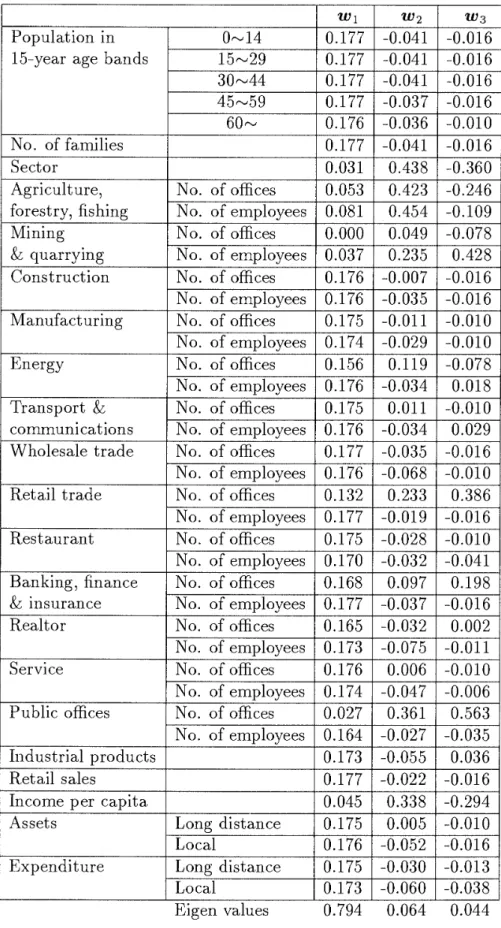
= 1 , 2 , - - - , q ) of the outputs were obtained. Weights w l , w2 and w3 in X I , x2 and x3 are shown in Table1.
For outputs, the contribution ratioC
Rl of the first PC is 0.998, and only the firstPC
was used as theDEA
outputs, whereK
is a number of original variables(K
= m for inputs) and\,
is the j-th largest eigenvalue of a variance-covarience matrix ofK
variables. For inputs the contribution ratios of the first and second principal components are0.794
and 0.064. Therefore, two PCs were used as DEA inputs.In principal component analysis, (-wk) is not differentiated from wk. In DEA, (-W^) gives a different evaluation from wk. At first, the sign of weight vectors was decided such that there are more positive xki for each
k .
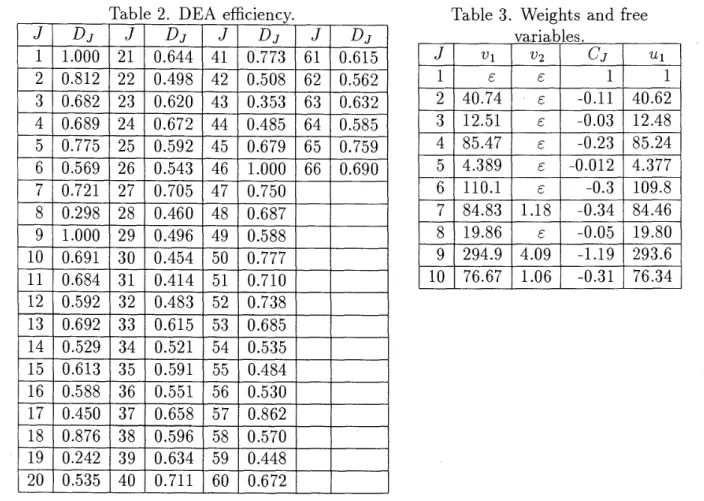
Table 2 shows the DEA efficiencyD J .
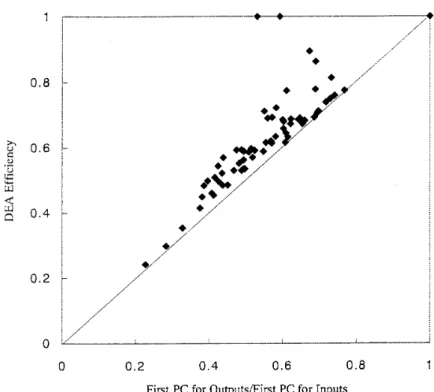
Figure1
shows the firstPC
for outputs divided by the first PC for inputs versus DEA efficiency.Application o f PCA for Parsimonious Summ.
Table 1. Weights.
1 A
l 1 l
Wholesale trade
1
No. of offices1
0.1771
-0.0351
-0.016No. of em~lovees
I
0.176I
-0.068I
-0.010l l l
Population in 15-year age bands
No. of families Sector Agriculture, forestry, fishing Mining
&
quarrying Construction Manufacturing Energy Transport&
communications l L " l l lRetail trade
1
No. of offices1
0.1321
0.2331
0.386 0.177 0.177 0.177 0.177 0.176 0.177 0.031 0.053 0.081 0.000 0.037 0.176 0.176 0.175 0.174 0.156 0.176 0.175 0.176 0-14 15-29 30-44 45-59 60- No. of offices No. of employees No. of offices No. of employees No. of offices No. ofemployees No. of offices No. of employees No. of offices No. of employees No. of offices No. of employees - ~Banking, finance
1
No. of offices1
0.1681
0.097I
0.198 -0.041 -0.041 -0.041 -0.037 -0.036 -0.041 0.438 0.423 0.454 0.049 0.235 -0.007 -0.035 -0.011 -0.029 0.119 -0.034 0.011 -0.034 Restaurant&
insurance1
No. of employeesI
0.177I
-0.037I
-0.016 -0.016 -0.016 -0.016 -0.016 -0.010 -0.016 -0.360 -0.246 -0.109 -0.078 0.428 -0.016 -0.016 -0.010 -0.010 -0.078 0.018 -0.010 0.029 L No. ofemployees No. of offices No. ofemployees Eigen values 0.794 0.064 0.044 Realtor S er vi ce Public offices Industrial products Retail salesIncome per capita, Assets Expenditure 0.177 0.175 0.170 - No. of offices No. ofemployees No. of offices No. of employees No. of offices No. of employees Long distance Local Long distance Local -0.019 -0.028 -0.032 -0.016 -0.010 -0.041 0.165 0.173 0.176 0.174 0.027 0.164 0.173 0.177 0.045 0.175 0.176 0.175 0.173 -0.032 -0.075 0.006 -0.047 0.361 -0.027 -0.055 -0.022 0.338 0.005 -0.052 -0.030 -0.060 0.002 -0.011 -0.010 -0.006 0.563 -0.035 0.036 -0.016 -0.294 -0.010 -0.016 -0.013 -0.038
Table 2. DEA efficiency.
Table 3. Weights and free
The distance from the diagonal line represents the effect of the second P C for the inputs.
Table 3 shows weights vi, v2 and
U\and free variables
CJ
in equation (2.9) for DMU1 to
DMU10.
All second PCs excluding MA (DMU)l for the inputs are positive, but the correlation
coefficients R(i, 1) between i-th P C for the inputs and the first P C for the outputs are
variables.
From the sign of R(2,
l ) ,it may
beconsidered t h a t
(-W^)should be used instead of the
~kused for Figure 1, but all second PCs excluding M A l , for the inputs become negative.
Considering that B(2,
l )is very small, only the first P C should be used. Here, DMU1 is
J1
a special DMU, having extremely larger (four to five times) inputs and outputs than the
second largest DMU and having the opposite sign of the second P C to other DMus as above
mentioned. This DMU1 is too large to compare with other DMus. Therefore, excluding
DMU1, analysis was also proceeded. In that case, the contribution ratio of the first P C for
output was 0.985. T h e contribution ratio of the first, second, and third PCs for inputs were
0.728, 0.057, and 0.053, so these three components were used as DEA inputs. Table 4 shows
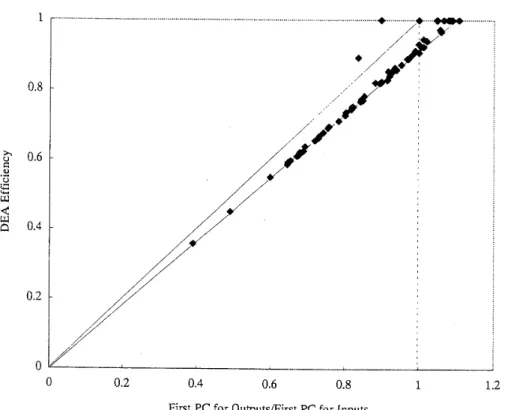
the weights and free variables and Figure 2 shows the first P C for outputs divided by the
first P C for inputs versus DEA efficiency when DMU1 is excluded. About half of
CJ
values
in Table 4 are positive and
CJ
does not have
abias toward negative, though all
CJ
except
for
(J
=1)
in Table 3 are negative.
As a result we propose that t h e number of PCs should be decided according t o the
values of the contribution ratios
C R k
and the correlation coefficients R(i,
l )and R(1,
jY
v1
Eafter exclusion of D M u s with extraordinary inputs or outputs.
v2
Ec,
1 U 11
Application o f PCA for Parsimonious Summ.
0 0.2 0.4 0.6 0.8 1
First PC for Outputs/First PC for Inputs
Figure 1. First PCs ratio versus DEA efficiency (including DMU1).
Table
4.
Weights and free variables (MA1 excluded).3. Modified Model
When the number, p, of PCs is less than the number, m, of original variables and the
cumulative contribution ratio of p PCs is r ,
(1
- r) of total information is usually consideredas a variation factor, that is, a noise or a disturbance. In this section, the information (for
example, N I H l and N2H2 in Figure 3) is used positively and presented by one additional
dimension, t h a t is, total information is presented by (p
+
1)
dimensions.3.1 Utilization of the mean and variance of a variation factor
When p PCs are x i , x2,
.
-
,
xp7 t h e ( p + l)-st variablexp+l
with mean pp+1 and varianceVp+l are added, where
0 0.2 0.4 0.6 0.8 1 1.2 First PC for Outputs/First PC for Inputs
Figure
2.
First PCs ratio versusD E A
efficiency (excludingD M U 1 ) .
Figure
3.
Perpendiculars fromN
toH.
The k-th
PC,
{ x k t
=( x k l , xk2,
-
,
x k n ) }
and its mean are given byj=1
Considering that the sum of means of m standardized variables a: =
( a i l 7
,
sin)
[i
=1 , 2 , - . - , m ]
isi=l
P
and
(E
p k )
out ofit
is presented by p PCs, let pp+l beApplication of PCA for Parsimonious Summ. 4 75 Because pp+l and Vp+l do not depend on the
DMU, x p + ~
is expressed as a scalar variable xp+l. The same procedure as for the inputs is applied to the outputs, using the (q+
l)-st variable, yq+l. T h e xp+1 and yq+l are supposed to be random variables. The following measure may come t o mind in place of the first equation in equation (2.7).For the same reason that in Sec.2.1 no constant can be introduced in the numerators, the three parameters uq+1
,
andCJ
cannot be used simultaneously. Therefore equation (3.5) cannot be used.3.2 Consideration of the discrepancy between
P C space and the original space
Let the coordinates of a point,N,
in vector space Vm beLet the coordinates in Vm of the foot,
H,
of a perpendicular fromN
to the vector space Vp whose elements are p PCs be(see Fig. 3). Because the number of PCs is limited to p, the vector of the values of m PCs at the point
H
isx(H)
= (X^,,, X ~ H ,,
X p H 1 0,.
,o)'.
Let
W
= ( w l , w 2 ,. .
,
wm)',X
= ( x i ,x2,
-
,
xm)' andA
= (01, 0 2 ,- - - ,
a m ) t ,where wk = (wkl, w42,
-
.
,
wkm)' fork
=1 , 2 ,
.
,
m , especially, wh = 0 forh
>
p,xk = (xk1, x k 2 , .
.
,
x k a fork
= l ,2, - -
, m , and a k = (akl, a k 2 ,- ,
aknlt fork
= 1 , 2 ,,
m.Then,
Therefore, (3.10)
X
=WA,
A
= W t X .Considering t h a t fewer (aiA - is desirable, we hit on the idea that the denominator of the first equation in equaiton (2.7) may be changed to
This compensates the reduction in information of PCs. Here, from the viewpoint of pa- rameter parsimony, individual parameters, up+;, should not be taken for each (ai7 - a;,/^).
Applying this idea t o the outputs as well as the inputs, the following modified model is proposed instead of equation (2.7). In this model, (p
+
2) variables, [vl, v2,- ,
vp+l, C'J], for inputs and (q+
1)
variables, [ul, u2,,
u ~ + ~ ] , for outputs must be decided.[Proposed Model]
max
9 S P m
D ~ 2 =
{'E
U ~ Y ~ J+
~ q + lE(bi~
- b i j ( H ) ) } / { ~ i x i J+
up+lY , ( ~ ~
- a i J ( ~ ) )+
C.,},
subject to
where
bij
andh i / '
are defined in the same way as aij and ai/^.Figure
4
shows the relation between the first P C of outputs divided by the first P C of inputs and the efficiency, DJ2, where DMU1 was excluded and {p = l , q = l}. Figure 4 has a slightly larger variation above the lowest line than Figure2.
First PC for Outputs/First PC for Inputs
Figure
4.
First PCs ratio versus DEA efficiency, DJ2 (excluding DMU1)3.3
Improvement of inputs in the modified model
This section discusses the improvement of inputs in the modified model of Sec.3.2 for the case in which outputs cannot be improved on the lines of equation (2.11). Suppose that every input, U ~ J , of an inefficient DMUJ is decreased at a constant rate,
K
(<
l ) , toApplication o f PCA for Parsimonious Summ.
that is,
hJ
is also decreased at rateI{.
Moreover,Therefore, if
then DJ2 = 1.
4. Conclusion
We proposed t h a t the sign of PCs for the inputs (outputs) should be decided according to the correlation coefficients between those PCs and the first P C for outputs (inputs), and that the number of PCs should be decided from the values of the contribution ratios, C R h and the correlation coefficients, R(i, 1) and R(1,
j ) .
We presented a basic model and a modification of it t h a t takes factors unexplained by PCs into account.We overcame the disadvantage of principal component analysis and made possible its use as a parsimonious summarization tool for DEA inputs and/or outputs. Of course, we do not use principal component analysis when the inputs or outputs are not so many and the correlations among the inputs or outputs are weak.
The number, p, of principal components is usually decided by the commulative contribu- tion ratio,
CC
RP, or t h e p-th eigenvalue, Ap. The more the value of p is, the more difficult it is to explain the meaning of each principal component. Therefore, we propose limiting p to the small values and recovering information with a modified model shown in Sec.3.2. From references [4],[5],
[7]
and181,
we recommend CCR,2
0.7
orA,
2
1
for correlation matrix. If the modified model is used for (p -1)
PCs, we can derive a model that has the same number of variables and does not neglect completely information which is presented by residual (m - p+
1) PCs. This model becomes a compromise between t h e basic model inSec.2 and models which use all variables. For the modified model there may be other ideas and we need further study.
If variables are classified into some groups whose members have a high correlation each other and t h e principal component analysis is applied to each group, intuitive interpretation of results becomes easy, but a number of inputs or outputs may not decrease very much.
In multivariate analysis, canonical correlation analysis is well-known as a means of an- alyzing two sets of variables. In this paper, they are a set of input variables and a set of output variables. Let the i-th canonical variables for inputs and outputs be f i and g,, respectively. Canonical correlation analysis has shortcomings as a method of summarizing parsimoniously variables and evaluating efficiency in DEA. For example, there is no corre- lation between f 2 and gl. We cannot explain any meanings of the linear combination of
fi
and f2. T h e fractional programming which has f2 in denominator and 91 in numeratorshould not be approved. When as a measure of efficiency, we only use a ratio, g l /
f l
,
of the first canonical variables, canonical correlation analysis may have some meanings.In equation (2.9) a non- Archimedean infinitesimal E was introduced. We can derive an c-free DEA in the same way as a 2-phase process in Tone
[g].
In the similar way we can also derive a n E-free DEA for equation (3.11).We discussed DEA as a fractional programming problem and added constraints that denominators must be positive. Discussion in negative weights and modified models are also applicable to other formulations of DEA. Especially, for the purpose that we do not
mind signs of inputs, it may be appropriate to use additive DEA models (see Charnes et al.
[l]). References
[l]