
Integrated Sensor Network Platform Implementation based on Fog Computing
5
0
0
全文
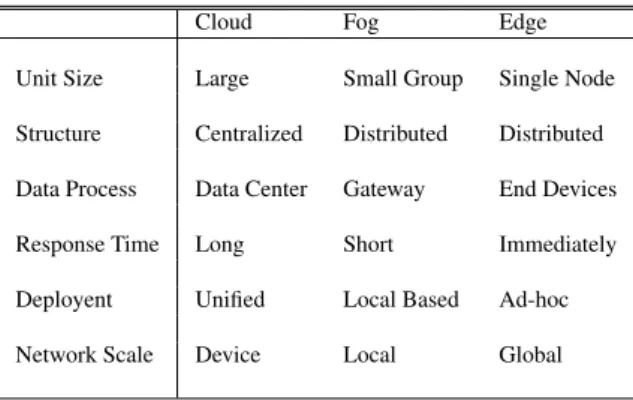
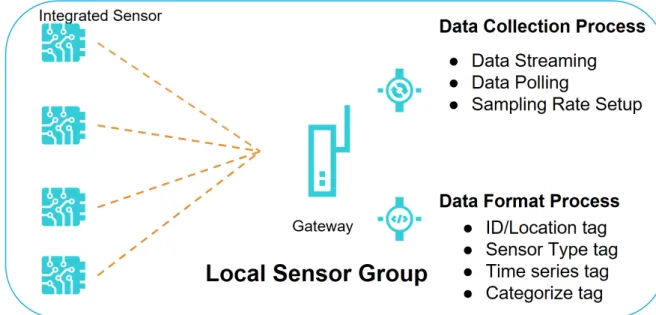
(2) Vol.2017-DPS-170 No.20 Vol.2017-CSEC-76 No.20 2017/3/2. IPSJ SIG Technical Report. Table 1: Summary of Cloud, Fog, Edge Computing Cloud. Fog. Edge. Unit Size. Large. Small Group. Single Node. Structure. Centralized. Distributed. Distributed. Data Process. Data Center. Gateway. End Devices. Response Time. Long. Short. Immediately. Deployent. Unified. Local Based. Ad-hoc. Network Scale. Device. Local. Global. as Google, Facebook, etc. However, features for those services also brought issues that hinder the coming IoT revolution [3]. For example, the huge amount of data take corresponding bandwidth and time for data transmission to user requests. The latency caused will not meet IoT systems requirements for real-time applications with users direct interaction. Another problem is Cloud Computing frees the client from the specifications of so many details, therefore it is difficult to provide location awareness for IoT systems. An information technology research company Gartner, Inc. forecasts that 6.4 billion connected things will be in use worldwide in 2016, and will reach 20.8 billion by 2020 [4]. Therefore, a new platform to meet these IoT system requirements like Fog Computing is required. In Chiang’s paper Fog Computing was the defined as: Fog is an architecture that distributes computation, communication, control and storage closer to the end users along the cloud-tothings continuum [3]. As it describes, by distributing the resources closer to client user, the structure can be more flexible to carry IoT systems. Especially the feature characteristics of less latency real-time interaction, hterogeneous compatibility, location awareness. There is another term Edge Computing which is similar to Fog Computing. The definition is as below: Edge Computing refers to the enabling technologies allowing computation to be performed at the edge of the network, on downstream data on behalf of cloud services and upstream on behalf of IoT services [5]. Compare to Fog Computing which is using a gateway, ”edge” represents any computing and network resources along the path between data sources and cloud data centers. This makes every edge devices can have capability of computation and data transmission through network. Different from P2P approaches, Edge Computing is a decentralized paradigm that allow heterogeneous resources to be connected and controled [6]. 2.2 Related Works Table 1 shows the the differences summary of the three diagrams. Compare to Cloud Computing, though the other two paradigms are difficult to organize, they are easier for IoT systems such as sensors and actuators. Edge provide more possibil-. c 2017 Information Processing Society of Japan. ities for the end devices, but for environment sensing usage, it is better to manage sensors in each area as one group rather than one by one. IBM Research describes their work in Smart Grid utilizing Fog Architecture [7]. To maintain low power consumption, sensors using Bluetooth or ZigBee were connected to gateway which conduct the computation and transmission tasks. Cirani is proposing a hub architecture which Fog gateway is managing the lower layers and providing organized information to client users, so that users can avoid the complex manipulations of end nodes [8]. The authors of this paper have been working on environment sensing and applications before [9] [10] [11]. Integrated Environment Sensor was used which have sensor modules of temperature, noise level, air pressure, light, etc. It can reduced nodes of environment sensors into one. In the past works sensor network with only one node of Integrated Sensor was implemented. In this paper Fog Computing structure was proposed for larger scale environment sensing platform, to provide features of real-time data access, heterogeneous support, location awareness.. 3.. Architecture. As describes in the section above, the proposed platform is focusing on environment sensing using Integrated Sensor as end nodes. Fig. 1 describes the construction local sensor group as one Fog Node. With one unique gateway, all data will be collected and organized for transmission. The gateway itself can connected to the Internet, and by providing RESTful API, both end users and cloud services can access the data directly. Because of the gateway is the only one layer between sensor group and data requests, the real-time access latency could be reduced to the minimum. The sensors may use different wireless communication method depends on different group, gateway should provide the interfaces to meet the sensors’ heterogeneity, such as Bluetooth, Mesh Wireless, etc. And for each gateway is set up one specific area, in that area sensors are located in different corners, it is easy to track the location information while accessing the sensor data. With the same structure of Fog Nodes, different local sensor groups can be connected together as a flexible scale sensor network. No matter what communication method the end sensor is using, on the gateway layer all data will be converted to a unified format. Applications can directly access one Fog Node for the environment data in that specific area, or it can access the cloud service which collecting all the Fog Nodes data together and store them for long term usage, like data analysis and other application. The whole architecture of all Fog Nodes is described as Fig. 2.. 4.. Implementation. For implementation, Raspberry Pi was used as the gateway of Fog Nodes, because it is based on Linux OS and easily to configure different wireless communication methods on its interfaces. It can also provide web server as for the data requests. Web socket was utilized for real-time communication. The Integrated Sensors are using 3 different wireless interfaces, Bluetooth, Mesh Network, Long range wireless’s communication. Wireless modules were add to the gateway, with WiFi connection the gateway. 2.
(3) Vol.2017-DPS-170 No.20 Vol.2017-CSEC-76 No.20 2017/3/2. IPSJ SIG Technical Report. Fig. 1: A Fog Node: Local Sensor Group with Gateway. Fig. 2: Architecture for all Fog Nodes. can get data input through the wireless modules and send data output through WiFi. The experiment was conducted in a university campus. Sensor groups using different wireless communication methods were separated into three remote buildings. As application, a location based visualizing interface was developed. Fig. 3 shows real-time data visualization of diffirent sensor groups, Fig. 4 shows one local sensor group.. Fig. 4: Indoor view for local sensor group. 5.. Conclusion. As a result the implementation works well for the real-time visualization from different type of sensor groups, and by using location based interface, it is easier for users to see the influence people activity will made to the environment. In the next step, bigger scale experiment need to be conducted to testify the proposed platform in more scenarios. Acknowledgments The authors wish to acknowledge the support of Architect Grand Design, Inc and OMRON Corporation in this work. References [1]. [2]. Fig. 3: Outdoor view for remote sensor groups. c 2017 Information Processing Society of Japan. [3]. Bonomi, F., Milito, R., Zhu, J. and Addepalli, S.: Fog Computing and Its Role in the Internet of Things, Proceedings of the First Edition of the MCC Workshop on Mobile Cloud Computing, MCC ’12, Vol. 1, New York, NY, USA, ACM, pp. 13–16 (online), DOI: 10.1145/2342509.2342513 (2012). Armbrust, M., Fox, A., Griffith, R., Joseph, A. D., Katz, R., Konwinski, A., Lee, G., Patterson, D., Rabkin, A., Stoica, I. and Zaharia, M.: A View of Cloud Computing, Commun. ACM, Vol. 53, No. 4, pp. 50–58 (online), DOI: 10.1145/1721654.1721672 (2010). Nadeem, M. A. and Saeed, M. A.: Fog computing: An emerging paradigm, 2016 Sixth International Conference on Innovative Computing Technology (INTECH), pp. 83–86 (online), DOI: 10.1109/INTECH.2016.7845043 (2016).. 3.
(4) IPSJ SIG Technical Report. [4]. [5] [6]. [7]. [8]. [9]. [10]. [11] [12]. Vol.2017-DPS-170 No.20 Vol.2017-CSEC-76 No.20 2017/3/2. van der Meulen, R.: Gartner Says 6.4 Billion Connected Things Will Be in Use in 2016, Up 30 Percent From 2015, Gartner, Inc (online), available from hhttp://www.gartner.com/newsroom/id/3165317i (accessed November 10, 2015). Shi, W., Cao, J., Zhang, Q., Li, Y. and Xu, L.: Edge Computing: Vision and Challenges, IEEE Internet of Things Journal, Vol. 3, No. 5, pp. 637–646 (online), DOI: 10.1109/JIOT.2016.2579198 (2016). Garcia Lopez, P., Montresor, A., Epema, D., Datta, A., Higashino, T., Iamnitchi, A., Barcellos, M., Felber, P. and Riviere, E.: Edge-centric Computing: Vision and Challenges, SIGCOMM Comput. Commun. Rev., Vol. 45, No. 5, pp. 37–42 (online), DOI: 10.1145/2831347.2831354 (2015). Cirani, S., Ferrari, G., Iotti, N. and Picone, M.: The IoT hub: a fog node for seamless management of heterogeneous connected smart objects, 2015 12th Annual IEEE International Conference on Sensing, Communication, and Networking - Workshops (SECON Workshops), pp. 1–6 (online), DOI: 10.1109/SECONW.2015.7328145 (2015). Jalali, F., Vishwanath, A., de Hoog, J. and Suits, F.: Interconnecting Fog computing and microgrids for greening IoT, 2016 IEEE Innovative Smart Grid Technologies - Asia (ISGT-Asia), pp. 693–698 (online), DOI: 10.1109/ISGT-Asia.2016.7796469 (2016). Wang, D., Sugiura, K. and Murase, Y.: Design and Implementation of User-centered Home Appliance Controlling Service Environment, Proceedings of Workshop on Mobile Video Delivery, MoViD’14, New York, NY, USA, ACM, pp. 7:1–7:6 (online), DOI: 10.1145/2579465.2579473 (2013). Wang, D., Lo, D., Bhimani, J. and Sugiura, K.: AnyControl – IoT Based Home Appliances Monitoring and Controlling, 2015 IEEE 39th Annual Computer Software and Applications Conference, Vol. 3, pp. 487–492 (online), DOI: 10.1109/COMPSAC.2015.259 (2015). Wang, D. and Sugiura, K.: Compact wireless sensor network for web and mobile applications, 2015 IEEE SENSORS, pp. 1–4 (online), DOI: 10.1109/ICSENS.2015.7370622 (2015). Chiang, M. and Zhang, T.: Fog and IoT: An Overview of Research Opportunities, IEEE Internet of Things Journal, Vol. 3, No. 6, pp. 854–864 (online), DOI: 10.1109/JIOT.2016.2584538 (2016).. c 2017 Information Processing Society of Japan. 4.
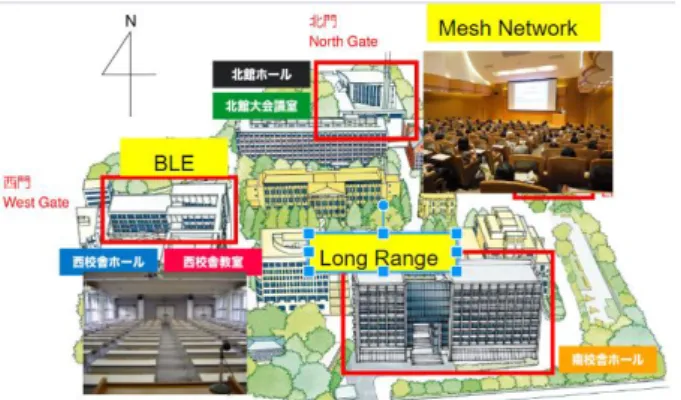
(5) IPSJ SIG Technical Report. Erratum to “Integrated Sensor Network Platform Implementation based on Fog Computing” Dongyu Wang†1. Ruowei Xiao†2. Naohisa Ohta†3. Kazunori Sugiura†4. Erratum: The paper published in 2017-DPS-170(20),1-4 (2017-02-23) , 2188-8906 with the title of ‘‘Integrated Sensor Network Platform Implementation based on Fog Computing’’ and authors Dongyu Wang, Ruowei Xiao, Naohisa Ohta, Kazunori Sugiura would like to have the following completion to the above article. Author Name The fourth author named with “Kazunori Uhyo Sugiura” should be Kazunori Sugiura.. Missing part in section 3 Architecture Add this paragragh in th beginning: In Fog Computing concept, the computation and other processing tasks are distributed to each gateway. A minimum unit of the proposed platform is a Local Sensor Group, which consists of two main elements: 1) Gateway; 2) sensor devices. With connecting sensors connected to the gateway, the Local Sensor Group can work alone to provide data and services. Or it can join with other groups together to build up a wider scale network. Thus, the Local Sensor Group is very important. It must provide the basic functions of data collections and transmission. In addition, it should have capabilities to enable the features of Fog Computing that have been discussed in the 2 Section. Add this paragragh in the end: As use cases, in homes, schools, offices and other environments, local sensor networks can be set up individually. There might be different types of sensors and communication methods inside of each network, but on the Fog Nodes layer, all data will be processed in a common way. With a uniform interface, applications can directly access any Fog Node for the environment data in that specific area. On the other hand, services that utilizing wider scale of environment data can access nodes from different locations at the same time. By recording and analyzing the data for a long term, the services will be able to provide more variety of applications.. communication methods installed: Bluetooth low energy(BLE), Mesh Network, Long Range Wireless. Basically, the usage of each module is from short to long distance. BLE was used in small and open spaces, Mesh Network can be used in a large and complicated environment inside one floor, the Long Range Wireless can be used between buildings. The data formats are different too with the communication methods. Gateways are divided into three groups, that configured with separated wireless modules and data conversion functions. As a result, all the groups will prepare a set of JSON data ready for application use. To stream the data in real-time, normal HTTP requests are not efficient enough. Therefore, WebSocket protocol*2 was utilized in the proposed platform. It was layered over TCP, enables two-way communication between clients and servers that not rely on opening multiple HTTP connections. Every Gateway with an independent IP address can be used as a WebSocket server for real-time data streaming. The latency could be reduced as the Gateway sending data right after the conversion process. For location information, the platform intends to separate indoor location and outdoor location. Outdoor location can be traced based on network or GPS. The indoor location could be preset with specific sensor identification. At the current stage of implementation, the location information process was done on the application side.. Missing part in section 4 Implementation Add these paragraphs in the beginning: To prove and test the proposed architecture, the platform was implemented from the Local Sensor Group to distributed Fog Networks based on campus experiments. Results and issues are discussed after the experiments. As described in the section above, the platform is focusing on environment sensing. Integrated Environmental Sensor has been used in the previous works. Each Integrated Sensor consists of a variety of environment sensing module, Temperature, Humidity, Light, Pressure, Noise, Acceleration. The sensors are all built with same integrated modules, but for different occasions and distances, there are three wireless. Fig. 3: Experiment Layouts in Keio University Mita Campus The experiment was conducted on a university campus. The layout of the whole network was shown in Fig. 3. Three Local Sensor Groups were deployed in three remote buildings. BLE type was in a classroom of West Building; Mesh Network type was in the hall of North Building; and Long Range Wireless sensors are located in South, North and West Building. Gateways for those nodes were given independent IP address through WiFi connection.. † Graduate School of Media Design, Keio University 1,2,3,4 {daniel.wang, ruowei.xiao, naohisa, uhyo}@kmd.keio.ac.jp. ⓒ2017 Information Processing Society of Japan. 1.
(6)
図
関連したドキュメント
Their basic components are the representation of candidate solutions to the problem in a “genetic” form, the creation of an initial, usually random population of solutions,
In 2003, Agiza and Elsadany 7 studied the duopoly game model based on heterogeneous expectations, that is, one player applied naive expectation rule and the other used
Because of the knowledge, experience, and background of each expert are different and vague, different types of 2-tuple linguistic variable are suitable used to express experts’
Thus, we use the results both to prove existence and uniqueness of exponentially asymptotically stable periodic orbits and to determine a part of their basin of attraction.. Let
[10] J. Buchmann & H.C. Williams – A key exchange system based on real quadratic fields, in Advances in Cryptology – Crypto ’89, Lect. Cantor – Computing in the Jacobian of
The numerical tests that we have done showed significant gain in computing time of this method in comparison with the usual Galerkin method and kept a comparable precision to this
Marco Donatelli, University of Insubria Ronny Ramlau, Johan Kepler University Lothar Reichel, Kent State University Giuseppe Rodriguez, University of Cagliari Special volume
In addition, the purpose of this paper is to demonstrate the proposed models and methods with various scenarios for real data analysis for comparing asymmetric distributions for
