Enumeration of unlabeled graphs such that both
the graph and its complement are 2-connected
Kumi Kobata, Shinsei Tazawa and Tomoki Yamashita
(Received December 28, 2015; Revised April 15, 2016)
Abstract. It is well-known that the complement of a disconnected graph is connected, that is, the number of disconnected unlabeled graphs whose com-plement is also disconnected is zero. By this fact, we can easily express the number of connected unlabeled graphs whose complement is also connected, by the numbers of graphs and connected graphs. The generating functions of them are obtained by Harary [5]. In this paper, we express the number of unlabeled graphs such that both the graph and its complement are 2-connected, by the numbers of graphs whose generating functions are known.
AMS 2010 Mathematics Subject Classification. 05C30, 05C40. Key words and phrases. Enumeration, connectivity, complement.
§1. Introduction
In this paper, we consider finite simple unlabeled graphs, which have neither loops nor multiple edges. For terminology and notation not defined in this paper, we refer the readers to [4]. We denote by V (G) and E(G) the vertex set and the edge set of G, respectively. For n ≥ 1, let Gn, Dn, Cn, Sn and
Bnbe the sets of graphs, disconnected graphs, connected graphs, graphs with
connectivity one and 2-connected graphs of order n, respectively. For a graph
G, G denotes the complement of G. For sets Hn and Kn of graphs, we let
HKn={G ∈ Hn | G ∈ Kn}.
Ramsey theory discusses graphs in which either the graph or its complement has a specified property. As a variation, in 1979–1981, Akiyama and Harary [1, 2, 3] have researched graphs such that both the graph and its complement have a common specified property. In this paper, we focus the connectivity as the specified property, and enumerate such graphs. It is well-known that the complement of a disconnected graph is connected, that is,|DDn| = 0. By this
The numbers of graphs and connected graphs are obtained by Harary [5]. By this theorem, we can obtain the following table.
n 1 2 3 4 5 6 7 8 9
|CCn| 1 0 0 1 8 68 662 9888 247492
In this paper, we enumerate graphs such that both the graph and its com-plement are 2-connected. To do it, we need to obtain the cardinalities ofSDn
and SSn. In 1979, Akiyama and Harary obtained a necessary and sufficient
condition for a graph to belong toSDn and SSn. (In 2002, Kawarabayashi,
Nakamoto, Oda, Ota, Tazawa and Watanabe rediscovered this result.) For a graph G and v∈ V (G), NG(v) and degG(v) denote the neighborhood and the
degree of a vertex v in G, respectively. Moreover, G− v denotes the graph obtained from G by deleting v and the edges incident with v.
Theorem 1.2 (Akiyama and Harary [1], Kawarabayashi et al. [7]). Let G be
a separable graph with a cut vertex u.
(i) G is disconnected if and only if degG(u) =|V (G)| − 1. (ii) G is separable if and only if either (a) or (b) holds:
(a) degG(u) =|V (G)| − 2.
(b) degG(u)≤ |V (G)| − 3 and G has a vertex v such that NG(v) ={u}
and G− v has a spanning complete bipartite subgraph.
By using this theorem, we determine the cardinalities of SDn and SSn.
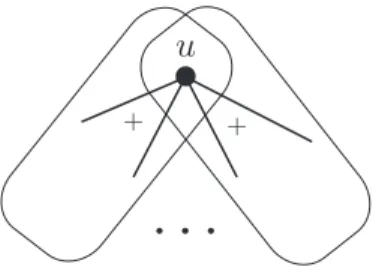
We first determine the structure of SDn and obtain the cardinality of it. Let
S0
n be the set of graphs G of order n such that G has exactly one cut vertex
u and degG(u) = n− 1 (see Figure 1). Then by Theorem 1.2 (i), it is easy to see that SDn = Sn0. Moreover, it is easily observed that there exists a
one-to-one correspondence between Sn0 and Dn−1. Hence we obtain the following
Figure 1: The structure of graphs inSn0.
Proposition 1.3. |SDn| = |Dn−1| holds for n ≥ 3.
We next determine the structure of SSn and obtain the cardinality of it.
Let Sn1 be the set of graphs G of order n such that G has exactly one cut vertex v and degG(v) = n− 2 (see Figure 2 (i)). Let Sn2 be the set of graphs
G of order n such that G has exactly two cut vertices u1 and u2 such that
degG(u1) = n− 2 and degG(u2) = n− 2, moreover and G has a vertex vi
(i = 1, 2) such that NG(vi) = {ui} (see Figure 2(ii)). Note that G ∈ Sn2 has
no cut vertex except for u1 and u2. Let Sn3 be the set of graphs G of order n
with a cut vertex u such that G and u satisfy Theorem 1.2 (ii)-(b) (see Figure 2(iii)).
Figure 2: The structures of graphs inSn1,Sn2 and Sn3
Theorem 1.4. Let n be an integer with n≥ 5. Then SSn =Sn1 ∪ Sn2∪ Sn3,
and Sni ∩ Snj =∅ for 1 ≤ i < j ≤ 3.
Here we show the relationship among Sn1, Sn2 and Sn3, and obtain the car-dinalities of Sn1 and Sn2. For a set H of graphs let H := {H : H ∈ H}. A
rooted graph is a graph in which one vertex has been distinguished as the root.
Let Dnr be the set of rooted disconnected graphs of order n. The generating functions of rooted graphs and rooted connected graphs have been obtained
We postpone the proofs of Theorems 1.4 and 1.5 to the next section. By Theorems 1.4 and 1.5, we can obtain the cardinality ofSSn.
Theorem 1.6. |SSn| = 2(|Dnr−1| − |Dnr−2| − |Gn−2|) + |Gn−4| holds for n ≥ 5.
By Proposition 1.3 and Theorem 1.6, we obtain the cardinality ofBBn. The
generating function of 2-connected graphs is obtained by Robinson [8] (see [6] p.187 for the detail).
Theorem 1.7. For n≥ 5, the following equality holds.
|BBn| = 2|Bn| − |Gn| + 2(|Dn−1| + |Dnr−1| − |Drn−2| − |Gn−2|) + |Gn−4|.
Proof. Note that|Sn| = |Cn| − |Bn|. By Proposition 1.3 and Theorem 1.6, we
deduce
|BBn| = |Bn| − |BSn| − |BDn|
= |Bn| − (|Sn| − |SSn| − |SDn|) − (|Dn| − |DSn| − |DDn|)
= |Bn| − (|Cn| − |Bn|) − |Dn| + 2|SDn| + |SSn|
= 2|Bn| − |Gn| + 2(|Dn−1| + |Drn−1| − |Drn−2| − |Gn−2|) + |Gn−4|.
By this theorem, we can obtain the following table.
n 1 2 3 4 5 6 7 8 9
|BBn| 0 0 0 0 1 8 126 3287 125838
§2. Proofs of Theorems 1.4 and 1.5.
In this section, we give proofs of Theorem 1.4 and Theorem 1.5. Before that, we prepare some notation. Let G be a graph, and let u, v, w and x be vertices with u̸∈ V (G), v, w, x ∈ V (G), vw ̸∈ E(G) and vx ∈ E(G). We denote by
G + u, G− v, G + vw, G − vx and G ∨ u the graph obtained from G by adding u, the graph obtained from G by deleting v and all the edges of v, the graph
obtained from G by adding vw, the graph obtained from G by deleting vx, and the graph obtained from G by adding u and by joining u and all vertices of V (G), respectively.
We first give a proof of Theorem 1.5.
Proof of Theorem 1.5. (i) We first show thatS1
n=Sn3. Suppose that G ∈
S1
n (see Figure 2(i)). Let v be the unique cut vertex of G. Since G− v is a
disconnected graph, G− v has a spanning complete bipartite subgraph. Let
u be the vertex with NG(v) = V (G)\ {u, v}. Then note that NG(v) ={u},
and hence u is a cut vertex in G. Since G has exactly one cut vertex, we have degG(u) ≥ 2, and hence degG(u) ≤ n − 3. Therefore G ∈ Sn3. Conversely, suppose that G ∈ Sn3 (see Figure 2(iii)). Since degG(v) = 1, it follows that degG(v) = n− 2. Since G − v has a spanning complete bipartite subgraph,
G− v is a disconnected graph. Hence v is a cut vertex of G. Since degG(u)≤
n−3, we have degG(u)≥ 2. Hence G has no cut vertex except for v. Therefore
G∈ Sn1.
We next show that|Sn1| = |Dnr−1| − |Drn−2| − |Gn−2|. Let D r(≥2)
n be the set
of rooted disconnected graphs of order n in which the degree of the root is at least 2.
Claim 1. There exists a one-to-one correspondence between Sn1 and Dr(n−1≥2).
Proof. Suppose that G ∈ Sn1. Let v be the unique cut vertex of G. Let
H = G− v. Let u be the vertex with NG(v) = V (G)\ {u, v}. Then H is
disconnected and degH(u) = degG(u) ≥ 2. Therefore if we regard u as the root of H then H ∈ Dr(n−1≥2). Conversely, suppose that H ∈ Dr(n−1≥2). Let u be the root of H with degH(u) ≥ 2. Let v be a vertex with v ̸∈ V (H), and let
G = (H∨ v) − uv. Since degG(u) = degH(u)≥ 2, v is the unique cut vertex of G. Therefore, we obtain G∈ Sn1.
By this claim, it suffices to enumerate the order of Dr(n−1≥2). Let Dr(0)n and
Dr(1)
n be the sets of rooted disconnected graphs of order n in which the degree
of the root is 0 and 1, respectively. Then it is obvious that (2.1) |Dr(≥2)n−1 | = |Drn−1| − |Dnr(0)−1| − |Dr(1)n−1|.
with NG(x) ={y} and let H = G − x. If we regard y as the root of H, then
H∈ Dnr−2. Conversely, suppose that H ∈ Dnr−2. Let y be the root of H, let x be a vertex with x̸∈ V (H), and let G = (H + x) + xy. If we regard x as the root of G, then G∈ Dnr(1)−1.
By the equality (2.1) and Claims 1–3, we deduce
|S1 n| = |D r(≥2) n−1 | = |Drn−1| − |Dnr(0)−1| − |Dr(1)n−1| = |Drn−1| − |Gn−2| − |Drn−2|.
(ii) We show thatS2
n=Sn2. Suppose that G∈ Sn2. Let u1 and u2 be the cut
vertices such that degG(u1) = degG(u2) = n− 2. Let v1 and v2be the vertices
such that NG(v1) = {u1} and NG(v2) = {u2}. Note that NG(u1) = {v2},
NG(u2) = {v1} and degG(v1) = degG(v2) = n− 2. Furthermore, the other
vertices are not cut vertices and have degree at most n−3 in G. Hence G ∈ Sn2. We show that |Sn2| = |Gn−4|. Suppose that G ∈ Sn2. We construct a graph H
from (G−u1)−u2by deleting vertices v1and v2. Then H ∈ Gn−4. Conversely,
suppose that H ∈ Gn−4. Let P4= v1u1u2v2be a path of order 4. We construct
a graph G from H and P4 by joining each of u1 and u2 to all vertices of H.
Then G∈ Sn2. Therefore|Sn2| = |Gn−4|.
We next prove Theorem 1.4.
Proof of Theorem 1.4. By Theorem 1.5, we obtain Sn1 ∪ Sn2 ∪ Sn3 ⊆ SSn.
Suppose that G∈ SSn. If there exists a cut vertex u with degG(u)≤ n − 3,
then Theorem 1.2 (ii) implies G∈ Sn3. Hence, by Theorem 1.2, we may assume that degG(u) = n− 2 for each cut vertex u. If G has exactly one cut vertex, then G∈ S1
n. Therefore, we may assume that G has at least two cut vertices.
Let u1 be a cut vertex in G. Since degG(u1) = n− 2, there exists a vertex
v2 such that NG(u1) = V (G)\ {u1, v2}. Since G has at least two cut vertices,
there exists a vertex u2 with NG(v2) ={u2}, and u2 is the unique cut vertex
except for u1. Since degG(u2) = n− 2, there exists a vertex v1 such that
NG(u2) = V (G)\ {u2, v1}. Since u1 is a cut vertex, we have NG(v1) ={u1}.
References
[1] J. Akiyama and F. Harary, A graph and its complement with specified properties I: Connectivity, Internat. J. Math. Math. Sci. 2(2) (1979) 223–228.
[2] J. Akiyama and F. Harary, A graph and its complement with specified properties III: Girth and circumference, Internat. J. Math. Math. Sci. 2(4) (1979) 685–692. [3] J. Akiyama and F. Harary, A graph and its complement with specified properties
IV: Counting self-complementary blocks, J. Graph Theory 5 (1981) 103–107. [4] J.A. Bondy and U.S.R. Murty, Graph theory, Graduate texts in Mathematics
244, Springer, New York, 2008.
[5] F. Harary, The number of linear, directed, rooted, and connected graphs, Trans. Amer. Math. Soc. 78 (1955) 445–463.
[6] F. Harary and E.M. Palmer, Graphical Enumeration, Academic Press, New York and London, 1973.
[7] K. Kawarabayashi, A. Nakamoto, Y. Oda, K. Ota, S. Tazawa and M. Watanabe, On separable self-complementary graphs, Discrete Math. 257 (2002) 165–168. [8] R.W. Robinson, Enumeration of non-separable graphs, J. Combinatorial Theory
9 (1970) 327–356.
Kumi Kobata
Faculty of Engineering, Kinki University
1 Takaya Umenobe, Higashi-Hiroshima, Hiroshima 739-2116, Japan
E-mail : [email protected]
Shinsei Tazawa
Professor emeritus, Kinki University
3-4-1 Kowakae, Higashi-Osaka, Osaka 577-8502, Japan
E-mail : [email protected]
Tomoki Yamashita
Department of Mathematics, Kinki University
3-4-1 Kowakae, Higashi-Osaka, Osaka 577-8502, Japan