
Traffic properties for extended random walks on scale-free networks
8
0
0
全文
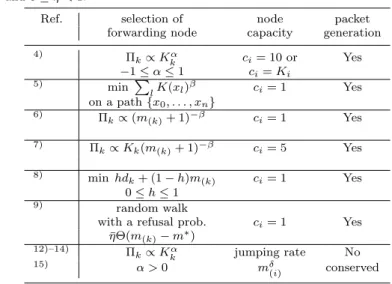
(2) Vol.2010-MPS-77 No.16 2010/3/4 IPSJ SIG Technical Report. to the terminal node. In a stochastic model9) , k ∈ Ni is chosen at random, a packet at the top of its queue is sent with probability 1 − η(m(k) ) or refused with probability η(m(k) ) as a nondecreasing function of the queue length m(k) . It has been investigated that, at the critical generation rate of packets, a congestion arises when many packets spread from hubs or large betweenness nodes to the rest of the network. These recent traffic models are summarized in Table 1, however many combinations of items may be considered. Without loss of generality, it is assumed that the source and the terminal nodes are randomly chosen under a constant generation rate of packets at each time step, and that the queue length is unlimited. On the other hand, the enhancement of the forwarding capability10),11) at a node is also reasonable. In the Internet or airline networks, an important facility with many connections has high performance; more packets or flights are processed as the incoming of communication requests or passengers increases. In a traffic model4) , it has also been considered that the node capacity ci is proportical to its degree Ki . Such higher performance at more busy nodes is effectively applied in a zero-range process (ZRP)12)–14) , which tends to distribute packets on the whole network instead of avoiding a path through hubs. The ZRP is a solvable theoretical model for traffic dynamics. In particular, in the ZRP with a random walk at α = 0, the phase transition between the condensation at hubs and the uncondensation on SF networks has been derived12),13) . For α > 0, a similar phase transition has been analyzed in the mean-field approximation15) . Based on another approach introduced in Refs.12),13) , we derive the phase transition in the ZRP on SF networks with the degree-dependent hopping rule for α > 0 and α < 0, inspired from preferential3)–5) and congestion-aware walks. Although it is not identical to the congestion-aware routing scheme6) based on the occupied queue length m(k) , α < 0 corresponds to avoiding hubs with large degrees on which many packets tend to be concentrated in a SF network. Furthermore, we study the traffic properties with the nearest-neighbor search into a terminal node at the last step. In particular, we show that, in the low forwarding performance at a small δ, the wandering path for α < 0 better reduces the mean travel time counted by the sum of hoppings and waitings trapped in queues at nodes on a path, and that, in the high forwarding performance at a large δ, nei-. ther the wandering path with a short waiting trapped at a node (α = −1) nor the short hopping path with a long waiting trapped at hubs (α = 1) becomes a good strategy. Consequently, an uniformly random walk at α = 0 yields slightly better performance. The dynamics of the persistent packets in the ZRP gives fundamental traffic properties. By adding generations and removals of packets, the condensation at a few nodes(hubs) influences on the whole network, then the congestion occurs. We investigate such a congestion phenomena on SF networks in the ZRP with the degree-dependent hopping rule, comparing with other models related to the traffic-aware routing7)–9) . Table 1 Recent traffic models for complex networks. When a packet is forwarded from a current node i to k ∈ Ni , the neighboring node k is chosen with probability Πk or by minimizing an objective function on a routing path. The node capacity ci is defined by the number of transferable packets from each node i at once. Here, K(xl ) denotes the degree of node xl , Θ(x) is the step function, m∗ is a threshold, β ≥ 0, and 0 ≤ η¯ < 1. selection of forwarding node. node capacity. packet generation. Πk ∝ Kkα −1P ≤α≤1 min K(xl )β l on a path {x0 , . . . , xn } Πk ∝ (m(k) + 1)−β. ci = 10 or ci = Ki ci = 1. Yes Yes. ci = 1. Yes. 7). Πk ∝ Kk (m(k) + 1)−β. ci = 5. Yes. 8). min hdk + (1 − h)m(k) 0≤h≤1 random walk with a refusal prob. η¯Θ(m(k) − m∗ ) Πk ∝ Kkα α>0. ci = 1. Yes. ci = 1. Yes. jumping rate mδ(i). No conserved. Ref. 4) 5). 6). 9). 12)–14) 15). 2. c 2010 Information Processing Society of Japan °.
(3) Vol.2010-MPS-77 No.16 2010/3/4 IPSJ SIG Technical Report. As in Ref.19) , we can derive that the stationary solution Pj∞ of the incoming probability to node j is approximately proportional to Kj1+α for the SF networks. In numerical simulations, we also show the exponent β ≈ 1+α in both cases with and without the nearest-neighbor search into a terminal node at the last step. 2.3 Phase transition in the ZRP We discuss the phase transition between the condensation and the uncondensation in the ZRP with the degree-dependent hopping rule of packets. For the configuration m(1) , . . . , m(i) , . . . , m(N ) of occupation at each node, the stationary solution is given by the factorized form 1 P (m(1) , . . . , m(i) , . . . , m(N ) ) = ΠN fi (m(i) ), (1) Z i=1 where Z is a normalization factor and µ ∞ ¶ Pi m(i) def fi (m(i) ) = Πω=1 , (2) qi (ω) for m(i) > 0 and fi (0) = 1. We consider a function qi (ω) = ω δ with a parameter 0 ≤ δ ≤ 1 of the forwarding performance. This means that a node works harder for the transfer as it has more packets in the queue with larger ω and δ. Using the probability distribution in Eq. (1) and the stationary probability def Pi∞ ∝ Kiβ , we can calculate the mean value hm(i) i at each node. Here, hm(i) i = P∞ ω=0 ωPj (m(i) = ω) is defined by using the propability distribution Pj (m(i) = ω) of the number of occupied packets at node i. 1 X Pj (m(i) = ω) = fi (ω)Πj6=i fj (m(j) ), Z where the sum is taken for {m(1) , . . . , m(i−1) , m(i+1) , . . . , m(N ) } in the constraint m(1) + . . . + m(i−1) + ω + m(i+1) + . . . + m(N ) = M , just like a delta-function. Introducing a fugacity variable z 20) , it is given by P ωz ω fi (ω) ∂ ln Fi (z) hm(i) i = z = Pω ω , (3) ∂z ω z fi (ω). 2. TRAFFIC MODEL 2.1 Routing rule Consider a system of M interacting packets on a network of N nodes with PN a density ρ = M/N , M = i=1 m(i) , where m(i) ≥ 0 denotes the occupation number of packets in the queue at each node 1 ≤ i ≤ N . For simplicity, we assume that the queue length is not limited and that the order of stored packets is ignored. If there is a limitation for the queue length, it may be necessary to discuss a cascading problem16)–18) in very complicated dynamics. To investigate the predicted properties from the theoretical analysis in the ZRP12)–14) , we have the same setting such that all packets persist on paths in the network without generations and removals of packets. For more complex situations with packet generations, some models modified by adding different routing rules will be studied in subsection 3.2. In this routing rule related to the ZRP, the total number M of packets is constant at any time, and each node performs a stochastic local search as follows: At each time step, a packet jumps out of a node i stochastically at a given rate qi (m(i) ) as a function of m(i) , and then comes into one of the neighboring nodes P k ∈ Ni chosen with probability Kkα / k0 ∈Ni Kkα0 . When a packet is transferred from i to k, the queue length m(k) is increased by one, and m(i) is simultaneously decreased. The above processes are conceptual, the relaxation dynamics for the simulation of a packet transfer is explained in Sec. 3. The effect of the deterministic nearest-neighbor search into a terminal node at the last step will be also discussed later. 2.2 Stationary probability in α-random walks Before investigating the influence of dynamical queue lengths on traffic properties, we consider the stationary probability of incoming packets at each node. As mentioned in the previous subsection, we extend a random walk routing14),19) , in which a walker chooses a node uniformly at random in the neighbors of the current node on a path, to a degree-dependent routing. We call it α-random walk. On the transition rule, a walker (packet) at node i chose one of Ki nodes in its neighbor Ni with probability proportionally to the α-power of the degree P Kk of a forwarding node k ∈ Ni , thus the probability is Kkα / k0 ∈Ni Kkα0 . 3. c 2010 Information Processing Society of Japan °.
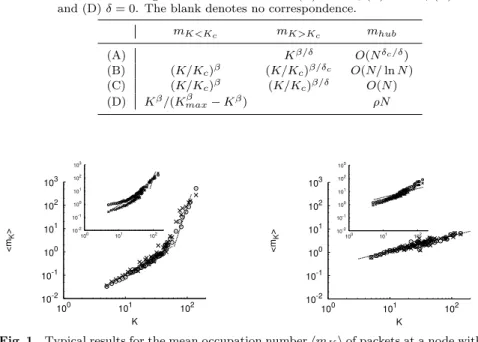
(4) Vol.2010-MPS-77 No.16 2010/3/4 IPSJ SIG Technical Report. Fi (z) =. ∞ X. Table 2 The mean occupation number mK at a node with degree K and mhub at the hub with the maximum degree Kmax for the cases: (A) δ > δc , (B) δ = δc , (C) 0 < δ < δc , and (D) δ = 0. The blank denotes no correspondence.. ω. z fi (ω).. ω=0. mK<Kc. From the definition (2), qi (ω) = ω δ , and Pi∞ ∝ Kiβ , we have ∞ X (zKiβ )ω Fi (z) = . (ω !)δ ω=0. because of fi (ω) = Πω m=1. (A) (B) (C) (D). (4) ³. Kiβ mδ. ´. (Kiβ )ω (ω!)δ. in Eq. (2). The fugacity z should be PN determined from the self-consistency equation ρ = i=1 hm(i) i/N as a function PN of z. Nore that M = i=1 hm(i) i is the total number of packets in a network of N nodes. In this paper, we consider a SF network whose degree distribution follows a power-law P (K) ∼ K −γ . According to the performances of jumping-out, we def classify the following cases (A) δ > δc = β/(γ − 1), (B) δ = δc , (C) δ < δc , and (D) δ = 0 for a critical value δc to the condensation of packets. The derivation is the same as in Refs.12),13) at α = 0 except with a slight modification for a general value of α (and the corresponding β ≈ 1 + α). We summarize the results in Table 2. In the cases (B) and (C), many packets condensate at nodes with degree K > Kc because of the larger exponent β/δ > β. Note that the occupation number is rewritten as mKi regarding for the dependence on the degree Ki . Here, the crossover degree is ( (ln Kmax )δc /β f or δ = δc Kc ∼ (Kmax )1−δ/δc f or δ < δc .. mhub. K β/δ (K/Kc )β/δc (K/Kc )β/δ. O(N δc /δ ) O(N/ ln N ) O(N ) ρN. 103. 3. 10. 102 <mK>. =. (K/Kc )β (K/Kc )β β K β /(Kmax − Kβ ). mK>Kc. 101. 103. 102. 3. 10. 101. 102. 100 10-1 10-2 0 10. 101. <mK>. def. 102. 0. 10. 10-1 10-2 100. 101. 102 101 100 10-1 10-2 0 10. 101. 102. 0. 10. 10-1 101 K. 102. 10-2 100. 101 K. 102. Fig. 1 Typical results for the mean occupation number hmK i of packets at a node with degree K in the routings without the nn-search. Left: Case(C) α = 0.5, δ = 0.2, Right: Case(A) α = −0.5, δ = 0.8. Inset: the cases with the nn-search. The circle and cross marks correspond to the results in 1000 and 100 rounds, respectively. The dashed lines guide the slopes of β and β/δ. Note that the condensation of packets at the nodes with high degrees occurs in the Case(C). These results are obtained from the averages of 100 samples of packet transfer on a BA network whose maximum degree is the closet to the average value Kmax = 132 in the 100 realizations.. 3. SIMULATION. selected at random. With probability qi (m(i) )/m(i) = mδ−1 (i) , the packet jumps out of its resident node i, and hops to j ∈ Ni as one of the neighboring nodes P with probability Kjα / j 0 ∈Ni Kjα0 . Otherwise, with probability 1 − qi (m(i) )/m(i) , the selected packet does not move. The time is measured in a unit of one round (Monte Carlo sweep) consisting of M trials of the random selection of a packet. Figure 1 shows the mean occupation number hmK i of packets at a node with degree K in both cases with/without the nearest-neighbor search (nn-search),. 3.1 Traffic properties for α-random walks in the ZRP We have performed the simulations for M = 1000 packets on scale-free networks generated by the BA model2) with a size N = 1000, the average degree hKi = 10, and the exponent γ = 3. From the initial state in which one packet is set on each node, the following processes are repeated as the relaxation of the ZRP13) from the node-based dynamics to the particle-based one20) . At each step, a packet is. 4. c 2010 Information Processing Society of Japan °.
(5) Vol.2010-MPS-77 No.16 2010/3/4 IPSJ SIG Technical Report 1. 1. 0.6. 0.8 Reachability. Reachability. 0.8. 0.4. 0.4 0.2. 0.2 0. 0.6. 0. 0. 0. 5000. 5000. 10000 15000 20000 25000 30000 Observed Interval. 1.0 0.5 0.0 -0.5 -1.0. 10000 15000 20000 25000 30000 Observed Interval. 500. 4000. 3000 <Ta>. 2500 2000 1500 1000. <Ta>. 500. 300. 0. 1.0 0.5 0.0 -0.5 -1.0. 8 6. 3 2.5 2 1.5 1 0.5 0. 0. 5000. 10000 15000 20000 25000 30000 Observed Interval. 4 2 0. 0. 5000. 10000 15000 20000 25000 30000 Observed Interval. 1.0 0.5 0.0 -0.5 -1.0. 3500. 400. Num. of Restarts per Round. 10. Num. of Restarts per Round. while the left of Fig. 1 shows the predicted piecewise linear behavior15) at the critical degree Kc ; the steeper line indicates the condensation at the nodes with high degrees, and the right of Fig. 1 shows that the condensation is suppressed by a more gentle line. As shown in the insets, the condensation slightly deviates from the line especially in the head and the tail because of the effect of the nnsearch into a terminal node at the last step. Thus, the condensation of packets at hubs can be avoided as the performance of transfer is enhanced at a large δ, although it depends on the probability of incoming packets according to the value of α; a negative α induces a nearly homogeneous visiting of nodes, while a positive α induces a heterogeneously biased visiting on the nodes with high degrees. We note that the uncondensed phase is maintained in a wide range of δ > δc for α < 0, as shown in the case (A). Next, in order to study the traffic properties, such as the travel time on the routing path, we focus on the packet dynamics in a realistic situation with the nn-search into a terminal node at the last step. If the terminal is included in the neighbors of the resident node for a randomly selected packet, then it is deterministically forwarded to the terminal node, taking into account the reachable chance, otherwise it is stochastically forwarded to a neighboring node j according P to the probability Kjα / j 0 ∈Ni Kjα0 . The nn-search is effective and necessary in order to reach a terminal node. If we consider the only stochastic forwarding without the nn-search, a packet may wander for a very long time, which is not bounded in advance for the simulation of the packet transfer. Without loss of generality, we assume that the probability to be a terminal is uniformly at random for all nodes, while the source is reset (the corresponding packet is restarted) at the node after the arrival. Since all packets are not removed, but persist through the walk, this setting corresponds to the theoretical ZRP. The difference is due to only the nn-search at the last step. Remember that the estimated values of β are similar in both cases of with/without the nn-search, although the stationary probability Pj∞ ∼ Kjβ of incoming packets may be changed because of the deterministic move to the terminal. Therefore, the behavior of the mean occupation number hmK i resembles as shown in Fig. 1 and the inset. In the case with the nn-search, we investigate the traffic properties for the reachability of packets, the number of hops, the travel time Ta including the. 0. 5000. 10000 15000 20000 25000 30000 Observed Interval. 200 100 0. 0. 5000. 10000 15000 20000 25000 30000 Observed Interval. Fig. 2 Convergence properties for the high-performance at δ = 0.8 in the observed interval [rounds] after the transient state of hmK i. Inset: results for the low-performance at δ = 0.0. These results are obtained from the averages of 100 samples of packet transfer on a BA network whose maximum degree is the closest to the average value Kmax = 132 in the 100 realizations.. waiting of trapped packets in the resident’s queues, and the sum Tw of waiting times on a path until arrived at the terminal. Note that the travel time is Ta = Tw + (the number of hops). We also define the averaged waiting time Tw /Nw at a node, where Nw is the number of trapping in queues at nodes on a path. These measures are cumulatively counted in the observed interval after 1000 rounds, and averaged over 100 samples of this simulation. Here, we discarded the initial 1000 rounds as a transient before the stationary state of occupation number m(i) of packets. Figure 2 shows, from top to bottom, the convergence of the reachability, the mean number of restarted packets per round, and the mean travel time in the high-performance at δ = 0.8. The inset shows a slightly slow convergence in the. 5. c 2010 Information Processing Society of Japan °.
(6) Vol.2010-MPS-77 No.16 2010/3/4 IPSJ SIG Technical Report. 4000. 160. 3500. 140 Num. of Hops. 3000 <Ta>. 2500 2000 1500 1000. 120 100 80 60 40. 500 0. low-performance at δ = 0.0. For other measures, similar convergence properties are obtained. We compare these curves according to the values of α. The reachability of the restarted packets is around 0.99 on similar curves for all values of α at δ = 0.8, while these curves separate down in increasing order of α at δ = 0.0 (see the inset at the top left of Fig. 2). Note that the number of restarted packets cumulatively increases as the observed interval is longer, although the rate per round is almost constant around 3 ∼ 5 in the ordering from α = 0, α = ±0.5, to α = ±1 for δ = 0.8, and less than 1 in the ordering from α = −1.0 to α = 1.0 for δ = 0.0, as shown in the top right of Fig. 2 and in the inset. In the mean travel time hTa i, the maximum and the minimum are obtained at α = −1 and α = 0, respectively, for δ = 0.8. However, all of the curves shift up for δ = 0.0 (see the inset at the bottom of Fig. 2), and hTa i is longer as the value of α increases, because of the waiting at high-degree nodes. We further investigate the above traffic properties, especially for the forwarding performance of packets with more detailed values of δ at 30000 round in the quasiconvergent state. As shown in Fig. 3, the mean travel time hTa i decreases as the value of δ increases with a higher forwarding performance, because the waiting time trapped in a queue decreases on average. In particular, packets tend to be trapped at hubs for a long time when α > 0, and then hTa i is longer. In contrast, the number of hops increases on average as the value of δ increases, because some longer paths are included in the higher reachability. The path length counted by hops tends to be short through hubs when α > 0, however it tends to be long with the wandering when α < 0. Therefore the number of hops increases in decreasing order of α. Note that the number of hops is very small compared to hTa i, which is dominated by the mean waiting time hTw i ≈ hTa i on a path. On the other hand, as shown in Fig. 4, the mean number hNw i of trapping at nodes on a path increases when α > 0 and decreases when α < 0 as the value of δ increases with a higher forwarding performance. This up-down phenomena may be caused by a trade-off between the avoidance of trapping by enough high forwarding performance at a node and the including of longer paths with the high reachability. The mean waiting time hTw /Nw i per node decreases as the value of δ increases, and is longer in increasing order of α because of the long waiting at hubs.. 0. 0.1. 0.2. 0.3. 0.4 δ. 0.5. 0.6. 0.7. 20. 0.8. 0. 0.1. 0.2. 0.3. 0.4 δ. 0.5. 0.6. 0.7. 0.8. Fig. 3 The mean travel time (left) and the mean number of hops (right). The 4, +, ∗, ×, and 5 marks correspond to α = 1.0, 0.5, 0.0, −0.5, and −1.0. The simulation conditions are the same as in Fig. 2.. 120. 160. 110. 140. 100. 120 <Tw>/<Nw>. <Nw>. 90 80 70 60 50. 80 60 40. 40. 20. 30 20. 100. 0. 0.1. 0.2. 0.3. 0.4 δ. 0.5. 0.6. 0.7. 0.8. 0. 0. 0.1. 0.2. 0.3. 0.4 δ. 0.5. 0.6. 0.7. 0.8. Fig. 4 The mean number of trapping at nodes (left) and the mean waiting time per node (right). The 4, +, ∗, ×, and 5 marks correspond to α = 1.0, 0.5, 0.0, −0.5, and −1.0. The simulation conditions are the same as in Fig. 2.. 6. c 2010 Information Processing Society of Japan °.
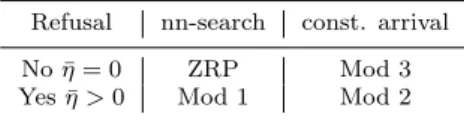
(7) Vol.2010-MPS-77 No.16 2010/3/4 IPSJ SIG Technical Report. 3.2 Congestion phenomena This subsection discusses the congestion phenomena when packets are randomly generated at each node at a constant rate p, and removed at the terminal nodes (not restarted within the persistency). In order to reduce the computational load, the packet dynamics starts from the the initial state: There are no packets except the generated ones. We compare the phenomena in our traffic model based on the ZRP with that in the following modifications related to traffic-aware routing8) at α = 09) . Mod 1: With probability η(m(j) ) = η¯Θ(m(j) − m∗ ), the selected packet is not transfered to j ∈ Ni but is refused at the resident node i, where Θ(x) is the step function, m∗ is a threshold, and a parameter 0 < η¯ ≤ 1. Here, node j is chosen deterministically by the nn-search if j is the terminal node, otherwise it is chosen with probability proportionally to Kjα . Mod 2: Moreover, instead of the nn-search, the selected packet is removed as the arrival with probability µ, or it enters the queue with probability 1 − µ. Mod 3: In Mod 2 , there is no refusal process (¯ η = 0). In Mod 1, the randomly selected packet from the queue does not leave node i with a constant probability η¯ if the occupation number m(j) of packets is greater than a threshold m∗ , while in Mod 2, after passing this refusal check, it is removed with a constant probability µ. Note that a constant arrival was assumed to theoretically predict the critical point of the congestion in the mean-filed approximation at N → ∞9) . With the packet generations, we can perform the ZRP as an extension of the model in Ref.9) . In particular, the case of δ = 0 corresponds to a node capacity ci = 1 for all nodes i; only one packet is transferable from a node at each time. The relation among these models are shown in Table 3.. M (t + τ ) − M (t) , τ pN where M (t) denotes the sum of the occupation numbers of packets at nodes in the network (practically for a large t), and τ is the observed interval. The value of op represents a level of the congestion, e.g. op ≈ 0 means a free-flow regime, while op ≈ 1 means a congested regime. We set η¯ = 0.7 and m∗ = 5 for the refusal process. The detailed results are shown in the presentation. op = lim. t→∞. 4. CONCLUSION We have studied the extensions of an uniformly random walk inspired by the theoretical ZRP12)–14),19) with both controls for the stochastic routing by the forwarding probability proportionally to Kjα 3)–5) to node j ∈ Ni with its degree Kj and the jumping rate mδ(i) 6) from node i according to the occupation number m(i) of packets in the queue. Based on the local search without generations and removals of packets, we have approximately analyzed the phase transition between the condensation at hubs and the uncondensation on SF networks from another approach12),13) instead of the mean-field approximation in the preferential walk for α > 015) . Moreover, we have numerically investigated the traffic properties including the realistic nn-search into a terminal node at the last step. The phase transition has been consistently observed in both cases with/without the nn-search. We emphasize that the uncondensed phase is maintained over a wide range of δ > δc ≈ 0.5 for α < 0, and that the wandering walk for α < 0 is rather better in the short travel time hTa i ≈ hTw i with a high reachability, even in the lowperformance at a small δ. Regarding the waiting properties at queues, the mean number hNw i of trappings at nodes is small on a short hopping path but the mean waiting time hTw i/hNw i at a hub is long for a large α > 0, while the mean number of trappings is large on a wandering long path but the mean waiting time at a node is short for a small α < 0. However, the difference for α > 0 and α < 0 is small in a high forwarding performance at a large δ; the case of α = 0 is slightly better, as shown in Fig. 2. This optimality at α = 0 is consistent with the results for the critical generation rate in other traffic model on a SF network with the node capacity (corresponding to the forwarding performance). Table 3 Modified traffic models. Refusal. nn-search. const. arrival. No η¯ = 0 Yes η¯ > 0. ZRP Mod 1. Mod 3 Mod 2. For varying the generation rate p, we investigate an appearance of the congestion by using the order parameter8),9). 7. c 2010 Information Processing Society of Japan °.
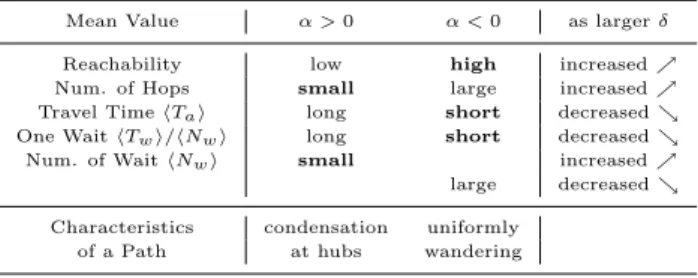
(8) Vol.2010-MPS-77 No.16 2010/3/4 IPSJ SIG Technical Report. proportionally to its degree4) . Our results are summarized in Table 4. We note that such traffic properties as the trade-off between a detoured path and long waiting at hubs can’t be obtained from only the theoretically predicted phase transition between the condensation and the uncondensation. On the fundamental traffic properties, we have investigated the congestion phenomena with packet generations, comparing with other models related to the traffic-aware routing7)–9) . We suggest that the high forwarding performance at a large δ is dominant than the refusal process in order to suppress the congestion in a small op, and that the difference of op is small for varying the values of α (the case of α = 0 is slightly better for the nn-search). The above results only show qualitative tendencies. As a further study, more complex and quantitative properties should be carefully discussed in many combinations of parameters α, δ, µ, η¯, m∗ , etc., although such simulations may be intractable due to huge computation and memory consuming for the processing over millions of packets in very long iterations.. 8) 9) 10) 11) 12) 13) 14) 15) 16) 17) 18) 19) 20). Echenique, P. et al.: Eupophys. Lett. Vol.71, pp.325 (2005). De Martino, D. et al.: Phys. Rev. E Vol.79, pp.015101(R) (2009). Liu, Z. et al: Physica A Vol.370, pp.843 (2006). Zhao, L. et al: Phys. Rev. E Vol.71, pp.026125 (2005). Noh, J.D., Shim, G.M., and Lee, H.: Phys. Rev. Lett. Vol.94, pp.198701 (2005). Noh, J.D.: Phys. Rev. E Vol.72, pp.056123 (2005). Noh, J.D.: arXiv:cond-mat/0701401 (2007). Tang, M., Liu, Z., and Zhou, J.: Phys. Rev. E Vol.74, pp.036101 (2006). Motter, A.E., and Lai, Y.-C.: Phy. Rev. E Vol.66, pp.065102 (2002). Motter, A.E.: Phy. Rev. Lett. Vol.93, pp.098701 (2004). Wu, J.J., Gao, Z.Y., and Sun, H.J.: Physica A Vol.378, pp.505–511 (2007). Noh, J.D., and Rieger, H.: Phys. Rev. Lett. Vol.92, No.11, pp.118701 (2004). Evans, M.R.: J. Phys. Vol.30, pp.42 (2000).. Table 4 Qualitative summary of the traffic properties. Mean Value. α>0. α<0. Reachability Num. of Hops Travel Time hTa i One Wait hTw i/hNw i Num. of Wait hNw i. low small long long small. high large short short. Characteristics of a Path. condensation at hubs. large. as larger δ increased increased decreased decreased increased decreased. % % & & % &. uniformly wandering. References 1) 2) 3) 4) 5) 6) 7). Goh, K.-I. et al.: Phys. Rev. Lett. Vol.87, pp.278701 (2001). Albert, R. and Barab´ asi, A.-L.: Rev. Mod. Phys. Vol.74, pp.47 (2002). Ikeda, S. et al.: Lecture Notes in Computer Science Vol.2719, pp.1054–1067 (2003). Wang, W.-X. et al.: Phys. Rev. E Vol.73, pp.026111 (2006). Yan, G. et al: Phys. Rev. E Vol.73, pp.046108 (2006). Danila, B. et al.: Phys. Rev. E Vol.74, pp.046114 (2006). Wang, W.-X. et al: Phys. Rev. E Vol.74, pp.016101 (2006).. 8. c 2010 Information Processing Society of Japan °.
(9)
図
![Fig. 2 Convergence properties for the high-performance at δ = 0.8 in the observed interval [rounds] after the transient state of h m K i](https://thumb-ap.123doks.com/thumbv2/123deta/6262203.1604258/5.1262.650.1155.116.449/convergence-properties-performance-observed-interval-rounds-transient-state.webp)

+3
関連したドキュメント
In this paper we have investigated the stochastic stability analysis problem for a class of neural networks with both Markovian jump parameters and continuously distributed delays..
We consider the cases of random networks with bounded but generic degrees of vertices, and show that the free energies can be exactly evaluated in the thermodynamic limit by the
Using the semigroup approach for stochastic evolution equations in Banach spaces we obtain existence and uniqueness of solutions with sample paths in the space of continuous
Besides, we offer some additional interesting properties on the ω-diffusion equations and the ω-elastic equations on graphs such as the minimum and max- imum property, the
By employing the theory of topological degree, M -matrix and Lypunov functional, We have obtained some sufficient con- ditions ensuring the existence, uniqueness and global
In this paper, we focus on the existence and some properties of disease-free and endemic equilibrium points of a SVEIRS model subject to an eventual constant regular vaccination
In this paper the classes of groups we will be interested in are the following three: groups of the form F k o α Z for F k a free group of finite rank k and α an automorphism of F k
Gilch [ 11 ] computed two different formulas for the rate of escape with respect to the word length of random walks on free products of graphs by different techniques, and also a
