
A Preliminary Evaluation of Chapel with Molecular Dynamics Simulation
10
0
0
全文
(2) Vol.2011-ARC-197 No.1 Vol.2011-HPC-132 No.1 2011/11/28. IPSJ SIG Technical Report. 2.1.1 Language Overview Chapel adopts a global view model rather than conventional fragmented model (which is derived from SIMD model). The major advantage of global view model is to set programmers free from difficulty and tedious of writing parallel programs in an explicit task-by-task manner. Chapel supports the abstractions of task parallelism, data parallelism, and nested parallelism. The parallelism is described using an implicit multithreading manner, in which independent computations are mapped to a collection of threads. Low-level threads management (e. g., create and join) is implemented by the compiler and runtime system instead of users. The unit of physical computation resources, i. e., CPU plus memory, is abstracted as locale in Chapel. For example, one machine with its local memory represents a locale in a cluster architecture. Locales are used to control the mapping of data and computation to the physical machine. Instead of directly compiling source code to generate executable binary, Chapel uses a source-to-source translation from Chapel source code to C code that links to a parallel library. Source-to-source translation not only allows Chapel to support interoperability to other languages such as Fortran or CUDA, but also provides users a chance to understand its underlying execution mechanisms by peeking transformed intermediate C code. 2.1.2 Task and Data Parallelism The parallelism in Chapel can be constructed by one of following parallel statements: begin, cobegin, coforall, and forall. For task parallelism, the begin statement is used with sync and single synchronization variables to construct concurrent tasks in an unstructured way. The cobegin and coforall statements are more straightforward for common structured tasks. Following code examples illustrate the difference between these statements.. procA(); // Synchronization is implicitly introduced. procB(); } // procA() and procB() finish separately and join here. coforall i in [1..10] { procA(); procB(); } // Repeat above cobegin block for 10 times.. Domain is an important data parallelism concept in Chapel. It is used for define data distributions of arrays (which is a mapping from index to data values). Concurrent tasks that manipulate a collection of data can be constructed using forall iterations over a domain or array. For example, var Dom: domain(1) = [1..m]; // Domain var ArrA, ArrB: [Dom] real; // Aaray forall a in Arr do { ... } // Iterate over an array ArrB = ArrA; // Implicit element-by-element copy in parallel. 2.1.3 Locality Control Locality is important for parallel programs to achieve good performance. Besides customizing domain distribution, there are two other ways of controlling locality by using on clause. As shown in following examples, one is to explicit specify the locale where computation should happen, the other is a data-driven approach that keeps computation local with data. // Explicit control of computation location forall loc in Locales do on loc do procedure(); // Data-driven manner forall i in Arr.domain do on Arr(i) do procedure(Arr(i));. 2.2 Molecular Dynamics Simulation Molecular Dynamics (MD) simulation10),11) is a scientific applications that uses numerical approach to study physical substances by simulating the motion of their build blocks: molecules and atoms. In MD simulation, the movements of molecules obey classical mechanics (i. e., Newton’s law of motion) and are dynamically determined by the forces between molecules. Generally, a MD simulation iterates a computation consisting of following two steps: 1) calculate the force for each molecule in system, 2) advance the. begin procA(); begin procB(); // The order of procA() and procB() is unspecified. cobegin {. 2. c 2011 Information Processing Society of Japan ⃝.
(3) Vol.2011-ARC-197 No.1 Vol.2011-HPC-132 No.1 2011/11/28. IPSJ SIG Technical Report. positions of the molecules to classical laws of motion. The intermolecular forces are calculated based on the modeling of force field. A potential function used to define the force field is also called kernel. A force field usually has two parts of interactions: 1) short range forces (e. g., van der Waals force) that fall off rapidly with distance and thus are typically evaluated only for nearby molecules, and 2) long range forces (i. e., electrostatic forces) that fall off slowly with distance. Therefore, a O(N 2 ) computation is required for calculating forces (esp. longrange forces) between all pairs of molecules. Long range forces are typically computed using faster approximate approaches. Some of widely used methods includes Ewald summation12) using Fast Fourier Transform (FFT), and the Fast Multipole Method (FMM)13),14) . FMM is a state-of-the-art algorithm for MD simulation because it significantly reduces the computation complexity of long-range force calculation from O(N 2 ) to O(N ). FMM achieves this by using multipole expansions to approximate the effects of groups of molecules instead of individual molecules with specified accuracy. The groups are further organized in a hierarchical way when the distance between them increases. Due to the lack of space, we refer interested users to further readings11),13),14) . FMM has several variants, such as KernelIndependent FMM (KIFMM)15) that avoids to expand underlying kernel. In order to harness the power of parallel machines, recent research effort has also been dedicated to the parallelization of FMM16),17) . One of major objectives of our work is also to parallelized FMM, however, by using a language approach rather than other algorithmic approach.. structure is implemented by record type that holds three vectors and other attributes, as shown below. We choose record rather than tuple mainly because of performance considerations (see section 4.2.2). record vector { var x, y, z: real; }; record mol { var r, rv, ra: vector; // Position, velocity, acceleration var chg: real; // Electric charge }. Other major data structures include a list to store the cells for multipole expansion, and a list for neighbour molecules to simulate soft-sphere interactions. Both of these lists are implemented using one dimensional array that stores the index of related molecules. A multidimensional array instead of a tree is used to store the expansion coefficients in the hierarchy. 3.2 Potential Functions For long-range interactions, electrostatic field force that follows the Coulomb’s law11) is used. To prevent molecules with opposite charges from approaching too closely, the pair potential (i. e., Lennard-Jones potential11) ) is used. 3.3 Parallelization Using Chapel to parallelize the serial code is straightforward and effortless: 1) separate the computation-intensive phase and identify the independent computations encapsulated in for loop, then 2) change the for into forall and protect the globally modified variables with atomic⋆1 statement or sync combinations. In our FMM implementation, several major computation intensive phases are parallelized using only forall loops, while begin and cobegin parallel statements are not used. Most of forall parallelism are iterations over the expansion cells. Manipulations on the whole array of molecules, such as initialization and leapfrog steps, are left with serial for loop. This is because parallelizing loops with less iterations or inexpensive computations may conversely introduce much more overhead than performance gain. Furthermore, we use user-defined iterators to replace the default range expression for those nested serial loops to reduce more overhead (see section 4.4).. 3. Molecular Dynamics in Chapel We implemented MD programs in Chapel based on an existing collection of C implementation11) . By this method, we are able to investigate the easiness of rewriting a serial program to a parallel one by Chapel. Additionally, this approach allows us to compare the performance with the performance of a well-understood conventional language. In this paper, we extensively use FMM instead of other programs as the example for description. 3.1 Data Structures The basic data structure is the representation of molecule. The molecular. ⋆1 Currently, atomic statement is not implemented yet.. 3. c 2011 Information Processing Society of Japan ⃝.
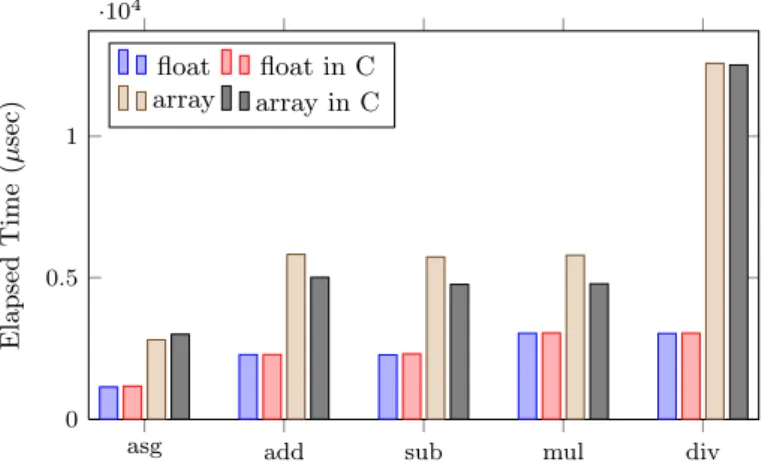
(4) Vol.2011-ARC-197 No.1 Vol.2011-HPC-132 No.1 2011/11/28. IPSJ SIG Technical Report ·104. Elapsed Time (µsec). Because of Chapel’s high expressiveness of parallelism, we generally find that less than 10% of the original code is modified/appended when we reconstruct the serial program into parallel program. 4. Evaluation 4.1 Experimental Environments The experimental environments consist of one cluster of 20 machines. Each machine is equipped with Xeon E5530 2.4GHz 8 cores CPU, 24GB MEM, and an uniform installation of Linux 2.6.26, GCC 4.3.2, and Chapel 1.3.0. Our Chapel implementation consists of several basic language benchmarks and MD simulation programs, where MD programs is based on an open-source C implementation⋆1 with detailed illustrations11) . Therefore, there is no algorithmic but only language descriptive differences between these two implementations. The used compilation options are shown below. Note that -O3 option is specified because the same level of optimization is used (which can be shown by --print-commands option) during the Chapel compilation from intermediate C code to executable.. . float . . float .in C . array . . array. in C 1. 0.5. . 0. . asg Fig. 1. add. sub. mul. div. Comparison of float point arithmetics. 4.2.2 Tuple vs. Record Tuple and Record are two light-weight data types for encapsulating a group of data. When translated to intermediate C code, tuple is transformed to multiple dimensional array and record is transformed to the struct type. Following code illustrates the correspondence in translation of tuple type, record type, and their nested constructions.. $ chpl prog.chpl -o prog --fast // Chapel compilation $ gcc prog.c -o prog -O3 -lm // C compilation. To investigate performance bottlenecks, we extensively uses source-to-source compilation feature (i. e., --codegen and --savec options) by exploring intermediate C code in following experiments. For each experiment, if not specified, the shown results are the average of 5 identical runs and their standard deviations are considerable small. 4.2 Language Primitives 4.2.1 Arithmetic and Array Indexing We first investigate the baseline performance of float point arithmetics for both one single variable and an array. Figure 1 shows the performance of conducting 106 operations, with the comparison of a direct C implementation. While the plain float point arithmetics perform the same as direct C implementation, the array reference introduce an average of 15% overhead.. /* Chapel source */ var tup: (int, int); var nstTup: (tup, tup);. /* C mapping */ int tup[2]; int nstTup[2][2];. record Rec {var x, y: int;} record nstRec { var x, y: Rec; }. struct rec {int x, y;} struct nstRec { struct rec x, y; }. As described in section 3.1, both tuple and record can be used to implement vector. Figure 2 and 3 show the manipulation performance of 1D and 2D vectors, respectively. 2D vector is implemented by nested types. The number of vectors is 106 and we also compare them with a direct C implementation using array and struct. Results show that using tuple has a potential indexing overhead (up to 50%) than using record, and the increment of overhead by using nested. ⋆1 Online available at http://www.ph.biu.ac.il/˜rapaport/mdbook/index.html.. 4. c 2011 Information Processing Society of Japan ⃝.
(5) Vol.2011-ARC-197 No.1 Vol.2011-HPC-132 No.1 2011/11/28. IPSJ SIG Technical Report. . .. . tuple . . array. in C . record . . struct. in C. ·104. 1. 0.5. . . asg Fig. 2. add. sub. mul. . 2D-Reg . 3D-Irr. 2. . . Fig. 3. sub. mul. asg. add. sub. mul. div. Indexing performance of arrays with different domains. sets, and irregular domain is like dictionary-style array which can use arbitrary type as index. To study the performance of domain reference, we compare the throughput of manipulation on arrays that are defined by rectangular domain and associate domain. The size of all arrays is set to 106 , and the length of a n-dimensional array is 106/n . Figure . 4 presents the experimental results. Generally, using regular domain is much more efficient (hundreds times faster) than using associate domain because regular domain typically requires O(1) space8) . 4.4 Nested For Loop The nested loop is common in scientific calculation, and it can be constructed using a nested iteration or zipper iteration in Chapel. But when the inner loop depends on the outer loop, the iteration can only use the nested way because the range literal is evaluated at once before iterations (see example below).. 4. add. 104. Fig. 4. 6. asg. 105. alloc. Performance of manipulations on 1D-vectors. . Nested. tuple . . in C 2D array . Nested .record . Nested struct . in C. 8. 106. .. div. ·104. Elapsed Time (µsec). . . 1D-Irr . . 3D-Reg. 107. Elapsed Time (µsec). Elapsed Time (µsec). 1.5. . . 1D-Reg . . 2D-Irr. div. Performance of manipulation on 2D-vectors. // Nested iteration for i in [1..I] do // Inner loop depends on outer loop for j in [1..I-1] { .. }. types is much higher comparing to direct C implementation. 4.3 Domain Indexing In Chapel, domain is classified as rectangular domain and irregular/associative domain8) . Rectangular domain describes multidimensional rectangular index. // Zipper iteration. 5. c 2011 Information Processing Society of Japan ⃝.
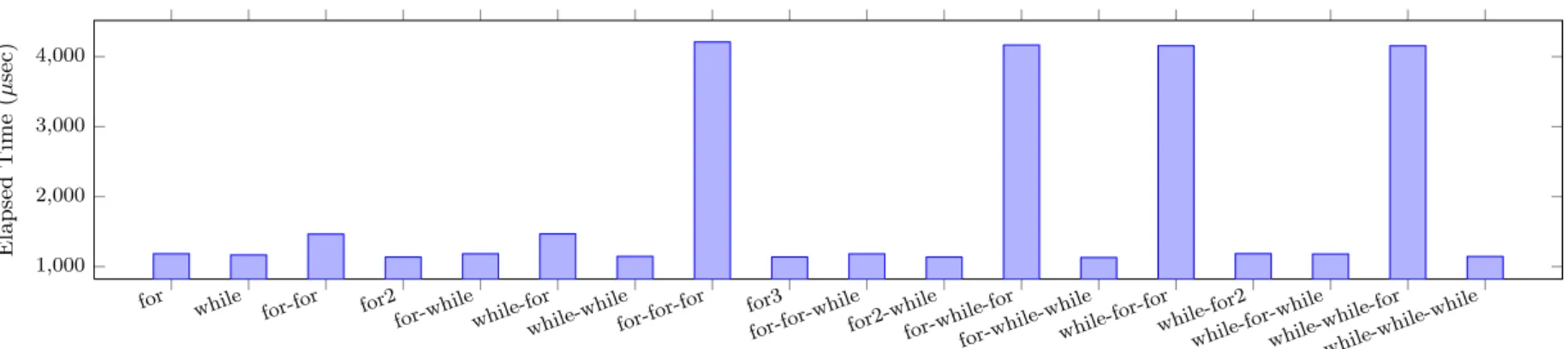
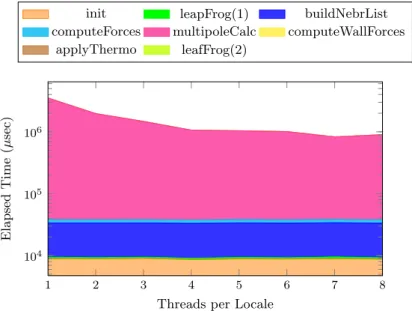
(6) Vol.2011-ARC-197 No.1 Vol.2011-HPC-132 No.1 2011/11/28. IPSJ SIG Technical Report. // OK // NG. 1. 60. Elapsed Time (sec). Figure 5 shows the elapsed time of conducing 106 times of accumulation by using different for/while constructions. Here, “for-for” stands for a nested iteration and “for2” stands for a zipper iteration. For a n-level nested loops, each level is iterated for 106/n times. It is clear that the overhead is non-trivial when for exists in inner loops. Following intermediate C code shows that a for loop in Chapel is translated into a while loop surrounded by a pair of domain constructor and destructor procedures which are also iterated by outer loops.. . C. . Chapel . 0.8. 40 0.6 0.4 20 0.2 0. .. 0 23. // Transformed C code of the for loop chpl__buildDomainExpr2(&loop_domain, ...); while (loop_domain) { ... } chpl__autoDestroy2(loop_variable, ...);. Speedup. for (i, j) in [1..I, 1..J] do { ... } for (i, j) in [1..I, 1..I-1] do { ... }. 43. 63. 83. 103. 163. Number of Molecules Fig. 6. Thus, there are three ways to overcome this problem by preventing compiler from inserting the domain construction procedures. • Define an iterator by using iter function8) , which preserves the semantics of data parallelism in the forall loop⋆1 . • Use the while statement for inner loop, if the inner loop does not need to be executed in parallel. • Use zipper iteration, if inner loop is independent of outer loop. 4.5 Molecular Dynamics Applications 4.5.1 Serial Execution Performance Figure 6 shows the performance of the serial version of FMM. Similar as evaluation results in previous sections, a Chapel program generally achieves about 50% of the performance of an identical C program. Though not shown here, other simpler MD programs with fewer array reference can achieve about 60-70% performance of the C implementation. 4.5.2 Parallel Execution Performance To parallelize a serial program, parallel statements and synchronization are inserted. Figure 7 shows the performance breakdown of FMM phases by a. Performance of serial FMM. serial version and a parallelized version (but executed serially) FMM programs. For the most computation intensive part (i. e., multipoleCalc phase), the parallelization can introduces 5 times of overhead because lock is used in a heavy loop part. Figure 8 shows the scalability of parallel FMM for different number of threads and problem sizes. Figure 9 illustrates the scalability of each phase for N = 323 . For a small problem size (e. g., N = 83 ), the performance drops down when the number of threads exceed 4 because there are less calculations for long range interactions and the computation for short range is dominant. When there are more molecules, which suggests larger space, the performance scales up to 8 threads. However, the speedup only achieves 4 for 8 threads, this is because an lock existing in multipoleCalc phase leads to significant overhead. We are currently developing a new algorithm for this phase to remove the usage of lock. 4.6 Source Lines of Code Figure 10 shows the head-to-head comparison of Lines of Code (LOC) between serial programs of our Chapel and original C implementation. Using Chapel saves 20-40% effort to develop a program. Note that the parallel version of programs in Chapel only introduce a small fraction of additional code. For example, our. ⋆1 However, the parallel iterator is not available now. It will be supported in the future8) .. 6. c 2011 Information Processing Society of Japan ⃝.
(7) Vol.2011-ARC-197 No.1 Vol.2011-HPC-132 No.1 2011/11/28. Elapsed Time (µsec). IPSJ SIG Technical Report. 4,000. 3,000. 2,000. . .. 1,000. for. le. whi. for. for2 r-while ile-for e-while -for-for fo wh whil for. for-. . Serial .FMM . Parallelized . FMM. 106. . .. 4. 105 104. N =. 83 . N =. 323 .. N =. 163 N =. 643. 3. 2 103 102. 1. . nit. i. . Fig. 7. Performance comparison of traversing various nested loops. Speedup. Elapsed Time (µsec). Fig. 5. for3 r-while -while ile-for e-while -for-for ile-for2 r-while ile-for e-while h l le fo for2 for-wh r-whil wh le-fo hile-w ile-whi forwhi fo whi w wh. (1). ist. ces. alc. ces. mo. (2). . 1. C or er or rL og rog eb uteF ipole allF yTh afFr pF N l a t e d p l W l p l le i e u p m a m ut bu co mp co. 2. 3. 4. 5. 6. 7. 8. Threads per Locale Fig. 8. Scalability of parallelized FMM. Serial performance breakdown of serial FMM and parallelized FMM. 5. Related Work 5.1 Parallel Programming Languages Conventional parallel programming languages (and libraries) includes SPMD languages such as MPI18) , UPC19) , OpenMP20) , HPF21) , Cilk2) , TBB3) . Besides Chapel, there are two other high-level parallel programming languages. parallelized FMM program has only 3% more lines of code than the serial version, which demonstrates that expressive of describing parallelism by Chapel.. 7. c 2011 Information Processing Society of Japan ⃝.
(8) Vol.2011-ARC-197 No.1 Vol.2011-HPC-132 No.1 2011/11/28. IPSJ SIG Technical Report. . . leapFrog(1) . . multipoleCalc . leafFrog(2). . buildNebrList . computeWallForces. 1. 1,000. . C. . Chapel . 0.8. 800. 106. 0.6 600 0.4 400 0.2 200. 105. . .. Propotion (Chapel:C). . . init . . computeForces . . applyThermo. Lines of Code. Elapsed Time (µsec). . . .. 0 allpairs2d veldist. Fig. 10. cellsub. nebrlist. fmm. Comparison of lines of code of serial MD programs. 104. . 1. 2. 3. 4. 5. 6. 7. 8. NAMD24) , Desmond25) , Tremole-X26) , etc.⋆1 While most of MD packages are written in C and Fortran, NAMD is implemented using Charm++27) . There are also parallel machines specifically designed for MD simulations, such as MDGRAPE28) and Anton29) . Different from general-purpose computers, they use specialized Application-Specific Integrated Circuits (ASICs) and network to perform computation, which can achieve speedup by several orders of magnitude than general-purpose machines. Other research projects, such as Folding@home30) and Docking@Home31) , harness the power of distributed computing resources (e. g., idle CPU of personal computers) to collaboratively perform simulations of protein folding and other molecular dynamics.. Threads per Locale Fig. 9. Parallel performance breakdown of parallelized FMM. that were also initiated by HPCS programme: Oracle’s Fortress6) and IBM’s X105) . Though these three languages share a common approach of using Partitioned Global Address Space (PGAS) model with multi-threading to adapt various parallel systems, they differ from each other in other aspects22) . For example, Chapel is an object-oriented programming language aiming for broader community. Fortress is designed to use mathematical syntax to benefit scientific computing users, and X10 targets Java programmers. . Though our implementation does use X10 and Fortress, a similar study of the programmability of HPCS languages conclude that they are also expressive for scientific problems7) . 5.2 Practices of Molecular Dynamics Simulations Prevalent MD simulations are conducted by software approaches on generalpurpose computers. Some of widely used software packages include CHARMM23) ,. 6. Conclusion and Future Work By implementing MD simulation programs in Chapel, we have studied the programmability and performance implication of using a high-level parallel language. Our experience show that Chapel has good expressiveness to describe ⋆1 Refer to http://en.wikipedia.org/wiki/Molecular_dynamics for a list of software for MD simulations.. 8. c 2011 Information Processing Society of Japan ⃝.
(9) Vol.2011-ARC-197 No.1 Vol.2011-HPC-132 No.1 2011/11/28. IPSJ SIG Technical Report. parallelism, which allows users to effectively write parallel program. Evaluation presents that Chapel has a reasonable performance for scientific applications. Since Chapel is still under development, users also need to be aware of the performance implications of various data and program structures to avoid potential performance overhead. Our major future work is to develop and optimize the FMM/KIFMM for various parallel architectures including clusters and supercomputers, as well as to investigate the possibility of adopting existing techniques32),33) within the Chapel framework. We also plan to extend current implementation to adapt GPGPUbased hybrid computing system, as suggested by recent effort of integrating GPU architecture by using user-defined distributions34) . Finally, the source code and documentation of this work is online available at http://mdoch.googlecode.com/. Acknowledgments This work is partially supported by JST, CREST through its research project: “Highly Productive, High Performance Application Frameworks for Post Petascale Computing.”. 9) Dongarra, J., Graybill, R., Harrod, W., Lucas, R. F., Lusk, E. L., Luszczek, P., McMahon, J., Snavely, A., Vetter, J.S., Yelick, K.A., Alam, S.R., Campbell, R.L., Carrington, L., Chen, T.-Y., Khalili, O., Meredith, J.S. and Tikir, M.M.: DARPAs HPCS Program: History, Models, Tools, Languages, Advances in Computers: High Performance Computing, Vol.72, pp.1–100 (2008). 10) Haile, J. M.: Molecular Dynamics Simulation: Elementary Methods, Wiley Professional, 1st edition (1997). 11) Rapaport, D. C.: The Art of Molecular Dynamics Simulation, Cambridge University Press, 2nd edition (2004). 12) Ewald, P. P.: Die Berechnung optischer und elektrostatischer Gitterpotentiale, Annalen der Physik, Vol.369, No.3, pp.253–287 (1921). 13) Greengard, L. and Rokhlin, V.: A Fast Algorithm for Particle Simulations, Journal of Computational Physics, Vol.73, pp.325–348 (1987). 14) Kurzak, J. and Pettitt, B. M.: Fast Multipole Method for Particle Dynamics, Molecular Simulation, Vol.32, No.10, pp.775–790 (2006). 15) Ying, L., Biros, G. and Zorin, D.: A Kernel-Independent Adaptive Fast Multipole Algorithm in Two and Three Dimensions, Journal of Computational Physics, Vol. 196, pp.591–626 (2004). 16) Lashuk, I., Chandramowlishwaran, A., Langston, H., Nguyen, T.-A., Sampath, R., Shringarpure, A., Vuduc, R., Ying, L., Zorin, D. and Biros, G.: A Massively Parallel Adaptive Fast-Multipole Method on Heterogeneous Architectures, Proc. of the Conference on High Performance Computing Networking, Storage and Analysis, SC ’09, New York, NY, USA, ACM, pp.58:1–58:12 (2009). 17) Ying, L., Biros, G., Zorin, D. and Langston, H.: A New Parallel KernelIndependent Fast Multipole Method, Proc. of the 2003 ACM/IEEE Conference on Supercomputing, SC ’03, New York, NY, USA, ACM, pp.14–30 (2003). 18) : MPI: Message Passing Interface, MPI Forum (online), available from ⟨http://www.mpi-forum.org/⟩ (accessed 2011-10-28). 19) : UPC: Unified Parallel C, UC Berkeley/LBNL (online), available from ⟨http://upc.lbl.gov/⟩ (accessed 2011-10-28). 20) : OpenMP, OpenMP Organization (online), available from ⟨http://openmp.org/⟩ (accessed 2011-10-28). 21) : High Performance Fortran, HPF Forum (online), available from ⟨http://hpff.rice.edu/⟩ (accessed 2011-10-28). 22) Weiland, M.: Chapel, Fortress and X10: Novel Languages for HPC, Technical report, HPCx Consortium (2007). 23) Brooks, B. R., III, C. L. B., Jr., A. D. M., Nilsson, L., Petrella, R. J., Roux, B., Won, Y., Archontis, G., Bartels, C., Boresch, S., Caflisch, A., Caves, L. S.D., Cui, Q., Dinner, A.R., Feig, M., Fischer, S., Gao, J., Hodoscek, M., Im, W., Kuczera, K., Lazaridis, T., Ma, J., Ovchinnikov, V., Paci, E., Pastor, R.W., Post, C.B., Pu, J.Z., Schaefer, M., Tidor, B., Venable, R.M., III, H. L.W., Wu, X., Yang, W., York,. References 1) Chamberlain, B. L., Callahan, D. and Zima, H. P.: Parallel Programmability and the Chapel Language, International Journal of High Performance Computing Applications, Vol.21, pp.291–312 (2007). 2) : The Cilk Project, MIT CSAIL Supertech Research Group (online), available from ⟨http://supertech.csail.mit.edu/cilk/⟩ (accessed 2011-10-28). 3) : Intel Threading Building Blocks, Intel Corporation (online), available from ⟨http://software.intel.com/en-us/articles/intel-tbb/⟩ (accessed 2011-10-28). 4) Inc, C.: Chapel Programming Language, Cray. Inc (online), available from ⟨http://chapel.cray.com/⟩ (accessed 2011-10-28). 5) IBM: X10 Programming Language, IBM (online), available from ⟨http://x10-lang.org/⟩ (accessed 2011-10-28). 6) Oracle: Fortress Programming Language, Fortress (online), available from ⟨http://projectfortress.java.net/⟩ (accessed 2011-10-28). 7) Shet, A.G., Elwasif, W.R., Harrison, R.J. and Bernholdt, D.E.: Programmability of the HPCS Languages: A Case Study with a Quantum Chemistry Kernel, Proc. of IEEE International Symposium on Parallel and Distributed Processing, IPDPS ’08, Miami, Florida, pp.1–8 (2008). 8) Cray Inc.: Chapel Language Specification v0.8 (2011).. 9. c 2011 Information Processing Society of Japan ⃝.
(10) Vol.2011-ARC-197 No.1 Vol.2011-HPC-132 No.1 2011/11/28. IPSJ SIG Technical Report. D.M. and Karplus, M.: CHARMM: the biomolecular simulation program, Journal of Computational Chemistry, Vol.30, No.10, pp.1545–1614 (2009). 24) Phillips, J. C., Braun, R., Wang, W., Gumbart, J., Tajkhorshid, E., Villa, E., Chipot, C., Skeel, R.D., Kal´e, L.V. and Schulten, K.: Scalable Molecular Dynamics with NAMD., Journal of Computational Chemistry, pp.1781–1802 (2005). 25) Bowers, K.J., Chow, E., Xu, H., Dror, R.O., Eastwood, M.P., Gregersen, B.A., Klepeis, J.L., Kolossvry, I., Moraes, M.A., Sacerdoti, F.D., Salmon, J.K., Shan, Y., and Shaw, D.E.: Scalable Algorithms for Molecular Dynamics Simulations on Commodity Clusters, Proc. of the ACM/IEEE Conference on Supercomputing, SC ’06 (2006). 26) : Tremole-X, Institute for Numerical Simulation, the University of Bonn (online), available from ⟨http://www.tremolo-x.com/⟩ (accessed 2011-10-28). 27) : Charm++ Parallel Languages, Parallel Programming Laboratory, University of Illinois (online), available from ⟨http://charm.cs.uiuc.edu/research/charm/⟩ (accessed 2011-10-28). 28) Narumi, T., Kawai, A. and Koishi, T.: An 8.61 Tflop/s Molecular Dynamics Simulation for NaCl with a Special-Purpose Computer: MDM, Proc. of the 2001 ACM/IEEE Conference on Supercomputing, SC ’01 (2001). 29) Shaw, D.E., Dror, R.O., Salmon, J.K., Grossman, J.P., Mackenzie, K.M., Bank, J.A., Young, C., Deneroff, M.M., Batson, B., Bowers, K.J., Chow, E., Eastwood, M.P., Ierardi, D.J., Klepeis, J.L., Kuskin, J.S., Larson, R.H., Lindorff-Larsen, K., Maragakis, P., Moraes, M. A., Piana, S., Shan, Y. and Towles, B.: Millisecondscale molecular dynamics simulations on Anton, Proc. of the Conference on High Performance Computing Networking, Storage and Analysis, SC ’09, pp.39:1–39:11 (2009). 30) : Folding@home Project, Pande Lab Stanford University (online), available from ⟨http://folding.stanford.edu/⟩ (accessed 2011-10-28). 31) : Docking@Home Project, University of Delaware (online), available from ⟨http://http://docking.cis.udel.edu/⟩ (accessed 2011-10-28). 32) Kurzak, J. and Pettitt, B. M.: Massively Parallel Implementation of a Fast Multipole Method for Distributed Memory Machines, Journal of Parallel and Distributed Computing, Vol.65, pp.870–881 (2005). 33) Chandramowlishwaran, A., Williams, S., Oliker, L., Lashuk, I., Biros, G., Vuduc, R. and Bernholdt, E.: Optimizing and Tuning the Fast Multipole Method for Stateof-the-Art Multicore Architectures, Proc. of IEEE International Symposium on Parallel and Distributed Processing, IPDPS ’10, Atlanta, Georgia, pp.1–12 (2010). 34) Sidelnik, A., Chamberlain, B.L., Garzaran, M.J. and Padua, D.: Using the High Productivity Language Chapel to Target GPGPU Architectures, Technical report, University of Illinois (2011).. 10. c 2011 Information Processing Society of Japan ⃝.
(11)
図


+2
関連したドキュメント
Standard domino tableaux have already been considered by many authors [33], [6], [34], [8], [1], but, to the best of our knowledge, the expression of the
mathematical modelling, viscous flow, Czochralski method, single crystal growth, weak solution, operator equation, existence theorem, weighted So- bolev spaces, Rothe method..
An example of a database state in the lextensive category of finite sets, for the EA sketch of our school data specification is provided by any database which models the
Nevertheless, when the turbulence is dominated by large and coherent structures, typically strongly correlated, the ergodic hypothesis cannot be assumed and only a probability
Comparison of the work (number of floating-point operations) required of the multilevel evaluation method for Example 6.4 with fast coarse level summation.. We presented a fast
In light of his work extending Watson’s proof [85] of Ramanujan’s fifth order mock theta function identities [4] [5] [6], George eventually considered q- Appell series... I found
In this work, we present a new model of thermo-electro-viscoelasticity, we prove the existence and uniqueness of the solution of contact problem with Tresca’s friction law by
This paper improves 3D spatial grid partition algorithm to increase speed of neighboring particles searching, and we also propose a real-time interactive algorithm on particle
