第 巻 第 号 抜 刷
年 月 発 行
Structural change and the profit rate dynamics
in Japan and the United States
Structural change and the profit rate dynamics
in Japan and the United States
Norihito Shimano
.Introduction
The profit rate dynamics has a great effect on capital accumulation. The trend of the rate of capital accumulation is determined by the movement of the profit rate in many cases. For this reason, the profit rate dynamics and determinants of the profit rate have an important meaning in relation to capital accumulation.
The profit rate dynamics is affected by several factors. We can demonstrate what factors have influenced the dynamics by factor decomposition of the profit rate. There are several ways to decompose the profit rate. Among them, the decomposition of the profit rate with a focus on structural change is particularly interesting in the sense that it can illustrate how changes of the scale of industries affect the profit rate when the components of the profit rate significantly differ among industries.
As studies that investigate the effect of structural change on the profit rate, Wolff( )and Vaona( )are representative ones. Focusing on income distribution and technical change, they decompose the profit rate into the profit-wage ratio and the organic composition of capital and show how structural change has affected the profit rate dynamics through its effect on these variables.
Although their flamework to decompose the profit rate is useful, few studies have investigated the effect of structural change on the profit rate in countries by
applying the method. To fill this gap, this study shows how structural change has affected the profit rate dynamics in Japan and the United States by the decomposition of the profit rate. This enables us to evaluate whether structural change has contributed to sustain the profit rate in both countries.
This study offers several contributions to the existing literatures. First, this study is the first attempt to conduct a complete decomposition of the profit rate for Japan and the United states, which reveals how structural change, changes of the scale of industries, has affected the profit rate dynamics through its effect on both income distribution and technical change.
Although Wolff( )investigates the effect of structural change on the profit rate in the United States, he only considers how structural change affects technical change and does not consider its effect on income distribution. Similarly, the study that defines structural change as changes of the scale of industries and demonstrates the effect of structural change on the profit rate in Japan by focusing on both income distribution and technical change does not exist yet.
Second, this study clearly shows that the influence of structural change on the profit rate can differ among countries. This study reveals while structural change has significantly affected the profit rate in the United States, its effect on the profit rate in Japan has been weak. Unlike Vaona( )that finds the always significant effect of structural change on the profit rate in Denmark, Finland, and Italy, this study shows that the effect of structural change on the profit rate dynamics can vary among countries when the economies of countries have different features.
The remainder of this paper is organized as follows. Section demonstrates the basic method to decompose the profit rate in this study. Section shows the profit rate dynamics in the Japanese economy and the influence of structural change on the profit rate in Japan. Section shows the profit rate dynamics in the US
economy and reveals how structural change has affected the profit rate dynamics in the US. Section concludes.
. The method of the decomposition of the profit rate
As a study that demonstrates the effect of structural change on the profit rate dynamics, Wolff( )is a first attempt to show how structural change affects a trend of the profit rate through its effect on the organic composition of capital. The basic idea of Wolff( )is that when vales of the organic composition of capital differ significantly among industries, changes of the scale of industries have an important influence on the organic composition of capital in aggregate term. Wolff ( )considers that when the organic composition of capital in aggregate term is greatly affected by this kind of structural change, the profit rate dynamics is also heavily influenced because the profit rate is calculated by dividing the profit-wage ratio by the organic composition of capital.
In mathematical formulas, the idea of Wolff( )is expressed as follows. At first, the profit rate(r)is decomposed by the profit-wage ratio(ε)and the organic composition of capital(θ).
%" "&#!$&# """
!
# ⑴
whereπ is the profits, w is the wage rate, n is the number of persons engaged in production, $"is the capital price deflator, and k is the real capital stock. ε is
"
&#, andθ is $&#"".
Furthermore, the organic of composition capital θ is decomposed into several factors. If the number of persons engaged in production in a industry j is #!and the volume of the real capital stock in the industry j is "!, a value of the organic composition of capital in the industry j, #!, is $""!
&#!. (Here, the wage rate and the capital price deflator are assumed to be equivalent among industries.) On the other
hand, if the ratio of the number of workers in the industry j to the number of workers in a total economy is'#, '#is %#
%. Then, "%&$$# )%#%& $$! )%!$% ! %"&$$ " )%"$% " %"$$$ Therefore, "%! '#"#!( j = , , , $$$) ⑵ Here, if *%!", a change of y from a time point (%!to a time point (%" is written as *(%"!*(%!%!#&"(%"!"(%!'""#&!(%"!!(%!'. (!# expresses the average value of a in a time point(%!and a in a time point (%". Namely, !#is the average value of!(%!and!(%".)
Using this expression, the rate of change of the organic composition of capital from a time point(%!to a time point (%"is written as
""!"! "! %!# '##&""#!"!#' !#'!#"!# "!# "##&'"#!'!#' !#'!#"!# ⑶
The meaning of the equation ⑶ is that the rate of change of the organic composition of capital in aggregate term can be decomposed into the sum of the change in the organic composition of capital in each industry and the sum of the change in the ratio of the number of workers in a industry to the number of workers in a total economy. The sum of the change in the organic composition of capital in each industry is expressed in the first term of the right side of the equation ⑶, and the sum of the change in the ratio of the number of workers in a industry to the number of workers in a total economy is captured by the second term.
What the equation ⑶ shows is that the rate of change of the organic composition of capital is not only affected by the change in the organic composition of capital in each industry, but it is also affected by labor mobility among industries. When a trend that workers move from industries where the organic composition of capital takes a low value to industries where it takes a high value becomes dominant in an economy, the organic composition of capital will increase through the rise in
the second term of the right hand of the equation ⑶. This route is what Wolff ( )considers as a prominent factor that structural change affects the organic composition of capital in aggregate term. In this case, the profit rate declines as the organic composition of capital increases, and vice versa.
The method Wolff( )takes is an effective way to estimate how structural change influences the profit rate dynamics through its effect on the organic composition of capital and is extremely useful. However, since Wolff( ) assumes that the profit-wage ratio does not vary significantly among industries, it does not consider the possibility that structural change also affects the profit rate through its effect on income distribution.
Vaona( )is a first study which notices the possibility. Vaona( ) considers that the profit-wage ratio does not necessarily take a similar value among industries, and changes of the scale of industries can affect the profit-wage ratio in aggregate term if the profit-wage ratio varies significantly among industries. Namely, Vaona( )regards that a change in income distribution induced by structural change can be another important factor to determine the profit rate.
The effect of structural change on income distribution that Vaona( ) formalizes is as follows.
At first, the profit-wage ratio, ε, is expressed as !" "#!""#!!!$$
where"$is the price deflator for value added and y is real value added. Then, the rate of change of the profit-wage ratio is expressed as
!"!!! !! $ $( & ! " " ( # ! " "! $ ( & ! " ! ( # ! " ! $( & ! " ! ( # ! " !!! $ $( & ! "#! "#( "! (! "# ! ! " $( & ! " ! ( # ! " !!! " ( # ! "#! "$&( "! $ ( & ! " ! ! " $( & ! " ! ( # ! " !!! ⑷
('%shows a value of x in a time point t.)
The equation⑷ shows that the rate of change of the profit-wage ratio can be decomposed into a change in labor productivity (
#
! "and a change in the relative price $( & ! ". In addition to this, !$ " &#$ #!" ! #!&!#!$#! &!#! &#&"!#!! ⑸ Here, "!
&!#!is the profit-wage ratio in a industry j, and & !#!
&# is the ratio of the wage bill in a industry j to the wage bill in the total economy. If we express "!
&!#! and &!#!
&# as !!and "!respectively, the profit-wage ratio in the total economy is indicated as
!$#!"!!! ⑹
From the equation ⑹, the rate of change of the profit-wage ratio can be decomposed as !"!!! !! $#! "!#%!"!!!!!& #!"!!!!! "#! !!#%""!!"!!& #!"!!!!! ⑺
The first term of the right side of the equation⑺ captures a contribution of a change in the profit-wage ratio in each industry, and the second term captures a contribution of a change in the ratio of the wage bill in a industry to the wage bill in the total economy. The second term shows the effect of structural change on
income distribution. If the ratio of the wage bill in a industry to the wage bill in the total economy increases in industries where the profit-wage ratio is high and it decreases where the profit-wage ratio is low, the profit-wage ratio in the total economy will rise through the increase in the second term of the right side of the equation⑺, and vice versa.
Similarly, the rate of change of the organic composition of capital can also be decomposed as #"!#! #! %%! "!#&#"!!#!!' %!"!!#!! "%! #!#&""!!"!!' %!"!!#!! ⑻
Considering that "!%&!#!
&# %&&$!##!, when && %&! ! and #!
# %%!, we can decompose the rate of change of"!as
""!!"!! "!! %&
"!#"!!&"#"!&!!#!!!&!#! &!!#!!!&!#! %&"!%"!!&!!%!!
&!!%!! %
%!#&&"!!&!!' &!!%!! "
&!#&%"!!%!!'
&!!%!! ⑼
The equation⑼ shows that the ratio of the wage bill in a industry j to the wage bill in the total economy can be decomposed into a change in the ratio of the number of workers in a industry j to the number of workers in a total economy and a change in the ratio of wage rate in a industry j to wage rate in the total economy.
Inserting the equation⑷ and ⑼ into the equation ⑺ , the rate of change of the profit-wage ratio can be written as
""!"! "! %%! "!#&""!!"!!' %!"!!"!! "%! "!#&""!!"!!' %!"!!"!! %%! "! #"!! %!"!!"!! $' & ! "!# ' # ! " "!! '! "#!! # $ $' & ! " !! ' # ! " !!!! " ' # ! "!# $' & ! " "!! $ ' & ! " !! # $ $' & ! " !! ' # ! " !!!! & ' "%! "! #"!! %!"!!"!! &!#&%"!!%!!' &!!%!! "
%!#&&"!!&!!'
&!!%!!
Similarly, inserting the equation⑼ into the equation ⑻ , the rate of change of the organic composition of capital can be written as
%"!%! %! %-! "!#&%"!!%!!' -!"!!%!! "-! %!#&""!!"!!' -!"!!%!! %-!"! #% "!!%!! & ' -!"!!%!! "-! %!#"!! -!"!!%!!
'!#&&"!!&!!' '!!&!! " &!#&'"!!'!!' '!!&!! # $ ⑾ When#% ! %, since%% $'#$$'#""% "
%%"#, we can write the rate of change of the profit rate r as
%"!%! %! %# #&""!"!' #!"! "" #&#"!#!' #!"! %# #&""!"!' #!"! "" # "! !!%" & '" !!& '%! !!%! %##&""!"!' #!"! "" # "! !% ! %" ! " %"!%! %! ! " ⑿
Inserting the equation⑽ and ⑾ into the equation ⑿, the rate of change of the profit rate can be finally expressed as
%"!%! %! %# #" "!"! & ' #!"! "" # "! !% ! %" ! " %"!%! %! ! " %### !-! "!#"!! -!"!!"!! $( ' ! "!# ( # ! " "!! (! "#!! # $ $( ' ! " !! ( # ! " !!!! " ( # ! "!# $( ' ! " "!! $ ( ' ! " !! # $ $( ' ! " !! ( # ! " !!!! . / ' + + + + + ) "-! "! #" !! -!"!!"!!
'!#&&"!!&!!'
'!!&!! " &!#&'"!!'!!' '!!&!! # $ ( , , , , , * """# ! !% ! %" ! "-!"! #% "!!%!! & ' -!"!!%!! "-! %!#"!! -!"!!%!!
'!#&&"!!&!!'
'!!&!! "
&!#&'"!!'!!'
'!!&!!
# $
% & ⒀
The equation⒀ is the basic framework in this study to decompose the profit rate focusing on structural change. What this equation demonstrates is that the profit rate dynamics are affected by the following factors. In the effect of a change
in the profit-wage ratio on the profit rate, the profit rate is influenced by a change in labor productivity in each industry, a change in the relative price in each industry, a change in the ratio of the number of workers in a industry to the number of workers in the total economy, and a change in the ratio of the wage rate in a industry to the wage rate in the total economy.
In the effect of a change in the organic composition of capital on the profit rate, the profit rate is influenced by a change in the organic composition of capital in each industry, a change in the share of the number of workers in a industry, and a change in the relative ratio of the wage rate in a industry. Using the equation ⒀, we demonstrate the effect of structural change on the profit rate dynamics in Japan and the United States.
. Structural change and the profit rate dynamics in Japan
In this section, we analyze how structural change has affected the profit rate in the Japanese economy over the period from to . The subject of the analysis is non-financial corporations(NFCs)in Japan. Data used for the analysis are drawn fromCorporation Statistics published by Ministry of Finance and Annual Report on National Accounts published by Cabinet Office.The analysis concerns the following twenty industries : food products : textiles : pulp, paper, and paper products : chemicals and chemical products : ceramics and soil and stone products : iron and steel : non-ferrous metals : metal products : general machinery : electrical machinery : transport equipment : other manu-facturing : agriculture, forestry, and fishing : mining : construction : electricity, gas, and water supply : transport and communication : wholesale trade and retail trade : real estate : services.
Figure : The profit rate in Japan from to ‐ . The profit rate dynamics in Japan
We first show trends of the profit rate, the profit-wage ratio, and the organic composition of capital from to . Figure shows the trend of the profit rate in Japanese NFCs in the period).
As shown in Figure , the profit rate in Japanese NFCs had the rising trend before , and it reached .% in . After that, it showed the declining trend, but it began to recover from the early s. The profit rate in Japanese NFCs temporarily dropped to .% in which was the lowest value in the analysis period, but it recovered to .% in .
Furthermore, Figure shows a trend of the profit-wage ratio and Figure shows a trend of the organic composition of capital from to .
Figure shows that the profit-wage ratio in Japanese NFCs had the almost
)Throughout this paper, the profit rate designates the net profit rate which is the ratio of net profit to net capital stock. Detailed definitions of the variables used to decompose the profit rate in Japan are provided in the appendix. As for data source, only the GDP deflator is obtained fromAnnual Report on National Accounts. Except for the GDP deflator, all other variables used to decompose the profit rate in Japan are obtained fromCorporation Statistics.
consistent declining trend from to . It declined from .% in to .% in . However, it showed the rising trend from the early s, and it recovered to .% in . In addition, Figure shows that the organic composition of capital in Japanese NFCs had the consistent declining trend from to , and after that, it turned to the rising trend before in the early s. It declined from . in to . in , but it increased to . in .
Figure : The profit-wage ratio in Japan from to
Figure : The organic composition of capital in Japan from to
After , the organic composition of capital showed the slightly declining trend, and it declined to . in .
Focusing on the trends of the profit-wage ratio and the organic composition of capital, we first decompose the profit rate in Japanese NFCs into these variables by using the equation ⑿. In the decomposition, the analysis period is divided into five periods. Except , years which separate each time period are at the peak of business cycle. Table shows the result of the decomposition.
Table shows that the rate of change of the profit rate was positive from to and from to , but it was negative in each time period over to . From to , the effect of a change in the profit-wage ratio on the profit rate was always negative in each time period. The negative effect of the profit-wage ratio was offset by the declining organic composition of capital from to . The profit rate of Japanese NFCs rose by .% from to , and it declined by only .% from to due to the declining organic composition of capital.
On the other hand, however, the rising organic composition of capital from to contributed to the great decline of the profit rate together with the declining profit-wage ratio. As a result, the profit rate declined by .% from to , and it declined by .% from to . Finally, the profit rate rose by .% from to , and this was mainly led by the great increase in the profit-wage ratio in the same period.
− − − − −
The rate of change of the profit rate .% − .% − .% − .% .% Change in the profit-wage ratio − .% − .% − .% − .% .% Change in the organic composition of capital .% .% − .% − .% .% Table : The result of the decomposition of the profit rate in Japan based on the equation ⑿
‐ . The effect of structural change on the profit rate in Japan
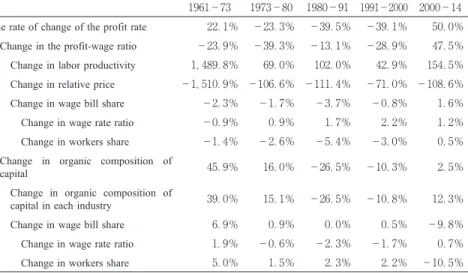
Next, we illustrate how structural change has affected the profit rate in the Japanese economy by using the equation ⒀. Table shows the result of decomposition of the profit rate of Japanese NFCs that is based on the equation⒀.
Table shows that the effect of structural change on the profit rate in Japan has been relatively weak. Structural change has hardly affected the profit-wage ratio over the analysis period. Change in the profit-wage ratio in each time period is almost affected by the change in labor productivity and the relative price in each industry.
On the other hand, change in the organic composition of capital is sometimes affected by structural change. From to , a contribution of the declining organic composition of capital to the profit rate was .%, and .% of the contribution was brought about by structural change. Labor mobility from industries with high organic composition of capital to industries with low organic
− − − − −
The rate of change of the profit rate .% − .% − .% − .% .% Change in the profit-wage ratio − .% − .% − .% − .% .% Change in labor productivity , .% .% .% .% .% Change in relative price − , .% − .% − .% − .% − .% Change in wage bill share − .% − .% − .% − .% .% Change in wage rate ratio − .% .% .% .% .% Change in workers share − .% − .% − .% − .% .% Change in organic composition of
capital .% .% − .% − .% .%
Change in organic composition of
capital in each industry .% .% − .% − .% .% Change in wage bill share .% .% .% .% − .% Change in wage rate ratio .% − .% − .% − .% .% Change in workers share .% .% .% .% − .%
composition of capital decreased the organic composition of capital in aggregate term, and it contributed to the rising profit rate in this period.
In addition, a contribution of the declining organic composition of capital to the profit rate was only .% from to , and this is because a contribution of change in the organic composition of capital in each industry was largely offset by a change in the wage bill share in the industries. In this case, negative structural change inhibited the rise in profit rate by offsetting the decrease in organic composition of capital in each industry. A clear feature of structural change in Japan was that changes in the wage bill share #!"!
#"
! "are almost led by changes in the workers share "!
" ! ".
But except for the two time period, the influence of structural change on the organic composition of capital is negligible. After all, it can be said that structural change has played only a minor role in the profit rate dynamics in Japan.
. Structural change and the profit rate dynamics in the United States
This section further reveals the influence of structural change on the profit rate dynamics in the United States from to . Thus far, various studies have examined the determinants of the profit rate in the United States. Wolff( ,, ), Moseley ( ), Henley ( ), Michi ( ), Mohun ( ,
), Bakir and Campbell ( , ), Izquierdo ( ), and Basu and Vasudevan( )are the main studies which focus on the profit rate dynamics in the United States. However, few attempts have been made to show how structural change has affected the profit rate dynamics in the United States. Wolff( ) explicitly demonstrates it. But Wolff( )only considers the effect of structural change on the organic composition of capital.
Since Wolff( )considers that values of the profit-wage ratio do not differ significantly among industries, it does not regard how structural change has affected
the profit rate through its effect on income distribution. To fill this gap, this section comprehensively reveals the relationship between structural change and the profit rate in the United States by focusing on its effect on both income distribution and technical change.
‐ . The profit rate dynamics in the United States
Before we show a trend of the profit rate in the United States, we need to remark data we use. The data are from NIPA tables and Fixed Assets Accounts Tables that the Bureau of Economic Analysis publishes. It is important that in NIPA tables and Fixed Assets Accounts Tables, industrial compositions change in the middle of time series. This is because estimates in the tables were based on SIC in the past, but they have been based on NAICS in recent years. Considering the situation, we construct time series data from to depending on SIC-based data of these tables and data from to depending on NAICS-based data.
In addition, since we deal with the private sector of the US economy which also includes non-corporate sector, we correct profits for the income for the self-employed. We define net profit as the sum of corporate profits after tax, inventory valuation adjustment for corporations, the profit portion of proprietor’s income, and net interest). This concept of net profit is similar to Wolff( )and Brennan
( ).
With these procedures, we calculate each variable. Figure shows the profit rate in the United States from to and from to ).
)The profit portion of proprietor’s income is calculated as follows. First, we define net national income as the sum of net profit and compensation of employees. Then we subtract proprietor’s income from net national income. We calculate the ratio of net profit to the net national income from which proprietor’s income is deducted. By multiplying this ratio by proprietor’s income, we obtain the profit portion of proprietor’s income.
Figure shows that the profit rate in the US had the decreasing trend from to the mid s, but it turned to the rising trend from the mid- s to . The profit rate in the US was .% in , and it declined to .% in . Then it began to recover and reached .% in . From to , it did not show a particular trend.
Next, we show trends the profit-wage ratio and the organic composition of capital in the United States. Figure shows the profit-wage ratio and Figure shows the organic composition of capital in the analysis period.
Figure shows that the profit-wage ratio squeezed in the late s. In , it dropped to .%, which was the lowest value over the entire period. After , it showed the increasing trend and reached to .% in . After , the profit-wage ratio showed the slightly decreasing trend until . From to
, it had the increasing trend.
Figure shows that the organic composition of capital first had the increasing trend from to the early s It increased from . in to . in . )Detailed definitions of the variables used to decompose the profit rate in the US are provided in the appendix.
Then, it decreased throughout s and s. In , it dropped to . . After , the organic composition of capital increased again.
Table shows the result of the decomposition of the profit rate in the US which bases on the equation ⑿. Years used to separate time periods are slightly below the peak of business cycle. This selection is the same as Wolff( ).
As shown in Table , the profit rate in the US changed very little in the first Figure : The profit-wage ratio in the United States from
to
Figure : The organic composition of capital in the United States from to
time period. It declined by only .% from to . This was because the rise in profit-wage ratio was offset by the increase in the organic composition of capital. In the second time period, the profit rate increased by .% from to , which was largely led by the decline in the organic composition of capital. In the next period, the profit rate continued to rise. It increased by .% from to , which was the result of an endurance of the decline in organic composition of capital. In the last period, the profit rate declined by .% because the organic composition of capital increased again in this period, and the trend erased the positive effect of the rising profit-wage ratio.
‐ . The effect of structural change on the profit rate in the United States Next, we demonstrate how structural change has affected the profit rate dynamics in the US. The analysis concerns the following industries from to : agriculture, forestry, and fishing : mining : construction : durable manufac-turing : non- durable manufacmanufac-turing : transportation : communication : electric, gas, and sanitary services : wholesale trade : retail trade : finance, insurance and real estate : services. From to , the following industries are concerned : agriculture, forestry, fishing, and hunting : mining : utilities : construction : durable manufacturing : non-durable manufacturing : wholesale trade : retail trade : trans-portation and warehousing : information : finance and insurance and real estate and rental and leasing : services.
− − − −
The rate of change of the profit rate − .% .% .% − .%
Change in the profit-wage ratio .% − .% − .% .%
Change in the organic composition of capital − .% .% .% − .% Table : The result of the decomposition of the profit rate in the US based on the
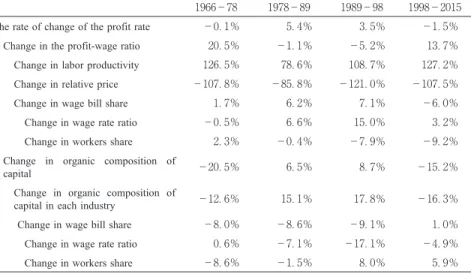
Table shows the result of the decomposition of the profit rate based on the equation⒀.
From Table , it is shown that from to , structural change caused by labor mobility among industries rose the organic composition of capital, and this depressed the profit rate. From to , changes in the wage bill ratio among industries helped to increase the profit-wage ratio, but it also made the organic composition of capital rise. In this sense, structural change in this period had the opposite effects on the profit rate dynamics. This tendency also held during the period from to . From to , changes in the wage bill share among industries had a negative effect on the profit-wage ratio. In this period, the negative effect of structural change on the profit rate dominated.
In the United States, structural change has had a significant effect on both the profit-wage ratio and the organic composition of capital. Sometimes its effect on
− − − −
The rate of change of the profit rate − .% .% .% − .% Change in the profit-wage ratio .% − .% − .% .% Change in labor productivity .% .% .% .% Change in relative price − .% − .% − .% − .% Change in wage bill share .% .% .% − .% Change in wage rate ratio − .% .% .% .% Change in workers share .% − .% − .% − .% Change in organic composition of
capital − .% .% .% − .%
Change in organic composition of
capital in each industry − .% .% .% − .% Change in wage bill share − .% − .% − .% .% Change in wage rate ratio .% − .% − .% − .% Change in workers share − .% − .% .% .%
Table : The result of the decomposition of the profit rate in the US based on the equation ⒀
income distribution influences the profit rate dynamics. Especially, a change in the wage bill share #!"!
#"
! "in finance, insurance and real estate industries had a great effect on the profit-wage ratio in aggregate term since the profit-wage ratio tend to be very large in the industry. This result is consistent with the claim of Panico and Pinto( )that increasing scale of financial industry in the era of financialization has a great influence on income distribution.
In addition, the organic composition in finance, insurance and real estate industries is also very large because the real estate industry especially has a large amount of the capital stock). Therefore, a change in the wage bill ratio in the industries also significantly affects the organic composition of capital in the total economy. The extraordinary values of the profit-wage ratio and the organic composition of capital in finance, insurance and real estate industries and a change in the wage bill ratio in the industries that frequently occurs make the effect of structural change on the profit rate in the US important).
In the US, changes in the wage bill share #!"! #"
! " among industries are sometimes largely influenced by the ratio of the wage rate in a industry to the wage rate in total economy #!
#
! ". These are the features of structural change in the US. Considering these results, we can conclude that structural change has significantly affected the profit rate dynamics in the US through its effect on both the profit wage ratio and the organic composition of capital and that the influence of structural change on the profit rate is much deeper in the US than in Japan.
)In the US, the average of the profit-wage ratio was . in finance, insurance and real estate industries and was . in all industries from to and the average of the ratio was
. in finance, insurance and real estate industries and was . in all industries from to . Furthermore, the average of the organic composition of capital in the US was . in finance, insurance and real estate industries and was . in all industries from to and the average of the ratio was . in finance, insurance and real estate industries and was
. in all industries from to . These values show that finance, insurance and real estate industries are quite distinct from other industries in the US.
. Conclusion
This paper has examined how structural change has influenced the profit rate dynamics in Japan and the United States. The results of this study show that the influence of structural change on the profit rate differs between Japan and the United States. In Japan, structural change has had a relatively weak effect on the profit rate dynamics. On the other hand, in the US, structural change has significantly affected the profit rate dynamics through its effect on both the profit-wage ratio and organic composition of capital.
In the study, we have confirmed that in the United States, structural change has also strongly affected income distribution and this has had an important effect of the profit rate, which Wolff( )overlooked. Furthermore, comparing the result of the effect of structural change on Japan and the US, we have revealed that structural change did not always significantly affect the profit rate in a country and the effect of structural change could differ among countries.
The result suggests that there is a difference between the Japanese economy and the US economy, which has produced the different effect of structural change on the
)The extraordinary values of the profit-wage ratio and the organic composition of capital also applies to the real estate industry in Japan. In Japan, from to , the average of the profit-wage ratio was . in the real estate industry and was . in all industries, and the average of the organic composition of capital was . in the real estate industry and was . in all industries. However, the influence of structural change on the profit rate is weak in Japan. This suggests that the weak influence of structural change in Japan is mainly attributable to the fact that a change in the wage bill share in the real estate industry in Japan is not so frequent. In fact, the dispersion of the wage bill share in finance, insurance and real estate industries in the US from to is much larger than the dispersion of the wage bill ratio in the real estate industry in Japan from to . The dispersion of the wage bill ratio in the industries in both countries get closer at last from to . The wage bill share
#!"! #"
! "in finance, insurance and real estate industries rose from . % in to . % in in the US. But the increase of the wage bill share in the real estate industry in Japan was small. It rose from . % in to . % in .
profit rate dynamics among the countries. In the US, the scale of finance, insurance and real estate industries in which both the profit-wage ratio and the organic composition of capital is very large continuously increased from the s to the s, which made the effect of structural change on the profit rate in the US significant. On the other hand, in Japan, the scale of the real estate industry which takes very high values of the profit wage ratio and the organic composition of capital did not so increase from the s to the mid- s, which was an important cause of the weak effect of structural change on the profit rate in Japan.
Acknowledgements
This work was supported by Research Grant from Matsuyama University in .
References
Bakir, E. and Campbell, A.( )“The Effects of Neoliberalism on the Fall in the Rate of Profit in Business Cycles”, Review of Radical Political Economics, Vol. , No. , pp. − . Bakir, E. and Campbell, A.( ) “The Bush Business Cycle Profit Rate : Support in a
Theoretical Debate and Implications for the Future”, Review of Radical Political Economics, Vol. , No. , pp. − .
Basu, D and Vasudevan, R( )“Technology, Distribution and the Rate of Profit in the US Economy : Understanding the Current Crisis”, Cambridge Journal of Economics, Vol. , No. , pp. − .
Brennan, D( )“‘Too Bright for Comfort’ : a Kaleckian View of Profit Realization in the USA, − ”, Cambridge Journal of Economics, Vol. , No. , pp. − .
Henley, A.( ) “Labor’s Share and Profitability Crisis in the US”, Cambridge Journal of Economics, Vol. , No. , pp. − .
Izquierdo, S.( )“The Cyclical Decline of the Profit Rate as the Cause of Crises in the United States( − )”, Review of Radical Political Economics, Vol. , No. , pp. − . Michi, T. R.( )“The two-stage Decline in U. S. Nonfinancial Corporate Profitability, −
”, Review of Radical Political Economics, Vol. , No. , pp. − .
Economics, Vol. , No. , pp. − .
Mohun, S( )“Aggregate Capital Productivity in the US Economy, − ”, Cambridge Journal of Economics, Vol. , No. , pp. − .
Moseley, F( )“The Rate of Surplus Value in the Postwar US Economy”, Cambridge Journal of Economics, Vol. , No. , pp. − .
Vaona, A.( )“Profit Rate Dynamics, Income Distribution, Structural and Technical Change in Denmark, Finland, Italy”, Structural Change and Economic Dynamics, Vol. , No. , pp. −
.
Wolff, E. N.( )“The Rate of Surplus Value, the Organic Composition, and the General Rate of Profit in the U. S. Economy, − ”, American Economic Review, Vol. , No. , pp.
− .
Wolff, E. N.( )“The Productivity Slowdown and the Fall in the U. S. Rate of Profit, −
”, Review of Radical Political Economics, Vol. , No. − , pp. − .
Wolff, E. N.( )“The recent rise of profits in the United States”, Review of Radical Political Economics, Vol. , No. , pp. − .
Wolff, E. N.( )“What’s Behind the Rise in Profitability in the US in the s and in the s ?” Cambridge Journal of Economics, Vol. , No. , pp. − .
Panico, C and Pinto, A( )Income Inequality and the Financial Industry, Metroeconomica, Vol. , No. , pp. − .
Appendix :
. Definitions of Variables used to decompose the profit rate in Japan
The profit rate is the ratio of net profit to net capital stock. Net profit is the operating profit. Net capital stock is tangible fixed assets.
The profit-wage ratio is the ratio of net profit to the total wage bill. The total wage bill consists of wages for employees, bonus for employees, compensation for officers, bonus for officers, and welfare expenses.
The organic composition of capital is the ratio of net capital stock to the total wage bill.
Labor productivity is the ratio of real value added to the number of workers. Real value added is obtained by dividing nominal value added by the GDP deflator. Nominal value added is the sum of net profit and the total wage bill. The number of workers is the sum of the number of employees and the number of officers.
The relative price is obtained by dividing the GDP deflator by the wage rate. The wage rate is obtained by dividing the total wage bill by the number of workers.
. Definitions of Variables used to decompose the profit rate in the US
The profit rate is the ratio of net profit to net capital stock. Net profit consists of corporate profits after tax, inventory valuation adjustment for corporations, the profit portion of proprietor’s income, and net interest. The definition of the profit portion of proprietor’s income is provided in the note . Net capital stock is Current-Cost Net Stock of Private Fixed Assets.
The profit-wage ratio is the ratio of net profit to the total wage bill. The total wage bill the sum of compensation of employees and the labor portion of proprietors’ income. The labor portion of proprietors’ income is obtained by subtracting the profit portion of proprietor’s income from proprietor’s income.
The organic composition of capital is the ratio of net capital stock to the total wage bill.
Labor productivity is the ratio of real value added to the number of workers. Real value added is obtained by dividing nominal value added by the GDP deflator. Nominal value added is the sum of net profit and the total wage bill. The number of workers is persons engaged in production.
The relative price is obtained by dividing the GDP deflator by the wage rate. The wage rate is obtained by dividing the total wage bill by the number of workers.