An Analysis of My Classroom Teaching Procedure in English Writing
— A Writing Course with Lots of Language Input —*
Hatsumi Kuni
yoshiABSTRACT
I would like to show my classroom teaching procedure with plenty of language input for an English Writing Course. With this teaching procedure, I tried to have the students study as much as possible. At the end of the course, they successfully developed some degree of productive ability;
in writing, as well as in speaking.
In this class, the sentence combining drill was adopted as the major activity, and the language input was given by actually letting them write and read aloud English sentences quite a lot. It had the successful effects on the students' English language ability. Students became able to pronounce English properly when they read the sentences aloud. Also , by writing English sentences in quantity, students' hands themselves got acquainted with the English writing system.
The effectiveness of this teaching procedure will also be considered by comparing the scores of the pretest and the post test, and by observing the answers to the questionnaire given at the end of the course.
This is an action research on teaching English writing.
KEYWORDS: sentence combining, writing, procedure, focus on forms
1. INTRODUCTION
There has been a controversy in teaching writing; between
traditional `Focus on Form Method' and recent `Process Approach.' Ann Raimes ' describes `Focus on Form Method' as a kind of language instruction which takes the form of sentence drills such as
1) fill-ins, 2) substitutions, 3) transformations, and 4) completions.
She describes that the instruction of English writing reinforced or tested the accurate application of grammatical rules. Especially in the 1970's, teacher focused on the use of sentence combining. As far as controlled composition tasks are concerned, they are still widely
used today (Raimes, 1991).
She also describes `Process Approach' as the method of teaching English writing which focuses on the writers' making of personal meaning which underlines an almost total obsession with the cognitive relationship between the writer and the writers' internal world. She also claims that this kind of obsession is quite inappropriate for academic demands and for the expectations of
academic readers (Raimes, 1991).
Tony Silva describes `Controlled Composition' as a way of learning as habit formation. He says that the use of language is the manipulation of fixed patterns which are learned by imitation. He claims that not until fixed patterns have been learned can originality occur in the manipulation of patterns or in the choice of variables within the patterns. He says that the writer is simply a manipulator of previously learned language structures. He states that the reader is an EFL teacher in the role of editor or proofreader, not especially interested in quantity of ideas or expression but primarily concerned
with formal linguistic features (Silva, 1990).
To me, process approach seems to be an advanced way of teaching English writing. Its process of making outlines, drafts, and revising seems to be the technique that regards the basic knowledge of the language as a requirement, which my students actually did not have at all at the moment. For process approach, students should
know; 1) how to construct sentences, 2) basic word knowledge, and
have 3) the experience of writing English letters (alphabets), which
An Analysis of My Classroom Teaching Procedure in English Writing 223
my students knew or had none of them. And for process approach, considerable length of sentences and paragraphs that are long enough to make outlines, drafts, and do revising seem to be required, which is quite impossible for my students to do. What process approach does is real writing, but there should be a foundation of language knowledge to experience such a course.
Controlled Composition and Focus on Forms seem to be on the basic or elementary level of learning English writing. Students don't need to know anything about writing in English. That means there is no need for basic knowledge of English writing which quite suits my students. Some students couldn't distinguish "d" from "b" in the beginning. For these approaches, sentences need not to be long.
Exercises such as sentence combining, fill-ins, substitutions, and transformations all consider much shorter sentences than process approach is aimed at. There is no consideration on paragraphs but only on sentence level which very much suits my students.
Controlled Composition and Focus on Forms are much easier to tackle with and are quite fit for my students, considering their present situation.
According to 1) the students level of language ability which is very low intermediate, 2) the course requirement which is aimed at students learning as many English expressions as possible, and in 3) a Japanese special language environment which is strictly grammar
oriented, I will take the traditional `Focus on Form Method' in this writing class.
I think what they lack is a lot of language input, and the experience of writing English, and speaking English. `Focus on Form Method' is a rather unnatural way to let the students have the language input. But they are not on the level of practicing `Process Approach' or `Content Based Approach.' They have to learn to utter English words by themselves first without anyone's help.
Natural or unnatural, this course is aimed at 1) letting the students
get language input as much as possible, 2) writing English as much as
possible, and 3) speaking out English language as much as possible.
Their motivation is quite low. Nevertheless, at the end of the course, the students' attitude has actually changed to the much better one.
This paper will explain fully about my classroom teaching procedure in English writing, using three work sheets per one class hour following the principles of SLA field such as INPUT HYPOTHESIS,
OUTPUT HYPOTHESIS, THE PUSHED OUTPUT
HYPOTHESIS, COMPREHENSIBLE INPUT, COMPRE-
HENSIBLE OUTPUT, and I+ 1.
2e SITUATION
The site is Nihon Junior College Prefecture, Japan, which is affiliated to
students are;
at Funabashi in Chiba Nihon University. The
1) science and technology majors.
2) very low intermediate level of English language.
3) all freshmen.
4) required to take this class.
5) having almost no ability of producing English language
(speaking and writing).
6) having a little ability of listening and reading English
language.
7) brought up entirely in the same private school organization,
so that they might not have learnt anything about English language.
8) having no English language environment around them except
for some music from overseas and foreign movies, etc., but very rare.
9) Almost all of the students are male students, and are, most of
the time, sons of rich shop-owners. They are heirs of the big shop-owners so that they will need English language ability in
An Analysis of My Classroom Teaching Procedure in English Writing 225
the future for their business purposes.
10) This class is a required course for the graduation of the
students.
11) Students will have to strengthen their English writing skill
especially.
12) Students have to have lots of time for speaking out English
language as a reward for their strenuous exercises in writing English sentences in class hours by 'Focus on Form Method .'
3. MATERIAL
In this class, I used three different kinds of work sheets produced by me. One sheet is for reviewing the contents of the previous class hour. Reviewing is done by doing sentence combining drills which cover the grammatical structure studied in the previous class hour. Another sheet is explaining the new grammatical structure which will be learnt in the present class hour.
This sheet contains 1) explanation of the new grammatical structure , 2) two example English sentences which contain the new grammatical structure, and 3) Japanese translation attached to each
of the example English sentences. The other sheet is for the practice of the newly learnt grammatical structure. The students will practice it by doing sentence combining drills using the list of English words
on the sheet accompanied by Japanese translation beside it.
At the end of the class, I also did a short quiz in order to confirm the students' understanding of which they've learnt for the day.
4. GOALS AND OBJECTIVES
4.1. GOALS
According to the situation and the students' needs , such course
goals as follow can be set. This English writing course will;
1) give the students as much language input as possible.
2) let the students write English sentences as much as possible to
strengthen the students' ability to express in English language.
3) let the students speak English sentences aloud as much as
possible to strengthen the students ability to express in English language.
4.2. OBJECTIVES
According to the above course goals, objectives for this English writing course.
course, students will be able to;
I have set such course In this English writing
1) have lots of English language input as much as possible.
2) combine English sentences using a list of English words.
3) identify some grammatical structures contained in the English
sentence when they see them.
4) read English sentences aloud with correct pronunciation.
5) have the concepts of many items of basic English vocabulary
through lots of language input.
6) have the experience of writing lots of English sentences, so
that their hands physically get used to scribe the English' writing system.
5. BACKGROUND PRINCIPLES
There are several principles in SLA field which support this classroom teaching procedure of English writing course. The first one is INPUT HYPOTHESIS, and the second ones are OUTPUT
HYPOTHESIS, THE PUSHED OUTPUT HYPOTHESIS, and the
third ones are COMPREHENSIBLE INPUT, COMPREHENSIBLE
An Analysis of My Classroom Teaching Procedure in English Writing 227
OUTPUT, and I+1.
The first principle of INPUT HYPOTHESIS means as follows. Second language learners should have lots of language input before they actually produce the language, such as speaking, and writing. Through reading aloud, and writing lots of English sentences, students get used to the writing system of the language, get the gist of its sentence structures, get used to the sounds of the language, and memorize its items of vocabulary.
The second principles of OUTPUT HYPOTHESIS, and THE
PUSHED OUTPUT HYPOTHESIS mean as follows. Let the
students speak and write the language, and they learn the language by themselves through experience. Teacher should not talk throughout the class hour, but let the students labour on the language themselves. Students' actual production of the language will benefit the most.
The third principles of COMPREHENSIBLE INPUT,
COMPREHENSIBLE OUTPUT, and I+1 mean as follows. The
level of writing and speaking activity in class hours should be on the level which is slightly higher than the students actual writing and speaking language ability, but not too much higher. Adequate level of difficulty in class activities leads the students motivation towards them, thus strengthen the effects of those; whereas too much difficulties in class activities will lead to the students' apathy.
6. CLASSROOM PROCEDURE
According to the above principles in SLA field, I devised a classroom teaching procedure of an English writing course.
Procedure of 1 class-hour goes on as follows.
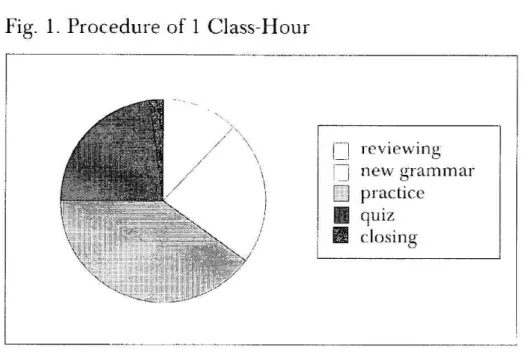
Fig. 1. Procedure of 1 Class-Hour
__I reviewing pi_new grammar El practice El quiz
closing
The procedure is divided into five parts. Look at the graph
from the top to clock wise. The class starts with 1) reviewing for 10 minutes, goes on to 2) studying the new grammatical structure for 20 minutes, 3) practicing the grammatical structure for 40 minutes, 4) doing a short quiz for the day for 20 minutes, and 5) making a
closing remark for a second.
6A. THE FIRST STEP (REVIEWING)
The first step of reviewing the previous class hour is done in the following process. Students first do the work sheet no. 1 of sentence combining which contains the specific grammatical structure learned in the previous class. Below is one example sentence combining exercise extracted from worksheet no. 1.
TQVi:1J T II (2) -- worksheet no. 1 (extract) 1. 360r) L) 7 i) Ov t ~'t
(that dog, running, look at, in the garden)
An Analysis of My Classroom Teaching Procedure in English Writing 229
The procedure of doing worksheet no. 1 is as follows.
1) do the worksheet.
2) students check the answers.
3) teacher picks the students up one by one and asks each of
them for the answer until one of them finally hits the correct
answer.
4) students and teacher read the combined sentences aloud by
doing chorus reading two times for each sentence.
There are always six sentences for this worksheet no. 1.
6.2. THE SECOND STEP (NEW GRAMMAR)
The second step of studying the new grammatical structure is done in the following process. Teacher explains the new grammatical structure by using worksheet no. 2. Below is the extract from worksheet no. 2 of the explanation of a new grammatical aspect.
ff.) V)
(1) --- worksheet no. 2 (extract)
1P] + —ing
This work sheet contains 1)the form of the new grammatical structure, 2)the name of the structure, and 3)two example sentences
which contains that structure.
The procedure of doing worksheet no. 2 is as follows.
1) teacher explains the grammatical structure.
2) students and teacher read the example sentences aloud.
3) teacher picks up five students for each of the sentences and let
them read aloud by turns.
4) students and teacher do chorus reading of each sentence two
times.
5) students recite the sentences.
5)-1 students write each sentence three times.
5) -2 they memorize them.
5)-3 teacher picks up five students for each sentence, and let them
recite by turns.
5)-4 teacher confirms by doing chorus reciting the sentences with
students two times for each.
6.3. THE THIRD STEP (PRACTICE)
The third step of practicing the newly learned grammatical structure is done in the following process.
1) teacher let students do the worksheet no. 3 of sentence
combining exercise with the new grammatical structure.
Below is one example sentence combining exercise extracted from worksheet no. 3.
(7)0g (1) — worksheet no. 3 (extract) 4. [l L'-0a "l- 70 dt H
(in the dark room, harmful, is, reading, to the eyes)
There are always six sentences to complete with Japanese
translation attached to each of them. After doing the worksheet no. 3,
2) 2)-1 2)-2 3) 4) 5) 5)-1 5)-2 5)-3 5)-4 5)-4-1 5)-4-2
An Analysis of My Classroom Teaching Procedure in English Writing 231
students check the answers.
teacher picks the students up one by one.
teacher asks them for the answer for each exercise until someone finally reaches the correct answer.
teacher and students read the completed sentences aloud by students repeating after teacher.
teacher and students do chorus reading of each of the sentences two times.
teacher let students memorize the completed sentences.
teacher let them write each sentence three times on a paper.
students memorize the example sentences by heart at the time they completed this writing exercise.
teacher confirms by picking up five students for each sentence and letting them recite the sentence in class.
teacher also does chorus reading of each of the sentences two times with students.
teacher says the Japanese translation of the six sentences on
the worksheet no. 3.
students recite the English version of them according to the cues of teacher.
6.4. THE FOURTH STEP (QUIZ)
The fourth step of doing a short quiz for the day is done in the following process. This quiz is done by letting students write the memorized sentences on a sheet of paper distributed by teacher without looking at anything.
1) teacher picks up three sentences from all the memorized
sentences in class for the day.
2) teacher reads their Japanese translations aloud.
3) students write the English version of them down on the paper.
There are five minutes of waiting time before moving onto the quiz in order for students to prepare for the quiz. The two example sentences on the worksheet no. 2 always appear in this quiz. After students write the selected three sentences in English, there is to be a grammar practice for the day.
4) students underline the parts of the sentences where the newly
learned grammatical structure appears.
5) students write the Japanese translations of that specific
grammatical parts of the sentences beside the underlined.
6) students check the answers.
6.5. THE FIFTH STEP (CLOSING)
As for the fifth step, teacher makes a closing remark for a second and the class is dismissed. The papers for the short quiz are to be collected at this moment to count the students' attendance.
7. CHARACTERISTICS
In this procedure, the amount of time spent in writing is 45 minutes. The amount of time spent in speaking is 30 minutes. I class hour is 90 minutes each.
So this class is mostly focused on the productive English language ability; writing and speaking. The students already have a little of receptive English language ability; listening and reading, through their experience of studying English for six years. So when they accomplish this course, they will hopefully have the overall English language ability, the four skills of English; listening, reading, speaking, and writing.
`Focus on Form Method' was applied to this course for the students to have plenty of language input for the sake of Input Hypothesis. They wrote and uttered many set English sentences for the sake of the Pushed Output Hypothesis. The practice sentences
AnAnalysisofMyClassroomTeachingProcedureinEnglishWriting233
wereeasyEnglishforthesakeofComprehensibleInput,
ComprehensibleOutput,andI+1.Consideringtherestrictionsof thepresentsituation,Ibelievethiswasthebestpossiblewayforme tobringthedesiredresult.
8.THEEFFECTSOFTH‑SPROCEDURE
8.1.COMPAR正50NOFTHESCORESOFPRETESTANDPOSTTEST
TheeffectsofthisclassroomteachingprocedureofanEnglish writingcoursecanbemeasuredbycomparingtheresultsofthe
pretestandtheposttest.Bothpretestandposttestusedthesame onesheetofsentencecombiningquizandexerciseofanalyzingthe grammaticalstructure.Therearefivesentencecombiningquestions andonegrammaticalanalysisquestiononthissheet.Belowisthe extractfromthetestsheetusedforbothpretestandposttest.
pretest,posttest(extract}
次 の5つ の 日本 語 の 文 に そ っ て,括 弧 内 の 英 単 語 を並 べ 替 え て 英 語 の 文 を 作 り な さ い 。 文 頭 は 大 文 字 に し な さ い 。 ま た,1.のa)の 質 問 に 答 え
な さい 。
1.私 の 兄 は と て も 上 手 に テ ニ ス を し ま す 。 well,tennis,my,very,plays,brother)
a)こ の 文 の 文 型 は 第 何 文 型 で す か?下 に 説 明 しな さ い 。 形)
訳) 名)
Belowaretheresultsofthepretestandporttest.
Tab.
* Comparison of the Scores of Pretest and Post Test '
1. Results of Pretest and Post Test
Scores 0
1 2 3 4 5 6 TOTAL
Pretest 0
0 1 5 3 6 0 15
Post Test 0 0 0 1
6 3 5 15
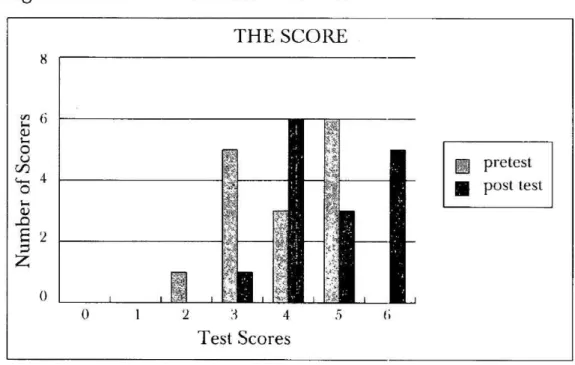
Among the fifteen students who took both pretest and post test, six students got the same points on both tests, seven students got one point higher on post test than on pretest, two students got three points higher on post test than on pretest. None of the students got any lower points on post test than on pretest.
* Comparison of the Results of Pretest and Post Test
The Same Points = 6 students
1 Point Higher = 7 students
2 Points Higher = 0 student
3 Points Higher = 2 students (among 15 students)
Below is a graph which shows the results of pretest and post
test.
An Analysis of My Classroom Teaching Procedure in English Writing 235
Fig. 2. Results of Pretest and Post Test
pretest post test
The test scorers of pretest are gathered around points 3 to 5.
Whereas the test scorers of post test are gathered around points 4 to 6. So the top of the mountains of the graph is slightly sliding. The post test scores are gathered on slightly higher points. Also the fact that nobody got lower points on post test than on pretest is a noticeable fact. There might not have been a drastic change on the points they got. However, every one of students had maintained their points and no one had slipped backward. Also, there are two students who made a dramatic change on their test scores for the better. So this case should be focused on.
8.2. SURVEILLANCE OF THE QUESTIONNAIRE
Questionnaire is there for teacher to listen to the voices of
students directly. It was done on the very last day of the course.
There were seven questions on the questionnaire; three are yes-no questions, one is selecting one out of six choices, one is selecting the activities students liked privately, and two are open ended questions.
Below is the questionnaire sheet.
ア ン ケ ー ト
学科 名 学籍番号 名前
1.次 の 授 業 の 中 で 行 っ た作 業 を 好 き な順 に並 べ て 記 号 で 答 え て 下 さい,, a)発 音 練 習b)書 い て 覚 え る練 習c)プ リ ン トで の並 べ 替 え練 習d)作 文
[こ た え]()()()(〉
2。一 番 好 き だ っ た 作 業 の 名 前 と な ぜ 好 きだ っ た か 自 由 に書 い て 下 さい 。 [名 削()
[理 劇
3.授 業 で は,キ ー セ ン テ ン ス や 並 べ 替 え た 例 文 を3回 ず つ 書 い て 覚 え ま し た 、,書 く こ と で,よ り 英 文 が 頭 に 残 っ た と 思 い ま す か?
a)は いb)い い え
4.今 ま で に 英 文 を 一一一度 に こ れ だ け 書 く こ と を 練 習 し た こ と は あ り ま す か?
a){よ レ》b)し 、し、え
rV̀
‑1書 く こ と は 苦 痛 で し た か?
a)1よ いb)い し、え
6.英 文 を書 い て 覚 え る練 習 の 中 で,思 っ た こ と,発 見 した こ と,自 分 の 頭 の 中 で の 理 解 の 変 化 に つ い て 自 由 に 書 い て 下 さい.
7.授 業 で 覚 え た た く さ ん の 英 文,英 語 表 現 の な か で,頭 に 残 っ た も の が ど の 程 度 あ る と 感 じ ら れ ま す か,,(単 語,フ レ ー ズ,文,っ づ り,他)
An Analysis of My Classroom Teaching Procedure in English Writing
a) - t: < b) 2-01 c) 4---61IN d) 7 --- 91I1 e)10--15f1
237
Below is the results of the questionnaire.
Results of Questionnaire
1. Which activity did you like most?
liked writing activity most = 3 students
liked writing activity least = 11 students(among 24 students) 7. How many English expressions can you remember right now?
quite a lot of expressions = 7 students
10-15 expressions = 2 students 7-9 expressions = 6 students 4-6 expressions = 7 students 2-3 expressions = 2 students
0 expression = 0 student (among 24 students)
Writing English sentences continuously for 45 minutes in 1 class hour is a strenuous thing to do. I well understood this to be hard for students, and ran the risk to let students have quantity of language input as much as possible. In the questionnaire, eleven students out of twenty-four answered that they liked writing activity least among various ones in class. But surprisingly three students answered that they liked this writing activity most among others.
The scores of these three students at the semester test were; a) 82 (male), b) 82 (female), c) 70 (male). The number of English
expressions each of them immediately could remember at the test
were; 10 to 15 for a) and b), and 7 to 9 for c). Among twenty-four
students, seven students answered they can remember plenty of English expressions immediately at the test, two students including the above two answered they can remember 10 to 15 English expressions immediately at the test, and six students answered that
they can remember 7 to 9 English expressions immediately at the test. So, fifteen students out of twenty-four answered they can say around 10 English expressions immediately without looking at anything at the end of the course.
Lastly, let us look through the answers for questionnaire no. 6.
Results of Questionnaire
6. What kind of changes happened inside your brain while you were doing the writing activity in order to acquire many of the
English expressions?
1) By writing, rather than by just saying, I could memorize many
more items of vocabulary and those spellings, and that did me good.
2) 1 think this could be applied to not only sentences but also to
words.
Repeating writing, watching, and saying the sentences will make the understanding inside my brain much deeper, so this
is a good way to do.
3) I have noticed that other than just watching, (0 practicing
writing, (') pronouncing, and (3; listening to the English sentences made it much easier for me to remember those
expressions. When I took the semester test, I noticed that I
had much better memory of English expressions than I
thought I had in me, and I was surprised.
4) Just trying to memorize the expressions without doing
anything is not good. By writing many English sentences, my fingers remember the expressions so that I can now write English sentences much more fluently than ever.
An Analysis of My Classroom Teaching Procedure in English Writing 239
* This paper is a modified version of a presentation given at LET 2000 Kanto Chapter, 108th Congress of Language Education &
Technology, held at Akita Prefectural University, Akita Campus, room A305, from 10:30-11:10, on Saturday 14th of October, 2000.
NOTE
1 Ann Raimes is a professor at Hunter College, City University of New York.
References
Brown, H. Douglas. (1994). Teaching by Principles: An Interactive Approach to Language Pedagogy. Englewood Cliffs, NJ.: Prentice Hall Regents.
Casanave, C. P. (1988). The process approach to writing instruction: An examination of issues. The CATESOL Journal, 1, 29-39.
Horowitz, D. (1986). Process, not product: Less than meets the eye. TESOL
Quarterly, 20, 141-144.
Krashen, Stephen D., and Terrell, Tracy D. (1983). The Natural Approach.
Language Acquisition in the Classroom. Pergamon Press.
Raimes, A. (1991). Out of the woods: Emerging traditions in the teaching of writing. TESOL Quarterly, 25, 407-430.
Reid, J. (1984). The radical outliner and the radical brainstormer:
A perspective in composing process. TESOL Quarterly, 18, 529-533.
Silva, T. (1990). Second language composition instruction: Developments,
issues, and directions in ESL. In B. Kroll (Ed.), Second language writing:
Research insights for the classroom (pp. 11-23). Cambridge: Cambridge
University Press.