九州大学学術情報リポジトリ
Kyushu University Institutional Repository
STUDY ON PRODUCTION EFFICIENCY AND AGRICULTURAL RISK MANAGEMENT: THE CASE OF MAJOR CROPS IN
NORTHERN VIETNAM
ホ ヴァン バク
http://hdl.handle.net/2324/1959180
出版情報:九州大学, 2018, 博士(農学), 課程博士 バージョン:
権利関係:
STUDY ON PRODUCTION EFFICIENCY AND
AGRICULTURAL RISK MANAGEMENT: THE CASE OF MAJOR CROPS IN NORTHERN VIETNAM
HO VAN BAC
2018
Graduate School of Bioresource and Bioenvironmental Sciences Department of Agricultural and Resource Economics
Laboratory of Agricultural and Farm Management
STUDY ON PRODUCTION EFFICIENCY AND
AGRICULTURAL RISK MANAGEMENT: THE CASE OF MAJOR CROPS IN NORTHERN VIETNAM
HO VAN BAC
FUKUOKA, JAPAN
2018
STUDY ON PRODUCTION EFFICIENCY AND
AGRICULTURAL RISK MANAGEMENT: THE CASE OF MAJOR CROPS IN NORTHERN VIETNAM
By HO VAN BAC
A Dissertation
Submitted to Kyushu University in partial fulfillment of the requirements for the degree of
DOCTOR OF PHILOSOPHY in
Agricultural and Resource Economics
Supervised by
Professor Teruaki NANSEKI, Ph.D Assistant Professor Yosuke CHOMEI, Ph.D
Dissertation Committee:
1. Professor Teruaki NANSEKI, Ph.D 2. Professor Koshi MAEDA, Ph.D 3. Professor Mitsuyasu YABE, Ph.D
KYUSHU UNIVERSITY 2018
SUMMARY OF DISSERTATION
Vietnam has a favorable natural condition for agricultural production, with a large agricultural land accounting for 82.4% total natural area. The sector has contributed significantly to the economy in terms of employment (48%), GDP share (18.1%), and food security. Especially, agricultural production is essential income source for people living in rural area and the poor in the region with 75% and 90% respectively. However, the sector has been facing many challenges such as low productivity and quality, scattered and small scale production, food safety etc. Besides, the sector also is very sensitive and vulnerable to various kinds of risks. Improving production efficiency and risk management could be seen as feasible measures contributing to the improvement of income for local people in the context of limited production land expansion and inefficient used resources. In Vietnam there have been several studies on production efficiencies of main crops such as rice, vegetable, tea etc.
However, understanding the risk sources and combination of efficiency and production risk are still limited. Moreover, there is not any comparison study on productive efficiency of farmers using propensity score matching approach to control the selection bias. Besides, the adoption of eco-friendly production practices such as VietGAP, organic methods are expected to increase household income and reduce concerns from food unsafety. But the study on evaluating impact of VietGAP adoption on farmer’s livelihood in Vietnam is rare.
Thus, the objectives of the study are to: (1) explore the production efficiency of rice and tea farmers and factors affecting inefficient levels; (2) investigate the economics of adoption, source of risks facing by farmers and also understand their management response to the risks.
The study was conducted in northern Vietnam where agricultural production plays an important role in household’s income sources. Tea and rice are two of major crops of the region and selected fort this study because of their representative and dominant importance.
While rice crop is mainly produced to serve household’s demand or self-sufficiency, tea plantation is grown as a commercial crop and provide cash income for other daily demands of households. At first location was purposely selected based on representative characteristics for rice and tea production areas, then rice and tea sampled farmers were randomly chosen from that province. Total 120 rice farmers and 326 tea farmers were used to analyze in the study. To achieve the purpose of the research, we applied several models to fit with specific objectives. Stochastic frontier approach (SFA) was used to analyze production and profit
efficiency of farmers, while principal component analysis (PCA) and multiple linear regression were applied to determine the sources of risk and farmers’ response to the risks.
Farmers’ decision to adopt new practice was analyzed using probit regression model. The findings of the study were derived from analyzing cross-sectional data of rice farmers and tea farmers collected in study area.
The findings of chapter 2 and 3, analyzing productive efficiency of rice and tea production, indicate that there are still potential rooms for improving efficiency with given inputs and technology through the use of better practice production methods or more efficient decision. In details, technical efficiency based on the SFA analysis with average score of 88 percent indicates that rice farmers could improve their technical efficiency for about 12 percent with given inputs and technology by improving farmer’s resource use efficiency. The result also revealed that reducing technical inefficiency of rice farmers could be done by enhancing educational levels, and land consolidation. While tea farmers have the potential of increasing their profit efficiency for about 25 percent. Further analysis indicated that investing active irrigation system, joining cooperatives/production groups and good extension service are major factors for improving the tea farmers’ profit efficiency. Notably, comparison the profit efficiency between two groups revealed that “safe” tea production practice (VietGAP) could achieve higher efficiency than conventional tea production practice.
Chapter 4 and 5 determine factors underlying the probability of tea farmer’s decision to adopt the new production practice and economic effect of VietGAP tea production on households’ income. In order to achieve the purpose, we analyzed two groups of sample, namely adoption and conventional one. The finding shows that farmers with better or more advantageous production features are more likely to adopt new production practice. Positive incentives affecting both conversion decision and more farmland allocation of tea farmers include number of household members, tea farm size, ratio of tea income over total household income, access technical information on new production practice from extension agencies and using labor-saving machinery in tea production. Furthermore, with the aim of estimating the casual effect of VietGAP adoption on farmers’ livelihood in Vietnam, PSM was employed. The result indicates that farmers adopting VietGAP tea production received economic benefits with higher income in comparison with conventional tea farmers. This also implies that VietGAP tea production should be supported for diffusion. The premium
benefit is attributed to better price and higher tea yield of farming practice under VietGAP standards.
Perception of farmers’ risk sources and their management response are an important part of the study. And its detailed contents are presented in Chapter 6. Descriptive statistics, PCA, and multiple linear regression were applied to determine the risk sources and also find socio-economic factors influencing the farmers’ risk perception and their management response. The result of descriptive analysis indicates that there are 17 sources of risk that perceived and listed by tea farmers in the study area. The analysis result indicates that price volatility, disease risk and an increase of production cost are the most serious in farmer’s perception as single risks. Moreover, there are no differences existing in farmer’s risk perception between VietGAP and conventional tea farming systems. Analyzing variables affecting on risk perceptions indicates that agricultural educated farmers were found to be related to lower worries and risk perception. Besides that, farmers with main occupation involving in farming activities worry more about production risk, yield and quality risk. For risk management response, farmers considered pest and disease prevention, production cost minimization as the most important measures to limit damages from risk sources above.
In short, the result of the study highlighted that there is a scope for further increasing efficiency scores of tea and rice farmers in the study area. More efficient resource allocation decision or better production management skills could lead to improve productive efficiency.
Moreover, conversion in tea production was promoted by economic incentives and adopting VietGAP tea production practice also contributed to increase the profit efficiency and households’ income of farmers. Thus, it is important that interventions and government support should aim at improving current production efficiency and expanding the conversion.
Lastly, agricultural production is exposed to various types of risks based on farmers’
perception. In which variability of output price, disease risk and increase of production inputs are perceived as the most serious risks. To reduce risks for farmers, stabilizing market price of output and production inputs, preventing disease risk with technical education programs that government should support for farmers would be meaningful.
Keywords
Production efficiency, stochastic frontier, principle component analysis, risk source, management response, major crops, Vietnam
ACKNOWLEDGEMENTS
I would like to thank all persons who have contributed to the successful completion of my PhD study at Kyushu University, Fukuoka, Japan. First and foremost, I would like to express my deepest gratitude and much respect to my academic supervisor, Prof. Dr. Teruaki NANSEKI, who has directly guided my study, provided valuable suggestions, insightful feedback and constructive comments for me to end up with a coherent dissertation. I really appreciate his constant support, both academic and social aspects. I understand that the study would not have come to successful completion without his kind support. My special thanks also go to Assistant Professor Dr. Yosuke CHOMEI for providing helpful advices and comments to this study. My great appreciation goes to other professors, Prof. YABE and Prof. MAEDA, for taking part of the dissertation committee and kindly revise the content of my thesis. Without their kind support and encouragements from the dissertation committee, it will be difficult to pursue and complete the study program for Doctoral degree.
I am deeply indebted to the Ministry of Education, Science, Culture, and Sports of Japan (MEXT scholarship) for the great opportunity and providing financial support for my studies in Japan. My special thanks are given to Kyushu University staffs for providing research facilities upon which the successful completion of this dissertation have critically depended.
I am grateful to Thai Nguyen University of Agriculture and Forestry and my colleagues in Vietnam, who always support and encourage me during my study period in Japan.
I wish to extend my appreciation to the households and staffs at Department of Agricultural and Rural Development from Thai Nguyen province, Vietnam on their hospitality and kind collaboration helped me doing field survey successfully. Without their assistance and cooperation in providing precious information, the study would not have been possible.
I would like to thank all friends in Kyushu University, and special thanks for colleagues in the Laboratory of Agricultural and Farm Management for their sharing of knowledge, skills and helping during my study period.
Last but not least, special appreciation is given to my wife PHAM THI THANH HUYEN for her constant supporting, encouraging, kind understanding and together taking care of
our son HO GIA BAO during my study period. I am very grateful to my lovely parents and all relatives for always understanding and encouraging me during the time for doing the research. Finally, I wish to thanks everyone who has helped and encouraged me to strive for academic excellence.
HO VAN BAC Fukuoka, September 2018
Table of Contents
SUMMARY OF DISSERTATION ... i
ACKNOWLEDGEMENTS ... iv
LIST OF FIGURES ... ix
LIST OF TABLES ... x
ABBREVIATION ... xi
CHAPTER 1. INTRODUCTION ... 1
1.1 Background information ... 1
1.1.1 Agricultural sector ... 1
1.1.2 Major yearly-planted crops ... 3
1.1.3 Major perennial plants ... 4
1.2 Production efficiency, risk and VietGAP adoption in Vietnam ... 7
1.2.1 Production efficiency ... 7
1.2.2 Linkage between agricultural risk and efficiency ... 9
1.2.3 The situation of VietGAP adoption ... 10
1.3 Problem statement ... 11
1.4 Research objective ... 13
1.5 Organization and structure of the dissertation ... 13
1.6 Selection of study area ... 15
CHAPTER 2. PRODUCTIVE EFFICIENCY OF RICE FARMERS AND ITS DETERMINANTS ... 17
2.1 Introduction ... 17
2.2 Methodology ... 18
2.2.1 Overview of efficiency ... 18
2.2.2 Techniques of efficiency measurement ... 19
2.2.3 Analytical framework ... 21
2.2.4 Data collection ... 22
2.3 Results and discussion ... 23
2.3.1 Descriptive statistics of variables ... 23
2.3.2 Estimation of stochastic frontier production function ... 24
2.3.3 Input elasticity and its responsiveness to rice yield ... 25
2.3.4 Frequency distribution of technical efficiency ... 26
2.3.5 Analysis of determinants of technical inefficiency ... 27
2.3.6 Estimation of potential rice yield ... 29
2.4 Conclusions and recommendations ... 29
CHAPTER 3: PROFIT EFFICIENCY OF TEA FARMERS AND ITS DETERMINANTS ... 31
3.1 Introduction ... 31
3.2 Methodology and data collection ... 32
3.2.1 Measurement of production and profit efficiency ... 32
3.2.2 Impact evaluation approach ... 34
3.2.3 Empirical model ... 34
3.2.4 Propensity score matching ... 36
3.2.5 Description of used variables ... 38
3. 2.6 Study area and data collection ... 39
3.3 Results and discussion ... 40
3.3.1 Socio-economic characteristics of tea farmers ... 40
3.3.2 Estimated result of profit frontier function ... 43
3.3.3 Factors explaining the profit efficiency of tea farmers ... 45
3.3.4 Distribution of profit efficiency and average treatment effect ... 47
3.3.5 Propensity score for VietGAP tea adoption ... 47
3.4 Conclusions and recommendations ... 50
CHAPTER 4. VIETGAP TEA PRODUCTION AND DETERMINANTS OF FARMER’S ADOPTION ... 52
4.1 Introduction ... 52
4.2 Methodology ... 53
4.2.1 Model specification ... 53
4.2.2 Variable selection in the model ... 55
4.3 Results and discussion ... 56
4.3.1 Comparative statistics of used variables ... 56
4.3.2 Factors affecting conversion decision of tea farmers ... 57
4.3.3 Factors influencing farmers’ farmland allocation ... 60
4.4 Conclusions and recommendations ... 63
CHAPTER 5. ASSESSING EFFECT OF VIETGAP TEA PRODUCTION ON
FARMER’S INCOME ... 65
5.1 Introduction ... 65
5.2 Methodology ... 66
5.2.1 Conceptual framework for VietGAP tea adoption ... 66
5.2.2 Econometric models for impact assessment ... 66
5.2.3 Specification of econometric models ... 67
5.3 Results and discussion ... 68
5.3.1 Descriptive statistics of variables ... 68
5.3.2 Econometric estimation ... 70
5.4 Conclusions and recommendations ... 73
CHAPTER 6. FARMER’S RISK PERCEPTION AND THEIR MANAGEMENT RESPONSES ... 75
6.1 Introduction ... 75
6.2 Methodology ... 76
6.2.1 Data collection ... 76
6.2.2 Theoretical framework and analysis technique ... 77
6.2.3 Description of variables used in the regression model ... 77
6.3 Results and discussion ... 79
6.3.1 Farmer’s perception on risk sources ... 79
6.3.2 Risk perception in relation to farm and farmer characteristics ... 83
6.3.3 Farmers’ perception on risk management ... 85
6.4 Conclusions and recommendations ... 87
CHAPTER 7. CONCLUSIONS AND POLICY IMPLICATIONS ... 88
7.1 Main conclusions ... 88
7.2 Policy implications ... 90
7.3 Study limitation and future research ... 91
REFERENCES ... 93
LIST OF PUBLISHED ARTICLES ... 106
LIST OF RELATED PRESENTATIONS ... 107
APPENDIX ... 108
LIST OF FIGURES
Figure 1. 1 Planted area of major crops in Vietnam (1000 ha) ... 3
Figure 1. 2 Planted perennial area of Vietnam ... 5
Figure 1. 3 Planted tea distribution in Vietnam ... 5
Figure 1. 4 Proportion of tea production among regions in Vietnam ... 6
Figure 1. 5 Variability of tea yield in Vietnam ... 7
Figure 1. 6 Overall structure of the dissertation ... 14
Figure 1. 7 Map of study area ... 16
Figure 3. 1 Density distribution of propensity scores………..49
LIST OF TABLES
Table 1. 1 Land statistics of Vietnam ... 1
Table 1. 2 Land use structure in Northern mountainous region of Vietnam ... 2
Table 1. 3 Structure land use of MNR ... 4
Table 2. 1 Descriptive statistic of variables in the model………..23
Table 2. 2 Estimated parameters of stochastic frontier production function ... 25
Table 2. 3 Frequency distribution of technical efficiency ... 27
Table 2. 4 Determinants affecting technical inefficiency ... 28
Table 3. 1 Variable definition of used models ………38
Table 3. 2 Descriptive statistics of tea production practices ... 40
Table 3. 3 Comparative statistics of model variables ... 42
Table 3. 4 Estimation result of profit efficiency among tea farmers ... 44
Table 3. 5 Factors affecting profit efficiency of tea farmers ... 46
Table 3. 6 Frequency distribution of profit efficiency (PE) ... 47
Table 3. 7 Logit estimates of the propensity to adopt VietGAP tea production ... 48
Table 3. 8 Estimation of average treatment effects on the treated ... 49
Table 4. 1 Definition of variables used in the models……….56
Table 4. 2 Descriptive statistics of explanatory variables in the model ... 57
Table 4. 3 Factors influencing farmer’s conversion decision of tea productions ... 58
Table 4. 4 Marginal effects of factors associated with farmer’ adoption ... 60
Table 4. 5 Factors affecting farmer’s farmland allocation ... 61
Table 4. 6 Marginal effect of factors associated with allocation ... 62
Table 5. 1 Basic features of two tea production practices ………..69
Table 5. 2 Coefficient estimation for adoption of VietGAP tea production ... 70
Table 5. 3 Test of matching quality ... 71
Table 5. 4 Balance condition ... 72
Table 5. 5 Estimation of treatment effects (ATT) ... 73
Table 6. 1 Statistics of variables used in multiple linear regression ………78
Table 6. 2 Mean score and rank for risk sources perceived by tea farmers ... 80
Table 6. 3 Varimax rotated factor loading for risk sources ... 82
Table 6. 4 Estimation of multiple linear regression model for risk sources ... 83
Table 6. 5 Mean score and rank for risk management ... 85
Table 6. 6 Varimax rotated factor loading for risk management ... 86
ABBREVIATION
ATT: Average Treatment Effect on the Treated ATE: Average Treatment Effect
ATU: Average Treatment Effect on the Untreated AseanGAP: Asean Good Agricultural Practices DEA: Data Envelopment Analysis
FAOSTAT: Food Agriculture Organization Statistics FDA: Food and Drug Administration
GlobalGAP: Global Good Agricultural Practices GDP: Gross Domestic Product
GSO: General Statistic Office of Vietnam
HACCP: Hazard Analysis and Critical Control Points KM: Kernel Matching
MLE: Maximum Likelihood Estimation
MONRE: Ministry of Natural Resource and Environment NMR: Northern mountainous region
NNM: Nearest Neighbor Matching OLS: Ordinary Least Square PSM: Propensity Score Matching PE: Profit Efficiency
PCA: Principal Component Analysis QD TTg: Prime Minister’s Decision RM: Radius Matching
SFA: Stochastic Frontier Approach TE: Technical Efficiency
VietGAP: Vietnamese Good Agricultural Practices UN: United Nations
WTA: World Tea Association
CHAPTER 1. INTRODUCTION 1.1 Background information
1.1.1 Agricultural sector
Vietnam has total natural land area of about 33,123 thousand ha. Of which total agricultural land, forestry land accounted for about 82.4% and 54.64% of total land area, respectively (MONRE, 2016). Agriculture plays an important role in Vietnam’s economy. In 2016 the agricultural sector shared 18.14% in Vietnam’s gross domestic product (WB, 2016). Although contribution of agricultural production to Vietnam economy has been decreasing recently, from 22.7% in 2000 to 18.14% in 2016 (WB, 2016), the sector is still considered as very sector contributing to national strategy on food security of Vietnam and support for industry sector development in coming years (MARD, 2009). By 2010 the sector employed 48% of the workforce (JICA, 2013). In recent two decades, agriculture grew consistently but the faster growth of the industry and service sectors led to the relative drop in the contribution of the agricultural sector.
Table 1. 1 Land statistics of Vietnam
Land types Area (1000 ha) Ratio (%)
Total natural land area 33,123 100
1. Agricultural land 27,284.9 82.37
1.1 Agricultural production land 11,526.7 42.25
1.2 Forestry land 14,908.4 54.64
1.3 Fishery raising land 797.2 2.92 1.4 Salt production land 17.5 0.06
1.5 other land 34.7 0.13
2. Non-agricultural land 3,725.3 11.25
3. Not used land 2,112.8 6.38
Source: Ministry of Natural Resource and Environment, 2016
Agricultural export increased consistently over years and bring in a substantial positive trade balance. The major agricultural export products are rice, rubber, coffee, cashew nuts, fishery and forestry products. In 2011 the total value of export reached $25 billion that doubled the export value in 2007 (JICA, 2013).
Although agriculture has achieved significant achievements contributing to poverty reduction, social economic development and food security of Vietnam, there are still many existing challenges and constraints. The first one is unstable agricultural development and less competitiveness in world market. Small production scale and scattered agriculture has led to high production cost. Moreover, food safety issue and low production efficiency are becoming emerging and increasing concerns in agriculture.
Besides, support services and industry in agricultural development is less developed.
Most of exported agricultural commodities are under raw and less processed products. As a result, added value and product quality are quite low compared with other nations’
products. In agriculture, cropping accounted for a high proportion (more than 50%). Of which, rice production is still the most important crop (MARD, 2009).
Table 1. 2 Land use structure in Northern mountainous region of Vietnam
Land types Area (1000 ha) Ratio (%)
Total land area 9522.2 100
1. Agricultural land 7575.9 79.6
1.1 Agricultural production land 2123.3 28.0
1.2 Forestry land 5406.9 71.4
1.3 Fishery land 43.1 0.6
1.4 Other land 2.5 0.03
2. Non agricultural land 611.5 6.4
3. No used land 1334.8 14.0
Source: Ministry of Natural Resource and Environment, 2016
Northern mountainous region of Vietnam (NMR) has advantage of forestry production with about 2.1 million ha, accounting for 71.4% of total agricultural land of the region. The agricultural production land covers about 28%. According to the plan of agriculture and rural development (2011-2020) issued by MARD (2009), the NMR will focus on forestry development and advantageous industrial crops such as tea, coffee (Arabica type), maize, lychee, soybean etc.
1.1.2 Major yearly-planted crops
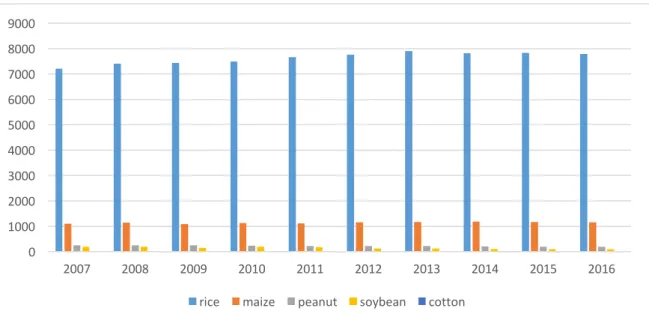
In Vietnam, rice production takes the very high land proportion, accounting for 59.2% of total annual cropping land area (MONRE, 2016). Over the past 10 years (2007 – 2016), total sown rice area increased consistently, reached approximately 8 million ha in 2016 (GSO, 2018). The figure 1.1 also indicates that rice production area is much more than than other crops in combination including maize, peanut, soybean, cotton.
Figure 1. 1 Planted area of major crops in Vietnam (1000 ha) Source: General Statistic Office of Vietnam, 2018
Northern upland area of Vietnam has about 2.1 million ha of agricultural land area, in which yearly-planted area is about 77%. And rice production is also an important crop, accounting for 35.4% of total cropping land area of the region. While perennial cropping areas such as tea, fruit, coffee (Arabica) … accounts for about 23% of total agricultural land of the region (MONRE, 2016). In the region, more than 90% people out
0 1000 2000 3000 4000 5000 6000 7000 8000 9000
2007 2008 2009 2010 2011 2012 2013 2014 2015 2016
rice maize peanut soybean cotton
of about 11 million people are living in rural area while agricultural activities such as cropping, animal husbandry, forest economics are their main income. Notably, rice production still takes an important role in household’s income source, accounting for about 25%. Besides, rice production is not for commercial purpose or export, but rice self-sufficiency also contributes to food security in the region where transportation system is still very difficult compared with flat area due to hilly and complex topography (Bac et al., 2013).
Table 1. 3 Structure land use of NMR
Land type Area (1000 ha) Ratio (%)
Total agricultural production land 2123.4 100
1. Annual cropping land 1635.3 77.0
1.1 Rice land 579.7 35.4
1.2 Other annual cropping land 1055.6 64.6
2. Perennial plant land 488.1 23.0
2.1 Tea land 95.7 19.6
Source: Ministry of Natural Resource and Environment, 2016
1.1.3 Major perennial plants
The trend over the last ten years of production are presented below for the major perennial plants in Vietnam. There has been a major expansion of rubber planting area, while coffee and pepper planted areas has rose moderately. Tea planted area remained fairly steady over the years.
Figure 1. 2 Planted perennial area of Vietnam Source: General Statistic Office of Vietnam, 2018
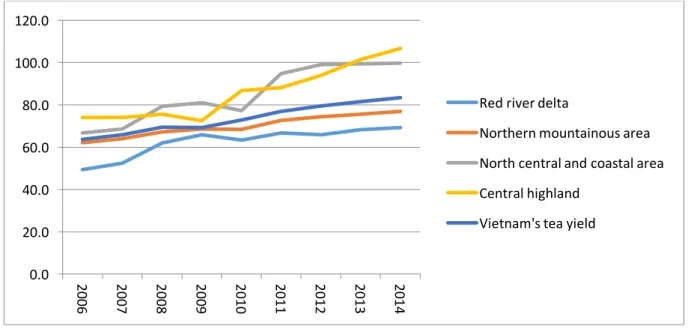
Vietnam is amongst few nations in the world that have advantages of natural and climatic conditions for tea production (SOMO, 2007). Tea production is taking place in 39 out of 64 provinces all over the country with total 130 thousand ha. NMR has the largest tea production area in comparison with other four regions of Vietnam, with about 93 thousand ha accounting for 72% of total planted tea area of Vietnam.
Figure 1. 3 Planted tea distribution in Vietnam Source: General Statistic Office of Vietnam, 2011
0 200 400 600 800 1000 1200
2007 2008 2009 2010 2011 2012 2013 2014 2015 2016
Cashew nut Rubber Coffee Tea Pepper
4%
72%
7%
17%
Red river delta
Northern mountainous area North central and coastal area Central highland
Similarly, the region also provide the highest tea production quantity of Vietnam, accounting for 66% of total produced tea quantity.
Figure 1. 4 Proportion of tea production among regions in Vietnam Source: General Statistic Office of Vietnam, 2011
Tea production plays an important role in both cultural and economic aspects. In Vietnam tea plantation has a long history and tea drinking custom, dating back about 3000 years (Tran, 2008). In 2012, tea production has contributed to total exported value of $224.8 million, with more than 146.8 thousand tons of exported tea products (FAO, 2012b). The sector also attracts about 400 thousand households involving in production and relevant activities for their income and livelihood. In total, tea sector provides employments for about 1.5 million people (SOMO, 2007).
3%
8%
66%
23%
Red river delta Northern mountainous area North central and coastal area Central highland
Figure 1. 5 Variability of tea yield in Vietnam Source: General Statistic Office of Vietnam, 2014
1.2 Production efficiency, risk and VietGAP adoption in Vietnam
1.2.1 Production efficiency
Production is a process of transforming inputs such as land, labor, capital, fertilizer and so on into output such as goods and services. This process is not only applied in agricultural production, but also in other production sectors. The difference of production performance is generally displayed at different inputs and outputs. Ultimate objective of agricultural production may be profit or revenue maximization, cost minimization, maximum output etc. They can vary from time to time or firm to firm.
Some concepts cover technical efficiency such as productive efficiency or economic efficiency.
Production efficiency is composed of two components including technical efficiency and allocative efficiency. The purely technical or physical component is defined as the farmer’s ability to avoid waste during production. In other words, a farmer uses the given inputs to create an output as high as possible, or produce a given output by applying inputs as low as possible. Thus, the target of an estimation of technical efficiency is to find solutions to increase output or decrease inputs in the context of available
0.0 20.0 40.0 60.0 80.0 100.0 120.0
2006 2007 2008 2009 2010 2011 2012 2013 2014
Red river delta
Northern mountainous area North central and coastal area Central highland
Vietnam's tea yield
conditions. While the allocative or price component is determined by combination of inputs and outputs in the optimal level in term of considering market prices. Measuring technical efficiency implies use of input and output quantity without introducing their prices. Technical efficiency can also be further decomposed into three subcomponents, which are scale efficiency (the potential productivity gain from achieving the optimal size of a firm), congestion (increase in some inputs could decrease output), and pure technical efficiency (Farrell, 1957).
Economic efficiency involves in increasing output without using more than conventional inputs. The use of existing technologies is more cost-effective than applying new technologies if farmers currently cultivate their products inefficiently with current technologies (Shapiro, 1977). Economic efficiency can be classified into two types:
technical efficiency and allocative efficiency. Technical efficiency measures the ability of a farmer to achieve maximum output with given and obtainable technologies. While allocative efficiency tries to capture a farmer’s ability to apply the inputs in optimal proportions with respective prices (Farrell, 1957, Shapiro, 1977). The technical efficiency (TE) of a firm always varies from 0 to 1 value (0 ≤ TE ≤ 1). If TE is equal to 1, the firm produces with full technical efficiency. For instance, the firm could achieve full technical efficiency.
Production efficiency is considered as means of fostering production, thus large number of studies has focused on agricultural efficiency (Thiam, 2001). In Vietnam, agricultural sector has contributed significantly to the economic growth, food security, social stability and poverty reduction. Thus, improving the sector efficiency also receives much attention from Vietnam government and scientists. In research aspect, there are few researches on production efficiency of crops such as rice, tea, vegetable etc. Almost of studies found that Vietnamese farmers did not operate at fully efficient level (Hong et al., 2015; Bac et al., 2013; Tran, 2008; Vu, 2005). This implies that there is a significant potential for farmers to reduce their costs by increasing efficiency. Moreover, efficiency improvement becomes more important in context of limited land source. Also, applying technology requires more capital investment and longer time. Another constraint for higher technology application is that agricultural production in Vietnam is characterized by scattered and small scale production.
1.2.2 Linkage between agricultural risk and efficiency
Production could be defined as a process of transforming inputs such as land, labor, capital, fertilizer etc into output such as goods and services. This process is not only applied in agricultural production, but also in other production sectors. In other words, production activities are generally linked closely to natural conditions and environment in which farmers operate. In agriculture, production process is subject to many uncertainties and risks. Any producers’ decision is closely linked with various potential outputs with different probability. The producers or farmers could not control events, including weather, market, policy, but these factors have direct effects on returns from farming activities and businesses. In the context, it is important that farmer has to manage farming risk as part of farm operation in general. In response to the multiple possible effect of those events, risk management strategies for farming systems may include decisions on-farm, changes in structure, use of market instruments, government support, and diversification of farming income sources. A standard approach to analyze aspects of risk management response involve in 3 steps. The first step is to determine or measure the risk source and possible variability. The next one is select the optimal risk management tool based on this information. Finally, appropriate government policies are designed to improve the risk management strategy (OECD, 2009). Another approach in risk analysis is called as holistic approach. In this approach, the linkage among three sets of element is considered as multiple relationship (not linear as in standard approach above).
As a certain part of agricultural production, risk study has been received many attentions from researchers. Thus, literature in this study field is abundant. Agricultural production is exposed to various sources of risks and uncertainties (Akcaoz and Ozkan, 2005). Similarly, agricultural production in Vietnam is also affected by those risky factors. Risk types and uncertainties are not uniformly spread over all farmers due to complexity and change of natural and climatic conditions (Riwthong et al., 2017). Risk source is very diversified and can be grouped into five sources of risk namely production risk, marketing risk, financial risk, legal and environmental risk, human resource risk (USDA, 1997). The relationship between production risk and efficiency was studied by Tiedemann (2013). The results also indicate that output variability in German organic and
conventional farming is mainly caused by production risk. Since risks have negatively affected production output of farmers, it is very important for farmers to identify and manage the risks (Drollette, 2009).
1.2.3 The situation of VietGAP adoption
As the same with many other Asian countries, the VietGAP adoption was motivated by the importance of GlobalGAP that is one of the most important private standards in the area of food safety and sustainability (Nabeshima, 2015). Besides, conventional agricultural production has been facing many challenges because excessive use of pesticides and chemical fertilizers has led to extremely negative impacts on human health and environment. Together with increasing concerns on food safety from domestic consumers, Good Agricultural Practices (GAPs) was encouraged to apply in agriculture.
Basically, GAP principle is a set of standards and guidelines which must be applied to all phases of production from field selection, pre-plant field preparation, production, harvest and post-harvest (FDA, 1998). To fit with specific conditions of Vietnam’s agriculture, the Vietnamese government has tried to initiate its own Good Agricultural Practice development, called Vietnamese Good Agriculture Practice (VietGAP), based on the Hazard Analysis Critical Control Points (HACCP) and principle of AseanGAP. On 28 Jan 2008 Ministry of Agriculture and Rural Development of Vietnam (MARD) issued the decree No. 379/QD-BNN-KHCN on VietGAP implementation. VietGAP was considered as the main standard, procedure and guidelines for production of safe fruit and vegetables. The aim of VietGAP adoption is to prevent and minimize the risk hazards which often occur in production, harvesting and post-harvesting processes of fruit and vegetables. Adopting GAP and/or safe standard package are also expected to return producer or farmers with economic benefits such as increasing and/or stabilizing revenue, reducing average costs, improving market access, reducing vulnerability to poor agricultural practices as well (Hobb, 2003).
Although VietGAP adoption has returned a wide range of practical benefits, the number of farmers who are certified VietGAP has not been high yet. Several barriers are attributed to the limited spreading of VietGAP adoption in Vietnam. The first one is low popularity of VietGAP in compared with other standards in the market as GlobalGAP.
Moreover, this domestic standard has not been yet recognized internationally. Thus, farmers or producers has no incentives to invest more on less credible certification. The next reason is that adopting VietGAP requires higher level of infrastructure. This seems to be more difficult for most of Vietnamese farmers who have very small land areas (0.25 ha on average). An other important reason is high cost for applying fro and getting VietGAP certificates for most of farmers or production firms. The high cost does not only limit new producers to apply the standards, but also discourage farmers to renew their certificates (Nabeshima, 2015).
1.3 Problem statement
Agriculture has achieved very impressive growth over the last two decades, but Vietnam is still a developing country with low average income. Although agricultural contribution to Vietnam’s GDP tends to decrease due to faster increase of industry and services, but the agricultural sector remains an important component to the economy.
Moreover, in Vietnam about 65.5% of population is living in rural area and agricultural activities are still main income sources of most of rural households. With remarkable achievement in agricultural development, national poverty rate has been declined from 58.1% in 1993 to 13.5% in 2014, many challenges still exist. Most of the poor are living in rural areas and also heavily rely on agricultural production. Especially, rate of ethnic minority is 35.7%, but the rates among some groups are extremely high: La Hu 84.9%
and H’Mong 82.9% (UNDP, 2017). In addition, the northern mountainous region of Vietnam has the highest poverty rate amongst regions (GSO, 2018). Thus, agriculture development, rural and farmers are under special attention of Vietnam government.
Over the last two decades, impressive increase in Vietnam agriculture has been partly motived by planting land expansion. Up to date horizontal growth seems to reach its limitation because the availability of undeveloped agricultural land in Vietnam is very limited. Moreover, Vietnam’s population density is considered as one of the highest ones in the world. This mean that there is no opportunity for horizontal expansion of cropping.
Findings of previous studies indicate that Vietnamese farmers are not fully efficient for many cropping activities such as rice, tea, vegetable etc. Thus, improving production efficiency and optimization of land production is a key factor when assessing growth potential. And improving the efficiency of the sector development is also one of six priority
goals recognized by Vietnam government in coming years (JICA, 2013). In 1999, the Vietnamese government established a tea production development plan for the period of 2005-2010 (Decision 43/1999 QD-TTg). Of which objective of its development plan was to increase production, export turnover and create employment opportunities for farmers who their income source heavily depends on tea production. The implementation of this policy was expected to reduce poverty rate in the uplands tea producing areas, which are often poor mountainous regions with small scale farming, and limited off-farm income opportunities. In addition, other important policy measures also were implemented to promote the development of the tea value chain and strengthen greater access to market for the rural poor farmers such as “the law of Private Enterprise” which was promulgated in 1990, and “the Enterprise Law” which was enacted in 1999 and revised in 2005.
Agricultural activities are generally linked to natural conditions and environment in which they operate. And the sector is often characterized by high variability of production outcomes due to production risk. The risk sources are also closely associated with negative outcomes originating from unpredictable biological, climatic and price variables that is not in control of agricultural producers (WB, 2005). In Vietnam, agricultural production is also under those situations. Besides, Vietnam agriculture is characterized by small scale and scattered production with low adoption of technology.
Thus, agricultural productivity and product quality is not high, less competitive in the market. High technology application and managing risk sources are very important in increasing agricultural production and farmer’s income.
The start of VietGAP standards had been considered as indispensable measure to issues of food safety in Vietnam that originated from increasing concerns of consumers in both domestic and international market. The safe production standards called Vietnamese Good Agriculture Practices (VietGAP) was issued by MARD in 2008, and was established in GlobalGAP, ASEAN Good Agriculture practices and Hazard analysis and critical control points. It is also considered as eco-friendly production practice because of maximal usage of organic component in cultivation and protection (Ha, 2014).
At first the standard package was targeted to vegetable production in Vietnam, then it was opened to apply in fruit and tea production in 2009. The applying VietGAP standards is expected to give farmers with more economic values and reducing production risks
through premium price, better access to market and lower average production cost.
However, in reality spreading of VietGAP adoption has not yet been high as expectation.
Also, farmers have different points of view on economic value on adopting this standard package. A large number of studies have been focused on production efficiency, but there are few researches on production efficiency of crops adopting VietGAP, and its impact on household income.
1.4 Research objective
From statements above, overall objective of the study is to analyze the current level of production efficiency of tea and rice farmers, contribution and importance of VietGAP tea production for livelihood of farmers, and risk sources facing farmers and their management response in northern Vietnam. The specific objectives of the study are to (1) explore the production efficiency of rice and tea farmers, and factors affecting inefficient levels; (2) investigate the economics of adoption, farmer’s perception on sources of risks and also understand their management responses.
To achieve the overall objective, three main research questions need to be investigated:
1. Do tea and rice farmers operate at fully efficient levels or is there any potential for improving farmer’s production efficiency? And which factors have effects on improving production efficiencies of farmers?
2. How does VietGAP tea production affect household’s income in the study area? And what are determinants for shifting from conventional to VietGAP tea production?
3. What is source of risks facing by farmers and how do they respond to those risk sources?
1.5 Organization and structure of the dissertation
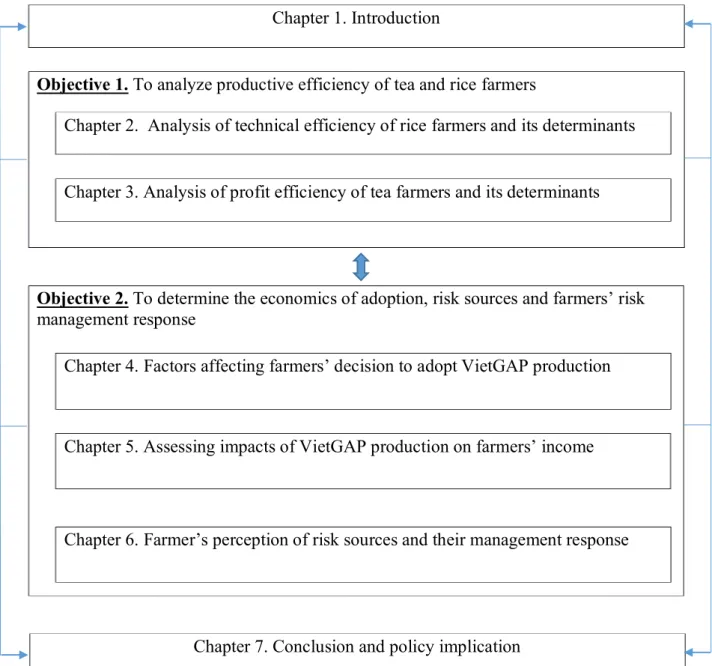
The content of study consists of 2 main objectives and is organized into 7 chapters.
Objective 1 covers chapter 2 and chapter 3, while chapter 4, 5 and 6 belong to the objective 2. The detail of each chapter is as follow. The chapter 1 with title “Introduction”
presents general information of agricultural sector, major crops and perennial plants, problem statement and objective of the study as well. While detailed analysis on current level of production and profit efficiency of rice and tea farmers would be found in chapter 2 and chapter 3 respectively. Moreover, determinants of improving technical and profit
efficiency for farmers will also be included in these chapters. Chapter 4 will focus on analyzing factors affecting farmers’ decision to adopt VietGAP tea production.
Contribution and importance of VietGAP tea production on household’s income will go into chapter 5. Farmer’s risk perception and their risk management response is one of important components of the study that will be detailed presented in chapter 6. Finally, main findings of the research and policy implications will be included in chapter 7.
The structure of the dissertation is presented as figure 1.6 below.
Figure 1. 6 Overall structure of the dissertation Chapter 1. Introduction
Objective 1. To analyze productive efficiency of tea and rice farmers
Chapter 2. Analysis of technical efficiency of rice farmers and its determinants
Chapter 3. Analysis of profit efficiency of tea farmers and its determinants
Objective 2. To determine the economics of adoption, risk sources and farmers’ risk management response
Chapter 4. Factors affecting farmers’ decision to adopt VietGAP production
Chapter 5. Assessing impacts of VietGAP production on farmers’ income
Chapter 6. Farmer’s perception of risk sources and their management response
Chapter 7. Conclusion and policy implication
1.6 Selection of study area
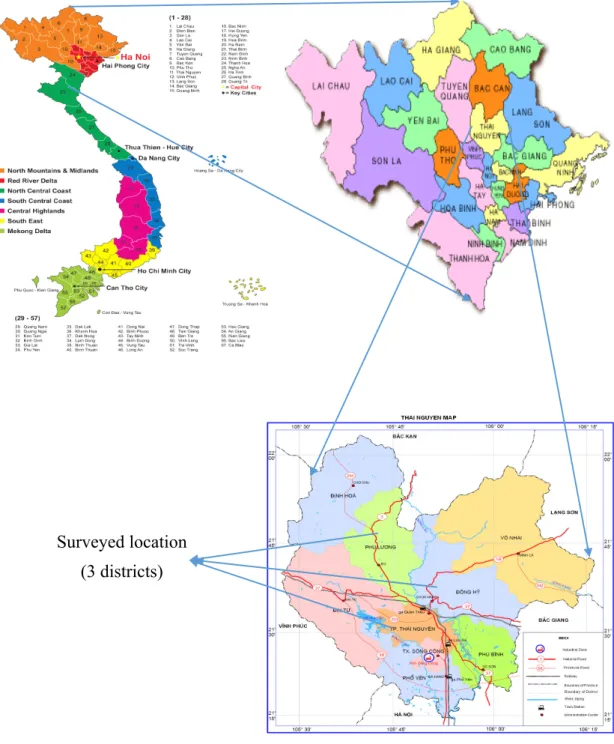
Northern Vietnam, including midland and northern mountainous region, has total natural land area of 95,222 km2 and population of 11.98 million people belonging to various ethnic minority groups (GSO, 2016). The region consists of 14 provinces locating in the northwest and northeast regions. The region is covered with mountains and hill ranges. And agricultural and forestry economics are dominated in the region due to favorable natural and climatic conditions for the sectors. The major cropping and perennial plants of the region include rice, maize, tea, rubber, Arabica-coffee etc. The study was conducted in Thai Nguyen province where its socio-economic and demographic characteristics could be a representative of Northern upland area of Vietnam. The province has a total population of 1,227.4 thousand persons with an average density of 384 persons per squared kilometer (GSO, 2016). Thai Nguyen province is divided into 09 administrative units including 7 districts, one city and one town: Dinh Hoa, Dai Tu, Dong Hy, Vo Nhai, Phu Binh, Phu Luong, Pho Yen district, Song Cong town and Thai Nguyen city. The smallest administrative unit in Vietnam is commune.
Moreover, tea and rice farming plays an essential role in household’s livelihood, especially in rural areas. While rice production is mainly produced for self- demand/sufficiency, tea plant is producing to serve as commercial purpose, bring back income as cash for daily life. The sampled farmers were randomly selected from representative districts of study area. Field survey was taken in two periods of time. Data of rice production was collected from 120 rice farmers, while primary data of tea production was gathered in 2016 through face to face interview of 116 VietGAP and 210 conventional tea farmers. Some observations with missing information was got rid out of dataset. Only observations with fully required information were used for analysis in the study. Prior to field survey, pretest survey was also conducted to adjust content of questionnaire following the real understanding of farmers and time management.
Numerators were selected from experienced staffs in field survey and also were carefully trained to ensure capturing the objective of research and get much information as possible.
Rice data was used in chapter 2, while data of tea production was used in all remaining chapters.
Surveyed location (3 districts)
Figure 1. 7 Map of study area
CHAPTER 2. PRODUCTIVE EFFICIENCY OF RICE FARMERS AND ITS DETERMINANTS
2.1 Introduction
Rice is a staple food of Vietnamese people, and is one of the main food crops that play an important role in household income in rural areas. Impressive growth of agriculture has brought significant benefits. The agricultural achievement has contributed significantly to poverty reduction in Vietnam. However, there are still many difficulties and challenges facing Vietnam now. Firstly, poverty rate is still as high as 13.5%
nationwide in 2014, and the rate is very high for ethnic minority groups. Secondly, income disparity is relative wide between urban and rural area, delta and mountainous area due to unequal growth amongst regions. Notably, ethnic minority groups of the region share only 7% of total population, but its poverty rate is 25.4% in compared with total number of the poor of the country (Nguyen et al, 2017). Northern upland area has total annual cropping land area of about 1.6 million ha, in which rice area is 579 thousand hectares, accounting for 35.4% and ranked 4th in Vietnam. The region’s economy is characterized by agricultural production. Farmer’s income depends mainly on agricultural activities such as cropping, animal husbandry, fishery raising and forestry activities, in which rice production plays an important role in household’s income, especially in the rural and mountainous area, accounting for about 25% (GSO, 2009).
Moreover, rice self-sufficiency also contributes to food security in upland area where public transportation system is still very difficult due to high and complex topography.
Although several studies on productive efficiency of agricultural crops were conducted in Vietnam (Nguyen et al. 2003; Linh, 2008), there are few studies on technical efficiency of rice production. And most of these studies were conducted in two main rice production areas such as Mekong river delta and Red river delta. Other studies tried to estimate the technical efficiency of rice production nationwide under an important assumption that there was no large difference among areas in Vietnam (Khai and Yabe in 2011). Therefore, our study would investigate technical efficiency and estimate the impact of various fertilizers on rice production. Its result will contribute more to comprehensive insight on whole picture of rice production in Vietnam.
2.2 Methodology
2.2.1 Overview of efficiency
Technical efficiency (TE) is one of the important and interesting index used in production firms. It is often used to measure efficiency of using resources such as land, labor, capital, materials and so on. And measuring technical efficiency is one of concerns of researchers with the objective to estimate efficient level of farmers involved in agricultural production. Technical efficiency helps researchers to answer question in short run: Can rice farmers increase their productivity under given conditions? Technical efficiency (TE) and allocative efficiency (AE) are two components of economic efficiency (EE).
2.2.1.1 Economic, technical and allocative efficiency
Production is a process of transforming inputs such as land, labor, capital, fertilizer… into output such as goods and services. This process is not only applied in agricultural production, but also in other production sectors. The difference of production performance is generally displayed at different inputs and outputs. Ultimate objective of agricultural production may be profit or revenue maximization, cost minimization, maximum output etc. They can vary from time to time or firm to firm. Some concepts cover technical efficiency such as productive efficiency or economic efficiency.
Production efficiency is composed of two components including technical efficiency and allocative efficiency. The purely technical or physical component is defined as the firm’s ability to avoid waste during production. In other words, a firm use the given inputs to create an output as high as possible, or produce a given output by applying inputs as low as possible. Thus, the target of an estimation of technical efficiency is to find solutions to increase output or decrease inputs in the context of available conditions. While the allocative or price component is determined by combination of inputs and outputs in the optimal level in term of considering market prices. Measuring technical efficiency implies use of input and output quantity without introducing their prices. Technical efficiency can also be further decomposed into three subcomponents, which are scale efficiency (the potential productivity gain from achieving the optimal size
of a firm), congestion (increase in some inputs could decrease output), and pure technical efficiency (Farrell, 1957).
Economic efficiency involves in increasing output without using more than conventional inputs. The use of existing technologies is more cost-effective than applying new technologies if farmers currently cultivate their products inefficiently with current technologies (Shapiro, 1977). Economic efficiency can be classified into two types:
technical efficiency and allocative efficiency. Technical efficiency measures the ability of a farmer to achieve maximum output with given and obtainable technologies. While allocative efficiency tries to capture a farmer’s ability to apply the inputs in optimal proportions with respective prices (Farrell, 1957, Shapiro, 1977). The technical efficiency (TE) of a firm always varies from 0 to 1 value (0 ≤ TE ≤ 1). If TE is equal to 1, the firm produces with full technical efficiency. For instance, the firm could achieve full technical efficiency.
2.2.1.2 Concept of production frontier
In microeconomic theory, a production function is a function that specifies the output of a firm for all combinations of inputs. Given the set of all technically feasible combinations of output and inputs, only the combination encompassing a maximum output for a specified set of inputs would constitute the production function.
Alternatively, a production function can be defined as a specification of the minimum input requirements needed to produce an output, given available technologies. By assuming that the maximum output technologically possible from a given set of inputs is achieved, economists are using production function in analysis to solve problems of technical efficiency and allocative efficiency. The observed outputs below the production frontier show the firm producing inefficiently.
2.2.2 Techniques of efficiency measurement
There are two methods widely applied to estimate the technical efficiency of a firm: parametric and non-parametric. The parametric approach assumes a functional relationship between output and inputs and uses statistical techniques to estimate the parameters of the function. The non-parametric approach, in contrast, constructs a linear piecewise function from empirical observations on inputs and output without assuming
any functional relationship between them. Non-parameter and parametric approach method are called in term of DEA and SFA respectively. The comprehensive reviews of the two methods are carried out by Kalirajan and Shand (1999); Bravo-Utera and Pinheiro (1997). The choice as the best method is unclear. Some rigorous empirical analyses have been conducted in assessing the sensitivity of efficiency measures to the choice of DEA and SFA in agriculture (Sharma et al. 1999). The limited findings show that efficient score estimated from each approach is quantitative change, although the ordinal efficiency ranking of farms achieved from two methods are quite similar. So the choice of other method application depends on the objectives of the study, type of farms and some assumptions regarding the data generating process.
Data envelopment analysis (DEA) is a mathematically programming method that is useful for multiple-input and multiple output production technologies. The method, initially studied by Charnes et al. (1978), uses linear programming methods to build a non-parametric piece-wise surface or frontier over the data and estimate each data point’s efficiency relative to the frontier. The DEA method assumes that the variables are reasonably separated into inputs and outputs. Each data point in DEA represents a decision-making unit (DMU), or a producer in practice. The decision of a unit is to create outputs by using inputs as efficiently as possible (Zheng et al, 2004).
Stochastic frontier approach (SFA) uses econometrics based on the deterministic parameter frontier. Aigner et al. (1977) independently proposed the stochastic frontier production function model of the form: lnqi = xiβ + νi – ui, where qi represents the output of the ith firm; xi is a vector containing the logarithms of inputs; β is a vector of unknown parameters; vi accounts for statistical noise; ui represents for technical inefficiency. The different techniques are applied to generate the strengths and weaknesses of the two methods. The econometric approach is stochastic and parametric. It has ability to separate the effects of noise from the effects of inefficiency and confound the effects of misspecification of functional form with inefficiency, but generate good results only for single output and multiple inputs. In contrast, DEA method is not stochastic and parametric. It does not separate the effect of noise and inefficiency during the computation of technical efficiency, and less sensitive to the type of specification error, but could be useful to apply for farms with multiple inputs and multiple outputs
production. The calculation of technical efficiency using the production frontier model is only applied to single output production. Depending on the structure of the data (whether cross-sectional data or panel data), different estimate techniques are applied in reality.
2.2.3 Analytical framework
As described in sections above, two methods have been widely used to estimate technical efficiency, including Data Envelope Analysis (DEA) and Stochastic Frontier Analysis (SFA). Both methods have different strengths and weaknesses. In the study, we use SFA technique because it can separate the effects of noise from technical inefficiency.
And it only can generate good results for production systems with only one output and multi-inputs. Rice production in Vietnam has one output of quantity and inputs of seed, fertilizers, labor, pesticide and hired machine. And Cobb-Douglas production function was extensively used in the literature. In the research rice yield is used as dependent variable instead of rice production as well as Nguyen et al. (2003), because it is a realistic assumption that a similar harvest regularity about scale for each farmer existed in the study area due to small rice area per household, given applied technology in rice production and similar natural conditions in the region. Logarithm both side of the function will result in the model as below.
The Cobb-Douglas production function can be expressed by following equation
ln yi = βo + Σ βj ln (xij) + εi (2.1)
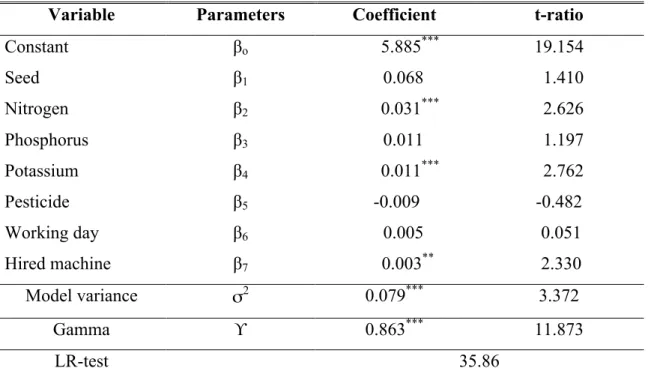
Where yi is rice yield of ith farm, xij is the jth input (j=1-7) used by ith farmer. βo is intercept and βj are parameters to be estimated or elasticity corresponding to each input (j=1-7), including used seed, nitrogen, phosphorus, potassium, pesticide, working day and hired machinery, respectively and εi is an error term consisting of two components, Vi and Ui. Where Vi is random variable error associated with random factors such as measurement errors and other statistical noise and exogenous factors beyond the farmer’s control such as natural disasters. Vi is assumed to be independently and identically distributed, and independent of Ui. While Ui is non-negative random variable associated with farm’s specific factors which would affect technical efficiency of rice farmers. Ui is assumed to be independently truncated-normal distribution with mean µ and variance δ2. Although
Ui can also have other distributions, FRONTIER 4.1c computer program used in the study can only harmonize with above assumption. The term µi is defined as follows
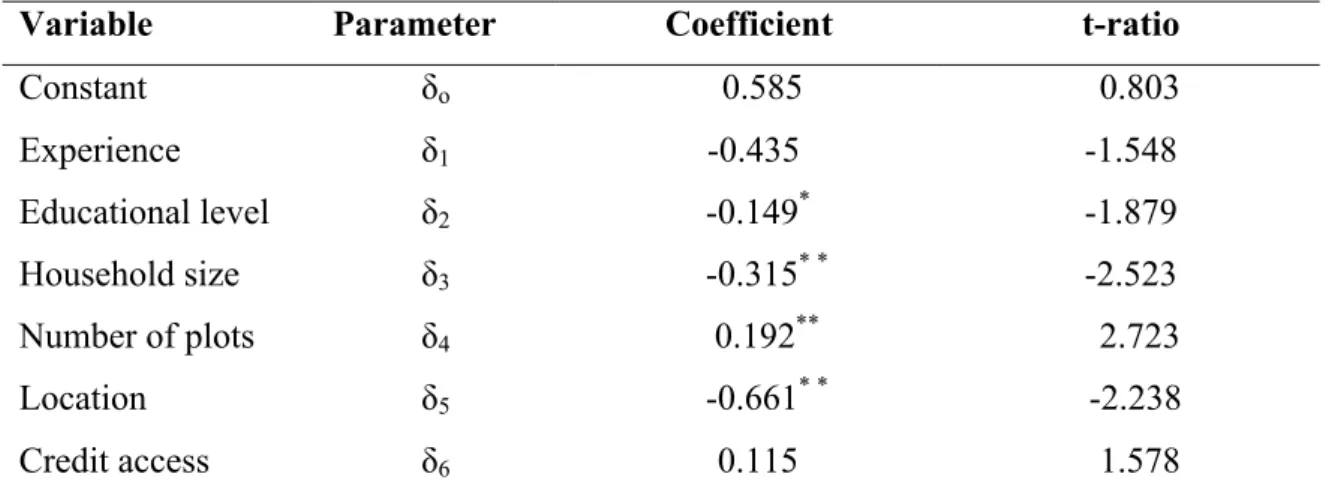
µi = δo + δ1Z1j + δ2Z2j + δ3Z3j + δ4Z4j + δ5Z5j + δ6Z6j + ωi (2.2) Where µi is inefficiency effects that could be estimated by 2 stage estimation technique in FRONTIER 4.1c spontaneously. δo is the intercept term, δj is the parameter for jth independent variables. Z1j is experience of farmers (years); Z2j is education level of farmers (years); Z3j is household size (persons); Z4j is number of land plots; Z5j is area variable, Z5j = 1 means Northeast and 0 means Northwest area; Z6j is credit access, if Z6j
= 1 then farmer has borrowed credit loans from financial agencies and zero otherwise; ωi
is an error term (unobservable random variables). Maximum likelihood estimates (MLEs) for all parameters of the stochastic frontier production (1) and inefficiency model (2) and were simultaneously estimated by using the FRONTIER 4.1c computer program (Coelli, 1996). This program also presented the coefficients of variance parameters.
σ2 = σ2v + σ2u (2.3)
γ = σ2u/ σ2v (2.4)
0 ≤ γ ≤ 1
Where γ parameter gamma shows the share of inefficiency in the overall residual variance and lies between zero and one. If gamma is equal to zero (0), then it means that all variations of rice yield are due to noise. And if gamma is equal to one, then it means that all variation of rice yield is due to technical inefficiency (Coelli and Battese, 1996).
2.2.4 Data collection
The study was conducted in Thai Nguyen province, locating in the center of the northern upland area of Vietnam. A multistage sampling technique was used to select 120 sample farmers in 18 villages belonging two districts of the province. For the sampling method, some aspects were considered in selecting households such as geographical location, rice production area, family status. The farm-level data was collected by interviewing farmers based on detail questionnaire, including information about general characteristics of household, farm size, inputs and output information such as rice yield, rice varieties, fertilizer applications, credit and agricultural extension service. While
secondary data was collected through General Statistic Office of Vietnam and communal report during field survey in 2011.
2.3 Results and discussion
2.3.1 Descriptive statistics of variables
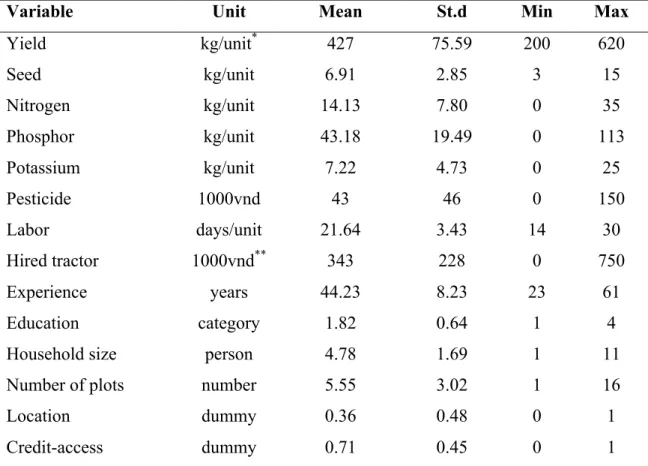
Table 2. 1 Descriptive statistic of variables in the model
Variable Unit Mean St.d Min Max
Yield kg/unit* 427 75.59 200 620
Seed kg/unit 6.91 2.85 3 15
Nitrogen kg/unit 14.13 7.80 0 35
Phosphor kg/unit 43.18 19.49 0 113
Potassium kg/unit 7.22 4.73 0 25
Pesticide 1000vnd 43 46 0 150
Labor days/unit 21.64 3.43 14 30
Hired tractor 1000vnd** 343 228 0 750
Experience years 44.23 8.23 23 61
Education category 1.82 0.64 1 4
Household size person 4.78 1.69 1 11
Number of plots number 5.55 3.02 1 16
Location dummy 0.36 0.48 0 1
Credit-access dummy 0.71 0.45 0 1
Note: *1 unit = 1000m2; **vnd: monetary unit of Vietnam Source: Author’s data was surveyed in 2011 (n=120)
Summary statistics of all variables in production function and some farm specific characteristics affected technical inefficiency was shown in table 2.1. Average rice yields o sampled farmers were 427 kg/unit. Seed quantity was applied to reach 6.91 kg/unit.
Other physical inputs of rice production include fertilizer, pesticide. For fertilizers, farmers apply various types such as nitrogen, phosphorous and potassium. And no respondents replied that organic fertilizers were applied in their rice farm. In study area chemical pesticide was also popularly applied in reducing damage from pest and insect.