
九州大学学術情報リポジトリ
Kyushu University Institutional Repository
符号問題のない領域からの量子色力学相図の決定
境, 祐二
九州大学大学院理学府
https://doi.org/10.15017/21708
出版情報:Kyushu University, 2011, 博士(理学), 課程博士 バージョン:
権利関係:
Determination of the phase diagram of Quantum Chromodynamics
from the regions with no sign problem
Yuji Sakai
Theoritical Nuclear Physics, Department of Physics,
Graduate School of Sciences, Kyushu University
Acknowledgements
I would like to express my special gratitude to Prof. Masanobu Yahiro who is teaching and supporting me as a supervisor. By his valu- able suggestions through many discussions, my Master and Doctoral Course become a fruitful and wonderful period in my life. I would like to thank Prof. Masayuki Matsuzaki and Associate Prof. Hiroaki Kouno who gave me a lot of useful comments and helpful discussions on this thesis. Through many discussions, I was able to obtain much beneficial knowledge. I wish to express my deep appreciation to As- sociate Prof. Yoshifumi R. Shimizu, Assistant Prof. Kazuyuki Ogata and Assistant Prof. Takuma Matsumoto. They gave me much im- portant knowledge of Nuclear Physics from all seminars, lessons and discussions. I would like to thank Assistant Prof. Namiko Mitarai for her helpful comments in the Front Researcher Development pro- gram. I would like to thank my friends in the Nuclear Theory Group and other divisions in Kyushu University. This work was supported by the Research Fellowships of the Japan Society for the Promotion of Science (JSPS) for Young Scientists. Finally, I deeply appreciated grateful supports of my families who stood by me and gave me in- telligent advices whenever I was at a loss what to do. Without their supports I never accomplished this great works.
Abstract
Quantum chromodynamics (QCD) is the theory of the strong inter- action between quarks and gluons. The interaction becomes small at high energy, while it does strong at low energy. It is highly expected from the energy dependence that the QCD matter at high tempera- ture T and/or high quark chemical potential µq experiences a phase transition from a confined state with the chiral symmetry breaking to a deconfined state with the symmetry restoration. The phase diagram in theT-µq plane is relevant to the early universe, compact stars and heavy-ion collisions. The first-principle lattice QCD (LQCD) suffers from the sign problem at finite µq where the integrand of the parti- tion function is complex and LQCD techniques break down. Therefore the QCD phase diagram at finite µq is unclear. In this thesis, we pro- pose a new strategy to investigate the QCD phase diagram at finite µq. There are some regions with no sign problem, imaginary µq and real and imaginary isospin chemical potentials µiso. We then propose an analytic continuation from the regions with no sign problem to the real µq region with the sign problem by using an effective model that can evaluate the QCD partition function in all the regions. The Polyakov-loop extended Nambu–Jona-Lasinio (PNJL) model is only the effective model that can do this. We show that the PNJL model reproduces LQCD data qualitatively in all the regions, but not quan- titatively. We then extend the PNJL model in order to reproduce the LQCD data quantitatively. The QCD phase diagram at realµq is predicted by the new model.
Contents
Contents iv
List of Figures viii
1 Introduction 1
2 Quantum Chromodynamics 3
2.1 Quantum Chromodynamics . . . 3
2.2 Symmetries in QCD Lagrangian . . . 4
2.3 QCD vacuum structure . . . 5
2.3.1 Chiral symmetry breaking . . . 5
2.3.2 Confinement . . . 7
2.3.3 Relation between two phenomena . . . 8
2.4 QCD phase diagram . . . 9
2.5 Thermodynamics of QCD . . . 10
2.6 Lattice QCD . . . 11
3 Polyakov-loop extended Nambu–Jona-Lasinio model 14 3.1 PNJL Model . . . 14
3.2 Polyakov potential . . . 16
3.3 Thermodynamics in the PNJL model . . . 18
3.3.1 Thermodynamic potential . . . 18
3.3.2 Meson properties . . . 20
3.3.3 Parameter set . . . 21
3.3.4 Chiral and deconfinement phase transitions . . . 21
CONTENTS
3.3.5 Thermodynamic quantities . . . 23
3.4 Summary . . . 25
4 Sign Problem 26 4.1 Sign Problem in the PNJL model . . . 26
4.2 Mean Field Approximation . . . 28
4.3 Average Phase Factor . . . 29
4.4 Purpose . . . 30
4.5 Formulation . . . 31
4.5.1 Mean Field Approximation . . . 32
4.5.2 Effect of the Static Fluctuation . . . 33
4.5.3 Effect of the Dynamic Fluctuation . . . 35
4.6 Numerical Results . . . 36
4.6.1 The Polyakov loop and its conjugate . . . 36
4.6.2 Average Phase Factor . . . 39
4.6.3 Comparison to the LQCD results . . . 39
4.6.4 The average phase factor in the µq-T plane . . . 42
4.6.5 Relation of the phase factor to the Polyakov loop . . . 42
4.7 Summary . . . 44
5 Imaginary Chemical Potential 45 5.1 Relation between real and imaginary µq. . . 45
5.2 Purpose . . . 47
5.3 Roberge-Weiss periodicity . . . 48
5.4 Roberge-Weiss transition . . . 50
5.5 The PNJL model at imaginary µq . . . 51
5.5.1 Extended Z3 symmetry . . . 51
5.5.2 θq reflection symmetry . . . 52
5.5.3 The potential at high or low T limit . . . 53
5.5.4 Comparison of the PNJL model to others . . . 55
5.6 θq dependence of some quantities . . . 55
5.6.1 Thermodynamic potential . . . 55
5.6.2 Polyakov loop . . . 56
CONTENTS
5.6.3 Chiral condensate . . . 57
5.6.4 Quark-number density . . . 58
5.6.5 Meson masses . . . 59
5.7 Phase diagram . . . 61
5.8 Analytic continuation to real µq . . . 63
5.9 Remarks . . . 65
5.9.1 Analogy to the Dashen mechanism . . . 66
5.9.2 Vector-type interaction . . . 67
5.10 Summary . . . 69
6 Isospin Chemical Potential 71 6.1 Purpose . . . 71
6.2 Pion at isospin chemical potential . . . 73
6.2.1 QCD inequalities . . . 73
6.2.2 Chiral perturbation theory . . . 74
6.3 Imaginary isospin chemical potential . . . 75
6.3.1 Properties of the partition function . . . 76
6.3.2 PNJL model . . . 77
6.3.3 θq dependence . . . 79
6.3.4 θiso dependence . . . 82
6.3.5 Thermodynamics in the θq-θiso plane . . . 84
6.3.6 Comparison of PNJL model with LQCD . . . 84
6.3.7 Phase diagram in θiso-T plane . . . 90
6.4 Real isospin chemical potential . . . 92
6.4.1 Chiral and Pion Condensates . . . 92
6.4.2 Phase diagram . . . 95
6.5 Summary . . . 95
7 Entanglement PNJL model 97 7.1 Purpose . . . 97
7.2 Entanglement PNJL model . . . 99
7.3 Comparison with LQCD . . . 100
7.3.1 Imaginary quark chemical potential . . . 101
CONTENTS
7.3.2 Isospin chemical potential . . . 109 7.3.3 Small real quark chemical potential . . . 113 7.4 Summary . . . 113
8 Conclusions 116
List of Figures
2.1 Schematic picture of the QCD phase diagram . . . 9
3.1 Order parameters in the PNJL model . . . 22
3.2 Order parameters in the PNJL model . . . 23
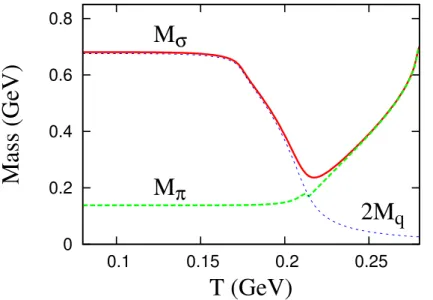
3.3 T dependence of the meson masses . . . 24
3.4 Order parameters in the PNJL model . . . 25
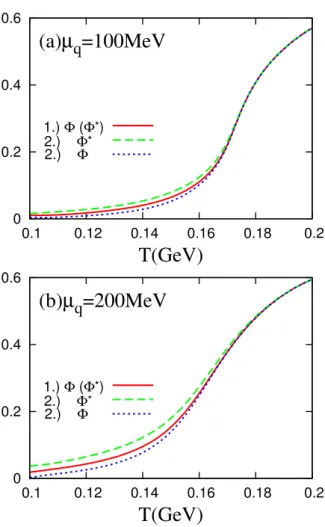
4.1 T dependence of the Polyakov loop and its conjugate . . . 37
4.2 The difference between the Polyakov loop and its conjugate . . . . 38
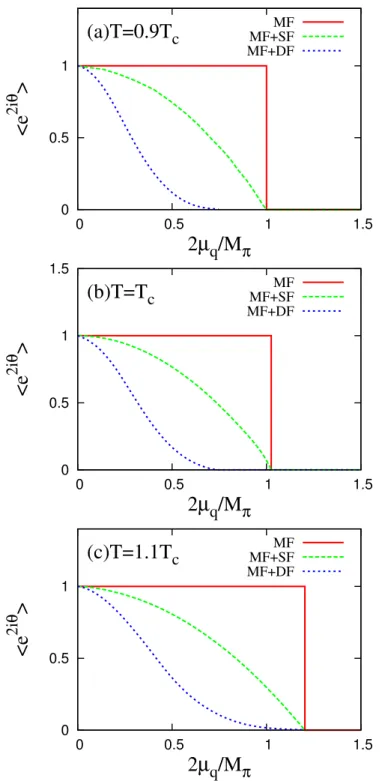
4.3 µq dependence of the average phase factor . . . 40
4.4 Comparison of the average phase factor with the LQCD results . . 41
4.5 The average phase factor in the µq-T plane . . . 43
4.6 The Polyakov loop dependence of the average phase factor . . . . 43
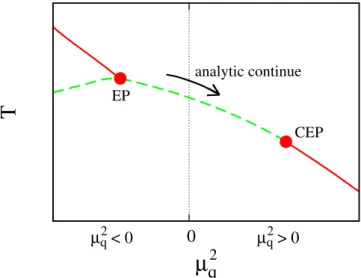
5.1 Schematic picture of the QCD phase diagram in the µ2q-T plane. . 46
5.2 Predictions for location of the critical endpoint . . . 48
5.3 θq dependence of the potential with the fixed phases . . . 51
5.4 θq dependence of the thermodynamic potential . . . 56
5.5 θq dependence of the Polyakov loop . . . 57
5.6 θq dependence of the chiral condensate . . . 58
5.7 θq dependence of the quark-number density . . . 59
5.8 θq dependence of the meson masses . . . 60
5.9 T dependence of the Polyakov loop at θq=π/3 . . . . 61
5.10 The Polyakov loop in theθq-T plane. . . 62
5.11 The phase diagram at imaginaryµq . . . 63
LIST OF FIGURES
5.12 The phase diagram in theµ2q-T plane . . . 64
5.13 Extrapolation of the chiral phase transition curve . . . 65
5.14 Dependence of CEP on the strength of the vector-type interaction 67 5.15 Impact of the vector-type interaction at imaginary µq . . . 68
6.1 θq dependence of the potential . . . 81
6.2 Phase diagram in the θiso-θq plane at T = 250MeV . . . 82
6.3 θI dependence at lower temperature . . . 83
6.4 Thermodynamics in theθq-θiso plane . . . 85
6.5 LQCD results for the number densities in the θq-θiso plane . . . . 86
6.6 Comparison of the PNJL model with LQCD . . . 87
6.7 T dependence of number densities . . . 89
6.8 T dependence of |Φ| and σ atθiso=π/2 . . . 90
6.9 Phase diagram in θiso-T plane . . . 91
6.10 Pion condensate at real isospin chemical potential . . . 94
6.11 Pion condensate at real isospin chemical potential . . . 94
7.1 Effective vertex in the EPNJL model . . . 100
7.2 T dependence of the order parameters atµq= 0 . . . 102
7.3 T dependence of the susceptibilities at µq = 0 . . . 102
7.4 T dependence of the order parameters atθq =π/3 . . . . 103
7.5 T dependence of the susceptibilities at θq=π/3 . . . . 103
7.6 θq and T dependences of the phase of the Polyakov loop . . . 104
7.7 Phase diagram in θq-T plane . . . 106
7.8 Mass dependence of the RW endpoint . . . 107
7.9 Phase diagram in the µ2q-T plane . . . 108
7.10 T dependence of the order parameters atθiso =π/2 . . . . 109
7.11 T dependence of the order parameters at realµiso . . . 111
7.12 Phase diagram in theµiso-T plane . . . 112
7.13 T dependence of the equation of state . . . 114
Chapter 1 Introduction
Quantum chromodynamics (QCD) is the theory of the strong interaction be- tween quarks and gluons. The interaction becomes small at high energy, while it does strong at low energy. As a result of the strong interaction, the QCD vac- uum has two remarkable phenomena, spontaneous chiral symmetry breaking and confinement. The spontaneous chiral symmetry breaking provides us the mech- anism of generation of massive nucleons from light quarks and that of pions as Nambu-Goldstone bosons. The confinement is a phenomenon that color charged particles, quarks and gluons, cannot be isolated. Since the interaction decreases with increasing the energy scale, it is natural to consider that the QCD matter at high energy density undergoes a phase transition from a confined state with the chiral symmetry broken to a deconfined state with the symmetry restored.
The QCD phase diagram in the plane of temperature T and quark chemical po- tential µq provides us many insights of nature. The early universe after the Big Bang would be very hot and thus have experienced the QCD phase transition at high T and low µq. The core of compact stellar objects such as neutron stars would be a relevant place for dense QCD matter at low T and high µq. Ex- perimentally, the heavy-ion collisions, such as the Relativistic Heavy-ion Collider (RHIC) at BNL, the Large Hadron Collider (LHC) at CERN and Japan Proton Accelerator Research Complex (J-PARC) at JAEA and KEK, provides us with a chance to create hot and/or dense QCD matter. In order to investigate the QCD phase diagram, we have to deal with some nonperturbative methods. Lattice
i.e., to evaluate the partition function numerically on a spacetime lattice. LQCD provides us many insights at finite T and zero µq; for example the chiral phase transition is crossover there. It, however, suffers from the sign problem at finite µq where the integrand of the partition function is complex and thereby LQCD techniques break down. The QCD phase diagram at finiteµqis therefore unclear.
In this thesis, we propose a new strategy to investigate the QCD phase diagram at finiteµq. There are some regions with no sign problem, imaginaryµq, real and imaginary isospin chemical potentials µiso. We then propose an analytic contin- uation from the regions with no sign problem to the real µq region by using an effective model that can evaluate the QCD partition function in all the regions.
The Polyakov-loop extended Nambu–Jona-Lasinio (PNJL) model is an effective model that can do this. We show that the PNJL model reproduces LQCD data qualitatively in all the regions with no sign problem, but not quantitatively. We then extend the PNJL model in order to reproduce the LQCD results quantita- tively.
This thesis is organized as follows. In Chapter 2, we overview properties of QCD at vacuum and the QCD phase diagram at finite T and µq. This shows current states and difficulties in the study of the QCD phase diagram. In Chapter 3, we recapitulate thermal properties of the PNJL model at zero µq. After these introductory chapters, Chapters 4-7 are devoted to our study. In Chapter 4, we investigate the sign problem by using the PNJL model. We evaluate the average phase factor as an indicator of the sign problem. The severe region where the factor is small or zero spreads widely over the phase diagram. It is thus difficult to investigate the phase diagram by LQCD directly. In Chapters 5 and 6, we analyze the imaginary µq region and the real and imaginary µiso regions with the PNJL model, respectively. For all the regions, the PNJL model reproduces the LQCD data qualitatively, but not for the coincidence between the chiral and deconfinement crossover transitions. In Chapter 7, we extend the PNJL model to solve this problem. The new model reproduces LQCD data quantitatively in all the regions with no sign problem. Finally we predict the QCD phase diagram with the new model.
Chapter 2
Quantum Chromodynamics
In this chapter we introduce Quantum chromodynamics (QCD) as the fundamen- tal theory of strong interactions. We discuss two important phenomena of QCD vacuum, the spontaneous chiral symmetry breaking and confinement, which play an important role in later parts of this work. We also discuss the QCD phase diagram at finite temperature and finite quark chemical potential [1].
2.1 Quantum Chromodynamics
Quantum Chromodynamics (QCD), the non-Abelian gauge theory with color SU(3)c gauge invariance, is the theory of the strong interaction. The fundamen- tal degrees of freedom are spin-1 gauge bosons (gluons Aµ), and massive spin-12 fermions (quarks q). Gluons and quarks belong to the adjoint and fundamental representations ofSU(3)c, respectively. QCD is defined as a field theory with the Lagrangian density,
L= ¯q(iγµDµ−m)q− 1
4g2Fµνa Faµν, (2.1) where m is the current quark mass, Dµ =∂µ+iAaµta is the covariant derivative with the coupling constant g and ta is the generators of SU(3)c satisfying the commutation relations, [ta, tb] = ifabctc, and the normalization, tr(tatb) = 12δab, wherefabc are the group structure constants. The field strength tensor is defined
2. Quantum Chromodynamics
the SU(3)c gauge transformation
q→U(x)q, Aµ→U(x)(Aµ+i∂µ)U†(x), (2.2) where U(x) = exp(−iθa(x)ta). Since QCD is renormalizable, its bare parameters g and m depend on the energy scale Q. The renormalization group equation based on the perturbative calculation reads
α(Q2) = g(Q2)
4π = 1
4πβ0ln(Q2/ΛQCD), (2.3) where β0 = (4π)1 2
(11− 23Nf)
and Nf is the number of quark flavors. The QCD scale parameter is given by ΛQCD = κexp(−1/2β0g2) with the renormalization point κ and determined from experiment to be ΛQCD ≈ 200MeV ≈ 1fm−1. As long as β0 > 0 (Nf ≤ 16), the running coupling decreases logarithmically at large energy (or short distance) so that the asymptotic freedom of QCD can be realized [2]. In contrast, the coupling increases at low energy and the perturba- tive calculation breaks down. Quarks have flavors of Nf = 6 with the masses mu ≈ md ≈ 5MeV, ms ≈ 150MeV, mc ≈ 1.5GeV, mb ≈ 5GeV, mt ≈ 170GeV, respectively. In this thesis, we focus on physics at the energy scale ∼ ΛQCD and we consider mainly the two-flavor case of u and d, since the influence of heavy quarks is negligible there.
2.2 Symmetries in QCD Lagrangian
Symmetries of Lagrangian are important to describe a main property of theories.
As for QCD, one of important symmetries is the chiral symmetry. In the massless limit m = 0, the QCD Lagrangian density (2.1) is divided into the left- and right-handed quark parts that are the eigenstates of the chirality operator γ5, qR/L= 12(1±γ5)q. In this limit, the QCD Lagrangian is thus invariant under the flavor U(Nf)L×U(Nf)R global transformation, qR/L → exp (−iθata)qR/L where ta is the generator of U(Nf). This is the chiral symmetry. The transformation
2. Quantum Chromodynamics
converts the vector and axial-vector ones as
q →e−iθaVtaq, q→e−iθAataγ5q, (2.4) withθV=θL =θRandθA=−θL=θR. The corresponding conserved currents are vector and axial-vector currents, JVaµ = ¯qγµtaq and JAaµ = ¯qγµγ5taq, and thereby they have the following relations
∂µJVaµ = i¯q[m, ta]q, (a= 0, ..., Nf2−1), (2.5)
∂µJAaµ = i¯q{m, ta}γ5q, (a = 1, ..., Nf2−1), (2.6)
∂µJA0µ = √ 2/Nf
(
iqmγ¯ 5q− 2Nf
64π2FaµνF˜µνa )
, (2.7)
where ˜Fµνa =ϵµνρσFaρσ(ϵ0123 = 1) is the dual field strength. TheU(1)AcurrentJA0µ is explicitly broken even at m = 0 by the quantum effect that is originated from the non-invariance of the path integral measure under theU(1)Atransformation.
This gives rise to an unnaturally large η′ meson mass.
2.3 QCD vacuum structure
Since the QCD running coupling becomes stronger at low energy, quarks and glu- ons interact nonperturbatively there. There are two remarkable phenomena in the nonperturbative regime, spontaneous chiral symmetry breaking and confinement.
2.3.1 Chiral symmetry breaking
The chiral symmetrySU(Nf)V×SU(Nf)Ain the Lagrangian is broken at vacuum.
Here we consider the Nf = 2 case for simplicity. In nature, there is a triplet of light pseudoscalar mesonsπ, while the parity partner of scalar mesonσhas much heavier mass. This mass gap is explained as spontaneous breaking of the chiral symmetry. For nonperturbative nature, the ground state|0⟩of QCD is symmetric only under the SU(Nf)V transformation generated by the vector charges QaV =
∫ d3xJVa0, i.e., QaV|0⟩ = 0, but not under the SU(Nf)A transformation generated
∫ | ⟩ | ⟩ ̸
2. Quantum Chromodynamics
energetically degenerate with the ground state|0⟩and which carries the quantum numbers of the corresponding axial charges. These are Nambu-Goldstone bosons of light pseudoscalar mesons. The SU(Nf)A transformation of the pion state, πa= ¯qiγ5taq, is given as, forNf = 2
[QaA,qiγ¯ 5taq] =−iδabqq,¯ (2.8) thus the chiral partner of the pseudoscalar mesons is the sigma mesonσ= ¯qq and the expectation value of theσ state is an order parameter of the chiral symmetry,
⟨qq¯ ⟩=⟨q¯LqR+ ¯qRqL⟩. (2.9) The decay amplitude of the pion is written as
⟨0|JAaµ(x)πb(p)⟩
=−ipµfπδabe−ipx, (2.10) where fπ is the pion decay constant. By combining (2.6) with (2.8), we obtain
⟨0|[
Q1A, ∂µJA1µ]
|0⟩=−i
2(mu+md)⟨qq¯ ⟩, (2.11) where mu and md are u and d quark masses, respectively. The expression on the left-hand side can also be calculated from (2.10) by inserting a complete set of pseudoscalar states in the commutator. Truncating this set by the one-pion states |πa⟩, one obtains
Mπ2fπ2 =−m⟨qq¯ ⟩+O(m2), (2.12) where the isospin symmetry is assumed, mu = md = m. The relation (2.12) is called the Gell-Mann–Oakes–Renner relation [7]. Here inserting fπ ≈ 93MeV, Mπ ≈ 140MeV and m ≈ 5MeV into (2.12), we obtain ⟨qq¯ ⟩ ≈ −(250MeV)3 and the chiral symmetry is spontaneously broken at vacuum.
2. Quantum Chromodynamics
2.3.2 Confinement
Another important aspect of nonperturbative QCD is quark confinement. The mechanism is however much less known. Confinement is the phenomenon that all color charges are completely screened in the far away region of the color source.
In the heavy quark limit, confinement means that a system with a static color source and a static color sink at infinite separation has an infinite free energy.
More precisely, the free energy FQQ¯ of a heavy quark ¯QQ pair is proportional to the separation R of the two quarks. The free energy is obtained from the expectation value of the Wilson loop [8]
W(C) = Tr [
Pexp (
−i I
C
Aµdxµ )]
, (2.13)
where the integral is made over a closed pathC andPdenotes the path ordering.
In order to relate the Wilson loop to the free energy, we consider the process where a heavy static ¯QQ pair is created at x0 = 0, propagates to time x0 = T → ∞, and then is annihilated. The Euclidian amplitude for the process is obtained as
⟨QQ¯ e−HTQQ¯⟩
=
∫
DAaµe−S−i∫AaµJaµd4x =e−FQQ¯ (R)T, (2.14) whereHis the Hamiltonian andFQQ¯ is the free energy. The currentJaµ describes the closed path C of the creation and annihilation of the QQ¯ pair. We take the current Jaµ = H
Cdzµtaδ4(x−z) corresponding to a quark Q moving along the path C,
e−FQQ¯ (R)T =
∫
DAaµe−S−iHCAaµtadxµ =⟨W(C)⟩. (2.15) Evaluating the expectation value of the Wilson loop, we thus get the free energy of a heavy static particle-antiparticle pair. The free energy proportional to the distance does not allow the flux to spread over infinite space. The factor of the proportionality is called string tension.
2. Quantum Chromodynamics
2.3.3 Relation between two phenomena
The chiral symmetry is realized only in the limit of light quark. Meanwhile, the confinement is well defined only at heavy quark masses. Thus the two phenomena can be considered in the opposite limits. Here we comment on the simple argu- ment about the relation between the two phenomena. An argument [4] made by Casher is that the chiral symmetry should be broken in the confinement phase.
The argument is simple and transparent. Suppose quarks are confined in hadrons and the attraction is chiral invariant. In a semi-classical description a bound state is constructed by superposing paths where the bound quarks have to reverse its direction of motion. Since the chirality, that is helicity in massless limit, is con- served in the interaction, the force can flip neither the spin nor the direction of motion due to the helicity conservation. In compensation for the chirality the chiral condensate has a non-zero expectation value and then the chiral symmetry is spontaneously broken in the confinement phase. Another argument [5] is based on the anomaly matching condition proposed by ’t Hooft [6]. Some of the elec- troweak anomalies are canceled between quarks and leptons. Since the leptonic anomaly is unchanged in the confinement phase, the hadrons must represent the flavor anomalies of QCD and ensure the cancellation of the leptonic anomaly. We consider flavor currents such as a left-handed current Jµ = ¯qξ(1−γ5)γµq where ξ is some combination of the generators of SU(Nf) with tr(ξ3)̸= 0. This current has an anomaly expressed as
rαΓµνα(p, q, r) = i g2
4π2tr(ξ3)ϵµνβγpβqγ, (2.16) Γµνα(p, q, r) =
∫
d4x1d4x2eipx1+iqx2⟨Jµ(x1)Jν(x2)Jα(0)⟩ (2.17) where (p+q+r)α = 0. This amplitude Γµνα has massless poles likep2, q2 orr2. Thus the current Jµ has to create massless states, that is, the Nambu-Goldstone boson due to the spontaneous chiral symmetry breaking.
2. Quantum Chromodynamics
2.4 QCD phase diagram
Since the QCD running coupling decreases with respect to increasing the energy scale, it is natural to consider that the QCD matter at high energy density under- goes the phase transition from a confined state with the chiral symmetry breaking to a deconfined state with the chiral symmetry restoration. The former (latter) is called the hadron (quark-gluon plasma: QGP) phase. Since the intrinsic scale of QCD is ΛQCD ∼ 200MeV, the QCD phase transition may take place around temperature T ∼ ΛQCD or the baryon number density ρ1/3B ∼ ΛQCD = 1fm−1. In the early universe about 10−5s after the Big Bang, the universe would have
QCD
Quark-Gluon Plasma Temperature
Color Superconductor Quark Chemical Potential Hadron Phase
Figure 2.1: Schematic picture of the QCD phase diagram.
experienced the QCD phase transition. The core of compact stellar objects such as neutron stars thus would be the relevant place where dense QCD matter at low temperature is realized. For asymptotically high density, the QCD ground state forms a condensate of quark Cooper pairs, namely the color superconductor.
Since quarks have color and flavor quantum numbers, the color superconductor phase has a rich structure. Experimentally, the heavy-ion collisions such as the Relativistic Heavy-ion Collider (RHIC) at BNL, the Large Hadron Collider (LHC)
2. Quantum Chromodynamics
and KEK provides us with a chance to create hot and/or dense QCD matter [3].
Figure 2.1 sketches a schematic picture of the QCD phase diagram in the plane of temperature T and quark chemical potential µq. At present, our knowledge is limited only in asymptotically high µq region, where the perturbative calcula- tion is available, and small µq/T ≪1 region, where the numerical calculation on lattice is available as explained in Sec. 2.6.
2.5 Thermodynamics of QCD
For QCD in equilibrium with volume V, temperature T and quark chemical potential µq, the partition function of the grand-canonical ensemble Z(T, µq) is defined as
Z(T, µq) = tr (
e−β( ˆH−µqNˆq) )
, (2.18)
whereβ = 1/T and ˆH and ˆNq are the Hamiltonian and the quark-number opera- tors, respectively. The thermodynamic potential is defined as Ω =−VT lnZ. The partition function (2.18) is expressed as a Euclidian functional integral
Z(T, µq) =
∫
Dq¯DqDAνexp [
−
∫ β
0
dτ
∫
d3x(LE−µqqγ¯ 4q) ]
, (2.19) whereLEdenotes the Lagrangian density in the Euclidian spacetime. Quarks and gluons satisfy antiperiodic and periodic boundary conditions in τ, respectively.
Since the τ direction is compacted, the momentum integral is replaced as
∫ d4p (2π)4
T̸=0
−−→ 1 β
∑
n
∫ d3p
(2π)3 (2.20)
with the momentump= (p, ωn) whereωn= 2nπT for gluons andωn= (2n+1)πT for quarks. From now on we work in Euclidean spacetime without exception. The Wilson loop (2.13) with the path connecting two points at τ = 0 and β is then rewritten into
⟨W⟩=⟨trcL†(R)trcL(0)⟩=e−FQQ¯ (R)β, (2.21)
2. Quantum Chromodynamics
whereFQQ¯ (R) is the free energy of heavy quarks with the separationR. Here the contributions from two paths in the opposite space direction at τ = 0 and β are canceled out each other, note that the τ direction is compacted. The Polyakov loop Φ [9] is defined by
Φ(x) = 1
3trcL(x), L(x) =Pexp (
−i
∫ β 0
A4(τ,x)dτ )
, (2.22)
where P denotes the path ordering. Therefore the Polyakov loop Φ(x) is related to the free energyFQQ¯ at temperatureT of two static color sources ¯QandQwith a spatial separation R [10]. In the limit |R| → ∞, the free energy is reduced to
FQQ∞¯ =−Tln|⟨Φ⟩|2. (2.23) This expression can be related to the free energy of a single quark, FQ∞, and a sin- gle antiquark, FQ∞¯ . Consequently, ⟨Φ⟩is an order parameter for the confinement.
In the confinement phase, the free energy is infinite so that⟨Φ⟩= 0, while⟨Φ⟩ ̸= 0 in the deconfinement phase. The Polyakov loop is also an order parameter of the Z3 symmetry [11] that is the center elements of color SU(3)c, zk = e−2πik/3 for integer k. Under a non-periodic gauge transformation Uk(x) = [zk]τ /β, the tem- poral gauge field is shifted asA4 →A4+2πk3β so that the Polyakov loop is changed as Φ → zkΦ. The gauge fields satisfy the periodic boundary condition and the Z3 symmetry is exact in pure gauge limit. The boundary condition for quarks is however changed as q(β,x) = zkq(0,x) under the transformation so that the Z3
symmetry is explicitly broken in the presence of quarks.
2.6 Lattice QCD
In order to investigate the QCD phase diagram, we have to deal with some non- perturbative methods. Only a reliable method to do this is lattice QCD (LQCD) where the partition function (2.19) is evaluated numerically on the spacetime lat- tice with a lattice spacingaby using importance sampling techniques. In LQCD, the ingredients are the link variablesUµ(n) = e−iaAµ(n) that connect the neighbor
2. Quantum Chromodynamics
analytically:
Z =∑
n
∑
µ
detD[U]e−Sg[U], (2.24)
where D[U] tends to the Dirac operator γνDν + m − µqγ4 in the continuum limit. For a lattice with Ns (Nt) sites in each spatial (temporal) direction, the total number of integration is Ns3 ×Nt×NU where NU = 4 ×8 is degrees of freedom of the link variables at a point. For such a high-dimensional integral, Monte-Carlo methods with importance sampling are suitable where the sampling is generated with a probability proportional to detD[U]e−Sg[U]. For finite quark chemical potential µq, the probability is no longer positive due to the property of the Dirac operator
[detD(µq)]∗ = det (γνDν +m−µqγ4)†
= det[ γ5(
γνDν +m+µ∗qγ4) γ5]
= detD(−µ∗q), (2.25) so that the importance sampling techniques break down for finite µq. This is called the sign problem. Several approaches have been proposed so far to circumvent the difficulty; for example, the Taylor-expansion method [13], the reweighting method [12], and the analytic continuation from imaginaryµqto real µq [34; 35; 36; 37]. The Taylor-expansion method has the convergence problem, i.e., the radius of convergence is limited toµq/T <1. In the reweighting method, an expectation value of operator O at µq ̸= 0 can be rewritten in terms of an ensemble average at µq= 0:
⟨O⟩µq =⟨OR(µq)⟩0
/⟨R(µq)⟩0, (2.26)
whereR(µq) = detD(µq)/detD(0) is called the reweighting factor. The reweight- ing method has the overlap problem that the factor R is small in addition to the sign problem. For imaginary µq, there is no sign problem because of the relation (2.25). Quantities evaluated in LQCD at imaginaryµqcan be continued to realµq by some analytic functions. The truncation of the functions, however, limits the range of applicability of this method. All the methods are still far from perfection
2. Quantum Chromodynamics
and the QCD phase diagram at finite µq is still under discussion.
Chapter 3
Polyakov-loop extended
Nambu–Jona-Lasinio model
In the previous chapter, we discussed the QCD phase diagram. The first-principle lattice QCD (LQCD) is only a reliable method to investigate such a nonperturba- tive region, however it has the sign problem at finite quark chemical potential. As an approach complementary to LQCD, many effective models have been proposed so far. In the QCD phase diagram, important phenomena are chiral symmetry restoration and deconfinement. Recently an effective model which can treat both the phenomena was proposed. The model is call the Polyakov-loop extended Nambu–Jona-Lasinio (PNJL) model. In this chapter, we review properties of the PNJL model at finite temperature and zero chemical potential.
3.1 PNJL Model
The Nambu–Jona-Lasinio (NJL) model [14] has a long history and has been used extensively to describe the dynamics and the thermodynamics of light hadrons, including investigations of the phase diagrams [15]. Such a schematic model offers a simple and practical illustration of the mechanism of the spontaneous chiral symmetry breaking that is a key feature of low-energy QCD. The NJL model is based on an effective Lagrangian of quarks that interact through local current- current couplings, assuming that gluonic degrees of freedom can be frozen into
3. PNJL model
pointlike effective interactions between quarks. The gluonic correlation length calculated in lattice QCD (LQCD) [16] is small, say ∼ 0.2 fm, compared with a characteristic momentum scale Λ−QCD1 ≈1 fm. Consider the non-local interaction between two quark color currents, Jaµ = ¯qγµtaq, where ta are the generators of the color SU(3)c gauge group. The contribution of this current-current coupling to the action is
Sint =−1 2
∫
d4xd4yJaµ(x)Dabµν(x−y)Jbν(y), (3.1) whereDabµν is the full gluon propagator. ThisSint generates the familiar one-gluon exchange between quarks and maintains its higher interactions. Since the gluonic correlation length is much shorter than the typical momentum scale of quarks, the interaction can be approximated by a local coupling between their color currents
Sint =−Gc
∫
d4xJaµ(x)Jµa(x). (3.2) By integrating out gluon degrees of freedom and absorbing them in the four- quark interaction Sint, the local SU(3)c gauge symmetry is now reduced to a global one in the NJL model. The interaction action Sint evidently preserves the chiral symmetry in the massless limit. A Fiertz transformation of the color current-current interaction (3.2) produces a set of exchange terms acting in quark- antiquark channels: for the two-flavor case,
Sint → −Gs
∫
d4x[(¯qq)2+ (¯qiγ5⃗τ q)2] +· · · , (3.3) where ⃗τ are the isospin SU(2) Pauli matrix. The color-singlet pair of scalar- isoscalar and pseudoscalar-isovector operators (3.3) is a minimal subset satisfying the chiral symmetry. The four-quark interaction (3.3) is the starting point of the NJL model. The NJL model illustrates the spontaneous chiral symmetry breaking, that is, the generation of massive quasiparticles from light quarks and that of pions as Nambu-Goldstone bosons. Despite of the success to describe the chiral symmetry breaking, the NJL model lacks the confinement mechanism, a key feature of low-energy QCD besides the chiral symmetry breaking. The
3. PNJL model
deconfinement phase transition is characterized by spontaneous breaking of the Z3 center symmetry of colorSU(3)cas discussed in Sec. 2.5. The order parameter is the Polyakov loop
Φ(x) = 1
3trcL(x), L(x) = Pexp (
−i
∫ β 0
dτ A4(x, τ) )
, (3.4)
whereA4 is the temporal gauge field andPdenotes path ordering. The Polyakov- loop extended NJL (PNJL) model, recently proposed in Ref. [64], can describe the spontaneous breaking of the chiral symmetry and the deconfinement mechanism simultaneously. In the PNJL model, the coupling of the Polyakov loop Φ to the quark fields q is accomplished by the minimal gauge coupling procedure, where the temporal component of the gauge field is assumed to be spatially constant and the other components are neglected. Its basic ingredients are the NJL type four-quark contact interaction and the coupling to a spatially-constant temporal gauge field representing the Polyakov loop. The model Lagrangian is obtained in the Euclidian spacetime as
L= ¯q(γνDν+m0)q−Gs[(¯qq)2+ (¯qiγ5⃗τ q)2] +UΦ, (3.5) where Dν = ∂ν +iA4δ4ν and m0 is the current quark mass. UΦ is an effective potential for the Polyakov loop and is called as the Polyakov potential. In the PNJL model, the chiral and deconfinement transitions are described as the four- quark interaction and the Polyakov potential, respectively.
3.2 Polyakov potential
In the PNJL model the gluonic dynamics is incorporated into the Polyakov po- tential UΦ. The functional form is inspired by the strong coupling expansion [17].
In the strong coupling limit, the effective action in terms of the Polyakov loop reads
SL =−e−σaβ∑
n.n.
trcL†(xi)trcL(xj), (3.6)
3. PNJL model
which describes a hopping interaction between adjacent Polyakov loops. Here a and σ are the lattice spacing and the string tension, respectively. This action is similar to the nearest neighbor interaction of a spin system of the Polyakov loop.
The partition function of the action is ZΦ =
∫
DL e−SL =e−VΦeff, (3.7) where DL represents the functional integral with the group invariant (Haar) measure, i.e., the Faddeev-Popov determinant. In the mean field approximation, the effective potential (per volume) for the Polyakov loop is obtained as
VΦeff =−54e−σaβΦ∗Φ−lnMHaar, (3.8) where the Haar measure for the SU(3)c group is given by
MHaar = 1−6Φ∗Φ + 4(Φ∗3+ Φ3)−3(Φ∗Φ)2 (3.9) in the Polyakov gauge where the temporal gauge field is diagonal and static. The second term in (3.8) favors the confined state at Φ = 0, while the first term does the deconfined state Φ = 1. Thus, the Haar measure could play an essential role in the realization of the confinement [18]. Together with the two terms, a phase transition takes place. Here, we distinguish the conjugate of the Polyakov loop, Φ∗ = ⟨13trcL†⟩, from Φ; they are just identical at zero quark chemical potential, µq= 0, but a difference between them arises at finiteµq. The difference has much to do with the sign problem as discussed in Sec. 4.6.1. Inspired by the functional form from the strong-coupling analysis, we adopt the following ansatz to fit the pressure in the pure gluonic sector [25]:
UΦ =−a(T)
2 Φ∗Φ +b(T) ln[1−6Φ∗Φ + 4(Φ∗3+ Φ3)−3(Φ∗Φ)2]. (3.10) The parameters are determined to reproduce the LQCD data [19] in the pure gauge limit, a(T)/T4 = 3.51−2.47t+ 15.2t2 and b(T)/T4 = −1.75t3 with t = T0/T. The first term in a(T) is constrained by the Stefan-Boltzmann limit at
3. PNJL model
LQCD yields T0 = 270 MeV in pure gauge limit.
3.3 Thermodynamics in the PNJL model
3.3.1 Thermodynamic potential
Given the PNJL model Lagrangian (3.5), we can discuss the thermodynamics.
We start with the partition function Z =
∫
dA4Dq¯Dq exp [
−
∫
d4x(L−µqqγ¯ 4q) ]
, (3.11)
where the temporal gauge field A4 is assumed to be spatially and temporally constant in the PNJL model. For proceeding the path integral of the quark field q, we introduce the auxiliary bosonic fields, σ and ⃗π.
N=
∫
DσDπiexp(
−Gs[(¯qq−σ)2+ (¯qiγ5τiq−πi)2])
. (3.12)
Inserting the constant terms in the partition function, we can convert the four- quark interaction to the bosonic one. The path integration over the quark fields can be carried out and then the partition function is obtained as
Z =
∫
dA4DσDπi e−Sbos, (3.13) with the bosonized action
Sbos=−ln det[β(γνDν +Mq−µqγ4)] +
∫ d4x(
Gs[σ2+⃗π2] +UΦ)
, (3.14) where the symbol det denotes the functional determinant andMq=m0−2Gs(σ+ iγ5τiπi) is the dynamical quark mass. We evaluate the partition function (3.13) in the mean field approximation. In the mean field approximation, the field variables φ are replaced by the mean fields ¯φ. The mean field configurations are spatially and temporally constants that contribute mostly to the path integral.
In this approximation, the partition function is reduced to Z =e−S( ¯φ) =e−βVΩ, where Ω is the thermodynamic potential and V is the volume. The mean fields
3. PNJL model
are determined by minimizing the potential, i.e., the stationary condition
∂Ω
∂φ = 0 for φ = ¯φ. (3.15)
For finite quark chemical potential µq, the action (3.14) is in general complex. It is then difficult to take the configurations that most contribute to the partition function, i.e., the sign problem. We address this problem in Chapter 4. Here we consider only the zeroµqcase where the action remains real. The thermodynamic potential Ω in the mean field approximation is obtained as
Ωmf =−2Nf1 β
∑
n
∫ Λ d3p
(2π)3trcln[
(ωcn)2+p2+Mq2]
+Gs[σ2+π2i] +UΦ, (3.16) where ωnc =ωn−iµq−A4 and ωn = (2n+ 1)πT are the Matsubara frequencies for quarks. Here we introduce the momentum cutoff Λ since the PNJL model is nonrenormalizable. We assume that there is no pion condensate ⟨πi⟩ = 0, which is justified whenever the isospin chemical potential is zero. By using some technique for the sum, the first term of the potential becomes
ln[
(ωnc)2 +p2+Mq2]
=[
Eq+ ln(
1 +Le−β(Eq−µq)) + ln(
1 +L†e−β(Eq+µq))]
(3.17) with the quasiparticle energy Eq = √
p2+Mq2 and L = e−iβA4 in the Polyakov gauge. Furthermore the color trace is explicitly taken to be a form of
trcln(
1 +Le−β(Eq−µq))
= ln(
1 + 3Φe−β(Eq−µq)+ 3Φ∗e−2β(Eq−µq)+e−3β(Eq−µq))
, (3.18) trcln(
1 +L†e−β(Eq+µq))
= ln(
1 + 3Φ∗e−β(Eq+µq)+ 3Φe−2β(Eq+µq)+e−3β(Eq+µq))
. (3.19) From the stationary condition for σ, we can get the relation
⟨σ⟩=−4Nf1 β
∑
n
∫ d3p (2π)3trc
( Mq
(ωnc)2+p2 +Mq2 )
=⟨qq¯ ⟩, (3.20) that is the self-consistence condition in the PNJL model. This relation connects the scalar meson field σ to the chiral condensate.
3. PNJL model
3.3.2 Meson properties
Here we consider the mesonic fluctuations around the mean fields. We write σ(x) = ⟨σ⟩+δσ(x), πi(x) = δπi(x) and expand the bosonized action (3.14) per volume around the mean field up to the second order of the mesonic fluctuations δσ, δπ
Sbos=Sbos(0) +Sbos(2), (3.21) whereSbos(0) corresponds to the mean field part (3.16). The second term is obtained as
Sbos(2) = 1 2
∫ d4p (2π)4
(F+(p2)δσ(p)δσ(−p) +F−(p2)δπi(p)δπi(−p))
, (3.22) where p = (p, ωm) with the Matsubara frequencies ωm = 2mπT for meson. The inverse meson propagators, F+(p2) = V1δσ(p)δσ(−p)δ2Sbos and F−(p2) = V1 δπ(p)δπ(−p)δ2Sbos , are obtained as
F±(p2) =
∫ d4q (2π)4tr[
Γ±S(q+)Γ±S(q−)]
+ 2Gs= (2Gs)2 (
N±I(p2) + m0 2GsMq
)
, (3.23) where S(q±) = (iγ ·q±+Mq)−1 is the quark propagator with q± =q±p/2 and
q = (q, ωnc). The trace is taken over Dirac, flavor and color. The symbol +(−) represents the σ (πi) meson mode and N+ = p2 −4Mq2, N− = p2, Γ+ = 1, Γ− =iγ5τi and
I(p2) = 2Nf
∫ d4q
(2π)4trc 1
[(q+)2+Mq2][(q−)2+Mq2]. (3.24) The pion mass Mπ is determined by the pole of the pion propagator, while the quark-pion coupling constant g2π¯qq is by the residue of the pion pole,
Mπ2 =gπ2qq¯ m0
2GsMq, gπ−qq¯2 =I(p2). (3.25) This relation shows that when the chiral symmetry is broken in the massless limit m0 = 0, the pion behaves as the massless Nambu-Goldstone boson. The


![Figure 5.2: Predictions for location of the critical endpoint [40]. Red points are predictions of the NJL [41], the PNJL [25], the linear sigma (LS) [43], the random matrix (RM) models [42] and the Schwinger-Dyson calculation (SD) [44]](https://thumb-ap.123doks.com/thumbv2/123deta/9883519.1907190/59.892.236.622.337.609/figure-predictions-location-critical-endpoint-predictions-schwinger-calculation.webp)
![Figure 5.6: θ q dependence of the chiral condensate σ in (a) the PNJL model and (b) LQCD [35]](https://thumb-ap.123doks.com/thumbv2/123deta/9883519.1907190/69.892.169.726.465.674/figure-θ-dependence-chiral-condensate-pnjl-model-lqcd.webp)
