A Model of 'Disparitions Brusques' (sudden disappearance of eruptive prominences)
As an Instability Driven by MHO Waves
Jun-ichi SAKAI
Department of Applied Mathematics and Physics, Faculty of Engineering, Toyama University, Takaoka, Toyama 933, Japan.
and
Ken-Ichi NISHIKAWA
Plasma Physics Laboratory, Princeton University, Princeton, New Jersey, 08540 U.S.A
ABSTRACT
A model of 'disparitions brusques' (sudden disappearance of eruptive prominences) is discussed based on the .Kippenhahn and Schluter configuration. It is shown that Kippenhahn and Schluter's current sheet is very weakly unstable against magnetic reconnecting modes during the lifetime of quiescent prominences. Disturbances in the form of fast magnetosonic waves originating from nearby active regions or the changes of whole magnetic configuration due to newly emerged magnetic flux may trigger a rapidly growing instability associated with magnetic field reconnection.
This instability gives rise to disruptions of quiescent prominences and also generates high energy particles.
I . INTRODUCTION
It is well known that quiescent prominences are long-lived, slowly changing phenomena with lifetimes ranging from days to months, and which sometimes undergo a sudden disappearance due to an ascending motion which is called as 'disparitions brusques' (see Tandberg-Hanssen, 197 4). Their dimensions are generally taken to be of the order of 5 X 10³ km wide, 5 X 10⁴ km high, and 105 km long. The characteristic temperature is of the order of 5 X 10³ K and the elec
tron number density is in the range of 1010 - 1011 cm-s. The magnetic field is not as yet directly measurable, but limb observations give a line of sight magnetic field Bn which is in the range of 0.5 to 30 or 40 gauss (Tandberg-Hanssen, 1974).
The cause of disparitions brusques generally is a flare-induced activation and here the external perturbations have a profound influence on the stability of quiescent prominences. Some tempo
rary disturbances seem to trigger an instability which causes the disparition brusque.
__ S�ylab observations have shown that the filament disruptions represent one of the most important mechanisms of solar activity (see Svestka, 1989). Soft X -rays pictures show a brightening
- 80 -
A Model of 'Disparitions Brusques' ]. Sakai, K. I. Nishikawa
above the place where the filament just disappeared (Svestka, 1976, p. 230), which means that there occur plasma heating and particle acceleration.
The filament activation has been discussed in connection with the two-ribbon flare. After the disparition brusque, X-rays pictures show that a system of growing loops has maximum brightness at their tops, where the temperature exceeds 107 K (Svestka, 1980). This loop system grows and at the same time the two ribbons drift apart at the loop foot points (Svestka, 1976, Fig. 6). Hyder (1967) has presented a phenomenological model for disparitions brusques based on the Kippenhahn and Schuh.iter model (1957) and the Dungey model (1958). For a comprehensive review of prominences and models the reader is referred to Tandberg-Hanssen's book (1974).
Since the Kippenhahn and Schluter model, several attempts of explaining the structure of quiescent prominences have been made (Low, 1975; Lerche and Low, 1977; Heasley and Mihalas, 1976; Milne, Priest and Roberts, 1979; Low and Wu, 1981) by the combination of magneto-statics and energetics.
On the other hand, the problem of the stability of quiescent prominences has been attacked by several authors (Kuperus and Tandberg-Hanssen, 1967; Anzer, 1969; Nakagawa and Malville, 1969; Nakagawa, 1970; Pustil'nik, 1974; Dolginov and Ostryakov, 1980; also see Tandberg-Hanssen's book, 1974). However, the triggering mechanisms causing disparitions brusques are still not clear.
In the present paper we propose a model of disparitions brusques as an instability externally driven by MHD waves, based on the Kippenhahn and SchlUter equilibrium model which is generally accepted. Except for the Rayleigh-Taylor instability which may be important for lim
iting the size of prominence (Dolginov and Ostryakov, 1980), the Kippenhahn and Schluter con
figuration is stable against ideal MHD perturbations with k·g = 0 (Miglivalo, 1982) as well as kllg (Zweibel, 1982). In Sec. II, we present the stability analysis for resistive MHD perturbations, especially magnetic reconnecting modes which may be important for the explanation of plasma heating and particle acceleration processes observed after disparition brusque. It is shown that the Kippenhahn and Schluter's current sheet is very weakly unstable against magnetic reconnecting modes during the lifetime of quiescent prominences.
In Sec. III we discuss some temporary disturbances such as fast magnetosonic waves origi
nating from nearby active regions or the changes of whole magnetic configuration due to a newly emerged magnetic flux nearby. We show that these disturbances may trigger a rapid growing instability associated with magnetic field reconnection. It is shown that the ponderomotive force due to finite amplitude fast magnetosonic waves can induce an effective ascending motion which in turn causes a rapid growing instability with broad band fluctuations. In Sec. IV we discuss some nonlinear effects associated with reconnecting modes and suggest the plasma heating and particle acceleration mechanisms.
II. STABILITY OF KIPPENHAHN AND SCHLUTER MODEL AGAINST RECONNECTING MODES
II -I, Kippenhahn and Schlater Model
We briefly review the Kippenhahn and SchlUter model, which is a most simple analytic model. A dense plasma sheet in the corona against gravity is supported by the magnetic tension
Bulletin of Faculty of Engineering Toyama University 1983
(Fig. 1). The solution can be obtained from the static equilibrium equation,
'11 Po - Pogex -41:rr curl Bo X Bo= 0 , (2-1) and the equation of state,
Po = noxTo, (2-1)
where p0 is the density, Po the pressure,
Eo the magnetic field, no the number density,
T0 the temperature and x Boltzman constant.
The magnetic field and density distribution are given by the following relations,
Byo = Bn = const. ,
Po (y) = p ( 0) sech2(y/ a),
(2-3) (2-4) (2- 5) where a is the characteristic width of the prominence, B� the magnetic field com
ponent far from the sheet, p(O) the density at y = 0 (Fig. 2 (a)). From the force balance in the x direction, we have
(2-6) where c, is the sound velocity (temperature is assumed to be constant), and En shows the measure of relative strength between B;, and By. In the corona, En is in the range of 1-10, if we use a- 5.103 km, g -104
cms-2 and T0 - 5 X 10³ K.
II -2. Reconnecting Modes
We investigate the stability of the current sheet shown in Fig. 2 (a) against reconnecting modes, namely current fila
mentation instability in which magnetic field disturbances are schematically drawn in Fig.
2 (b). This reconnecting mode has been treated (Nishikawa and Sakai, 1982) in con
nection with tearing modes (Furth, Killeen and Rosenbluth, 1963), because in the limit of E, -+ 0 , the Kippenhahn and Schluter
corona
photosphere
Fig. 1 A schematic configuration of a quiescent promi
nence based on Kippenhahn and SchlUter model.
X
!
gravity(a )
Y�---�---
0
( b )
Fig. 2 Magnetic field configurations. (a) The equilibrium state. (b) Reconnecting modes and vortex motions.
-82-
A Model of 'Disparitions Brusques' ]. Sakai, K. I. Nishikawa
configuration becomes an ideal neutral current sheet with completely anti-parallel magnetic field.
We present basic MHD equations including gravity,
� +
div (p
v) = 0 ,p(��+
v·vv)
=-V'P+
417rcur1Bx B-pge,,a
(if B = curl ( v X B)+ 41ra c2 V'
B,(2-7) (2-8)
(2-9) where the pressure is p = pc� and a the conductivity. The plasma is assumed to be incom
pressible, because the prominence plasma is low (3. Introducing vector potentials
¢>
andA
definedby v= curl¢>ez and B= curl Ae" and furthermore linearizing Eqs. (2-7)-(2-9) around the equi
librium solutions of Eqs. (2-3) -(2-5) lead to the following system of equations,
ap1 _ a¢ �/)o at ax d
y = 0a[a(pa¢>) +__E_( p0aif>)]-_!_[E t:.(aA)_d2E,o aA +E
n !::. aa�y]
(jf
ax O ax ay
\'a
y 4JrxO ax
dy2 iJx+ gaP1 ay
= 0 ,(2-10)
(2-11)
aA a¢ a¢ c2
at =
E
nay + Exoax +
41rat:.A , (2-12)where Eq. (2-11) can be derived from the z component of the curl of Eq. (2-8) and Eq. (2-12) is the x component of Eq. (2-9). The last term
g!;
in Eq. (2-11) gives rise to an effective acceleration on disturbances which leads to strong stabilization on reconnecting modes. Taking En- 0, these equations reduce to those derived by Furth et aL (1963). We assume that all physical quantities vary like f(y)exp[i(kx-wt)] and we normalize these quantities as follows:p, if>, A, y, and t by p(O), vAa, aE00, a and TA, respectively, where VA = Ro! j47rp(O)f 112 and TA =alvA.
After some manipulations, we obtain rP dy2 A = EA
+
Fd¢> + G¢
dy 'dz¢
dy2 =pd¢> +Q¢ + RdA
dy dy+ VA
,where coefficients are given by
E = a2-iSw0,
G
= -iS a th ( y) ,P =
{ [
2th(y)+ ::
sh(2y)[
S-�0
sech2(y)] }
IT,Q=(;o
{sEn+
iSash2( y)-2i:
[1-3th2(y)]}
+ az)IT,R
= SEnch2(y)IT,V
= ash(2y)[
iSI2-�0
sech2(y)]
IT,(2-13) (2-14)
(2-15)
Bulletin of Faculty of Engineering Toyama University 1983
T = 1 + iSfi;_� Wo ch2(y), a= ka, Wo= WTA.
S = TR/ TA ( TR = 4naa2 I c2) shows the magnetic Reynolds number which is the order of 107-108 in the prominence. Alfven trasit time TA is 20 s and the resistive diffusion time TR is about 109 s. The eigen-value equations, (2-13) and (2-14) have been solved for the even A and odd ¢ mode (Fig. 3) which shows magnetic islands. The numerical procedure employed is referred to our previous work (Nishikawa, 1980).
The characteristics of the reconnecting mode are summarized as follows :
( 1 ) As shown in Fig. 4, gravity, namely the normal magnetic field Bn (see eq. (2-6)) has
A 80 60 40 20 0
-20
8 6 4 2
-8 -4 .. ,
"rmA
Y/a 0
!\
,, ,,
4 8
_// /Re¢
� o��-=--=--�---�--=--=��·==��=-�
-2 \(/ _____ _
-4 \{ \Im¢
-6 -8
-8 -4 0
Y/a 4 8
Fig. 3 Eigenmode structures of A and ¢
with 5=103, E.=B./&=0.01, ka=
0.5, and WTA = 0.001806 + 0.01049 i.
The amplitudes of A and ¢ . are plotted in arbitrary units.
- 84 - 10-1
,...-'---�
10-2 s �103
s �104 10-3
lf7A
s ·105
10"4
1.0
lO
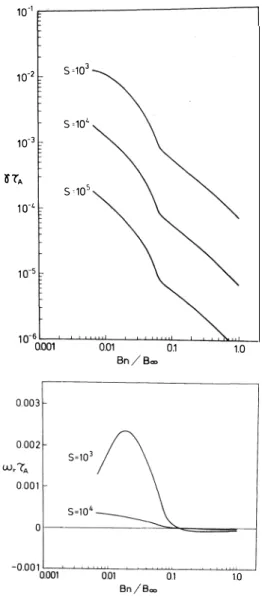
Fig. 4 Dependence of the eigenvalues on the values of E.= B./B. with ka=
0.5 and 5 = 103, 104, and lOS
A Model of 'Disparitions Brusques' J. Sakai. K. I. Nishikawa strong stabilization effect against the reconnecting mode. The growth rate YTA is proportional to s-l
for E,. 2: 0.1 as compared to YTA ex: 5=315 for the classical collisional tearing mode. It is difficult to compute the growth rate in the range of S :::::: 107- 108 for prominences, however, we find that the growth rate YTA is the order of 10-7-10-8 by the extrapolation of computational results. This growth
0.020 ...---,
0.016
0.012 time is close to the diffusion time TR - 109 S, which W(A means that the prominences are almost stable during 0.008 their lifetime (several months :::::: 107 s).
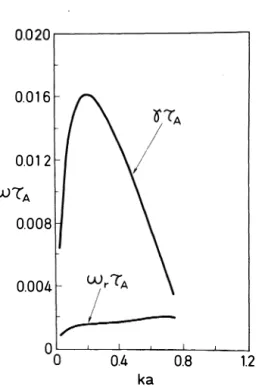
( 2 ) The growth rate versus wavenumber is shown in Fig. 5. The maximum growth rate occurs near ka :::::: 0.2. The reconnecting mode has a real frequency, which shows that the magnetic islands can propagate along the vertical direction of the prommence.
From these results, we conclude that the prominence based on Kippenhahn and SchlUter model is almost stable against the reconnecting mode.
0.004
r
oo��-��-L--L� 0.4 0.8 1.2 ka
Fig. 5 Growth rate and real frequency as a function of ka with S = 103 and E. = B./ Boo = 0.01.
III. T RIGGERING MECHANISMS OF DISPARITIONS BRUSQUES
Observations indicate that the whole prominence rises in the atmosphere at a steady increasing velocity and disappears. Since the prominence often reforms in the same location and basically with the same shape, it is thought that the supporting magnetic field is not destroyed, merely temporarily disturbed. This temporary disturbances seem to trigger an instability which causes the disparition brusques. Some disturbances may originate from nearby active region or solar flares.
We propose two triggering mechanisms leading to ascending motion of prominences. One possibility is that if some disturbances may hit the foot magnetic field supporting the prominence, to increase the normal magnetic field B.. the magnetic tension may exceed the gravity force and in turn, give rise to ascending motion. Another possibility considered here is the interaction between the reconnecting mode and fast magnetosonic waves originating from other active regions or solar flares.
We may imagine that the finite amplitude fast magnetosonic disturbances propagate vertically along the prominence, because in the prominence the main magnetic field is horizontal, i.e., ( En
)> Bxo). If we consider fast modes with wavelengths, A .L' which is smaller than the width, a, of the prominence (A j_ ::S a), it is a good approximation to neglect the diffraction effect due to inhomogeneity and also to treat fast modes propagating almost perpendicular to the normal magnetic field B •.
Bulletin of Faculty of Engineering Toyama University 1983
Ill:-1. Ponderomotive Force due to Fast Magnetosonic Waves
We consider nonlinear fast magnetosonic waves propagating upward in the prominence.
Recently, the ponderomotive force due to fast waves has received much attention, because it can produce plasma vortex motions and excite forced tearing modes and ballooning modes (Sakai and Washimi, 1982; Sakai, 1982 (a)). The ponderomotive force due to fast waves (sakai and Washimi, 1982) is given by
F y--
PoVA
2 ai dy''(3-1)
(3-2) where I denotes the wave intensity of the fast waves, I= 1 cjJ 12 = (!::,.
B!
Bol The sign of the y component of the force means that it acts as a negative pressure, while the x component acts as an usual pressure. From the fact that curl F =F 0, we can conclude that the ponderomotive force creates plasma vortex motions which may enhance the weakly unstable reconnecting modes in the prominence. If we take into account the ponderomotive force due to fast magnetosonic waves, Eq. (2-11) takes the form as� [�(Po��)+� (Po��)]-
417r[ Bxo/::,. (��)- d;�xO ��
+ Bn /::,.
�u Ay] + g
dpl dy+
2PoV A
2 _?!1_ dxdy -- 0 , (3-3) where the last term represents the effect of the ponderomotive force, which comes from the zcomponent of curl F
III -2. Wave Kinetic Equation for Fast Magnetosonic Waves
In order to make dicussions self-consistent, we have to consider the wave kinetic equation for fast magnetosonic waves, which describes the wave intensity I, interacting with the reconnecting modes. The wave kinetic equation (Sakai and Washimi, 1982) is given by
ai at
+
v g()I+
dx _g_ vg I+ _l_ [_l_
vgPo
ap- � ()2A dx 2np0 drrf¢ ()2¢] -
+
vg dxdy+
dtdy I-0' (3-4)where vg is the group velocity of the fast waves and p the pressure perturbation associated with the reconnecting mode, which is given by
(3-5) The basic equations describing the coupling between the fast magnetosonic waves and the reconnecting modes are Eq. (2-10), (2-12), (3-3) and (3-4).
III-4. Forced Reconnecting Modes due to Fast Waves
If we assume that the external fast magnetosonic waves persist long enough ( > 102 s) during the interaction with reconnecting modes, we can divide the wave intensity I into two parts,
I (x, y, t) = Io (x)
+
I1 (x, y,t) , (3-6)- 86-
A Model of 'Disparitions Brusques' ]. Sakai, K. I. Nishikawa where
10
is determined from the equationvg aio ax vg
+ __ff_10
= 0 ,which gives a solution
fo(x)
= J(O) exp(-gx/v�).
(3-7)
(3-8)
II represents the perturbation due to the coupling with reconnecting modes. From Eq. (3-8), we find that the wave intensity gradually decreases in the vertical direction, where its characteristic scalelength !:::.. is given by !:::.. =
v�/
g. If we usevg :::::: vA
=2.107em
s-1,g�
104em
s-2, !:::.. becomes!:::.. :::::: 4 X 10¹⁰
em,
which means that the wave intensity!0
is nearly constant in the prominence, because !:::.. is larger than the characteristic height (5.104km)
of the prominence. Assuming all perturbed quantities as / (y) exp[i (kx-wt)]
and linearizing Eq.(3-4) around !0, we find(3-9)
where we used Eq. (3-5). As shown later, the real frequency part is approximately given by
w :::::: kvg
=kvA,
which shows that the dominant terms in Eq. (3-9) are the first and the second terms and also the dominant term in the denominator in Eq. (3-9) is the last term. From these considerations and elimination of II in Eq. (3-3), we obtaind2¢- k2A· dy2
'f' + P�Po dy 47rpow d¢
+_k_
[B
xO (dy2 d2 - k2
)A- B" A
xO ]+ -�
47rp0Iw dy3 47rp0Iw d3A
_Bnk2
(1-4Ml)0 dy dA
+�
k
( 1-2e2 v2 k21 s A 0
.) - (P',f.,) =O, dlpow2
lf2dy
O'f' (3-10)where the last two terms shows the modification due to the ponderomotive force of the fast waves.
Here we consider the physical mechanism, why the slowly growing reconnecting modes can be enahnced by the ponderomotive force of the fast waves. We imagine the situation where there occurs weakly unstable reconnecting modes, as shown in Fig. 2 (b). Near the X type
points region the plasma exhibits inflow into the X-point, while near the G-type region, the outflow occurs. Equation (2-10) shows that density enhancement appears near the G-type region, on the other hand the density decreases near the X-point. The coupling eq. (3-9) between the reconnecting modes and fast modes indicates that the density increment gives rise to the decre
ment of II and vice-versa, because the dominant term of Eq. (3-9) should be read as II ::::::
i
( kf0e;; gp0)
PI• which shows that PI and II are out of phase with each other. These interactions cause the inhomogeneous distribution of the intensity of the fast mode, which was nearly constant in the prominence. The wave intensity can be enhanced near the X -point region. Eventually, the ponderomotive force of the fast mode can drive the plasma vortex motions near the X -point shown in Fig. 6.We have confirmed by numerical calculations that the main term contributing to the stability is the last one in Eq. (3-10), which represents the acceleration effect due to gravity, if the
Bulletin of Faculty of Engineering Toyama University 1983
ponderomotive force does not exist, and furthermore the term including aA; ay is not essential for the stability problem ; it only modifyies the real fre
quency part.
If we take into account the ponderomotive force, and the intensity 10 exceeds a critical value
Ic given by
I =
g2
(3-11)c 2 c;
v�k2
the sign of the last term in Eq. (3-10) can change, which means that the effective gravity due to the ponderomotive force exceeds the gravity, g. It is easily understood that if the net gravity changes sign by the lifting force due to fast waves, the system will be unstable. In order to confirm the above idea, we have changed the sign of gravity in Eq. (3-10) and calculated the growth rate. The growth rate and real frequency versus B.! Boo are shown in Fig. 7, with parameters, S = 103, a= ka
= 0.5. From the numerical calculations, we find that the forced reconnecting mode does not depend on S, which means that the instability can be driven by the effective accelerating term due to the pon
deromotive force. The growth rate
yr
A is about0.3 in the region of En :::::: 0 ( 1 ), which means that the typical growing time
r
is about 100 s, i.e. very rapid.Another interesting characteristic of this insta
bility appears in its eigenfunction of velocity shown in Fig. 8. The eigenfunction
¢
oscillates across the current sheet, which means that the instability creates multiple plasma vortexes across the prominence. Furthermore, fairly broad band waves with
--plasma
v vortex motion
enhancement of I1 ponderomotive
force
Fig. 6 The plasma vortex motions due to the ponderomotive force of the fast magnetosonic waves.
2.0.---,
1.6
1.2
08
0.4
-o.4;,-0 ---'---;:;.0.4-;--�Q::':B,----J-,�. 2--,L 6 __j
Bn/Bco
Fig. 7 Growth rate and real frequency of the forced reconnecting mode as a function of E, = B,/ Boo with ka = 0.5 and S = 103.
shorter wavelength than the width of the prominence can be excited. By making use of quasi- linear approximation, we can estimate the diffusion coefficient Dj_ across the prommence.
Dj_= � 2(w; +
yk2 yz)l¢kl2.
We estimate the total mass loss Mz as
(3-12)
(3-13) where !:::.tis the typical growth time, which is taken as !:::. t ::::::10
2
s, and ap;ax :::::: m;n0/a = m;1010/5 X 108 =20m;. S0 is the total area, S0:::::: 5·104kmx 105km = 5 X 1019 cm
2
. On the- 88-
A Model of 'Dispariticns Brusques' J Sakai, K. I. Nishikawa other hand, the diffusion coefficient Dj_ is approxi-
mately given by 6
D j_ � --2wr y 2 v2 k • (3-14) where we used Wr � y in the of E, � 0 ( 1 ) and
Vk is typical random velocity. As y � 0.3 rA1 and
Wr � <.4\ we find
(3-15) Observations (Tandberg-Hanssen, 1974) show that prior to a dispersion brusque, the prominence ma
terial exhibits increased random motions with velocities vk � 30-50 km s-1. If we use this value as Vk in Eq.(2-30), we obtain Dj_ � 101
5
cm2s-1.The total mass loss M1 is about 1038 mig, which is about 20 % of original total prominence mass. Due to the mass loss leading to the unbalance of forces along the vertical direction [p0g < (B./ 4n') ( aBxol ay)], the prominence may exhibit the observed ascending motion.
N. DISCUSSIONS AND CONCLUSIONS We have shown that the current-sheet prom
inence of Kippenhahn and SchlUter is almost stable against reconnecting modes, however, it becomes suddenly unstable with the time scale of r � 102 s
A 4 2
-4
-6 L-J--L�--�-L�--L-���
-10 -8 -6 -4 -2 0 2 4 6 8 10
6 4 2
Y/a
Re'P
\
¢ o�--,�HlliffiH�mtr�������
-2 -4 -6
� � � � � 0 2 4 6 8 w
Y/a
Fig. 8 Eigenmode structures of A and ¢ with
S = 103, E.= B.! B� = 0.1, ka = 0.5 and
w rA = 0.02078 + 0.1427i. The oscillating structure of ¢ makes a series of vortexes in the magnetic island. The amplitudes of A and ¢ are plotted in arbitrary units.
by the externally driven nonlinear fast magnetosonic waves. The threshold of fast waves causing forced reconnecting instability is given by Eq.(3-ll), which can be estimated as Ic = 0.5(vA/c,)2 (k!:lr2. If we take vAles � 10, and (kt:,) � 102, Ic is about 0.5·10-2, which means that if the wave amplitude </J =t:,B/Bo of fast waves exceeds </Jc = 0.07, the forced reconnecting mode can be excited by the ponderomotive force of the fast waves.
The first magnetosonic waves with relatively high amplitude </J - 0.1 may be excited from other active regions or solar flares. It is interesting to note that such finite amplitude fast magnetosonic waves that excite reconnecting modes are modulational unstable (Sakai, 1983(b )), and decay into slow magnetosonic modes associated with local enhancement of the amplitude.
The modulational instability which threshold </Jm is given by </Jm = c.lvA � 0.1 gives rise to more effective interaction between fast waves and reconnecting modes.
Besides the role of fast magnetosonic waves causing the effective acceleration, the increase of supporting magnetic field B. due to hitting of the foot or whole magnetic field change by a newly emerging magnetic flux nearby may give rise to the ascending acceleration, and in turn there appear forced reconnecting modes.
It is important to consider the nonlinear stage of the forced reconnecting modes, in connection
Bulletin of Faculty of Engineering Toyama Umversily 1983
with plasma heating and particle acceleration mechanism, because as mentioned before soft X-rays pictures (Svestka, 1976) show a brightening above the place where the filament just disappeared.
In the early stage of the reconnecting instability, many current filaments are produced with currents all in the same direction Such a system will be unstable against nonlinear coalescence instability (Wu et al, 1980; Leboeuf et aL, 1981), which leads to intense plasma heating and particle acceleration. It is important to keep in mind that about 10 % of the magnetic field energy sustaining current filaments can be converted to plasma thermal energy as well as high energy particle acceleration. The nonlinear coalescence instability is thought to an important mechanism for plasma heating after disparition brusque as well as solar flares and X-rays bright
ening in the corona (Tajima et aL, 1982)
We have investigated the triggering mechanism of disparitions brusques by fast magnetosonic waves which leads to forced excitation of the reconnecting mode. The reconnecting mode can also be externally driven by finite amplitude shear Alfven waves which may originate from the foot of the magnetic field sustaining the prommence. The details of this mechanism will be published elsewhere (Sakai, 1983 (c )
ACKNOWLEDGMENTS
The one (Sakai) of authors would like to thank S. Migliuolo, C. Hyder, and B. C. Low for their valuable comments concerning the manuscript. He also would like to thank R. M. MacQueen and the staff of the High Altitude Observatory for their hospitality while visiting the Observatory
A part of the paper has been presented in the 1982 International Conference on Plasma Physics held on June 8-15, 1982 at Goteborg, Sweden.
REFERENCES 1) Anzer, U. : 1969, Solar Phys. 8, 37.
2) Dolginov, A Z., and Ostryakov, V. M.: 1980, Sov Astron. 24, 749.
3) Dungey, ]. : 1958, Cosmic Electrodynamics, University Press, Cambridge, p. 54.
4) Furth, H. P., Killeen, ]. K., and Rosenbluth, M. N. : 1963, Phys. Fluids 6, 459.
5) Measley, ]. N., and Mihalas, D. : 1976, Ap. ]. 205, 273.
6) Hyder, C. L.: 1967, Solar Phys. 2, 49.
7) K1ppenhahn, R., and Schluter, A: 1957, Z. Aztrophys. 43, 36.
8) Kuperus, M., and Tandberg-Hanssen, E.: 1967, Solar Phys. 2, 39.
9) Leboeuf, ]. M., Tajima, T., and Dawson, ]. M.: 1982, Phys Fluids 25, 784.
10) Low, B. C. : 1975, Ap. ]. 197, 251.
11) Low, B. C., and Wu, S. T. : 1981, Ap. ]. 248, 335.
12) Lerche, I., and Low, B. C. : 1977, Solar Phys. 53, 385.
13) Migliuolo, S. : 1982, ]. Geophys. Res. f/.7, 8057.
14) Milne, AM., Priest, E. R., and Roberts, B.: 1979, Ap ]. 232, 304.
- 90 ·-
A Model of 'Disparitions Brusques' ]. Sakai, K. I. Nishikawa 15) Nakagawa, Y. : 1970, Solar Phys. 12, 419.
16) Nakagawa, Y., and Malville, ]. M. : 1969, Solar Phys. 9, 102.
17) Nishikawa, K-I.: 1980, ]. Phys. Soc. Japan 48, 2104.
18) Nishikawa, K-I., and Sakai, ]. : 1982, Phys. Fluids 25, 1384.
19) Pustil'nik, L. A.: 1974, Sov. Astron. 17, 763.
20) Sakai, ]. : 1982 ( a ), Ap. ]. 263, 970.
21) Sakai, ]. : 1983 ( b ), Solar Phys. (in press) 22) Sakai, ]. : 1983 (c), (in preparation).
23) Sakai, ]., and Washimi, H. : 1982, Ap. ]. 258, 823.
24) Svestka, Z. : 1976, Solar Flares, Dordrecht, D. Reidel.
25) Svestka, Z.: 1980, Phil. Trans. R. Soc. Lond. A297, 575.
26) Tajima, T., Brune!, F., and Sakai, ]. : 1982, Ap. ]. 258, L45.
27) Tandberg-Hanssen, E.: 1974, Solar Prominences, D. Reidel Pub. Co.
28) Wu, C. C., Leboeuf, ]. N., Tajima, T., and Dawson, ]. M.: 1980, PPG-511, Center for Plasma Physics and Fusion Engineering, UCLA.
29) Zweibel, E. : 1982, Ap. ]. 258, L53.
(Received. October 20. 1982)