Theory
By
Shinichi Mochizuki
∗Abstract
Inter-universal Teichm¨uller theory may be described as a sort of arithmetic version of Teichm¨uller theory that concerns a certain type of canonical deformation associated to an elliptic curve over a number fieldand aprime number l≥5. We begin our survey of inter- universal Teichm¨uller theory with a review of the technical difficulties that arise in applying scheme-theoretic Hodge-Arakelov theory to diophantine geometry. It is precisely the goal of overcoming these technical difficulties that motivated the author to construct thenon- scheme-theoretic deformationsthat form the content of inter-universal Teichm¨uller theory.
Next, we discuss generalities concerning“Teichm¨uller-theoretic deformations” of various familiar geometric and arithmetic objects which at first glance appearone-dimensional, but in fact have two underlying dimensions. We then proceed to discuss in some detail the various components of thelog-theta-lattice, which forms the central stage for the various construc- tions of inter-universal Teichm¨uller theory. Many of these constructions may be understood to a certain extent by considering the analogy of these constructions with such classical results as Jacobi’s identity for the theta function and the integral of the Gaussian distribu- tion over the real line. We then discuss the “inter-universal” aspects of the theory, which lead naturally to the introduction of anabelian techniques. Finally, we summarize the main abstract theoretic and diophantine consequences of inter-universal Teichm¨uller theory, which include a verification of theABC/Szpiro Conjecture.
Contents
§1. Hodge-Arakelov-theoretic Motivation
§2. Teichm¨uller-theoretic Deformations
§3. The Log-theta-lattice
§4. Inter-universality and Anabelian Geometry
2000 Mathematics Subject Classification(s): Primary: 14H25; Secondary: 14H30.
Key Words: elliptic curve, number field, theta function, hyperbolic curve, anabelian geometry, ABC Conjecture, Szpiro Conjecture.
∗RIMS, Kyoto University, Kyoto 606-8502, Japan.
e-mail: [email protected]
§1. Hodge-Arakelov-theoretic Motivation
Theinter-universal Teichm¨uller theorydeveloped in [IUTchI], [IUTchII], [IUTchIII], [IUTchIV] arose from attempts by the author, which began around the summer of 2000, to overcome certain technical obstructionsin the scheme-theoretic Hodge- Arakelov theoryof [HASurI], [HASurII] to applying this theory to diophantine geom- etry [cf. the discussion of [HASurI], §1.5.1; [HASurII], Remark 3.7; [IUTchI], Remark 4.3.1]. Thus, we begin our overview of inter-universal Teichm¨uller theory with a brief review of the essential content of those aspects of scheme-theoretic Hodge-Arakelov theory that are relevant to the development of inter-universal Teichm¨uller theory.
Let l be a prime number. Then we recall that the module E[l] of l-torsion points of a Tate curve E def= Gm/qZ [over, say, a p-adic field or the complex field C], whose q-parameter we denote by q, fits into a natural exact sequence
0 −→μl −→ E[l] −→ Z/lZ −→ 0.
That is to say, one has canonical objects as follows:
a “multiplicative subspace” μl ⊆E[l] and “generators” ±1∈Z/lZ.
In the following discussion, we fix an elliptic curve E over a number field F and a prime number l ≥5. For convenience, we shall use the notation
l def= l−21.
Also, we suppose that E has stable reductionat all nonarchimedean primes of F. Then, in general, the module E[l] [i.e., more precisely, the finite ´etale group scheme overF] of l-torsion points of E does notadmit
a “global multiplicative subspace” or “global canonical generators”
— i.e., a rank one submodule M ⊆E[l] or a pair of generators of the quotient E[l]/M that coincide with the above canonical multiplicative subspace and generators at all nonarchimedean primes of F where E has bad multiplicative reduction. Nevertheless, let us
suppose that such global objects do in fact exist!
Also, let us write
K def= F(E[l])
for the extension field of F generated by the fields of definition of the l-torsion points of E, V(K) for the set of [archimedean and nonarchimedean] valuations of K, and
V(K)bad ⊆V(K) for the set of nonarchimedean valuations where E has bad multiplica- tive reduction. For v∈V(K), we shall write Kv for thecompletion of K at v, Ov ⊆Kv for the subset of elements f ∈ Kv such that |f|v ≤ 1, and mv ⊆ Ov for the subset of elements f ∈Kv such that |f|v <1. Let N ⊆E[l] be a rank one submodule such that the natural morphism of finite group schemes over F
M × N →∼ E[l]
is an isomorphism. Then the Fundamental Theorem of Hodge-Arakelov Theorymay be formulated as follows [cf. [HASurI],§1; [HASurII], §1,§3; the explicit series representa- tion of the theta function on a Tate curve given in [EtTh], Proposition 1.4]:
Theorem 1.1. (“Idealized” Version of Fundamental Theorem of Hodge- Arakelov Theory) We maintain the notation of the above discussion. In particular, we assume the existence of a global multiplicative subspaceand global canonical generators [as described above] forE[l]. Write∗E def= EK/N for the elliptic curve over K obtained by forming the quotient ofEK def= E×FK byN; ∗E† →∗E for the universal vectorial extension of ∗E; L for the line bundle of degree one on∗E determined by some nontrivial F-rational2-torsion point of ∗E; L|∗E† for the restriction of L to ∗E†. Then restriction of sections of L|∗E† of relative degree [i.e., relative to ∗E† → ∗E] < l — a condition which we shall denote by means of a superscript “< l” — to MK def= M ×F K via the composite inclusion MK →EK[l]→∗E[l], followed by application of a suitable theta trivializationof the restriction ofLtoM yieldsfunctionson M; consideration of the Fourier coefficients of such functions determines an isomorphism of K-vector spaces of dimension l
Γ(∗E†,L|∗E†)<l →∼
l
j=−l
(qj2 · OK)⊗OK K (∗HA)
— where we write
q def= {qv}v∈V(K)bad
for the collection of q-parameters of EK at v ∈V(K)bad [so qv ∈mv] and q def= {q
v}v∈V(K)bad
for some collection of 2l-th roots “q
v = qv1/2l” of the qv; the direct summand labeled j of the codomain of the isomorphism (∗HA) is to be understood as a copy of K which we regard as being equipped with the integral structure obtained from the integral structure given by the ring of integers OK ⊆K by replacing, for each v∈V(K)bad, the integral structure given by Ov by the integral structure given by qj2
v · Ov. The domain
of this isomorphism admits a natural Hodge filtration F−i, for i ∈ N, given by the sections of relative degree ≤ i; the subquotients of this Hodge filtration admit natural isomorphisms
F−i/F−i+1 →∼ ω∗⊗E(−i)⊗K F0
— where we write ω∗E for the cotangent space at the origin of ∗E. The codomain of the isomorphism (∗HA) admits a natural Galois action, i.e., an action by Gal(K/F). Fi- nally, this isomorphism (∗HA)ofK-vector spaces is in factcompatible, up to relatively mild discrepancies, with the natural integral structures (respectively, metrics) at nonarchimedean (respectively, archimedean) elements of V(K); here, the integral struc- ture of the codomain at nonarchimedean v ∈V(K) is as described above.
Over the complement in Spec(OK) of V(K)bad, as well as at the archimedean primes of K, the content of Theorem 1.1 is essentially equivalent to the content of the [“non-idealized”] Fundamental Theorem of Hodge-Arakelov Theory given in [HASurI], Theorem A; [HASurII], Theorem 1.1 [cf. the discussion preceding [HASurII], Defini- tion 3.1] — i.e., “non-idealized” in the sense that it holds even in the absence of the assumption of the existence of the global multiplicative subspace and global canonical generators. On the other hand, the portion of Theorem 1.1 that concerns the integral structures at the valuations ∈ V(K)bad follows immediately [i.e., in light of the theory reviewed in [HASurI], §1] from the explicit series representation of the theta function on a Tate curve given in [EtTh], Proposition 1.4.
One way to understand [both the “idealized” and “non-idealized” versions of] the Fundamental Theorem of Hodge-Arakelov Theory is as a sort of scheme-theoretic version of the classical computation of the Gaussian integral
∞
−∞
e−x2dx = √ π
by applying a coordinate transformation from cartesian to polar coordinates — cf.
the discussion of [IUTchII], Remark 1.12.5, (i). Indeed, the function “j →qj2” — which may be thought of as a sort of discrete version of the Gaussian distribution “e−x2” — appears quite explicitlyin the codomain of the isomorphism (∗HA) of Theorem 1.1. On the other hand, the value “√
π” may be thought of as corresponding to the [negative]
tensor powers of the sheaf “ω”that arise in the subquotients of the Hodge filtration that appear in thedomainof this isomorphism. Indeed, if, in the domain of this isomorphism, one omits the restriction “< l”, then one obtains a natural crystal — cf. the theory of the “crystalline theta object” discussed in [HASurII], §2. Unlike the crystals that typically arise in the case of the de Rham cohomology associated to a family of varieties, which satisfy the property of Griffiths transversality, this crystal exhibits a property that we refer to as Griffiths semi-transversality [cf. [HASurII], Theorem
2.8], i.e., the crystal corresponds to a connection whose application has the effect of shifting the Hodge filtration [not by one, but rather] by two steps! This property of Griffiths semi-transversality gives rise to aKodaira-Spencer isomorphism[cf. [HASurII], Theorem 2.10] betweenω⊗2 and the restriction via the classifying morphism associated to the elliptic curve under consideration of the sheaf of logarithmic differentials on the moduli stack of elliptic curves — i.e., in effect, between ω and the “square root” of this sheaf of logarithmic differentials. Here, it is useful to recall that this sheaf of logarithmic differentials admits a canonical generator in a neighborhood of the cusp at infinity of the moduli stack of elliptic curves, namely, the logarithmic differentialq−1·dq of the q-parameter, which, if one thinks in terms of the classical complex theory and integrates this logarithmic differential once over a loop surrounding the cusp at infinity, has an associated period equal to 2π. This provides the justification for thinking of
“ω” as corresponding to “√
π”. Finally, we recall that this relationship between the Fundamental Theorem of Hodge-Arakelov Theory and the classical Gaussian integral may be seen more explicitly, via the classical theory of Hermite polynomials, when this theory is restricted to the archimedean primes of a number field via the“Hermite model”
[cf. the discussion of [HASurI], §1.1].
In this context, it is also of interest to note that unlike many aspects of theclassical theory of theta functions, the Hodge-Arakelov theory discussed in [HASurI], [HASurII]
does not admit a natural generalization to the case of higher-dimensional abelian varieties [cf. the discussion of [HASurI], §1.5.2]. This is perhaps not so surprising in light of the analogy discussed above with the classical computation of the Gaussian integral reviewed above, which does not admit, at least in any immediate, naive sense, a generalization to higher dimension. This phenomenon of a lack of any immediate generalization to higher dimension may also be seen in the theory of the ´etale theta function developed in [EtTh], which plays a central role in inter-universal Teichm¨uller theory. In the case of the ´etale theta function, this phenomenon is essentially a reflection of the fact that, unlike the case with the complement of an ample divisor in an abelian variety of arbitrary dimension, the complement of the origin in an elliptic curve may be regarded as a hyperbolic curve, i.e., as an object for which there exists an extensive and well-developed theory of anabelian geometry, which may be [and indeed is, in [EtTh]] applied to obtain various importantrigidityproperties involving the ´etale theta function [cf. the discussion of the Introduction to [EtTh]].
As discussed in [HASurI], Theorem A, the isomorphism of Theorem 1.1 may be considered over the moduli stack of elliptic curves Mell over Z. Indeed, as dis- cussed in [HASurI], §1, a proof of thecharacteristic zero portion of the isomorphism of Theorem 1.1 [or [HASurI], Theorem A] may be given by considering the corresponding map between vector bundles of rank l over (Mell)Q def= Mell ×Z Q: That is to say, an
easy explicit computation involving the explicit series representation of the theta func- tion on a Tate curve [cf., e.g., [EtTh], Proposition 1.4] shows that this map between vector bundles on (Mell)Q is an isomorphism at the generic point of (Mell)Q. Then one concludes that this map between vector bundles is in fact an isomorphism on (Mell)Q by computing the degrees of the domain and codomain of the map under considera- tion and observing that these two degreescoincide. Although the precise computation of these degrees is rather involved, from the point of view of the present discussion it suffices to observe that the highest order portions of the average degrees [i.e., where by “average”, we mean the result of dividing by the rank l] of the domain [i.e., “LHS”]
and codomain [i.e., “RHS”] vector bundles on (Mell)Q of the map under consideration coincide:
1l ·LHS ≈ −1l ·l−1
i=0
i·[ωE] ≈ −2l ·[ωE]
1
l ·RHS ≈ −l12 · l
j=1
j2 ·[log(q)] ≈ −24l ·[log(q)] = −2l ·[ωE]
— where we write [ωE] for the degree on (Mell)Q of the line bundle ωE [i.e., the line bundle determined by the relative cotangent bundle at the origin of the tautological semi-abelian scheme over (Mell)Q]; we write [log(q)] for the degree on (Mell)Q of the di- visor at infinity of (Mell)Q; we recall the elementary fact [a consequence of the existence of the modular form typically referred to as the “discrimant”] that [log(q)] = 12·[ωE].
In this context, we remark that the line bundle F0 [i.e., the line bundle on (Mell)Qthat corresponds to the line bundle denoted “F0” in Theorem 1.1] is“sufficiently small”that it may be ignored, i.e., from the point of view of computing portions of highest order.
Now let us return to considering arithmetic vector bundles on Spec(OK) in the context of Theorem 1.1. The Hodge filtration F−i is not compatible with the direct sum decomposition of the codomain of the isomorphism (∗HA) of Theorem 1.1. This fact may be derived, for instance, from the explicit series representation of the theta function on a Tate curve [cf., e.g., [EtTh], Proposition 1.4] and is closely related to the theory of thearithmetic Kodaira-Spencer morphismarising from this isomorphism [cf. the discussion of [HASurII], §3, especially, [HASurII], Corollary 3.6]. In particular, it follows that, for most j, by projecting to the factor labeled j of this direct sum decomposition, one may construct a [nonzero!] morphism of arithmetic line bundles [i.e., of rank one K-vector spaces that is compatible “from below” with the integral structures at nonarchimedean primes and the metrics at archimedean primes — cf., e.g., the discussion of [GenEll], §1]
(OK⊗OK K ≈) F0 → (qj2 · OK)⊗OK K
— where we remark that, from the point of view of computations to highest order, one may think of the arithmetic line bundle corresponding to F0 as being, essentially
the trivial arithmetic line bundle, and one may ignore the “relatively mild discrepan- cies” referred to in Theorem 1.1. Such a nonzero morphism of arithmetic line bundles implies an inequality between arithmetic degrees “degarith(−)” of arithmetic line bundles, i.e., if we write ΩlogM|E for the arithmetic line bundle on Spec(OK) determined by restricting the line bundle of logarithmic differentials on Mell [relative to the log structure determined by the divisor at infinity] via the classifying morphism associated to EK, then
1
6 ·degarith(log(q)) = htE < constant
— where we write htE def= 2·degarith(ωE) = degarith(ΩlogM|E) for thecanonical height of the elliptic curve EK and degarith(log(q)) for the arithmetic degree of the arithmetic divisor on Spec(OK) determined by restricting the divisor at infinity of Mell via the classifying morphism associated toEK [cf., e.g., the discussion of [GenEll],§1,§3]. Here, the arithmetic degrees are to be understood as beingnormalized[i.e., by dividing by the degree over Qof the number field under consideration — cf. the discussion of [GenEll],
§1] so as to be invariant with respect to the operation of passing to a finite extension of the number field under consideration.
Before proceeding, we pause to discuss the meaning of the“constant”that appears in the inequality of the preceding display. First of all, to simplify the discussion, we assume that the complex moduli of the elliptic curve EK at the archimedean primes of K are subject to the restriction that they are only allowed to vary within some fixed compact subset of (Mell)C def= (Mell)×ZC that does not contain the divisor at infinity. It follows from [GenEll], Theorem 2.1, that, from the point of view of verifying the ABC Conjecture, this does not result in any essential loss of generality. Then it follows from the discussion of the “´etale integral structure” in [HASurI], §1 [cf. also [HASurI], Theorem A], together with elementary estimates via Stirling’s formula, that this “constant” isroughly of the order of log(l). In particular, if [as is done, for instance, in [GenEll], §4; [IUTchIV], §2] one assumes that l is roughly of the order of htE, then, by possibly enlarging the “constant” of the inequality under consideration,
one may assume without loss of generality — i.e., so long as one respects the restrictions just imposed on the complex moduli and the size of l relative to the height! — that this constant is, in fact, independent of the elliptic curve E, thenumber field F, and the prime number l.
For a more precise statement, we refer to [GenEll], Lemma 3.5, where an inequality is derived by assuming, in effect, only theexistence of a global multiplicative subspace[i.e., without assuming the existence of global canonical generators!] for E[l]; moreover, the proof of [GenEll], Lemma 3.5, is entirely elementary and does not require the use of the scheme-theoretic Hodge-Arakelov theory surveyed in [HASurI], [HASurII]. Thus, one
may conclude — i.e., either from the above discussion of the inequality arising from Theorem 1.1 or from [the argument of] [GenEll], Lemma 3.5 — that
if one bounds the degree [F : Q] of the number field F over Q and the complex moduli of the elliptic curve E at the archimedean primes of F, then the assumption that E[l] admits a global multiplicative subspaceand global canonical generators [i.e., where, in fact, the latter is unnecessary, if one applies [the argument of] [GenEll], Lemma 3.5, as is done, for instance, in the proof of [IUTchIV], Corollary 2.2, (ii)] implies that there are only finitely many possibilities for the j-invariant of E [cf. [GenEll], Propositions 1.4, (iv); 3.4].
[Here, we remark in passing that the various hypotheses on the prime l that appear in the statement of [GenEll], Lemma 3.5, are applied only to conclude that the cyclic subgroup under consideration is “global multiplicative”. That is to say, if one assumes from the start that this cyclic subgroup is “global multiplicative”, then the argument of the proof of [GenEll], Lemma 3.5, may be applied without imposing any hypotheses on the prime l.]
In this context, it is of interest to consider the following complex analytic ana- logueof the above discussion. LetES →S be a family of one-dimensional semi-abelian varieties over a connected smooth proper algebraic curve S over C that restricts to a family of elliptic curves EU → U over some nonempty open subscheme U ⊆ S. Write EU → U for the complex analytic family of complex tori determined byEU →U. Let U → U be a universal covering space of the Riemann surface U. Then the classify- ing morphism of the family EU → U determines a holomorphic map φ : U → H to the upper half-plane H which is well-defined up to composition with an automorphism ofH induced by the well-known action of SL2(Z) on H. Now one verifies immediately that this map φ : U → H is either constant or has open dense image in H. In particular, if φ is nonconstant, then it follows that every point in the boundary ∂H of H [i.e., where we regard H as being embedded, in the usual way, in the complex projective line P1C] lies in the closure of the image Im(φ) of φ. On the other hand, the natural complex analytic analogue of the condition that there exist aglobal multiplicative subspace in the sense of the above discussion concerning elliptic curves over number fields may be formulated as follows:
The local system on U in rank two free Z-modules determined by the [abelian!]
fundamental groups of the fibers of EU → U admits a rank one subspace that coincideswith the subspace of the“complex Tate curve Gm/qZ”determined by thefundamental group ofGmin every sufficiently small neighborhood of a point of the Riemann suface S associated toS where the familyEU → U degenerates.
Moreover, one verifies immediately that this condition is equivalent to the condition that the intersection with ∂H of the closure of Im(φ) be equal to a single cusp [i.e., a single point of the SL2(Z)-orbit of the point at infinity of P1C]. In particular, one concludes that this condition can only hold if φis constant, i.e., if the original family of elliptic curves EU →U is isotrivial.
Now let us return to our discussion of elliptic curves over number fields. Then, roughly speaking, the above discussion may be summarized as follows:
The assumption of the existence of a global multiplicative subspace and global canonical generators may be thought of as a sort of arithmetic analogue of the geometric notion of an isotrivial family of elliptic curvesand, moreover, implies bounds on the height of the elliptic curve under consideration.
This state of affairs motivates the following question:
Is it possible to obtain bounds — perhaps weaker in some suitable sense!
— on the height of arbitraryelliptic curves over number fields, i.e., without assuming the existence of a global multiplicative subspace or global canonical generators?
Put another way, one would like to somehow carry out the above derivation of bounds on the height from the isomorphism (∗HA) of Theorem 1.1 without assuming the exis- tence of a global multiplicative subspace or global canonical generators. As discussed in [HASurI],§1.5.1, if one tries to carry out the above derivation by applying the“non- idealized” version of Theorem 1.1 [i.e., which holds without assuming the existence of a global multiplicative subspace or global canonical generators!], then one must con- tend with “Gaussian poles” — i.e., with a situation in which the critical morphism of arithmetic line bundlesthat appears in the above discussion haspolesof relatively large order! — which have the effect of rendering the resulting inequality essentiallyvacuous.
That is to say, from the point of view of generalizing the derivation of bounds on the height given above, the above question may be reinterpreted as follows:
Is it possible to somehow reformulate the scheme-theoretic Hodge-Arakelov theoryof [HASurI], [HASurII] in such a way that one maycircumvent the tech- nical obstruction constituted by theGaussian poles?
It was this state of affairs that motivated the author in the summer of 2000 to initiate the development of theinter-universal Teichm¨uller theoryestablished in [IUTchI], [IUTchII], [IUTchIII], [IUTchIV].
From anextremely naivepoint of view, the approach that underlies the development of inter-universal Teichm¨uller theory may be described as follows:
Suppose that the assignment
qj2
j=1,...,l → q (∗KEY)
— that is to say, for each valuation v∈V(K)bad, one considers the assignment {qj2
v }j=1,...,l → q
v — somehow determines an automorphism of the number field K!
Before proceeding, we remark that the assignment (∗KEY) may be thought of as a sort oftautological solutionto the problem discussed above of resolving thetechnical obstructionconstituted by theGaussian poles— i.e., in short, the problem of contending with the absence of the domain of the assignment (∗KEY) in a situation in which the presence of the codomain of the assignment (∗KEY) may be taken for granted.
This approach may seem somewhat far-fetched at first glance but is in fact mo- tivated by the classical analogy between number fields and function fields: that is to say, if one thinks of a typical 2l-th root of a q-parameter q
v as being, roughly speak- ing, like some positive power of a prime number p, and one thinks of, say, the rational number field Q as corresponding to the one-dimensional function field Fp(t), i.e., so p corresponds to the indeterminate t, then the assignment (∗KEY) considered above cor- responds, roughly speaking [i.e., if one reverses the direction of “→”], to an assignment of the form
t → ta
for some positive integer a, i.e., an assignment which does indeed determine a homo- morphism of fields Fp(t) → Fp(t). Also, in this context, it is of interest to observe that the proof of the result quoted earlier [i.e., [GenEll], Lemma 3.5] to the effect that the existence of a global multiplicative subspace implies bounds on the height proceeds precisely by observing that the existence of a global multiplicative subspace implies that the elliptic curve under consideration is isogenousto — i.e., in effect, has roughly [that is to say, up to terms of relatively negligible order] the same height as — an el- liptic curve whose q-parameters areprecisely the l-th powers of the q-parameters of the original elliptic curve [cf. the application of [GenEll], Lemma 3.2, (ii), in the proof of [GenEll], Lemma 3.5]: that is to say, in short, the existence of a global multiplicative subspace implies that one is in a situation that is invariant, so to speak, with respect to the transformation “q → ql”! As discussed in the introduction to [GenEll], §3, this technique is, in essence, a sort of miniature, or simplified, version of a technique which dates back to Tate for proving “Tate conjecture-type results” and may be seen, for instance, in Faltings’ work on the Tate conjecture.
At any rate, if one assumes that one has such an automorphism of the number fieldK, then since such an automorphism necessarilypreservesdegrees ofarithmetic
line bundles, it follows — since the absolute value of the degree of the RHS of the assignment (∗KEY) under consideration is“small”by comparison to the absolute value of the [average!] degree of the LHS of this assignment — in a similar fashion to the discussion of the derivation of a bound on the height from Theorem 1.1 that a similar inequality, i.e., a bound on the height ofEK, holds:
1
6 ·degarith(log(q)) = htE < constant.
Of course, needless to say, such automorphisms of number fields do not in fact exist!! On the other hand, the starting point of inter-universal Teichm¨uller theory lies in adopting the following point of view:
We regard the “{qj2}” on the LHS and the “q” on the RHS of the assignment
(∗KEY)
qj2
j=1,...,l → q
as belonging to distinct copies of “conventional ring/scheme theory”, i.e., “distinct arithmetic holomorphic structures”, and we think of the assignment (∗KEY) as a sort of arithmetic version of the notion of a quasicon- formal mapbetween Riemann surfaces equipped withdistinct holomorphic structures.
That is to say, this approach allows us to realize the assignment (∗KEY), albeit at the cost of partially dismantling conventional ring/scheme theory. On the other hand, this approach requires us
to compute just how much of a distortion occurs
as a result of deforming conventional ring/scheme theory. This vast computation is the essential content of inter-universal Teichm¨uller theory. In the remainder of the present paper, we intend to survey the ideas surrounding this dismantling/deformation of conventional ring/scheme theory.
We begin by observing that one way to approach the issue of understanding such dismantling/deformation operations is to focus on that portion of the objects under consideration which is invariant with respect to — i.e., “immune” to — the dis- mantling/deformation operations under consideration. For instance, in the case of the classical theory of quasiconformal maps between Riemann surfaces equipped with dis- tinct holomorphic structures, the underlying real analytic surfaceof the Riemann surfaces under consideration constitutes just such an invariant. In inter-universal Te- ichm¨uller theory, such invariant mathematical structures are referred to as cores, and the corresponding property of invariance is referred to as coricity. In the case of the deformations of thearithmetic holomorphic structure — i.e., the conventional
mono-analytic container
... = ... ? ... = ... ? ... = ... ?
... = ... ?
log-volume estimate
ring/scheme-theoretic structure — of a number field equipped with an elliptic curve that are studied in inter-universal Teichm¨uller theory, the structures that correspond, relative to the analogy with quasiconformal maps between Riemann surfaces, to the
“underlying real analytic surface” are referred to as mono-analytic. That is to say, the term “mono-analytic” may be understood as a shorthand for the expression “the arithmetic analogue of the term real analytic”. Thus, to summarize, in the terminology of [IUTchI], [IUTchII], [IUTchIII], [IUTchIV], the coricity of mono-analytic struc- tures plays a central role in the theory.
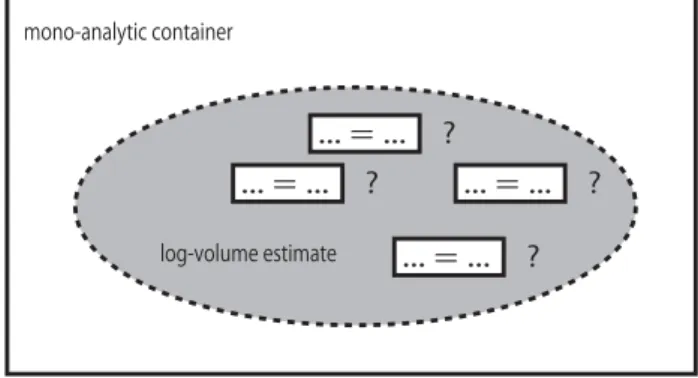
The approach taken in inter-universal Teichm¨uller theory to estimating the distor- tion discussed above consists of constructing “mono-analytic containers” in which the alien arithmetic holomorphic structures that appear — e.g., the arithmetic holomorphic structure surrounding the domain of the assignment (∗KEY) discussed above, when considered from the point of view of the arithmetic holomorphic struc- ture surrounding the codomain of this assignment — may be embedded, up to certain relatively mild indeterminacies — cf. Theorem 4.1 below; [IUTchIII], Theorem A. Once such an embedding is obtained, one may then proceed to estimate the log- volume of a region which is sufficiently large as to cover all the possibilities that arise from such indeterminacies — cf. Fig. 1.1 below; [IUTchIII], Theorem B.
Fig. 1.1: Log-volume estimate region inside a mono-analytic container
In this context, it is of interest to note that the idea of constructing appropriate
“mono-analytic containers” has numerous classical antecedents. Perhaps the most fun- damental example is the idea of studying the variation of the complex holomorphic moduli of an elliptic curve by studying the way in which the [complex] Hodge fil- tration is embedded within the topological invariant constituted by the first singular cohomology module with complex coefficients of the underlying torus. A slightly less classical example may be seen in conventional Arakelov theory, in which one studies the metric aspects of — i.e., the analytic torsion associated to — the holomorphic variation of a complex variety by embedding the space of holomorphic sections of an ample line bundle into the space of real analytic [or, more generally, L2-] sections of the line bundle. That is to say, the theory of analytic torsion may be thought of as a sort
of approach to measuring the metric aspects of this embedding [cf. the discussion of [IUTchIV], Remark 1.10.4, (a)]. Indeed,scheme-theoretic Hodge-Arakelov theory was originally conceivedprecisely as a sort ofarithmetic analogueof these two relatively classical examples [cf. the discussion of [HASurI], §1.3,§1.4; [IUTchIV], Remark 1.10.4, (b)].
At a concrete level, the log-volume estimates discussed above may be summarized as asserting that the “distortion” that occurs at the portion labeled by the index j of the LHS of the assignment (∗KEY) is [roughly]
≤ j·(log-diffF + log-condE)
— i.e., where we write log-diffF for thelog-differentof the number fieldF and log-condE for the log-conductor of the elliptic curve E [cf. [GenEll], Definition 1.5, (iii), (iv), for more details]. In particular, by the exact same computation [cf. the discussion of [IUTchIV], Remark 1.10.1] — i.e., of the term of highest order of the average over j
— as the computation discussed above in the case of degrees of vector bundles on the moduli stack of elliptic curves over Q, we obtain the followinginequality:
1
6 ·degarith(log(q)) = htE ≤ (1 +)·(log-diffF + log-condE) + constant This inequality is the content of the so-called Szpiro Conjecture, or, equivalently [cf., e.g., [GenEll], Theorem 2.1], the ABC Conjecture — cf. Corollary 4.2 below;
[IUTchIV], Theorem A.
§2. Teichm¨uller-theoretic Deformations
In §1, we discussed in some detail the Hodge-Arakelov-theoretic motivation that underlies the deformations of conventional ring/scheme theory — i.e., ofarithmetic holomorphic structure — that form the principal content of inter-universal Te- ichm¨uller theory. In the present §2, we begin to take a closer look at certain qualitative aspects of these deformations of arithmetic holomorphic structure.
The ultimate motivating example that lies behind these deformations considered in inter-universal Teichm¨uller theory is the theory of deformations of holomorphic structure of a Riemann surface that are studied in classical complex Teichm¨uller theory. Here, we recall that such classical Teichm¨uller deformations are associated to a nonzero square differential on a Riemann surface. Relative to the canonical holomorphic coordinatesobtained locally on the Riemann surface by integrating various square roots of the given square differential, these classical Teichm¨uller deformations may be written in the form [cf. Fig. 2.1 below]
z → ζ = ξ+iη= λx+iy
— where 1< λ < ∞ is the dilation factor [cf., e.g., [Lehto], Chapter V, §8]. The key qualitative featureof such deformations that is shared by the deformations of arithmetic holomorphic structure that occur in inter-universal Teichm¨uller theory may be described as follows:
The two underlying real dimensions of the single holomorphic dimension un- der consideration are “decoupled” from one another; then one of these two underlying real dimension is dilated/deformed, while the other underlying real dimension is left fixed/undeformed.
Fig. 2.1: One dimension is dilated, while theother is left fixed
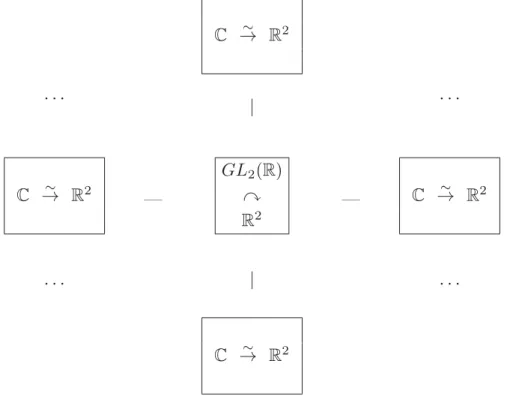
Before proceeding, we introduce some terminology which will be useful in our dis- cussion of deformations of various types of “holomorphic” structure. To get a sense of the qualitative aspects of the terminology introduced, it is useful to keep in mind the fundamental example of the situation in which one considers various complex linear structures [i.e., “copies ofC”] on a two-dimensional real vector space [i.e., “R2”]
— cf. the discussion surrounding [IUTchII], Introduction, Fig. I.3; [Quasicon], Ap- pendix. This fundamental example is illustrated in Fig. 2.2 below. As discussed in §1, structures which are common to the various distinct “holomorphic” structures under consideration — i.e., such as the underlying real analytic structure in the context of deformations of the holomorphic structure of a Riemann surface or the underlying real vector space structure in the context of various one-dimensional complex linear struc- tures on a two-dimensional real vector space — will be referred to as coric. On the other hand, structures which depend on a specificchoice of “holomorphic” structure — i.e., a specific choice of a “spoke” in the diagram of Fig. 2.2 — will be referred to as uniradial.
In this context, perhaps the most subtle notion is the notion of amultiradialstruc- ture. This term refers to structures that depend on a choice of “holomorphic” structure, but which are described in terms of underlying coric structures in such a way as to be unaffected by alterations in the “holomorphic” structure. In the case of the example illustrated in Fig. 2.2, a typical [albeit somewhattautological!] example of a multiradial
structure is given by the GL2(R)-orbit of an R-linear isomorphism C →∼ R2. This terminology is summarized in Fig. 2.3 below. If one thinks of “holomorphic” structures as “fibers” and of the underlying coric structure as a “base space”, then multiradial structures may be thought of as fiber spaces equipped with a“connection”that may be applied to execute“parallel transport”operations of fibers corresponding toarbitrary motions in the base space [cf. the discussion of [IUTchII], Remark 1.7.1].
C →∼ R2 . . .
| . . .
C →∼ R2
. . .
—
GL2(R) R2
|
— C →∼ R2
. . .
C →∼ R2
Fig. 2.2: Numerousone-dimensional complex linear structures
“C” on a single two-dimensional real vector space“R2”
coric structure underlying common structure R2
multiradial “holomorphic” structure described in GL2(R) structure terms of underlying coric structure C →∼ R2
uniradial structure “holomorphic” structure C Fig. 2.3: Coric, multiradial, and uniradial structures
Another important motivating example may be seen in the p-adic Teichm¨uller theory of [pOrd], [pTeich], [CanLift]. This theory concerns p-adic canonical lift- ings of a hyperbolic curve over a perfect field of positive characteristic equipped with a nilpotent ordinary indigenous bundle. Such canonical liftings of hyperbolic curves are equipped with canonical Frobenius liftings — i.e., canonical liftings of the Frobe- nius morphism in positive characteristic — which are compatible with certain canonical
. . .
p p
p p
p p p
p p
p
p p
p p
p p p
p
p p
p
Frobenius liftings on certain p-adic stacks that may be thought of as p-adic ´etale local- izations of the moduli stack of hyperbolic curvesof a given type. These canonical Frobenius liftings on hyperbolic curves and [certain p-adic ´etale localizations of] mod- uli stacks of hyperbolic curves may be regarded as p-adic analogues of the well-known metric on the Poincar´e upper half-plane and theWeil-Petersson metric on com- plex Teichm¨uller space — cf. Fig. 2.4 below. We refer to the Introductions of [pOrd], [pTeich] for more detailed descriptions of p-adic Teichm¨uller theory.
Fig. 2.4: Frobenius liftings on hyperbolic curves and their moduli thought of as “p-adic metric flows”
The analogy between inter-universal Teichm¨uller theory and p-adic Teichm¨uller theory is as summarized in Fig. 2.5 below. In this analogy, the number field equipped with a(n)[once-punctured] elliptic curvethat appears in inter-universal Teichm¨uller the- ory [cf. the discussion of§1!] corresponds to the positive characteristic hyperbolic curve equipped with a nilpotent ordinary indigenous bundle that appears inp-adic Teichm¨uller theory. That is to say, the number field, equipped with the finite set of valuations which are either archimedean valuations or nonarchimedean valuations at which the given el- liptic curve has bad multiplicative reduction, corresponds to the positive characteristic hyperbolic curve[which may be thought of as a one-dimensional function field, equipped with finitely many valuations, i.e., the “cusps at infinity”]. The [once-punctured] ellip- tic curve over the number field then corresponds to the nilpotent ordinary indigenous bundle over the positive characteristic hyperbolic curve. Then just as inter-universal Teichm¨uller theory concerns the issue of deforming conventional ring/scheme theory [i.e., “over Z”], p-adic Teichm¨uller theory concerns the issue ofp-adically deforming certain given objects in positive characteristic scheme theory. Finally, the canoni- cal Frobenius liftings that play a central role in p-adic Teichm¨uller theory may be thought of as corresponding to the log-theta-lattice in inter-universal Teichm¨uller
theory, which we shall discuss in more detail in §3 below. From this point of view, it is of interest to recall the transformations
“t → ta” and “q → ql”
— which appeared in the discussion of §1, and which aresomewhat reminiscentin form of the usual Frobenius morphism in positive characteristic. Indeed, the key assignment
(∗KEY)
qj2
j=1,...,l → q
— i.e., which played a central role in the discussion of§1 and will play a central role in the discussion of the log-theta-lattice in§3 — may be thought of as a sort of “deformation”
from the identity assignment
q → q
to the assignment
q(l)2 → q
— i.e., which, if one reverses the direction of the arrow, is reminiscent of the Frobenius morphism in positive characteristic. That is to say, the assignment (∗KEY) may be thought of as a sort of“abstract formal analogue”of the notion of [the mixed character- istic aspect of] a Frobenius lifting in the p-adic theory [cf. the discussion of [IUTchII], Remark 3.6.2, (iii)].
Inter-universal Teichm¨uller theory p-adic Teichm¨uller theory
number field, equipped with hyperbolic curve over a perfect a finite set of valuations field of positive characteristic [once-punctured] elliptic curve nilpotent ordinary indigenous bundle conventional ring/scheme theory over Z positive characteristic scheme theory
the log-theta-lattice canonical Frobenius liftings Fig. 2.5: The analogy between inter-universal Teichm¨uller theory
and p-adic Teichm¨uller theory
At a very rough, qualitative level, p-adic Teichm¨uller theory may be thought of as a canonical analogue for hyperbolic curves over a perfect field of positive characteristic equipped with a nilpotent ordinary indigenous bundle of the well-known classical theory of the ring ofWitt vectorsW(F) associated to aperfect fieldFof positive character- istic. That is to say, the ring of Witt vectors may be thought of as a “p-adic canonical lifting”of the given perfect field of positive characteristic. Moreover, this “p-adic canon- ical lifting” is equipped with a canonical Frobenius lifting ΦW(F) :W(F)→ W(F),
i.e., a lifting of the usual Frobenius morphism on the given perfect field of positive char- acteristic. One central object in the theory of Witt vectors is the multiplicative group of Teichm¨uller representatives
[F×] ⊆ W(F)
of the nonzero elements of the fieldW(F)/(p) →∼ F, which may be characterized by the property ΦW(F)(λ) =λp, for λ∈[F×]. From this point of view, one central aspect of the theory of canonical liftings inp-adic Teichm¨uller theory that sets this theory apart from the classical theory of Witt vectors is the existence of canonical coordinates, i.e., q-parameters“qx”, in the completion of each closed pointx of theordinary locus of acanonically lifted curve X over W(F) which may be characterized by the property
ΦX(qx) = qxp
— where we write ΦX :Xord→Xord for the canonical Frobenius lifting on the ordinary locus Xord of [the p-adic formal scheme associated to] X. These q-parameters may be regarded as generalizations of the q-parameters on the moduli stack of elliptic curves over Zp that appear in Serre-Tate theory. From the point of view of the analogy between p-adic Teichm¨uller theory and classical complex Teichm¨uller theory [i.e., as reviewed above!],
these q-parameters “qx” may be thought of as corresponding to the underlying real dimension that is subject to dilation.
From the point of view of the theory of p-adic Galois representations of the arith- metic fundamental group ofX×Spec(Zp)Spec(Qp), theq-parameters “qx” — i.e., which have the effect of “diagonalizing” the Frobenius lifting ΦXand exhibiting it as a“mixed characteristic p-adic flow” [cf. Fig. 2.4] — may be thought of as corresponding to positive slope Galois representations, i.e., Galois representations that “straddle the gap” between “mod pn” and “mod pm” for n = m [cf. the discussion of the “positive slope version of Hensel’s lemma”in [AbsTopII], Lemma 2.1; [AbsTopII], Remarks 2.1.1, 2.1.2]. By contrast, the group of Teichm¨uller representatives “[F×]” may be thought of as corresponding to [a certain portion of] the structure sheaf of the given positive characteristic hyperbolic curve that is held fixed — i.e., is coric — with respect to the deformation to mixed characteristic. From the point of view of the theory of p- adic Galois representations, the group of Teichm¨uller representatives “[F×]” may be thought of as corresponding to [a certain portion of the] slope zero Galois repre- sentations, i.e., at a more concrete level, to invariants of theFrobenius morphism in positive characteristic. Relative to the analogy with classical complex Teichm¨uller theory [i.e., as reviewed above!],
such slope zero Galois representations may be thought of as corresponding to the underlying real dimension that is held fixed.
The above discussion may be related to the theory ofabsolute Galois groups of p-adic local fields, as follows. Let Gk be the absolute Galois group of a p-adic local field k [i.e., a finite extension of Qp]. WriteOk ⊆k for the ring of integers ofk, Ok× ⊆ Ok for the subgroup of units, and Ik⊆Gk for the inertia subgroup of Gk. Then at the level of absolute Galois groups, slope zero and positive slopeGalois representations correspond, respectively, to the maximal unramified quotient Gk/Ik of Gk and the inertia subgroup Ik ⊆Gk. From the point of view ofcohomological dimension, thetwocohomological dimensions of Gk may be thought of as consisting precisely of the one cohomological dimension of Gk/Ik (∼= Z) and the one cohomological dimension of Ik. From the point of view of local class field theory, the one cohomological dimension of Gk/Ik corresponds to the value group k×/Ok×, while the one cohomological dimension of Ik corresponds to the group of units O×k.
The above discussion ofp-adic local fields may be related naturally to the discussion of complex Teichm¨uller theory at the beginning of the present §2. That is to say, by applying the exponential function on C, the one real dimension consituted by the real axis may be thought of as corresponding to the first factor “R>0” of the natural product decomposition
C× = R>0 × S1,
while the one real dimension constituted by the complex axis may be thought of as corresponding to the second factor “S1” of this product decomposition. If one thinks in terms of the singular cohomology with compact supports of C or C×, then the two underlying real dimensions of C or C× may be thought of consisting precisely of the
“cycles with compact supports” determined by these two real dimensions “R>0” and
“S1”, i.e., put another way, of the value group and group of units of the complex archimedean local fieldC. That is to say, one obtains an entirely analogous description to the description discussed above in the case of p-adic local fields.
One important point of view in the context of the above discussion of the “two underlying arithmetic dimensions”of p-adic and complex archimedean local fields is the following:
p-adic and complex Tate curves “Gm/qZ” allow one to relate, in a natural fashion, the “two underlying arithmetic dimensions” of the local field under consideration to the “two underlying geometric dimensions”of the [elliptic curve constituted by such a] Tate curve.
This point of view plays an important role throughout inter-universal Teichm¨uller the- ory. At a more concrete level, the Tate curve “Gm/qZ” admits anatural covering, in a
suitable sense, by “Gm”. Then by considering the points of this copy of “Gm” valued in the local field under consideration, this natural covering serves to map the two under- lying arithmetic dimensions of the above discussion onto the two underlying geometric dimensions of the elliptic curve given by such a Tate curve. These two underlying di- mensions may be seen concretely in the usual topological [i.e., in the complex case] or
´
etale [i.e., in the p-adic case] fundamental group of this elliptic curve. Moreover, if one thinks of this elliptic curve as the compactification of the once-punctured elliptic curve obtained by removing the origin, then the highly nonabelian structure of the resulting nonabelian fundamental group may be thought of as representing the “intertwining”
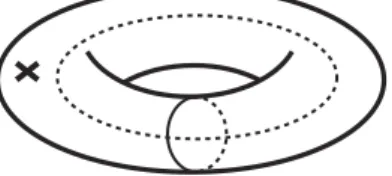
of these two underlying dimensions — cf. Fig. 2.6 below. In this context, it is of interest to recall that
a suitable quotient of this nonabelian fundamental groupof aonce-punc- tured elliptic curve is naturally isomorphic to the theta group associated to the ample line bundle on the elliptic curve determined by the origin
Fig. 2.6: Intertwining cycles on a once-punctured elliptic curve
— cf. the discussion at the beginning of [EtTh], §1, §2. Indeed, the above chain of observations may be thought of as the starting point for the introduction of the theory of theta functions as developed in [EtTh] in inter-universal Teichm¨uller theory. In fact, the review of complex Teichm¨uller theorygiven at the beginning of the present §2 was included precisely to motivate the following fundamental aspect of inter-universal Teichm¨uller theory:
The local portions of the deformations of a number field equipped with an elliptic curve that are constructed in inter-universal Teichm¨uller theory are obtained precisely by dilatingthe “one underlying arithmetic dimension”con- stituted by thevalue groups by means of atheta function, while the“other underlying arithmetic dimension” constituted by the groups of units is left fixed.
We refer to §3 below for a more detailed discussion.
In the context of the above discussion, it is of interest to recall that unlike theta groups, thearithmetic fundamental groupof a once-punctured elliptic curve over an
“arithmetic” field such as a number field or ap-adic local field satisfies highly nontrivial
rigidity properties, which are an important theme in [EtTh], and which play a central role in inter-universal Teichm¨uller theory [cf. the discussion of §3, §4 below]. For instance, one verifies immediately that a pro-l theta group — i.e., the pro-l group generated by three generators α, β, γ satisfying the relations
α·γ = γ·α, β ·γ = γ·β, α·β = β·α·γ
— admits automorphisms of the form
α → αλ, β → βλ, γ → γλ2,
for λ ∈ Z×l . Such automorphisms cease to exist if one regards this theta group as a subquotient of the arithmetic fundamental group of a once-punctured elliptic curve over a number field or a p-adic local field.
So far in our discussion of “two underlying arithmetic dimensions”, we have concen- trated on local fields, i.e., on the various archimedean and nonarchimedean localizations
“Fv” of a [say, for simplicity, totally complex] number field F. Note, however, that by considering the second Galois cohomology moduleof the absolute Galois groupGF of F
— i.e., in essence, the Brauer group of F — one may relate, via the various restriction maps in Galois cohomology, the two cohomological dimensions of GF to the two cohomological dimensions of the various nonarchimedean Fv.
On the other hand, in the various constructions of inter-universal Teichm¨uller the- ory, the phenomenon of “two underlying arithmetic dimensions” in the context ofglobal number fields will also appear in a somewhat different incarnation, which we describe as follows. The two underlying cohomological dimensions of the absolute Galois group Gk of ap-adic local field k are easiest to understand explicitly if one restricts oneself to the maximal tamely ramified quotient of Gk, i.e., which may be described explicitly as a [“representatively large”] closed subgroup of the product over prime numbers l=p of profinite groups of the form
Zl Z×l
— where the semi-direct product arises from the natural action of the multiplicative group Z×l on the additive group Zl. This motivates the point of view that the semi- direct product of monoids
(Z,+) (Z,×)
— where the semi-direct product arises from the natural action of the multiplicative monoid (Z,×) [i.e., obtained by considering the multiplicative portion of the structure of the ring of integersZ] on theadditivegroup (Z,+) [i.e., obtained by considering the additive portion of the structure of the ring of integers Z] — may be thought of as a sort of“fundamental underlying combinatorial prototype”of thetwo underlying arithmetic dimensions of a local field, as discussed above.


![Fig. 3.1: The log-theta-lattice consists of “ • ” [i.e., Θ ± ell NF-Hodge theaters],](https://thumb-ap.123doks.com/thumbv2/123deta/7120175.2342918/25.892.328.568.684.990/fig-log-theta-lattice-consists-θ-hodge-theaters.webp)