Studies On Characterization Of Total Domination Number And Chromatic Number Of Fuzzy Graph
*Dr. Satendra Kumar and **Sonu Kumar
* Professor, Department of Mathematics, OPJS University, Churu, Rajasthan (India)
**Research Scholar, Department of Mathematics, OPJS University, Churu, Rajasthan (India) Email: [email protected]
Abstract: In many practical problems, information about the problem is not certain. There is vagueness in the description of objects or in its relationship or in both. For example, in a time tabling problem, the priorities given to the teachers need not be equal. In that situation, we need to design fuzzy graph model for that problem. Fuzzy graph theory was introduced by Azriel Rosenfeld in 1975. During the same time researcher introduced various connectedness concepts in graph theory. Researcher has obtained the fuzzy analogues of several basic graph theoretic concepts like bridges, paths, cycles, connectedness and established some of their properties. Fuzzy set theory provides meaningful and powerful representation of measurement of uncertainties, as well as vague concepts expressed in natural languages. Every crisp set is fuzzy set but every fuzzy set is not crisp set. The mathematical embedding of conventional set theory into fuzzy sets is as natural as the idea of embedding the real numbers into complex plane.
Researcher introduced domination in fuzzy graph using strong edges. Researcher studied the concept of regular fuzzy graph. The concept of fuzzy line graph was introduced by researcher and the fuzzy labeling graph was introduced by the researcher. Researcher introduced the concept of middle, subdivision & total fuzzy graph and their properties. The concept of Dominator coloring was introduced by the researcher. The fuzzy coloring of a fuzzy graph was defined by the researcher. They defined the fuzzy coloring of the fuzzy graph based on some conditions which is same as crisp coloring.
[Kumar, S. and Kumar, S. Studies On Characterization Of Total Domination Number And Chromatic Number Of Fuzzy Graph. Academ Arena 2020;12(11):1-9]. ISSN 1553-992X (print); ISSN 2158-771X (online).
http://www.sciencepub.net/academia. 1. doi:10.7537/marsaaj121120.01.
Keywords: Solution, Domination, Charomatic Number, Fuzzy Graph
1.1 Introduction
The investigation of dominating sets in diagrams was started by Ore and Berge, the domination number;
all out domination number are presented by Cockayne and Hedetniemi. A Mathematical system to portray the marvels of vulnerability, all things considered, circumstance is first proposed by L.A. Zadeh in 1965.
Research on the hypothesis of fuzzy sets has been seeing an exponential development; both inside science and in its applications. This extents from conventional numerical subjects like rationale, topology, variable based math, examination and so forth consequently fuzzy set hypothesis has risen as potential zone of interdisciplinary research and fuzzy diagram hypothesis is of late intrigue.
The fluffy definition of fluffy charts was proposed by Kaufmann, from the fluffy relations introduced by Zadeh Although Rosenfeld introduced another expounded definition, including fluffy vertex and fluffy edges. A few fluffy analogs of diagram theoretic concepts, for example, ways, cycles connectedness and so on. The idea of domination in fluffy charts was investigated by A. Somasundram, S.
concepts of free domination, complete domination, associated domination and domination in Cartesian item and structure of fluffy charts.
A few creators have examined the issue of obtaining an upper destined for the entirety of a domination parameter and a diagram theoretic parameter and portrayed the comparing extremely charts.
In, Paulraj Joseph J and Arumugam S proved that they additionally described the class of diagrams for which the upper bound is attained. They additionally proved comparative outcomes for and Yt In, Paulraj Joseph J and Mahadevan G, proved that cc + χ ≤ 2n-1 and portrayed the corresponding extremely diagrams.
In, Mahadevan G presented the idea the correlative immaculate control number cp and proved that what's more, portrayed the corresponding extremely charts. They additionally acquired the comparative outcomes for the incited corresponding immaculate domination number and chromatic number of a chart. In, S. Vimala and J.S.
Sathya proved that . They likewise described the class of charts for which the upper bound is achieved.
Spurred by the above outcomes, in this section we get an upper bound for the total of the fluffy absolute domination number and chromatic number and portray the comparing extremely structures of fluffy diagrams of request up to 2n-6.
The accompanying preliminary outcomes and documentations are utilized in consequent portrayals:
Previous Results
Theorem I For any connected graph Theorem II For any connected graph The following notations are used in the succeeding theorems.
Notation 1.1 Kn (Pm) denotes the diagram got from Kn by attaching the end vertex of Pm to anybody vertices of Kn.
Example:
Figure 1.1 edges to any one vertex K4(P5)
Notation 1.2 Kn (m1,m2, m3....m k) denotes the chart got from Kn by joining m1 edges to any one vertex ui of Kn, m2 edges to any one vertex uj for i ≠ j of Kn, m3
edges to any one vertex for i ≠ j ≠ k of Kn, m1, m2,... mk edges to all the distinct vertices of .
Notation 1.3 Let ܩ be a connected fluffy chart
with m vertices . The graph
. where
m, is obtained from G by attaching times a pendant vertex of on the vertex
, times a pendant vertex of on the vertex and so on.
Example: Let be the vertices of
the graph is obtained from by
connecting multiple times a pendant vertex of on ,1time a pendant vertex of on ,1 time a pendant vertex of and and 1 time a pendant vertex of on .
Figure 1.2 pendant vertex K4(2P2, P3, P4, P3)
Notation 1.4 ( ) is the graph obtained from by attaching the pendant edge of to any one vertices of .
Figure 1.2 pendant vertex C3(P5)
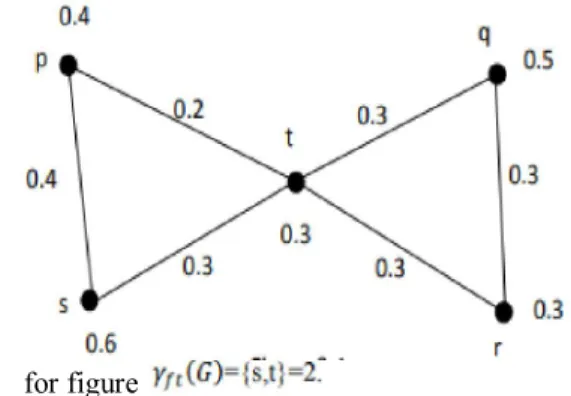
Definition 1.5: A subset S of V is known as a dominating set in a fuzzy diagram if every vertex in is successfully neighboring at least one vertex is S. The base cardinality assumed control over every ruling set in G is known as the mastery number of G and is signified by .
An overwhelming set is said to be all out ruling set if each vertex in V is viably neighboring at any rate one vertex in S. The base cardinality assumed control over all negligible complete commanding set is known as the absolute mastery number and is meant by Example:
for figure
Figure 1.4 hypotheses any place the logical inconsistency
Note: In all the accompanying hypotheses any place the logical inconsistency is happened there is no fluffy chart exists.
Main Results
Theorem 1.6 For any associated solid fluffy chart a’s more, the correspondence holds if and as it were if G≠ .
Proof: Let
Then the only possible case is
since so that
G≠
Proof: Assume that this is possible only if
Case (i) Let .
Since G contains an inner circle K on n-1 vertices or doesn't contain a coterie K on n-1 vertices. Let G contains an inner circle K on n-1 vertices.
Figure 1.5 fluffy diagram
Let x be a vertex of . Since G is associated, the vertex x is nearby one vertex for some i in . Then { } is a - set so that we have n=1.
Then x=0 which is a contradiction.
In the event that G doesn't contain a club K on n-1 vertices, at that point it very well may be confirmed that no new fluffy diagram exists.
Since But for , so that
n=2, x=1. Hence Converse is obvious.
Theorem 1.7 For any associated solid fluffy diagram
Proof: If G is , then clearly
Conversely assume that This is
possible only if or
or
Case (i) Let
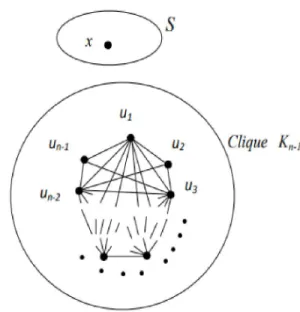
Since X (G)= n-2 contains a faction K on n-2 vertices or doesn't contain a coterie K n-2 vertices. Let G contains an inner circle K on n-2 vertices.
Figure 1.6 coterie Kn-2 vertices
Subcase (a) Let
Let x,y be the vertices of . Since G is associated, if x is adjoining a few of then {x, } is - set, so that (G)=2 and hence n=2. But X (G)=n-2=0 which is a contradiction.
Subcase (b) Let .
Let x,y be the vertices of Since G is associated, x is nearby a few of . Then y is adjacent to the same of . Then { } is - set, so that (G) =1 and hence n=1.But X (G)=n-2=
negative worth which is a logical inconsistency. Leave y alone neighboring of for i≠j. In this case { , } is -set, so that (G)=2 and hence n=1. But
which is a contradiction.
On the off chance that G doesn't contain an inner circle K on n-2 vertices, at that point it very well may be checked that no new fluffy diagram exists.
Case (ii) Let (G)= n-2 and X (G)=n-1.
Since X (G)=n-1 G contains a club K on n-1 vertices or doesn't contain a coterie on n-1 vertices. Let G contains an inner circle K on n-1 vertices.
Let x be a vertex of Since G is associated, x is nearby one vertex for some i in . Then { } is - set, so that we have n=1. Then X=n-1=1, which is for completely disengaged chart.
This is a logical inconsistency.
In the event that G doesn't contain a clique K on n-1 vertices, at that point it very well may be confirmed that no new fluffy chart exists.
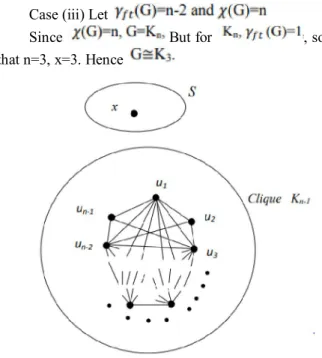
Case (iii) Let
Since But for , so
that n=3, x=3. Hence
Figure 1.7 coterie on n-1 vertices
Theorem 1.8 For any connected strong fuzzy
graph G, if and only if
Proof: If then clearly
conversely assume that this is possible only if
and (or) and
Case (i) Let
Since G contains a clique K on n-3 vertices or doesn't contain a clique K on n-3 vertices.
Let G contains a clique K on n-3 vertices
Figure 1.8 clique K on n-3 vertices
Let
Subcase (a) Let < S > =
Let x,y,z be the vertices of . Since G is associated, x is nearby a few of . Then {x, } is -set so that (G) =1. And hence n=1. But X (G)
=n-3= negative worth which is a logical inconsistency.
Subcase (b) Let
Let x,y,z be the vertices of . Since G is associated, one of the vertices of say is neighboring all the vertices of S (or) there exists in which is adjoining x and y and uj is contiguous z (or) every vertices of S are neighboring diverse vertices
of .
If ui for some I is adjoining all the vertices of S, at that point { } in is a -set of G, so that (G)=1 and hence n=1. But X (G) =n-3= negative worth, which is a logical inconsistency. Since G is associated for some I is nearby two vertices of S say x and y and z is adjacent to for i ≠ j in Kn-3, then { , } in Kn-3 is -set of G, so that (G) =2 and hence n=1.
But X (G) =n-3=negative value, which is a contradiction.
If for some i is adjacent to x and uj is adjacent to y and is adjacent to z, then { , } for i≠j≠k in Kn-3 is a -set of G, so that (G) =3 and hence n=3. But X (G)=n3=0, which is a contradiction.
Subcase (c) Let
Let xy be the edge of U and z is the isolated vertex of U . Since G is connected, there exists a ui in Kn-3 is adjacent to x and z. Then {x, ui} is -set of G, so that (G) =2 and hence n=1. But X (G)
=n-3=negative value, which is a contradiction. If z is adjacent to for some i≠j then {x, , } for i≠j is -set of G, so that (G)=3 and hence n=3. But X (G) =n-3=0, which is a contradiction.
Subcase (d) Let
Let x, y, z be the vertices of . Since G is connected, x (or equivalently z) is adjacent to ui for some i in . Then {x, y, ui} is a -set of G. so that (G) =3 and hence n=3. But X (G) =n-3=0, which is a logical inconsistency. In the event that ui is neighboring y, at that point { , y } is a -set of G, so that (G)=2 and hence n=1. But X (G)
=n-3=negative value, which is a contradiction.
Case (i) let
Since X (G) =n-2, G contains a clique K on n-2 vertices or G doesn't contain a clique on n-2 vertices.
Let G contains a clique K on n-2 vertices.
Figure 1.9 clique K on n-2 vertices
Let
Subcase (a) Let
Let x,y be the vertices of . Since G is connected, x (or equivalently y) is adjacent to some of . Then {x,ui} is - set, so that (G)=2 and hence n=3. But X (G) =n-2=1 for which G is completely detached, which is a logical inconsistency.
Subcase (b) Let .
Let x,y be the vertices of . Since G is associated, x is contiguous a few of . Then y is adjacent to the same of . Then { } is - set, so that (G)=1 and hence n=1. But X (G)=n-2=0, which is a logical inconsistency. In any case x is contiguous of for some i and y is adjacent to
of for i≠j. In this { , } is - set, so that (G)=2 and hence n=3. But X (G) = 1 for which G is completely detached, which is a logical inconsistency.
On the off chance that G doesn't contain a clique K on n-2 vertices, at that point it very well may be checked that no new fluffy diagram exists.
Case (iii)
Since X (G)=n-1, G contains a clique K on n-1 vertices or doesn't contain a clique K on n-1 vertices.
Let G contains a clique K on n-1 vertices.
Leave x alone a vertex of S. Since G is associated the vertex x is neighboring one vertex for some i in so that (G) =1, we have n=3 and x=3. Then K= = uv. If x is adjacent to ui, then
On the off chance that G doesn't contain a clique K on n-1 vertices, at that point it very well may be confirmed that no new fluffy diagram exists.
Case (iv) Let
Figure 1.10 clique K on n-1 vertices
Since
Theorem 1.9 For any associated solid fluffy
diagram if and only if
Proof: If then clearly
conversely assume that this is possible only if and
Case (i) Let
Since X (G)=n-4, G contains a clique K on n-4 vertices or doesn't contain a clique K on n-4 vertices.
Let G contains a clique K on n-4 vertices.
Let S = { , , , } ∈G-Kn-4. Then the induced sub graph >S< has the following possible cases
Subcase (a) Let
Let be , , , the vertices of . Since G is connected, without loss of generality is adjacent to some of . Then is - set, so that (G)=2 and hence n=1. But X (G)=n-4=negative value, which is a contradiction.
Subcase (b) Let
Figure 1.11 clique K on n-4 vertices
Let , , , be the vertices of . Since G is associated, one of the vertices of say is adjacent to all the vertices of S. Then { } is - set, so that (G)=1 and hence n=1. But X (G) =n-4=
negative worth, which is a logical inconsistency.
Since G is associated. One of the vertices of say is adjacent to three vertices of S and for some i≠j of K is neighboring fourth vertex of S. Right now { , } is - set, so that (G) =2 and hence n=1. But X (G)=negative value, which is a contradiction.
If two vertices say , are nearby the vertex ui and the staying two vertices are contiguous . In this case is - set, so that (G)=2 and hence n=1.
But X (G)=negative worth, which is a logical inconsistency. On the off chance that two vertices state and are adjoining the vertex ui and in the staying two vertices, one vertex is nearby for i≠j and another one is adjacent to for i≠j≠k. In this is - set, so that (G) =3 and hence n=3. But X (G)
=negative value, which is a contradiction.
Let the four vertices of are adjacent to distinct vertices of . In this is - set, so that (G) =4 and hence n=4. But X (G) =0, which is a contradiction.
Subcase (c) Let
Let , , , be the vertices of -{e}. Leave e alone any of the edges in the cycle . Since G is associated, without loss of sweeping statement is adjacent to some of . Then is - set,
so that (G) =2 and hence n=1. But X (G) =n-4=
negative worth, which is a logical inconsistency. Leave e alone any of the edges inside the cycle Since G is associated, without loss of all inclusive statement is adjacent to some of . Then is - set, so that (G) =2 and hence n=1. But X (G)=n-4=
negative worth, which is an inconsistency.
Since G is associated, there exists a vertex in which is adjacent to v1 and another vertex uj for some i≠j is adjacent to . Then is -set of G, so that (G) =3 and hence n=3. But X (G)
=n-4=negative value, which is a contradiction Subcase (e) Let
Let , be the vertices of and and be the vertices of another . Since G is connected, there exists a ui in is adjacent to and . Then is -set of G, so that (G) =3 and hence n=3. But X (G) =n-4=negative value, which is a contradiction. If v3 is adjacent to uj for some i≠j then for i≠j is -set of G, so that (G)=4 and hence n=4. But X (G)=n-4=0, which is a contradiction.
Subcase (f) Let
Let , be the vertices of and and be the vertices of . Since G is connected, there exists
a in is adjacent to Then
is -set of G, so that (G) =2 and hence n=1. But X (G) =n-4=negative value, which is a contradiction.
Since G is connected there exists a in is adjacent to and another vertex of for some i≠j is adjacent to , then for i≠j is -set of G, so that (G)=3 and hence n=3. But X (G) =n-4=negative value, which is a contradiction.
If is adjacent to and is adjacent to for i≠ and another one vertex is adjacent to for i≠j≠k. In this is - set, so that (G) =4 and hence n=4. But X (G)=0, which is a contradiction.
Subcase (g) Let
Let be the vertices of , . Without loss of consensus let us expect that is a root vertex.
Since G is associated, is adjacent to some of . Then is - set, so that (G)=2 and hence n=1. But X (G) =n-4= negative worth, which is an inconsistency. In any case let ui be contiguous any of the swinging vertices state In this is - set, so that (G) =3 and hence n=3. But X (G)=n-4= negative worth, which is an inconsistency.
Subcase (h) Let
Let be the vertices of . Since G is connected, (or equivalently ) is adjacent to for some i in . Then is -set of G, so that - (G)=4 and hence n=4. But X (G) =n-4=0, which is a contradiction. If is adjacent to (or equivalently ) then is -set of G, so that (G) =3 and hence n=3. But X (G)=n-4=negative value, which is a contradiction.
Subcase (i) Let
Let be the vertices of and be the isolated vertex of . Since G is connected, there exists a in is adjacent to (or equivalently ) and . Then { , , } is -set of G, so that (G)=3 and hence n=3. But X (G)=n-4=negative value, which is a contradiction. If there exists a vertex in is adjacent to and . Then { , } is - set of G, so that (G) =2 and hence n=1. But (G)=n-4=negative value, which is a contradiction.
Since G is associated, there exists a vertex in which is adjacent to (or equivalently ) and another vertex for some i≠j is adjacent to Then is -set of G, so that (G)=4 and hence n=4. But X (G) =n-4=0, which is a contradiction.
If there exists a vertex in is adjacent to and for some i≠j is adjacent to . Then { , , } is -set of G, so that (G)=3 and hence n=3. But X (G)=n-4=negative value, which is a contradiction.
Subcase (j) Let
Let be the vertices of . Since G is connected, is adjacent to some of . Then is - set, so that (G) =3 and hence n=3. But X (G) =n-4=negative value, which is a contradiction.
Subcase (k) Let
Let be the vertices of (1,0,0).
Since G is connected, (equivalently ) is adjacent to some of . Then is - set, so that (G)=3 and hence n=3. But X (G)
=n-4=negative value, which is a contradiction.
Since G is associated, is neighboring a few of . Then is - set, so that (G) =2 and hence n=1. But X (G) =n-4=negative value, which is a contradiction.
On the off chance that G doesn't contain a clique K on n-4 vertices, at that point it very well may be checked that no new fluffy chart exists
Case (ii) Let
Since X (G)=n-3, G contains a clique K on n-3 vertices or doesn't contain a clique K on n-3 vertices.
Let G contains a clique K on n-3 vertices.
Let
Subcase (a) Let
Let x, y, z be the vertices of . Since G is associated, x is nearby a few of . Then is - set, so that (G) =2 and hence n=3. But X (G)=n-3=0, which is a contradiction.
Subcase (b) Let
Let x, y, z be the vertices of. Since G is associated, one of the vertices of say is neighboring all the vertices of S (or) there exists in which is adjoining x and y and is adjacent to z (or) each vertices of S are adjacent to different vertices
of .
If for some I is nearby all the vertices of S, at that point { } in is a -set of G, so that (G)
=1 and hence n=1. But X (G) =n-3= negative worth, which is a logical inconsistency. Since G is associated for some I is contiguous two vertices of S state x and y and z is adjacent to for i≠j in , then in is -set of G, so that (G)=2 and hence n=3.
But X (G) =n-3=0, which is a contradiction. If ui for some i is adjacent to x and is nearby y and uk is
adjoining z, at that point
for i≠j≠k in Kn-3 is a -set of G, so that (G)=3 and hence n=4. But X (G) =n-3=1, which is for completely disengaged chart, which is a logical inconsistency.
Subcase (c) Let
Let xy be the edge of and z be the isolated vertex of . Since G is connected, there exists a in is adjacent to x and z. Then is -set of G, so that (G)=2 and hence n=3. But X (G) =n-3=0, which is a contradiction. If z is adjacent to for some i≠j then is -set of G, so that (G)=3 and hence n=4. But X (G) =n3=1, which is for completely detached diagram, which is a logical inconsistency.
Subcase (d) Let
Let x,y,z be the vertices of . Since G is associated, x (or identically z) is contiguous to for some i in . Then is a -set of G so that (G) =3 and hence n=4. But X (G) =n-3=1, which is for completely detached chart, which is a logical inconsistency. If is adjacent to y then is a -set of G. so that (G) =2 and hence n=3. But X (G) =n-3=0, which is an inconsistency.
Case (iii) Let
Since X (G) =n-2, G contains a clique K on n-2 vertices or G does not contain a clique on n-2 vertices.
Let G contains a clique K on n-2 vertices.
Let Then
Corresponding author:
Mr. Sonu Kumar
Research Scholar, Department of Mathematics, OPJS University, Churu,
Rajasthan (India)
Contact No. +91-9812227126 Email- [email protected]
References:
1. Amirthavalli. M., Fuzzy Logic and Neural Networks, SCITECH Publications private Ltd, India.
2. Aravamudhan. B. and Rajendran, B., “On Antipoal Graphs”, Disc Math 49 (1984), 193-195.
3. Balakrishnan. R., Ranganathan. K., A Text Book of Graph Theory, Springer, 1991.
4. Balakrishnan. V.K., Graph Theory, Schaum’s Outlines Tata McGraw – Hill Edition, 2004.
5. Bela Bollobas, Modern Graph Theory, Springer International Edition 1998.
6. Bezdek. C., and Pal. S.K., Fuzzy Models for Pattern Recognition, IEEE Press, 1991.
7. Bhattacharya. P., “Some Remarks on fuzzy graphs”, Pattern Recognition Lett6: (1987) 297-301.
8. Bhutani. K.R., “On Automorphism of Fuzzy graphs”, Pattern Recognition Lett 9: (1989) 159-161.
9. Bhutani. K.R., and Azriel Rosenfeld, “Strong Arcs in Fuzzy Graphs”, Information Science 152(2003)319-321.
10. Bhutani. K.R., “On M-Strong Fuzzy graphs”, Information Sciences, 155(2):103–109, 2003.
11. Bondy. J.A. and Murty, U.S.R., Graph Theory with Applications, Macmillan London, 1976.
12. Brigham. C. and Dutton. D., J. Combinatorics, Inf
& Syst Science 12(1987) 75-85.
13. Buckley. F. and Harary. F., Distances in Graphs, Addison-Wesley, 1990.
14. Choudam. S.A., A first course in Graph Theory, Macmillan India Ltd., 2006.
15. Craine. W.L., “Characterization of Fuzzy Interval Graphs”, Fuzzy Sets and Systems 68:
183, 1994.
16. Douglas B. West, Introduction to Graph Theory, Prentice Hall of India, Private Ltd., New Delhi, 1999.
17. Foulds. L.R., Graph Theory Applications Narosa Publishing House, 1993.
18. Frank Harary, Graph Theory, Narosa / Addison Wesley, Indian Student Edition, 1988.
19. Garry Johns and Karen Sleno, “Antipodal graphs and Digraphs” International Journal Math and Math Sci. vol. 16, No. 3 (1993) 579-586.
20. Gary Chartrand, Ping Zhang, Introduction to Graph Theory, Tata McGraw–Hill Publishing Company Ltd., New Delhi, 2006.
21. George J. Klir, and Bo Yuan, Fuzzy Sets and Fuzzy Logic: Theory and Applications, Prentice Hall of India Pvt. Ltd., New Delhi, 2000.
22. Jin AKIYAMA, Kiyoshi ANDO, David AVIS,
“Eccentric Graphs”, Discrete Mathematics 56(1985)1-6.
23. Kaufmann. A., Introduction to the theory of Fuzzy Subsets, Vol. 1, Academic Press, New York 1975.
24. Kim. J.B., Determinant Theory for fuzzy matrices, Fuzzy Sets and systems 29:
349-356(1989).
25. Kulli. V.R. and Janakiraman. B., “The common minimal Dominating Graph”, J. Pure Appl.
Math., 27(2):193-196, February 1996.
26. Lootsma. F.A., Fuzzy Logic for planning and decision making, Kluwer, 1997.
27. Luo. C.S., “The theorems of Decomposition and Representation for Fuzzy Graphs”, Fuzzy Sets and Systems 42:237-243, 1991.
10/24/2020