ORIGINAL RESEARCH
Association Between Public Assistance and Frequent Emergency Department Visits in Urban Areas of Japan: A Case-Control Study
Keiichiro IKEDA
1,2,3Taku HARADA
2(https://orcid.org/0000-0001-8794-6744) Yoko TARUMI
2,3(https://orcid.org/0000-0001-8433-5075), Hirotaka OCHIAI
1Takako SHIRASAWA
1Takahiko YOSHIMOTO
1Akira MINOURA
1Juichi HIROSHIGE
2(https://orcid.org/0000-0001-7288-3736) Akatsuki KOKAZE
1Kenji DOHI
3(https://orcid.org/0000-0002-4451-0382)
1
Department of Hygiene, Public Health and Preventive Medicine, Showa
University School of Medicine, 1-5-8 Hatanodai, Shinagawa-ku, Tokyo 142-8555, Japan;
2
Department of General Medicine, Showa University School of Medicine, 1-5-8
Hatanodai, Shinagawa-ku, Tokyo 142-8555, Japan;
3
Department of Emergency, Disaster and Critical Care Medicine, Showa University School of Medicine, 1-5-8 Hatanodai, Shinagawa-city, Tokyo 142-8555, Japan
Correspondence to: Keiichiro IKEDA
Department of General Medicine, Showa University School of Medicine, 1-5-8 Hatanodai, Shinagawa-ku, Tokyo 142-8555, Japan
Tel: +83 33 784 8000 Fax: +83 33 784 8358
Email: [email protected]
Short title: Public assistance and frequent ED visits
Abstract
Purpose: Emergency department (ED) crowding due to frequent visitors increases medical costs and endangers the safety of patients who need prompt treatment.
Although some studies have examined the social background of frequent visitors to the ED, there are few comprehensive studies of factors related to frequent ED visits in Japan. The present study examined whether public assistance status, age, and underlying conditions are associated with frequent visits to the ED.
Methods: Subjects in this study were patients over 20 years of age who visited the ED of General Medicine in Showa University Hospital in Tokyo, Japan, from April 1, 2014, to March 31, 2015 (n = 6,182). Information regarding sex, age, public insurance, hypertension, diabetes mellitus, dyslipidemia, chronic obstructive pulmonary disease, cancer, dysuria, bronchial asthma, and chronic kidney disease was collected using a patient database created from medical and hospital records.
Based on a previous study, subjects who visited the ED four or more times were
defined as frequent visitors, while those who visited the ED less than four times
were considered infrequent visitors. Logistic regression analysis was performed to
calculate odds ratios (ORs) and 95% confidence intervals (CIs) for frequent ED
visits.
Findings: Receipt of public assistance significantly increased the OR for frequent visits (4.26, 95% CI: 1.90–9.56), even after adjusting for sex, age, and potential confounding factors (OR: 3.89, 95% CI: 1.62–9.35).
Conclusions: The current study found a significant association between frequent ED visits and the receipt of public assistance. Emergency physicians and medical practitioners need to share information with outpatient physicians and welfare officers and work together with patients to address their specific medical and social vulnerabilities.
Keywords: Emergency Department; Frequent Visit; Public Assistance
Introduction
It has been reported that the number of patients seen in Emergency Departments (EDs) has increased annually in various countries and regions (1,2); only 8% of ED frequent visitors take up 28% of the case time (3,4). ED crowding due to frequent visitors increases medical costs and fatigue of medical personnel (5), and it
endangers the safety of patients in need of prompt treatment (6). Moreover, recent studies indicated that ED crowding might lead to a subsequent increase in the in- hospital mortality rate. Thus, ED crowding is a subject of concern in many countries including Japan (7,8).
In Japan, some large hospitals charge an additional fee for treatment of patients who visit after hours, in order to reduce nighttime visits to the ED by patients who are only mildly ill. However, recipients of medical assistance,
accounting for about 1.7% of the population in Japan, are exempt from paying this fee and the cost of hospital visits, including transportation expenses. Consequently, if they have multiple ED visits, medical staff tend to regard these patients as
“frequent visitors with low medical indications,” However, there are many medical assistance recipients who have health problems including psychiatric problems;
thus, receipt of public assistance itself may be a marker of medical risk.
Some studies have examined the social background of frequent visitors to the
ED. Of these, one reported that frequent visitors to the ED tended to be both
medically and socially vulnerable (9), while Saef et al. (10) reported that users of public medical insurance had a higher risk of being frequent visitors to the ED. In Japan, studies have focused on specific conditions, such as bronchial asthma and psychiatric disorders, but there are few studies regarding the association of other factors and ED visitation frequency. A study by Takeuchi et al. indicated that patients receiving public medical assistance had a higher risk of frequently visiting the ED than did patients using regular medical insurance in Japan (11), but that study did not take age or underlying conditions into account.
We considered that there is a need to explore the interventions that medical staff should take in order to reduce the number of frequent ED visitors. We
therefore studied the background of frequent ED patients and investigated whether public assistance recipients actually comprise a large proportion of these patients, after taking age and underlying conditions into account.
Material and methods
We conducted a retrospective study of patients aged over 20 years who
visited the ED of Showa University Hospital from April 1, 2014, to March 31, 2015.
The facility is a tertiary and educational hospital for advanced care, and has 853
beds. During the study period, the hospital recorded a total of 19,005 emergency
visits in the entire ED.
The study protocol was approved by the Ethics Committee on Human Studies of Showa University (Approval number: 2678). As the current study was retrospective and involved no intervention, the ethics committee approved the use of opt-out, either through our webpage or by following the instructions on a poster, instead of informed consent forms. The data obtained were de-identified to
maintain confidentiality of private information of the patients.
Following the ED protocol of Showa University Hospital at the time of study initiation, emergency patients who were critical, were referred by his/her primary care physician, or were in emergencies related to specialized fields (i.e., obstetrics, gynecology, ophthalmology, dermatology, and otorhinolaryngology) and who did not visit the ED because they were provided medical care in a specific department (e.g., a critical care center), were excluded from the current study. The number of cases coming from individual visitors was counted. The outcomes (hospitalization or non-hospitalization) of each case were aggregated.
Information regarding sex, age, medical insurance, hypertension, diabetes mellitus, dyslipidemia, chronic obstructive pulmonary disease, cancer, dysuria, bronchial asthma, and chronic kidney disease was collected using a patient
database created from medical records and hospital records. Medical insurance was classified either as part of public assistance or as part of some other medical
insurance system.
Based on a previous study (12), patients who visited the ED four or more times in the study period were defined as frequent visitors. In contrast, patients who visited the ED more than once on the same day, but who visited the ED fewer than four times during the study period were defined as infrequent visitors. Subjects with missing data were excluded from the analysis; eventually, 69 frequent visitors and 271 infrequent visitors (340 subjects in total) were analyzed (Table 1).
Pearson’s χ
2test or the Wilcoxon rank-sum test was used to compare cases and controls. In addition, the association between receiving public assistance and frequent visits to the ED was analyzed using logistic regression analysis. Logistic regression analysis was performed to calculate odds ratios (OR) and 95%
confidence intervals (CIs) for frequent visits to the ED. Based on the underlying diseases that were suggested to be involved in frequent ED visits in previous studies (13), adjustments were made in the logistic regression model for potential confounding factors, including sex, age, hypertension, diabetes mellitus,
dyslipidemia, chronic obstructive pulmonary disease, cancer, dysuria, asthma, and chronic kidney disease.
P-values < 0.05 were regarded as statistically significant. JMP
®pro 14
statistical analysis software (SAS Institute Inc; Carey, NC, USA) was used for
statistical analyses.
Results
From April 1, 2014, to March 31, 2015, 6,182 adult patients (7,304 cases) visited the ED in Showa University Hospital. Among these patients, 264 (4.27%) were public assistance recipients, and of these 69 patients (336 cases) were subjects who visited the ED four or more times; thus, the number of frequent ED visitors was 1.12% (69/6,182) of the total ED visitors. The ED utilization rate of frequent visitors was 4.60% (336/7,304).
Of the 6,393 visits with known outcomes, 23.4% (1,494/6,393) involved hospitalization, at a rate of 71/296 cases (24.0%) of the frequent ED visitors and 1,423/6,097 cases (23.4%) of the infrequent ED visitors; there was no significant difference (P = 0.7789). In contrast, the hospitalization rate for frequent ED visitors receiving public assistance was only 14/74 cases (18.9%) compared to 94/292 cases (31.9%) for infrequent ED visitors who were public assistance recipients, and the difference in this case was significant (P = 0.0356; Table 2).
Compared with infrequent visitors, frequent ED visitors were significantly older (median; 73 vs. 59 years, P < 0.001), and a higher proportion was receiving public assistance (18.8% vs. 5.2%, P < 0.001). Moreover, the proportion of
frequent visitors with chronic obstructive pulmonary disease, cancer, and chronic
kidney disease tended to higher (13% vs. 3.7%, P = 0.003, 33.3% vs. 16.2%, P =
0.001, 26.1% vs. 12.5%, P = 0.005, respectively; Table 3).
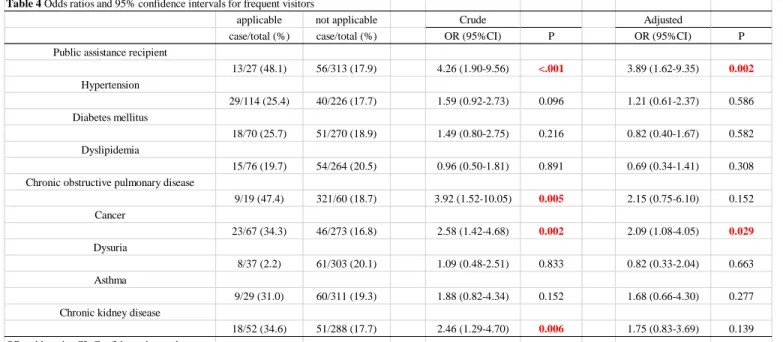
Logistic regression analysis was performed to examine the association between receipt of public assistance or underlying diseases and ED visitation frequency. Public assistance, chronic obstructive pulmonary disease, cancer, and chronic kidney disease significantly increased the ORs for frequent visits to the ED.
Public assistance (OR: 3.89, 95% CI: 1.62–9.35) and cancer (OR: 2.09, 95% CI:
1.08–4.05) were significantly associated with frequent ED visits, even after
adjusting for potential confounding factors (Table 4). Similar results were obtained when six variables were selected in order of importance.
Discussion
The current study examined the characteristics of subjects who frequently visited the ED of a university hospital located in an urban area in Tokyo over a 1-year period, from 2014 to 2015. We found a significant association between frequent visits to the ED and receiving public assistance or having cancer. The results remained significant even after adjusting for sex, age, and potential confounding factors. To our knowledge, no previous study has examined the association between frequent visits to the ED and public medical insurance in Japan while taking age and underlying conditions into account. Therefore, the findings of the present study should be clinically meaningful.
According to public data, public assistance recipients in the areas
0.84–1.32% of the population (14), whereas the proportion of public assistance recipients among the ED visitors over 20 years old was higher, at 4.27%. Thus, this study confirmed that public assistance itself is a risk factor for frequent ED visits.
In addition, frequent ED visitors in this study were more likely to have
chronic diseases, such as chronic obstructive pulmonary disease and chronic kidney disease, than did infrequent visitors; in particular, for cancer this association was statistically significant. This implies that patients with diseases with long-term progression may gradually find it difficult to maintain a good state of health, other than when receiving daily medical care.
In contrast, previous studies have indicated that having a chronic condition, multiple physical diseases, poor mental health, or a psychiatric disorder influences ED visitation frequency (12). Moreover, patients with socioeconomic difficulties, such as a low income, poverty, or the need to use public medical insurance such as Medicaid and Medicare, tend to visit the ED more frequently. It has been suggested that these patients have problems related to both social and medical vulnerability (10).
A variety of non-medical factors could also influence the frequency of ED visits for public assistance recipients, based on their lower rate of hospitalization following the ED visit compared to infrequent visitors receiving similar assistance.
According to data from the Ministry of Health, Labor, and Welfare, nearly half the
public assistance recipients in Japan are elderly individuals in single households and 58.2% of cases are considered poor, although 46.9% of the overall cost is used for medical assistance, rather than living expenses, and 7.3% of the medical
assistance costs are for treating psychiatric/behavioral disorders (the fourth leading illness category) (15,16). According to these data, public assistance recipients who frequently visit the ED are likely to have physical, psychological, and social
problems (e.g., no housemates or relatives to rely on, difficulty in managing their health on their own, inadequate adjustment to support such as care and welfare).
This may hamper their ability to respond to minor health-related changes, making them strongly reliant on medical care, particularly emergency medical care. Hence, it was suggested that there might to be expected emergency medical care to resolve psychological/social problems that should be addressed by the patients themselves or their caregivers. In other words, emergency physicians might have the
opportunity to intervene in patient problems by focusing on psychological/social problems based on information on frequent ED visits.
The current study had the following limitations. First, this study used data
from a single facility. Accordingly, the characteristics identified here cannot be
generalized to frequent ED visitors in urban areas in Japan. Second, information on
psychiatric disorders is an important background factor in dealing with frequent ED
visits; however, this information was often insufficiently collected and not reflected
adequately in the study analysis. Third, this study was based on paper-based medical records, which were often missing data related to the main complaint, diagnosis, and outcome information for past visitation frequency, which made it difficult to analyze the reason for and validity of frequent visits. For instance, no subjects in the frequent visitors group were excluded because of missing data, whereas five of 276 subjects in the infrequent visitors group were excluded because of missing data. However, the proportion of infrequent visitors with missing data was approximately 1.8%; therefore, this factor may not have had a substantial effect on the study results.
Conclusion
The current study found that public medical assistance and chronic diseases that progress irreversibly, with repeated remissions and exacerbations, such as cancer, were associated with frequent ED visits.
However, public assistance recipients who frequently visit the ED often
return home without the requirement of medical care. The study suggested that
emergency physicians and medical staff need to share information about patients
who have psychological/social problems with primary care physicians and welfare
officers and ask them to follow-up at short intervals in order to relieve patient
anxiety.
Acknowledgments
The research and publication of this article was funded by research expenditure of the Department of Hygiene, Public Health and Preventive Medicine, Showa
University School of Medicine.
Disclosures
The authors report no conflicts of interest related to this work.
This study was approved by a suitably constituted Ethics Committee of the
institution (the Ethics Committee of Showa University School of Medicine).
References
1) Hunt KA, Weber EJ, Showstack JA, et al. Characteristics of frequent users of emergency departments. Ann Emerg Med. 2006;48:1-8.
2) Pitts SR, Pines JM, Handrigan MT, et al. National trends in emergency department occupancy, 2001 to 2008: effect of inpatient admissions versus
emergency department practice intensity. Ann Emerg Med. 2012;60:679-686.e3.
3) Fertel BS, Hart KW, Lindsell CJ, et al. Patients who use multiple EDs:
quantifying the degree of overlap between ED populations. West J Emerg Med.
2015;16:229-233.
4) Ondler C, Hegde GG, Carlson JN. Resource utilization and health care charges associated with the most frequent ED users. Am J Emerg Med. 2014;32:1215- 1219.
5) Sendai T, Otsu S, Uchino M, et al. Problems about the emergency
correspondence of the emergency visit frequent consultation case. J Jpn Soc Emerg Med. 2002;5:158-158.
6) Milani SA, Crooke H, Cottler LB, et al. Sex differences in frequent emergency department use among those with multi-morbid chronic diseases. Am J Emerg Med. 2016;34: 2127-2131.
7) Hong KJ, Shin SD, Song KJ, et al. Association between ED crowding and delay
in resuscitation effort. Am J Emerg Med. 2013;31:509-515.
8) Sun BC, Hsia RY, Weiss RE, et al. Effect of emergency department crowding on outcomes of admitted patients. Ann Emerg Med. 2013;61:605-611.e6.
9) Bieler G, Paroz S, Faouzi M, et al. Social and medical vulnerability factors of emergency department frequent users in a universal health insurance system.
Acad Emerg Med. 2012;19:63-68.
10) Saef SH, Carr CM, Bush JS, et al. A comprehensive view of frequent emergency department users based on data from a regional HIE. South Med J.
2016;109:434-439.
11) Takeuchi S, Funakoshi H, Nakashima Y, et al. Unique characteristics of frequent presenters to the emergency department in a Japanese population: a retrospective analysis. Acute Med Surg. 2019;6:145-151.
12) Krieg C, Hudon C, Chouinard MC, et al. Individual predictors of frequent emergency department use: a scoping review. BMC Health Serv Res.
2016;16:594.
13) Castillo EM, Brennan JJ, Howard J, et al. Factors associated with geriatric frequent users of emergency departments. Ann Emerg Med. 2019;74:270-275.
14) Bureau of Social Welfare and Public Health in Tokyo. 2014 Welfare Annual Report. Available from:
http://www.fukushihoken.metro.tokyo.jp/kiban/chosa_tokei/nenpou/2014.files/2
6-7seikatsuhogo.pdf. Accessed November 20, 2019.
15) Livelihood costs contribution report in Japan Available from:
https://www.mhlw.go.jp/content/12002000/000488808.pdf.
Accessed November 20, 2019.
16) 2014 Medical Assistance Survey in Japan. Available from: https://www.e- stat.go.jp/stat-
search/files?page=1&layout=datalist&toukei=00450313&tstat=000001024563
&cycle=7&tclass1=000001067706&stat_infid=000027997897. Accessed
November 20, 2019.
Table 2
Comparison of the number of admitted cases between health insurance subscribers and public assistance recipients Number of
admitted cases (%)
Pearson’s chi-square test
Number of admitted cases (%)
Pearson’s chi-square test Health
insurance subscribers (n=6025)
1388 (23.0%)
P=0.0112*
Frequent visitor (n=222)
57 (25.7%)
P=0.3415 Infrequent visitor
(n=5803)
1331 (22.9%) Public
assistance recipients (n=368)
106 (28.8%)
Frequent visitor (n=74)
14 (18.9%)
P=0.0356*
Infrequent visitor (n=294)
92 (31.3%)
Table 1 Patients Characteristics (n=340) Sex
Men 164 (48.2) Women 176 (51.8) Age, median (25th percentile, 75th percentile) 59 (41, 77)
Public assistance 27 (7.9)
Hypertension 114 (33.5)
Diabetes mellitus 70 (20.6)
Dyslipidemia 76 (22.4)
Chronic obstructive pulmonary disease 19 (5.6)
Cancer 67 (19.7)
Dysuria 37 (10.9)
Asthma 29 (8.5)
Chronic kidney disease 52 (15.3)
The values are expressed as numbers (%), except where indicated
Table 3 Comparison between frequent visitors and infrequent visitors in emergency department
Frequent visitors Infrequnet visitors P*
(n=69) (n=271)
Sex
Men 34 (49.3) 130 (48.0) 0.846
Women 35 (50.7) 141 (52)
Age, median (25th percentile, 75th percentile) 73 (58, 80) 59 (39, 74) <0.001 Public assistance
yes 13 (18.8) 14 (5.2) <0.001
no 56 (81.2) 257 (94.8)
Hypertension
yes 29 (42) 85 (31.4) 0.094
no 40 (58) 186 (68.6)
Diabetes mellitus
yes 18 (26.1) 52 (19.2) 0.206
no 51 (73.9) 219 (80.8)
Dyslipidemia
yes 15 (21.7) 61 (22.5) 0.891
no 54 (78.3) 210 (77.5)
Chronic obstructive pulmonary disease
yes 9 (13) 10 (3.7) 0.003
no 60 (87) 261 (96.3)
Cancer
yes 23 (33.3) 44 (16.2) 0.001
no 46 (66.7) 227 (83.8)
Dysuria
yes 8 (11.6) 29 (10.7) 0.832
no 61 (88.4) 242 (89.3)
Asthma
yes 9 (13) 20 (7.4) 0.133
no 60 (87) 251 (92.6)
Chronic kidney disease
yes 18 (26.1) 34 (12.5) 0.005
no 51 (73.9) 237 (87.5)
The values are expressed as numbers (%), except where indicated P*: Pearson’s χ-squared test or the Wilcoxon rank-sum test
Table 4 Odds ratios and 95% confidence intervals for frequent visitors
applicable not applicable Crude Adjusted
case/total (%) case/total (%) OR (95%CI) P OR (95%CI) P
Public assistance recipient
13/27 (48.1) 56/313 (17.9) 4.26 (1.90-9.56) <.001 3.89 (1.62-9.35) 0.002 Hypertension
29/114 (25.4) 40/226 (17.7) 1.59 (0.92-2.73) 0.096 1.21 (0.61-2.37) 0.586
Diabetes mellitus
18/70 (25.7) 51/270 (18.9) 1.49 (0.80-2.75) 0.216 0.82 (0.40-1.67) 0.582
Dyslipidemia
15/76 (19.7) 54/264 (20.5) 0.96 (0.50-1.81) 0.891 0.69 (0.34-1.41) 0.308
Chronic obstructive pulmonary disease
9/19 (47.4) 321/60 (18.7) 3.92 (1.52-10.05) 0.005 2.15 (0.75-6.10) 0.152
Cancer
23/67 (34.3) 46/273 (16.8) 2.58 (1.42-4.68) 0.002 2.09 (1.08-4.05) 0.029
Dysuria
8/37 (2.2) 61/303 (20.1) 1.09 (0.48-2.51) 0.833 0.82 (0.33-2.04) 0.663
Asthma
9/29 (31.0) 60/311 (19.3) 1.88 (0.82-4.34) 0.152 1.68 (0.66-4.30) 0.277
Chronic kidney disease
18/52 (34.6) 51/288 (17.7) 2.46 (1.29-4.70) 0.006 1.75 (0.83-3.69) 0.139
OR, odds ratio; CI, Confidence interval
Sex, age, public medical assistance, hypertension, diabetes mellitus, dyslipidemia, chronic obstructive pulmonary disease, cancer, dysuria, asthma and chronic kidney disease were included for adjustment.