日本機械学会 2011 年度年次大会 [2011.9.11‐14]
CopyrightⒸ2011 一般社団法人 日本機械学会
[No.11-1] 日本機械学会 2011 年度年次大会 DVD-ROM 論文集 〔2011.9.11‐14,東京〕
G010014
表面および界面の力学的特性を考慮した薄膜を有する半無限異方性弾性 体の接触解析
*古口 日出男*1,林 高雄*2,林 裕太*3
Contact analysis for anisotropic elastic region with a thin film considering surface and
interface mechanical property
Hideo KOGUCHI
*1, Takao HAYASHI and Yuta HAYASHI
*1 Department of Mechanical Engineering, Nagaoka University of Technology 1603-1, Kamitomioka, Nagaoka, Niigata, 940-2188 Japan
In this paper, contact analysis for anisotropic elastic layered half-space is performed using surface Green function considering surface and interface property. The discrete convolution and fast Fourier transform (DC-FFT) method and conjugate gradient (CG) method were used for conducting the contact analysis. The contact analysis was conducted for investigating the effect of thickness of thin films and material of substrate on the penetration depth for the rigid spherical indenter.
Key Words : Contact Mechanics, Anisotropic, Elasticity, Thin Film, Surface Property, Interface Property
1. 緒 言
近年,ハードディスク等の薄膜を有する電子機器等に用いられるようになり,薄膜の力学的特性に関する研究 が盛んに行われている.ナノスケールの薄膜では体積に対する表面や界面の割合が大きくなるため,表面や界面 の力学的特性を考慮することも必要である.本研究では表面および界面の力学的特性を考慮した薄膜を有する半 無限異方性弾性体の表面グリーン関数を用い,接触解析を行う.接触解析ではいくつかの薄膜厚みで解析を行い,
押し込み深さに対する表面および界面の力学的特性と薄膜厚みの影響について調べたので,報告する.
2. 表面および界面の力学的特性を考慮した薄膜を有する半無限異方性弾性体の表面グリーン関数 異方性材料における平衡方程式は変位ukと弾性定数Cijklを用いて,以下のように表すことができる.
Cijkluk,lj=0 (1)
変位と応力の成分を(x1,x2)平面内について2次元フーリエ変換する.
f%
(
!1,!2x3)
= "#$
"#+#f x(
1,x2,x3)
ei(!1x1+!2x2)dx1dx2$
+# (2)f x
(
1,x2,x3)
= 12!
( )
2 #$%
#$+$f%(
"1,"2x3)
ei("1x1+"2x2)d"1d"2%
+$ (3)この式より,式(1)は以下のように表せる.
Ci!k"#!#"u%k+i C
(
i!k3+Ci3k")
#au%k,3$Ci3k3u%k,33=0 (4)*1 正員,フェロー,長岡技術科学大学(〒940-2188 新潟県長岡市上富岡町1603-1)
*2 正員,長岡技術科学大学大学院 工学研究科
*3 長岡技術科学大学大学院 E-mail: [email protected]
式(4)の一般解は以下のように表せる.
u
(
!1,!2x3)
=ae"ip#x3 (5)ここで,pとaは以下の固有関係を満たす.
Q+p
(
R+RT)
+p2T{ }
a=0 (6)ここで,である.作用力ベクトルtは以下のように定義される.
t=
[
!13,!23,!33]
T (7)ここで,式(7)をHookeの法則を考慮して(x1, x2)平面内について2次元フーリエ変換をすると,
%t=!i"be!ip#x3 (8)
となる.ここで,
b=
(
RT+pR)
a=!1p(
Q+pR)
a (9)となり,またpi+3=pi, ai+3=ai, bi+3=bi,(i=1,2,3)である.
表面応力,表面弾性定数,界面応力,界面弾性定数を考慮した境界条件は以下の2つの式で表す事ができる.
(1) 表面の境界条件
f=t%1+!2F( )0u%1 (10)
(2) 界面の境界条件
%u1=u%2 (11)
%t1!%t2="2F( )1,2u%2 (12)
ここで,添字1と2はそれぞれ薄膜と下地を示している.式(10)は,表面では集中荷重fと作用力ベクトルt1 の関係式は,表面特性を考慮しているため,!2F( )0u%1を加えた式になる.式(12)も同様に,薄膜中の作用力ベ クトルt1と半無限体中の作用力ベクトルt2の関係式は,界面特性を考慮しているため,!2F( )1,2u%2を加えた式にな る.ここで,
F=
d1!1"n!n" d1!2"n!n" 0
d2!1"n!n" d2!2"n!n" 0
0 0 #$!0 n$n!
%
&
' ''
(
)
*
**
a (13)
!"#
0 :表面応力,d!"#$:表面弾性定数,F( )0 :表面の力学特性行列,F( )1,2 :界面の力学特性行列,f:表面に作用 している集中荷重,
%u1,%t1:薄膜中の変位場および作用力,
%u2,%t2:下地の変位場および作用力である.また,変 位場の式は,式(5)と式(8)に対して,固有値pと固有ベクトルa,bのそれぞれ3つの解を足し合わせるこ とで得ることができる.
・薄膜中の変位場 u1
(
x1,x2,x3)
= 12!
( )
2 " A1 e#ip*2"(x3+h) g1+A1 e#ip*2"(x3+h) q1
( )
d"d$#%
&
0 0&
2! (14)・ ・下地の変位場 u2
(
x1,x2,x3)
= 12!
( )
2 " A2 e#ip*2"(x3+h) g2
( )
d"d$#%
&
0 0&
2! (15)ここで,A=
[
a1,a2,a3]
,B b[
1,b2,b3]
, e!ip"x3 =diag#$e!ip1"x3,e!ip2"x3,e!ip3"x3%&である.また,g1,g2,q1は未知の複素 ベクトルを示し,境界条件より求めることができる.
3. 接触解析 3・1 接触解析への表面グリーン関数の適応
一般に,単位集中荷重に対する表面の応答をK(x1, x2)で表すと,接触圧力p(x1,x2)に対する応答変位w(x1,x2)は次 式で求めることができる.
w x
(
1,x2)
= "#$
"#+#p(
!1,!2)
K x(
1"!1,x2"!2)
d!1d!2$
+# (16)ここでK=u3である.この式をFourier変換すると,畳み込み演算はそれぞれの関数をFourier変換した関数の積で 表され.
%
w
(
!1,!2)
= p%(
!1,!2)
K%(
!1,!2)
(17)と書くことができる.本研究ではLiuら(1)が提案したDC-FFT法を用いて接触による変位分布を求める.
3・2 接触問題の離散化解法
接触面を含む領域を微小領域に分け,中心座標を(xi, xj)とする.接触時の二面間の間隔gijは,微小領域の変位 wijを用いて以下の式から求めることができる.
gij=hij!" !wij (18)
ここで,hijは初期二面間の間隔で,δは押し込み深さである.また,接触時の圧力分布pijはgijについて以下の 関係式から得られる.
In contact :gij=0 thenpij>0 In separation :gij>0 thenpij=0
pij
!
=P0"
#$$
%
$$
(19)
ここで,第一式は接触格子点での二面間隔gijと圧力pijの関係,第二式は非接触格子点での二面間隔gijと圧力 pijの関係,第三式は圧力分布pijの総和と押し込み荷重P0の関係式である.これらの連立方程式を解くために,
PolonskyとKeer(2)が提案した共役勾配法を用いた.
3・3 解析モデルおよび条件
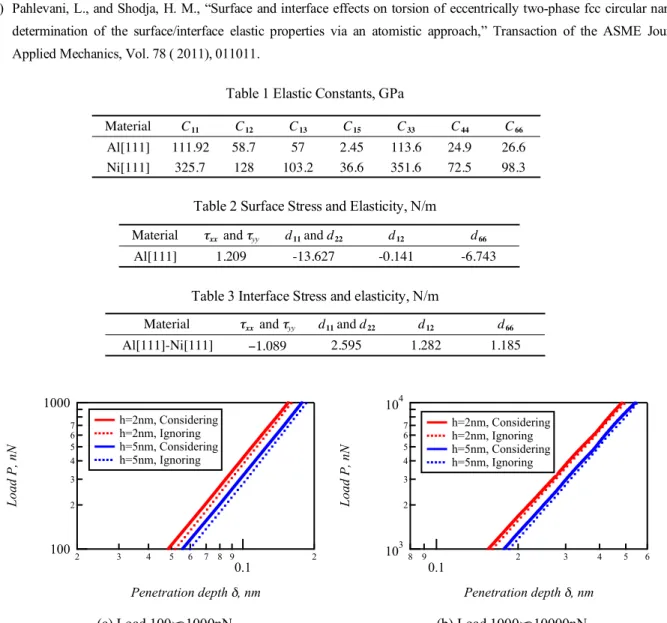
解析対象は薄膜をAl[111]とし,下地をNi[111]にした.それぞれの材料の弾性定数は表1のとおりで,表面応 力および表面弾性定数は分子動力学法を用いて算出した表2の値を用い,界面応力および界面弾性定数は
Pahlevaniら(3)が算出した表3の値を用いた.本解析では薄膜厚みを2.0,5.0nmに設定する.これらの値をもとに,
式(14)および式(15)を用いて変位分布を算出し,接触解析における影響係数として接触解析する.解析モデ ルは格子点数64 64,格子点間隔0.5nmである.接触解析では剛体球状圧子,半径100nmを用い,押し込み荷
重を100~1000nNおよび1000~10000nNの範囲で解析する.
4. 解析結果および考察
接触解析の結果を図1に示す.図1(a)は押し込み荷重100~1000nNで,図1(b)は押し込み荷重1000~10000nN である.それぞれの図において実線が表面特性と界面特性を考慮している結果,点線が表面特性と界面特性を考 慮していない結果を示している.薄膜厚みで比較すると,厚みが2nmの方が5nmよりも押し込み深さが浅い.
これは薄膜の材料が下地の材料よりも柔らかいため,薄膜厚みが薄いほど下地の影響で見かけの硬さが硬くなる.
また表面特性と界面特性を考慮すると,押し込み深さが浅くなる.これは,表面と界面の特性を考慮することで 材料の見かけの硬さが硬くなったためである.また,図1(b)で押し込み荷重を大きくすると,表面特性と界面特
性を考慮した結果としていない結果の押し込み深さの差が小さくなる.これは,表面応力の影響が表面に近いほ ど大きいため,押し込み深さが深くなると表面応力の影響が小さくなるためである.薄膜厚みによる押し込み深 さの差も小さくなっている.これは,押し込み深さが深くなると薄膜に対する下地の影響が大きくなるためであ る.
5. 結 言
本研究では表面と界面の力学的特性を考慮した薄膜を有する半無限異方性弾性体の接触解析を行い,薄膜厚み や下地を変えて,押し込み荷重と押し込み深さに対する影響について調べた.その結果,表面特性と界面特性を 考慮することで材料の見かけの硬さは硬くなり,押し込み深さが深くなることで,表面特性と界面特性を考慮し たことによる押し込み深さの違いが小さくなる.
文 献
(1) Liu, S., Wang, Q., and Liu, G., “A versatile method of discrete convolution and FFT (DC-FFT) for contact analysis,” Wear, Vol. 243 (2000), pp.101-111.
(2) Polonsky, I.A., and Keer, L.M., “A numerical method for solving rough contact problems based on the multi-level multi-summation and conjugate gradient techniques,” Wear, Vol. 231 (1999), pp. 231-219.
(3) Pahlevani, L., and Shodja, H. M., “Surface and interface effects on torsion of eccentrically two-phase fcc circular nanorods:
determination of the surface/interface elastic properties via an atomistic approach,” Transaction of the ASME Journal of Applied Mechanics, Vol. 78 ( 2011), 011011.
Table 2 Surface Stress and Elasticity, N/m Material !xx and !yy d11 and d22 d12 d66
Al[111] 1.209 -13.627 -0.141 -6.743
Table 3 Interface Stress and elasticity, N/m
Material !xx and !yy d11 and d22 d12 d66
Al[111]-Ni[111] "1.089 2.595 1.282 1.185
Fig. 1 Penetration depth vs. Load for Al[111]-Ni[111]
(a) Load 100~1000nN (b) Load 1000~10000nN
100
2 3 4 5 67
1000
Load P, nN
2 3 4 5 6 7 8 9
0.1 2
Penetration depth !, nm h=2nm, Considering h=2nm, Ignoring h=5nm, Considering h=5nm, Ignoring
103
2 3 4 5 67
104
Load P, nN
8 90.1 2 3 4 5 6
Penetration depth !, nm h=2nm, Considering h=2nm, Ignoring h=5nm, Considering h=5nm, Ignoring Table 1 Elastic Constants, GPa
Material C11 C12 C13 C15 C33 C44 C66
Al[111] 111.92 58.7 57 2.45 113.6 24.9 26.6
Ni[111] 325.7 128 103.2 36.6 351.6 72.5 98.3