Cellular Neural Networks with Switching Three-Type Templates for Edge Detection
Takahisa Ando, Yoko Uwate and Yoshifumi Nishio
Department of Electrical and Electronic Engineering, Tokushima University 2-1 Minami-Josanjima, Tokushima 770–8506, Japan
E-mail: {ando, uwate, nishio}@ee.tokushima-u.ac.jp
Abstract—In 1998, Cellular Neural Networks (CNN) were
developed by Chua and Yang. The main characteristics of the CNN are the local connection and the parallel signal processing.
The CNN consists of cells connected each other. The performance of the CNN depends on the parameters which is called the template. When the template has a good influence for processing, the CNN can perform complex processing. In this study, we propose Switching Three-Type Templates CNN. In our proposed method, 3×3 template and 5×5 template are switched according to the output values around a cell in processing. Then noise removal template process from a certain number of calculation.
We investigate the performance of our proposed method by some simulations.
I. INTRODUCTION
Recently, many information have been existed in our life.
In general, digital circuits are used for information processing.
However, digital circuits cannot process many information in real time. Therefore, Neural Networks were proposed.
The Neural Networks was based on the human’s nervous system. The Cellular Neural Networks (CNN) is introduced by replacing neuron with cell. Hence, the CNN has been success- fully used for various high-speed parallel signals processing applications such as image processing, pattern recognition and so on [1]. The CNN was paired Neural Networks with the Cellular Automata by L.O.Chua in 1998 [2]. The CNN consists of cells connected each other and the structure of CNN resembles the structure of the animal’s retina. Thus the CNN has been suitable for various image processing.
The performance of CNN depends on the parameters which is called the template. The template represents strength of connection between cells. If the template influences exactly, CNN can perform complex processing. Additionally, various applications for image processing and pattern recognition of CNN have been reported.
In previous study, we have proposed the method of switch- ing two-type templates CNN [5]. Two-type templates are 3×3 template and 5×5 template. In CNN processing, 3×3 template and 5×5 template have merit and demerit. Processing with 3×3 template is quick but the delicate process is difficult. On the other hand, processing with 5×5 template is brady and easy to receive noise effect but the delicate process is possible.
In simulation results with switching two-type templates, noise effect is observed.
In this study, we propose switching three-type templates CNN. Our proposed method is added noise removal template
to our previous method. In order to confirm the effectiveness of our proposed method, we perform edge detection.
II. CELLULAR NEURAL NETWORKS
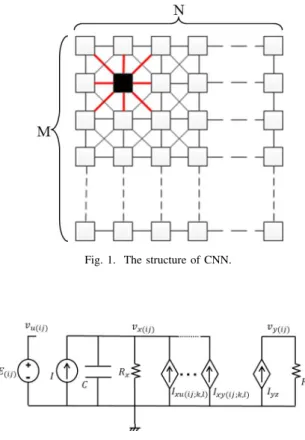
In this section, we explain the structure and processing flow of CNN. Basic unit circuit of CNN is called cell. The cell consists of linear element and nonlinear element. The CNN contains an array in a reticular pattern of many cells. We show a two dimensional array composed of M × N identical cells arranged in M rows and N columes. The array of the CNN is shown in Fig. 1. Figure 2 shows the circuit of cell.
Fig. 1. The structure of CNN.
Fig. 2. The circuit of cell.
A cell couples with only adjacent cells. Adjacent cells interact with one another. Cells which don’t couple with only adjacent cells have an indirect influence. The range
- 5 -
IEEE Workshop on Nonlinear Circuit Networks December 9-10, 2016
which some cells have influenced one cell is defined by neighborhood. We describe state equation of cell and output equation of cell below.
State Equation : dv
x(ij)dt = −v
x(ij)+
i+r
X
k=i−r j+r
X
l=j−r
A
(i,j;k,l)v
y(kl)(t)
+
i+r
X
k=i−r j+r
X
l=j−r
B
(i,j;k,l)v
u(kl)(t) + T. (1)
Output Equation : v
y(ij)(t) = 1
2 (|v
x(ij)(t) + 1| − |v
x(ij)(t) − 1|). (2)
v
x, v
yand v
uare state value, output value and input value. Output equation represents piece-wise nonlinear func- tion Fig 3.
Fig. 3. Piece-wise nonlinear function.
In Eq (1), A is feedback template, B is feedforward template, T is threshold. These value determine performance of CNN.
(a)3×3 (b)5×5
Fig. 4. System of neighborhood.
When we process the image with CNN, we should deter- mine the size of system of neighborhood. When this size is big, the amount of information in system of neighborhood is increasing. However, noise works easily. Figure 4 shows the size of system of neighborhood. Generally, the size which is
used for image processing is 3×3. In this study, we use 3×3 and 5×5 in combination. Figure 5 shows block diagram of image processing with CNN.
Fig. 5. Block diagram.
III. PREVIOUS METHOD
Our previous method is switching two-type templates CNN.
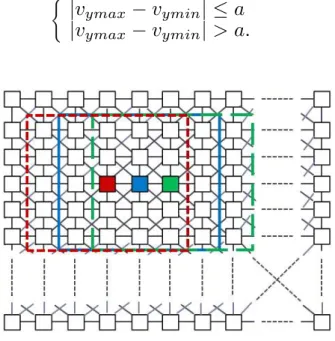
First, we calculate cell’s output value. Second, we calculate cell’s maximum output value v
ymaxand minimum output value v
yminin 5×5 neighborhood. Third, we calculate the difference value |v
ymax− v
ymin|. Fig 6 is shown the process which calculates the difference value |v
ymax− v
ymin|. In the end, 3×3 and 5×5 templates are switched according to the output values around cells in processing. This process is conducted for all cells every number of calculation n.
Switching condition depends on the difference value between the maximum and minimum output values v
ymaxand v
yminof each 5 × 5 neighborhood and is given as follows:
( |v ymax − v ymin | ≤ a
|v ymax − v ymin | > a. (3)
Fig. 6. Process of calculation.
We fix a certain value a as threshold about switching template. When the top inequality of (3) is satisfied, 3 × 3 template is used. In the other case, 5 × 5 template is used.
- 6 -
IV. PROPOSED METHOD
Our proposed method is added noise removal template to our previous method. The number of calculation is defined 50000 in this simulation. Switching process with our previous method is conducted for all cells every number of calculation 10 until the number of calculation 49900. Then noise removal template processes until the number of calculation 50000.
V. SIMULATION RESULTS
In this section, we show simulation results of the edge detection by using our proposed method and threshold value a is defined to get results which can be observed edge line and noise effect. We cite two instances. Using templates of the edge detection and noise removal are described as follows [3].
Edge detection template :
A =
0 0 0 0 1 0 0 0 0
,
B =
−1 −1 −1
−1 8 −1
−1 −1 −1
, T = −1. (4)
A =
0 0 0 0 0 0 0 0 0 0 0 0 1 0 0 0 0 0 0 0 0 0 0 0 0
,
B =
−1 −1 −1 −1 −1
−1 0 0 0 −1
−1 0 16 0 −1
−1 0 0 0 −1
−1 −1 −1 −1 −1
, T = −1. (5)
Noise removal template:
A =
0 3 0 3 2 3 0 3 0
,
B =
0 0 0 0 6 0 0 0 0
, T = 1. (6)
(a) (b)
(c) (d)
(e)
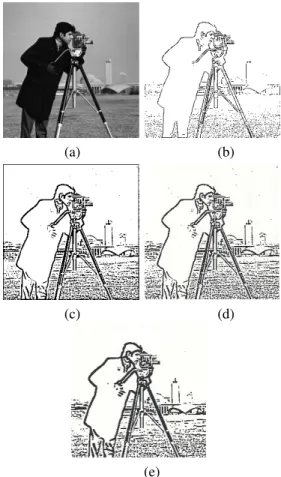
Fig. 7. Simulation results 1. (a) Input image. (b) Simulation result of the 3×3CNN. (c) Simulation result of the5×5CNN. (d) Switching two-type (3×3 and 5×5) templates CNN (a= 0.6). (e) Our proposed method
In one instance, Fig. 7 show images which are processed with CNN. Figure 7(a) shows an input image. The input image has the indistinct portions. Indistinct portions are the pillar of the left-side and an outline of a woman’s face. Figure 7(b) shows the simulation result of the 3 × 3 CNN. The 3 × 3 CNN cannot detect edge lines of indistinct portions. Figure 7(c) shows the simulation result of the 5 × 5 CNN. The 5 × 5 CNN can detect edge lines of indistinct portions, however image processed by this method receives the noise effect.
Figure 7(d) shows the simulation result of switching two- type template CNN (a = 0.6). Switcing two-type template can detect edge lines of indistinct portions and receive less noise effect compared to Fig. 7(c). In Fig. 7(e), dots which are caused by noise effect are rarely found, especially woman’s hat compared to Fig. 7(d).
We process another image for edge detection with our proposed method. Figure 8(a) shows an input image. The input image has indistinct portions. Indistinct portion is right-side buildings. Figure 8(b) shows the simulation result of the 3 × 3 CNN. The 3 × 3 CNN cannot detect edge lines of indistinct portions. Figure 8(c) shows the simulation result of the 5 × 5 CNN. The 5 × 5 CNN can detect edge lines of indistinct portions, however image processed by this method receives the noise effect. Figure 8(d) shows the simulation result of switching two-type template CNN (a = 0.3). In Fig. 8(d),
- 7 -
(a) (b)
(c) (d)
(e)
Fig. 8. Simulation results 2. (a) Input image. (b) Simulation result of the 3×3CNN. (c) Simulation result of the5×5CNN. (d) Switching two-type (3×3 and 5×5) templates CNN (a= 0.3). (e) Our proposed method.