DISCOURSE POLITENESS THEORY AND CROSS-CULTURAL PRAGMATICS
1Mayumi Usami
Tokyo University of Foreign Studies
3-11-1 Asahi-cho, Fuchu-shi, Tokyo 183-8534, JAPAN [email protected]
1 Introduction
In this paper, I introduce a preliminary framework for a Discourse Politeness Theory (hereafter, DPT), which has been developed based on the results of a series of empirical studies on discourse behavior (for a review, see Usami, 1993d, 1998b, 2001a, 2002a, 2002b). This approach is an attempt to enable researchers to contrast politeness behavior in different languages with and without honorifics within the same framework while minimizing cultural biases and develop a more comprehensive universal theory of politeness at the discourse level. This proposal also aims to broaden politeness research to encompass the concept of relative politeness in addition to absolute politeness, which has thus far been studied within the field of pragmatics (for example, Leech, 1983). This is because the notion of relative politeness permits the construction of a universal theory of Discourse Politeness (DP) as both a system of the principles of motivations that induce politeness strategies and a system of the interpretations of politeness in verbal interactions.
The DPT and second language acquisition are closely related. This is because in cross-cultural interactions, language learners have to identify the DP defaults (see 3. 1. 2) of the target language and culture and learn these in order to achieve smooth communication with others from the target language and culture. In this paper, therefore, I will present a more detailed explanation on the relationship between the DPT and cross-cultural pragmatics, by using examples from cross-cultural studies that can be explicated within the framework of the DPT. Finally, I will discuss the different ways in which this theory can
1 This paper is a revised version of the following paper, which is based on the plenary lecture of the CLS International Conference (CLaSIC) held at the National University of Singapore from the viewpoint of cross-cultural pragmatics. Usami, M (2004). “Discourse politeness and second language acquisition.” Proceedings of the Inaugural CLS International Conference (CLaSIC). 719–737. Singapore.
This is the pre-publication version of the paper, which may be different from the published version.
contribute to finding solutions to problems created by the transfer of politeness strategies from one’s first language to one’s second language in actual cross-cultural exchanges and the manner in which language teachers can integrate the perspective of the DPT into their teaching.
2 Basic definitions
In the following subsections, I will first define the terms that are crucial for a discussion on “politeness”
and “politeness theory.”
2.1 “Politeness”
Both Western politeness research and Japanese honorifics research have merely presented a vague definition of the term politeness; moreover, these researches do not clearly differentiate politeness from other terms such as deference, respect, and formality, which are occasionally used interchangeably. In this paper, the term “politeness” is understood in two contexts. In a broad context, it refers to all the different approaches and perspectives of the various theories of politeness. On the other hand, in a narrow or specific context, it refers to the politeness strategies defined by Brown & Levinson (1987) (hereafter, B&L), i.e., the choice of linguistic strategies to minimize the Face Threat of a particular act (for a review, see Usami, 2002a).
2.2 “Normative politeness” and “pragmatic politeness”
I also differentiate between the concepts of normative politeness, which refers to the traditional understanding of the degree of politeness intrinsic to “linguistic expressions,” and pragmatic politeness, which is defined as the “functions of language manipulation that work to maintain smooth human relationships” (Usami, 2001a, 2002a). In other words, pragmatic politeness not only comprises politeness resulting from linguistic forms and expressions (i.e., normative) but also comprises discourse behavior, such as topic initiation and the appropriate use of backchannels, speech-level shifts, incomplete utterances, context-dependent use of particles, appropriate frequency of the use of particles (Usami, 1993a, 1993b, 1993c, 1994a, 1994b, 1994c, 1995, 1996a, 1996b, 1998a), requestive speech acts, such as prefacing before making a request (Kashiwazaki, 1995; Xie, 2000), compliment-reply discourses (Kim, 2001), utterances that do not possess linguistic politeness markers (Usami & Lee, 2003), metalanguage behavior (Sugito,
1983, 1993), and so on. Thus, in addition to the sentence-level politeness of linguistic forms, discourse- level phenomena also play an important role in pragmatic politeness. In this study, I primarily focus on pragmatic politeness, which can be understood as one of the effects of interactions on verbal behavior.
2.3 “Language use according to social norms” and “Strategic language use”
In this paper, I employ the notion of language behavior that conforms to sociolinguistic norms and conventions to refer to all the literal, normative, and conventional language use that exist in the language of a society. In Japanese, these are not only limited to the use of honorifics, as mentioned in Ide (1982, 1989), but also include such behavior as the non-use of honorifics with close friends and the appropriate use of backchannels. Similarly, in English, it refers to the norms and conventions constraining linguistic behavior, such as the avoidance of slang in formal situations or the appropriate use of address terms.
On the other hand, strategic language use refers to voluntary linguistic behavior based on individual choice that shows consideration toward positive and negative face, as defined by B&L (see 3.3), irrespective of honorific system in the language concerned. For example, while communicating in Japanese, a speaker may strategically or unconsciously increase the frequency of the use of backchannels in order to indicate his/her interest (i.e., addressing positive face) in the interlocutor. In B&L’s politeness theory, the term strategic language use encompasses potentially unconscious language use, such as an increase in the frequency of the use of backchannels and speech-level shifts while communicating in Japanese, and such behavior as code-switching and the use of joking in both English and Japanese.
3 Discourse Politeness Theory
In this section, I will introduce the six key concepts of a DPT, which has been developed on the basis of the results of a series of empirical studies on discourse behavior (for a review of previous studies on politeness theory, see Usami, 1993d, 1998b, 2001a, 2002a, 2002b).
3.1 Basic concepts
Essentially, there are six key concepts in a DPT: (1) DP default, (2) marked and unmarked behavior, (3) marked and unmarked politeness, (4) discrepancy in the estimations of the degree of Face Threat (De value),
(5) three types of politeness effects, and (6) relative and absolute politeness. Before explaining these concepts, I will first explain the term “Discourse Politeness.”
3.1.1. “Discourse Politeness”
While there have been a number of researchers who have discussed discourse-level factors, such as metalanguage behavior or utterance organization (Blum-Kulka, 1990; Kasper, 1990; Leech, 1983; Sugito, 1983; Thomas, 1995 inter alia), no actual attempts have been made to integrate these phenomena into a politeness theory. Therefore, according to the results of my previous empirical studies (Usami, 1993a, 1993b, 1993c, 1993d, 1994a, 1994b, 1994c, 1995, 1996a, 1996b, 1998a), in addition to the sentence-level politeness of linguistic forms, I introduce the concept of DP based on the opinion that discourse-level phenomena play an important role in pragmatic politeness.
DP is defined as “the functional dynamic whole of factors of both linguistic forms and discourse-level phenomena that play a part in the pragmatic politeness of a discourse” (Usami, 1998b, 2001a, 2002a, 2002b). Basically, DP can be used in two ways. Its first use is when referring to pragmatic politeness that can only be interpreted at the discourse level. However, DP is also used to refer to the “DP default”
(see 3.1.2) of a certain discourse, which is understood to be the dynamic whole of the elements functioning for the pragmatic politeness of that particular discourse.
The DPT involves language use that conforms to social norms and conventions and an individual speaker’s strategic language use as well as the interaction between these two. This applies to both honorific and non-honorific languages such as Japanese and English, respectively. I contend that the individual elements in DP, such as the frequency of topic initiation and speech-level shifts, as well as DP itself as the functional dynamic whole of various elements are more appropriate focal points for studies that compare pragmatic politeness across languages with differing grammatical structures. Accordingly, the examination of these topics would contribute to the development of a comprehensive universal theory of politeness.
3.1.2. “Discourse Politeness Default”
The notion of DP default is fundamental to the DPT and can be illustrated with an example from the Japanese language:
Focusing on speech levels in Japanese, any utterance is classified as containing polite forms (P), non- polite forms (N), or containing no politeness markers that are described as non-marked utterances (NM) (e.g., incomplete utterances and backchannels). By calculating the frequency of the occurrence of each speech level within a specific discourse, it is possible to determine the overall ratios of the speech levels.
This indicates the DP default for the speech levels within that discourse, and the speech level with the highest frequency is referred to as the “dominant speech level.” For example, in a study of sentence-final speech levels (Usami, 2001b), the average ratio of P, N, and NM was 6:1:3. This can be concluded to be indicative of the DP default of the discourse in question. In this case, the P is the dominant or unmarked speech level (i.e., occurring in more than 50% of the utterances); therefore, using the N becomes marked behavior (see 3.1.3) and gives rise to particular politeness effects, such as expressing empathy with the interlocutor(s), i.e., positive politeness.
It is important to note that there exists a general DP default of the discourse that is unmarked in each specific discourse. Further, there are individual DP defaults for each individual element that contributes to DP in that discourse. In other words, there are two types of DP defaults: (1) the DP defaults of the discourse as a whole and (2) the DP defaults of individual elements within the discourse that constitute DP, such as speech levels and sentence-final particles. The DP defalts of the discourse as whole are considered as “unmarked discourse”, and the DP defaults of individual elements such as sentence-final particles are considered as “unmarked discourse elements.” The average frequency of the occurrence of various elements, such as speech-level shifts and backchannels, and the ratio of these elements relative to the structure of the discourse and their distribution within a particular discourse—which constitute a part of the DP of that discourse—are treated as one variable, i.e., as one of the DP defaults for the unmarked discourse elements.
The concept of DP default as a dynamic whole is vital to the DPT. This is because it becomes a base parameter for calculating a relative politeness fungtion, which is distinct from the politeness functions of its individual elements.
3.1.3. “Marked” and “unmarked” behavior
In the DPT, identifying the DP defaults of specific types of discourses is the first step in understanding the relative nature of politeness. A systematic investigation of relative politeness can be conducted by examining the movements toward and away from those DP defaults. Linguistic behavior that is consistent with those DP defaults is termed as “unmarked behavior,” while that which deviates from those defaults is termed as “marked behavior.” Marked behavior does not necessarily give rise to marked politeness (see 3.1.4) because both of these are distinct notions in the DPT. On the other hand, behavior consistent with DP defaults is always considered to be unmarked politeness. It is assumed that the elements comprising these DP defaults form DP as unmarked politeness, which is expected but unnoticed. However, if a hearer notices that something is either excessive or lacking with regard to these DP defaults, s/he might regard the speaker’s behavior as impolite (for further explanation, see 3.1.4).
3.1.4. “Marked” and “unmarked” politeness
In B&L’s politeness theory, politeness is understood as a strategy whereby one redresses Face Threatening Acts (FTAs), such as requests, which infringe upon another person’s face. However, it has been pointed out that in this approach, one cannot adequately explain politeness that arises in ordinary conversations where FTAs do not seem to occur.
In fact, a different type of politeness that does not involve redressing Face Threats can be found in an ordinary conversation. This type of politeness is associated with expected behavior, which is only noticed if it does not occur and generates perceptions of impoliteness. In the DPT, this is termed unmarked politeness. This type of politeness is contrasted with marked politeness, which encompasses B&L’s notion of politeness as linguistic strategies for redressing Face Threats.
In the DPT, unmarked politeness refers to both the state of the discourse as a whole and the language behavior that is unconsciously expected. When those linguistic behaviors do not occur as expected, the discourse or utterance is considered impolite. When a speaker behaves according to implicit expectations or the DP default in a given situation, s/he displays unmarked behavior, which constitutes unmarked
politeness. In contrast, unlike unmarked behavior, marked behavior that deviates from the expected norm or DP default does not necessarily give rise to marked politeness. Marked and unmarked politeness can be distinguished in terms of the ways in which they are recognized.
B&L’s politeness theory is considered to be a theory of marked politeness because it primarily focuses on linguistic politeness strategies that can be used to redress Face Threats in situations where one cannot help but commit an FTA.
In general, politeness theory should systematically address both marked and unmarked politeness within a single framework, rather than merely focus on marked politeness, as is the case in B&L’s politeness theory (see Usami, 2001a, 2002a, 2002b).
Although Fraser (1990) mentioned this type of unmarked politeness in his framework of “conversational contract” and Watts (1992) discussed the same type of behavior in a wider context of “politic behavior,” it can be said that neither of them fully developed a comprehensive theory of DP. The DPT attempts to systematically address both marked and unmarked politeness and consider both the speaker’s and the hearer’s points of view within a single framework.
3.1.5. “Discrepancy in estimation value”
In the DPT, the “politeness strategy” is determined based on the speaker’s estimation of the degree of the Face Threat of his/her act, and the actual “politeness effect” is determined by the “discrepancy between the speaker’s and hearer’s estimations of the degree of the Face Threat of the speaker’s act” from the hearer’s point of view. I term the latter “politeness effect” and distinguish it from the” politeness strategy”
in B&L's politeness theory.
The De value as an index of the actual “politeness effect” is calculated by comparing the speaker’s and hearer’s estimations of the degree of the Face Threat of the speaker’s act. The “De value” is the value assigned to this discrepancy between the speaker’s and hearer’s estimations of the degree of the Face Threat.
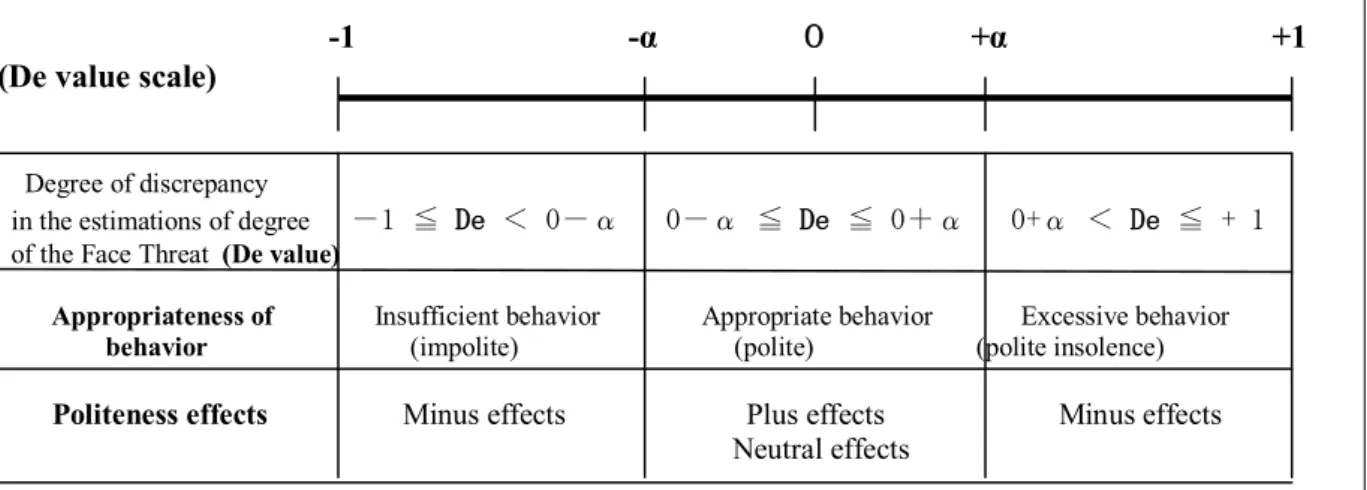
A De value cannot be an absolute numerical value, but rather is represented symbolically as distributed along a scale from –1 to 1. This is illustrated in Figure 1 below.
For example, minus-politeness effects include so-called “polite insolence” (inginburei); here, the hearer experiences unpleasant feelings despite the speaker’s use of polite forms. In the DPT, from the hearer’s perspective, polite insolence—which has thus far received little attention in honorifics research in Japanese—can be regarded as the result of a speaker’s excessive use of polite expressions that extend beyond the acceptable variation (+α) defined in the “De value scale” illustrated in Figure 1. In other words, the linguistic expressions employed by the speaker in a particular situation are excessively polite and go beyond the acceptable difference as compared with the hearer’s expectation regarding the appropriate linguistic behavior in that situation.
3.1.6. The three types of politeness effects
In the DPT, face redressing acts are considered to be a type of marked behavior. Three types of effects can arise from marked behavior: (1) plus-politeness effects, (2) neutral-politeness effects, and (3) minus- politeness effects. These effects essentially result in pleasantness, neutral effects (neither pleasant nor unpleasant), or unpleasantness, respectively. The neutral-politeness effects at the discourse level are not
-1 -α 0 +α +1
(De value scale)
Degree of discrepancy
in the estimations of degree -1 ≦ De < 0-α 0-α ≦ De ≦ 0+α 0+α < De ≦ + 1 of the Face Threat (De value)
Appropriateness of Insufficient behavior Appropriate behavior Excessive behavior behavior (impolite) (polite) (polite insolence)
Politeness effects Minus effects Plus effects Minus effects Neutral effects
Discrepancy in estimations:De = Se – He
De: the degree of discrepancy between the speaker’s and hearer’s estimations of the degree of the Face Threat of the speaker’s act.
Se: the speaker’s estimation of the degree of the Face Threat of his/ her act; expressed as a value between 0 and 1 He: the hearer’s estimation of the degree of Face Threat of the speaker’s act; expressed as a value between 0 and α:Acceptable difference between the speaker’s and hearer’s estimations of the degree of the Face Threat of the 1
speaker’s act from the viewpoint of the hearer.
Figure 1 Discrepancy in estimations (De value), appropriateness of behavior, and politeness effects
addressed in B&L’s politeness theory, since a notion of unmarked politeness would be necessary in order to examine these effects. Moreover, B&L’s politeness theory does not systematically treat the minus- politeness effects, which are produced by either making no effort to reduce the degree of threat to the hearer’s face or using excessive polite forms.
Thus, the DPT expanded B&L’s politeness theory in scope. This is because, in addition to plus-politeness effects, it encompasses the neutral- and minus-politeness effects within a unified theoretical framework.
Moreover, the neutral- and minus-politeness effects are systematically explained by introducing the concept of the degree of discrepancy between the speaker’s and hearer’s estimations of the degree of the Face Threat of the act in question. The discrepancy between these estimations, i.e., the De value is represented by a symbolic numerical continuum, as explained above. Thus, the minus-politeness effects (or unpleasantness), including both polite insolence and rudeness, can be explained by an integrated theory of politeness, namely the DPT.
3.1.7. “Absolute” and “relative” politeness
A final distinction to be made with regard to the DPT is between absolute and relative politeness. The former involves labeling particular linguistic forms or strategies as being intrinsically more polite than others, for example, the Japanese honorific verb irassharu (“go-Hon”) is considered to be inherently more polite than its non-honorific equivalent iku (“go”). However, if one uses honorifics while conversing with someone with whom one usually speaks to rather casually (the DP default of that discourse is casual speech), it could be implied as sarcasm rather than politeness. Similarly, even if one uses non-polite expressions in situations where the DP default is polite forms, depending on the context, the effect could be an increase in the feeling of solidarity rather than an implication of impoliteness. Thus, in the DPT, politeness effects are considered to not be produced by merely using polite expressions in an absolute sense, but rather to be relatively produced by the “movement” toward and away from the DP defaults of the discourse in question.
I term this type of politeness as “relative politeness.”
It is important that the DPT includes both the concepts of “De value” (discrepancy between the speaker’s and hearer’s estimations of the degree of the Face Threat) and “DP default” as a base parameter for calculating “relative politeness” effects. Thus, the DPT integrates the interactive and relative aspects of
politeness effects by including the abovementioned concept of “relative politeness.” It is important to include these three concepts within a theory of politeness; thus, these three constitute the fundamental aspects of the DPT.
3.2 Politeness effects arising from deviated behavior from the DP default: Examples from Japanese and English
DP has been defined as “the functional dynamic whole of factors of both linguistic forms and discourse- level phenomena that give rise to pragmatic politeness of a discourse” (lit. “The dynamic whole of functions of various elements that exist in both linguistic forms and discourse-level phenomena that play a part in the pragmatic politeness of a discourse”) (Usami, 1998c, 2001a, 2002a, 2002b).
3.2.1. Speech-level shifts in Japanese conversations
Japanese conversations have numerous elements that constitute DP; however, for the sake of brevity, I will only focus on speech levels as an example of an element of DP. I will explain the relative nature of the politeness effects through Figure 2.
In Figure 2, the largest circle represents a set of functions of various elements in DP as a whole. The small circles inside the larger ones represent a set of functions of each element in DP, which is hypothesized to be factors such as the frequency of backchannels, topic introduction, and speech levels. The number of elements is not limited to five as shown in the large circles above. The circles from which the arrows are pointing outward represent the unmarked speech levels as the DP defaults of the respective discourses.
In the example in Figure 2, the speech level that deviates from the unmarked dominant speech level as the DP default, becomes “marked behavior” at the utterance level (N in conversations between people meeting for the first time, and P in conversation between friends).
N P
Deviation from the unmarked speech level
(marked behavior)
Marked behavior gives rise to particular functions
(“plus-politeness effects,” “neutral-politeness effects,” or “minus-politeness effects”) Figure 2 DP defaults and marked behavior in specific activity-types
As illustrated by the diagram on the left-hand side of the figure, in the case of a conversation between unacquainted people, P (polite forms) is the dominant, unmarked speech level as the DP default of the discourse. Therefore, the continued use of P maintains unmarked politeness, while the use of N (non- polite forms) becomes marked, giving rise to certain special functions or effects, such as showing empathy and indicating a topic change (Usami, 1995).
On the other hand, as illustrated on the right-hand side of the figure, in the case of a conversation between friends or married couples, the DP default or unmarked speech level is contrary to the previous case, i.e., N. Accordingly, in this discourse, the use of N constitutes the DP default as unmarked politeness and can be considered as sufficiently polite. Thus, the use of P in this discourse becomes marked behavior, and contrary to the view of politeness as the “politeness level of linguistic forms,” a failure to conform to the DP default by the use of a P may result in the minus-politeness effect, i.e, sarcasm or impoliteness. This might be understood intuitively in terms of everyday observations.
P N
DP defaults
of conversations between people meeting for the first time
(Unmarked speech level = P: polite forms)
DP defaults
of conversations between friends or married couples
(Unmarked speech level = N: non-polite forms)
According to the DPT, marked behavior gives rise to one of the following three types of politeness effects: (1) plus-politeness effects (e.g., expressions of familiarity or closeness), (2) neutral-politeness effects (e.g., changing topic), or (3) minus-politeness effects (e.g., sarcasm or impoliteness).
Accordingly, we notice that P can be used either when arguing or to express sarcasm in conversations where N is the unmarked speech level of the discourse. In other words, in conversations where N is unmarked, the use of P, which constitutes marked behavior, can also give rise to the three effects mentioned above including minus-politeness effect, despite the fact that P itself is a ‘polite form.’
These examples indicate that, essentially, it is the “dynamics” of language use—in a specific situation where the speaker deviates from and returns to the DP defaults as unmarked politeness — and not the absolute politeness level of the linguistic form that is responsible for occurrence of pragmatic politeness effects (Usami, 2001a, 2002a, 2002b).
3.2.2. The switching of the absolute politeness level of linguistic expressions in conversations between English speaking couples
The same phenomenon can be observed in English and can also be explained by using the notion of the DP default given in the DPT; this indicates that it is possible to interpret pragmatic politeness in different languages within the same framework.
The following example is taken from Thomas (1995: 156).
(1) [Taken from a short story by James Thurber]2
A married couple is trying to decide on a restaurant. The husband says:
“You choose.”
Thomas maintains that although this utterance is a direct imperative, it would normally be seen as perfectly polite because the speech act is what Leech (1983: 107–108) terms as “costly to the speaker” or (better in this case) “beneficial to the hearer” (Thomas, 1995: 156). This explanation is applicable to
2 James Thurber (1963). A couple of hamburgers. Vintage Thurber (p. 103). London: Hamilton ,.
English; however, it cannot be used to explain a Japanese translation of this example (“Kimi, erabe yo”).
Irrespective of the utterance’s “benefit to the hearer,” if the hearer is of a higher social status than the speaker or the hearer is someone the speaker has met for the first time, it is impossible for such an utterance to be understood as polite. The alternative translation “Erande kudasai” has the minimum appropriate amount of politeness; however, as compared with the original, it has a higher “politeness level” in terms of linguistic form. Further, it is not a direct imperative; it is the form of a request. Therefore, Thomas’s argument does not hold for this example in Japanese, and we can conclude that one cannot translate the politeness effects in English directly into Japanese. What this example does show is that due to the strong influence of the various structures and characteristics of different languages, it is impossible to present a consistent explanation of politeness across languages at the utterance level.
Thomas (1995) further discusses her claim that there is no necessary connection between the politeness level of linguistic forms and the politeness (effect) arising from those forms with the following example (p.
156) in which a married couple is becoming irritated with each another:
(2) “Will you be kind enough to tell me what time it is?”
[and later]:
“If you’ll be kind enough to speed up a little.”
Thomas explains that in the context of an intimate relationship, these utterances “appear inappropriately indirect” (p. 156). However, while Leech’s politeness maxims can explain why the utterance in example (1) is regarded as polite, they cannot explain why the utterances in example (2) cannot be regarded as polite, despite the use of indirect expressions. Thomas comments that only “…in the context of an intimate relationship they appear inappropriately indirect…” (p. 156); however, she does not explain why one would interpret it in this way.
In the DPT, both examples (1) and (2) can be interpreted by adopting a common principle. Direct expressions can be assumed to be the unmarked politeness or DP default between English speaking couples.
Therefore, the direct “You choose” in example (1) constitutes unmarked politeness and is thus sufficiently polite (or perhaps it would be more appropriate to suggest that it is not rude/impolite). On the other hand,
in example (2), since direct expressions are the DP default, the wife’s use of so-called “polite expressions”
became a marked behavior and produced a minus-politeness effect (i.e., sarcasm or impoliteness).
3.3 Determining DP defaults for research in cross-cultural pragmatics
According to the DPT, after identifying the DP default as unmarked politeness for each individual conversation or discourse, one can examine the politeness effects arising from the marked behaviors in that discourse interaction. Accordingly, one can interpret the pragmatic politeness effects arising in a specific conversation in a relative manner, even if there are variations in the discourse content, use of linguistic forms, and relationships between the interlocutors in the absolute sense.
The determination of the DP default of a discourse—which is an amalgamation of various elements—
includes the determination of the DP default of the overall discourse and individual elements, such as speech level default, backchannel frequency default, default for the frequency of topic initiation by each interlocutor, default for the request sequence pattern, and so on. Thus, it is necessary to identify the elements that give rise to important functions in the DP of representative activity-types in various languages and cultures. It is then necessary to identify the DP defaults of both the discourse as a whole and the crucial elements within the discourse.
Identifying the DP defaults of each element in particular activity-types in different languages and cultures is a relatively simple starting point and is a topic of significant interest. However, strict adherence to the process of determining the DP default of the overall discourse and each activity-type within the discourse and then identifying the individual marked behaviors that deviate from these DP defaults using the newly collected data requires considerable time and effort. Thus, in order to simplify this process, one can use the approximate tendencies that emerged in similar activity-types from the results of previous studies as the DP defaults for a specific discourse or activity-type. For example, with regard to the discourse between married couples, there exists considerable data proving that “direct expressions” are unmarked in English.
In this way, the abovementioned utterance (Will you be kind enough to tell what time it is?) in the conversation between the married couple can be interpreted to be an example of sarcasm rather than politeness.
3.4 The DPT and associated research
A number of empirical researches have pursued various interests in pragmatics from the perspective of DP. These studies have identified the DP defaults of crucial elements in the various activity-types of a discourse as the basis of the research. For example, the DP defaults for the frequency of topic initiation, distributions of speech levels, and frequency of the speech-level shift have been identified for conversations between Japanese adults meeting for the first time (Usami,1996a, b, 1998c, 2001a, 2002a). Otsuka (2004) has analyzed the effects of changes in speech style in TV debates utilizing the DPT framework.
Case study findings have also identified tentative DP defaults for the use of backchannels at the beginning and the end of conversations between Japanese adults meeting for the first time (Usami, 1993a, b, c, d, 1994a, 1995). DP defaults for the frequency of the use of the particle ne in casual conversation between colleagues and in meetings have also been examined (Usami, 1997). Kiyama (2005) has identified that there are different DP defaults for “substantive disagreement” and “courtesy disagreement” in Japanese conversations between friends and strangers. Xie (2000) has identified the DP defaults in Chinese and Japanese for sequence patterns in request discourses. Olivieri (1999) has identified the DP defaults of speech levels in conversations between the Japanese and those between the Japanese and Italians meeting for the first time; Usami and Lee (2003) has identified the DP defaults of speech levels and their distribution in conversations between the Japanese and those between the Koreans. In addition, although not planned specifically from the perspective of DP, the ways in which the DP defaults for the Japanese with regard to the conversations between newly acquainted Japanese and Koreans changed over time were also investigated on four different occasions over a set period of time (Oyanagi, 2000).
4 The application of the DPT to cross-cultural pragmatics and language education
The DPT is intended to be a universal theory of politeness. However, at the same time, the theory integrates the factors that are related to cultural norms and customs in speech acts and discourse behaviors by introducing the concept of “relative politeness,” which is based on the “DP default” as unmarked politeness. Therefore, the first step in applying the DPT is to identify the main elements/factors that constitute DP defaults and conduct comparative studies on the defaults of these elements with regard to DP in various languages and cultures.
The important constituents for DP may be different in each language and culture; moreover, even if the same constituents are important, the DP defaults of those constituents may differ for each language and culture. In this sense, although investigating the DP defaults for each main activity-type in various languages and cultures seems to be an investigation of the typology of linguistic behavior patternsfrom the perspective of the DPT, it also means identifying the DP default as unmarked politeness in various languages and cultures in order to analyze the effects of marked behavior.
For example, if the differences in request or refusal behaviors among various cultures are examined from the perspective of the DPT, the different “DP defaults” for request or refusal discourses in each culture can be regarded as the basis for identifying “marked behaviors,” which basically produce politeness effects in each language and culture. Based on this, one can regard such studies as those that do not simply describe cultural differences from a cross-cultural perspective, but rather identify the DP defaults of specific verbal behaviors in various languages and cultures from the perspective of the DPT. In this case, one can utilize the DP defaults as the basis for the different perceptions and impressions of specific verbal behaviors in each culture. Thus, the DPT can be applied to find ways to solve intercultural miscommunication.
Furthermore, these findings allow a universal explanation of the motivations and mechanisms that give rise to politeness strategies and the effects that underlie the identified culture-specific behaviors in various languages and cultures.
For example, Xie (2000) examined request discourse in Japanese and Chinese based on the data from the discourse completion tests (DCT) and the recordings of actual conversations. In the case of the former, an analysis of the utterance-level responses showed no differences between requests in Chinese and Japanese.
However, in the case of the latter, she found that in Japanese it was common for there to be a sequence of (1) attention-getter, (2) checking the possibility of compliance, (3) supportive strategies (explanation for the request), etc., before the appearance of the request utterance itself. However, in Chinese, the request utterance followed immediately after the attention-getter; thus, suggesting a difference in sequence patterns between the two languages.
If we interpret these results in terms of DP, we can observe that the DP default as unmarked politeness with regard to the request discourse is different in Japanese and Chinese. In Japanese, going through the
elaborate sequence before making a request constitutes unmarked politeness; however, in Chinese, the short sequence, i.e., an attention-getter, followed by a request utterance constitutes unmarked politeness. Based on these results, if learners of Japanese who are native speakers of Chinese transfer the utterance sequence that constitutes unmarked politeness in Chinese to Japanese, their Japanese interlocutors may feel that their requests are either abrupt or rude. This might be the case even if the “politeness level of the linguistic forms” in their requests is appropriate at the utterance level.
On the other hand, if one follows the Japanese request sequence pattern to make a request in Chinese, this marked behavior may be viewed as being cold and distant or as harboring some ulterior motive. Thus, if you consider the differences in the DP defaults across various languages and cultures, the identification of the DP defaults going beyond the utterance level for specific “activity-types” can be useful in facilitating smoother intercultural communication and clarifying the causes of intercultural miscommunication with regard to politeness.
Similarly, by analyzing the differences in the DP defaults of important speech acts in various languages and cultures, one can focus on the interactions between native and non-native speakers. This leads to a richer understanding of the reasons for intercultural miscommunication at the discourse level, moving beyond a focus on grammatical errors and the use of honorifics at the sentence/utterance level. Ultimately, this understanding may be applied to facilitate smoother intercultural communication.
The DPT and second language acquisition (language learning) are closely related. This is because in terms of cross-cultural interaction, language learners have to identify the DP defaults and learn them in order to achieve smooth communication with others in the target language and culture. Some studies have already begun to analyze natural conversation data and conversation teaching materials in order to compile language teaching materials with the view to utilize the framework of the DPT (Usami, 2005; Suzuki et al., 2005; Xie et al., 2003).
5 Future issues with regard to the DPT
Future work on the DPT will focus both on validating its assumptions through empirical research and further development of the theory itself. Validating the DPT involves identifying the DP defaults as unmarked politeness for various “activities types” of discourse in different languages. The DP defaults
for a particular type of discourse are identified by examining the typical examples of that discourse. Thus, identifying these DP defaults is somewhat similar to clarifying the sociolinguistic norms and customs in language use at the discourse level.
However, the aim of this research is not to establish model examples of discourse, as such, but rather to focus on the deviations from the DP defaults in order to develop a better understanding of the relative politeness phenomena associated with these DP defaults. Further, the theoretical development of the DPT will focus on predicting, interpreting, and explaining how politeness functions in human interactions. It is necessary to further clarify how the content of the utterances and the speaker’s intentions are related to their various effects, such as expressing empathy with others, picking fights, or simply emphasizing the prepositional content of the utterances. The issues that need to be further studied can be summarized under the following four main themes:
(1) Systematizing the relationship of the interactional politeness effects between the utterance content and the politeness level of its linguistic forms.
(2) Systematizing the process of identifying and predicting the politeness effects (plus- , neutral- , and minus-politeness effects) arising from a marked behavior.
(3) Systematizing the politeness effects associated with the utterance sequences.
(4) Theorizing about the speaker’s “intentionality” of committing (or not committing) FTAs.
6 The DPT as a theory of interpersonal communication
The ultimate aim of the DPT is to establish a universal theory to investigate and compare politeness effects in languages with and without honorifics, such as Japanese and English. The DPT has a number of innovative aspects including expanding the scope of research beyond that encompassed by B&L’s politeness theory to the discourse level and defining the term “politeness” operationally as a relative phenomenon involving the interaction from both the speaker’s and hearer’s perspectives. The DPT also introduces the notion of “relative politeness” by incorporating the notion of the DP defaults of particular activities types of discourses as unmarked politeness; this enables the DP default to serve as the basis for
an analysis through which deviations as marked behavior become apparent, thereby generating actual politeness effects.
The DPT differs from B&L’s politeness theory, which emphasizes the speaker’s estimation of the degree of the Face Threat. In other words, when considering the actual politeness effects, the DPT incorporates not only the use of the speaker’s politeness strategies based on his/her estimation of the degree of the Face Threat of the act in question but also the discrepancy between the speaker’s and hearer’s estimations of the degree of the Face Threat of the speaker’s act. Hence, as shown in Figure 1, when the discrepancy between the speaker’s and hearer’s estimations of the degree of the Face Threat of the speaker’s act is approximately zero or within acceptable variations (0 ± α), it is regarded as appropriate behavior, regardless of the politeness level of the linguistic forms themselves. In other words, it is assumed that the actual politeness effects are assumed to arise from the discrepancy between the speaker’s and hearer’s estimations of the degree of the Face Threat of the speaker’s act3. Furthermore, in the DPT, the “differences in their perceptions of the prototypical patterns or schemata of specific activity-types” are also regarded as the “DP defaults” of those activity-types and assume an important role in the overall theoretical focus. The above discussion implies that the hearer’s perspective and the discourse-based perceptions of both the speakers and hearers are given more weight in the explanation of pragmatic politeness. Thus, this approach incorporates the discourse-based relative perception of human interaction as a key aspect and is the first to systemize politeness at the discourse level. This is the primary reason for terming this framework the DPT.
In the DPT, politeness is a general term encompassing not only absolute politeness, or the speaker’s politeness strategies, but also the relative politeness effects arising through deviated behaviors from the DP defaults of various activity-types of discourses. The aim of the DPT is to investigate the universality of the mechanisms underlying these types of discourse behaviors as well as culture-specific politeness strategies that arise out of the universal motivations for smooth human relations and interpersonal communication. In this sense, this theory can be regarded as a theory of interpersonal communication.
7 Conclusion
3 It is assumed that the speaker acts on the basis of his/her own estimation of the degree of the Face Threat. Cases in which the speaker intentionally threatens the face of the hearer through linguistic behavior are treated separately.
In this paper, I have discussed the key aspects of the DPT by focusing on the concept of relative politeness and the interactive and dynamic nature of politeness strategies and politeness effects. Several other issues are being examined within the framework of the DPT and its connection to second language acquisition.
Further, there remain a number of unresolved issues that have been mentioned in this paper. These issues, although related to the DPT, are also important aspects for future research in the fields of cross-cultural pragmatics, interpersonal communication, and second language acquisition. In other words, all these issues are related to our approach to systematize the functions of interactivity, dynamics, and relativity in interpersonal communication. The further development of this theory will not only lead to a more comprehensive theory of politeness but may also contribute to the further development of theories of cross- cultural pragmatics and interpersonal communication as well as the application of this theory to second language acquisition.
References
Blum-Kulka, Shoshana (1990). “You don’t touch lettuce with your fingers: Parental politeness in family discourse”. Journal of Pragmatics 14(2), 259–288.
Brown, Penelope & Stephen Levinson (1987). Politeness: Some universals in language usage. Cambridge:
Cambridge University Press.
Fraser, Bruce (1990). “Perspective on politeness”. Journal of Pragmatics 1, 219–236.
Kashiwazaki, Hideko (1995). “Danwa level de toraeru teineisa – danwa tenkai ga teineido hyôtei ni ataeru eikyô [Politeness at the discourse level – the influence of discourse development on politeness level]”.
Nihon Bunka Kenkyûjo Kiyô 1, 61–73.
Kasper, Gabriele (1990). “Linguistic politeness: Current research issues”. Journal of Pragmatics 14(2), 193–218.
Kim, Kyongbun (2000). “Home ni taisuru hentô no nikkan taishô kenkyû. [A comparative study of ‘return to compliments’ in Korean and Japanese.]”. Gengo Chiikibunka Kenkyû 8, 179–196.
Kiyama, Sachiko (2005). “Disagreement in the Japanese small talk – in respect to politeness”. Japanese studies: research and education annual report 9,27-48. Department of Japanese studies and Student Exchange Division, Tokyo Universty of Foreign Studies.
Leech, Geoffrey (1983). Principles of pragmatics. New York: Longman.
Olivieri, Claudia (1999). Italia-jin gakushûsha no nihongo ni okeru speech-level shift [Speech-level shift in the Japanese of Italian learners]. Unpublished Masters thesis, Tokyo University of Foreign Studies.
Otsuka, Yoko (2004). “Terebi tôron bangumi ni okeru buntai kirikae no kôka [Effects of change in speech style in TV debates – In terms of politeness theory-]”. Gifu Shôtoku gakuen daigaku kiyô Gaikokugo gakubu 43, 111–124.
Oyanagi, Mayuko (2000). Nishakan kaiwa ni okeru kyori o chijimeru strategy [Distance minimizing strategies in dyadic conversation]. Unpublished Masters thesis, Tokyo University of Foreign Studies.
Sugito, Seiju (1983). “Taigû hyôgen to shite no gengo kôdô – ‘chûshaku’ to iu shiten [Speech acts as ‘taigû hyôgen’ – views on ‘notation’]”. Nihongogaku 2(7), 32–42.
Sugito, Seiju (1998). “Meta-gengo kôdô hyôgen’ no kinô: taijinsei no mechanism [The function of meta- expressions of linguistic acts: The mechanism of interpersonal communication]”. Nihongogaku – fukuzatsuka shakai no communication 17(11), 168–177.
Suzuki, T., Matsumoto, K., and Usami, M. (2005). “An analysis of teaching materials based on New Zealand English conversation in natural settings: Implications for the development of conversation teaching materials”, In Kawaguchi, Y., Zaima, S., Takagaki, T., Shibano, K., and Usami, M. (Eds.), Linguistic Informatics -State of the Art and the Future-, 295-315. John Benjamins Publishing Company.
Thomas, Jenny (1995). Meaning in interaction: An introduction to pragmatics. New York: Longman.
Thurber, James (1963). Vintage Thurber: A Collection, in Two Volumes, of the Best Writings and Drawings of James Thurber with an Introduction by Helen Thurber.
Usami, Mayumi (1992). “Speech-level shift in Japanese discourse”. Proceedings of the conference of the Society of Japanese as a Foreign Language. 19–24.
Usami, Mayumi (1993a). “Shotaimen nishakan kaiwa ni okeru kaiwa no strategy no bunseki. [Analysis of discourse strategies in dyadic conversation between unacquainted people]”. Gakuen 647, 37–47.
Usami, Mayumi (1993b). “Shotaimen nishakan no kaiwa no kôzô to washa ni yoru kaiwa no strategy.
[Discourse structure and strategies in dyadic conversations between unacquainted people]”. Human Communication Studies 21, 25–39.
Usami, Mayumi (1993c). Politeness in Japanese dyadic conversations between unacquainted people: the influence of power asymmetry. Paper presented at the 10th World Congress of Applied Linguistics, Amsterdam, Netherlands.
Usami, Mayumi (1993d). “Danwa level kara mita ‘politeness’: ‘Politeness theory’ no fuhenriron kakuritsu no tameni [‘Politeness’ in discourse: Towards the construction of a universal theory of ‘politeness’]”.
Kotoba 14, 20–29.
Usami, Mayumi (1994a). Politeness and Japanese conversational strategies: Implications for the teaching of Japanese. Unpublished qualifying paper submitted to Harvard University.
Usami, Mayumi (1994b). “Gengo-kôdô ni okeru ‘politeness’ no nichibei hikaku [A comparative study of polite language behavior in Japan and the United States]”. Speech Communication Education 7, 30–
41.
Usami, Mayumi (1994c). “Seisa ka chikara no sa ka: shotaimen nishakan no kaiwa ni okeru wadai-dônyû no hindo to keishiki no bunseki yori [Power or gender?: From the analysis of frequencies and forms of topic initiations in dyadic conversations between unacquainted people]”. Kotoba 15, 53–69.
Usami, Mayumi (1995). “Danwa level kara mita keigo shiyô: speech-level shift seiki no jôken to kinô [Conditions for speech-level shift occurrence in Japanese discourse]”. Gakuen 662, 27–42.
Usami, Mayumi (1996a). Discourse Politeness in Japanese conversation: From the results of speech-level shifts and topic management strategies. Paper presented in special sessions: Round table “Culture- specific behaviors and language teaching: Across disciplinary discussions”, at the 11th World Congress of Applied Linguistics, Jyvaskyla, Finland.
Usami, Mayumi (1996b). “Shotaimen nishakan-kaiwa ni okeru wadai-dônyû no hindo to taiwa aite no nenrei, shakaitekichii, sei no kankei ni tsuite [The interrelationship between frequency of topic
initiation and age, social status, and gender in dyadic conversations between newly acquainted people]”. Kotoba 17, 44–57.
Usami, Mayumi (1997). “‘Ne’ no communication kinô to ‘Discourse Politeness’ [‘Discourse Politeness’
and the communicative functions of the sentence-final particle ‘ne’]”. In Gendai Nihongo Kenkyukai (Eds.), Josei no kotoba shokuba hen [Research on female speech in the workplace]. 241–268, Hituzi Syobô.
Usami, Mayumi (1998a). ‘Discourse Politeness strategy’ to shite no ‘speech-level shift’ [Speech-level shift as a Discourse Politeness strategy]. Heisei 10 nendo, Nihongo kyôiku gakkai shûki taikai yokôshû [Proceedings of the Fall conference of the Society for Teaching Japanese as a Foreign Language].
110–115.
Usami, Mayumi (1998b). “Politeness’ riron no tenkai: ‘Discourse Politeness’ to iu toraekata [On the notion of ‘Discourse Politeness’: Towards the development of a universal theory of politeness]”.
Department of Japanese studies annual report 1997, Tokyo University of Foreign Studies 49–61.
Usami, Mayumi (1998c). “Shotaimen nishakan kaiwa ni okeru ‘Discourse Politeness’ [Discourse Politeness in dyadic conversation between newly acquainted people]”. Human Communication Studies 26, 60–
67.
Usami, Mayumi (1999a). “Shiten to shite no nihongo kyôikugaku [Perspectives on Japanese pedagogy]”.
Gengo 4, 19–24.
Usami, Mayumi (1999b). “Danwa no teiryôteki bunseki: gengo-shakaishinrigaku-teki approach [Quantitative analysis of discourse: A social psychological approach]”. Nihongogaku 10, 40–56.
Usami, Mayumi (1999c). Discourse Politeness in Japanese conversation: Some implications for a universal theory of politeness. Unpublished doctoral dissertation. Harvard University.
Usami, Mayumi (1999d). On the notion of “Discourse Politeness”: Based on the analyzes of Japanese conversations. Paper presented at the International Symposium on Linguistic Politeness: Theoretical Approaches and Intercultural Perspectives (ISLP 99). Chulalongkorn University, Bangkok, Thailand.
Usami, Mayumi (2000a). Topic management strategy in “Discourse Politeness”. Paper presented at the SIETAR Europe 10th Annual Congress, Brussels, Belgium.
Usami, Mayumi (2000b). Honorific use as a stylistic marker and speech-level shift as a Discourse Politeness strategy. Paper presented at the Sociolinguistics Symposium 2000, Bristol, England.
Usami, Mayumi (2000c). Discourse Politeness in Japanese conversation: Some implications for a universal theory of politeness. Poster presented at the 7th International Pragmatics Association Conference, Budapest, Hungary.
Usami, Mayumi (2000d). Functions of honorifics and topic management in “Discourse Politeness” as unmarked politeness: From the analysis of Japanese conversations. Poster presented at the 10th annual meeting of the Society for Text and Discourse. Lyon, France.
Usami, Mayumi (2001a). Danwa no politeness: Politeness no danwa riron kôsô [Discourse Politeness:
Discourse theory of politeness - A Preliminary Framework-] “Danwa no politeness” (Dai 7 kai kokuritsu kokugo kenkyûjo kokusai symposium hôkokusho) [Discourse Politeness] (Proceedings of the National Language Research Institute Seventh International Symposium). 9–58. Kokuritsu Kokugo Kenkyûjo [The National Language Research Institute], Bonjinsha.
Usami, Mayumi (2001b). “Discourse Politeness to iu kanten kara mita Keigo Shiyô no Kinô – Keigo Shiyô no atarashii toraekata ga Politeness no danwariron ni shisasuru koto. [How manipulation of honorific use functions in ‘Discourse Politeness’ in Japanese conversation: Some implications for a universal theory of Discourse Politeness]”. Gogakukenkyûjo Ronshû 6, 1–29, Tokyo University of Foreign Studies.
Usami, Mayumi (2002a). Discourse Politeness in Japanese Conversation: Some Implications for a Universal Theory of Politeness, Hituzi Syobô.
Usami, Mayumi (2002b). “Politeness riron no tenkai (1-12) [Development of theories of politeness]”.
Gengo 31, 1–5, 7–13. Taisyu-kan Syoten.
Usami, Mayumi (2003). Ibunka sesshoku to politeness: Discourse Politeness riron no kanten kara. [Cross cultural contact and politeness: From the viewpoint of Discourse Politeness Theory.] Japanese Linguistics, 54(3), 117–132. The Society for Japanese Linguistics.
Usami, Mayumi (2004). “Discourse Politeness and second language acquisition”. Proceedings of the Inaugural CLS International Conference (CLaSIC). 719–737. Singapore.
Usami, Mayumi (2005). “Why do we need to analyze natural conversation data in developing conversation teaching materials? – Some implications for developing TUFS language modules-”. In Kawaguchi, Y., Zaima, S., Takagaki, T., Shibano, K., and Usami, M. (Eds.), Linguistic Informatics –State of the Art and the Future-:279-294. John Benjamins Publishing Company.
Usami, M. & Lee, E.M. (2003). A comparative study of “utterances without politeness markers” in conversations in both Japanese and Korean between interactants meeting for the first time.
Proceedings of the conference of the Japanese Language and Literature Association of Korea. The Japanese Language and Literature Association of Korea, 99–106.
Watts, Richard C. (1992). “Linguistic politeness politic verbal behavior: reconsidering claims for universality 43-69”. In R. J. Watt’s et al. (Ed.), Politeness in Language: Studies in Its History, Theory and Practice, Mouton De Gruyter.
Xie, Yun (2000). Irai kôi no nicchû taishô kenkyû [A contrastive study of Japanese and Chinese requests].
Unpublished Masters thesis, Tokyo University of Foreign Studies.
Xie, Yun, Rie Kibayashi, Sachiko Kiyama, Hsin-yu Shih, Eun Mi Lee, Kyonbun Kim, Koji Matsumoto and Mayumi Usami. (2003). “A comparative analysis of discourse behaviors in Japanese natural conversation and the Japanese skits of the TUFS dialogue modules: Implications for the development of conversation teaching materials”, Linguistic InformaticsⅠProceedings of the First International Conference on Linguistic Informatics. 219–233.