Strategy-proofness and efficiency with non-quasi-linear preferences: A characterization of minimum
price Walrasian rule
ShuheiMorimoto
Graduate School of Economics, Kobe University
ShigehiroSerizawa
Institute of Social and Economic Research, Osaka University
We consider the problem of allocating objects to a group of agents and how much agents should pay. Each agent receives at most one object and has non- quasi-linear preferences. Non-quasi-linear preferences describe environments where payments influence agents’ abilities to utilize objects or derive benefits from them. Theminimum price Walrasian(MPW)rule is the rule that assigns a minimum price Walrasian equilibrium allocation to each preference profile. We establish that the MPW rule is the unique rule satisfyingstrategy-proofness,effi- ciency,individual rationality, andno subsidy for losers. Since the outcome of the MPW rule coincides with that of thesimultaneous ascending (SA)auction, our result supports SA auctions adopted by many governments.
Keywords. Minimum price Walrasian equilibrium, simultaneous ascending auction, strategy-proofness, efficiency, heterogeneous objects, non-quasi-linear preferences.
JELclassification. D44, D47, D71, D82.
Shuhei Morimoto:[email protected] Shigehiro Serizawa:[email protected]
We are very grateful to the co-editor and four anonymous referees for their many detailed and helpful com- ments. This article was presented at the conference honoring Barberà at the Universitat Autònoma de Barcelona in 2011, Frontiers of Market Design at Ascona, Switzerland in 2012, the 2012 Annual Conference of the Association for Public Economic Theory, the 2012 Meeting of the Society for Social Choice and Wel- fare, the 2012 Autumn Meeting of the Japanese Economic Association, the 2013 North American Summer Meeting of the Econometric Society, the 2013 Conference on Economic Design, the 2013 Asian Meeting of the Econometric Society, and CIREQ Montreal Matching Conference in 2014. We thank participants at those conferences for their valuable comments. We are also grateful to seminar participants at Hitotsubashi, In- dian Statistical Institute, Keio, Kobe, Kyoto, Rice, Rochester, Stanford, Tohoku, Tokyo, and Waseda for their comments. We specially thank Ahmet Alkan, Tommy Andersson, Itai Ashlagi, Salvador Barberà, Anna Bogo- molnaia, Jeremy Bulow, Atsushi Kajii, Fuhito Kojima, Paul Milgrom, Debasis Mishra, Hervé Moulin, Shinji Ohseto, Motty Perry, Marek Pycia, John Roberts, Alvin Roth, Toyotaka Sakai, James Schummer, Ilya Segal, Arunava Sen, Lars-Gunnar Svensson, William Thomson, and Jun Wako for their detailed comments. Mori- moto is a Research Fellow of Japan Society for the Promotion of Science (JSPS), and gratefully acknowledges the financial support from JSPS Research Fellowships for Young Scientists (JSPS KAKENHI Grant 25·2188).
Remaining errors are ours.
Copyright© 2015 Shuhei Morimoto and Shigehiro Serizawa. Licensed under theCreative Commons Attribution-NonCommercial License 3.0. Available athttp://econtheory.org.
DOI:10.3982/TE1470
1. Introduction 1.1 Purpose
Since the 1990s, governments in numerous countries have conducted auctions to allo- cate a variety of objects or assets including spectrum rights, vehicle ownership licenses, and land. Although auctions sometimes make a large amount of government revenue, the announced goals of many government auctions are rather to allocate objects “ef- ficiently,” i.e., to agents who benefit most from them.1 Agents who benefit more are willing to pay higher prices and thus, have a better chance to win the auctions. How- ever, as mentioned below, large-scale auction payments would influence agents’ abili- ties to utilize objects or benefit from them, thereby complicating efficient allocations.
This article analyzes rules that allocate auctioned objects efficiently even when pay- ments are so large that they impair agents’ abilities to utilize them or realize their bene- fits. We investigate what types of allocation rules can allocate objects efficiently in such environments.
1.2 Main result
Anallocation rule, or simply arule, is a function that assigns to each preference profile anallocation, which consists of an assignment of objects and agents’ payments. Each agent receives one object at most, and has a preference over objects and payments.2 Thedomainof rules is the class of preference profiles. We assume that preferences sat- isfy monotonicity,3 continuity, andfiniteness, which means that, given an assignment, any change of assigned object is compensated by a finite amount of money. We call such preferencesclassical. It is well known that in this model, there is a minimum price Walrasian equilibrium (MPWE),4and that the allocation associated with the MPWE co- incides with the outcome of a certain type of auction called thesimultaneous ascending (SA)auction.5 Under SA auctions, bids on all objects start simultaneously, and the sale of any object is not settled as long as new bids are made on some objects. We focus on the rule that assigns an MPWE allocation to each preference profile. We refer to this rule as theminimum price Walrasian(MPW)rule.
The MPW rule satisfies four desirable properties. The first is (Pareto) efficiency.
An allocation isefficient if no agent can be made better off without either some other agents being made worse off or the government’s revenue being reduced.6The second is strategy-proofness. Note that efficiency is evaluated based on agents’ preferences. Thus, an efficient allocation cannot be chosen without information about preferences. Since
1For example, frequency auctions in the United States were introduced to promote “efficient and inten- sive use of the electromagnetic spectrum.” SeeMcAfee and McMillan(1996, p. 160).
2Each agent knows his own preference. In this sense, our model is one of private value models.
3More precisely, in this article, we introduce two types of monotonicity assumptions, which we call money monotonicity and desirability of objects. SeeSection 2for the formal definitions.
4SeeDemange and Gale(1985).
5For example, seeDemange et al.(1986).
6In our auction model, efficiency is defined by taking government revenue into account.
preferences are private information, agents may have an incentive to behave strategi- cally to influence the final outcome in their favor. Strategy-proofness is an incentive- compatibility property, which gives a strong incentive for each agent to reveal his true preference. It says that for each preference profile, in the normal form game induced by the rule, it is a (weakly) dominant strategy for each agent to reveal his true prefer- ence. The MPW rule satisfies strategy-proofness7 and chooses an efficient allocation corresponding to the revealed preferences.
The third property of the MPW rule isindividual rationality, which requires that no agent should be made worse off than if he had received no object and paid nothing. This property induces voluntary participation. The fourth property isno subsidy for losers.
Under the MPW rule, the governments never subsidize losers. This property prevents agents who do not need objects from flocking to auctions only to sponge subsidies.
The primary conclusion of this article is that only the minimum price Walrasian rule satisfies strategy-proofness, efficiency, individual rationality, and no subsidy for losers (Theorem 2). Since the outcome of the MPW rule coincides with that of the SA auction (Proposition 1), the result supports SA auctions adopted by many governments.
1.3 Related literature
Holmström(1979) establishes a fundamental result relating to our question that applies when agents’ benefits from auctioned objects are not influenced by their payments, i.e., agents have “quasi-linear” preferences. He assumes that preferences are quasi-linear, and shows that only the Vickrey–Clarke–Groves (VCG)8 type allocation rules satisfy strategy-proofness and efficiency.9 His result implies that on the quasi-linear domain, only the Vickrey rule10satisfies strategy-proofness, efficiency, individual rationality, and no subsidy for losers.11AsMarshall(1920) demonstrates, preferences are approximately quasi-linear if payments for goods we analyze are sufficiently low.12 However, quasi- linearity is not an appropriate assumption for large-scale auctions. Excessive payments for the auctioned objects may damage bidders’ budgets to purchase complements for effective uses of the objects and thus, may influence the benefits from the objects. Alter- natively, bidders may need to obtain loans to bid high amounts, and typically finan- cial costs are nonlinear in borrowings, which makes bidders’ preferences on objects and payments non-quasi-linear.13 In spectrum license auctions and vehicle ownership
7In addition, the MPW rule isgroup strategy-proof, i.e., by jointly misrepresenting their preferences, no group of agents should obtain assignments that they prefer.
8SeeVickrey(1961),Clarke(1971), andGroves(1973).
9More precisely,Holmström(1979) studies public goods models. When agents have quasi-linear prefer- ences, his result can be applied to the auction model.
10SeeSection 6for the formal definition.
11Recall that the payment of an agent under the VCG rule is decomposed into two parts. The first part is what is calledVickrey price, the social opportunity cost to allocate him an object; the second part is the term that is independent of his preference. Individual rationality and no subsidy for losers imply that the second part is zero. See alsoChew and Serizawa(2007).
12See alsoVives(1987) andHayashi(2013) for mathematical arguments.
13SeeSaitoh and Serizawa(2008) for numerical examples.
license auctions, license prices often equal or exceed bidders’ annual revenues. Thus, bidders’ preferences are non-quasi-linear for such important auctions.14 As contrasted withHolmström(1979), our result applies to such environments.
Saitoh and Serizawa(2008) investigate a problem similar to ours in the case where the domain includes non-quasi-linear preferences and there are multiple copies of the same object. They generalize Vickrey rules by employing compensated valuations from no object and no payment, and characterize the generalized Vickrey rule by strategy- proofness, efficiency, individual rationality, and no subsidy.15We stress that when pref- erences are not quasi-linear, the heterogeneity of objects makes the MPW rule different from the generalized Vickrey rule.16
Although the assumption of quasi-linearity neglects the serious effects of large-scale auction payments in actual practice, it is difficult to investigate the above question with- out this assumption. Quasi-linearity simplifies the description of efficient allocations.
More precisely, under quasi-linear preferences, an efficient allocation of objects can be achieved simply by maximizing the sum of realized benefits from objects (agents’ net benefits), and hence, is independent of how much agents pay. In this sense,Holmström (1979) characterizes only the payment part of strategy-proof and efficient rules. On the other hand, without quasi-linearity, efficient allocations of objects do depend on pay- ments and thus, cannot be simply identified in the same way as in the quasi-linear case. In this article, we overcome that difficulty. Furthermore, as mentioned earlier, on non-quasi-linear domains, the MPW rule is different from the generalized Vickrey rule, and the former outperforms the latter in terms of our desirable properties, i.e., strategy-proofness and efficiency are satisfied by the MPW rule, but not by the general- ized Vickrey rule. Needless to say,Holmström’s (1979) results cannot be applied to prove our results on the non-quasi-linear domain. It is worthwhile to mention that most stan- dard results of auction theory, such as the revenue equivalence theorem, also depend on assuming quasi-linearity. Recently,Baisa(2013) studies an auction model where proba- bilistic allocations are accommodated and he demonstrates that the effect of non-quasi- linearity makes optimal mechanisms qualitatively different.
SinceHurwicz’s (1972) seminal work, many authors have investigated efficient and strategy-proof rules in pure exchange economies.17 In pure exchange economies, clas- sical18preferences are standard, but no rule is strategy-proof, efficient, and individu- ally rational on the classical domain. On the other hand, Demange and Gale(1985) show that, in the model studied in this article, the MPW rule is strategy-proof, efficient,
14Ausubel and Milgrom(2002) also discuss the importance of the analysis under non-quasi-linear pref- erences. SeeBaisa(2013) for more examples of non-quasi-linear preferences.
15Sakai(2008) also obtains a result similar to theirs.
16InSection 6, we give a detailed discussion on this point by contrasting the MPW rule with the general- ized Vickrey rule.
17For example, seeZhou(1991),Barberà and Jackson(1995),Schummer(1997),Serizawa(2002), and Serizawa and Weymark(2003).
18In pure exchange economies, where consumption spaces are some multidimensional Euclidean space, classical preferences are assumed to satisfy convexity in addition to continuity and monotonicity. Clearly, the class of such preferences contains non-quasi-linear preferences.
and individually rational on the classical domain.19 Generalizing the MPW rule to the situations where price ranges are bounded,Andersson and Svensson(2014) introduce theminimum rationing price equilibrium rule, and demonstrate that it satisfies (group) strategy-proofness and a weak variant of efficiency. Miyake(1998) shows that only the MPW rule satisfies strategy-proofness amongWalrasian rules.20Note that the Walrasian rules are a small part of the class of allocation rules satisfying efficiency, individual ratio- nality, and no subsidy for losers. By developing analytical tools different fromMiyake’s (1998),21we extend his characterization in that we establish the uniqueness of the rules satisfying the desirable properties without confinement to Walrasian rules.
Many authors have analyzed SA auctions in quasi-linear settings (e.g.,Gul and Stac- chetti 2000,Ausubel and Milgrom 2002,Ausubel 2004,2006,de Vries et al. 2007,Mishra and Parkes 2007, Andersson et al. 2013). In non-quasi-linear settings, the MPW rules differ from the generalized Vickrey rules, and it is the MPWE allocation that coincides with the outcome of the SA auction. Alaei et al.(2013) construct an alternative algo- rithm computing MPWE in non-quasi-linear settings. Our result demonstrates that the SA auction and alternative algorithms analyzed by those authors are more important in non-quasi-linear settings.
The problems of allocating objects and money have been studied by many authors.
One of the extensively studied problems not referenced above is the one of fair (envy- free) allocation (Svensson 1983,Maskin 1987,Alkan et al. 1991,Tadenuma and Thom- son 1991).22 In the context of strategy-proofness, fair allocation rules are investigated byTadenuma and Thomson(1995),Sun and Yang(2003),Ohseto(2006), andSvensson (2004,2009).23
WhenSvensson(2004,2009) characterizes the class of strategy-proof and envy-free rules, he does not impose no subsidy for losers on rules, but imposes only thenonneg- ativity of the sum of payments—the requirement that the sum of the agents’ payments be nonnegative.24 This alternative requirement is mild and natural. However, we em- phasize that envy-freeness is a strong requirement in his model and in ours. When each object is assigned to some agent, envy-freeness implies efficiency (Svensson 1983) and is almost equivalent to Walrasian equilibrium conditions. Given an allocation such that each object is assigned to some agent, take the price vector such that the price of each object is the payment of the agent who receives it. Envy-freeness implies that for this
19More precisely,Demange and Gale(1985) study two-sided matching markets that contain our model as a special case and show that the rules selecting an optimal stable assignment for one side of the market are group strategy-proof for the agents on that side.
20AWalrasian ruleis the rule that assigns a Walrasian equilibrium allocation to each preference profile.
21InAppendix B, we discuss why different analytical tools are necessary.
22Envy-freeness(Foley 1967) is the requirement that no agent should prefer anyone else’s assignment to his own.
23Some authors also investigate the problem by other fairness axioms. See, for example,Ashlagi and Serizawa(2012) andMukherjee(2014) for the axiom ofanonymity in welfare, and seeSakai(2013) and Adachi(2014) for the axiom ofweak envy-freeness for equals.
24To be precise, he requires that the sum of the agents’ payments have a lower bound. This requirement implies that the total subsidy is limited by a prespecified level, but not that the subsidy to an individual agent is limited.
price vector, each agent demands the object he receives in the given allocation. Since we do not impose envy-freeness on rules, our results and the results ofSvensson(2004, 2009) are logically independent.
Other authors have investigated the existence of strategy-proof andnonbossyrules.25 Miyagawa(2001) characterizes the class of strategy-proof, nonbossy, individually ratio- nal, and onto rules. Svensson and Larsson (2002) characterize the classes of strategy- proof and nonbossy rules with several additional desirable properties.26It is well known that nonbossiness together with strategy-proofness makes the analysis tractable. Since the MPW rules violate nonbossiness, we do not impose this demanding property and thus, cannot apply their proof techniques in our proof.
1.4 Organization
The article is organized as follows. Section 2sets up the model and introduces basic concepts. Section 3defines the MPWE and discusses its properties. Section 4provides our main result.Section 5defines the SA auction, and shows that its outcome coincides with the MPWE.Section 6introduces the generalized Vickrey rules and contrasts them with the MPW rules. Section 7concludes. Most proofs appear in theAppendix. Proofs omitted from the main paper are given in a supplementary file on the journal website, http://econtheory.org/supp/1470/supplement.pdf.
2. The model and definitions
There arenagents andmobjects, where2≤n <∞and1≤m <∞. We denote the set of agents byN≡ {1 n}and the set of objects byM≡ {1 m}. LetL≡ {0} ∪M. Each agent consumes one object at most. We denote the object that agenti∈N receives by xi∈L. Object0is referred to as the null object, andxi=0means that agentireceives no
“real” object. We denote the amount that agentipays byti∈R. For eachi∈N, agenti’s consumption setisL×R, and a (consumption)bundlefor agentiis a pairzi≡(xi ti)∈ L×R. Let0≡(00).
Each agentihas a complete and transitive preference relationRionL×R. LetPi
andIi, respectively, be the strict relation and the indifference relation associated with Ri. Given a preferenceRiand a bundlezi, let the upper contour set and lower contour set ofRiatzibeUC(Ri zi)≡ {zi∈L×R:ziRizi}andLC(Ri zi)≡ {zi∈L×R:ziRizi}, respectively. For eachi∈N, agenti’s preferenceRisatisfies the following properties.
Money monotonicity. For each xi ∈ L and each ti ti ∈ R, if ti < ti, then (xi ti) Pi(xi ti).
Finiteness. For each ti ∈ R and each xi xi ∈ L, there exist ti ti ∈ R such that (xi ti) Ri(xi ti)and(xi ti) Ri(xi ti).
25Nonbossiness(Satterthwaite and Sonnenschein 1981) is the requirement that when an agent’s prefer- ences change, if his assignment remains the same, then the chosen allocation should remain the same.
26See alsoSchummer(2000) for the other analysis of strategy-proof and nonbossy rules.
Continuity. For eachzi∈L×R,UC(Ri zi)andLC(Ri zi)both are closed.
LetRE denote the class of money monotonic, finite, and continuous preferences—
theextended domain. GivenRi∈RE, zi≡(xi ti)∈L×R, and yi∈L, we define the compensating valuation cvi(yi;zi)ofyifromziforRiby(yi ti+cvi(yi;zi)) Iizi, and we letCVi(yi;zi)≡ti+cvi(yi;zi). We refer toCVi(yi;zi)as thecompensated valuationofyi
fromziforRi. Note that by continuity and finiteness,CVi(yi;zi)exists, and by money monotonicity,CVi(yi;zi)is unique. The compensated valuation forRi is denoted by CVi.
We introduce another property of preferences.
Desirability of objects. For eachxi∈Mand eachti∈R,(xi ti) Pi(0 ti).27
Definition1. A preferenceRiisclassicalif it satisfies money monotonicity, finiteness, continuity, and desirability of objects.
Let RC denote the class of classical preferences—the classical domain. Note that RCRE.
Definition 2. A preference Ri is quasi-linear if there is a “valuation function”
vi:L→R+ such that (i)vi(0)=0, (ii) for eachx∈M,vi(x) >0, and (iii) for eachzi≡ (xi ti)∈L×Rand eachzi≡(xi ti)∈L×R,ziRiziif and only ifvi(xi)−ti≥vi(xi)−ti.
LetRQdenote the class of quasi-linear preferences—thequasi-linear domain. Note thatRQRC.
Anobject allocationis ann-tuple(x1 xn)∈Lnsuch that for eachi j∈N, ifxi=0 andi=j, thenxi=xj, that is, no two agents receive the same object except when both receive the null object. Let X be the set of object allocations. A(feasible) allocation is an n-tuple z ≡(z1 zn)≡((x1 t1) (xn tn))∈ [L×R]n of bundles such that (x1 xn)∈X. LetZbe the set of feasible allocations. We denote the object allocation and the agents’ payments atz∈Zbyx≡(x1 xn)andt≡(t1 tn), respectively.
LetRbe a class of preferences such thatR⊆RE. Apreference profileis ann-tuple R≡(R1 Rn)∈Rn. GivenR≡(R1 Rn)∈Rn andN⊆N, letRN≡(Ri)i∈N and R−N≡(Ri)i∈N\N.
Anallocation rule, or simply arule, onRnis a functionf fromRntoZ. Given a rule f and a preference profileR∈Rn, we denote agenti’s assigned object underf atRby fix(R)and denote his payment byfit(R), and we write
fi(R)≡(fix(R) fit(R)) f (R)≡(f1(R) fn(R)) and fx(R)≡(fjx(R))j∈N We introduce basic properties of rules. The efficiency condition defined below takes the auctioneer’s preference into account and assumes that he is only interested in his revenue. An allocationz∈Z(Pareto-) dominatesz∈ZforR∈Rnif
27A preferenceRisatisfiesweak desirability of objectsif for eachxi∈M,(xi0) Pi0. All the results in this article still hold if desirability of objects is replaced by weak desirability of objects.
(i)
i∈Nti≥
i∈Nti
(ii) for eachi∈N ziRizi, and (iii) for somej∈N,zjPjzj.
An allocationz∈Z is(Pareto) efficient forR∈Rn if there is no feasible allocation that dominateszforR.
Efficiency. For eachR∈Rn,f (R)is efficient forR.
Individual rationality says that a rule should never select an allocation at which some agent is worse off than if he had received the null object and paid nothing. No subsidysays that the payments should always be nonnegative.No subsidy for loserssays that the payments of agents who obtain the null object should always be nonnegative.
No subsidy implies no subsidy for losers.
Individual rationality. For eachR∈Rnand eachi∈N,fi(R) Ri0.
No subsidy. For eachR∈Rnand eachi∈N,fit(R)≥0.
No subsidy for losers. For eachR∈Rnand eachi∈N, iffix(R)=0, thenfit(R)≥0.
The two properties below have to do with incentives. First, by misrepresenting his preferences, no agent should obtain an assignment that he prefers.
Strategy-proofness. For each R ∈ Rn, each i ∈ N, and each Ri ∈ R, fi(R) Rifi(Ri R−i).
The second property is stronger: by jointly misrepresenting their preferences, no group of agents should obtain assignments that they prefer.
Group strategy-proofness. For each R∈Rn and each N⊆N, there is no RN ∈ R|N|such that for eachi∈N,fi(RN R−N) Pifi(R).28
3. Minimum priceWalrasian equilibrium 3.1 Definition of Walrasian equilibria
We define Walrasian equilibrium and minimum price Walrasian equilibrium. LetR⊆ REin this section. All results in this section also hold on the classical domainRC.
Letp≡(p1 pm)∈Rm+be a price vector. Thebudget set at pricespis defined as B(p)≡ {(x px):x∈L}, wherepx=0ifx=0. Giveni∈N,Ri∈R, andp∈Rm+, agenti’s demand setis defined asD(Ri p)≡ {x∈L:for eachy∈L (x px) Ri(y py)}.
28Let|A|denote the cardinality of setA.
Definition3. LetR∈Rn. A pair((x t) p)∈Z×Rm+is aWalrasian equilibrium forR if
(WE-i) for eachi∈N,xi∈D(Ri p)andti=pxi, and (WE-ii) for eachy∈M, if for eachi∈N,xi=y, thenpy=0.
Condition (WE-i) says that each agent receives an object he demands and pays its price. Condition (WE-ii) says that an object’s price is zero if it is not assigned.
Fact1. For eachR∈Rn, there is a Walrasian equilibrium forR.
Fact 1is already known.29 GivenR∈Rn, letW (R)be the set of Walrasian equilibria forR, and letZ(R)andP(R)be the sets of Walrasian equilibrium allocations and prices forR, respectively, i.e.,
Z(R)≡ {z∈Z:for somep∈Rm+ (z p)∈W (R)} and P(R)≡ {p∈Rm+:for somez∈Z (z p)∈W (R)}
Next is a first welfare theorem for our model.30
Fact2. LetR∈Rnandz∈Z(R). Thenzis efficient forR.31
Fact 3says that for each preference profile, there is a unique minimum Walrasian equilibrium price vector. Theminimum price Walrasian equilibrium(hereafter MPWE) is the Walrasian equilibria associated with the minimum price.
Fact3 (Demange and Gale 1985). For eachR∈Rn, there is a uniquep∈P(R)such that for eachp∈P(R),p≤p.
Letpmin(R)denote this price vector forR.
GivenR∈Rn, letWmin(R)be the set of minimum price Walrasian equilibria forR and let
Zmin(R)≡
z∈Z:(z pmin(R))∈Wmin(R)
29For example, seeAlkan and Gale(1990). Our model is a special case of theirs.
30See alsoSvensson(1983).
31To see this, suppose thatz≡(z1 zn)is not efficient forR. Then there isz≡(z1 zn)such that (i)
i∈Nti≥
i∈Nti
(ii) for eachi∈N,ziRizi
(iii) for somej∈N,zjPjzj.
Sincez∈Z(R), there is a price vectorp∈Rm+such that(z p)∈W (R). Then, by (ii) and (WE-i), for each i∈N,ti≤pxi. By (iii) and (WE-i),tj< pxj. Thus,
i∈Nti<
i∈Npxi=
i∈Nti. This contradicts (i).
payment objectA
null object
R2 R1
R3
CV3(A;0) CV1(A;0) z1
•
• objectB
CV2(A;0) z2
•
CV2(B;0) CV1(B;0) R1
0=z3 CV3(B;0)
pB
pA
Figure 1. Illustration of non-quasi-linear preferences and the minimum price Walrasian equilibrium.
By Facts1and3, for eachR∈Rn, the setZmin(R)is nonempty. Although the correspon- denceZmin is set-valued, it isessentially single-valued, i.e., for eachR∈Rn, each pair z z∈Zmin(R), and eachi∈N,ziIizi.32
AsDemange et al.(1986), e.g., show for the quasi-linear domain, and as shown for our domain (Section 5), the SA auctions achieve the MPWE.
3.2 Illustration of minimum price Walrasian equilibrium
Figure 1illustrates an MPWE for three agents, and two objects, sayAandB. There are three horizontal lines. The lowest one corresponds to the null object. The middle and highest lines correspond to the real objectsAandB, respectively. The intersection of the vertical line and each horizontal line denotes the bundle consisting of the correspond- ing object and no payment. For example, the origin0denotes the bundle consisting of the null object and no payment. For each pointzion one of the three horizontal lines, the distance fromzito the vertical line denotes payment. For example,z1denotes the bundle consisting of objectAand paymentpA. Indifference between bundles is shown by a curvy line connecting them. Welfare increases with decreasing payments. Thus, in Figure 1, agent 1 prefersz1to0.
Assume that preferences are as depicted inFigure 1. The compensated valuations from the origin are ranked as CV1(A;0) >CV3(A;0) >CV2(A;0) and CV1(B;0) >
32An allocationz∈Zis obtained by an indifferent permutation fromz∈Zif there is a permutationπon Nsuch that for eachi∈N,zi=zπ(i)andziIizi(Tadenuma and Thomson 1991). Note that for each pair z z∈Zmin(R),zis obtained by an indifferent permutation fromz.
CV2(B;0) >CV3(B;0). InFigure 1, agent 1’s preference is not quasi-linear, but clas- sical.33Thus,Figure 1also illustrates thatRQRC.
The MPWE for the preference profileR=(R1 R2 R3)is as follows: Agent 1 receives objectAand paysCV3(A;0), i.e., the pricepAof objectAisCV3(A;0). His consump- tion isz1. Agent 2 receives objectBand paysCV1(B;z1), i.e., the pricepBof objectBis CV1(B;z1). His consumption isz2. Agent 3’s consumption is0and is depicted asz3.
Let us see why the allocationz≡(z1 z2 z3)is an MPWE forR. First, note that for each agenti=123,ziis maximal forRiin the budget set{0 (A pA) (B pB)}. Thus,z is a Walrasian equilibrium.
Next, let(pA pB)be a Walrasian equilibrium price vector. We showpA≥pAand pB≥pB. IfpA< pAandpB< pB, then all agents prefer(A pA)or(B pB)to0, that is, all three agents demandAorBor both. In that case, one agent cannot receive an object he demands, contradicting (WE-i) inDefinition 3. Thus,pA≥pAorpB≥pB. If pA< pA, thenpB≥pB, and so both agents 1 and 3 prefer(A pA)to0and(B pB), that is, both demand onlyA. In that case, agents 1 or 3 cannot receive the object they demand, contradicting Walrasian equilibrium. Therefore,pA≥pA. IfpB< pB, both agents 1 and 2 prefer(B pB)to0and(A pA), and so agents 1 or 2 cannot receive the object they demand, contradicting Walrasian equilibrium. Therefore,pB≥pB. Hence, (z p)is the MPWE.
3.3 Overdemanded and underdemanded sets
Next, we introduce the concepts of overdemanded set and underdemanded set (Mishra and Talman 2010, e.g.), and relate these concepts to Walrasian equilibria.
Definition4. (i) A setM⊆Mof objects is(weakly) overdemanded atpforRif {i∈N:D(Ri p)⊆M}(≥) >|M|
(ii) A setM⊆Mof objects is(weakly) underdemanded at pforRif [∀x∈M px>0] ⇒{i∈N:D(Ri p)∩M=∅}(≤) <|M|
In Figure 1, note that {i∈N:D(Ri p)⊆ {A}} =∅, {i∈N:D(Ri p)⊆ {B}} = {2}, {i∈N:D(Ri p)⊆ {A B}} = {12},{i∈N:D(Ri p)∩ {A} =∅} = {13},{i∈N:D(Ri p)∩ {B} =∅} = {12}, and{i∈N:D(Ri p)∩ {A B} =∅} = {123}. Thus, no set is overde- manded or weakly underdemanded.
Fact 4andTheorem 1below are established byMishra and Talman(2010) for quasi- linear preferences. Fact 4is a characterization of Walrasian equilibria by means of the concepts of overdemanded and underdemanded sets. Their proof also works forFact 4 in the extended domain.
33Suppose that agent 1’s preference is quasi-linear. Then sinceCV1(B0) >CV1(A0), agent 1’s com- pensated valuationCV1(B z1)of objectBfrom the pointz1inFigure 1must be greater thanCV2(B0).
However, inFigure 1, agent 1 prefersz1to the point(BCV2(B0)). This is a contradiction.
Fact4 (Mishra and Talman 2010). LetR∈Rn. A price vectorpis a Walrasian equilib- rium price vector forRif and only if no set is overdemanded and no set is underdemanded atpforR.
Theorem 1 is a characterization of the minimum price Walrasian equilibrium by means of the concepts of overdemanded and weakly underdemanded sets. We em- phasize, in contrast toFact 4, thatMishra and Talman’s (2010) proof crucially depends on quasi-linearity. It relies on the simple fact that when preferences are quasi-linear, if a setM is weakly underdemanded at a Walrasian equilibrium price vector p, then all the prices ofMcan be slightly lowered by the same amount while maintaining the Walrasian equilibrium conditions (WE-i) and (WE-ii).34 However, this is not true when preferences are not quasi-linear.Theorem 1is a novel result, and is the key to obtaining Theorem 2andProposition 1.
Theorem1. 35 LetR∈Rn. A price vectorpis a minimum Walrasian equilibrium price vector forRif and only if no set is overdemanded and no set is weakly underdemanded at pforR.
Corollary 1says that if the number of objects is greater than or equal to the number of agents, the price of some objects is 0. It is used to proveFact 6. Corollary 2says that each object whose price is positive is “connected” by agents’ demands to the null object or to an object with a price of0. This corollary is used to prove Theorem 2.36 For example, inFigure 1, objectBhas a positive equilibrium price, agent 1’s demand connects objectsAandB, and agent 3’s demand connects objectAand the null object.
Corollary1 (Existence of free object). Letm≥n,R∈Rn, andz∈Zmin(R). Then there isi∈Nsuch thatpxmini (R)=0.
Corollary 2 (Demand connectedness). 37 LetR∈Rn and(z p)∈Wmin(R). For each x∈Mwithpx>0, there is a sequence{ik}Kk=1ofKdistinct agents such that (i)xi1=0or pxi1=0, (ii) for eachk∈ {2 K−1},xik=0andpxik >0, (iii)xiK=x, and (iv) for each k∈ {1 K−1},{xik xik+1} ⊆D(Rik p).
Here, we also introduce a concept ofdi-truncation of a preference. This concept is important to proveTheorem 1. It says that the welfare position of each bundlezi∈M×R is lowered as much asdiin terms of money, but their relative positions are kept.
GivenRi∈Randdi∈R, thedi-truncation of Ri is the preferenceRisuch that for eachzi∈M×R,CVi(0;zi)=CVi(0;zi)+di. GivenR∈Rnandd∈Rn, thed-truncation of Ris the preference profileRsuch that for eachi∈N,Riis thedi-truncation ofRi.
The following remark and fact pertain to truncations. Remark 1(i) andFact 5are used to proveTheorem 1.
34For details, refer to the proof of Lemma 3 inMishra and Talman(2010).
35Alaei et al.(2013) also establish this result independently by using different proof methods.
36SeeLemma 12for details.
37This structure is discussed byDemange et al.(1986) andMiyake(1998).
Remark1. LetRi∈R, di∈R, and Ri be thedi-truncation ofRi. Then the following statements hold:
(i) For eachzizˆi∈M×R,ziRizˆiif and only ifziRizˆi.
(ii) Risatisfies money monotonicity, finiteness, and continuity, and soRi∈RE. (iii) For largedi,Riviolates desirability of objects.38
Fact5 (Roth and Sotomayor 1990). LetR∈Rn and letR be ad-truncation ofRsuch that for eachi∈N,di≥0. Thenpmin(R)≤pmin(R).
4. Main results
In this section, we provide a characterization of the MPWE by means of properties of rules. LetR⊆RE.
Definition 5. A rule f onRn is aminimum price Walrasian(MPW) ruleif for each R∈Rn,f (R)∈Zmin(R).
4.1 Properties of the minimum price Walrasian rule
Letg be an MPW rule onRn. First, byFact 2, for eachR∈Rn,g(R)is efficient for R.
LetR∈Rn. Then there is a price vectorp≡(p1 pm)∈Rm+ such that for eachi∈N, (a)gi(R)∈B(p), and (b) for eachzi∈B(p),gi(R) Rizi. Leti∈N. Note that, for each x∈M, px≥0andB(p)= {(00) (1 p1) (2 p2) (m pm)}. Thus, by (a),gti(R)≥0, and by (b),gi(R) Ri0. Therefore, the MPW rule satisfies efficiency, individual rationality, and no subsidy.
Fact6 (Demange and Gale 1985). The minimum price Walrasian rule is group strategy- proof.
Theorem 1allows a direct proof (seeAppendix B).
4.2 Characterizations
In this subsection, we assume that each agent has a classical preference and the number of agents exceeds the number of objects. Recall that all results established inSection 3 also hold in this case. Theorem 2is our main result of this article, a characterization of the MPW rule.
Theorem2. Let R≡RC andn > m. A rule f on Rn satisfies strategy-proofness, effi- ciency, individual rationality, and no subsidy for losers if and only if it is a minimum price Walrasian rule: for eachR∈Rn,f (R)∈Zmin(R).
38Because ofRemark 1(iii), adi-truncation of a classical preference may not be classical. However, this does not create any problems in the proofs of this article.
The proof is given in Appendix B. Since the MPW rules are group strategy-proof, Theorem 2implies that only the MPW rules satisfy group strategy-proofness, efficiency, individual rationality, and no subsidy for losers. Since no subsidy implies no subsidy for losers,Theorem 2also implies that only the MPW rules satisfy strategy-proofness, efficiency, individual rationality, and no subsidy.
4.3 Indispensability of the axioms and assumptions
The “only if” part ofTheorem 2fails if we drop any of the four axioms, as shown by the following examples.
Example1 (Dropping strategy-proofness). Letf be the rule that chooses a “maximum”
price Walrasian equilibrium allocation for each preference profile. Thenf satisfies the
axioms ofTheorem 2except for strategy-proofness.39 ♦
Example2 (Dropping efficiency). Letfbe the rule such that for each preference profile, each agent receives the null object and pays nothing. Then f satisfies the axioms of
Theorem 2except for efficiency. ♦
Next, we introduce variants of Walrasian equilibria—those with “entry fees.” Given an entry feeei∈R, letD(Ri p ei)≡ {x∈L:for eachy∈L (x px+ei) Ri(y py +ei)}, wherepx=0ifx=0. A pair((x t) p)∈Z×Rmis aWalrasian equilibrium with entry fees forR∈Rnif there is an entry fee vectore=(e1 en)∈Rnsuch that
(WE-i*) for eachi∈N xi∈D(Ri p ei), andti=pxi+ei, and (WE-ii) for eachy∈M, if for eachi∈N,xi=y, thenpy=0.
Note that, similarly to Facts1,2, and3, for each preference profileR∈Rnand each e=(e1 en)∈Rn, there is an MPWE with entry feese, and it is efficient. A rulef is a minimum price Walrasian rule with entry feesif there is an entry fee vectore∈Rn and for each R,f (R) is an MPWE with entry feese. Then, MPW rules with entry fees are efficient. Similarly toFact 6, we can show that they are also group strategy-proof.
Example 3 (Dropping individual rationality). Lete=(e1 en)∈Rn be an entry fee vector such that for eachi∈N,ei>0. Then the associated minimum price Walrasian rule with entry fees satisfies the axioms ofTheorem 2except for individual rationality.♦ Example 4 (Dropping no subsidy for losers). Lete=(e1 en)∈Rn be an entry fee vector such that for eachi∈N,ei<0. Then the associated minimum price Walrasian rule with entry fees satisfies the axioms ofTheorem 2except for no subsidy for losers.♦
39Demange and Gale(1985) also show that for each preference profile, there is a maximum price Wal- rasian equilibrium. When there is only one object, the maximum price Walrasian equilibrium corresponds to the first price auction. It is well known that the first price auction is not strategy-proof.
We further generalize MPW rules with entry fees as follows: a rulef is a minimum price Walrasian rule withvariable entry feesif there is a list{ei(·)}i∈N of entry fee func- tions defined onRn, and for eachR,f (R)is an MPWE with entry fees{ei(R)}i∈N.
MPW rules with variable entry fees are also efficient. Note that if for eachi∈N, the entry fee functionei(·)depends only on the other agents’ preferencesR−i, then the associated MPW rule with variable entry fees{ei(·)}i∈N on the quasi-linear domain is strategy-proof and so, byHolmström(1979), it is a rule, called Groves rule.40However, as illustrated inExample 5, an MPW rule with variable entry fees{ei(·)}i∈N is not strategy- proof on the classical domain even if for eachi∈N, the entry fee functionei(·)depends only on the other agents’ preferences R−i. This fact demonstrates the complexity of analysis on the classical domain.
Example5 (A violation of strategy-proofness of an MPW rule with variable entry fees).
Let N≡ {12}and M≡ {1}. Letf be the MPW rule with variable entry fees{ei(·)}i∈N
such that for eachR2,e1(R2)=0, and for eachR1,e2(R1)=CV1(1;0). LetRbe a pref- erence profile such that CV1(1;0)≡4, cv2(1;(04))≡2, andcv2(1;(07))≡1. Then f1(R)=(12). Let R1 be such that CV1(1;0)≡7. Then f1(R1 R−1)=(11). Thus,
f1(R1 R−1) P1f1(R). ♦
One might wonder if the MPW rules with entry fees can be characterized by only strategy-proofness and efficiency. Our proof ofTheorem 2fails if individual rationality and no subsidy for losers are dropped. However, we have not found an example of a rule that satisfies strategy-proofness and efficiency, but is not an MPW rule with entry fees.
Therefore, it is an open question whether the class of MPW rules with entry fees can be characterized by only strategy-proofness and efficiency.
One might also wonder if the assumption thatn > mcan be dropped inTheorem 2.
Our proof ofTheorem 2also fails ifn≤m. However, we have not found an example of a rule that satisfies the four axioms ofTheorem 2, but is not an MPW rule even ifn > mis dropped. Therefore, this question is also open.
5. Simultaneous ascending auction
We define a class of simultaneous ascending auctions and show that they achieve the MPWE. LetR⊆RE,R∈Rn, andp∈Rm+.
Definition6. A setM⊆Mis aminimaloverdemanded set atpforRifMis overde- manded atpforRand there is noMMsuch thatMis overdemanded atp.
Under a (continuous time) simultaneous ascending auction, there is a constantd >
0, and at each time, each bidder submits his demand at the current price vector and the prices of the objects in a minimal overdemanded set are raised at a speed at leastd.
When there is no overdemanded set, the auction stops. Given a preference profile, a simultaneous ascending auction generates a “price path.”
40SeeSection 6for the definition of Groves rule.
Definition7. Asimultaneous ascending(SA)auctionis a functionτfromR+×Rm+× RntoRm+such that the following statements hold:
(i) GivenR∈Rn,τis integrable with respect to timet∈R+and pricep∈Rm+.
(ii) There isd >0such that for eacht∈R+, eachp∈Rm+, each R∈Rn, and each x∈M,
(ii-a) ifxis in a minimal overdemanded set atp, thenτx(t p R)≥d (ii-b) τx(t p R)=0otherwise.
For eachR∈Rn, theprice pathgenerated by an SA auctionτis a functionpfromR+
toRm+such that the following statements hold:
(i) For eachx∈M,px(0)=0.
(ii) For eachx∈Mand eacht∈R+, px(t)=
t 0
τx(s p(s) R) ds
Proposition 1says that the outcome of an SA auction coincides with the MPWE.
Proposition1. For eachR∈Rn, the price path generated by any simultaneous ascend- ing auction converges to the minimum Walrasian equilibrium price in a finite time.
The proof is given inAppendix C. Proposition 1implies that for eachR∈Rn, the price pathp(·)generated by an SA auction has atermination timeT such that for each t≥T,p(t)=p(T )=pmin(R), and at the final pricesp(T ), each agent receives an object from his demand and pays the final price of the object that he receives.
6. GeneralizedVickrey rule
In this section, we introduce the generalized Vickrey rules and contrast them with the MPW rules.
6.1 Generalized Vickrey rule
Each quasi-linear preferenceRican be defined by means of a valuation functionvi:L→ R+, and a preference profile R in the quasi-linear domain corresponds to a valua- tion profilev(R)≡(v1(R1) vn(Rn)). Given a valuation profilev=(v1 vn), let (x∗1(v) x∗n(v))∈ arg max(x1xn)∈X
ivi(xi), σ−i(v) ≡
j=ivj(x∗j(v)) and σ−i(v)≡ max(x1xn)∈X
j=ivj(xj).41 On the quasi-linear domain, the Vickrey rules are defined as follows.
41Note that effectivelyσ−i (·)is a function ofv−i.
Definition 8. A rulef on the quasi-linear domain is aGroves ruleif (i) for each val- uation profilev, fx(v)∈arg max(x1xn)∈X
ivi(xi), and (ii) for eachi∈N, there is a functionhiof the other agents’ valuation profilev−isuch that for each valuation profile v,fit(v)=hi(v−i)−σ−i(v). A Groves rulef is aVickrey ruleif for eachi∈N,hi=σ−i .
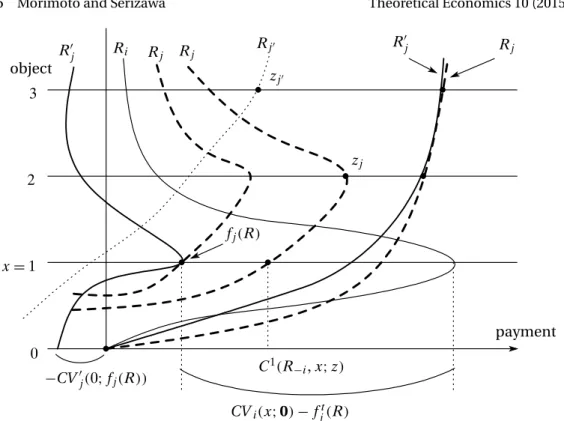
To generalize Vickrey rules to the classical domain, we need to use some valuation functionvifor each classical preferenceRi. The compensated valuationCVi(·;0)from the origin is defined for each classical preferenceRiand a generalization of valuation function, and so is a natural candidate. Given a classical preferenceRi, letvi(·;Ri)be a function defined as, for eachx∈L,vi(x;Ri)≡CVi(x;0). Given a classical preference profileR, letv(R)≡(v1(·;R1) vn(·;Rn)).
Definition9. A rulef on the classical domain is ageneralized Vickrey ruleif for each classical preference profileR, fx(v(R))∈arg max(x1xn)∈X
ivi(xi;Ri), and for each i∈N,fit(v(R))=σ−i (v(R))−σ−i(v(R)).
A classical preference Ri is object-blind if for each x y ∈ M and each t ∈ R, (x t) Ii(y t). We call the class of object-blind preferences theobject-blind domain.
The object-blind domain is a subset of the classical domain. On the object-blind do- main,Saitoh and Serizawa(2008) andSakai(2008) characterize the generalized Vickrey rules.
Fact 7 (Saitoh and Serizawa 2008,Sakai 2008). Let n > m. A rule on the object-blind domain satisfies strategy-proofness, efficiency, individual rationality, and no subsidy if and only if it is a generalized Vickrey rule.42
On the quasi-linear domain, the classes of Vickrey rules, generalized Vickrey rules, and MPW rules coincide. Fact 7suggests that the generalized Vickrey rules are natural generalizations of the Vickrey rules on the object-blind domain. On the object-blind domain, the classes of generalized Vickrey rules and MPW rules also coincide. How- ever, these two classes of rules differ outside the above two domains, as explained in Section 6.2. Thus,Fact 7does not implyTheorem 2. Since the object-blind domain is smaller than the classical domain,Theorem 2does not implyFact 7either. Therefore, the two results are mathematically independent.
6.2 Generalized Vickrey rule vs. minimum price Walrasian rule
Notice that, in example ofSection 3.2(Figure 1), agent 2’s payment in the MPWE al- locationz cannot be computed from the compensated valuationsvi(·;Ri), i=123, from the origin 0. Payments of the MPW rule depend on the compensated valua- tions from various points. It is worthwhile to mention that for the preference profile inFigure 1, it is agent 1’s preferenceR1that determines whether agent 2 or agent 3 re- ceives a real object in the MPWE allocation. InFigure 1, agent 1 prefers(ACV3(A;0))
42It is straightforward that on the object-blind domain, strategy-proofness, efficiency, individual ratio- nality, and no subsidy for losers imply no subsidy.