JAIST Repository
https://dspace.jaist.ac.jp/
Title ロバスト主成分分析およびその拡張法を用いた音楽か
らの歌声の分離
Author(s) 李, 峰
Citation
Issue Date 2019‑09
Type Thesis or Dissertation Text version ETD
URL http://hdl.handle.net/10119/16170 Rights
Description Supervisor:赤木 正人, 先端科学技術研究科, 博士
Separation of Singing Voice from Music using Robust Principle Component Analysis and its Extensions
Feng Li
Japan Advanced Institute of Science and Technology
Doctoral Dissertation
Separation of Singing Voice from Music using Robust Principle Component Analysis and its Extensions
Feng Li
Supervisor: Professor Masato Akagi
Graduate School of Advanced Science and Technology Japan Advanced Institute of Science and Technology
[Information Science]
September 2019
Abstract
The development in multimedia technologies has promoted dramatically the rapid growth of music data in recent years. There are various different applications for people’s demands in music such as information retrieval, identification and handing. However, singing voice and background music are related to each other in the mixed music, the mutual interference has brought huge obstacles to music information processing. The problem of how to extract the audio information from music has become an important research topic. As the part of music information retrieval, the technologies of singing voice separation are facing unprecedented challenge.
The objective of this research is to deal with the problem of singing voice separation from monaural record- ings. It is even more difficult than multichannel since the spatial information cannot be applied in the separation procedure. Singing voice separation is a technique for separating or extracting singing voice from a musical mix- ture, which has found many applications in the wide areas such as singer identification, singing evaluation and query by humming. This is a relatively easy separation task of the human auditory system, but it becomes more difficult when we attempt to simulate this problem in a computational method. To achieve the task of singing voice separation, this study mainly focuses on robust principal component analysis (RPCA) and its extensions.
RPCA has been recently proposed of popularization and effectiveness way of separation approach that sep- arates singing voice and accompaniment from a mixture music. It decomposes a given amplitude spectrogram (matrix) of a mixture signal into the sum of a low-rank matrix (accompaniment) and a sparse matrix (singing voice). Since musical instruments reproduce nearly the same sounds every time, a given note is played in a given song, the magnitude spectrogram of these sounds can be considered as a low-rank structure. Singing voice, in contrast, varies significantly, but has a sparse distribution in the spectrogram domain to its harmonic structure.
Although RPCA is an effective approach to separate singing voice from the mixed audio signal, it fails when there are significant differences in dynamic range among the different background instruments. Some instruments, such as drums, correspond to singular values with tremendous dynamic range; because it uses nuclear norm to estimate the rank of the low-rank matrix, RPCA algorithm over-estimates the rank of a matrix that includes drum sounds.
The accuracy of such separation results thus decreases, as drums may be placed in the sparse subspace instead of being low-rank. Thus, it motivates us to describe exactly the separated low-rank matrix.
To overcome the disadvantage of RPCA for singing voice separation, two extensions of RPCA algorithm are proposed in this dissertation. One is called weighted robust principal component analysis (WRPCA). It uses different weighted values to describe the low-rank matrix for singing voice separation. Additionally, incorporat- ing the proposed WRPCA with gammatone auditory filterbank for singing voice separation. The significance of WRPCA can describe different low-rank matrix under the conditions of human’s auditory perceptual properties.
Because the cochleagram is derived from non-uniform time-frequency transform whereas time-frequency units in low-frequency regions have higher resolutions than in the high-frequency regions, which closely resembles the functions of the human ear. Therefore, it is promising to separate singing voice via sparse and low-rank decompo- sition on cochleagram instead of the spectrogram.
Another extension of RPCA with rank-1 constraint called constraint RPCA (CRPCA). It utilizes the rank-1 constraint minimization of singular values in RPCA instead of minimizing the nuclear norm for separating singing voice from the mixture music. Thus, it not only provides a robust solution to large dynamic range differences among instruments but also reduces the computation complexity. Then, incorporating the proposed CRPCA with gammatone auditory filterbank on cochleagram for singing voice separation. In addition, constructing coales- cent masking and vocal activity detection on CRPCA method to constrain the temporal segments that allowed to constrain singing voice from the mixed music datum. Finally, combining F0 and non-negative rank-1 constraint
RPCA, which incorporates F0 and non-negative rank-1 constraint minimization of singular values in RPCA instead of minimizing the nuclear norm.
In conclusion, this dissertation proposes two extensions of the effective optimization algorithms concentrating on RPCA for singing voice separation. One is using different weighted value for describing the separated low-rank matrix. The other is exploring rank-1 constraint minimization of singular value in RPCA. In terms of source-to- artifact ratio, the previous is better than the later. However, CRPCA obtains better separation quality than WRPCA in singing voice separation. The outcomes of this research contribute to further improving the technologies related to music information retrieval. Additionally, the potential contribution of this research is to deal with the problems of noise reduction and speech enhancement by using the separated low-rank and sparse model. Since the back- ground noise is assumed as the part of low-rank component and the human speech is regarded as the part of sparse component.
Keywords: Singing voice separation, robust principal component analysis, weighted, rank-1 constraint, F0.
Acknowledgments
The past three academic years for my PhD study has been full of fun and fruitful period of my life in Japan. As I am finishing up my study by now, I can easily admit that all my achievements own to my advisors, teachers, labmates, friends, and family.
First and foremost, I would like to express my deepest appreciation to Prof. Masato Ak- agi, my Ph.D supervisor, who gives his extremely support, continuous teaching, and patient guidance during the period of my doctoral study at Japan Advanced Institute of Science and Technology (JAIST). This dissertation could not be accomplished without his precious sug- gestions and well-directed advice. I am grateful for his insights and encouragement, which accelerate my academic research in cracking complex problems.
I would also like to express my gratitude towards co-advisor Prof. Masashi Unoki of JAIST in Japan. Professor Unoki checked carefully and gave me many precious comments for my presentation and research report.
I am also grateful to minor research advisor Prof. Jianwu Dang of JAIST and Tianjin Univer- sity for his suggestion and comments, as well as being a member of the dissertation committee.
When I talked with Prof. Dang, I could feel his energy for research which inspire me a lot.
I would like to express my thanks to Prof. Mark Hasegawa-Johnson, University of Illinois at Urbanna-Champaign (UIUC), who give me an opportunity to study in the USA. I also would like to thank Dr. Kaizhi Qian from UIUC, who gives me lots of suggestions and comments when I stay at UIUC.
I would like to thank Dr. Rieko Kubo, Dr. Yongwei Li and Dr. Yawen Xue, who gave me much information during my doctoral study and gave me many helps between the life and research at JAIST.
I want to appreciate Dr. Zhichao Peng and all members in Acoustic Information Science (AIS) Laboratory for their valuable comments, helps and encouragements at JAIST. The dis- cussion among us always provided me many new ideas and gave me a lot of happiness during the boring research period.
I am also thankful to the Ministry of Education, Culture, Sports, Science and Technology (MEXT) of Japan Scholarship and the China Scholarship Council (CSC) of China Scholarship to support me during my doctoral studies in Japan.
Finally, I would like to delicate this dissertation to my parents, my father and my mother, for their forever encouragement and love over many years. Without their support and understand, I can not achieve all things I have now.
Table of Contents
Abstract i
Acknowledgments iii
Table of Contents v
List of Figures vii
List of Tables xi
Acronym and Abbreviation xiii
1 Introduction 1
1.1 Motivation . . . 1
1.2 Methodology . . . 2
1.3 Research goal . . . 5
1.4 Organization of the dissertation . . . 5
2 Background 8 2.1 Related work . . . 9
2.1.1 Non-negative matrix factorization . . . 9
2.1.2 REPET-based approach . . . 12
2.1.3 Robust principle component analysis . . . 13
2.1.4 Deep learning . . . 15
2.2 Experiment databases . . . 16
2.2.1 MIR-1K dataset . . . 16
2.2.2 ccMixter dataset . . . 17
2.2.3 DSD100 dataset . . . 17
2.2.4 iKala dataset . . . 18
2.3 Evaluation metrics . . . 18
3 WRPCA-based singing voice separation 21 3.1 WRPCA for singing voice separation . . . 22
3.1.1 Principal of WRPCA . . . 22
3.1.2 Experimental evaluation . . . 24
3.1.3 Result and conclusion . . . 25
3.2 WRPCA with gammatone auditory filterbank for singing voice separation . . . 27
3.2.1 Application to mask estimation . . . 28
3.2.2 Experimental evaluation . . . 29
3.2.3 Result and conclusion . . . 29
3.3 Discussion and summary . . . 34
4 CRPCA-based singing voice separation 35 4.1 CRPCA for singing voice separation . . . 36
4.1.1 Principal of CRPCA . . . 37
4.1.2 Experimental evaluation . . . 40
4.1.3 Result and conclusion . . . 41
4.2 CRPCA with gammatone auditory filterbank for singing voice separation . . . 43
4.2.1 Gammatone filterbank and cochleagram . . . 44
4.2.2 CRPCA using time-frequency masking . . . 44
4.2.3 Experimental evaluation . . . 45
4.2.4 Result and conclusion . . . 45
4.3 CRPCA with vocal activity detection for singing voice separation . . . 46
4.3.1 Proposed method . . . 47
4.3.2 Experimental evaluation . . . 49
4.3.3 Result and conclusion . . . 52
4.4 Discussion and summary . . . 54
5 Informed NCRPCA for singing voice separation 57 5.1 Informed NCRPCA . . . 59
5.1.1 Update rules based on rank-1 constraint . . . 60
5.2 Reconstructed voice spectrogram . . . 60
5.3 Phase recovery . . . 61
5.4 Experimental evaluation . . . 62
5.4.1 Experiment settings . . . 62
5.4.2 Evaluation metrics . . . 66
5.4.3 Result and conclusion . . . 66
6 Conclusion 69 6.1 Summary . . . 69
6.2 Contributions . . . 71
6.3 Future works . . . 71
Bibliography 73
Publications 85
List of Figures
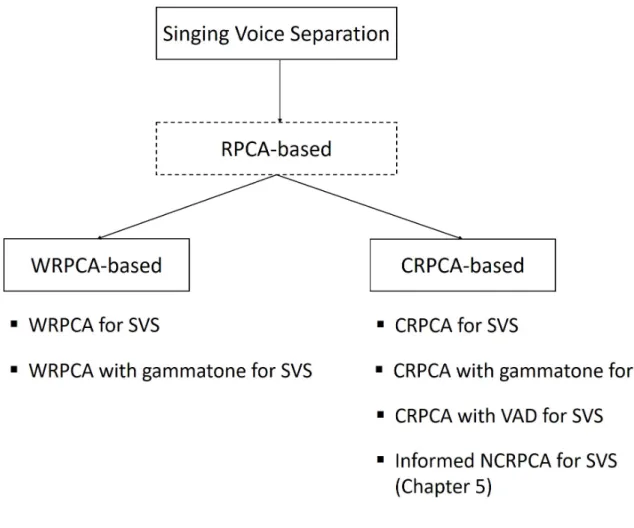
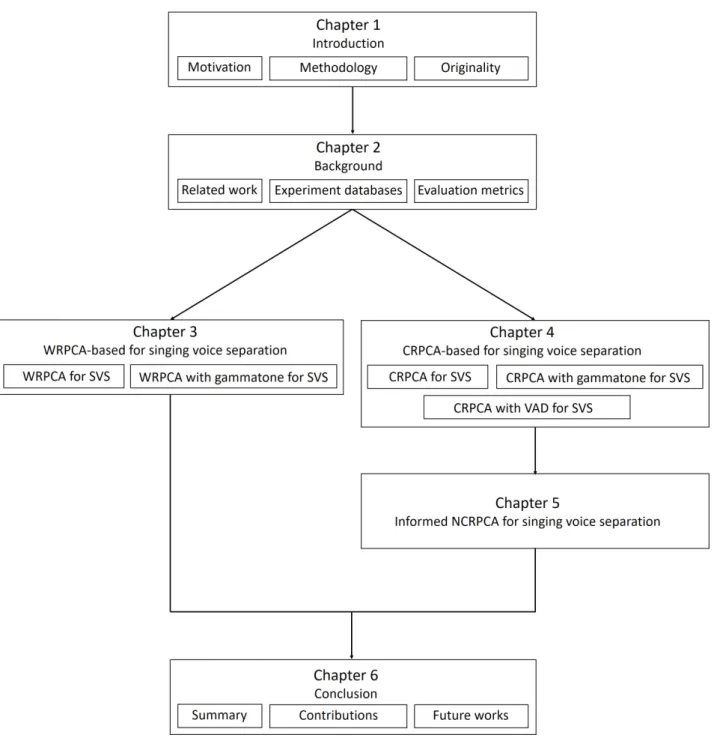
1.1 The proposed methods for singing voice separation (SVS) in the dissertation. . 4 1.2 Organization of the dissertation. . . 7 2.1 Illustrate the system of singing voice separation. . . 9 2.2 The decomposition model of NMF, which uses KL divergence and K = 3 on
Mery Had a Little Lamb. Vis the mixture matrix, Wis the basic matrix and His the activation matrix which describes the time-varying gains for each basis vector. . . 10 2.3 Overview of the REPET method for singing voice separation. Stage 1: calculate
the beat of mixed music and then estimate the time length of repetition accord- ing to the calculation values on the beat. Stage 2: slice the mixture spectrogram and calculate the repeating accompaniment by taking median operation. Stage 3: extract the residual parts in the spectrogram that cannot be represented and separate it as singing voice part [26]. . . 12 2.4 Example of system of singing voice separation by using RPCA [11]. (a) is
the original matrixX(musical mixture), (b) is the separated low-rank matrixL (accompaniment), and (c) is the separated sparse matrixS(singing voice). . . . 14 2.5 DNN architecture for musical source separation. The mixture magnitude spec-
trograms are set as inputs, and source magnitude spectrograms of the desired source Sj are set as the targets [68]. . . 16 3.1 Comparison of singing voice separation results using RPCA and the proposed
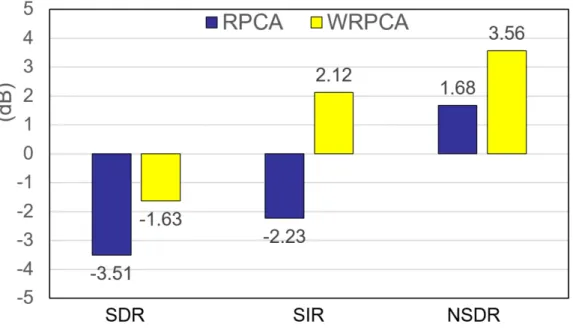
WRPCA on the ccMixter dataset. Note that SDR for the original dataset is -5.19 dB. . . 25
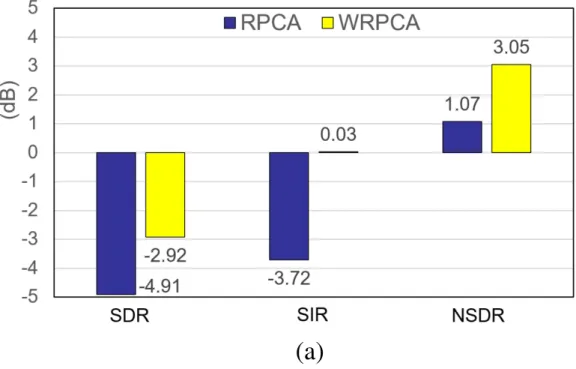
3.2 Comparison of singing voice separation results using conventional RPCA and the proposed WRPCA on the DSD100 dataset. (a) is the set of DSD100/dev data; (b) is the set of DSD100/testdata. Note that SDRs for the original datasets, devandtest, are -5.98 dB and -5.18 dB, respectively. . . 26 3.3 Block diagram of the proposed singing voice separation . . . 28 3.4 Comparison of singing voice separation results on theccMixterdataset among
conventional RPCA, RPCA with IRM, RPCA with IBM, WRPCA, WRPCA with IRM, and WRPCA with IBM, respectively. . . 30 3.5 Comparison of singing voice separation results on theccMixterdataset among
conventional RPCA, RPCA with IRM, RPCA with IBM, WRPCA, WRPCA with IRM, and WRPCA with IBM, respectively. Note that SDR for the original datasets, ccMixter is -5.16 dB. . . 31 3.6 Comparison of singing voice separation results on theDSD100dataset among
conventional RPCA, RPCA with IRM, RPCA with IBM, WRPCA, WRPCA with IRM, and WRPCA with IBM, respectively. . . 32 3.7 Comparison of singing voice separation results on theDSD100dataset among
conventional RPCA, RPCA with IRM, RPCA with IBM, WRPCA, WRPCA with IRM, and WRPCA with IBM, respectively. Note that SDR for the original datasets, DSD100 is -5.11 dB. . . 33 4.1 Block diagram of the proposed singing voice separation system. . . 38 4.2 Comparison of singing voice separation results on theccMixterdataset among
RPCA, WRPCA, CRPCA and CRPCA with IBM on SDR, SIR, and NSDR, respectively. . . 40 4.3 Comparison of singing voice separation results on theDSD100dataset among
RPCA, WRPCA, CRPCA and CRPCA with IBM on SDR, SIR, and NSDR, respectively. . . 41 4.4 Block diagram of the proposed singing voice separation system. . . 43 4.5 Comparison of unsupervised singing voice separation results on the MIR-1K
dataset among of the conventional RPCA, CRPCA and CRPCA on cochlea- gram, respectively. . . 46 4.6 Block diagram of the proposed singing voice separation system. . . 48
4.7 Example of spectrograms are excerpted from the ccMixter dataset: (a) spec- trogram of original singing voice, (b) spectrogram of separated singing voice by RPCA,(c)spectrogram of separated singing voice by WRPCA,(d)spectro- gram of separated singing voice by CRPCA (Proposed 1), (e)spectrogram of separated singing voice by CRPCA with IBM (Proposed 2),(f)spectrogram of separated singing voice by CRPCA using coalescent masking and VAD (Pro- posed 3), respectively. . . 50 4.8 Example of spectrograms are excerpted from the ccMixter dataset:(a)spectro-
gram of original accompaniment,(b)spectrogram of separated accompaniment by RPCA,(c)spectrogram of separated accompaniment by WRPCA,(d)spec- trogram of separated accompaniment by CRPCA (Proposed 1),(e)spectrogram of separated accompaniment by CRPCA with IBM (Proposed 2), (f) spectro- gram of separated accompaniment by CRPCA using coalescent masking and VAD (Proposed 3), respectively. . . 51 4.9 Comparison of the separation results on theccMixterdataset for conventional
RPCA, WRPCA, CRPCA, CRPCA with IBM, and CRPCA using coalescent masking and VAD in terms of SDR, SIR, and NSDR, respectively. . . 52 4.10 Comparison of the separation results on the DSD100dataset for conventional
RPCA, WRPCA, CRPCA, CRPCA with IBM, and CRPCA using coalescent masking and VAD in terms of SDR, SIR, and NSDR, respectively. . . 53 4.11 Spectrogram of the mixed music by combining singing voice with drums. . . . 55 4.12 Separation results by using different separation methods. . . 56 5.1 Example of waveform and spectrogram comparison of the clean and separated
audio using NCRPCAi and NCRPCA methods on the iKala dataset (71716 chorus).
Left are singing voice and the right are accompaniment. (a) is the clean audio (Top), (b) and (c) are the separated audio by NCRPCAi(Middle: SDR is 12.30 dB) and NCRPCA(Bottom: SDR is 6.82 dB), respectively. . . 63
5.2 Example of waveform and spectrogram comparison of the separation results by using RPCA, RPCAi, and LRR methods on the iKala dataset (71716 chorus).
Left are singing voice and the right are accompaniment. (a) is the separated audio by RPCA (Top: SDR is 5.62 dB), (b) and (c) are the separated audio by RPCAi (Middle: SDR is 12.28 dB) and LRR (Bottom: SDR is 8.05 dB), respectively. . . 64 5.3 Example of waveform and spectrogram comparison of the separation results
by using LRRi, GSR, and GSRi methods on the iKala dataset (71716 chorus).
Left are singing voice and the right are accompaniment. (a) is the separated audio by LRRi(Top: SDR is 12.18 dB), (b) and (c) are the separated audio by GSR(Middle: SDR is 5.89 dB) and GSRi(Bottom: SDR is 12.18 dB) meth- ods, respectively. . . 65
List of Tables
2.1 All the experiment databases . . . 17
4.1 Running time (hh:mm:ss) . . . 42
5.1 Singing Voice Separation Results on the iKala Dataset in dB(252) . . . 66
5.2 Singing Voice Separation Results on the iKala Dataset in dB(208) . . . 67
List of Abbreviations
RPCA Robust Principal Component Analysis
WRPCA Weighted Robust Principal Component Analysis CRPCA Constraint Robust Principal Component Analysis STFT short-time Fourier transform
ISTFT Inverse short-time Fourier transform MLRR Multiple Low-Rank Representation VAD Vocal Activity Detection
IBM Ideal Binary Masking IRM Ideal Ratio Masking
MIR Music Information Retrieval ReLu Rectified Linear Units DNN Deep Neural Network KAM Kernel Additive Modeling CNN Convolutional Network Network LSTM Long Short-Term Memory ALM Augmented Lagrange Multipliers iALM inexact Augmented Lagrange Multiplier REPET REpeating Pattern Extraction Technique ADMM Alternating Direction Method of Multipliers APG Accelerated Proximal Gradient
T-F Time-Frequency
F0 Fundamental Frequency SDR Source-to-Distortion Ratio SIR Source-to-Interference Ratio SAR Source-to-Drtifact Ratio NSDR Normalized SDR
NCRPCA Non-negative Constraint Robust Principal Component Analysis
NCRPCAi Informed Non-negative Constraint Robust Principal Com- ponent Analysis
SVD Singular Value Decomposition NMF Non-negative Matrix Factorization KL Kullback-Leibler
IS Itakura-Saito
EUC Euclidean
CI Cochlear Implant
Chapter 1 Introduction
1.1 Motivation
In recent years, the development in multimedia technologies has promoted dramatically the rapid growth of music data. There are various different applications for people’s demands in music such as information retrieval, identification and handing. However, singing voice and background music are related to each other in the mixed music, the mutual interference has brought huge obstacles to music information processing. The problem of how to extract the audio information from music signal has become an important topic. As the part of music information retrieval, the technologies of singing voice separation are facing unprecedented challenge.
Singing voice separation is a technique for separating or extracting singing voice from a musical mixture, which has found many applications in the wide areas like music information retrieval [1], singer identification [2], music emotion recognition [3], chord recognition [4], melody extraction [5], drum extraction [6], Karaoke applications [7], and education for musical instruments [8].
This is a relatively easy separation task of the human auditory system, but it becomes more difficult when we attempt to simulate this problem in a computational method. Although there are many methods for singing voice separation, the separation quality is not well because the many instruments are coexisting in the background music. The separation results of state-of- the-art methods are still far behind human hearing capability. The existing problems of singing voice separation are still facing severe challenging [9] [10]. Therefore, it is an important task
for solving the problem of singing voice separation.
Many academic challenges about singing voice separation were also hold in the previous years. For example, the organizations of Music Information Retrieval Evaluation eXchange (MIREX) and Signal Separation Evaluation Campaign (SiSEC) are also evaluated for singing voice separation task. MIREX is an annual challenges, which contains of various tasks related to the problems of music information retrieval. Since 2014, singing voice separation is included as a sub-task of MIREX. SiSEC is held one and a half year. It consists of the different problems about audio source separation task. Music source separation is also included as a sub-task of SiSEC, which separates singing voice (vocals) from the musical mixture (vocals, drums, bass, and others).
Motivated by the above considerations, an effective optimization algorithm plays an impor- tant role in singing voice separation. In particular, the audio information of singing voice can be described exactly and improve the separation quality from the music. This study mainly fo- cuses on solving the problem of singing voice separation in monaural recording. It is even more difficult than multichannel since the spatial information cannot be applied in the separation pro- cedure. Therefore, research in the field of monaural singing voice separation become very hot topic. Many methods are focused on unsupervised and supervised learning. As for supervised method, deep learning is the most popular method in monaural singing voice separation. How- ever, a large number of training data are needed in advanced. So, the unsupervised learning has made great progress in singing voice separation.
Therefore, to obtain better separation performance from the observed mixed music, the ef- fective optimization algorithm is need to be solved by unsupervised learning method in the singing voice separation task, the main works of the dissertation are focused on different opti- mization approaches for singing voice separation.
1.2 Methodology
Currently, robust principal component analysis (RPCA) [11] has been recently proposed of popularization and effectiveness way of separation approach that separates singing voice and accompaniment from a mixture music in monaural recording. It decomposes a given amplitude spectrogram (matrix) of a mixture signal into the sum of a low-rank matrix (accompaniment)
As for the mixture music, since musical instruments reproduce nearly the same sounds every time, a given note is played in a given song, the magnitude spectrogram of these sounds can be considered as a low-rank structure. Singing voice, in contrast, varies significantly, but has a sparse distribution in the spectrogram domain to its harmonic structure. Therefore, RPCA method can be well-described as the part of singing voice from the mixed music signal by the separated sparse matrix. The mixture music signal can be described as the low-rank and sparse model. And the process of RPCA decomposition is very suited to the singing voice separation task.
Although the model of RPCA has been successfully applied to singing voice separation task, it fails when there are significant differences in dynamic range between the different background instruments. Some instruments, such as drums, correspond to singular values with tremendous dynamic range; because it uses nuclear norm to estimate the rank of the low-rank matrix, RPCA over-estimates the rank of a matrix that includes drum sounds. The accuracy of such singing voice separation results thus decreases, as drums may be placed in the sparse subspace instead of being low-rank.
Therefore, to obtain the better separation performance in singing voice separation, this dis- sertation mainly focuses on RPCA and its extension for singing voice separation. Two exten- sions of RPCA were proposed in this dissertation. Figure 1.1 shows the proposed methods for singing voice separation in this dissertation. The methods are mainly focus on RPCA for singing voice separation.
The first extension of RPCA called WRPCA method. On the one hand, evaluate the pro- posed WRPCA for singing voice separation. It utilizes different weighted values to constraint the separated low-rank matrix. The experimental evaluation is carried out on the ccMixter dataset and on the DSD100 dataset. On the other hand, combining the proposed WRPCA with gammatone auditory filterbank on cochleagram for singing voice separation. And the experi- ments are conducted on the ccMixter and DSD100 datasets. However, WRPCA suffers from high computational cost due to computing the singular value decomposition at each iteration during the separation processing. Hence, the running time of WRPCA is slower than RPCA.
Therefore, we propose another deformation instead of WRPCA method for singing voice sepa- ration.
The another extension of RPCA called CRPCA method, which utilizes the rank-1 constraint
Figure 1.1: The proposed methods for singing voice separation (SVS) in the dissertation.
minimization of singular values in RPCA instead of minimizing the nuclear norm for separating singing voice from the mixture music. Thus, it not only provides a robust solution to large dynamic range differences among instruments but also reduces the computation complexity.
The experiment are conducted by combining other feature to evaluate the proposed methods on the different databases.
Firstly, we evaluate CRPCA model on the ccMixter and DSD100 datasets. Secondly, we combine the proposed CRPCA with gammatone auditory filterbank on cochleagram for singing voice separation. Thirdly, we construct the coalescent masking and vocal activity detection (VAD) to constrain the temporal segments that allowed to constrain singing voice. The results on the ccMixter and DSD100 datasets reveal that the proposed method are very effective than the previous in singing voice separation task. Finally, we introduce a singing voice separation method by combining the human-labeled F0 and non-negative CRPCA to separated the singing voice from the mixture music. Experiment evaluation is compared with the previous methods on the iKala dataset.
As for the above discussed two extensions of RPCA method, WRPCA and CRPCA, re- spectively. In terms of source-to-artifact ratio, WRPCA obtains the better results than CRPCA in singing voice separation. However, CRPCA can get the better separation performance in source-to-distortion ratio and source-to-interference ratio.
1.3 Research goal
The goal of this research is to deal with the problem of singing voice separation from monaural recordings. It is even more difficult than multichannel since the spatial information cannot be applied in the separation procedure.
To achieve the task of singing voice separation, this study mainly focuses on RPCA and its extensions. Because RPCA is one of the popularization of such separation algorithm. It decomposes a given amplitude spectrogram of a mixture signal into the sum of a low-rank matrix (accompaniment) and a sparse matrix (singing voice).
Since the instruments reproduce nearly the same sounds every time, the magnitude spec- trogram of these sounds can be considered as a low-rank structure. Singing voice, in contrast, varies significantly, but has a sparse distribution in the spectrogram domain to its harmonic structure.
Although RPCA algorithm has been successfully applied to singing voice separation, it fails when one singular value (e.g., drums) is much larger than all others (e.g., bass, guitar or other accompanying instruments). The accuracy of such separation results thus decreases, as drums may be placed in the sparse subspace instead of being the low-rank from mixture original matrix.
With regards to RPCA-based approach, the main method in this dissertation mainly fo- cuses on solving the disadvantage of RPCA algorithm for singing voice separation in monaural recordings.
1.4 Organization of the dissertation
Figure 1.2 shows organization of the dissertation and the remainder of the dissertation is struc- tured as follows:
• Chapter 2provides the background about related work of singing voice separation. First, introduces the previous studies and methods in the task of singing voice separation. Then, gives some related databases in singing voice separation tasks in this dissertation. Finally, explains several evaluation metrics to measure the separation performance of the proposed methods.
• Chapter 3proposes an extension of RPCA called WRPCA, which describes the different weighted values to constraint the separated low-rank matrix. The experimental evalu- ation is carried out on the ccMixter dataset and on the DSD100 dataset. In addition, combines the proposed WRPCA with gammatone auditory filterbank on cochleagram for singing voice separation. All the experiments are conducted on the ccMixter and DSD100 datasets.
• Chapter 4 describes another extension of RPCA called CRPCA, which constraints the low-rank matrix in RPCA to have rank greater than or equal to one, thereby describing the sensitively of RPCA to dynamic range variation. Then, combines the proposed CRPCA with gammatone auditory filterbank on cochleagram for singing voice separation. Finally, constructs coalescent masking and incorporates vocal activity detection to constrain the temporal segments that allowed to constrain singing voice. The experiments are evaluated on the ccMixter and DSD100 datasets.
• Chapter 5proposes a singing voice separation method by combining F0 and non-negative CRPCA, which incorporates F0 and non-negative rank-1 constraint minimization of sin- gular values in RPCA instead of minimizing the nuclear norm. Experimental evaluation are conducted on the iKala dataset.
• Chapter 6 first summarizes all of this work in this dissertation. Then, draws the con- clusions focuses on the proposed methods for singing voice separation. And the future works are discussed in the end.
Figure 1.2: Organization of the dissertation.
Chapter 2 Background
Mixture music signal is very popular in our daily life, which is the main research target in this dissertation. It contains the singing voice and various instruments (e.g., piano, drums, guitar and others). Singing voice separation is a technique for separating singing voice from a musical mixture and has been intensively studied in recent years. This technique can be used for many applications including music information retrieval [1], Karaoke applications [7], chord recognition [4], music auto-tagging [12], singing lyric recognizer [13] [14], melody extraction [5], and fundamental frequency (F0) estimation [15].
However, the results on state-of-the-art methods are still far behind human hearing capa- bility. The existing problems of singing voice separation are still faced with serious chal- lenges [9] [10] [16] due to the musical instruments involved and time-varying spectral overlap between singing voice and background music.
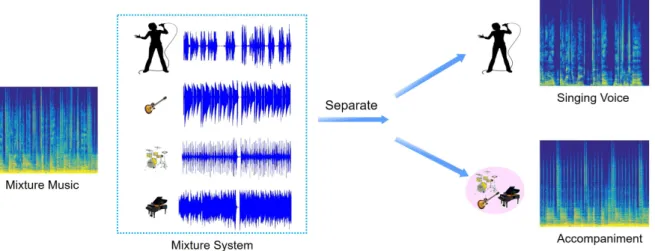
Figure 2.1 illustrates the system of singing voice separation. This figure shows that after separating the singing voice from mixture system by the separation algorithm, the separated singing voice and accompaniment can be obtained from the musical mixture. Therefore, it is obvious that effective optimization algorithms play a significant role in the process of the separation task.
Until recently, there have been many approaches proposed to solve the difficult in singing voice separation tasks. It can be divided into two categories: unsupervised and supervised learning methods.
Figure 2.1: Illustrate the system of singing voice separation.
2.1 Related work
According to the previous studies, the separation approaches are mainly divided into two cate- gories: unsupervised and supervised methods, respectively. In terms of unsupervised methods for singing voice separation, sparse or low-rank approximation assumption is typical methods for singing voice separation, for example, Non-negative Matrix Factorization (NMF) and RPCA methods. Additionally, another popular approach for singing voice separation is based on the repetitive nature of background music (REPET). As for the supervised method, deep learning- based methods are very poplar for singing voice separation.
2.1.1 Non-negative matrix factorization
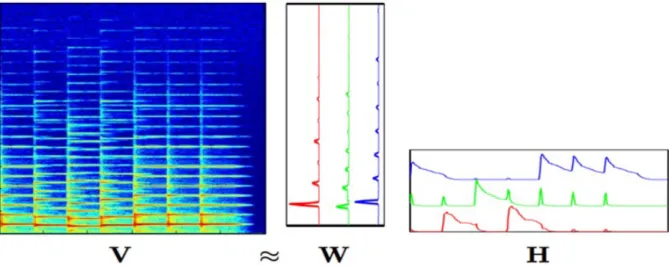
NMF [17] [18] [19] [20] [21] [22] is a specially sparse representation algorithm model for singing voice separation, which is a type of dimensionality reduction that decomposes a non- negative matrix into a non-negative basis matrix and a non-negative activation matrix using an iterative cost-minimization algorithm with multiplicative update rules. The matrix decomposi- tion model can be defined as follows:
V ≈W H, (2.1)
whereV(V∈Rm×n) is an observed non-negative matrix that represents an amplitude spectrogram of sound source signals,W(W∈Rm×k) is a non-negative basis matrix of a sound signal as column vectors,H(H∈Rk×n) is a non-negative activation matrix that corresponds to the activation of each
Figure 2.2: The decomposition model of NMF, which uses KL divergence andK = 3 on Mery Had a Little Lamb. Vis the mixture matrix,Wis the basic matrix andHis the activation matrix which describes the time-varying gains for each basis vector.
basis vector ofW, m and n are the rows and columns of observed sound signals, respectively.
And k is the number of supervised signal basis vectors. Usually, we choose m × k + k × n
<< m× n; hence reducing the dimensions of the input data. Figure 2.2 gives an example of NMF decomposition. And the basic vector is set as k = 3 with KL divigence on Mery Had a Little Lamb. The basic matrix shows representative spectral patterns, while the activation matrix illustrates time-varying gains for each basis vector.
The β-divergence [23] [24] is a family of cost functions parameterized by a signal shape parameterβand can be defined as
Dβ(y|x)=
yβ+(β−1)xβ−βyxβ−1
β(β−1) , β∈R\ {0,1}
y
x −logy
x−1, (β=0)
ylogy
x +x−y. (β=1)
(2.2)
Generally, the cost functions in NMF can be calculated by the following three distances:
Itakura-Saito divergence (β= 0), Kullback-Leibler divergence (β= 1), and Euclidean distance
(β=2). The corresponding formulas are given as
Dβ(y|x)=
y
x−logy
x−1, (β=0) ylogy
x +x−y, (β=1) 1
2(y−x)2. (β=2)
(2.3)
In NMF, the multiplicative update rules for W and H have been derived to minimize each of the three divergences and without the need for constraints to enforce non-negativity. In order to reduce dimension, commonly, set to a small number, which results in NMF being a low-rank matrix approximation method. Therefore, the multiplicative update rules are derived as follows for the Euclidean distance (EUC),
W ←W ⊗ V HT
W HHT. (2.4)
H ← H⊗ WTV
WTW H. (2.5)
Kullback-Leibler divergence (KL),
W ← W⊗
V W HHT
1HT . (2.6)
H← H⊗ WT VW H
WT1 . (2.7)
and Itakura-Saito divergence (IS)
W ←W⊗
V (W H)2HT
1
W HHT . (2.8)
H ←H⊗ WT(W H)V 2
WTW H1 . (2.9)
where the operator⊗denotes element-wise multiplication of two matrices (Hadamard product),
V
W H denotes element-wise division, (W H)2denotes element-wise exponentiation, and 1 denotes a matrix of ones of appropriate dimension.
Owing to the non-negative assumption can be suited for the non-negative values of music spectrogram and also be approximated as the combination of the non-negative audio source
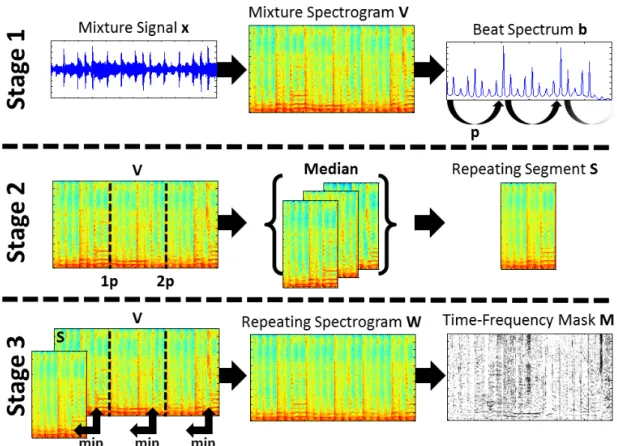
Figure 2.3: Overview of the REPET method for singing voice separation. Stage 1: calculate the beat of mixed music and then estimate the time length of repetition according to the calculation values on the beat. Stage 2: slice the mixture spectrogram and calculate the repeating accompa- niment by taking median operation. Stage 3: extract the residual parts in the spectrogram that cannot be represented and separate it as singing voice part [26].
spectrogram, therefore, NMF can be also applied to singing voice separation. Although NMF has shown impressive results in monaural audio source separation, it is difficult to determine the appropriate number of nonnegative basis vectors.
2.1.2 REPET-based approach
REPET-based approaches are also popular for singing voice separation, which is according to the feature of background repetition characteristics [25] [26]. This methodology is based on the observation that the different individual sources tend to repeat over time, depending on its beat or speech.
Rafii et al. [25] [26] used the REPET algorithm for separating the repeating music part of the non-repeating singing voice in a musical mixture signal. The basic idea was to identify the periodically repeating segments in the mixture audio, then compared them to a repeating seg-
ment model derived from them, and finally extracted the repeating patterns via time-frequency masking.
Figure 2.3 illustrates the overview of REPET method for singing voice separation. In the first stage, calculate the beat of mixed music and then estimate the time length of repetition according to the calculation values on the beat. In the second stage, slice the mixture spec- trogram and calculate the repeating accompaniment by taking median operation. In the third stage, extract the residual parts in the spectrogram that cannot be represented and separate it as singing voice part. Additionally, there are some methods that extend the original REPET method, including adaptive REPET by using the moving-median [27], or by using the similar- ity matrix [28].
2.1.3 Robust principle component analysis
Cand´es et al. [29] proposed a convex RPCA model, which decomposed an input matrix X ∈ Rm×ninto the sum of a low-rank matrixL∈Rm×nand a sparse matrixS ∈Rm×n. The model can be defined as follows:
minimize|L|∗+λ|S|1,
subject toX = L+S. (2.10)
where| · |1 is theL1-norm, which is the sum of absolute values of matrix entries,| · |∗denotes the nuclear norm (sum of singular values), andλ > 0 is a positive constant parameter between the parts of sparsity matrix S and low-rank matrix L. Moreover, this convex model can be solved by accelerated proximal gradient (APG) or augmented Lagrange multiplier (ALM) [30].
According to the previous study [11], an inexact version of ALM (iALM) was used as a baseline for comparison in the dissertation.
Huang et al. [11] proposed a method on RPCA for singing voice separation, which is an effective approach because the singing voice can be well modeled as a sparse matrix, while the accompaniment as well modeled as a low-rank matrix. RPCA has been extensively and succes- sively applied in other signal processing applications like speech enhancement [31] [32] [33], SAR imaging [34] [35], direction of arrivals tracking [36] and also in computer vision applica- tions [37] [38] [39]. Inspired by this sparse and low-rank model, a new RPCA-based method that incorporates harmonicity priors and a back-end drum removal procedure was proposed [40]
Figure 2.4: Example of system of singing voice separation by using RPCA [11]. (a) is the original matrixX(musical mixture), (b) is the separated low-rank matrixL(accompaniment), and (c) is the separated sparse matrixS(singing voice).
for singing voice separation. Figure 2.4 shows an example of the singing voice separation by using RPCA, the top spectrogram is the original matrix (musical mixture), the left bottom is separated low-rank matrix (accompaniment) and the right bottom is the separated sparse matrix (singing voice), respectively.
In a similar vein, Yang [41] proposed multiple low-rank representations (MLRR) to decom- pose a magnitude spectrogram into two low-rank matrices. Sprechmann et al. [42] proposed a real-time online singing voice separation by robust low-rank modeling. Fourer et al. [43]
proposed a novel unsupervised singing voice detection method which uses single-channel blind source separation algorithm as a preliminary step. Chan et al. [44] proposed using informed group-sparse representation with the idea of pitch annotations separation. Pu et al. [45] pro- posed an approach in audio separation with the assistance of visual information. In addition, he [46] also proposed a non-linear generalization of RPCA, which uses two autoencoder net- work to realize the low-rank and sparse matrix decomposition. One autoencoder for low-rank part and the other one for the sparse part.
As stated above, RPCA is an effective algorithm to separate singing voice from the mixture
music signal, which can be well-described as the part of singing voice from the mixed music signal by the separated sparse matrix. And the mixture music signal can be described as the low-rank and sparse model. So, the process of RPCA decomposition is suited to the singing voice separation task. Additionally, many previous studies have shown that such decomposition is very effective in singing voice separation applications. It decomposes a given amplitude spectrogram (matrix) of a mixture signal into the sum of a low-rank matrix (accompaniment) and a sparse matrix (singing voice). Since musical instruments reproduce nearly the same sounds every time, a given note is played in a given song, the magnitude spectrogram of these sounds can be considered as a low-rank structure. Singing voice, in contrast, varies significantly, but has a sparse distribution in the spectrogram domain to its harmonic structure.
2.1.4 Deep learning
Recently, deep learning has been received much attention for singing voice separation. Convo- lutional Network Network (CNN) architecture has been successful in audio source separation, especially in singing voice separation [47] [48] [49].
Chandna et al. [47] utilized the convolutional filters specifically designed for audio database and allowed a significant gain in processing time over a simple multi-layer perception, in the fully connected layer, dimensional reduction allows the model to learn a more compact rep- resentation of the input data from which the source can be separated. Takahashi et al. [48]
extended DenseNet to tackle the music source separation with the proposed MDenseNet archi- tecture.
In addition, he [49] proposed MMDenseLSTM framework for audio source separation, which is a variant of CNN architecture. It integrates long short-term memory (LSTM) in multiple scales with skip connection to efficiently model long-term structures within an au- dio context. There are also many new neural network based on extension of CNN archi- tecture [50] [51] [52] [53] [54] [55] [56] [57], including the U-Net architecture and its vari- ant [58] [59] [60] [61] [62] [63].
Deep neural network (DNN)-based models [7] [58] [64] [65] [66] [67] are perhaps the most widely used supervised learning models for singing voice separation. Figure 2.5 gives an ex- ample of musical source separation by using DNN architecture. Although they have proven effective for separating singing voice, a large number of training data are needed in advance,
Figure 2.5: DNN architecture for musical source separation. The mixture magnitude spectro- grams are set as inputs, and source magnitude spectrograms of the desired source Sj are set as the targets [68].
which makes these models difficult to apply in case of small audio data. In addition, when there is a mismatch between training and testing samples [69], separation quality decreases due to overfitting.
2.2 Experiment databases
In this dissertation, to evaluate the proposed optimization algorithm on the task of singing voice separation, a reasonable and feasible dataset is contributed to confirm the effectiveness of the proposed algorithm. In this chapter, several public databases are introduced that are commonly used in singing voice separation task. The general description of all the experiment databases are showed in Table 2.1.
2.2.1 MIR-1K dataset
MIR-1K dataset [70]1 contains 1000 Chinese pop songs recorded at 16 kHz sampling rate with 16 bit resolution. The duration of each song slip ranges from 4 to 13 seconds. The length of all datasets are 133 minutes. These song clips were extracted from 110 Chinese karaoke pop songs. The singing voice and the clean music accompaniment were recorded at the right and left channels, respectively. And the singing voice sung by amateur singers (8 females and 11
1https://sites.google.com/site/unvoicedsoundseparation/mir-1k
Table 2.1: All the experiment databases
Name Clips Duration(s) Sampling rate(kHz)
MIR-1K 1000 4∼13 16
ccMixter 50 77∼456 44.1
DSD100 100 141∼435 44.1
iKala 252 30 44.1
males), and the music accompaniment retrieved from the popular Chinese songs. This is the first dataset for singing voice separation task that released in public.
2.2.2 ccMixter dataset
ccMixter dataset [71]2contains 50 full songs with duration rang from 1 minute 17 seconds to 7 minutes 36 seconds. Each audio music data contains the following three parts: singing voice, background music, and a mixture music, respectively. These audio dataset is extracted from 110 karaoke songs which contain a mixture track and a music accompaniment track. And the songs are freely selected from the 5000 Chinese popular music songs and sung by their lab-mates of 8 females and 11 males. Most of the singers are amateur and do not have professional music training.
2.2.3 DSD100 dataset
DSD100 dataset contains 100 full stereo songs of different audio data was recorded as the Demixing Secrets Dataset (DSD100). It ranges from 2 minutes 21 seconds to 7 minutes 15 seconds, as also used for the 2016 Signal Separation Evaluation Campaign (SiSEC) [9]3, which is split into 50 train (Dev) and 50 test (T est) songs. Each datum consists of bass, drums, other, and singing voice, respectively.
2https://members.loria.fr/ALiutkus/kam/
3http://liutkus.net/DSD100.zip
2.2.4 iKala dataset
iKala dataset [72]4 contains 252 song clips with duration 30 seconds. Each song clip in this database is recorded sampled with 44.1 kHz. And there is two channels in a wave file. The right channel is the ground truth singing voice, and the left channel is the ground truth background music. This dataset also contain the human-labeled fundamental frequency estimation of each audio data.
2.3 Evaluation metrics
In this dissertation, to evaluate the separation performance of the proposed method on audio source separation (e.g., singing voice separation), assess its separation performance in terms of source-to-distortion ratio (SDR), source-to-interference ratio (SIR), source-to-artifact ratio (SAR), and normalized SDR (NSDR) by using the BSS-EVAL evaluation toolbox 3.0 metrics [73] [74]5. The estimated signal ˆS(t) is defined as
Sˆ(t)=Starget(t)+Sinter f(t)+Sarti f(t), (2.11)
whereStarget(t) denotes the allowable deformation of the target sound,Sinter f(t) denotes the al- lowable deformation of the sources that account for the interferences of the undesired sources, and Sarti f(t) denotes the artifact term that may correspond to the artifact of the separation method.
The formulas for SDR, SIR, SAR, and NSDR are respectively defined as
S DR=10 log10
P
tStarget(t)2 P
t
Sinter f(t)+Sarti f(t)2, (2.12)
S IR=10 log10 P
tStarget(t)2 P
tSinter f(t)2, (2.13)
S AR= 10 log10 P
t(Starget(t)+einter f(t))2 P
tearti f(t)2 , (2.14)
4http://mac.citi.sinica.edu.tw/ikala/
5http://bass-db.gforge.inria.fr/bss eval/
and
NS DR(ˆv, v,x)=S DR(ˆv, v)−S DR(x, v), (2.15) where ˆv is the separated voice part,v is the original singing voice signal, and xis the original mixture value. The NSDR is used to estimate the overall improvement in SDR between xand v.ˆ
Higher values of SDR, SIR, SAR, and NSDR mean that the corresponding separation algo- rithm exhibits better separation performance in terms of the separation tasks. More specifically, the value of SDR indicates the overall quality of the separated target sound signals, while the value of SIR reflects the suppression of the interfering source. All the metrics are expressed in dB.
In addition, report the global of SDR, SIR, SAR, and NSDR in the experiment. In other words, the separation results in GSDR, GSIR, GSAR, and GNSDR are performed, respectively.
The equations are defined as follows
GS DR= Pn
i=1S DRi
n , (2.16)
GS IR = Pn
i=1GS IRi
n , (2.17)
GS AR= Pn
i=1NS ARi
n , (2.18)
and
GNS DR= Pn
i=1NS DRi
n . (2.19)
In a similar vein, the higher values of GSDR, GSIR, GSAR, and GNSDR represent better quality of the separation approach. Noticeable, especially in the GNSDR, which is the most important measure metric for the overall improve the separation performance in the singing voice separation task.
The subjective evaluation is also important for evaluating the separation quality. Accord- ing the previous research on subjective evaluation, asking many different people to listen the separated singing voice and accompaniment from the mixture music signal, and than giving a reasonable scores according the evaluation standards. So, the related work will be done in the future work.
In a conclusion, in terms of human use of the separated results (separated singing voice), the subjective evaluation quality of singing voice separation becomes very important than the objective evaluation.
Chapter 3
WRPCA-based singing voice separation
In this chapter, an effective strategy is to deal with the problem of singing voice separation by using weighted robust principal component analysis (WRPCA). It constraints the value of separated low-rank matrix by utilizing the different weighted values. According to previous study [11], RPCA-based method is an effective strategy for singing voice separation because singing voice can be well modeled as a low-rank matrix. However, it fails when there are significant differences in dynamic range among the different background instruments. Some instruments, such as drums, correspond to singular values with tremendous dynamic range;
because it uses nuclear norm to estimate the rank of the low-rank matrix, RPCA over-estimates the rank of a matrix that includes drum sounds. The accuracy of such separation results thus decreases, as drums may be placed in the sparse subspace instead of being low-rank. Therefore, WRPCA can solve this problem by using the different weighted values to describe the separated low-rank matrix. So the separation quality can be improved due to the drums are described as low-rank matrix.
Therefore, in this chapter, there are two experiments to evaluate the proposed WRPCA method for singing voice separation. On the first experiment, we evaluate the proposed WRPCA for singing voice separation on the spectrogram with the ccMixter and DSD100 datasets. On the second experiment, we combine the proposed WRPCA method with gammatone auditory filterbank on the cochleagram for singing voice separation. To confirm the effectiveness of this proposed method, the experimental evaluation is also carried out on the ccMixter and DSD100 datasets.
3.1 WRPCA for singing voice separation
According to the previous studies, RPCA is an effective method to separate singing voice from the mixed music signal, which decomposes a given amplitude spectrogram (matrix) of a music signal into the sum of a low-rank matrix (music accompaniment) and a sparse matrix (singing voice). Since music accompaniment tends to have a similar phase, resulting in a spectrogram with the low-rank structure part. While singing voice varies significantly and continuously over time, resulting that a spectrogram has a sparse structure part. Although RPCA has been suc- cessfully applied to singing voice separation, it has a strong assumption. For example, drums may lie in the sparse subspace instead of being low-rank, which lead that the separation perfor- mance is decreased in many real world applications, especially for the drums existing in music signal. To copy with this problem, in this section, a weighted value method to make sure differ- ent scale values to describe sparse and low-rank matrices called WRPCA was proposed, which is choosing different weighted values between low-rank and sparse matrices.
3.1.1 Principal of WRPCA
WRPCA is an extension of RPCA model that has different scale values between the separated low-rank and sparse matrices model. The corresponding convex WRPCA model can be defined as
minimize|L|w,∗+λ|S|1,
subject toX = L+S, (3.1)
wherewis a vector of weights and|L|w,∗ is the low-rank matrix computed using weighted sin- gular value minimization, S is the sparse matrix, X ∈ Rm×n is an input matrix, and λ > 0 is a trade-off constant parameter between the sparse matrix S and the low-rank matrix L.
λ = 1/√
max(m,n) was used as suggested by Cand´es et al. [29]. I also adopted an efficient inexact ALM [30] to solve this convex model. The corresponding augmented Lagrange func- tion is defined as
J(X,L,S, µ)= |L|w,∗+λ|S|1+< J,X−L−S >+µ
2|X−L−S|2F, µ
In RPCA, nuclear norm minimization and L1-norm affect not only the sparsity and low- rankness of the two decomposed matrices but also their relative scale values. In order to better balance their scale values, WRPCA uses different weighted value strategies to trim the low-rank matrix during each stage of the singing voice separation processing.
SetX=UΣVT,X ∈Rm×n, where
Σ =
diag(δ1(X), δ2(X), ..., δn(X)) 0
, (3.2)
andδi(X) denotes the i-th singular value ofX. If the positive regularization parameterC exists and the positive valueε < min(√
C,δC
1(X)), by using the reweighting formulawli = δi(LCl)+ε [75], the weighted values will converge to
L∗= UΣ0VT, (3.3)
where
Σ0 =
diag(δ1(L∗), δ2(L∗), ..., δn(L∗)) 0
, (3.4)
and
δi(L∗)=
0 c1+ √
c2
2
(3.5)
where c1 = (δi(X) −ε) and c2 = ((δi(X)+ ε)2 − 4C) [76]. In this study, set the regulariza- tion parameterC as the maximum matrix size, which enables us to obtain the best separation performance results on the audio data, e.g.,C =max(m,n) [77].
The specific process for separating singing voice from the mixed music signal is outlined inAlgorithm 1, where the value ofX is a mixed music signal from the observed audio datum.
After separation by WRPCA, finally, obtain a low-rank matrixL(accompaniment) and a sparse
Algorithm 1WRPCA for singing voice separation Input: Mixture signalX ∈Rm×n, weight vectorw.
1:Initialize: ρ, µ0,L0= X,J0 =0,k=0.
2: While not converge, 3:do:
4:
Sk+1 =arg min|S|1+ µ2k|X+µ−1k Jk−Lk −S|2F. 5:
Lk+1 =arg min|L|w,∗+ µ2k|X+µ−1k Jk−Sk+1−L|2F. 6:
Jk+1= Jk +µk(X−Lk+1−Sk+1).
7:
µk+1 =ρ∗µk. 8:
k=k+1.
9:end while.
Output:Sm×n, Lm×n.
matrixS (singing voice). Therefore, WRPCA method decomposed an input matrix into a low- rank matrix part and a sparse matrix part. The separation results outperform the RPCA method in different audio data. However, it suffers from high computational cost due to computing a singular value decomposition (SVD) at each iteration, which in turns leads to slow running time.
3.1.2 Experimental evaluation
In this section, the proposed WRPCA is evaluated on two different databases.
Experiment settings
One is the ccMixter dataset, to reduce the computations in the experiment, 30 seconds clip (from 0’30” to 1’00”) was used at the same time of each song, which is the maximum period of all songs containing singing voice, but there are still exist 2 songs with no singing voice during this period, adopt to another period (from 1’30” to 2’00”) in this 2 songs.
The other is DSD100 dataset. I also use only 30 seconds clip (from 1’45” to 2’15”), which
Figure 3.1: Comparison of singing voice separation results using RPCA and the proposed WR- PCA on the ccMixter dataset. Note that SDR for the original dataset is -5.19 dB.
is the only period where all 100 full stereo songs contain singing voice. Because there are 4 sources (bass, drums, vocals and others) for each track, considering the sum of bass, drums and others as music accompaniment part.
In this chapter, the experiment mainly focuses on monaural source separation. It is even more difficult than multichannel source separation since only one single channel information was available. The two-channel stereo mixtures were downmixted into a single channel and obtained an average value of each channel. All experimental data are sampled at 44.1 kHz. The input feature is calculated using short-time Fourier transform (STFT) and inverse short-time Fourier transform (ISTFT). A window size of 1024 samples and a hop size of 256 samples for the STFT. And FFT size is 1024.
To confirm the effectiveness of our proposed method, the quality of separation is assessed in terms of SDR, SIR, and NSDR using the BSS-EVAL evaluation toolbox 3.0 metrics. All the metrics are expressed in dB.
3.1.3 Result and conclusion
Figure 3.1 shows the experiment results of SDR, SIR and NSDR between WRPCA and RPCA on the ccMixter dataset. The experiment results show that the proposed method gets better results on the ccMixter dataset.
(a)
(b)
Figure 3.2: Comparison of singing voice separation results using conventional RPCA and the proposed WRPCA on the DSD100 dataset. (a) is the set of DSD100/devdata; (b) is the set of DSD100/testdata. Note that SDRs for the original datasets,devandtest, are -5.98 dB and -5.18 dB, respectively.
In addition, the experiment results are compared with the conventional RPCA on the DSD100 dataset. Figure 3.2(a) is the separation results of SDR, SIR and NSDR ondevdata (top); Figure 3.2(b) is the separation results of SDR, SIR and NSDR ontest data (bottom). The above two figures show that the proposed WRPCA method also yields promising experimental results than the conventional RPCA method on the DSD100 dataset.
In this chapter, an extension of RPCA with different weighted values for singing voice separation was proposed. The experimental results on the ccMixter and DSD100 datasets show clearly that the proposed method outperforms the conventional RPCA for the singing voice separation on the two databases.
3.2 WRPCA with gammatone auditory filterbank for singing voice separation
Even if the previous proposed WRPCA method can obtain acceptable separation results from mixture music signals, they ignore the features of the human auditory system, which plays a vital role in improving the quality of separation results. Recently a study was published hinting that cochleagram, as an alternative time-frequency (T-F) analysis based on gammatone filter- bank, is more suitable than spectrogram for source separation [78]. This is because, cochlea- gram is derived from non-uniform T-F transform whereas T-F units in low-frequency regions have higher resolutions than in the high frequency regions, which closely resembles the func- tions of the human ear. Similarly, singing voice performances are quite different from music accompaniment on cochleagram. The spectral energy centralizes in a few T-F units for singing voice and thus can be assumed to be sparse. On the other hand, music accompaniment on the cochleagram has similar spectral patterns and structures that can be captured by a few basis vectors, so it can be hypothesized as a low-rank subspace. Therefore, it is promising to separate singing voice via sparse and low-rank decomposition on cochleagram instead of spectrogram.
To overcome the above-mentioned problems and imitate the human auditory system, adopt gammatone auditory filterbank as the first stage of WRPCA in cochleagram processing. Finally, apply ideal binary mask (IBM) or ideal ratio mask (IRM) [79] to enforce the constraints between an input mixture signal and the output results.
Figure 3.3: Block diagram of the proposed singing voice separation
3.2.1 Application to mask estimation
After obtaining the separation results of sparseS and low-rank matricesL by using WRPCA, applied IBM and IRM estimations to further improve the separation performance. A block diagram of the singing voice separation system is illustrated in Figure 3.3. It consists of two stages: WRPCA on cochleagram and singing voice separation based on IBM and IRM esti- mations. The first stage performs the cochlear analysis with gammatone filter, calculates the cochleagram of the mixture music signal, and then decomposes matrixes into sparse and low- rank matrices by using WRPCA. The second stage applies IBM/IRM estimation to improve the separation results. The IBM and IRM are defined as [79]
Mibm=
1 Si j ≥ Li j
0 Si j < Li j
(3.6)
and
Mirm = Si j
Si j +Li j
(3.7) where Mibm and Mirm are the values of IBM estimation and IRM estimation, respectively. Si j
and Li j are the values of the sparse and low-rank matrices. The separated matrices can be synthesized as described by Wanget al.[69].
3.2.2 Experimental evaluation
In this section, we introduce how evaluated WRPCA by using two different databases: ccMixter and DSD100 datasets, and how compared it with the conventional RPCA.
Experiment settings
In this chapter, to evaluate WRPCA, two different databases are used in this experiment. The first was the ccMixter dataset, for which I chose 43 full stereo songs with only 30 seconds clip (from 0’30” to 1’00”) at the same time of each song, which is the maximum period of all songs containing singing voice. Each audio contains three parts: singing voice, music accompani- ment, and a mixture of them.
The second was the DSD100 dataset. To reduce computations, 30 seconds clip were adopted (from 1’45” to 2’15”) at the same time for all audio data, which comprised 36 development songs and 46 test songs. Each track consists of four sources, for example, bass, drums, vocals and others. In the experiment, two-channel stereo mixtures were downmixted into a single mono channel and obtained an average value for each channel. All experiment data were sampled at 44.1 kHz. Setting parameters for cochleagram analysis: 128 channels, 40∼11025 Hz frequency range, and 256 frequency length. To compare the results with those obtained with WRPCA, calculated the input feature by using STFT and ISTFT, which is a part of contrast experiments that have been performed on spectrogram for conventional RPCA and WRPCA. The window size of 1024 samples was used, a hop size of 256 samples for the STFT and an FFT size of 1024.
3.2.3 Result and conclusion
To evaluate WRPCA algorithm, the first experiment was evaluated on the ccMixter dataset.
Figure 3.4 and 3.5 indicate the comparison results of conventional RPCA, RPCA with IRM, RPCA with IBM, WRPCA, WRPCA with IRM, and WRPCA with IBM, respectively. The methods of RPCA, RPCA with IRM, RPCA with IBM and WRPCA) are calculated on spec- trogram (without gammatone filterbank), while WRPCA with IRM and WRPCA with IBM are calculated on cochleagram (with gammatone filterbank). The experiment results obtained with the SDR and SAR show that WRPCA gets better results on the ccMixter dataset, especially for the IBM estimation (with gammatone filterbank). In contrast, the conventional RPCA got
Figure 3.4: Comparison of singing voice separation results on the ccMixter dataset among conventional RPCA, RPCA with IRM, RPCA with IBM, WRPCA, WRPCA with IRM, and WRPCA with IBM, respectively.
![Figure 2.4: Example of system of singing voice separation by using RPCA [11]. (a) is the original matrix X (musical mixture), (b) is the separated low-rank matrix L (accompaniment), and (c) is the separated sparse matrix S (singing voice).](https://thumb-ap.123doks.com/thumbv2/123deta/6146456.1081242/33.892.110.776.112.555/figure-example-singing-separation-original-separated-accompaniment-separated.webp)
![Figure 2.5: DNN architecture for musical source separation. The mixture magnitude spectro- spectro-grams are set as inputs, and source magnitude spectrospectro-grams of the desired source S j are set as the targets [68].](https://thumb-ap.123doks.com/thumbv2/123deta/6146456.1081242/35.892.131.796.114.363/figure-architecture-musical-separation-mixture-magnitude-magnitude-spectrospectro.webp)